Unspecified Year: Clever Tom Clinch, hung like a hero

This 1726 poem by Jonathan Swift toasts a charismatic client of the Tyburn tree — who is, alas, completely fictional.

Clever Tom Clinch going to be hanged

As clever Tom Clinch, while the Rabble was bawling,
Rode stately through Holbourn, to die in his Calling;
He stopt at the George for a Bottle of Sack,
And promis’d to pay for it when he’d come back.
His Waistcoat and Stockings, and Breeches were white,
His Cap had a new Cherry Ribbon to ty’t.
The Maids to the Doors and the Balconies ran,
And said, lack-a-day! he’s a proper young Man.
But, as from the Windows the Ladies he spy’d,
Like a Beau in the Box, he bow’d low on each Side;
And when his last Speech the loud Hawkers did cry,
He swore from his Cart, it was all a damn’d Lye.
The Hangman for Pardon fell down on his Knee;
Tom gave him a Kick in the Guts for his Fee.
Then said, I must speak to the People a little,
But I’ll see you all damn’d before I will whittle.
My honest Friend Wild, may he long hold his Place,
He lengthen’d my Life with a whole Year of Grace.
Take Courage, dear Comrades, and be not afraid,
Nor slip this Occasion to follow your Trade.
My Conscience is clear, and my Spirits are calm,
And thus I go off without Pray’r-Book or Psalm.
Then follow the Practice of clever Tom Clinch,
Who hung like a Hero, and never would flinch.

Any relationship between this literary gallows scene and any particular calendar date is purely coincidental, although the condemned man’s past-tense reference to executed thief-taker Jonathan Wild would theoretically place it subsequent to that man’s hanging on May 24, 1725.

On this day..

1725: John Gow and his pirate crew

On this date in 1725, John Gow and seven comrade raiders hanged for piracy.

Having mutinied to commandeer a merchant vessel in November 1724, Gow managed merely a three-month career of seaboard outlawry* in European waters before an ill-fated landward raid in his native Scotland saw the ship run aground.

Captured, Gow and confederates were hailed to London to stand trial, the captain delaying matters by refusing to plead before the threat of being pressed forced his hand. The inevitable sentence came off a little … unevenly. During the hanging,

[Gow’s] friends, anxious to put him out of his pain, pulled his legs so forcibly that the rope broke and he dropped down; on which he was again taken up to the gibbet, and when he was dead was hanged in chains on the banks of the Thames.

Scottish scribbler Sir Walter Scott mined the local lore of “the Orkney pirate” heavily for his novel The Pirate.

* Exhaustingly catalogued in the Newgate calendar.

On this day..

1862: William B. Mumford, flag desecrator

On this date in 1862, a 42-year-old gambler hanged at the New Orleans mint where, six weeks before, he had pulled down the Stars and Stripes of the arriving Union occupiers to the delight of a Confederate mob.

Moving to secure the Mississippi, Northern forces had the Big Easy encircled and about to surrender when, an advance team landed in the undefended city and pulled down the Stars and Bars over the mint on Esplanade Avenue.

William Bruce Mumford was among the Confederate loyalists who took exception to the Yankee flag, so he chopped it down and dragged it through the street (provoking a cannonade from a Union warship). The flag was little but tatters by the time he had through with it.

Although the city was not officially occupied at the time of this incident, the mint was a federal building. Army General Benjamin Butler resolved to make a salutary example out of the incident to quell any possible civil unrest.

I find the city under the dominion of a mob. They have insulted our flag — torn it down with indignity. This outrage will be punished in such a manner as in my judgment will caution both the perpetrators and abettors of the act, so that they will fear the stripes, if they do not reverence the stars of our banner.

Butler, it should be allowed, had some reason for this conclusion. The Picayune exulted the act as, well, a call to resistance.

The names of the party that distinguished themselves by gallantly tearing down the flag that had been surreptitiously hoisted, we learn, are W. B. Mumford, who cut it loose from the flag-staff amid the shower of grape. Lieutenant N. Holmes, Sergeant Burns and James Reed. They deserve great credit for their patriotic act. New Orleans, in this hour of adversity, by the calm dignity she displays in the presence of the enemy, by the proof she gives of her unflinching determination to sustain to the uttermost the righteous cause for which she has done so much and made such great sacrifices, by her serene endurance undismayed of the evil which afllicts her, and her abiding confidence in the not distant coming of better and brighter days — of speedy deliverance from the enemy’s toils — is showing a bright example to her sister cities, and proving herself, in all respects, worthy of the proud position she has achieved. We glory in being a citizen of this great metropolis.

This free book argues that Butler’s clemency a few days before to a group of condemned southern enlisted men made mercy politically impossible in the Mumford case, lest the citizenry interpret executive weakness as an invitation to lawlessness.

If that was Butler’s calculus, Confederate die-hards did not appreciate it.

Accordingly, when Mumford was “hung … from a flag-staff projecting from one of the windows under the front portico” of the mint, he won promotion into the pantheon of southern martyrs.

Confederate President Jefferson Davis issued an order condemning General Butler, and even his officers, to death, along with some outsized bluster about embargoing prisoner exchanges that the Confederacy had not the manpower to seriously intend:

William B. Mumford, a citizen of this Confederacy, was actually and publicly executed in cold blood by hanging alter the occupation of the city of New Orleans by the forces under the command of General Benjamin F. Butler when said Mumford was an unresisting and non-combatant captive, and for no offense even alleged to have been committed by him subsequent to the date of the capture of the said city …

the silence of the Government of the United States and its maintaining of said Butler in high office under its authority for many months after his commission of an act that can be viewed in no other light than as a deliberate murder, as well as of numerous other outrages and atrocities hereafter to be mentioned, afford evidence only too conclusive that the said Government sanctions the conduct of said Butler and is determined that he shall remain unpunished for his crimes:

Now therefore I, Jefferson Davis, President of the Confederate States of America, and in their name do pronounce and declare the said Benjamin F. Butler to be a felon deserving of capital punishment. I do order that he be no longer considered or treated simply as a public enemy of the Confederate States of America but as an outlaw and common enemy of mankind, and that in the event of his capture the officer in command of the capturing force do cause him to be immediately executed by hanging; and I do further order that no commissioned officer of the United States taken captive shall be released on parole before exchange until the said Butler shall have met with due punishment for his crimes.

And whereas the hostilities waged against this Confederacy by the forces of the United States under the command of said Benjamin F. Butler have borne no resemblance to such warfare as is alone permissible by the rules of international law or the usages of civilization but have been characterized by repeated atrocities and outrages

… (examples of atrocities omitted) …

I, Jefferson Davis, President of the Confederate States of America and acting by their authority, appealing to the Divine Judge in attestation that their conduct is not guided by the passion of revenge but that they reluctantly yield to the solemn duty of repressing by necessary severity crimes of which their citizens are the victims, do issue this my proclamation, and by virtue of my authority as Commander-in-Chief of the Armies of the Confederate States do order-

1. That all commissioned officers in the command of said Benjamin F. Butler be declared not entitled to be considered as soldiers engaged in honorable warfare but as robbers and criminals deserving death, and that they and each of them be whenever captured reserved for execution.

2. That the private soldiers and non-commissioned officers in the army of said Butler be considered as only the instruments used for the commission of the crimes perpetrated by his orders and not as free agents; that they therefore be treated when captured as prisoners of war with kindness and humanity and be sent home on the usual parole that they will in no manner aid or serve the United States in any capacity during the continuance of this war unless duly exchanged.

3. That all negro slaves captured in arms be at once delivered over to the executive authorities of the respective States to which they belong to be dealt with according to the laws of said States.

4. That the like orders be executed in all cases with respect to all commissioned officers of the United States when found serving in company with armed slaves in insurrection against the authorities of the different States of this Confederacy.

The Confederates never got a chance to enforce the order; he resumed his colorful political career and died in 1893 hailed as Massachusetts’ greatest citizen-soldier. Complain (pdf) as they might of his iron-heeled rule, the residents of New Orleans had good cause to appreciate the relatively early and orderly occupation of their city, which spared it the flames visited on more recalcitrant rebel strongholds.

For the South, the loss of its largest city and the gateway to the Mississippi was a severe blow. As the rebel position crumbled in the months to come, Jefferson Davis must have had a worry for his own neck.

Somehow, he and every other Southerner escaped execution for their treasonable design, which leaves William Bruce Mumford, the riverboat gambler who tore down Old Glory, as the only American since at least the War of 1812 to be put to death for treason against the United States.*

* Anti-slavery rebel John Brown was hanged for treason in 1859, but it was treason against the state of Virginia — not against the U.S. Julius and Ethel Rosenberg were electrocuted for espionage, not treason.

On this day..

1935: Pat Griffin and Elmer Brewer

On this date in 1935, the first double hanging* in the state of Iowa took place at Fort Madison.

Waterloo, Iowa, police heading out to query Elmer Brewer “in connection with alleged misconduct of Brewer with juvenile girls” alarmed Brewer and his friend Patrick Griffin, who assumed they were coming to arrest them for a robbery.

The two killed Deputy Sheriff William Fay Dilworth in a shootout.

Long forgotten, Griffin’s rodeo avocation, his friendship with the classmate who was to be his Catholic confessor, his offer to give all his earnings to the victim’s family were his sentence commuted to hard labor.

Just a lost file from the police blotter, moldering in a musty corner of a local archives. Although the glacial progress of the legal proceedings will look more familiar to modern eyes.

Thus closes a case which has been more or less in the courts since December 16, 1932. Attorney James Fay of Emmetsburg and Attorney John McCartney of Waterloo made valiant efforts to save the lives of the two men, but to no avail. Following their conviction of the murder in the district court in Waterloo on January 5, 1933, they were sentenced to be hanged on January 26, 1934. In May, 1933, an appeal was filed with the state supreme court, thus automatically staying the execution. The supreme court denied the appeal. On June 24, 1934, Attorneys Fay and McCartney petitioned the supreme court for a rehearing. This was denied January 10, 1935. A plea for commutation of the sentences to life imprisonment was denied by Governor Clyde Herring on February 1 and the chief executive set April 5, 1935, as the execution date. Continuing farther with their efforts the attorneys sought a writ of habeas corpus from District Judge John Craig of Fort Madison, but their request was denied. The refusal opened another loophole for the attorneys to ask a review of Judge Craig’s action. Again refused, the lawyers announced that they would go to the United States supreme court where they would ask the court for a writ of habeas corpus. In order to allow time for this step Governor Herring granted the convicted slayers a 60-day stay of execution but at the same time he announced that it was the last reprieve that could be expected from him. Illness of defense attorneys, it was said, prevented them from prosecuting their appeal to the supreme court. Monday Mr. Fay appealed to Federal District Court Judge Charles A. Dewey for a stay order and a writ of habeas corpus, but Judge Dewey refused to interfere. In Des Moines Tuesday a last minute effort to save the men was made in an appeal to Governor Herring, but the appeal for a commutation of sentence was denied.

A family member has compiled old clippings about this case — from which, both the excerpt above and the illustration — here.

* According to Iowans Against the Death Penalty. There had been a previous double execution when Iowa was a territory, and a triple execution in 1918.

On this day..

1989: Sandra Smith and Yassiem Harris

(Thanks to Richard Clark of Capital Punishment U.K. for the guest post, a reprint of an article originally published on that site. The images accompanying this post are also provided by Mr. Clark. -ed.)

Sandra Smith was the last woman to be hanged in South Africa (with her boyfriend Yassiem Harris).

Background.

Sandra Smith was a 22-year-old coloured woman (official South African designation during the apartheid era) who was married to a trawlerman called Philip and had two small children. Philip spent long periods at sea and sent money back for Sandra and the children. She began having an affair with Yassiem Harris, who was 3 years her junior, in the autumn of 1983 and soon they were deeply in love. Harris had been involved in crime since the age of 13 and had convictions for theft and fraud and was also a drug user. Philip found out about the affair from his neighbours and in March of 1986, he finally threw Sandra out. She and Harris now began living together in a rented apartment but soon the money that Philip used to give her ran out and their finances became tight.

The crime.

To make ends meet, they tried renting video recorders from shops and then selling them but this didn’t net them any real money. Harris, who was unemployed, also spent time hanging about outside a girl’s school and got to know some of the girls, including Jermaine Abrahams. He soon found out where she lived and from his conversations with Jermaine, he concluded that her family were quite wealthy.

They hatched a plan to break into the Abrahams’ family home and steal her mother’s jewelry and anything else of value. Harris had also found out that her parents left for work at 7.00 a.m. in the morning and she left for school about 7.40 a.m.

The victim, Jermaine Abrahams.

Smith and Harris arrived at the house about 7.30 a.m. on September the 1st, 1986, and Harris was let in by Jermaine on the pretext of him wanting to use the telephone. They tied Jermaine up but were disturbed by someone knocking at the door. She started to shout for help and struggle so they then tried to strangle her with a dish cloth. Harris now fetched a knife from the kitchen and repeatedly stabbed Jermaine in the neck. Amazingly, she didn’t die from her injuries and managed to get to her feet and stagger a few paces before collapsing. Harris carried Jermaine to her parents bedroom and made her show him where the jewelry and valuables were kept. He wrapped the poor girl in a duvet and then cut her throat, leaving her to bleed to death. He and Smith collected up what they wanted and then left the house.

Two weeks later, while Smith was being questioned by the police regarding the video scam, she surprised the interviewing officer by confessing to the killing of Jermaine. “I wouldn’t have been able to live with it,” she said. In her statement she told the police, “He pulled the scarf tight across her mouth and then cut her throat.”

On the 15th of September 1986, Sandra Smith was formally charged with the murder and 5 days later Harris was arrested and also charged with it.

Trial.

At their committal hearing at the Mitchell’s Plain Magistrates’ Court on the 23rd of September, they pleaded guilty to murder, alternatively to culpable homicide, and to stealing R2,000 worth of jewelry.

They were tried together at the Cape Town Supreme Court on December the 1st, 1986, before Mr. Justice Munnik, the Judge-President of the Cape Court, and two assessors. South Africa did not use the jury system, although its court proceedings were based upon British law, but instead a system of a judge and assessors. Both were represented by counsel and both attempted to shift the blame on to the other. Smith maintained that Harris had done the actual killing and Harris claimed to have been dominated by Smith, although they both admitted being present during the murder.

Sandra Smith was embarrassed by the revelations of her sex life with Harris in court and seemed at times more concerned with these than the fact that she was on trial for her life.

Having heard all the evidence, Mr. Justice Munnik gave a full reasoned judgement in which he described Harris as “an appalling witness.” He said it was clear that it was Harris who had stabbed the girl and slit her throat to prevent her identifying them. He also rejected Harris’ defence claim that he been dominated by Smith which had been refuted by the psychiatrist giving evidence for the prosecution. He accepted that Smith was demanding but not dominant, and there was no evidence to indicate that she forced Harris to kill Jermaine, nor that she had done anything to prevent the murder. He thus concluded that they were both equally responsible for the crime under the doctrine of “common purpose.” Thus on the 11th of December 1986, they were both formally convicted of the murder of Jermaine Abrahams and with robbery with aggravating circumstances and remanded for sentence.

Eleven days later they were brought back to the court and received the mandatory sentence for murder — that they be hanged by the neck until they were dead. Additionally, Harris received a 10-year prison sentence for robbery and Smith was given seven years for it. Sandra Smith became hysterical when she was sentenced to death and had to be taken struggling and screaming to the cells.

They were transferred to the country’s only death row, at Pretoria Central Prison, a modern facility on the outskirts of the capital where all South African executions were carried out. Their appeals were turned down and the review of the trial transcripts to determine whether to recommend that the state president grant clemency carried out by the Ministry of Justice failed to find any mitigating circumstances. As clemency was not forthcoming, their execution date was set for the 2nd of June 1989. Apparently, only around one in 50 people convicted of homicide were actually hanged at this time, the majority serving a prison sentence.

Execution.

At 6.50 a.m. on that morning, Smith was taken to meet Harris for the first time in over two and a half years. Together with two other men who had been convicted of murder, they were led the 52 steps to the pre-execution room next to the gallows. The death warrants were read to them and they were given the opportunity to say their last words. Their hands were handcuffed behind them and white hoods placed over their heads, these having a flap at the front which was left up until the last moment.

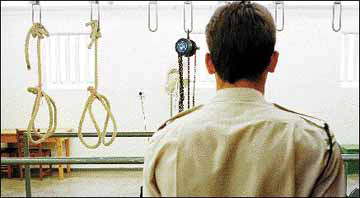
They were now led forward by warders into the large and brightly lit execution room. It was some 40 feet long with white painted walls. They would have seen the gallows beam running the length of the room and the 7 large metal eyes from which the four nooses dangled. (Seven prisoners could and often were hanged at once on this gallows.) The picture shows very much what Smith and Harris would have seen as they were led to the gallows. The chain hoist on the middle metal eye is used for raising the trapdoors after an execution.

They were positioned side by side, on painted footprints over the divide of the trap and held by warders while the hangman placed the nooses around their necks. He then turned down the hood flaps and when all was ready, pulled the lever plummeting them through the huge trapdoors.

They were left to hang for 15 minutes before being stripped and examined by a doctor in the room below. Once death had been certified, the bodies were washed off with a hose and the water allowed to drain into a large gully in the floor. A warder put a rope around each of their bodies and with a pulley lifted them to allow the rope to be taken off. They were then lowered onto a stretcher and placed directly into their coffins before taken to a public cemetery for burial.

Although executions in South Africa were held in private, the procedure was described in detail by the then hangman, Chris Barnard, in an interview before he died. He officiated at over 1,500 hangings there.

South Africa hanged 1,123 people at Pretoria Central prison between 1980 and 1989, Solomon Ngobeni being the last on November 14th, 1989. Surprisingly perhaps, almost all of these were for “ordinary” murders rather than politically motivated crimes and most attracted very little publicity.

According to the South African Department of Correctional Services, two other coloured women were hanged for murder in the years 1969 to 1989, Gertie Fourie, on the 20th of May 1969 and Roos de Vos, on the 12th of December 1986. A total of 14 women were executed between 1959 & 1989, out of a total of 2,949 hangings.

President De Klerk ordered a moratorium on executions in 1990 and capital punishment was abolished altogether by the incoming black government of Nelson Mandela on the 7th of June 1995.

Comment.

We cannot know why Smith and Harris went to the Abrahams’ home while they knew Jermaine would still be there or whether they had actually formed any intention to kill her. Neither of them had any record of violence prior to the murder. My guess is that they panicked when she started to call for help from the person who knocked on the door and they tried to silence her. However, it seems hard to believe that Harris really thought she wouldn’t identify him to the police as soon as they had left and he may well have decided to kill her for this reason. It is claimed that Smith wanted Jermaine dead as she was jealous of her having some sort of relationship with Harris. In any event, Jermaine suffered a horrible and agonising death at their hands.

We cannot know, either, which one of them did the actual killing or whether they both took equal part in it. But there was clear “common purpose” established under law, and there were no obvious mitigating circumstances to allow the state to reduce the sentence on either of them. South Africa had the highest rate of judicial execution in the world during the 80’s so they would surely have known the penalty for murder but like so many people, gave no thought to it until it was too late.

Sadly, it is so typical of the kind of brutal and senseless murder that happens all too frequently and one that led to cruel deaths for three young people.

On this day..

1871: The Paris Commune falls

On this date in 1871, the last barricade of the Paris Commune fell to the onslaught of the army — and a legion of Parisians fell to the army’s firing squads.

On the evening of that bright Sunday when the insurrection finally collapsed, a Sunday when the streets of central Paris were crowded with returning bourgeois, all expressing their satisfaction that the struggle was at last over, the city’s walls were placarded with a proclamation emanating from MacMahon. “Inhabitants of Paris,” said he, “the Army of France has come to save you. Paris is delivered. At four o’clock our soldiers carried the last position occupied by the insurgents. Today the struggle is over, order, work and security will now revive.

I read that announcement in the Rue de Rivoli, not far from the Hotel-de-Ville. A moment later, however, I heard a discharge of musketry … Several insurgents who had been taken fighting were being shot. (My Adventures in the Commune, Paris, 1871, an anti-Commune source)

The day was climax and curtains for the first working-class seizure of power in industrial Europe, but in truth indiscriminate reprisal executions had been underway since troops of the conservative Versailles government first breached rebellious Paris on May 21.

What followed was semaine sanglante, the “bloody week” — each barricade’s surviving defenders executed summarily, and anyone in the city liable to a similar fate if the nearest French officer disliked the cut of his or her jib. Rumors swept the city that women of the Commune were torching buildings, for instance, and suddenly any woman in the street could be killed as an arsonist; some firefighters were shot as saboteurs when the “water” they threw on such flames failed to speedily quench them,* and was consequently adjudged to be kerosone.

And heaven help he who should chance to resemble one of the wanted Communard leaders!

Any passer-by calling a man by a revolutionary name caused him to be shot by soldiers eager to get the premium … Members and functionaries of the Commune were thus shot, and often several times over, in the persons of individuals who resembled them more or less.


Un rue de Paris en 1871, by Maximilien Luce.

The total body counts are guesswork: the killing ran far ahead of the record-keeping. Twenty thousand, or thirty, or more are thought to perished by summary execution. Even the press of the bourgeoisie, whose sword arm the Versailles men comprised, was aghast. London’s Times filled its broadsheets with calumnies upon the Commune, but noted on May 29:

“The Revolution is crushed;” but at what a cost, and amid what horrors! … the Communists seem not very much worse than their antagonists. It sounds like trifling for M. Thiers to be denouncing the Insurgents for having shot a captive officer “without respect for the laws of war.” The laws of war! They are mild and Christian compared with the inhuman laws of revenge under which the Versailles troops have been shooting, bayoneting, ripping up prisoners, women and children, during the last six days.

Whatever the true death toll, it massively surpassed that of the much more eagerly commemorated Revolutionary Terror.

Not for Executed Today to number what the butchers themselves could not. In a city turned charnel house in the midst of a Week of Blood, a few scenes of mortality from the day the Commune fell. (Heavily sourced to the very pro-Commune — hence potentially sensational — History of the Commune of 1871)

This people, heroes in the face of the foreigner, must therefore by called assassins, criminals, wretches, because they died for the Universal Republic, because in defense of their beliefs, their conscience, their idea, they preferred, in their fierce enthusiasm, to bury themselves in the ruins of Paris rather than abandon it to the coalition of despots a thousand times more cruel and more lasting than any foreigner.

-Lissagaray

The 147 Fédérés at Communards’ Wall

At a wall still consecrated to leftists in the Pere Lachaise cemetery of Belleville, 147 were summarily shot.

The 147 are acclaimed as the last defenders of the Commune.

the Commune is in its death throes. Like the dragon of fairy lore, it dies, vomiting flames … What must these men feel who are killing and being killed in the cemetery! To die among the dead seems horrible. But they never give it a thought; the bloody thirst for destruction which possesses them allows them only to think of one thing, of killing! Some of them are gay, they are brave, these men. That makes it only the more dreadful; these wretches are heroic! Behind the barricades there have been instances of the most splendid valour. A man at the Porte Saint-Martin, holding a red flag in his hand, was standing, heedless of danger, on a pile of stones. The balls showered around him, while he leant carelessly against an empty barrel which stood behind. — “Lazy fellow,” cried a comrade. ‘”No,” said he, “I am only leaning that I may not fall when I die.”

Paris Under the Commune, an anti-Commune source

Communard Eugene Varlin

Varlin, alas! was not to escape. On Sunday the 28th May he was recognized in the Rue Lafayette, and led, or rather dragged, to the foot of the Buttes Montmartre before the commanding general. The Versaillese sent him to be shot in the Rue des Rosiers. For an hour, a mortal hour, Varlin was dragged through the streets of Montmartre, his hands tied behind his back, under a shower of blows and insults. His young, thoughtful head, that had never harboured other thoughts than of fraternity, slashed open by the sabres, was soon but one mass of blood, of mangled flesh, the eye protruding from the orbit. On reaching the Rue des Rosiers, he no longer walked; he was carried. They set him down to shoot him. The wretches dismembered his corpse with blows of the butt-ends of their muskets.

Varlin was shot along with a nameless batch of others to whom the March 18 execution of Generals Lecomte and Thomas had been hastily imputed (they were held at the generals’ execution site, to contemplate their sin). A pro-government paper allowed that Varlin “died game.”
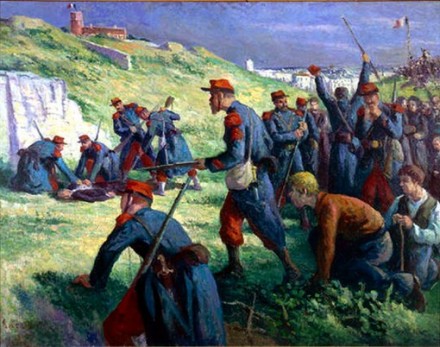

L’execution de Varlin, another Maximilien Luce scene.

Many at the stock exchange

According to the Paris Francais as quoted by this Marxist review of the events

It is at the Bourse that there was to-day the largest number of executions. The doomed men who attempted to resist were bound to the iron railing.

The stock exchange is “a fit place, to be sure, for this sort of business,” observes our interlocutor.

Eighty-plus defenders of Belleville, at the Arc de Triomphe

The London Times editorialized on May 31 upon this incident when the Marquis de Gallifet plucked from the mass of Belleville’s May 28 captives “eighty prisoners, principally soldiers of every arm, linesmen, artillerymen, and Zouaves, [who] were set apart and afterwards led to the right of the rampart to be shot.”

The French are filling up the darkest page in the book of their own or the world’s history. The charge of ruthless cruelty is no longer limited to one party or to one class of persons. The Versailles troops seem inclined to outdo the Communists in their lavishness of human blood. The Marquis de Gallifet is escorting a column of prisoners to Versailles or Satory. He “picks out eighty-two of them, and shoots them at the Arc de Triomphe.” Next came a lot of 20 firemen, then a dozen women, one aged 70. On another spot our Correspondent came upon “80 corpses, piled upon each other, a mass of arms and legs and distorted faces, while the roads and gutter literally flowed with blood.” About 1,000 are said to have thus suffered. By this wholesale and summary execution of prisoners in batches of 50 and 100, not only must the innocent perish with the guilty, but many must bear the penalty of imaginary guilt.

An utterly disconnected Englishman, according to the paper’s correspondent, was accidentally among the four score at the Arc, and only saved by the fortuitous intervention of a Belgian attache.

an English officer somehow got mixed up in the procession, and was forced to keep in it by the escort, who, out of 5,000 prisoners, could not, of course, be expected to recognize one innocent man … it so happened that some of the prisoners tried to escape, and to make an example the leader of the cavalry escort, the Marquis de Gallifet, a man who is not prone to err on the side of mercy, had then and there 81 shot, and the English officer was all but one of them, his explanations being at first refused the slightest attention. Human life has, in fact, become so cheap that a man is shot more readily than a dog.

Socialist physician Tony Moilin

One single fact was Tony Moilin reproached with: that of having on the 18th March taken possession of the mairie of his arrondissement, and having thus had a share in giving the signal for the insurrection …

The court-martial condescended to tell him that the fact of the mairie, the only one he could be reproached with, had in itself not much importance, and did not merit death, but that he was one of the chiefs of the Socialist party, dangerous through his talents, his character, and his influence over the masses; one of those men, in short, of whom a prudent and wise Government must rid itself when it finds a legitimate occasion to do so

[A] respite of twelve hours was granted him in order that he might make his testament, write a few words of farewell to his father, and finally [marry his pregnant lover] … on the 28th May, in the morning, Tony Moilin was led into the garden a few steps from the palace and shot. His body, which his widow claimed, the surrender of which had been at first promised, was refused her. (History of the Commune of 1871)

The unnumbered dead of Lobau Barracks

Since morning a strong cordon is being formed round the theatre (Châtelet); where a court-martial is permanently established. From time to time one sees a band of fifteen to twenty individuals coming out, composed of National Guards, civilians, women and children fifteen to sixteen years old.

These individuals are condemned to death. They march two by two, escorted by a platoon of chasseurs, who lead and bring up the rear. This cortege goes up the Quai de Gevres and enters the Republican Barracks in the Place Lobau. A minute after one hears from within the fire of platoons and successive musketry discharges; it is the sentence of the court-martial which has just been executed.

The detachment of chasseurs returns to the Chatelet to fetch other prisoners. The crowd seems deeply impressed on hearing the noise of the shootings.

This is another publication’s story cited in the History of the Commune of 1871, which itself also details the court-martial procedures of this drumhead tribunal:

Thousands of prisoners who were led there were first of all penned in upon the stage and in the auditorium, under the guns of the soldiers placed in the boxes; then, little by little, like sheep driven to the door of the slaughter-house, from wing to wing they were pushed to the saloon, where, round a large table, officers of the army and the honest National Guard were seated, their sabres between their legs, cigars in their mouths. The examination lasted a quarter of a minute. ‘Did you take arms? Did you serve the Commune? Show your hands.’ If the resolute attitude of a prisoner betrayed a combatant, if his face was unpleasant, without asking for his name, his profession, without entering any note upon any register, he was classed. ‘You?’ was said to the next one, and so on to the end of the file, without excepting the women, children, and old men. When by a caprice a prisoner was spared, he was said to be ordinary, and reserved for Versailles. No one was liberated.

The classed ones were at once delivered to the executioners, who led them into the nearest garden or court. From the Châtelet, for instance, they were taken to the Lebau Barracks. There the doors were no sooner closed than the gendarmes fired, without even grouping their victims before a platoon. Some, only wounded, ran along by the walls, the gendarmes chasing and shooting at them till they fell dead. … There were so many victims, that the soldiers, tired out, were obliged to rest their guns actually against the sufferers. The wall of the terrace was covered with brains; the executioners waded through pools of blood.


Summary executions — death squads — continued for days or weeks afterwards in Paris; martial law throttled left organizing in the city; and those “fortunate” enough to have been captured alive were processed in a steady stream of judicial executions over the months yet to come.

The Commune, a palpably subversive example even in the present day, was destroyed in every way possible for the Versailles government. But its example could hardly be forgotten.

Marx would write The Civil War in France of the only proletarian revolution he would actually witness in his lifetime.

The next generation’s subversives also took inspiration from the Parisian example … and lessons from its mistakes. Lenin — a fond student of the Commune, who was eventually buried wrapped in a Communard banner — said that

two mistakes destroyed the fruits of the splendid victory. The proletariat stopped half-way: instead of setting about “expropriating the expropriators”, it allowed itself to be led astray by dreams of establishing a higher justice in the country united by a common national task; such institutions as the banks, for example, were not taken over … The second mistake was excessive magnanimity on the part of the proletariat: instead of destroying its enemies it sought to exert moral influence on them; it underestimated the significance of direct military operations in civil war, and instead of launching a resolute offensive against Versailles that would have crowned its victory in Paris, it tarried and gave the Versailles government time to gather the dark forces and prepare for the blood-soaked week of May.

“The lesson learnt by the proletariat will not be forgotten,” Lenin vowed, and his own revolution gained a vital object lesson in the Bloody Week of Paris, and an anthem besides: Communard Eugene Pottier, fleeing the Versailles army’s slaughter, wrote the verses that have been sung ever since by millions dreaming of a better world — the Internationale.

* Water can accelerate a fire, under the right circumstances.

On this day..

1980: Kim Jaegyu, intelligence chief

On this date in 1980, the former intelligence chief of South Korea was hanged for assassinating President Park Chung-hee.*

In this surreal affair — known after its date as the “10.26 incident” in South Korea — the head of the Korean Central Intelligence Agency popped the autocratic head of state during a private dinner party at a secret KCIA compound.

He then returned to another dinner party at the compound and, without disclosing what he had done, reported an “accident” and started dropping suggestions to a general that this might be an opportune moment to arrange martial law. Instead, the two repaired to a bunker. There, several hours’ confused wind-gauging by a hastily assembled cross-section of the country’s power brokers (not knowing their own chief spook had pulled the trigger) gave illustration to the Ovid maxim that “treason doth never prosper: what’s the reason? If it prosper, none dare call it treason.”

Only two participants, Kim Chae Kyu and Kim Kye Won, had witnessed the assassination, and neither disclosed the killer … Without an explanation from these two, the others present were left to speculate whether the killings were truly accidental, organized by North Koreans, or perpetrated as part of a South Korean conspiracy, large or small. They could not rule out the possibility that some among them … were part of a plot. Without knowing the balance of power, both civilian ministers and military officers worried about making a wrong move … (Source)

The truth, eventually, would out. But the reason for this shocking internecine turn by a supposed confidante of the president? The murder was too well-planned to square with initial reports of an argument gone out of control. It seems a coup, but if so, our assassin disastrously — almost delusionally — miscalculated the post-Park lay of the land. Maybe we have to entertain the defendant’s own far-out claim to have struck against the authoritarian concentration of presidential power.

I shot the heart of Yusin Constitution like a beast. I did that for democracy of this country. Nothing more nothing less.

The controversial 2005 flick The President’s Last Bang offers a darkly comic look at the twisted mise en scene in the intelligence compound that fateful 10.26 … and doesn’t find a lot of participants worth admiring.

Whatever its cause, South Korea’s unanticipated transition was a wobbly one. Even as the spymaster who had set it in motion was hanged this date with some of his conspiring security men, successor dictator Chun Dwoo-hwan was crushing a student uprising in Gwangju.**

* Park had survived previous assassination attempts, often authored by North Korea — including one that slew his wife in 1974.

** This uprising resulted in a death sentence against future South Korean president Kim Dae-jung — obviously not carried out. Under Kim’s administration years later, Chun was himself condemned to die for the massacre; Kim returned the gesture of clemency.

On this day..

1832: Samuel Sharpe, “I would rather die upon yonder gallows than live in slavery”

On this date in 1832, Jamaican national hero Samuel Sharpe died upon the gallows for instigating the slave revolt that would (help to) end slavery.

Samuel Sharpe, an educated slave who was also a Baptist deacon, was the moving spirit behind the attempted general strike that became the Christmas Rebellion.

That time of year was less than festive for Jamaica’s enormous slave population, for Saint Nick opened the short window for harvesting the island’s sugar cane.

Samuel Sharpe and collaborators had the wit to realize that being depended upon to bring in the cash crop that made life comfortable for their owners put the slaves’ hands upon a potent economic lever. In the last few days of 1831, they pressed it.

The “passive resistance” thing didn’t last long, however, and the “strike” transmuted into a rebellion — the cause swiftly taken up by thousands of slaves around the island who torched crops. Given the small (less than 20) white body count,* the “violence” appears to have been directed against the instruments, rather than the perpetrators, of their enslavement.

Not so the reprisals.

The rebellion was suppressed within days, and over 300 put to death for it (in addition to 200 slave casualties during the pacification itself). There’s an absorbing BBC Witness episode about this affair available as a podcast here.

Sharpe was the last of those executed.

But his revolt is widely thought to have given impetus to the British parliament’s deliberations over the ensuing months that ultimately led to the Slavery Abolition Act (1833).

What [abolitionist MP William] Wilberforce was endeavoring to win from the British senate by his magic eloquence the slaves themselves were endeavoring to gain by outbreaks and violence. The combined action of one and the other wrought out the final result. While one showed that slavery was wrong, the other showed that it was dangerous as well as wrong. Mr. Wilberforce, peace man though he was, and a model of piety, availed himself of this element to strengthen his case before the British Parliament, and warned the British government of the danger of continuing slavery in the West Indies. There is no doubt that the fear of the consequences, acting with a sense of the moral evil of slavery, led to its abolition. The spirit of freedom was abroad in the Islands. Insurrection for freedom kept the planters in a constant state of alarm and trepidation. A standing army was necessary to keep the slaves in their chains. This state of facts could not be without weight in deciding the question of freedom in these countries … I am aware that the insurrectionary movements of the slaves were held by many to be prejudicial to their cause. This is said now of such movements at the South. The answer is that abolition followed close on the heels of insurrection in the West Indies, and Virginia was never nearer emancipation than when General Turner kindled the fires of insurrection at Southampton.

Frederick Douglass

Sharpe, today, is an official national hero of Jamaica. The place in Montego Bay that he hanged is known as Sam Sharpe Square, and his face adorns the currency.

* Contrast with the much smaller, much bloodier rebellion of Nat Turner in the U.S., which preceded the Christmas Rebellion by a few months.

On this day..

1946: Karl Hermann Frank

On this date in 1946, the Sudeten German whose fifth column had paved the way for the Nazi conquest of Czechoslovakia expiated his war crimes at Prague’s Pankrac Prison.

Karl Hermann Frank (English Wikipedia page | German) had been a prewar mover and shaker in the Sudeten German Party, increasingly the Reich’s stalking-horse as it bluffed European rivals into acceding to Czechoslovakia’s dismemberment.

The onetime Czechoslovakian MP did well by the Anschluss, gaining the rank of Obergruppenführer and becoming one of Bohemia and Moravia’s top evildoers.

Notably, he helped orchestrate (though the orders for it came from above) the notorious massacre of Lidice in revenge for the assassination of Reich Protector Reinhard Heydrich.

The Lidice operation formed a war crimes charge against Herr Frank after the war, and Frank’s own lasting badge of infamy: the systematic destruction of the entire male population of an arbitrarily chosen village remains the emblematic crime of the Nazi occupation to this day.

(Source of the video)

Thousands of spectators came to see the former “Protector of Bohemia and Moravia” executed in Prague’s Pankrac Prison by the Austro-Hungarian “pole hanging” method, as depicted in the film above.

Those of Lidice’s widows who were able to come — and widows of some of the 30,000 other Czechs for whose executions Frank had been adjudged indirectly responsible — occupied the second row of seats. …

Not the slightest gleam of compassion could be seen in that long row of unforgiving eyes as Frank, garbed in a ragged Nazi Elite Guard uniform, walked quietly between two guards. …

As the noose was adjusted about his neck, Frank muttered: “Deutschland wird leben auch wenn wir nicht leben” (“Germany will live even if we do not live.”)

The spectators, admitted by special cards, watched quietly in the bright sunshine. (New York Times)

On this day..

1975: Michael X

On this date in 1975, black revolutionary Michael X was hanged for murdering an insubordinate follower.

Born Michael de Freitas to a mixed-race parentage, the future Michael X immigrated to London from his native Trinidad in 1957.

There, he quickly established a criminal niche — drugs, racketeering, prostitution. “They’ve made me the archbishop of violence in this country,” he joked. It was a background noticeably parallel to that of Malcolm X, whose naming convention he took after a 1965 meeting.

By then, our day’s subject had been swept into the contradictory whirl of the 1960’s, emerging as Britain’s “authentic voice of black bitterness”, whose networks ran the gamut from the criminal underbelly to the rich and powerful.

(He’s a fringe character in the 2008 film The Bank Job, which imaginatively posits that he ducked prosecution for a heist by threatening to expose incriminating photos of swinging royal Princess Margaret.)

Michael’s chameleon-like identity — he was raised to pass as white, and known as “Red Mike” by black nationalist compadres — meshes well with the Rorschach-blot times he lived in. Certainly there was the eloquent spokesman of black militancy. There was also, ever more predominant, the violent avatar of social breakdown.

Michael X skipped bail in England to bolt for Trinidad and an agricultural commune with an increasingly creepy bent. Eventually, two bodies turned up: Joseph Skerritt, personally murdered by a machete-wielding Michael X for refusing to attack a police station and/or general disillusionment; and (sensationally) the socialite daughter of a Tory M.P. evidently buried alive.

Michael X — now Michael Abdul Malik — still had the cachet to draw celebrity support for his clemency campaign; Angela Davis, William Kunstler and John Lennon (who had put up Michael de Freitas’s bail in some previous legal scrapes) backed the “Save Malik” committee, but to no avail.

On this day..