1839: William John Marchant

On this date in 1839, a spooked 18-year-old servant was hanged at Newgate Prison for murdering fellow-servant Elizabeth Paynton.

A good Chelsea lad with no rap sheet, Marchant slashed Paynton’s throat with a razor when they were left alone, fled, but was so pursued by guilt that he gave himself up and pleaded guilty. Awaiting death, he lamely told his distraught parents

the upper house-maid and the cook went out, leaving [Marchant] with the deceased in the house by themselves. The cook, as she was leaving the house, dared him to get possession of a riband or pair of garters which the deceased had displayed before the servants in the kitchen in jest, and threatened to inflict some ludicrous punishment upon him if he did not … [Marchant] improperly endeavoured to obtain possession of the garters, but she resisted him, and at length slapped his face, called him some ill names, and said she would get him out of his situation for his rudeness. He then ran to fetch a razor to cut the garters and get them into his own possession, and he then had not the least intention of killing her or perpetrating any other offense … but when he did return with the razor in his hand he was seized, as he says, with a sudden and unaccountable impulse, which he could not define, and in a paroxysm of insanity in a moment, and without premeditation, he cut her throat.

(In a later telling, he dropped the garter cover story and copped to a more distinctly identifiable attempted rape, with the murder precipitated by its object’s threat to have him sacked.)

As the London Times remarked on the hanging,

It is difficult, perhaps, to hold him out as an example to other erring youth; for, as he neither appears to have been a drunkard, nor given up to licentious courses, his crime is of so extraordinary a character, that it is hardly possible any other, by following the same course, should terminate his career by the same shameful death … there [may] be no occasion to read a lesson to those who in ordinary cases might be seduced to commit a similar offence.

The dearth of instructional opportunity (and the fact that “the crowd was not great”) did not obstruct London’s enterprising gallows-foot entrepreneurs from cranking out multiple broadsides,* complete with cookie-cutter didactic poem. This sort of thing was standard fare for the day’s forgettable petty villains, not merely its crimes of the decade.

All ye who pity my sad fate,
With sorrow most sincere,
Unto the truth which I will state,
I pray you lend an ear.
Condemned in scorn and shame to die
My doom is most severe,
‘Tis but a few short days since I
Just reached my eighteenth year.

My face is all beset with woe,
My cheeks are worn with care,
My eyes are parch’d and sunk with Grief,
That once so sparkling were.
Strange horrors chill my every vein,
A voice most wild and true,
Whispers to this distracted brain,
Thy hand Elizabeth slew.

At this my very heart doth bleed
With grief, remorse, and guilt
To think upopn the ruthless deed,
The blood which I have spilt;
For never since that hour have I
One moment’s comfort knew,
And poor Elizabeth’s murdered corpse
Is ever to my view.

Behold my days are like a flower,
That blooms at break of day,
Cut down and withered in an hour,
And vanished away.
Lament, lament, to see me die
All ye who do me view,
A poor, heartbroken, wretched lad,
Must bid this world adieu.

Vain, are my lamentations, vain
These unavailing sighs,
Girm [sic] death is hastening apace,
I must prepare to die.
Heaven grant none may hereafter be
Like luckless me undone,
But always strive with humble mind,
The tempters snare to shun.

* From Harvard University’s collection.

Update: The Times Archive Blog flags another interesting bit of this story: the newspaper’s hectoring the doomed footman’s chaplain for excessive “enthusiasm.”

Part of the Themed Set: The Ballad.

On this day..

1896: Charles Thomas Wooldridge, of The Ballad of Reading Gaol

On this date in 1896, Royal Horse Guard trooper Charles Thomas Wooldridge was hanged by the neck until dead at Reading Gaol, for the crime of murdering his wife.

Celebrated playwright and wit Oscar Wilde had been clapped in that same prison the previous November after his sensational conviction for “gross indecency” — that is, homosexuality.

Wilde’s immortal poetic rendering of the “Hell” of prison, “The Ballad of Reading Gaol”, is written to Wooldridge’s memory, and about his hanging. Its dedication frontispiece reads:

In memoriam
C.T.W.
Sometime Trooper of the Royal Horse Guards.
Obiit H.M. Prison, Reading, Berkshire,
July 7th, 1896.

Having no words to improve on Wilde’s, we offer his “Ballad” in its entirety for the savoring (the audio file is a reading of the text). Find it on Gutenberg or Google Books.

[audio:http://ia311533.us.archive.org/3/items/ballad_of_reading_gaol_jg_librivox/ballad_of_reading_gaol_wilde.mp3]

I.

He did not wear his scarlet coat,
For blood and wine are red,
And blood and wine were on his hands
When they found him with the dead,
The poor dead woman whom he loved,
And murdered in her bed.

He walked amongst the Trial Men
In a suit of shabby grey;
A cricket cap was on his head,
And his step seemed light and gay;
But I never saw a man who looked
So wistfully at the day.

I never saw a man who looked
With such a wistful eye
Upon that little tent of blue
Which prisoners call the sky,
And at every drifting cloud that went
With sails of silver by.

I walked, with other souls in pain,
Within another ring,
And was wondering if the man had done
A great or little thing,
When a voice behind me whispered low,
“That fellows got to swing.”

Dear Christ! the very prison walls
Suddenly seemed to reel,
And the sky above my head became
Like a casque of scorching steel;
And, though I was a soul in pain,
My pain I could not feel.

I only knew what hunted thought
Quickened his step, and why
He looked upon the garish day
With such a wistful eye;
The man had killed the thing he loved
And so he had to die.

Yet each man kills the thing he loves
By each let this be heard,
Some do it with a bitter look,
Some with a flattering word,
The coward does it with a kiss,
The brave man with a sword!

Some kill their love when they are young,
And some when they are old;
Some strangle with the hands of Lust,
Some with the hands of Gold:
The kindest use a knife, because
The dead so soon grow cold.

Some love too little, some too long,
Some sell, and others buy;
Some do the deed with many tears,
And some without a sigh:
For each man kills the thing he loves,
Yet each man does not die.

He does not die a death of shame
On a day of dark disgrace,
Nor have a noose about his neck,
Nor a cloth upon his face,
Nor drop feet foremost through the floor
Into an empty place

He does not sit with silent men
Who watch him night and day;
Who watch him when he tries to weep,
And when he tries to pray;
Who watch him lest himself should rob
The prison of its prey.

He does not wake at dawn to see
Dread figures throng his room,
The shivering Chaplain robed in white,
The Sheriff stern with gloom,
And the Governor all in shiny black,
With the yellow face of Doom.

He does not rise in piteous haste
To put on convict-clothes,
While some coarse-mouthed Doctor gloats, and notes
Each new and nerve-twitched pose,
Fingering a watch whose little ticks
Are like horrible hammer-blows.

He does not know that sickening thirst
That sands one’s throat, before
The hangman with his gardener’s gloves
Slips through the padded door,
And binds one with three leathern thongs,
That the throat may thirst no more.

He does not bend his head to hear
The Burial Office read,
Nor, while the terror of his soul
Tells him he is not dead,
Cross his own coffin, as he moves
Into the hideous shed.

He does not stare upon the air
Through a little roof of glass;
He does not pray with lips of clay
For his agony to pass;
Nor feel upon his shuddering cheek
The kiss of Caiaphas.

II.

Six weeks our guardsman walked the yard,
In a suit of shabby grey:
His cricket cap was on his head,
And his step seemed light and gay,
But I never saw a man who looked
So wistfully at the day.

I never saw a man who looked
With such a wistful eye
Upon that little tent of blue
Which prisoners call the sky,
And at every wandering cloud that trailed
Its raveled fleeces by.

He did not wring his hands, as do
Those witless men who dare
To try to rear the changeling Hope
In the cave of black Despair:
He only looked upon the sun,
And drank the morning air.

He did not wring his hands nor weep,
Nor did he peek or pine,
But he drank the air as though it held
Some healthful anodyne;
With open mouth he drank the sun
As though it had been wine!

And I and all the souls in pain,
Who tramped the other ring,
Forgot if we ourselves had done
A great or little thing,
And watched with gaze of dull amaze
The man who had to swing.

And strange it was to see him pass
With a step so light and gay,
And strange it was to see him look
So wistfully at the day,
And strange it was to think that he
Had such a debt to pay.

For oak and elm have pleasant leaves
That in the spring-time shoot:
But grim to see is the gallows-tree,
With its adder-bitten root,
And, green or dry, a man must die
Before it bears its fruit!

The loftiest place is that seat of grace
For which all worldlings try:
But who would stand in hempen band
Upon a scaffold high,
And through a murderer’s collar take
His last look at the sky?

It is sweet to dance to violins
When Love and Life are fair:
To dance to flutes, to dance to lutes
Is delicate and rare:
But it is not sweet with nimble feet
To dance upon the air!

So with curious eyes and sick surmise
We watched him day by day,
And wondered if each one of us
Would end the self-same way,
For none can tell to what red Hell
His sightless soul may stray.

At last the dead man walked no more
Amongst the Trial Men,
And I knew that he was standing up
In the black dock’s dreadful pen,
And that never would I see his face
In God’s sweet world again.

Like two doomed ships that pass in storm
We had crossed each other’s way:
But we made no sign, we said no word,
We had no word to say;
For we did not meet in the holy night,
But in the shameful day.

A prison wall was round us both,
Two outcast men were we:
The world had thrust us from its heart,
And God from out His care:
And the iron gin that waits for Sin
Had caught us in its snare.

In Debtors’ Yard the stones are hard,
And the dripping wall is high,
So it was there he took the air
Beneath the leaden sky,
And by each side a Warder walked,
For fear the man might die.

Or else he sat with those who watched
His anguish night and day;
Who watched him when he rose to weep,
And when he crouched to pray;
Who watched him lest himself should rob
Their scaffold of its prey.

The Governor was strong upon
The Regulations Act:
The Doctor said that Death was but
A scientific fact:
And twice a day the Chaplain called
And left a little tract.

And twice a day he smoked his pipe,
And drank his quart of beer:
His soul was resolute, and held
No hiding-place for fear;
He often said that he was glad
The hangman’s hands were near.

But why he said so strange a thing
No Warder dared to ask:
For he to whom a watcher’s doom
Is given as his task,
Must set a lock upon his lips,
And make his face a mask.

Or else he might be moved, and try
To comfort or console:
And what should Human Pity do
Pent up in Murderers’ Hole?
What word of grace in such a place
Could help a brother’s soul?

With slouch and swing around the ring
We trod the Fool’s Parade!
We did not care: we knew we were
The Devil’s Own Brigade:
And shaven head and feet of lead
Make a merry masquerade.

We tore the tarry rope to shreds
With blunt and bleeding nails;
We rubbed the doors, and scrubbed the floors,
And cleaned the shining rails:
And, rank by rank, we soaped the plank,
And clattered with the pails.

We sewed the sacks, we broke the stones,
We turned the dusty drill:
We banged the tins, and bawled the hymns,
And sweated on the mill:
But in the heart of every man
Terror was lying still.

So still it lay that every day
Crawled like a weed-clogged wave:
And we forgot the bitter lot
That waits for fool and knave,
Till once, as we tramped in from work,
We passed an open grave.

With yawning mouth the yellow hole
Gaped for a living thing;
The very mud cried out for blood
To the thirsty asphalte ring:
And we knew that ere one dawn grew fair
Some prisoner had to swing.

Right in we went, with soul intent
On Death and Dread and Doom:
The hangman, with his little bag,
Went shuffling through the gloom
And each man trembled as he crept
Into his numbered tomb.

That night the empty corridors
Were full of forms of Fear,
And up and down the iron town
Stole feet we could not hear,
And through the bars that hide the stars
White faces seemed to peer.

He lay as one who lies and dreams
In a pleasant meadow-land,
The watcher watched him as he slept,
And could not understand
How one could sleep so sweet a sleep
With a hangman close at hand?

But there is no sleep when men must weep
Who never yet have wept:
So we–the fool, the fraud, the knave–
That endless vigil kept,
And through each brain on hands of pain
Another’s terror crept.

Alas! it is a fearful thing
To feel another’s guilt!
For, right within, the sword of Sin
Pierced to its poisoned hilt,
And as molten lead were the tears we shed
For the blood we had not spilt.

The Warders with their shoes of felt
Crept by each padlocked door,
And peeped and saw, with eyes of awe,
Grey figures on the floor,
And wondered why men knelt to pray
Who never prayed before.

All through the night we knelt and prayed,
Mad mourners of a corpse!
The troubled plumes of midnight were
The plumes upon a hearse:
And bitter wine upon a sponge
Was the savior of Remorse.

The cock crew, the red cock crew,
But never came the day:
And crooked shape of Terror crouched,
In the corners where we lay:
And each evil sprite that walks by night
Before us seemed to play.

They glided past, they glided fast,
Like travelers through a mist:
They mocked the moon in a rigadoon
Of delicate turn and twist,
And with formal pace and loathsome grace
The phantoms kept their tryst.

With mop and mow, we saw them go,
Slim shadows hand in hand:
About, about, in ghostly rout
They trod a saraband:
And the damned grotesques made arabesques,
Like the wind upon the sand!

With the pirouettes of marionettes,
They tripped on pointed tread:
But with flutes of Fear they filled the ear,
As their grisly masque they led,
And loud they sang, and loud they sang,
For they sang to wake the dead.

“Oho!” they cried, “The world is wide,
But fettered limbs go lame!
And once, or twice, to throw the dice
Is a gentlemanly game,
But he does not win who plays with Sin
In the secret House of Shame.”
No things of air these antics were
That frolicked with such glee:
To men whose lives were held in gyves,
And whose feet might not go free,
Ah! wounds of Christ! they were living things,
Most terrible to see.
Around, around, they waltzed and wound;
Some wheeled in smirking pairs:
With the mincing step of demirep
Some sidled up the stairs:
And with subtle sneer, and fawning leer,
Each helped us at our prayers.

The morning wind began to moan,
But still the night went on:
Through its giant loom the web of gloom
Crept till each thread was spun:
And, as we prayed, we grew afraid
Of the Justice of the Sun.

The moaning wind went wandering round
The weeping prison-wall:
Till like a wheel of turning-steel
We felt the minutes crawl:
O moaning wind! what had we done
To have such a seneschal?

At last I saw the shadowed bars
Like a lattice wrought in lead,
Move right across the whitewashed wall
That faced my three-plank bed,
And I knew that somewhere in the world
God’s dreadful dawn was red.

At six o’clock we cleaned our cells,
At seven all was still,
But the sough and swing of a mighty wing
The prison seemed to fill,
For the Lord of Death with icy breath
Had entered in to kill.

He did not pass in purple pomp,
Nor ride a moon-white steed.
Three yards of cord and a sliding board
Are all the gallows’ need:
So with rope of shame the Herald came
To do the secret deed.

We were as men who through a fen
Of filthy darkness grope:
We did not dare to breathe a prayer,
Or give our anguish scope:
Something was dead in each of us,
And what was dead was Hope.

For Man’s grim Justice goes its way,
And will not swerve aside:
It slays the weak, it slays the strong,
It has a deadly stride:
With iron heel it slays the strong,
The monstrous parricide!

We waited for the stroke of eight:
Each tongue was thick with thirst:
For the stroke of eight is the stroke of Fate
That makes a man accursed,
And Fate will use a running noose
For the best man and the worst.

We had no other thing to do,
Save to wait for the sign to come:
So, like things of stone in a valley lone,
Quiet we sat and dumb:
But each man’s heart beat thick and quick
Like a madman on a drum!

With sudden shock the prison-clock
Smote on the shivering air,
And from all the gaol rose up a wail
Of impotent despair,
Like the sound that frightened marshes hear
From a leper in his lair.

And as one sees most fearful things
In the crystal of a dream,
We saw the greasy hempen rope
Hooked to the blackened beam,
And heard the prayer the hangman’s snare
Strangled into a scream.

And all the woe that moved him so
That he gave that bitter cry,
And the wild regrets, and the bloody sweats,
None knew so well as I:
For he who live more lives than one
More deaths than one must die.

IV.

There is no chapel on the day
On which they hang a man:
The Chaplain’s heart is far too sick,
Or his face is far to wan,
Or there is that written in his eyes
Which none should look upon.

So they kept us close till nigh on noon,
And then they rang the bell,
And the Warders with their jingling keys
Opened each listening cell,
And down the iron stair we tramped,
Each from his separate Hell.

Out into God’s sweet air we went,
But not in wonted way,
For this man’s face was white with fear,
And that man’s face was grey,
And I never saw sad men who looked
So wistfully at the day.

I never saw sad men who looked
With such a wistful eye
Upon that little tent of blue
We prisoners called the sky,
And at every careless cloud that passed
In happy freedom by.

But their were those amongst us all
Who walked with downcast head,
And knew that, had each go his due,
They should have died instead:
He had but killed a thing that lived
Whilst they had killed the dead.

For he who sins a second time
Wakes a dead soul to pain,
And draws it from its spotted shroud,
And makes it bleed again,
And makes it bleed great gouts of blood
And makes it bleed in vain!

Like ape or clown, in monstrous garb
With crooked arrows starred,
Silently we went round and round
The slippery asphalte yard;
Silently we went round and round,
And no man spoke a word.

Silently we went round and round,
And through each hollow mind
The memory of dreadful things
Rushed like a dreadful wind,
An Horror stalked before each man,
And terror crept behind.

The Warders strutted up and down,
And kept their herd of brutes,
Their uniforms were spick and span,
And they wore their Sunday suits,
But we knew the work they had been at
By the quicklime on their boots.

For where a grave had opened wide,
There was no grave at all:
Only a stretch of mud and sand
By the hideous prison-wall,
And a little heap of burning lime,
That the man should have his pall.

For he has a pall, this wretched man,
Such as few men can claim:
Deep down below a prison-yard,
Naked for greater shame,
He lies, with fetters on each foot,
Wrapt in a sheet of flame!

And all the while the burning lime
Eats flesh and bone away,
It eats the brittle bone by night,
And the soft flesh by the day,
It eats the flesh and bones by turns,
But it eats the heart alway.

For three long years they will not sow
Or root or seedling there:
For three long years the unblessed spot
Will sterile be and bare,
And look upon the wondering sky
With unreproachful stare.

They think a murderer’s heart would taint
Each simple seed they sow.
It is not true! God’s kindly earth
Is kindlier than men know,
And the red rose would but blow more red,
The white rose whiter blow.

Out of his mouth a red, red rose!
Out of his heart a white!
For who can say by what strange way,
Christ brings his will to light,
Since the barren staff the pilgrim bore
Bloomed in the great Pope’s sight?

But neither milk-white rose nor red
May bloom in prison air;
The shard, the pebble, and the flint,
Are what they give us there:
For flowers have been known to heal
A common man’s despair.

So never will wine-red rose or white,
Petal by petal, fall
On that stretch of mud and sand that lies
By the hideous prison-wall,
To tell the men who tramp the yard
That God’s Son died for all.

Yet though the hideous prison-wall
Still hems him round and round,
And a spirit man not walk by night
That is with fetters bound,
And a spirit may not weep that lies
In such unholy ground,

He is at peace–this wretched man–
At peace, or will be soon:
There is no thing to make him mad,
Nor does Terror walk at noon,
For the lampless Earth in which he lies
Has neither Sun nor Moon.

They hanged him as a beast is hanged:
They did not even toll
A requiem that might have brought
Rest to his startled soul,
But hurriedly they took him out,
And hid him in a hole.

They stripped him of his canvas clothes,
And gave him to the flies;
They mocked the swollen purple throat
And the stark and staring eyes:
And with laughter loud they heaped the shroud
In which their convict lies.

The Chaplain would not kneel to pray
By his dishonored grave:
Nor mark it with that blessed Cross
That Christ for sinners gave,
Because the man was one of those
Whom Christ came down to save.

Yet all is well; he has but passed
To Life’s appointed bourne:
And alien tears will fill for him
Pity’s long-broken urn,
For his mourner will be outcast men,
And outcasts always mourn.

V.

I know not whether Laws be right,
Or whether Laws be wrong;
All that we know who lie in goal
Is that the wall is strong;
And that each day is like a year,
A year whose days are long.

But this I know, that every Law
That men have made for Man,
Since first Man took his brother’s life,
And the sad world began,
But straws the wheat and saves the chaff
With a most evil fan.

This too I know–and wise it were
If each could know the same–
That every prison that men build
Is built with bricks of shame,
And bound with bars lest Christ should see
How men their brothers maim.

With bars they blur the gracious moon,
And blind the goodly sun:
And they do well to hide their Hell,
For in it things are done
That Son of God nor son of Man
Ever should look upon!

The vilest deeds like poison weeds
Bloom well in prison-air:
It is only what is good in Man
That wastes and withers there:
Pale Anguish keeps the heavy gate,
And the Warder is Despair

For they starve the little frightened child
Till it weeps both night and day:
And they scourge the weak, and flog the fool,
And gibe the old and grey,
And some grow mad, and all grow bad,
And none a word may say.

Each narrow cell in which we dwell
Is foul and dark latrine,
And the fetid breath of living Death
Chokes up each grated screen,
And all, but Lust, is turned to dust
In Humanity’s machine.

The brackish water that we drink
Creeps with a loathsome slime,
And the bitter bread they weigh in scales
Is full of chalk and lime,
And Sleep will not lie down, but walks
Wild-eyed and cries to Time.

But though lean Hunger and green Thirst
Like asp with adder fight,
We have little care of prison fare,
For what chills and kills outright
Is that every stone one lifts by day
Becomes one’s heart by night.

With midnight always in one’s heart,
And twilight in one’s cell,
We turn the crank, or tear the rope,
Each in his separate Hell,
And the silence is more awful far
Than the sound of a brazen bell.

And never a human voice comes near
To speak a gentle word:
And the eye that watches through the door
Is pitiless and hard:
And by all forgot, we rot and rot,
With soul and body marred.

And thus we rust Life’s iron chain
Degraded and alone:
And some men curse, and some men weep,
And some men make no moan:
But God’s eternal Laws are kind
And break the heart of stone.

And every human heart that breaks,
In prison-cell or yard,
Is as that broken box that gave
Its treasure to the Lord,
And filled the unclean leper’s house
With the scent of costliest nard.

Ah! happy day they whose hearts can break
And peace of pardon win!
How else may man make straight his plan
And cleanse his soul from Sin?
How else but through a broken heart
May Lord Christ enter in?

And he of the swollen purple throat.
And the stark and staring eyes,
Waits for the holy hands that took
The Thief to Paradise;
And a broken and a contrite heart
The Lord will not despise.

The man in red who reads the Law
Gave him three weeks of life,
Three little weeks in which to heal
His soul of his soul’s strife,
And cleanse from every blot of blood
The hand that held the knife.

And with tears of blood he cleansed the hand,
The hand that held the steel:
For only blood can wipe out blood,
And only tears can heal:
And the crimson stain that was of Cain
Became Christ’s snow-white seal.

VI.

In Reading gaol by Reading town
There is a pit of shame,
And in it lies a wretched man
Eaten by teeth of flame,
In burning winding-sheet he lies,
And his grave has got no name.

And there, till Christ call forth the dead,
In silence let him lie:
No need to waste the foolish tear,
Or heave the windy sigh:
The man had killed the thing he loved,
And so he had to die.

And all men kill the thing they love,
By all let this be heard,
Some do it with a bitter look,
Some with a flattering word,
The coward does it with a kiss,
The brave man with a sword!

“Each man kills the thing he loves” … words that must have originated in a fathomless depth in the soul of our renowned poet, who signed the poem only with his cell number and died penniless in 1900.

Part of the Themed Set: The Ballad.

On this day..

1840: Francois Benjamin Courvoisier, for the murder of Lord Russell

On this date in 1840, a valet was hanged at Newgate Prison for the murder of his aristocratic employer, Lord William Russell.

This celebrity murder of a former Member of Parliament, septuagenarian patriarch of one of England’s august noble houses, by a member of his household activated all the crime-panic circuits still familiar a couple centuries later.

That of class, of course: the perpetual frisson of animosity between the respectable and those they held in economic servitude, bursting bloodily onto the front pages.

That of foreignness, since Courvoisier was Swiss.

And that ever-popular fear of youth amok, when the 23-year-old claimed inspiration from William Harrison Ainsworth‘s then-popular potboiler about the beloved underclass robber Jack Sheppard.*

Speedy Trial

The valet was quickly on trial for his life; the total time elapsed from Russell’s death to Courvoisier’s own was two months to the day.

But a less hasty schedule might have permitted better investigation, as Courvoisier was well on his way to acquittal with his lawyer’s deft rebuttal of the crown’s entirely circumstantial case.

When police discovered the decisively damning evidence of Russell’s stolen effects midway through the trial, the Swiss man made himself an milepost in the evolution of professional ethics at the bar. Summoning his lawyers, Courvoisier informed them that he was indeed guilty but that he had no intention of pleading guilty to a hanging crime and expected his defense to continue.

Attorney Charles Phillips reluctantly complied, implicating fellow-servant Sarah Mancer as the potentially guilty party. When it became publicly known after the trial that Phillips had become aware of his client’s guilt, he was publicly vilified for the vigor of his representation, e.g., contesting “with violent language the witnesses for the prosecution, whose evidence he [knew to be] true,” and a lively debate among legal types on professional propriety in such an instance ensued.**

Read All About It

None of this availed Benjamin Courvoisier aught. His celebrity was brief, but intense — he even signed an autograph for the sheriff, dating it “the day of my execution,” as he was being pinioned for hanging. Broadsides like these below (links to selections from Harvard Library’s extensive publication of execution broadsides) sold a reported 1.65 million copies. (Source)

Broadside 1

Broadside 2

Broadside 3

Broadside 4

Among the published broadsides are several popular ballads relating to the case — one written to lament the murder, before the apprehension of a suspect; others for the condemned’s execution. One certainly wouldn’t call these great literature, but they’re representative examples of broadside balladry, nearly de rigueuer for scandal-mongering Victorian crime coverage and therefore very relevant for these pages.

COURVOISIER’S LAMENT
(Written by Himself.)

You Christians all of every nation,
A warning take by my sad fate–
For the dreadful crimes that I’ve committed,
I, alas! repent too late.
Only think what I must suffer,
And the death which I must undergo–
I cannot rest by day or night,
My heart’s so full of grief and woe.

My parents they were poor — but honest —
And brought me up in virtuous ways;
And never, ’till this sad occurrence,
Did I embitter their fond days.
But now, alas! quite broken-hearted,
My friends and family must be,
To think that I soon must quit
This world for a long Eternity.

My Master was a Nobleman–
Lord William Russell was his name;
Beloved he was by all who knew him,
And well he did deserve the same.
Oh! how could I so basely murder
One that was so good and kind?
I hope the Lord above will pardon
Me, that I may mercy find.

Alas! my days they are all numbered.
When I must give up my last breath;
For the horrid crimes that I’ve committed,
Die an ignominious death.
Oh! while I’ve life, let me entreat you
All, take warning by my fate!
Shew the ways of evil-doers,
Or you’ll repent when ’tis too late.

Attend unto my true confession–
A lesson it may be to you;
Give not your mind too much to pleasure,
Act upright — be just and true.
Let not the sight of gold e’er tempt you
To act dishonest to your friend:
For that alone caused me to murder,
And brought me to this untimely end.

Let not the world blame those two Females
Who, fellow-servants were with me;
For of the murder and the robbery,
None whatever knew but me.
No other crimes have I committed,
Save one single robbery;
Tho’ it was said that Etiza Grimwood
Basely murdered was by me.

Charles Dickens attended this hanging, mining the scene for Barnaby Rudge.

William Thackeray came too — he was becoming publicly engaged as a man troubled by capital punishment, and it was the first execution he had witnessed. (Actually, he turned away at the decisive moment.) Thackeray published an article about the experience in Fraser’s magazine, reflecting doubt at the salutary value of public executions and empathy with the young man’s scrambled mental state as he was raced from condemnation to the gallows in a mere fortnight.

At first, his statements are false, contradictory, lying. He has not repented then. His last declaration seems to be honest, as far as the relation of the crime goes. But, read the rest of his statement — the account of his personal history, and the crimes which he committed in his young days; them “how the evil thought came to him to put his hand to the work.” It is evidently the writing of a mad, distracted man. The horrid gallows is perpetually before him; he is wild with dread and remorse. Clergymen are with him ceaselessly; religious tracts are forced into his hands: night and day they ply him with the heinousness of his crime, and exhortations to repentance. Read through that last paper of his. By heaven, it is pitiful to read it. See the Scripture phrases brought in now and anon; the peculiar terms of tract-phraseology (I do not wish to speak of these often meritorious publications with disrespect). One knows too well how such language is learned-imitated from the priest at the bedside, eagerly seized and appropriated, and confounded by the poor prisoner.”

* Courvoisier’s Jack Sheppard reference triggered thunderous indictments of this text in the popular press — “a publication calculated to familiarise the mind with cruelties,” howled the London Examiner “and to serve as the cut-throat’s manual” and caused the stage adaptation to be censored (pdf).

Though Ainsworth had decades of writing ahead of him, it’s been argued that his reputation never fully recovered from this case, and that’s why he’s not in the canon. What he lacks in posthumous celebration he garnered in contemporary buzz; Ainsworth’s “Newgate novels” valorizing highwaymen helped to feed an enduring popular craze for hanging broadsides and “penny dreadfuls” and to mainstream a (commercialized) version of thieves’ cant. See The Hanging Tree: Execution and the English People 1770-1868.

** See The Bar & The Old Bailey, 1750-1850. In a more unctuous vein, the bishop of London submitted a petition to the House of Lords demanding repeal of the right of defendants’ lawyers to make closing statements.

Part of the Themed Set: The Ballad.

On this day..

1931: Ernesto Opisso

On this date in 1931, a carpenter became the first Gibraltar native hanged by the British on that strategic peninsula.

Ernesto Opisso was convicted, in his second trial (the first jury hung), of murdering Marie Bassano, the true crime sensation of the day. Strangely, the elderly woman had been killed in her apartment but neither robbed nor sexually assaulted; Opisso was placed in the vicinity by a witness despite his denials, and a “maybe they got into a fight” theory sufficed to outfit him for the halter.

(Courtroom color: Opisso’s lawyer, evidently something of a functional alcoholic, got around a no-drinking-in-court rule by dipping bread in liquor. “Not drinking, m’Lord,” he replied when the judge’s suspicions were aroused. “Eating.”)

Popular dissatisfaction with the questionable verdict against a local was widespread; because nobody on Gibraltar itself would carry out the execution, a hangman had to be imported from Britain.

The London Times reported of the scene on the eve of the hanging, once all prospect of reprieve had been refused,

Scenes of wild disorder were witnessed to-night when crowds surged through the streets demonstrating against the execution fixed for to-morrow morning of a carpenter, Ernesto Opisso, who has been sentenced to be hanged for the murder of an elderly woman. It will be the first execution in Gibraltar since 1896. A reprieve was refused by the Governor in Council. The crowds thronged the streets demanding a reprieve and forced cafes and places of amusement to close. No taxis were to be had, as the drivers are on strike.

So ugly was the situation that troops turned out and are patrolling the streets armed with hockey sticks.

It was Gibraltar’s first execution of any kind since 1896 — and remains to date its last peacetime execution. (Two Spanish citizens were hanged for wartime offenses in 1944.)

On this day..

1777: William Dodd, mind wonderfully concentrated

On this date in 1777, they hanged the macaroni parson at Tyburn.

High-living, Cambridge-educated vicar William Dodd achieved this emasculating nickname for his frippery — macaroni (or maccaroni) being 18th century slang for a sort of outrageous continental metrosexual.*

He came particularly in for public ridicule when he was caught trying to bribe his way to a lucrative ecclesiastical position, financial hardship from his lifestyle having driven him to the desperate need for a pay hike. (In sorer straits later, he would sum up his life: “my greatest evil was expense. To supply it, I fell into the dreadful and ruinous mode of raising money by simonies. The annuities devoured me.”

Playwright Samuel Foote skewered the recently-humiliated Dodd on the stage in The Cozeners as “Dr. Simony,” described in the scrambled boast of “Mrs. Simony”:

not a more populous preacher within the sound of Bow-bells: I don’t mean for the mobility only … with a cambric handkerchief in one hand, and a diamond ring on the other: and then he waves this way and that way; and he curtsies, and he bows, and he bounces, that all the people are ready to — but then his wig, madam! I am sure you must admire his dear wig … short, rounded off at the ear, to show his plump cherry cheeks, white as a curd, feather-topped, and the curls as close as a cauliflower…

Then, my doctor is none of your schismatics, madam; believes in the whole thirty-nine! and so he would if there were nine times as many.

Three years after Foote’s cruel pen gave Dodd’s name immortality, the divine himself was (so he should think) ushered into eternity, after he got caught passing a forged bond against the revenues of his onetime student Lord Chesterfield.

Condemned to die for the offense,** a longer-than-usual lag from sentence to execution gave Dr. Simony leave to follow that classic Calvary of errant clerics with a mien of pious self-flagellation that helped his case raised a public outcry for clemency.

Samuel Johnson was among thousands of Britons who petitioned for mercy, and in Johnson’s case, went a bit further to ghost-write a piece in Dodd’s name, “The convict’s address to his unhappy brethren”. It was when the litterateur’s hand was suspected behind this prose† that Johnson made his quotable, tweetable remark,

“Depend upon it Sir, when a man knows he is to be hanged in a fortnight, it concentrates his mind wonderfully.”

Dr. Johnson, nevertheless, was the true author, and the old scribbler used it to express some of his particular opinions on the proper staging of gallows-theater.

It is the duty of a penitent to repair, so far as he has the power, the injury which he has done. What we can do, is commonly nothing more than to leave the world an example of contrition. On the dreadful day, when the sentence of the law has its full force, some will be found to have affected a shameless bravery, or negligent intrepidity. Such is not the proper behaviour of a convicted criminal. To rejoice in tortures is the privilege of a martyr; to meet death with intrepidity is the right only of innocence, if in any human being innocence could be found. Of him, whose life is shortened by his crimes, the last duties are humility and self-abasement. We owe to God sincere repentance; we owe to man the appearance of repentance.—-We ought not to propagate an opinion, that he who lived in wickedness can die with courage.‡

William Dodd (together with another criminal, Joseph Harris: there’s a wonderful profile of this forgotten youth here) had occasion to do just that this day in 1777. Dodd became the last person hanged for forgery at Tyburn.

Updated: According to Wendy Moore, there was an posthumous attempt at resuscitation, which was known to work sometimes.

Dodd, himself a big death penalty opponent from his former public perch, gave a sermon the very year of his eventual death titled The Frequency of Capital Punishments Inconsistent with Justice, Sound Policy and Religion, critiquing “voluntary destruction” of human life and its inconsistency with “the humane and benevolent spirit which characterizes the present times.”

He was also — which helps explain the revival attempt — a big supporter of the Humane Society, which sought to apply the developing science of the Enlightenment to the problem of resuscitating the (near-)drowned. (The Royal Humane Society’s motto today is lateat scintillula forsan, “a small spark may perhaps lie hid.”)

Dodd preached an enthusiastic sermon to this body in 1776, expansively anticipating its work for analogous “various other kinds of sudden and accidental death” such as “malefactors executed at the gallows, [which] would afford opportunities of discovering how far this method might be successful in relieving such as may have unhappily become their own executioners by hanging themselves.” Dodd’s own engagement with both the medical and the theological questions at stake in resuscitation surely conditioned his own anticipation under the noose that, if revived, he might live on as a “renovated being.”

(Dodd’s involvement with the Humane Society is detailed in Kelly McGuire’s “Raising the Dead: Sermons, Suicide, and Transnational Exchange in the Eighteenth Century,” Literature and Medicine, Spring 2009.)

It was, surely, an astounding time to live; no less so, to die. And the mysterious border between the two might be re-engineered by human ingenuity.

As Lord Byron (a man with his own fascination for the scaffold) wrote in Don Juan,

What opposite discoveries we have seen!
(Signs of true genius, and of empty pockets.)
One makes new noses, one a guillotine,
One breaks your bones, one sets them in their sockets;

Bread has been made (indifferent) from potatoes;
And galvanism has set some corpses grinning,
But has not answer’d like the apparatus
Of the Humane Society’s beginning
By which men are unsuffocated gratis:
What wondrous new machines have late been spinning!

* The lyrics of “Yankee Doodle Dandy” (“stuck a feather in his hat and called it macaroni”) may be the most recognizable modern-day relic of this lexicon.

** Dodd made a groveling plea to the jury in the face of overwhelming evidence against him, at one point bold enough to appeal to injury his death would inflict upon those who lent him money: “I have creditors, honest men, who will lose much by my death. I hope, for the sake of justice towards them, some mercy will be shown to me. ”

† Dodd could write a little himself; he had a theological tract and a commentary on Shakespeare already to his name, and at Newgate cranked out Thoughts in Prison, a collection of sub-Villon poetry.

‡ In an addendum that would have warmed the cockles of the Roberts court, Johnson-as-Dodd also opined,

Every man reposes upon the tribunals of his country the stability of possession, and the serenity of life. He therefore who unjustly exposes the courts of judicature to suspicion, either of partiality or error, not only does an injury to those who dispense the laws, but diminishes the public confidence in the laws themselves, and shakes the foundation of public tranquility.

On this day..

1574: Gabriel de Lorges, accidental regicide

On this date in 1574, Gabriel de Lorges was beheaded in Paris for treason.

Known by the time of his death as the Comte de Montgomery (English Wikipedia entry | French) — though the title was punitively stripped from the man and his heirs, causing him to spit at the scaffold, “tell my children, if they are not able to reclaim their position, I curse them from the grave” — Lorges’ treason was going Protestant and fighting for the Huguenots in the wars of religion ravaging France.

But his claim to fame, and indeed (if quite unjustly) one of the explicit charges laid against him, was a regicide that fueled those wars and helped bring down the Valois dynasty.

The ol’ lance-in-the-eye

The vigorous 40-year-old French king Henri II seemingly had the Valois in good shape and anti-Huguenot policy firmly in the saddle.

In 1559, though, the sporting monarch put his own butt in the saddle at a joust with our day’s principal, then a captain of Henri’s Scots Guards (and a Catholic).

Gabriel’s shattered lance somehow found a chink in the king’s visor and managed to tolchock the royal gulliver just beside the eye.* After a week and a half in agony, Henri succumbed to the injury.**

Henri’s sudden death was bad news for France, because the oldest† of his seven children was only 15 years old, and feeble. He died the next year.

As the widowed Italian queen Catherine de’ Medici struggled over the ensuing decades to find a stable Valois heir among her brood, the aggressively Catholic House of Guise‡ flexed its political muscle to the resentment of the Bourbons and the Huguenot lords, and pitched France towards civil war.

Our errant knight, meanwhile, although forgiven by the dying Henri II, had despairingly retired and hurled himself into study that soon converted him to the Protestant party.

Quickly distinguishing himself as perhaps the ablest Huguenot commander, Montgomery was in Paris in 1572 during an ostensible truce for interparty dynastic nuptials when the Catholic faction sprang the St. Bartholomew’s Day massacre.

Though Montgomery was a specific target for assassination that day, he somehow managed to escape. He gave the Catholics fits for the two years left him, enough that the crown tried to buy him off. (Like most Protestants, he was distrustfully defiant after the horrors of St. Bartholomew’s Day.)

He was finally overcome in 1574; as Henri’s second son had just kicked the bucket without an heir, Catherine assumed the regency while a third boy was fetched from Poland, and got herself some gratifying but untoward revenge on the inadvertent author of her family’s unfolding ruin.

No time was lost in condemning [Montgomery] to the penalties of high treason; he was beheaded at the Greve, his body quartered, and his family degraded from their nobility. Previous to his execution, he was cruelly tortured to make him confess the existence of the late admiral‘s conspiracy, but the pain drew no such acknowledgment from him, and mangled and wounded as he was, he went to the scaffold with remarkable serenity. We have an account, given by a contemporary, of his steady attachment to his principles: “He would not confess to the Archbishop of Narbonne, who went to him in the chapel to admonish him; nor would he take or kiss the crucifix, which is usually presented to those who are being led to execution; nor in any way attend to the priest, who had been placed in the cart by his side. A cordelier thinking to draw him out of error, began to speak to him, and said that he had been abused. Looking at him steadily, he answered, ‘How! abused? and if I have been it is by those of your order: for the first person who ever handed me a Bible in French, and made me read it, was a cordelier like you; and therein I have learned the religion which I hold, which alone is the true religion, and in which, having since lived, I wish now by the grace of God to die.'”

(Some sources place Montgomery’s execution on May 27, which I believe confuses his date of death with his date of capture.)

Just like Montgomery himself, the Huguenot cause proved resistant to every policy of Catherine or the Guises; this day’s execution only screwed up the nerve of a party that had been given notice on St. Bartholomew’s Day that their lot must be to conquer or die. Since Henri II’s boys could neither, over 30 years’ time, produce an heir nor master their foes at arms, the Huguenots conquered when the throne finally passed to a Bourbon.

A public-domain biography of Gabriel de Lorges, comte de Montgomery, can be enjoyed by French-speakers here. For the English-speakers, Alexandre Dumas’ fictionalized treatment, The Two Dianas, is freely available in translation.

* French surgeon Ambroise Pare attended the dying monarch. Pare’s grim description of the king’s injuries appears in this biography of the physician, which also reports that Henri’s caregivers

secured the heads of four criminals that had been beheaded and experimented upon them with a lance in order to ascertain the probable course of the splinters.

** The fatal joust is alleged to be one of the vindicated prophecies of Nostradamus. Prophecy or no, the family had bad luck with sports; Henri came in line for the throne when his older brother dropped dead after playing tennis.

† Henri II’s immediate heir Francis II was married to Mary, Queen of Scots. After the death of her husband, she unhappily shipped back out to Scotland to contest the English throne, with unsatisfactory results.

‡ More about the House of Guise before, during and after this period from this public domain text.

On this day..

1920: Dennis Gunn, hanged by a fingerprint

On this date in 1920, Dennis Gunn’s fingerprints made history by hanging their owner for murder.

“You’ll have a job to prove it,” said Dennis Gunn when police charged him with murder.

Use of the fingerprint in forensic science had been developing over the decades preceding, and already begun to earn its bones with criminal convictions.

Dennis Gunn’s conviction marked a watershed in the mainstreaming of the youthful science, especially in New Zealand and the British Empire/Commonwealth: the first execution that hung — so to speak — on a print.

The 25-year-old was tied to the murder of Ponsonby postmaster Augustus Braithwaite because a smudge left on a stolen cashbox matched the prints Gunn had contributed to the nascent New Zealand fingerprint library when he had been convicted of evading military service two years before.

Armed with this connection, a police search of Gunn’s environs turned up the apparent tools of the crime — a revolver (with yet another matching print), a thieves’ kit, and more pilfered proceeds of the postal strongroom.

Gunn attempted to indict the reliability of the fingerprint evidence at trial, and according to the London Times (Apr. 20, 1920) he had the support in this endeavor of “public demonstrations of sympathy, men and women rushing to shake hands with Gunn.”

But it didn’t fly with the jury.*

Gunn’s condemnation, read the official report,

disposes of all attempts to question the conclusiveness of this class of evidence, and proves the truth of the remark of the Chief Justice of Australia, that a man who leaves a clear fingerprint on an object leaves there an unforgettable signature.

Law enforcement organs around the world rapidly accepted the principle.

Too rapidly? Some think so; and, in the train of a new century’s bulletproof identification technology, DNA, wrongful convictions founded on purported fingerprint matches have drawn some renewed scrutiny (pdf) to the technique that put Dennis Gunn on the Mount Eden Prison gallows this date in 1920.

* Playing for time after conviction, Gunn copped to the robbery and tried to pin the murder on a supposed confederate. No dice.

On this day..

1962: Marthinus Rossouw, for services rendered

On this date in 1962, Marthinus Rossouw was hanged in Pretoria after an unusual defense strategy failed to repel a headline-grabbing murder charge.

Rossouw shot dead Baron Dieterich Joachim Gunther von Schauroth, a rich farmer (dude was born in a castle) who had been forced into city living by a long run of drought and was known for the life expectancy-compromising habit of toting around large sums of cash.

Rossouw insisted at trial that the killing had been at Von Schauroth’s own instigation, so freighted with care was the victim’s life that he implored his younger friend to end it. The defendant hoped thereby to mitigate the sentence as a case of murder by consent.*

Whether telling the truth or not, Rossouw didn’t make a very credible witness; caught in several lies and omissions, and naturally lacking any corroborating witness to the alleged murder pact, the jury gave him no slack.

Neither did the noose.

* The proper legal handling of a case where the victim of a homicide has freely desired to die is a longstanding salami-slicing juridical problem — witness a whole chapter in an 1897 British primer on consent issues in the law.

On this day..

1867: Emperor Maximilian I of Mexico, “Archdupe”

On this date in 1867, a firing squad disabused a Habsburg heir of his pretensions to the throne of Mexico.

A little bit loopy, a little bit liberal, and fatally short of common sense, Ferdinand Maximilian Joseph* decamped from the easy life at his still-under-construction dream palace outside Trieste for an exalted title that really meant playing catspaw for Napoleon III‘s Mexican land grab.

(To assuage the pangs of imperial adventurism upon our tender-headed hero, Maximilian had been “invited” to assume the Mexican throne by a convention handpicked to do just that.)

There the puppet emperor with the silver spoon in his mouth found himself pitted in civil war against the Amerindian peasant from the school of hard knocks: Benito Juarez, one of Mexico’s great liberal statesmen.

As the tide turned in favor of Juarez and the liberals, and Napoleon’s attention increasingly fixated on problems closer to home, the French threw in the towel.

But Maximilian had too much honor or too little sense to heed his patron’s advice to get out while the getting was good; sticking it out with “his people,” he was captured in May, 1867.

Juarez desiring to give any future bored European nobles second thoughts about New World filibustering, Maximilian got no quarter.**

While Louis Napoleon emceed a world’s fair on the other side of the planet, Maximilian was shot with two of his generals, Miguel Miramon and Tomas Mejia.


Manet’s The Execution of Maximilian, showing an obvious compositional debt to Goya’s Executions of the Third of May. Further analysis: written English; video Spanish.

Maximilian’s widow Charlotte — “Carlota”, when trying to blend with her adoptive subjects — descended into a long-lived madness back in the Old World, but was rumored to have borne with one of Maximilian’s French officers an illegitimate child who would go on to become an infamous Vichy collaborator.

Books about Emperor Maximilian

This sensational affair attracted plenty of coverage in the ensuing years; as a result, there is a good deal of topical material from near-contemporaries now in the public domain. Maximilian in Mexico: A Woman’s Reminisces of the French Intervention 1862-1867 (Gutenberg | Google Books) is a zippy read.

* Brother to Austrian Emperor Franz Joseph.

** Spanish trial records are here. European appeals for clemency poured in, but Maximilian had doomed himself with the “Black Decree” of 1865, ordering summary executions of captured Republicans.

The time for indulgence has gone by: it would only encourage the despotism of bands of incendiaries, of thieves, of highwaymen, and of murderers of old men and defenseless women.

The government, strong in its power, will henceforth be inflexible in meting out punishment when the laws of civilization, humanity, or morality demand it.

Juarez answered the clemency appeal of Princess Salm-Salm with solemn words:

If all the Kings and Queens in Europe [pled for Maximilian] I could not spare that life. It is not I who take it; it is the people and the law, and if I should not do their will the people would take it and mine also.

On this day..

1947: Shigematsu Sakaibara, “I obey with pleasure”

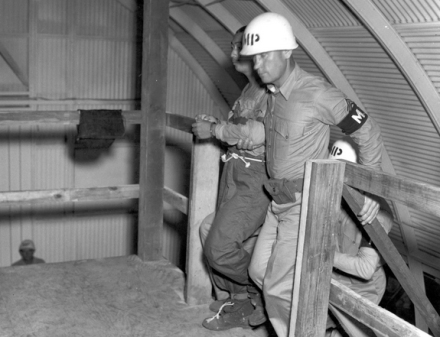
In the evening of June 18, 1947,* six convicted Japanese war criminals were hanged** by the U.S. Navy War Crimes Commission on Guam.


An unidentified Japanese prisoner ascends the gallows on Guam.

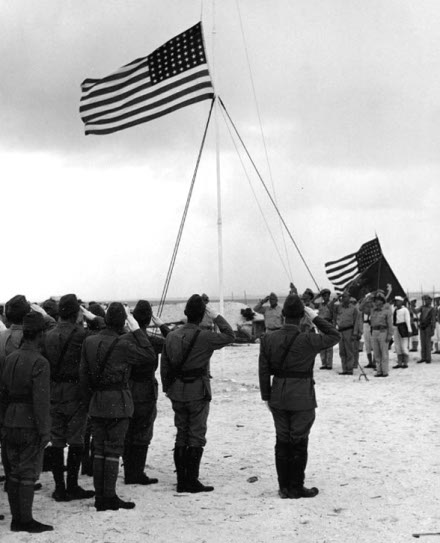
The most lastingly notable of the six was Rear Admiral Shigematsu Sakaibara, who was hanged for ordering (and perhaps in one instance, personally conducting) an infamous mass execution on Wake Island that has already appeared in these pages.

According to Judgment at Tokyo:

For some, the hanging of one of these six men had been a horrible tragedy and perhaps even a mistake. Rear Adm. Shigematsu Sakaibara had enjoyed the reputation of “gentleman soldier” and protector of the common man. Hailing from a wealthy family near Misawa in Tohokhu province, some 450 miles north of Tokyo, Sakaibara never forgot his roots. Forever poking fun at the fast-paced Tokyo lifestyle, the rear admiral touted the value of rural living, the integrity and honesty of those who lived in Japan’s rugged north country, and Tokyo’s need to recognize their great contributions to the war effort. Contemplating a postwar political future, he would be following in the footsteps of his politically influential family in northern Japan. That future was linked to championing the rights of returning veterans and other have-nots. Misawa had indeed had a heroic reputation as an important navy town and base for years. Sakaibara had assisted in the training exercises held there for the Pearl Harbor attack plan in late 1941. His future seemed golden no matter who won the war. But what some in his command called “The 1943 Incident” changed all that.


Shigematsu Sakaibara (right foreground) surrendering Wake Island on September 4, 1945.

These events, Sakaibara admitted in his trial, had taken place in an atmosphere of near starvation and impending doom. The defense counsel especially emphasized that point, asking the commission to understand and respect the pressures and strains on Sakaibara at the time of the incident. But the commission was not in a forgiving mood. In the chaos of retreat or not, innocent civilians had been murdered.

… Unfortunately for Sakaibara, several members of his former command expressed surprise on the witness stand when asked about the desperate situation on Wake in 1943. These men insisted that Sakaibara and his defense team’s description of a starving, chaotic Wake was an exaggerated one. There had been no unexpected miseries, confusion, or sense of peril, they said. Sakaibara’s fate was sealed.

True to form, defendant Sakaibara offered a very literate final statement to the commission. In contrast to so many of his colleagues on trial in Tokyo, on Guam, or elsewhere, Sakaibara, albeit with carefully picked words, admitted he was guilty of rash and unfortunate actions. He appeared especially convincing when he noted that he wished he had never heard of Wake Island. But his most memorable comments involved his own view of morality in war. A nation that drops atom bombs on major cities, the rear admiral explained, did not have the moral authority to try so many of his countrymen. With Hiroshima and Nagasaki in mind, Sakaibara claimed there was little difference between himself and the victors over Japan. With that statement a legend grew, particularly in his home town, of Sakaibara, the victim of American revenge.

… As late as the 1990s, some people there, not necessarily of the World War II generation, still bowed in reverence to Sakaibara family members out of respect for the “sacrificed” gentleman soldier.

His last words:

I think my trial was entirely unfair and the proceeding unfair, and the sentence too harsh, but I obey with pleasure.

* Some sources places the executions on June 19; the U.P. wire story, dated June 19th, referred to the hangings occurring “last night,” and the preponderance of evidence I have been able to locate appears to me to support the 18th rather than the 19th.

** An interesting bit of interservice-rivalry color on proceedings in Guam, courtesy of Prisoners of the Japanese:

The United States Navy had hanged fewer than a handful of men in more than a hundred years … Now on Guam they had all kinds of Japanese to try and sentence to death … They had to requisition an Army executioner to show them how to hang. He was a lieutenant with silver-rimmed glasses, a leading-man moustache, and a paunch. He used the traditional British drop formula, but he was an innovator as well: He invented a method of lowering the dead body to the stretcher without having to cut the rope.

On this day..