1997: Norio Nagayama, spree killer and author

On this date in 1997, the wait was over for a writer who had spent his entire adult life awaiting the noose.

Norio Nagayama witnessed another (eventually executed) murderer‘s Tokyo shooting spree in 1965, and three years later popped four people (two security guards and two cabbies) himself. The killing spree shocked Japan.

Only 19 at the time, which made him a juvenile by Japanese law, Nagayama was sentenced, unsentenced, re-sentenced. Twenty-eight years he spent from his arrest until his execution, not necessarily an atypical span for Japan.

It’s what Nagayama did with those years that makes him so remarkable: entering the criminal justice system from an impoverished background, Nagayama became a literary figure and a prominent public spokesman for social justice. He’s still commemorated years after his death.

Nagayama is credited with nine works, the first (Tears of Ignorance) about the poverty he blamed for his murders; the last (Hana) published posthumously from his manuscripts; he donated proceeds to victims’ families and poor children, especially in Peru. In fact, all these years dead, he’s still raising money for children.

Some books by Norio Nagayama
(all in untranslated Japanese)

Nagayama’s death was triggered, at last, by apprehension of a 14-year-old for a sensational crime barely a month prior to this date; in hanging Nagayama, the government aimed “to foster support for legislation that would ‘get tougher’ on juvenile offenders. Indeed, in 2000 Japan’s Juvenile Law was revised to make it easier to transfer minors to adult court.”

Nagayama was hanged in Tokyo with another murderer, Hideki Kanda; a husband-wife convict couple were executed the same day in Sapporo.

On this day..

1959: Cho Pong-am, Presidential runner-up

A half-century ago today, South Korean strongman Syngman Rhee, winner of that country’s 1956 presidential election, had the runner-up hanged for treason.

Cho Pong-am (or Cho Bong-am), who cut his teeth as a young Communist in the 1920’s and 30’s but had become an independent socialist since, won over 2.1 million votes as the Progressive Party candidate in 1956, on a platform of peaceful reunification with North Korea — the outstanding political issue in South Korea at the time.

The position had some popularity as against Rhee’s “march North” policy of conquering North Korea by force. Peaceful unification and support for the Progressive Party continued to grow after 1956, to Rhee’s fury.

Probably in fear of the increase in popular sentiment favourable to ‘peaceful unification’, the Rhee regime was determined to destroy the Progressive Party. On 13 January 1958, Cho Pong-am was arrested, together with other party officials, on charges of espionage and violation of the National Security Act … Given the fact that the government had suspected Cho’s ideological orientation, and that Communist infiltration of the South was increasing at that time … the arrest of the progressive leader might have been caused partly by the government’s genuine fear of Communist subversion. Cho’s trial, however, clearly indicated that the main purpose of Rhee’s action was to suppress political opposition, and especially to control the idea of ‘peaceful unification’.

Cho Pong-am was indicted on charges that his advocacy of ‘peaceful unification’ by elections in North and South Korea denied the sovereignty of the ROK and consequently was subversive in nature, and that he had been in secret contact with North Korean agents. … police and prosecution officials admitted that the espionage case against Cho was ‘very weak’, and indicated that they were expending considerable effort on analysing his concept of ‘peaceful unification’ in order to classify it as a crime against the ROK.

… Seoul district court, in July, sentenced him to five years’ imprisonment … [and] found that the Progressive Party’s platform did not violate the National Security Law. Three months later, however, the appellate court, reversing the decision of the district court, sentenced Cho to death … [and] ruled that his unification formula represented a plan to overthrow the ROK government.

Cho was hanged just one day after the Supreme Court rejected his appeal — “sudden and highly questionable,” to the American embassy that hurriedly attempted to impress Rhee’s Foreign Minister with the damage this execution could do to South Korea internationally. Cognizant, perhaps, of such concerns, Seoul imposed press censorship from August 1 on further reporting about the case.

Rhee himself would be forced from office by popular outcry the following year after attempting to steal the 1960 election, but “the tragic end of Cho Pong-am and his Progressive Party made it unequivocally clear that a serious leftist movement could not be openly promoted in South Korea without falling victim to violent suppression by the Government.” (Source)

Update: He was posthumously rehabilitated in 2011.

On this day..

1826: The Decembrists

On this date* in 1826, five leaders of the Decembrist revolt were hanged at St. Petersburg’s Peter and Paul fortress for their abortive eponymous uprising eight months before.

The most renowned and romantic of Russia’s hapless liberals, the Decembrists were a secret clique of idealistic young officers, many of whom had cut their teeth chasing Napoleon’s grande armee out of Russia in 1812.

In Russia’s complex interaction with the West — its ideas, its political institutions, its ways of life — these were the westernizers, who saw constitutionalism as the way of the future.

Upon the mysteriously sudden death of Tsar Alexander I, an irregular succession to the second-oldest surviving brother, Nicholas I, gave our day’s doomed and gallant youth cause to occupy St. Petersburg’s Senatskaya Square to uphold the rights of the first brother — and more to the point, to uphold the constitution to the extent of constraining the monarchy.
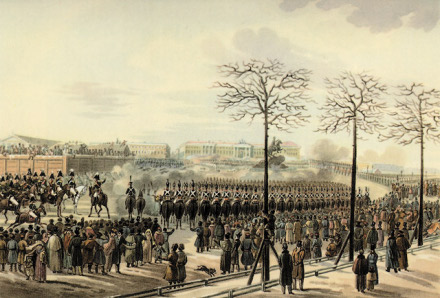

Decembrists at Senate Square, as depicted by Karl Kolman.

Uh … Now What?

This badly organized affair failed in its aim to attract the mass of soldiery and, constitutionalists as its organizers were, did not even aim at mobilizing the general populace.

After the initial heady rush of marching into the square in the name of liberty, the Decembrists were left in a standoff against a much larger force of loyalists. When the latter started shooting, that was that.

Those that survived faced trial, with five — Peter Kakhovsky, Kondraty Ryleyev, Sergei Muravyov-Apostol, Mikhail Bestuzhev-Ryumin and Pavel Pestel — initially sentenced to drawing and quartering.

“Mere” hanging was deemed sufficient for the purpose. That would be about the maximum embrace of liberalism by the Russian autocracy, whose lesson from the uprising was to crack down against any hint of forward-thinking politics — ultimately an unsuccessful strategy for the Romanov dynasty.

St. Petersburg’s Senate Square — renamed Decembrist Square by the Soviet government — where the action happened. The iconic equestrian statue of Peter the Great, commissioned by Catherine the Great and unveiled in 1782, witnessed it all; the statue acquired its enduring moniker, “The Bronze Horseman”, from a poem of the same title penned in 1833 by Alexander Pushkin, a friend of several Decembrists.

One of the greatest works of Russian literature, Pushkin’s “Bronze Horseman” weaves an ambiguous Decembrist-tinged critique of cruel imperial power and overreach into a complex narrative of St. Petersburg whose upshot is still up for lively literary debate. “The Bronze Horseman’s crag rose up before the poet on an empty square,” wrote one historian, “washed with the blood of those who rebelled on December 14, 1825”

Appalling there
He sat, begirt with mist and air.
What thoughts engrave His brow! what hidden
Power and authority He claims!
What fire in yonder charger flames!
Proud charger, whither art thou ridden,
Where leapest thou? and where, on whom,
Wilt plant thy hoof?

“They don’t even know how to hang you …”

When the hangings were carried out, Kakhovsky, Muravyov-Apostol and Ryleyev all had their ropes break; while some in the crowd anticipated the old prerogative of mercy for any prisoner who survives an execution, they just got re-hung instead. “Unhappy country,” quipped Ryleyev as the fresh nooses were fixed up, “where they don’t even know how to hang you.”**

Other Decembrists not condemned to the unreliable craftmanship of the Russian gallows were shipped to Siberia, where they invigorated the cultural life of the Lake Baikal city of Irkutsk — many of them famously followed by their “Decembrists’ wives,” an iconic type that continues to denote heroically sacrificial loyalty since the women had to renounce their own right to return to European Russia.

These, at least, had a place to call their own, however distant. But the class of Russian elites to which they belonged would be thrust into a trackless wilderness by their failure (in the Decembrist rising and otherwise) to carve out some distinct place for themselves. Russia’s long reckoning with modernity still had many years to run.


A worn postcard of a 19th century Russian painting depicting (perhaps) a political prisoner in the Peter and Paul Fortress.

* July 25 was the date on the Gregorian calendar; per the Julian calendar still in use in Russia at the time, the date was July 13.

** Ryleyev was quite the saucy one, having fought a “mysterious” duel with Pushkin in 1823, and instigated (and served as second at) a famous St. Petersburg jilted-love duel in 1825 that cost the lives of both antagonists.

A poet himself and a romantic to the point of fanaticism, Ryleyev wrote odes extolling executed national heroes like Artemy Volynsky and Severyn Nalyvaiko, seemingly alluding (as in this excerpt from the latter work) to his anticipation of joining them.

I know full well the dire fate
Which must upon the patriot wait
Who first dare rise against the foe
And at the tyrant aim the blow.
This is my destined fate

On this day..

1942: Joan Peiro i Belis, Catalan anarchist

On this date in 1942, anarchist, trade unionist and anti-fascist Joan Peiro was shot with six others at Paterna, Spain.

Joan (or Juan) Peiro (English Wikipedia page | Spanish) was a Barcelona glassworker of anarcho-syndicalist politics.

As Secretary General of the Confederacion National del Trabajo (CNT) and editor of the anarchist rag Solidaridad Obrera, Peiro mixed it up in the rough-and-tumble interwar political scene, eventually becoming Minister of Industry for Republican Spain — an untoward position to more orthodox anarchists.

When the Spanish Republic lost the Civil War, Peiro fled to France, where he was nabbed and extradited.

The nationalist general Emilio Mola had said before the war’s conclusion,

Whoever is, openly or secretly, a supporter of the Popular Front, must be shot … we must sow terror … eliminating without scruple or hesitation those who do not think as we do. (Source)

In practice, reprisals weren’t that vicious (maybe because Mola himself had died in a plane crash and wasn’t managing them) — but the leadership and intelligentsia who could rally an anti-Franco political bloc were purged ruthlessly.

The imprisoned Peiro was offered — repeatedly — a sellout package to oversee Franco’s house unions, and he repeatedly refused.

He earned martyrdom for his troubles, and after Franco’s death re-entered the public sphere as the sort of bloke to name streets after. (As an anti-Stalinist, Peiro had had all the right enemies.)


Placa Joan Peiro, a major square in Barcelona.

The Spanish judiciary, however, has thus far declined (Spanish link) to overturn his sentence.

Peiro is saluted in Catalan here.

On this day..

1976: Lt. Col. Abu Taher

At 4 a.m. this date in Dhaka Central Prison, Lt. Col. Abu Taher was hanged for treason.

A series of coups in the mirrored-sunglasses era of military governance shook the young state of Bangladesh:

  • The autocratic Sheikh Mujibur Rahman was toppled by a revolt of junior officers on August 15, 1975;
  • Senior brass in turn felled the ruling junta on November 3, 1975, jailing powerful officer Ziaur Rahman;
  • A quick counter-coup of junior officers — also remembered as the “sepoy mutiny”* — mounted by leftist war hero Abu Taher on November 7 put Ziaur Rahman’s hand back on the helm of state.

While November 7 is still marked in Bangladesh as National Revolution and Solidarity Day, its author got short shrift from its beneficiary.**

Abu Taher, a retired officer and a hero of the 1971 Bangladesh Liberation War that had detached the former East Pakistan from Islamabad, had visions of social revolution. But three coups in as many months is the sort of thing to rattle the new big man, and Zia consolidated his own power by eliminating threats to both left and right political flanks.

A mere 17 days after doing that National Revolution and Solidarity thing, the guy with the mass movement (pdf) of armed men was arrested for treason. He faced a military tribunal the following year.

Taher scorned the charges against him, but of course the fix was in.

* An allusion to colonial history.

** However, Taher’s own date of martyrdom is also still marked by his posthumous partisans.

On this day..

1889: “Cattle Kate” Ella Watson lynched

On this date in 1889, Ella Watson, a homesteader with a small ranch, was demonstratively lynched by vigilantes of Wyoming’s powerful cattlemen.


“Cattle Kate”

In the Western frontier amidst the rapine of the Gilded Age, ranching oligopolists had Wyoming by the throat.

Ellen Watson was a late-30’s escapee of an abusive marriage in Kansas who had homesteaded her own land and set up shop as an independent proprietor.

This put her in a class of people soon to be pitted in a resource war against the big ranchers — the Johnson County War, to erupt in 1892.

Watson was a casualty of the increasingly violent run-up to open “war”, a period when the catchall “cattle rustling” charge did the dirty work of licensing arrests and property seizures (and worse) deemed convenient for Big Cattle. When the latter decided that Watson’s stock was stolen, they seized her and partner James Averell and strung them up.

Hanging from the limb of a stunted pine growing on the summit of a cliff fronting the Sweetwater River, were the bodies of James Averell and Ella Watson. Side by side they swing, their arms touching each other, their tongues protruding and their faces swollen and discolored almost beyond recognition. Common cowboy lariats had been used, and both had died by strangulation, neither fallen over two feet. Judging from signs too plain to be mistaken a desperate struggle had taken place on the cliff, and both man and woman had fought for their lives until the last.

The subsequent trial of the paramilitaries ended in acquittal when potential witnesses were bought off or intimidated into silence, leaving “Cattle Kate” a legendary figure most defined by cattlemen-controlled Cheyenne newspapers. These made her out to be not only a thief but a (literal) whore, an image sharply contested by George Hufsmith’s The Wyoming Lynching of Cattle Kate.

Michael Cimino’s legendary cinematic Hindenburg Heaven’s Gate is about the Johnson County War, and features Isabelle Huppert as Watson, opposite Kris Kristofferson as Jim Averell. The film treats her sympathetically … but she’s also a madam who accepts payment for her cathouse’s services in the form of rustled cattle.

On this day..

2005: Mahmoud Asgari and Ayaz Marhoni, gay teens

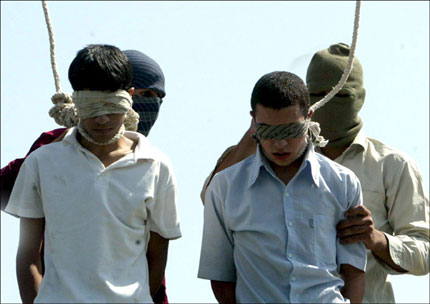
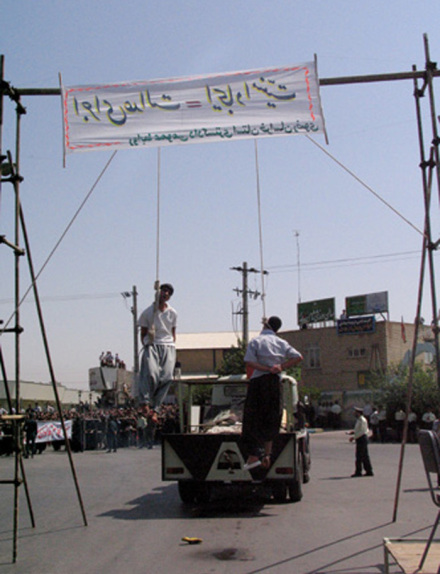
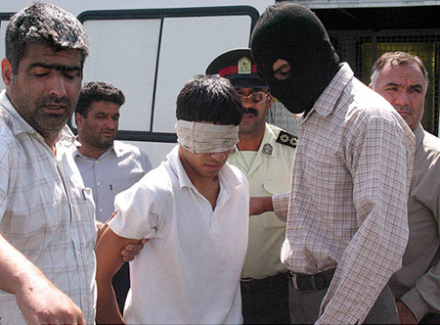
On this date in 2005, two teenagers were hanged in Mashhad, Iran.

Affecting photos of these two youths, their faces etched in fright and grief, their 16- and 18-year-old bodies pitifully boyish next to their executioners, became an immediate worldwide sensation.

These shocking images were quickly followed by a storm of controversy. The crime for which Asgari and Marhoni swung was the rape of a 13-year-old while both the offenders were themselves minors; gay organizations and human rights groups subsequently became mired in contentious dispute over whether (as a factual, legal, or tactical matter) they could be said to have succumbed to a “lethal reign of terror targeting Iranian gays”. For instance, was the conviction reliable, or a pretext? Would these boys actually have self-identified as “gay”?

To that were added charges and countercharges among western campaigners of racism, imperial lickspittle-ism, objective-pro-Islamic-fascism, and the like. Like, awfully convenient that Iran’s longtime dim view of homosexuality has everyone exercised at just the moment bombing Tehran was being openly mooted.

But whatever the text: those pictures. Still, those pictures.

It is certain that both Mahmoud Asgari and Ayaz Marhoni were juvenile offenders, whose execution is anathema almost everywhere in the world but Iran — just one of that country’s unique characteristics.

On this day..

1865: Chief Ahan of the Tsilhqot’in

“The Indian Ahan,” read the dispatch in the British Columbian this date in 1865, “will have expiated his crime upon the gallows ere these lines meet the public eye. The execution will take place in the rear of the jail early this morning.”

Ahan and another Tsilhqot’in (or Chilcotin) were of the party of Klatsassin, whom we have already met in these pages. Months after the Chilcotin War‘s mass execution, the luckless pair were arrested trying to pay what would have been a routine-for-them bit of blood money.

Both were condemned; Lutas received clemency, and his freedom. (“I eagerly availed myself of some favorable circumstances in the case of Sutas and sent him back pardoned to his tribe. A sufficient number of Indians has now perished on the scaffold to atone for the atrocities committed last year.”)

Documents related to this proceeding are archived at a canadianmysteries.ca page on Klatsassin.

Ahan’s execution in New Westminster, now part of the Vancouver, B.C. metropolis, isn’t dead, though — and isn’t even past.

Over the course of the past year, a public school project in the city that had been built over an old pauper’s grave that might have become the hanged man’s resting place was gravely (ahem) complicated by the continuing Tsilhqot’in search for Ahan’s remains. While Ahan’s own situation remains unresolved, the suit on his behalf eerily outlined the macabre past lurking everywhere beneath our workaday feet.

On this day..

1939: Howard Long, New Hampshire’s most recent hanging

As of today, it’s been 70 years since the U.S. state of New Hampshire carried out an execution, despite maintaining a death penalty statute almost continuously since.

“Craving for boys,” Long was condemned for molesting and beating to death a 10-year-old in 1937, evidently his second molestation/murder: in the first, he reportedly drove around for 10 hours with his prisoner before plucking up the heart to do the thing, the sort of mental picture to cast a child murder victim of a wannabe-serial killer in the unexpected aspect of boredom.

Long’s execution in the bicentennial of New Hampshire’s first legal hangings was itself the first in 21 years in the Granite State. Although a handful of cases since have potentially fit the steadily narrowing set of death penalty circumstances, none has actually come so far as the gallows (or, today, theoretically, lethal injection) before taking one of the many possible exits — plea bargain, sentence reduction, premature death — from the capital punishment system.

New Hampshire’s present-day death row consists of only one person, and earlier this year its legislature actually voted to abolish the death penalty, a measure spearheaded by State Rep. Renny Cushing, who is the son of a murder victim.* The measure was vetoed by Gov. John Lynch.

* Full disclosure: also a personal friend. Cushing founded Murder Victims Families for Human Rights (MVFHR).

On this day..

1537: Robert Aske, for the Pilgrimage of Grace

On this date in 1537, Robert Aske was hanged for leading the Pilgrimage of Grace.

The year preceding had been among the most wrenching in British history, and when Henry VIII began shuttering Catholic monasteries, many an egg that would comprise the English Reformation‘s omelette would be shattered.

In the conservative and Catholic-leaning north, Thomas Cromwell‘s reforms (combined with various political and economic grievances) triggered an uprising that soon controlled York.

This fraught situation ended much easier for the English crown than it might have, with a royal negotiating strategy of nominally accepting the Pilgrimage’s terms inducing the massive rebel force to disband, allowing its leaders to be seized thereafter on the first pretext of renewed trouble.

[flv:https://www.executedtoday.com/video/Pilgrimage_of_Grace.flv 440 330]

Robert Aske, the barrister who had come to the fore of the Pilgrimage movement and had personally negotiated terms with Henry, was among about 200 to suffer death for their part in the affair. In Aske’s case, it was against the will of Jane Seymour, Henry’s demure third queen and also a Catholic-inclined traditionalist; she made an uncharacteristic foray into state policy by ask(e)ing for Aske’s life, summarily vetoed by the king’s reminding her the fate of her politically-minded predecessor.*

Here’s Aske hanged at York Castle in The Tudors:

And here’s an inscription on a Yorkshire church reminding one of Aske’s surviving brothers of the events of those pivotal months.

* In other wives-of-the-king developments, Henry’s future (sixth, and final) wife Katherine Parr was taken a hostage by the rebels during the Pilgrimage.

On this day..