1915: Eleven Arab nationalists

On August 21, 1915, the Turkish governor of Syria had 11 Arab nationalists publicly hanged in Beirut for seditious contacts with the French.

A larger and more famous batch would follow these the next year, like today’s victims the fruit of the French consul‘s leaving an incriminating list of potential allies in its embassy when it bugged out.

According to Charles Winslow,

[i]n all, fifty-eight individuals were tried and sentenced to death; forty-five of these were either out of the country or avoided arrest; two were given reprieves; and the other eleven, ten Muslims and one Christian, were disgracefully hanged. This public display of terror was only a prelude to additional steps taken as part of the wartime policy of repression…

Lightly defended, Jemal argued that he had no means other than those of terror to hold the area. He claimed that the executions had, in fact, forestalled a rising in Syria. Others, however … see Jemal’s actions in Syria as turning the tide against Istanbul, “causing the Arab Muslims in the area to make up their minds once and for all to break away from the Turkish Empire.” Jemal had perpetrated a “Remember-the-Alamo” for the Lebanese. Throughout the country, the story of his perfidy was passed from person to person and from village to village … One can hardly measure the significance of these hangings in stimulating people to abandon their Ottoman attachment.

By the next year, Arabs had risen in revolt, in alliance — as Pasha had feared — with the Triple Entente.

On this day..

1799: Eleonora Fonseca Pimentel, Neapolitan Jacobin

(Thanks to Jeff Matthews of the Around Naples Encyclopedia for allowing us to run this abridged version of a much more detailed entry in that encyclopedia that’s well worth the read. -ed.)

Failed revolutionaries usually wind up as footnotes in history books. Certainly, the period between 1789 (the beginning of the French Revolution) and 1805 (the year in which Napoleon crowned himself emperor) is one of such turmoil in Europe that it is easy not to see any but those who are larger than life.

Eleonora Fonseca Pimentel vaulted onto the Naples literary scene as a teenage pop princess with a hit poem for the nuptials of King Ferdinand and Maria Carolina (the latter was Marie Antoinette‘s sister).

Pimentel parlayed her puissant pen into a permanent position on the salon circuit, doing late-18th-century literary things like quoting classics and maintaining voluminous correspondences.

By the revolutionary 1790’s, she’d risen to become the aforementioned Queen Maria Carolina’s librarian, but was among those inspired by the liberta, egalita, fraternita of the French Revolution. When Napoleon tore through northern Italy and conquered as far as Rome, the monarchy rode out to reconquer the Eternal Cityget itself decimated, and Naples’ dreamers had their chance.

Pimentel turned her literary talents to the Republic’s service, including some outstandingly vituperative verse savaging the exiled Maria Caroline as a lesbian and threatening her with the guillotine.

-ed.

Eleonora Fonseca Pimentel is one such overlooked person. She was a major figure, but on a small stage, connected with the little known and failed Neapolitan revolution and subsequent short-lived Neapolitan republic of 1799. It was a sister of the French republic and one of many set up in the 1790s in Europe, all of which—the Neapolitan version included—have been relegated to the status of “also-rans” in history.

Eleonora was an unlikely revolutionary. She was born in Rome in 1751 of Portuguese nobility and would be hanged in Piazza Mercato in Naples in 1799 in a grotesque caricature of an execution. Her executioner, Maria Caroline of Hapsburg, Queen of Naples during the Neapolitan Revolution was also born in 1751. That was also the decade of the great Lisbon earthquake, about which an anonymous poet wrote lines as if describing the dramatic events that would soon shake Europe the way the earth had shaken Portugal:

With her last earthquake this round world shall rise,
The sun shall lose his fires in endless night,
And the moon turned to blood, glare horrid light,
When comets dire shall sweep athwart the sky,
And stars like leaves before the tempest fly.

Certainly, the last days of one of Portugal’s daughters, Eleonora Fonseca Pimentel, seem contained in that verse.

Stendahl, in Rome, Florence and Naples (1826) , reports at length a conversation about the Neapolitan Revolution and its grisly conclusion with a young man he identifies only as T***, an eye-witness to the events, themselves. Stendahl concludes: “I have been careful to suppress, during the course of this narrative, all the more gruesome details. Robespierre, whatever his faults, has this at least to be said in his favor: he did not count a majority of personal friends among the total number of his victims. Those whom he sacrificed, he sacrificed to a system, however ill-founded; not to his petty, personal spite.”

In Piazza Mercato, the fortunate among those sentenced to death* were beheaded swiftly. The less fortunate, among whom was Eleonora, were hanged. In her case, it was a ghoulish affair. Her body was left dangling from the gallows for a day, exposed to further jibes and humiliation, such as the popular verse making the rounds at the execution (cited in Albanese 1998):

A signora donna Lionora,
che cantava ncopp’ o triato,
mo abballa mmiezo ‘ o mercato,
viva viva ‘u papa santo,
c’ha mannato i cannuncini,
pe scaccià li giacubini!
Viva a’ forca ‘e Masto Donato
Sant’Antonio sta priato.

Roughly:

To lady Eleonora
who used to sing upon the stage
and now dances in market square,
long live the Holy Pope,
who sent us the guns
to chase away the Jacobins!
Long live the gallows and Master Donato [a traditional name for the hangman]
Praise be to Sant’Antonio.

Eleonora was calm at the gallows. She asked for some coffee, and—true to her intellect to the last—her last words were in Latin: “Forsan et haec olim meninisse juvabit,” a citation from Virgil—“Perhaps one day this will be worth remembering.”


Giuseppe Boschetto, La Pimentel Conducted to the Gallows, 1869

One of the most interesting memories of the Revolution is the Palazzo Serra di Cassano, on via Monte di Dio. It was the home of Giovanni Serra, Duke of Cassano, one of Eleonora’s closest friends. Looking down at the crowd as he was about to die, he said, “I have always wanted good for them and now they cheer at my death” [cited in Albanese 1998]. The next day, his father closed the portal of the building that opens onto the Royal Palace and said it would remain closed until the ideals his son had died for were realized. The door is still closed.

The greatest memorial in recent memory, however, was when Vanessa Redgrave, the English actress, stepped out on the stage of the San Carlo Theater on Friday, January 8, 1999, and recited, in magnificent Italian, the title role in Eleonora, a 3-hour oratorio, an absolute hymn of praise to Eleonora Fonseca Pimentel. It was composed by Roberto de Simone, prominent Neapolitan composer and musicologist. The production had had a two-week run-up in the Neapolitan daily, il Mattino, replete with histories of the Neapolitan revolution, fragments of Eleonora’s poetry, long citations from historical heavyweights such as Benedetto Croce, and even the news that a descendant of Eleonora’s (through her brother’s line), another Fonseca Pimentel, would be at the premiere. The production, itself, was generally well received. The next day, the critic from il Mattino called it “an allegory of all the martyrs in history” (Gargano 1999). “Art is liberty,” he wrote, “and must free itself from the bonds of time like an ever-evolving presepio,” thus comparing the production to the traditional Neapolitan manger scene that celebrates the birth of the Savior. Heady praise, indeed.

Visit the Around Naples Encyclopedia for an expanded version of this post with much more about Eleonora Fonseca Pimentel’s biography, the unfolding of the Revolution, and its legacy.

Bibliography

Acton, Harold. The Bourbons of Naples. London: Prion Books, 1957.
Albanese, Camillo. Cronache di una Rivoluzione, Napoli 1799. Milan: Franco Angeli, 1998.
Bradford, Ernle. Nelson, The Essential Hero. London: MacMillan, 1977.
Croce, Benedetto. “Eleonora de Fonseca Pimentel.” Monograph. Rome: Tipografia nazionale, 1887.
Croce, Benedetto , et al. La Rivoluzione Napoletana. 1999 reprint by Tullio Pironti, ed. Naples: Morano, 1899.
Croce, Benedetto. “Eleonora de Fonseca Pimentel e il Monitore Napoletano” in La Rivoluzione Napoletana di 1799. Bari: Laterza, 1926.
Cuoco, Vincenzo. Saggio Storico sulla Rivoluzione Napoletana nel 1799. Milano: 1806.
Diana, Rosario. Forward to Vincenzo Cuoco, Pl atone in Italia. Naples: Pagano, 2000.
Gargano, Pietro. “Quei martiri nostri fratelli.” Il Mattino, January 9, 1999.
Gurgo, Bice. Eleonora Fonseca Pimentel. Napoli: Cooperativa Libreria, 1935.
Irace, Clorinda. E.F.P. Le tracce, i luoghi. Naples: Lions Club, 1977.
Macciocchi, Maria Antonietta. Cara Eleonora. Milan: Biblioteca Universale Rizzoli, 1993.
Stendahl. Rome, Florence and Naples. 1826.(Richard N. Coe, trans.) London: John Calder, 1959.
Urgnani, Elena. La Vicenda Letteraria e Politica di Eleonora de Fonseca Pimentel. Il Pensiero e la storia. Ed. Istituto Italiano per gli Studi Filosofici. Vol. 54. Naples: La Città del Sole, 1998.

On this day..

1909: Madanlal Dhingra, Indian revolutionary

A century ago today, the first Indian revolutionary martyr to be hanged in England was put to death at Pentonville Prison.

Madanlal Dhingra (or Madan Lal Dhingra) was a bright young scion of a loyalist Indian family that disowned him when he took to radical politics.

As an engineering student in London, Dhingra quaffed the martyr’s cup by assassinating Sir William Curzon Wyllie, a career imperial official spending his golden years keeping tabs on nationalist types among England’s Indian students. (Evidently, he could have been doing his job better.)

Dhingra rejected the legitimacy of the British court, disdained a defense, and was sentenced to death on the first day of trial. His martyrdom being the shared object of both the prosecutors and the offender, he was not long for the world — supposedly checking out with the well-turned last words,

My only prayer to God is that I may be re-born of the same mother and I may re-die in the same sacred cause till the cause is successful.

Dhingra is a noteworthy martyr to the cause of Indian independence now, but like anything else things weren’t so black and white at the time. Gandhi was not down with Dhingra — Gandhi’s own differences with Hindu extremists would eventually cost him his life — and plenty of Indian liberal types shared his abhorrence.

On the other hand, a subversive Brit like poet Wilfrid Scawen Blunt filled his blog-like diary with admiration for the assassin during the weeks of his celebrity — writing of this date, for instance:

They have done me the honour of choosing [my birthday] for Dingra’s execution, thus making of it an anniversary which will be regarded as one of martyrdom in India for generations.

And reflecting later, after the hanging:

People talk about political assassination as defeating its own end, but that is nonsense; it is just the shock needed to convince selfish rulers that selfishness has its limits of imprudence.

Other subjects of the Empire were inclined to agree.


From the Aug. 19, 1909 London Times.

On this day..

2004: Dhananjoy Chatterjee, the last hanged in India … for now

On this date in 2004, Dhananjoy Chatterjee hanged at Calcutta’s Alipore Central Jail for the 1990 rape-murder of 14-year-old Hetal Parekh.

Chatterjee’s hanging also brought into the limelight the garrulous, publicity-hounding 84-year-old executioner Nata Mallick, who conducted the hanging with his son and grandson and told anyone with a microphone stories of the hangman’s glory days.

Those days are long past on the subcontinent.

Among death penalty countries, India is the anti-Singapore: despite its billion-plus population, death sentences are vanishingly rare. Chatterjee is not only the most recent person hanged in India as of this writing, but the only one hanged there since 1995.

One actual hanging in fourteen years for a billion-person country? The only lower execution rate would be actual abolition.

Chatterjee may be relieved of his milestone distinctions in the not-too-distant future, however. (Where “not-too-distant” by the standards of the Indian death penalty might still mean years away.)

Mohammad Afzal, condemned for the 2001 terrorist attack on the Indian Parliament, has become a political lightning rod; India’s conservative Hindu party Bharatiya Janata Party (BJP) has made political hay pushing for Afzal’s execution.

Update: A different Pakistani terrorist, Ajmal Kasab, became the next hanged after Chatterjee in 2012. Afzal Guru got his in February 2013.

On this day..

1868: Thomas Wells, the first private hanging in England

The hanging this date at Kent’s Maidstone Prison of Thomas Wells for the murder of the Dover postmaster stamped the understated debut of England’s era of private executions.

It was a shift almost a century in the making; in 1783, Albion had eliminated London’s traditional, disorderly procession to Tyburn in favor of public hangings just outside the walls of the prison — to the chagrin of traditionalists like Samuel Johnson.

As the 19th century unfolded, even this compromised spectacle attracted increasing criticism, noticeably from literary types who decried the aesthetics, effectiveness, and/or morality of public execution.

Eventually, on May 29, 1868,* Parliament passed the Capital Punishment Amendment Act of 1868, also known as the Capital Punishment within Prisons Act. The public hanging was no more.

Our day’s otherwise mundane murderer became the first to answer for his crime in this brave new behind-prison-walls world. And if the objective was to banish the spectacle and theater of the scaffold — well, the report in next day’s London Times of Thomas Wells’ hanging would suggest the measure achieved its purpose.

Yesterday morning Thomas Wells, aged 18, who was found guilty at the last Kent Assizes of the wilful murder of Mr. Walsh, the master of the Priory Station on the London, Chatham, and Dover Railway, by shooting him in revenge for a reprimand which that gentleman, under whom he served as a porter, had given him for some misconduct, suffered the extreme penalty of the law. This was the first execution under the new Act requiring executions in future to be inflicted within the prison walls.

It was, of course, generally known that the execution would be conducted in private, and that the only sign would be the hoisting of a black flag outside the prison wall. At the moment of the falling of the drop there were very few, if any, strangers in the vicinity of the prison, and the town presented quite its ordinary appearance, presenting a marked and extraordinary contrast to that which it has hitherto exhibited on the occasion of a public execution. The scaffold was erected in a small yard adjoining the debtors’ portion of the gaol, which had at one time been used as an exercise yard for the prisoners. It is enclosed by four high walls. The apparatus is the same that was formerly used, with some slight alterations. The drop is on a level with the stone paving of the yard, and the executioner has to descend several steps to remove the bolt which supports the platform, and the latter then drops into a recess prepared for it. No one was present at the execution but the undersheriff, governor, sergeant, chaplain, and the representatives of the Press.

After his trial the culprit seemed to have been fully aware that there was no hope for him, but he expressed remorse for the act he had committed, and wrote a very penitent letter to Mrs. Walsh, the widow of the deceased, entreating her forgiveness. No efforts appear to have been made in any quarter to obtain a remission of the capital sentence.

The culprit prayed fervently with the Rev. Mr. Frazer, the chaplain, for a few seconds, and as the drop fell he was singing with a loud clear voice the 486th hymn. He appeared to die after two or three convulsive struggles.

Of course, not everything old can be new overnight; this hanging was carried out by longtime public hangman William Calcraft, who’d had his start in the trade back in 1829 and was renowned for unpleasantly strangling his charges with his itty-bitty drops. Though the Times report downplays the climax, other press attendees agreed that Wells died hard.

This day’s milestone, nevertheless, was a way station en route to further innovations, the decisive transition from an ancient form of public corporal discipline to the rational, calculated, mechanistic procedure meet for an industrial empire.

Behind prison walls, Calcraft would yield his own place to William Marwood’s precisely measured drops, and then to the 20th century’s coolly efficient Albert Pierrepoint. The changes may have been incremental, but by the end, little save the rope remained of England’s storied hanging era.

The natural end of that evolution, some would have us believe, is disposing the rope altogether. If Wells’s private hanging held the seed of capital punishment’s eventual abolition, it sprouted quite neatly indeed: it was this same date in 1964 that England conducted its last private hangings — or executions of any kind.

* The act was passed only three days after the last public hanging in England.

On this day..

1922: Joseph O’Sullivan and Reginald Dunne, helping spark the Irish Civil War

(Thanks to Rob at Another Nickel In The Machine, a delectable blog about 20th century London, for this post. It originally ran on Another Nickel October 4, 2008.)

“I do not approve, but I must not pretend to misunderstand” – Eamon de Valera

The arrest of Reginald Dunne and “James Connolly” (Joseph O’Sullivan) in 1922

On December 1921 at 22 Hans Place in Knightsbridge, a treaty was signed between a provisional Irish Government and the British to create what was called the Irish Free State. However only six months later, a few hundred yards away in Eaton Place, an assassination occurred, the reverberations of which could be said to have helped start the Irish Civil War in 1922.

Sir Henry Hughes Wilson in 1918

Sir Henry Hughes Wilson in 1921

At around midday of 22 June 1922, Field-Marshall Sir Henry Wilson unveiled a war memorial at Liverpool Street Station. He made a speech, quoted some relevant Kipling poetry and soon after returned by taxi to his home at 15 Eaton Place in Knightsbridge. Two 24 year old men, Reginald Dunne and Joseph O’Sullivan, were surreptitiously waiting for his arrival. They watched while Wilson paid for his taxi before running up to him and killing him in cold blood on the footsteps leading up to his front door. In Dunne’s words:

I fired three shots rapidly, the last one from the hip, as I took a step forward. Wilson was now uttering short cries and in a doubled up position staggered towards the edge of the pavement. At this point Joe fired once again and the last I saw of him he (Wilson) had collapsed.

Joseph O’Sullivan

Reginald Dunne

The Field Marshall had half withdrawn his sword in a futile effort to protect himself but after being shot seven times he fell face first on to the pavement with blood running profusely from his body and mouth. Dunne and O’Sullivan started to run but O’Sullivan had been seriously wounded at Ypres during WW1 (both men had fought for the British) and his wooden leg severely hindered their escape. Dunne and O’Sullivan both attempted to shoot their way out of trouble and shot and injured two policemen and a civilian in the process but were soon surrounded by an angry and hostile crowd and the two men were quickly arrested. They actually had to be protected by the police from a mob who wanted instant revenge for Wilson’s death.

The steps of 36 Eaton Place where the Field Marshall fell fatally wounded.

The killing of Field-Marshall Wilson in Eaton Place turned out to be pivotal in an extraordinarily complex political period of Ireland’s history when a national liberation struggle turned into a civil war. However much of Britain was outraged with the murder and The Times wrote:

Field-Marshall Sir Henry Wilson, the famous and gallant soldier, was murdered yesterday upon the threshold of his London home. The murderers were Irishmen. Their deed must rank among the foulest in the foul category of Irish political crimes.

Six months earlier at 2.20 am 6th December 1921 the Anglo-Irish Treaty was signed between an Irish delegation, led by Michael Collins, and the British Government at 22 Hans Place. Incidentally, there is nothing on the outside of the building commemorating the historical event and today, in what is probably one of the most expensive property areas of London, seems to be unused and empty with security boards up in the windows.

22 Hans Place in Knightsbridge and where the Anglo-Irish Treaty was negotiated

Signing the Anglo-Irish treaty in 1922

Michael Collins in London October 1921

11th October 1921

Collins outside Downing Street 1921

The treaty envisaged an independent Ireland that would be known as the Irish Free State but the agreement was hugely controversial, especially back in Ireland. For a start, de Valera, the President of the Irish Republic and who had a difficult relationship with Collins at the best of times, was angry that the treaty was signed without his authorisation (although it was at his insistence that Collins went, with de Valera considering it wrong to be involved in the negotiations if Britain’s King George V wasn’t either). Also controversial was both the British insistence that they continued to control a number of ports, known as the Treaty Ports, for the Royal Navy and that Northern Ireland (which had been created in the Government of Ireland Act 1920) was able to leave the Irish Free State within one month, which of course it duly did.

In April 1922 a group of 200 anti-treaty IRA men had occupied the Four Courts in Dublin in defiance of their Government. Collins, wanting to avoid Civil War at all costs, decided to leave them alone. However after the Field Marshall’s assassination and the subsequent Fleet Street outrage this all changed. It was assumed by the British that Dunne and O’Sullivan were anti-treaty IRA men and after the shock of the Field Marshall’s murder Winston Churchill wrote to Collins threatening that unless he moved against the Four Courts anti-treaty garrison he (Churchill) would use British troops to do so for him. After a final attempt to persuade the men to leave the Courts, Collins borrowed two 18 pounder Artillery guns from the British and bombarded the Four Courts until it’s garrison surrendered. A surrender which almost immediately led to the Irish Civil War with fighting breaking out over Dublin and subsequently the rest of the country.

The Four Courts siege, Dublin 1922

Sackville Street, Dublin 1922

Meanwhile back in London at the Old Bailey, and before Mr Justice Shearman, Dunne and O’Sullivan were both tried together for the murder of Sir Henry Wilson on 2 July 1922. Dunne stood with his arms folded while the charge was being read while O’Sullivan stood stiffly at attention. When Dunne was asked, “Are you guilty or not guilty?” he replied “I admit shooting Sir Henry Wilson.” “Are you guilty or not guilty of the murder?” the Clerk of Arraigns repeated. “That is the only statement I can make,” was the response. O’Sullivan made a similar reply and after some discussion the plea was treated as one of “Not guilty.”

Towards the end of the trial, which lasted just three hours, the defence Counsel handed the judge a double sheet of blue official paper given to him by Dunne. After perusing the contents Mr Justice Shearman said – “I cannot allow this to be read. It is not a defence to the jury at all. It is a political manifesto…I say clearly, openly, and manifestly it is a justification of the right to kill.”*

Dunne’s hand written statement

Dunne and O’Sullivan were sentenced to death by hanging and sent to Wandsworth gaol where they were both hanged together by the executioner John Ellis on the 10th August 1922.

Less than two weeks later Michael Collins was ambushed and shot dead in his home county of Cork by anti-treaty IRA members.
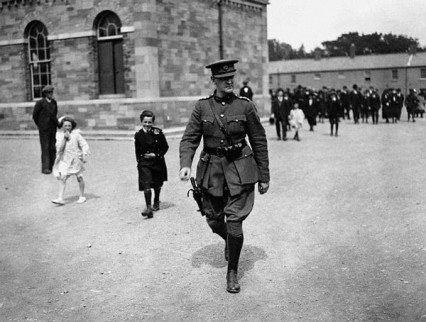
Commander in Chief Michael Collins in July 1922, two or three weeks before he was assassinated in Cork.

Michael Collins' funeral, O'Connell Street August 1922
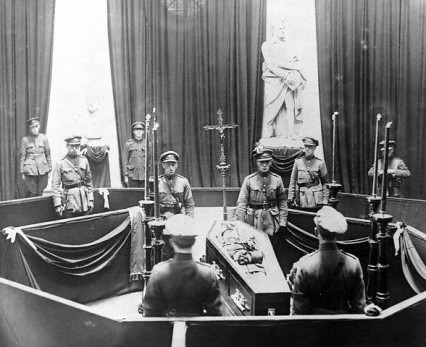
The coffin bearing the body of Michael Collins lying in state in the City Hall, Dublin. September 2, 1922 Dublin, Ireland

Michael’s brother Sean Collins

It was never really established whether Dunne and O’Sullivan acted on their own (the assassination seemed pretty badly organised for an official assassination so this was likely) or with the approval and help of Michael Collins. Collins had been a friend of Dunne’s while Sir Henry Wilson was responsible for establishing the Cairo Gang (a group of experienced British Intelligence agents who met frequently at Dublin’s Cairo Cafe) twelve of whom were murdered by the IRA acting under Collins command in 1920. The Cairo Gang killings provoked the British Auxiliaries in Dublin to shoot trapped innocent civilians at Croke Park in not the bloodiest but perhaps the nastiest of the various historical Bloody Sundays.

The infamous Cairo gang

Perhaps the ironic aspect to the story of the murder of Sir Henry Hughes Wilson was that Reginald Dunne and Joseph O’Sullivan were both born and bred in London, whereas Field-Marshall Wilson was born smack bang in the middle of Ireland at Ballinalee in County Longford.

A letter sent to O'Sullivan while waiting for his execution

Sinéad O’Connor – She Moves Through The Fair

* The text of Dunne’s intended last statement, as transcribed from the images in this post.

Lord and Members of the Jury. My friend and I stand here before you today charged with the offense of murder; and I have no doubt that, from the evidence placed before you by the prosecution, you will find us both guilty. With respect to the charges of attempted murder, we merely tried, as everyone must know, to try and escape arrest.

The offence of murder is a very serious matter; so much so, that any act which results in loss of human life requires very grave and substantial reason. We have never until now been charged with any crime. As you have heard from the Police Officer, who gave evidence as to our character and our previous records, we have both been in the British Army. We both joined voluntarily, for the purpose of [making Europe safe?] in order that the principles for which this country stood, should be upheld and preserved. These principles, we were told, were Self-Determination and Freedom for Small Nations. We both, as I have said, fought for these principles, and were commended for doing so; and I imagine that several of you gentlemen of this jury did likewise. We came back from France to find that Self-Determination had been given to some Nations we had never heard of, but that it had been denied to Ireland, We found, on the contrary that our Country was being divided into two Countries; that a Government had been set up for the Belfast district, and that under that Government outrages were being perpetrated, that are a disgrace to civilization — many of the outrages being committed by men in uniform and in the pay of the Belfast Government. We took our part in supporting the aspiration of our fellow Countrymen, in the same way as we took part in supporting the nations of the world who fought for the right of small nationalities.

Who was Sir Henry Wilson? What was his policy? And what did he stand for? You have all read in the newspapers lately, and been told, that he was a great British Field Marshal; but his activities in other fields are unknown to the men of the British public. The nation to which we have the honour to belong, the Irish nation, knows him, not so much as the British Field Marshal, but as the man behind what is known in Ireland as the Orange Terror. He was at the time of his death the Military Advisor to what is colloquially called the Ulster Government, and as Military Advisor he raised and organized a body of men known as the Ulster Special Constabulary, who are the principle agents in his campaign of terrorism.

My Lord and Members of the Jury, I do not propose to go into details of the horrible outrages committed on men, women and children of my race in Belfast and other places under the jurisdiction of the Ulster Government. Among Irishment it is well known that about 500 men, women and children have been killed within the past few months, nearly two thousand wounded, and not one offender brought to justice. More than 9000 persons have been expelled from their employment; and 23,000 men, women, and children driven from their homes. All the big cities of this country and even those of Northern France are now receiving these refugees. Sir Henry Wilson was the representative figure and the organiser of the system that made these things possible.

At his suggestion and advice the Ulster Parliament passed an Act authorising the [purging?] of political opponents and this power is now exercised and enforced by the Courts in Ulster.

There is and can be no political liberty in a country where one political party outrages, oppresses, and intimidates not only its political opponents, but persons whose religious opinion differ from those of the party in power. The same principle for which we shed our blood on the Battle Field of Europe led us to commit the act we are charged with.

My Lord and Members of the Jury, you can condemn us to death today, but you cannot deprive us of the belief that what we have done was necessary to preserve the lives, the homes, and the happiness of our countrymen in Ireland. You may by your verdict find us guilty, but we will go [to] the scaffold justified by the verdict of our own Conscience.

Dunne truncated his statement to “cut out the patriotic adjectives I feel inclined to use under the present circumstances” (as well as his specific delineation of the atrocities of Henry Wilson and the Ulster government). -ed.

On this day..

1812: Daniel Dawson, for the integrity of sport

On this date in 1812, Daniel Dawson “suffered the awful sentence of the law, at the top of Cambridge Castle, amidst a surrounding assemblage of at least twelve thousand spectators, it being market-day.”

The crowd was an appropriate ornament to the condign punishment of the most famous horse-poisoner in English history — and perhaps the most severely-punished sports cheat in all of modernity.

A tout scrabbling his living about the storied Newmarket tracks of Cambridge, Dawson killed the favorite for a high-profile race (and three other horses besides) by poisoning their trough, intending only to hamper the beasts enough to make good a variety of bookies’ bets against the fair Pirouette.

Although acquitted for that crime, Dawson was promptly returned to the dock for a previous, and previously unsolved, horse-poisoning, and convicted under a “black act” statute to punish livestock-killing.

According to the inevitable trial pamphlet, freely available from Google Books,

DAWSON behaved with a sullen and impudent levity during the trial, and he frequently abused the witnesses whilst giving their testimony, loud enough to be heard throughout the court … with horrid imprecations, ill becoming his unhappy situation, and at other times he was nodding at and saluting with his hand different persons in court. The verdict of GUILTY had not the slightest effect on him, and his general conduct was altogether depraved. On his return to the castle, his conduct, at times, bordered on insanity, and he appears too illiterate to feel a consciousness of wrong, although he has confessed his guilt to the full extent.

(Katherine Watson adds that although Pirouette’s owner sought a reprieve for the poisoner, Dawson “spoke bitterly of the hypocrisy of the Jockey Club, few of the members of which were above cheating.”)

On this day..

1864: Romuald Traugutt and the January Uprising leaders

On this date in 1864, the leadership of Poland-Lithuania’s abortive January Uprising against the Russian tsar was hanged before 30,000 at Warsaw Citadel.


Romuald Traugutt depicted (somewhat ironically) on the 20-zloty note of Soviet bloc Poland.

Romuald Traugutt (English Wikipedia link | Polish) had been a decorated Lieutenant Colonel in the Tsarist army, and a heretofore apolitical man — but he resigned shortly after the outbreak of the doomed national uprising to take up sides against Russia.

This installment of the venerable Russians vs. Poles series was characteristically nasty.

In 1863 – Polonia by Jan Matejko, an allegory for the Polish nation is manacled by the Russians.

And it ended the way these affairs have ended these last 400 years or so: Russian victory.

The fallout was severe.

In addition to this day’s batch — Traugutt along with (all Polish Wikipedia links) Rafal Krajewski, Jozef Toczyski, Roman Zulinski and Jan Jezioranski — a further 391 were put to death after the war; tens of thousands were deported to Siberia or otherwise scattered in the vast Romanov empire; a war indemnity tax was imposed; and over three thousand estates in Poland and Lithuania were confiscated.

Traugutt has gained some latter-day support in the Catholic Church for beatification.

On this day..

1726: Mary Standford, shunning convict transportation

(Thanks to Anthony Vaver of Early American Crime for the guest entry, reposted from a fascinating entry in his series on convict transportation. Vaver is the author of Bound With An Iron Chain: The Untold Story of How the British Transported 50,000 Convicts to Colonial America. -ed.)

Mary Standford was convicted of privately stealing a shagreen pocket book, a silk handkerchief, and 4 guineas from William Smith on July 11, 1726. After her conviction, she strongly rejected transportation to the American colonies as an alternative to execution.

Early Years

Standford was raised just outside of London by good parents who sent her to school and educated her in the principles of Christian values. Standford, however, showed more interest in the “Company of Young Men,” so she was sent to London to become a servant, where she lost several positions due to her behavior. In her last position she was seduced by a footman, which subsequently forced her into prostitution.

Standford quickly fell in company with Mary Rawlins, “a Woman of notorious ill fame,” and the two of them walked the streets between Temple Bar and Ludgate-Hill looking to empty the pockets, one way or another, of gullible men. Later, they had considerable success targeting sailors who, after returning from their voyages, had money to spend for their favors. Standford eventually married a man with the last name of Herbert, but after a year and a half she left him or, by her account, he abandoned her. Soon afterward, she had a child out of wedlock from another man, who was a servant.

Standford’s Arrest

With two mouths to feed, Standford set out to practice prostitution on her own, and it was then that she was arrested for theft. William Smith, who brought her to trial and was surprisingly frank in his testimony, related that he was walking along Shoe Lane after one o’clock in the morning when he was approached by Standford, who offered him to “take a Lodging with her.” He spent 2 or 3 three hours with her, all the while ordering drinks to be brought up from downstairs. He soon realized that he was missing money, and when he confronted Standford about it, she bolted from the room.

A constable caught Standford running away from Smith in the street. He picked up one of Smith’s guineas after Standford had dropped it, and he found another in her hand and two in her mouth. He also discovered Smith’s handkerchief and pocket book on her. In his testimony, the constable called Smith a “Country Man” and described him as very drunk at the time.

Standford’s version of the event was quite different. She claimed that Smith was drunk when she met him, and that he forced himself up to her room. There, he placed the four guineas one by one in her bosom and then threw her onto the bed. In the struggle, she speculated that his pocket book must have fallen out of his pocket, and when she discovered it after he left, she ran after him to return it. Not believing her story, the jury found her guilty, and she was sentenced to death.

A Rejection and a Defense of Transportation

After receiving her sentence, Standford’s friends pleaded with her to ask for a pardon in exchange for transportation. Standford refused, “declaring that she had rather die, not only the most Ignominious, but the most cruel Death that could be invented at home, rather than be sent Abroad to slave for her Living.”

The author of the Lives of the Most Remarkable Criminals was baffled by Standford’s position and presents a lengthy defense of the institution of convict transportation:

such strange Apprehensions enter into the Heads of these unhappy Creatures, and hinder them from taking the Advantage of the only possibility they have left of tasting Happiness on this side the Grave, and as this Aversion to the Plantations has so bad Effects, especially in making the Convicts desirous of escaping from the Vessel, or of flying out of the Country whither they were sent, almost before they have seen it. I am surpriz’d that no Care has been taken to print a particular and authentick Account, of the Manner in which they are treated in those Places; I know it may be suggested that the Terrour of such Usage as they are represented to meet with there, has often a good Effect in diverting them from such Facts as they know must bring them to Transportation, yet . . . if instead of magnifying the Miseries of their pretended Slavery, or rather of inventing Stories that make a very easy service, pass on these unhappy Creatures for the severest Bondage. The Convicts were to be told the true state of the Case, and were put in Mind that instead of suffering Death, the Lenity of our Constitution, permitted them to be removed into another Climate, no way inferiour to that in which they were born, where they were to perform no harder tasks, than those who work honestly for their Bread in England do, and this not under Persons of another Nation, who might treat them with less Humanity upon that Account, but to their Countrymen, who are no less English for their living in the New, than if they dwelt in Old England, People famous for their Humanity, Justice and Piety, and amongst whom they are sure of meeting with no variation of Manners, Customs, &c. unless in respect of the Progress of their Vices which are at present, and may they long remain so, far less numerous there than in their Mother-Land. I say if Pains were taken to instill into these unhappy Persons such Notions . . ., they might probably conceive justly of that Clemency which is extended towards them, and instead of shunning Transportation, flying from the Countries where they are landed, as soon as they have set their Foot in them, or neglecting Opportunities they might have on their first coming there, be brought to serve their Masters faithfully, to endure the Time of their Service chearfully, and settle afterwards in the best Manner they are able, so as to pass the Close of their Life in an honest, easy, and reputable Manner; whereas now it too often happens, that their last End is worse than their first, because those who return from Transportation being sure of Death if apprehended, are led thereby to behave themselves worse and more cruelly than any Malefactors whatsoever (Vol. III, pp. 287-289).

The author’s cheery account of life as an indentured servant in the American colonies certainly makes transportation sound like a compelling alternative to execution. The reality of life overseas under such conditions, though, does not match this picture, and some criminals valued their liberty over enforced servitude, even if it meant their own death.

Execution

In his account of her execution, James Guthrie, the minister at Newgate Prison, described Standford as “grosly Ignorant of any thing that is good.” He went on to say that “she was neither ingenious nor full in her Confessions, but appeared obstinate and self-conceited.” Standford continued to maintain her innocence in the affair with Smith, and she appeared indifferent about the fate of her child, expressing to Guthrie the hope that the parish would take care of it. Guthrie claimed, however, that “she acknowledg’d herself among the chief of Sinners.”

Mary Standford was executed on Wednesday, August 3, 1726 at Tyburn. She was 36 years old. Executed alongside her were 3 other criminals. Thomas Smith and Edward Reynolds were both sentenced to die for highway robbery. John Claxton, alias Johnson, was put death for returning twice from transportation before his 7-year sentence had run out.

Resources for this article:

On this day..

1904: Heinrich, a Herero

The Times of London reported thus, on Aug. 30, 1904:

GERMAN SOUTH-WEST AFRICA.

(FROM OUR OWN CORRESPONDENT.)

BERLIN, AUG. 29.

It is intended to hold Courts-martial in German South-West Africa for the trial of natives who have been implicated in the massacre of German colonists or who have rendered assistance to the insurgents. The first of these trials resulted in the condemnation of a Herero named Heinrich, alias Egbert, who had been concerned in the murder of a German farmer, and who had also acted as a spy in the interest of the rebels. Heinrich, who is described as “a schoolmaster and Evangelist,” was sentenced to death, and, according to intelligence just received, was hanged at Swakopmund on August 2. This case will produce a painful impression in German missionary circles, which have lately been in bad odour with the Government owing to the criticisms they had passed upon the conduct of some of the whites.

This “Heinrich” was thereby the first judicial execution for the January 1904 Herero raid that touched off the Herero genocide. Germany would secure the military scene just nine days later by routing Herero warriors at the Battle of Waterberg … and then proceed to drive almost the whole of the Herero nation into the deserts on pain of instant execution. (Jolly postcards were made of such scenes.)

Estimated body count: tens of thousands. Germans feel just awful about it.

On this day..