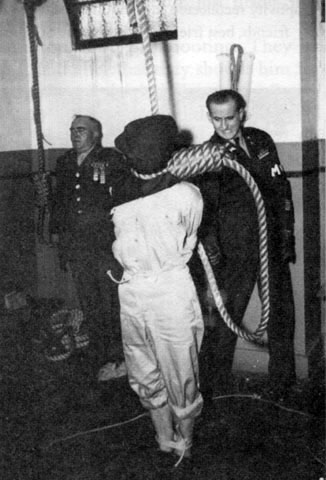
One day after William Joyce became the last Briton put to death for treason, 27-year-old Theodore Schurch hanged for treachery at London’s Pentonville Prison.
Like Joyce, Schurch had enrolled in the British Union of Fascists as a teenager in the 1930’s, and it was reputedly at the party’s direction that he joined the army as a driver.
During World War II, Schurch crossed and recrossed enemy lines, delivering operational intelligence to the Italians and Germans by helping to interrogate prisoners of war, or posing as a P.O.W. himself to gain the confidences of other captured Allied soldiers.
Scurch’s army buddies seemed to think he was alright, and there was probably more than a shred of truth to the defense’s contention, paraphrased by the London Times (September 18, 1945), that the lad
was a poor, uneducated fool who was caught young [by fascist ideology] when he knew no better and jockeyed into a position from which he could not recover.
But obviously, one makes this argument when one is in no position to contest factually the capital charges against oneself, and indeed has admitted much of it. Schurch was convicted on all nine counts of treachery, plus one of desertion. Not a big fish, maybe — but just the right size to become the last man hanged in Britain for a crime other than murder.
He’s actually listed as a war casualty, which in a way he was, on the Commonwealth War Graves Commission’s Brookwood Memorial outside of London.
On this date in 1946, fascist William Joyce, famous by the nickname “Lord Haw-Haw” for his English-language Nazi propaganda broadcasts, was hanged at Wandsworth Prison for treason.
As a pugilistic young anti-Semite with the unusual credential of being a Unionist Irish Catholic, Joyce had been a moving spirit in the interwar British fascist party. (Since audio broadcasts would define Joyce’s life, it seems appropriate to refer the reader for a fuller biography to this recent Oxford biography podcast.)
But because time loves a good laugh, it had the guy haranguing his countrymen for insufficient patriotism marked out for the last treason execution in British history, and unrepentant about it by the time he got there.
The Brooklyn-born Joyce (he never lost his American citizenship) who naturalized as a German in 1940 had a rather tenuous claim on the patriotic high horse to begin with, and after the war, that meant the treason charge proceeded on legally doubtful grounds: speaking the King’s English didn’t mean he owed allegiance to the king. Prosecutors ultimately hung him with a British passport he’d obtained fraudulently, and the legal principle has never since sat well with jurists.
However limited the resources at his disposal — sparse intelligence, paltry staff, and of course, after 1942, a disastrously collapsing war effort — he had fashioned them into broadcast spin to twist the British lion’s tail in countless British homes throughout the war.
Here’s one episode, with Joyce savaging Winston Churchill, selected from archive.org’s library of Joyce broadcasts (1-7, 8-16, 17-23).
[audio:William_Joyce_Churchill.mp3]
Joyce’s star shone brightest and his invective cut deepest early in the war. Once everything at the front stopped coming up Teutons, he descended into irrelevance and self-parody, albeit without professing the slightest doubt in his fascist convictions.
This last broadcast, prepared just a few days before Germany capitulated, has our day’s principal ramblingly drunkenly from the besieged Nazi capital.
[audio:William_Joyce_final_broadcast.mp3]
Content-wise, not much had changed eight months later, but at least he managed to make his gallows statement coherently.
In death as in life, I defy the Jews who caused this last war, and I defy the power of darkness which they represent. I warn the British people against the crushing imperialism of the Soviet Union. May Britain be great once again and the hour of the greatest danger in the West may the standard be raised from the dust, crowned with the words — you have conquered nevertheless. I am proud to die for my ideals and I am sorry for the sons of Britain who have died without knowing why.
There’s a thorough, and lavishly illustrated, history of Joyce here.
* Authorities passed on prosecuting his wife Margaret, who’d also appeared on some Lord Haw-Haw broadcasts. Under the circumstances, Joyce’s daughter (by his first marriage) Heather Iandolo turned out pretty balanced.
The state of Vermont has long since dispensed with the death penalty; it hasn’t had a death penalty law on the books since 1964, and its last execution was a decade before that. (Source)
But back when the traps were dropping on Green Mountain State scaffolds, no consideration of sentiment (or holiday pay) barred hanging a man on New Year’s Day, as occurred in 1892.
You could call Sylvester Bell a ladykiller.
According to family genealogists familiar with the case, the Canadian-born farmer used two of his wife’s relatives as character witnesses in his naturalization proceedings … and eight months later, shot said wife, the mother of his five children. Not only did Sylvester win acquittal for this non-fatal attack, Marcia Farnsworth Bell actually had to fight to get a divorce on the grounds of “intolerable severity”.
Marcia and her unmarried children moved to Randolph, Vt., where the kids opened a major department store.
Nothing daunted, a then-54-year-old Sylvester remarried the decades-younger Emma Lock (or Locke) in 1887.
‘Til death do us part: Sylvester and Emma’s marriage certificate.
We may imagine an ensuing union not altogether free of discord,* as we rejoin the public record of their lives with the Jan. 2, 1890 Burlington Clipper.
It appears that Mrs. Bell had left her husband and applied for a divorce. Thursday she, in company with Deputy Sheriff Hall, went to the house to remove her things. Bell met them very pleasantly and permitted her to pick up her goods. As she was about ready to leave she went up stairs and he followed her. Soon afterward a pistol shot was heard and Officer Hall rushed up, and Bell met him at the door of the room into which Mrs. Bell had gone and handed him the pistol, saying, “Take this. I have done the deed.” The ball entered the head of the unfortunate woman, just back of the ear, and she lived about thirty minutes, unconscious.
Bell was put under arrest and for a time the excitement, and sympathy was so strong for the murdered woman that it looked as if Bell would be lynched, but the law will now be allowed to take its course.
The article understatedly observed, “Bell’s reputation with his wives is bad.”
The course of the law will not hold much suspense for readers of this blog.
The novelty of the eventual New Year’s execution attracted the New York Times which (botching the hanged man’s name and the date of his crime) reported the scene from the scaffold, where “Stephen” Bell bought himself an extra 34 minutes in this vale of tears with the verbosity of his last statement.
WINDSOR, Vt., Jan. 1. — Stephen H. Bell was hanged here this afternoon for the murder of his wife, in the town of Fairfax, Dec. 26, 1880. At 1:40 the door of the west wing of the prison was closed and at 1:44 the prisoner was taken from his cell, where he was holding an earnest conversation with Chaplain Wassall.
The prisoner was somewhat pale from long confinement. He boldly ascended the steps and, although assisted, appeared to be nerved up for the occasion. Chaplain Wassall offered a fervent prayer, during which Bell bowed and covered his face with his hand. Sheriff Lovell, as soon as the Chaplain had finished, stepped forward and said: “Stephen H. Bell, have you anything to say why the penalty of the law should not be executed on you?”
Bell, rather pale and tremulous, stood erect, and after addressing the Sheriff and officers in charge, asking for all the time he wanted in which to speak, began a talk which lasted thirty-four minutes. It was a rambling statement, in which he declared his innocence. When he had finished, Bell stepped back to his chair.
Sheriff Lovell took him by the arm, and the condemned man stood up bravely. When Deputies How and Randall had pinioned his wrists, arms, and legs Bell stepped on the drop and said: “Gentlemen, I am a dying man; good-bye.” Instantly the Sheriff touched the spring and the drop fell. In fourteen minutes he was pronounced dead. The body was buried in Windsor Cemetery.
Bell’s descendants continue to seek information on Sylvester; anyone who may know more can get in contact via this author.
* Another report of the murder describes Emma fleeing to live with her parents on account of Sylvester’s repeatedly menacing her with a butcher knife and a gun, until the “overseer of the poor, after a time succeeded in getting them together again, he giving up his pistol and agreeing to behave himself.” Clearly, it was a different time for domestic violence victims.
On the last day of the 19th century, a Chinese officer was beheaded on the public street where he had precipitated western* military intervention in the Boxer Rebellion by killing a German diplomat.
In addition to massacring hated missionaries, the Boxers besieged foreign diplomatic missions in Peking … and veteran German ambassador Klemens von Ketteler was killed in a firefight on a crowded street. (The particular circumstances of the killing seem highly confused, and were immediately colored by the various interested parties’ axe-grinding; it’s sometimes called an “assassination,” but there’s no proof von Ketteler was specifically targeted, and the ambassador himself managed to get a shot off in the fray.)
Given the financial interests at stake, it would be far too much to say that von Ketteler’s death caused the military intervention that ensued, but it certainly catalyzed the conflict. The next day, China’s Dowager Empress declared war against the Eight-Nation Alliance. Within two months, Peking (Beijing) was under foreign occupation.
The man detained as von Ketteler’s murderer — En Hai, or Enhai, or Su-Hai — was proud to claim the act himself, and intimations of the Chinese government’s official blessing for anti-foreigner activities were carefully massaged since the Eight-Nation powers would have need of the Qing dynasty to keep order locally.
On the afternoon of this day in 1900, En Hai was brought out from German custody to the street where von Ketteler had met his end and handed over to the Chinese for beheading. Notice the substantial foreign attendance in both the photograph and the drawing. A German officer’s diary entry cited in The Origins of the Boxer War: A Multinational Study recounted the scene.
Ketteler’s murderer was executed at last — for months past the unfortunate wretch has been begging for his execution. It took place in one of the busiest thoroughfares but there were only a few curious onlookers. Scarcely fifty yards away the usual business was being quietly transacted in the streets, people who were eating did not suffer themselves to be interrupted, and a teller of fairy-tales who was recounting his absurd stories had interested his numerous audience much more than the execution.
And to see that the lesson would not be lost on future generations of Chinese, the humiliating peace imposed upon China that December (and formally signed the following year) required China to expiate its guilt by
erect[ing] on the spot of the assassination of his Excellency the late Baron von Ketteler, commemorative monument worthy of the rank of the deceased, and bearing an inscription in the Latin, German, and Chinese languages which shall express the regrets of His Majesty the Emperor of China for the murder committed
Having been made an offer it couldn’t refuse, China honored the intersection (German link) where both the victim and his killer had died in their turns with a massive pailou archway, inscribed
This monument has been erected by order of His Majesty the Emperor of China for the Imperial German Minister Baron von Ketteler, who fell on this spot by heinous murder on the 20th of June, 1900, in everlasting commemoration of his name, as an eternal token of the Emperor’s wrath about this crime, as a warning to all.
“Everlasting commemoration,” in this case, lasted 15 years.
The national aspirations that had fired the Boxers reared up again in 1911-12 to topple the Qing. Days after Germany’s surrender in World War I, the Chinese Republic began removing the von Ketteler monument.
Visitors will need to look sharp to catch it now, in Zhongshan Park (aka Sun Yat-Sen Park or Central Park), where it has been rededicated to abstractions that age a little better than our German civil servant.
But this was still not quite the last the name von Ketteler was heard in the consular world. A relative (German link) of the man slain in Peking was a conservative diplomat of the Weimar and early Nazi period who opposed the national socialist government. Wilhelm Emmanuel von Ketteler was abducted by the Gestapo in 1938 and murdered thereafter in unclear circumstances, possibly for involvement in a very early plot to kill Hitler.
* “Western” in this case includes Japan, the regional industrial power that also flanked the Russian Empire to the east — very much a player on the European balance-of-power chessboard. Germany (obviously), France, Italy, Russia, the U.K., and the U.S.A. were the other nations involved in the intervention, along with the Austro-Hungarian Empire, whose naval deployment to China included future Sound of Music character Georg Ritter von Trapp.
A fair amount of detail on China’s foreign relations during this period is available free in the (dry, and sometimes dated) public-domain 1918 work The International Relations of the Chinese Empire.
On this date in 1903, a 42-year-old mother of 11 was hanged side by side with her 30-year-old lover for murdering an abusive husband in the small South Yorkshire town of Wombwell.
That June, Emily Swann had shown her outgoing boarder and lover John Gallagher (together with some neighbors) the results of William Swann’s latest beating. John returned to the house and repaid the injuries in kind — and with interest.
After some minutes of fighting audible to the neighbors, Bill had been beaten to death.
Emily’s battered-wife situation might cut a lot more ice today, but by the jurisprudence of the day it was a fairly straightforward case, especially since all kinds of incriminating remarks were attributed by the neighbors to both Emily and John — “Give it to him, Johnnie, punch him to death,” for instance, and Gallagher’s own mid-bout respite at a neighbor’s house where he reported having broken four ribs with plans to break more. Both illustrated a level of intent among both parties beyond the heat of passion.
And you wouldn’t say the authorities were disposed to sympathize with Emily’s situation in general. They rather viewed her immorality — with John and otherwise — as the cause of the thrashings William gave her.
the wonder is that he has not killed her. He has frequently gone home after leaving work and found his wife drunk in the house and nothing prepared for him in the way of food. (case file comment, quoted here)
Fortified by a stiff drink of brandy, Emily Swann glided onto the platform at Leeds’ Armley Prison beside her already-trussed defender and delivered the somewhat famous greeting, “Good morning John.” Gallagher managed to return the salutation, and a few seconds before both were launched into eternity, she replied, “Good-bye. God bless you.”
It was an unusual exchange because the English execution protocol did not solicit remarks from the doomed prisoner, and in the occasional double hangings,* most participants were too frightened, awed or preoccupied to make small talk with their fellow-sufferers in the few seconds available.
* England would soon do away with double hangings altogether. Subsequent convicts to be hanged “together,” like Edith Thompson and Frederick Bywaters, were in fact executed simultaneously but at different prisons.
On this date in 1894, Sioux Chief Cha Nopa Uhah (“Two Sticks”) was hanged in Deadwood, S.D., for instigating the murder of white ranchers on the Pine Ridge Reservation.
The story begins little more than two years after one of the most tragic and emblematic events in the white conquest of North America — Wounded Knee:
By early 1893, the “Ghost Dance” religious movement that had animated the Lakota people had not disappeared … nor had the futile dream of armed resistance to white domination.
A band under Chief Two Sticks, a leader described as resistant to settled white civilization and inclined towards retaining the traditional nomadic life, raided a white cattle ranch. The raid was not deadly, but its consequences were.
Indian police dispatched to arrest the raiders were killed in a shootout, after which the raiders again attacked the ranch — looking this time for men, not cattle. Four white cowboys were killed.
A number of additional Indians died when tribal authorities deployed in force to stop Two Sticks’ followers, perhaps narrowly averting much worse — as it’s a given that federal authorities would not have countenanced Two Sticks’ continued liberty.
The chief himself was severely wounded in the process, and only after a lengthy recovery was he well enough to stand trial in the white men’s courts in Deadwood.
His last words, according to an impressive HistoryNet retelling of Chief Two Sticks’ tale with a great deal of detail about his last hours (including an attempted suicide, so that he could die by Indian hands), denied responsibility for the violence.
My heart is not bad. I did not kill the cowboys; the Indian boys [meaning White Faced Horse, Fights With, Two Two and First Eagle] killed them. I have killed many Indians, but never killed a white man; I never pulled a gun on a white man. The great father* and the men under him should talk to me and I would show them I am innocent. The white men are going to kill me for something I haven’t done. I am a great chief myself. I have always been a friend of the white man. The white men will find out sometime that I am innocent and then they will be sorry they killed me. The great father will be sorry, too, and he will be ashamed. My people will be ashamed, too. My heart is straight and I like everybody. God made all hearts the same. My heart is the same as the white man’s. If I had not been innocent I would not have come up here so good when they wanted me. They know I am innocent or they would not let me go around here. My heart knows I am not guilty and I am happy. I am not afraid to die. I was taught that if I raised my hands to God and told a lie that God would kill me that day. I never told a lie in my life.
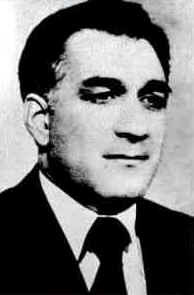
On this date in 1979, the 104-day term of Afghan president Hafizullah Amin met a violent end as a Soviet-engineered coup raised the curtain on a war destined to bring misery to both Cold War combatants.
The Soviet Union’s ongoing intervention in Afghan politics had through the 1970’s steadily mired it deeper into an unstable political situation.
Now, it was running out of patience with the country’s president, Hafizullah Amin.
He’d got the best of rival Nur Mohammad Taraki in a power struggle that September, but to the political chaos and the blossoming Islamic insurgency roiling his country, Amin added a level of brutality that was all his own, and a streak of diplomatic independence that was distinctly unwelcome in Moscow.
Amin was a Communist himself, and both he and the predecessor he’d murdered had wanted ever-increasing Soviet aid to keep the country stable.
Though Kabul radio would announce that Amin had been tried and summarily executed for “crimes against the state,” the short-lived dictator’s fate had been decided two weeks before when the Soviet Politburo passed a secret resolution for his ouster — having lost whatever confidence it had once held in him as a dependable satellite governor.
has seemed deeply troubled by the inability of either the Taraki or Amin governments to put down the rebellions in Afghanistan, which have been largely tribal but also militantly anti-Communist.
Amin survived a KGB poisoning, so the Red Army dispensed with subtlety by raiding the palace, plucking their preferred satrap out of exile in eastern Europe to take Amin’s place.
It would not see the last of Afghanistan until 10 years, 15,000 Soviet dead, and hundreds of thousands of Afghan casualties later.
A memorial in Ekaterinburg, Russia, to the Soviet dead in the Afghan war. Image courtesy of beatdrifter (Andy Holmes).
Two years ago today, Japan resumed executions after a break of more than a year with four hangings.
Septuagenarians Yoshio Fujinami (wheelchair-bound) and Yoshimitsu Akiyama (partially blind) both needed the guards’ assistance to reach the trap at Tokyo Detention Center, a mere hour after they were informed of their imminent demise.
Two other prisoners, 64-year-old Michio Fukuoka and 44-year-old Hiroaki Hidaka, were simultaneously hanged in Osaka and Hiroshima, respectively.
Hidaka, a serial killer, had dropped his appeals and thus died a mere 12 years after his crimes. Fukouka died maintaining his innocence of three murders from 1978-81 he said police torture had forced him to confess. The oldest men were on the hook for killings dating to 1975 and 1981. (Much more from The Japan Times.)
Talk about justice delayed.
In Japan’s strange death penalty system, the condemned might await death for decades only to be hanged, as these were, with next to no warning. Their families and supporters did not hear about it until after the deed was done.
These hangings, though protested, were not altogether unexpected, for a break in the Japanese Diet around the end of the year often heralds an appearance on the public stage by the gallows. (Look for them in 2008 as the Diet goes out of session starting today.) And a turnover at the top of the Justice Ministry had replaced a pol disinclined to authorize any hangings, the source of the long break between executions during a decade when Japan’s use of the death penalty has generally been intensifying.
Although at least one particularly pressing motivation for this date’s hanging will not be present this year. After the long hiatus, an anonymous official told a newspaper,
We absolutely wanted to avoid ending the year with zero executions.
Because we executioners are not bereft of sentiment, it is with glad season’s tidings that we remember the veritable rebirth on Christmas Eve of housebreaker John Smith, who was cut down from the Tyburn tree this day in 1705 and revived.
“Though the crimes committed by this man were not marked with particular atrocity, nor his life sufficiently remarkable for a place in these volumes, yet the circumstances attending his fate at the place of execution are perhaps more singular than any we may have to record,” begins the Newgate Calendar, and one can all but see our Marlow setting light to his tobacco as he makes ready to unspool a particularly satisfying yarn.
After John Smith dangled 15 minutes this day at Tyburn, the crowd at his hanging began calling for a reprieve. One gets the impression our narrator may be eliding in a sentence quite an unruly affair; that “the malefactor was cut down” we may well guess, but after a mere 15 minutes? Did the crowd overpower the sentries, or were the officers of the law simply in a Christmas spirit?
There is, too, allusion to his friends’ working to obtain clemency and failing. Family and supporters of the accused intervened at Tyburn in all sorts of meddlesome ways, when they could — pulling the condemned prisoner’s legs to shorten his suffering, or holding his legs up to give him a chance at survival; fighting with anatomists for possession of the corpse, and obviously agitating for mercy at the slightest opportunity. Was it these friends who instigated the crowd’s appeal?
Whether or not Smith’s luck was as dumb as William Duell‘s, they did cut him down, and did revive him “in consequence of bleeding and other proper applications.”
So, what’s it like to be hanged?
When he had perfectly recovered his senses he was asked what were his feelings at the time of execution; to which he repeatedly replied, in substance, as follows. When he was turned off, he for some time was sensible of very great pain, occasioned by the weight of his body, and felt his spirits in a strange commotion, violently pressing upwards. That having forced their way to his head, he as it were saw a great blaze, or glaring light, which seemed to go out at his eyes with a flash, and then he lost all sense of pain. That after he was cut down, and began to come to himself, the blood and spirits, forcing themselves into their former channels, put him, by a sort of pricking or shooting, to such intolerable pain that he could have wished those hanged who had cut him down.
All this violent commotion of the spirit was enough to score a pardon, but not quite equal to the task of reforming the man now known as “Half-Hanged Smith”.
Our narrator relates that he went twice more to the Old Bailey in some danger of his neck, escaping once on a technicality and then again upon the uncommonly timely death of the prosecutor.
Nothing more is henceforth heard of the man, and it is unknown whether he decided to stop tempting fate, or whether officers of the law were in no further mood to tempt the hand of a Providence evidently determined to protect him, or whether some still more mysterious purpose thereafter summoned him away from the worldly cares of the justices.
And laying his finger aside of his nose,
And giving a nod, up the chimney he rose;
He sprang to his sleigh, to his team gave a whistle,
And away they all flew like the down of a thistle.
But I heard him exclaim, ere he drove out of sight,
“Happy Christmas to all, and to all a good-night.”
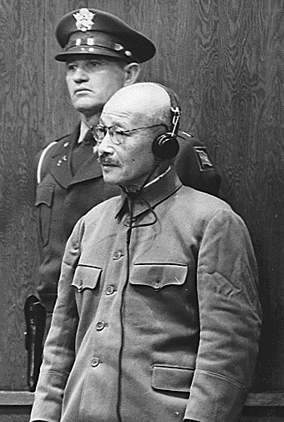
On this date in 1948, seven “Class A” war criminals, including Japan’s wartime Prime Minister Hideki Tojo, were hanged at Sugamo Prison by the American occupation authorities.
Like other Axis heads of state, Tojo was in for a bad end: he shot himself in the chest before American troops could arrest him, but missed his heart even though a doctor had helpfully marked the spot on his chest for him.
Fail.
However inevitable Tojo’s postwar fate, however, he was not exactly of a kind with the likes of Hitler and Mussolini. Indeed, he’d been cashiered from his Prime Ministerial gig in 1944 by the real power behind the throne — the Japanese military.
Unlike the “Fuhrer” and “Il Duce,” Tojo was a reflector, not a creator, of national thought. His word was not law. It was not his command or dictate. He was one among many and not even the first among equals. He was a militarist — misguided, naive, and narrow in outlook; he regarded war as a legitimate instrument of national policy; he apparently believed what he told the court, and failed to recognize the patent contradictions between his contentions and the facts. This had been his undoing.
That’s Robert Butow in Tojo and the Coming of War. Butow argues that the titular authority in Japan (he became Prime Minister shortly before the bombing of Pearl Harbor), a dedicated, patriotic officer of adequate talents but limited vision, came much too late and controlled much too little to be seen as the equal of the European theater’s villains.
The Japan of which General Hideki Tojo became premier was operated by remote control. It was a country in which puppet politics had reached a high state of development, to the detriment of the national welfare. The ranking members of the military services were the robots of their subordinates — the so-called chuken shoko, the nucleus group, which was active “at the center” and which was composed largely of field-grade officers. They, in turn, were influenced by younger elements within the services at large and by ultranationalists outside military ranks. The civilian members of the cabinet were the robots of the military — especially of the nucleus group, working through the service ministers and the chiefs of the army and navy general staffs. The Emperor himself, through no fault of his own, was the robot of the government — of the cabinet and the supreme command, a prisoner of the circumstances into which he was born … Finally, the nation — the one hundred million dedicated souls, the sum and substance of Japan, from whom the blood and toil and tears and sweat of Churchill’s phrase were wrung — the nation was the robot of the throne.
He was the man for his time and place. He fit right in.
The former premier embraced responsibility, diligently shielding the Emperor from any intimation of guilt (some argue this was the procedure’s entire raison d’etre, from the perspective of both the prosecution and the defense), and walked a dignified and honorable last mile in the courtrooms of the victor’s justice, presenting his perspective as he knew it in the context of a wish for peace between the late antagonists.
1. I deny that Japan “declared war on civilization.”
2. To advocate a New Order was to seek freedom and respect for peoples without prejudice, and to seek a stable basis for the existence all peoples, equally, and free of threats. Thus, it was to seek true civilization and true justice for all the peoples of the world, and to view this as the destruction of personal freedom and respect is to be assailed by the hatred and emotion of war, and to make hasty judgments.
3. I would like to point out their [my accusers’] inhumane and uncivilized actions in East Asia ever since the Middle Ages.
4. In the shadow of the prosperity of Europe and America, the colored peoples of East Asia and Africa have been sacrificed and forced into a state of semi-colonization. I would point out that the cultural advance of these people has been suppressed in the past and continues to be suppressed in the present by policies designed to keep them in ignorance.
5. I would point out that Japan’s proposal at the Versailles Peace Conference on the principle of racial equality was rejected by delegates such as those from Britain and the United States.
6. Of two through five above, which is civilization? Which is international justice? Justice has nothing to do with victor nations and vanquished nations, but must be a moral standard that all the world’s peoples can agree to. To seek this and to achieve it — that is true civilization.
7. In order to understand this, all nations must hate war, forsake emotion, reflect upon their pasts, and think calmly.
The “Class A” convicts not executed along with Tojo were freed afterwards.
Tojo has enjoyed a bit of a latter-day resurgence in the public regard, product of the nationalist right’s resurgence in Japan. The hanged man’s granddaughter Yuko Tojo has waged a tireless campaign to clear him.
Further to that end, his ashes — and those of the other Class A convicts — were covertly added to the controversial Yasukuni Shrine, and remain there to this day. That public tribute to principals of Japan’s bloody foreign occupations has become a hot political football between Japan and other nations, especially China.
Japan … faced considerable military threats as well.
Japan attempted to circumvent these dangerous circumstances by diplomatic negotiation, and though Japan heaped concession upon concession, in the hope of finding a solution through mutual compromise, there was no progress because the United States would not retreat from its original position. …
Since events had progressed as they had, it became clear that to continue in this manner was to lead the nation to disaster. With options thus foreclosed, in order to protect and defend the nation and clear the obstacles that stood in its path, a decisive appeal to arms was made.
* According to John Dower’s Embracing Defeat, the suicide scenario angered some nationalists because Tojo only “belatedly summoned the will to die,” and “chose the foreigner’s way of the bullet rather than the samurai’s way of the sword, and then botched even this.”


 Now, it was running out of patience with the country’s president,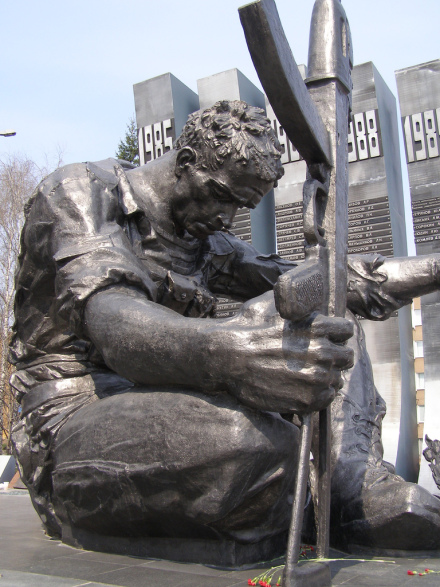


 However inevitable Tojo’s postwar fate, however, he was not exactly of a kind with the likes of Hitler and Mussolini. Indeed, he’d been cashiered from his Prime Ministerial gig in 1944 by the real power behind the throne — the Japanese military.