1962: James Hanratty, the killer all along

Fifty years ago today, still insisting that he had “a clean conscience,” James Hanratty was hanged at Bedford Prison for the murder of Michael Gregsten and the rape-shooting of his mistress Valerie Storie.

Hanratty, a petty criminal with no history of violence — “I try to live a respectable life, except for my housebreaking” he testified* — fell into a web of questionable circumstantial evidence, plus the (also questionable**) eyewitness identification of the surviving Ms. Storie.

It was called the “A6 murder” because a stickup man had forced the lovers at gunpoint to drive him along that road, until pulling them over at the aptly-named Deadman’s Hill where he did the vicious deeds and left his victims for dead.

This was a bizarre and shocking crime, and the investigation led back to Hanratty only via a winding, almost accidental trail.

The murder weapon materialized on a bus, wiped clean of fingerprints; later, cartridges to match it materialized at a boarding house, and a confused reconstruction of whose aliases were occupying which rooms there uncertainly suggested Hanratty as a suspect.

The case, checking in at a then-record 21 trial days, featured 70 witnesses battling over inconclusive data points like the doubtful relationship between autobiographical remarks made by the killer and Hanratty’s actual biography, and Hanratty’s want of an apparent motive for an act so foreign to his previous m.o. On the other hand, some witnesses put him in incriminating places, and Hanratty damningly lied about and changed his alibi.

What to do? A jury mired in hours of inconclusive deliberation at one point sent back to the court to clarify the concept of “reasonable doubt.” In the end, it decided its doubts weren’t reasonable enough to spare James Hanratty the noose.

Meanwhile, another suspect from the same boarding-house, Peter Alphon, behaved extremely erratically in the run-up to Hanratty’s hanging, hounded Hanratty’s friend until the latter committed suicide, and then eventually (after the hanging) confessed outright. For Hanratty’s many advocates, Alphon looked an awful lot like reasonable doubt … or more.

This case was long a cause celebre for death penalty foes in the U.K. owing to its evidentiary shakiness; none of the other seven put to death in Great Britain after Hanratty were plausible innocents.


John Lennon and Yoko Ono commiserate with James Hanratty’s parents in 1969. (Photo by Express/Express/Getty Images, via here.)

In 2000, DNA tests conducted on Valerie Storie’s underwear and the handkerchief which wrapped the recovered gun finally offered the prospect of more certain forensic identification than had been available at the time of the trial. Those tests matched (pdf) James Hanratty’s DNA … and nobody else’s.

While this result has not resolved all controversy about the A6 murder case — witness this book-length forum discussion — nor ended the Hanratty family’s campaign for exoneration, it’s pretty well cut the legs from Hanratty’s actual-innocence argument. Whatever one can say about the original trial, it sure looks like Hanratty was the killer all along.

A few books about James Hanratty and the A6 case

* Feb. 8, 1962 testimony, as reported in the next day’s London Times.

** Aside from the inherent unreliability eyewitness testimony, Valerie Storie at one point picked an airman stand-in in a lineup; when she later identified Hanratty, it was not by his appearance but by his cockney accent.

On this day..

1098: Rainald Porchet, martyr Crusader

On this date in 1098, Antioch’s besieged Muslim defenders martyred a Crusader knight who refused to secure a ransom for himself.

The armies of the First Crusade had pressed their way through Anatolia and had laid to siege these past five months the ancient Syrian city of Antioch. (It’s in modern Turkey now, where it’s known as Antakya.)

On April 3, 1098, by the account of the priest Peter Tudebode, an eyewitness to the event,

the Turks led to the top of an Antiochian wall a noble knight, Rainald Porchet [alternatively, Rainaud or Reynaud Porquet], whom they had imprisoned in a foul dungeon. They then told him that he should inquire from the Christian pilgrims how much they would pay for his ransom before he lost his head.

According to Encounter Between Enemies: Captivity and Ransom in the Latin Kingdom of Jerusalem — a source which ought to know, if any would — marching a guy out to appeal to his comrades was little to the Antiochians but the time-honored practice of ransoming captured VIPs, “the usual diplomatic method of starting a peaceful encounter with the enemy, in the between-fighting interlude.” It’s not like this sort of hostage-hocking was unknown to Europeans; even hundreds of years later, France cratered its economy by ransoming its captured king from the English.

To the shock of the garrison, Porchet went all clash-of-civilizations on this routine diplomacy.

From the heights of the wall Rainald addressed the leaders: “My lords, it matters not if I die, and I pray you, my brothers, that you pay no ransom for me. But be certain in the faith of Christ and the Holy Sepulchre that God is with you and shall be forever. You have slain all the leaders and the bravest men of Antioch; namely, twelve emirs and fifteen thousand noblemen, and no one remains to give battle with you or to defend the city.”

The Turks asked what Rainald had said. The interpreter replied: “Nothing good concerning you was said.”

The emir, Yaghi Siyan, immediately ordered him to descend from the wall and spoke to him through an interpreter: “Rainald, do you wish to enjoy life honorably with us?”

Rainald replied: “How can I live honorably with you without sinning?”

The emir answered: “Deny your God, whom you worship and believe, and accept Mohammed and our other gods. If you do so we shall give to you all that you desire such as gold, horses, mules, and many other worldly goods which you wish, as well as wives and inheritances; and we shall enrich you with great lands.”

Yaghi Siyan was obliged to make this proposition of apostasy to his prisoner as a prelude to executing him.

Rainald replied to the emir: “Give me time for consideration;” and the emir gladly agreed. Rainald with clasped hands knelt in prayer to the east; humbly he asked God that He come to his aid and transport with dignity his soul to the bosom of Abraham.

When the emir saw Rainald in prayer, he called his interpreter and said to him: “What was Rainald’s answer?”

The interpreter then said: “He completely denies your god. He also refuses your worldly goods and your gods.”

After hearing this report, the emir was extremely irritated and ordered the immediate beheading of Rainald, and so the Turks with great pleasure chopped off his head: Swiftly the angels, joyfully singing the Psalms of David, bore his soul and lifted it before the sight of God for Whose love he had undergone martyrdom.

Rainald got himself a starring role in the Chanson d’Antioche, an epic poem celebrating the Crusade, for this pious self-sacrifice. We can only presume that his name- and numberless compatriots in the dungeons, who also paid the price for Rainald’s obstinacy, were satisfied with suffering the same fate but only getting a role in the chorus.

Then the emir, in a towering rage because he could not make Rainald turn apostate, at once ordered all the pilgrims in Antioch to be brought before him with their hands bound bend their backs. When they had come before him; he ordered them stripped stark naked, and as they stood in the nude he commanded that they be bound with ropes in a circle. He then had chaff, firewood, and hay piled around them, and finally as enemies of God he ordered them put to the torch.

The Christians, those knights of Christ, shrieked and screamed so that their voices resounded in heaven to God for whose love their flesh and bones were cremated; and so they all entered martyrdom on this day wearing in heaven their white stoles before the Lord, for Whom they had so loyally suffered in the reign of our Lord Jesus Christ, to Whom is the honor and glory now and throughout eternity. Amen.

In these heady early months of the Crusades, when the enterprise stumbled from near-disaster to miraculous success, the renown of Porchet et al was clinched by the siege’s success in early June — just days ahead of the arrival of a Turkish relief force which thereafter had to content itself with besieging the now-Crusader-held city.

When this second siege was repelled with the help of the Christians’ convenient — staged, one might think — “discovery” of the Holy Lance of Antioch, everyone had to know that the Big Guy was truly on their side.

On this day..

1674: Benjamin Gourd, the last bestiality execution

On this date in 1674, Benjamin Gourd (or Goad) was hanged for bestiality in Puritan Massachusetts.

Six New England colonists (pdf) had died for bestiality up through 1662, but the sentence was falling out of fashion.

Gourd, caught having his way with a mare “at noon day in an open yard” and within sight of the gallows, has the distinction of being the last colonist of the future United States put to death for fauna-philia. And even the jury that sentenced him was noticeably reluctant about dooming the 17-year-old.

Well, preacher Samuel Danforth wasn’t going to have any of this ungodly backsliding on Gourd’s ungodly backsliding.

Danforth’s The Cry of Sodom Enquired Into; Upon Occasion of the Arraignment and Condemnation of Benjamin Goad, for His Prodigious Villany (that’s a pdf of the full spiel; here’s a Cliff Notes version) is regarded as the first published “execution sermon” in American history.

the Earth groans under the burthen of such Wickedness. You pity his Youth and tender years, but I pray pity the holy Law of God, which is shamefully violated; pity the glorious Name of God, which is horribly profaned; pity the Land, which is fearfully polluted and defiled.

We think Corey Robin will recognize Danforth’s indictment of the youth’s “licentious liberty” obtained in defiance of an unnamed Master as the root of all his ruin, and any American with an AM radio dial will recognize the rest.

Being at length, by the good hand of God, brought under the Yoke of Government and Service, (which might have bridled and restrained him from such wickedness) he violently brake away from his Master, and with an high hand boldly and impudently, like a childe of Belial, shook off that Yoke of God, casting reproach and disgrace upon his Master. Having now obtained a licentious liberty, he grew so impudent in his wickedness, as to commit this horrid Villany in the sight of the Sun, and in the open field, even at Noon-day; proclaiming his sin like Sodom. Though he be a Youth in respect of years, yet he is grown old in wickedness, and ripe for Vengeance.

On this day..

1872: William Frederick Horry, Marwood’s first

If Pa killed Ma, who’d kill Pa?

Marwood.

Victorian riddle/pun

On this date in 1872, the landmark hanging career of William Marwood commenced — when, having persuaded the authorities at Lincoln Castle Gaol, he executed his very first subject.

The man of the milestone was William Frederick Horry, a Boston native — not Boston, Massachusetts, but the Lincolnshire port that was its namesake.

“Fred” wed Jane and the two ran The George Hotel in Burslem together.

Until Fred’s drunken, possessive outbursts led Jane to flee the house. Let it be said that a partnership in the hospitality industry might not be the ideal choice for your controlling type.

Jane and the couple’s three children actually took refuge with Fred’s own kin, the husband’s father barring his own son from the home. Horry got around that by showing up with a revolver and shooting her dead in an act of coldly calculated passion: he immediately handed the gun to his stunned brother and stayed to await arrest, saying, “You have no notion, Tom, how I loved that woman, but I could not stand the jealousy.” Nor did he show any interest in appealing for clemency; he hanged within days of his conviction.

If this reads to modern eyes like the unedifying passion play of an abusive, loutish spouse, many in Burslem were ready to consider Fred Horry “a martyr, more sinned against than sinning.” (The funeral oration of a rector!) Three thousand people lined the streets to respectfully see Horry’s coffin to its rest; even the requisite crime broadsheet concurred in the apparent public judgment about Jane’s culpably easy virtue.

Now all you who give way to jealous passion,
And the crimes which it entails,
I hope that you will learn a lesson,
From my sad and mournful tale.
Their married life has ended early,
For his wife he says his temper tried
But for them now it is all ended,
For her faults she bled and died.

Supporters erected a monolith in his honor, an unusual tribute for a wife-murderer.


The man tasked to mete out the lesson for Horry’s jealous passion was, heretofore, a Horncastle cobbler.

Already into his fifties by this time, William Marwood was strictly self-educated in the science of hanging … but it is he who would bring the exacting mechanical arts to the hangman’s ancient craft.

(Actually, Marwood was fond of distinguishing himself from the mere hangman. “Calcraft hanged them,” he said of his notoriously slipshod predecessor’s operations. “I execute them.” He went so far as to assert his professionalism with business cards.)

To make this famous mark in the annals of capital punishment, Marwood the cobbler first had to talk his way into the Horry job. This was surely facilitated by the fact that the most recent execution at Lincoln Castle, that of Priscilla Biggadike or Biggadyke, had been a bit of a botch, with one of the realm’s forgettable barely-competent hangmen clumsily fitting the noose to the front of the convict’s throat on the supposition that this would snap her neck. Instead, she strangled.

Marwood’s arrival spelled the quick end to folklore and guesswork on the scaffold; his was the rational hand of industrial Britain finally touching the ancient hanging ritual.

For most of English history, the hanging had entailed simply shoving the unfortunate subject off a ladder or a cart, leaving them to gradually choke to death at the end of the noose. This protracted process was sometimes associated with unruly public scenes, and with “executed” criminals surviving (and even intentionally calculating to survive) the hanging. “Such as have but a very superficial Notion of Anotomy, may easily conceive how a Person very soon cut down may shew even strong Signs of Life,” the Ordinary of Newgate had passingly remarked in 1736, as if it really were no big deal.

Of course, it had long been understood that adding a little plummet could generate the force necessary to break the neck, to the advantage of both speed and certainty. Guy Fawkes is supposed to have exploited the carelessness of a Stuart executioner to hurl himself off the ladder when they were just setting up for the non-fatal hanging portion of his “hanged, drawn, and quartered” sentence — and thereby cleverly offed himself before they could do the agonizing Braveheart bits to his living body.

Small drops came into use with the move towards hanging platforms late in the 18th century, and by the mid-19th century larger drops of some kind were standard operating procedure: witness the description of the setup for the country’s first private hanging a few years before our date.

But the length and the nature of the drop remained very much within individual hangmen’s ad hoc discretion. The science of dropping would only arrive in the 1860s and 1870s. Until then, execution bulletins reporting that the unhappy soul “died hard” denoted the frequent occasions when death was effected via agonizing minutes of choking spasms. Even in the London Times‘ Dec. 22, 1875 report on one such man who “died hard” noted that “in the memory of Mr. John Rowland Gibson, the prison surgeon, extending, in that capacity, over more than 40 years, there are only two instances on record in Newgate of the neck of a convict having been dislocated during execution.”

Aiming to remedy that substandard record, the Irish doctor Samuel Haughton in 1866 published a landmark paper, “On hanging considered from a Mechanical and Physiological point of view” (read it here), in which he noted that whereas a short-dropped prisoner’s death by apoplexy or asphyxiation is “preceded by convulsions, lasting from five to forty-five minutes,” a broken neck “is instantaneous and painless, and is unaccompanied by any convulsive movement whatever.”

“It seems to me unworthy of the present state of science,” Haughton continued, “to continue a mode of execution which, as at present used, is extremely clumsy and also painful to the criminal.”

In a mass of equations abstractly working out foot-pounds’ shock expended on the neck and which vertebrae constituted the superior articulating surface, Haughton proceeded to suggest a protocol (adapted from the American drop method) “to give hanging all the rapidity of death by the guillotine without the painful spectacle of bloodshed.”

Haughton was just a theorist. Marwood actually put those concepts into practice.

Marwood is presumed to have been influenced by Haughton’s studies; although the basis for that renowned hangmanexecutioner‘s calculations is not known, Marwood is distinguished as the creator of the “long drop” hanging method — giving variable 4- to 10-foot falls to his subjects based on their body weight, with the knot stationed under the left jawline.

He was able to do all that because this first hanging of William Horry went off without a hitch. Still, as a nonentity at first, Marwood had to continue to hustle his hanging assignments — as with this solicitous handwritten 1873 pitch (page 1, page 2) to work an upcoming death date.

But Marwood’s clean long drops — he was the only executioner using the technique — soon secured him appointment as state executioner and the official London and Middlesex hangman. Over an 11-year career from 1872 to 1883, Marwood put 178 humans to death, the bulk of British executions during that period.

Marwood’s legacy — not his direct creation, since it was formalized in the years following his death — was the bureaucratic standardization of the hanging in the form of “drop tables” defining the length of rope to use relative to the weight of the executed prisoner to guarantee the death penalty would be implemented “in a becoming manner without risk of failure or miscarriage in any respect.”

On this day..

1312: Pierre Vigier de la Rouselle, Gascon

“It is unjust that that which is rightly judged should result in prejudice to us and bring damage to others …”

-Edward II, letter concerning the Pierre Vigier case

One is like to reckon the phenomenon of the interminable death penalty appeal a modern construct, product of the present day’s moral confusion or juridical inefficiency.

It’s been right about 700 years exactly since Pierre Vigier was hanged in the February-April neighborhood, in the year of our Lord 1312, for his impolitic sentiments on the governance of his native province. This medieval execution went with a very modern-sounding 12 years of indeteminate appeals.

Still, it is true what they say — “The past is a foreign country: they do things differently there.” In this foreign country, Gascony by name, they did the hanging first … and then did the appeals.

Our source here (virtually the only source short of plumbing the archives) is Joseph Kicklighter’s “English Bordeaux in conflict: the execution of Pierre Vigier de la Rousselle and its aftermath, 1312-24” from the Journal of Medieval History, no. 9 (1983).

And the source of all the judicial chaos was the bizarre situation of one king as a rival king’s vassal.

Gascony at this time was a sort of feudal leftover of the Angevin Empire whose Plantagenet descendants were still kings of England. This remaining Plantagenet patrimony* in southwestern France was a going source of conflict between the realms, the most recent of which had been expediently settled by making the English king also Duke of Gascony … and (with respect to Gascony) the French king his liege lord.


Seated French king Philip IV accepts the homage of his “vassal” Edward I.

The territory was worth the “submission”: ducal Gascony’s fertile land gave England a bounty in crops and wine. And the inevitable rivalry over sway in Gascony easily knocked on to the courts. As Barbara Tuchman put it in A Distant Mirror,

[t]he King of France still retained superior sovereignty under the formula of superioritas et resortum, which gave the inhabitants the right of appeal to the ultimate sovereign. Since his decisions were more than likely to go in their favor against their English overlord, and since the citizens, knowing this, exercised the right frequently, the situation was an endless source of conflict.

It was during such a conflict, when the rival factions of the Gascon capital of Bordeaux had the city in virtual anarchy as they jockeyed for power under the nominal lordship of English king Edward II, that the onetime royal castellan Pierre Vigier de la Rouselle apparently dumped on one of the new officials in conversation with a couple of informants.

The municipal government arrested Vigier and had him hanged — quickly, before Vigier’s inevitable attempted appeal to Parlement could save him.

(This all went down just a couple months before Edward II suffered a Gascon humiliation closer to home, when the Gascon nobleman Piers Gaveston, Edward’s dear friend and suspected lover, was executed by rival English lords.)**

Vigier’s aggrieved sons did pursue the appeal (it is they who provide posterity the circumstances of Pierre’s condemnation, so handle the story with care: one latter-day hypothesis is that Vigier was an outright rebel against the new appointees). Inevitably, the French backed their claim, allowing them undercut Edward’s ducal authority.


Productive relationship.

From there, the matter sank into an intractable mire of feudal Europe’s overlapping political authorities and factional rivalries. Parlement decreed some penalties. King Philip remitted some of them as a diplomatic gesture. The sons renewed their complaint. Bordeaux authorities tried to put the matter to bed by persecuting Vigier’s persecutors, only to be slapped down by an indignant King Edward. Persons were seized only to be ordered released, and estates likewise. Just as there was no single unambiguous authority to adjudicate it, there was no single wrongdoer to investigate, no single injury to repair (besides the matter of honor, there was the dead man’s property, and the fact that he was buried in unconsecrated ground), and no single arrangement of interested parties between the Vigier sons on the one side and the Plantagenet king on the other.

Edward seems to have taken particular affront at this imposition on his routine authority, and one must bear in mind that at this stage even the concept of sovereignty as we think of it today was simply not on the map. In some ways, the French appeals policy was pioneering it.

But as the suit bumped up and down or got kicked down the road by a Parlement that was probably enjoying its sport, Edward tried to dispose of it through such expedients as harassing its supporters and attempting to bankrupt the Vigiers. All this, naturally, just got rolled into the messy ol’ case.

Kicklighter:

Only time itself finally ended the appeal … in March 1324, King Charles IV announced the indefinite postponement of all ducal litigation at the Parlement of Paris becase of a mounting Anglo-French crisis which would soon lead to the brief War of Saint-Sardos. But even during the war, the court continued to deal with some aspects of the case; and the appeal was still under judgment when the Anglo-French feudal relationship was resumed with the accession of Edward III to the English throne.† It seems likely … Parlement had dropped the case by the 1330’s … in all probability, the Vigier case had lost the critical importance with which the king-duke and his officials had regarded it for so long. One might, with some justification, wonder why the appeal had ever enjoyed such attention.‡


In 1337, King Philip VI of France attempted to seize Gascony. In response, Edward III declared himself (not without at least some theoretical validity) the rightful King of France. The ensuing hostilities proved to be the opening act of the Hundred Years’ War.

“It was not the dynastic question that brought about the war,” wrote the historian T.F. Tout. “The fundamental difference between the two countries lay in the impossible position of Edward in Gascony.”

* Here’s a lovely free book about the preceding century’s backstory of English rule in Gascony.

** Potentially topical to this digressive connection: Edward’s loyal aide in Bordeaux, a gentleman by the name of Arnaud Caillau, may have been a cousin of Piers Gaveston. Edward certainly had a supportive Gascon faction that his own resentful alleged vassals were frequently keen to harass; maybe the whole Vigier intervention just struck a little too close to home.

† The reader will recall that Edward III’s route to power involved his French mother and her lover invading England and overthrowing Edward II. So there was a good deal of more interesting politics going on around this time than Pierre Vigier’s endless procedural appeal.

‡ Lest we misrepresent Kicklighter, he does go on to attempt to explain this hypothetical wonder as “a certain indication of the limited power of the English in Gascony.” I prefer my own stopping-point.

On this day..

1911: Joseph Christock

On this date in 1911, Joseph Christock — a “loose-jawed, low-browed fellow, a brother to the ox, under the fine-spun skin of the human” — was hanged for murder.

The last person executed in Schuylkill County, Pennsylvania had, a mere five months before, been a hired farmhand … until he drank himself stupid on cider and proceeded to rape the lady of the farm and murder both her and her 65-year-old mother.

The crime was a straightforward one, even if the prisoner was determined to run out the clock making what reads like a rather self-conscious display of bravado. (He wrote his own death-date into his Bible and coolly showed it off to a reporter; he also attempted suicide several times.)

The definitive blog post on Joseph Christock is this one at Coal Region History Chronicles, but we were drawn to this comment left below it …

my grandfather, charles reigle was a asst. warden at this time and joesph christock made an astrological drawing the night before the hanging which i possess along with a photo of my grandfather,joesph christock and the warden which i also posses.

I took the liberty of following up this comment, and Mr. Ron Young generously sent me copies of the images below, along with the following explanation.

The one is a photo of my grandfather, Charles Riegle, and the other is a drawing cristock made for my grandmother, Sarah Riegle. They,along with my mother, Dora and i don`t remember how many more of 13 children they had were living in a house right outside of the prison walls. The drawing always intrigued me because it looks astological, but could mean a number of things. My grandfather passed aroung 1938, so a lot of the stories, i heard were at a young age.

We don’t have any special research to add on this occasion, but submit them here with great gratitude to Mr. Young, and in the spirit of the uncanny. These small artifacts, from the doomed flesh of a long-dead murderer via two generations of a warden’s family, across a random meeting on the Internet and thence to points unknown.

On this day..

1946: Laszlo Baky and Laszlo Endre, Hungarian Holocaust authors

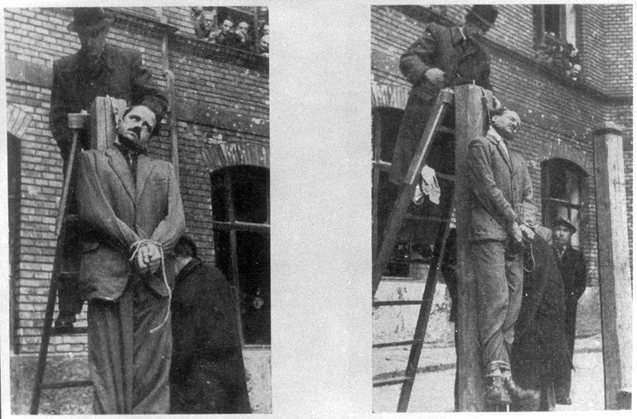
On this date in 1946, fascist Hungarian politicians Laszlo Baky and Laszlo Endre were executed by hanging in Budapest for their role in the decimation of Hungarian Jewry.

These two charmers were major figures in Hungary’s horrible final months of World War II.

Post-Stalingrad, the Hungarians had realized they were yoked to the losing side and started looking for an exit strategy; instead, early in 1944, they got a German occupation.

This occupation lifted the virulent anti-semites Baky and Endre into national power, because along with keeping Hungary in the Axis coalition, the Nazis also forcibly overcame its junior partner’s former reticence about Jewish genocide.

Adolf Eichmann arrived into Nazified Hungary and used our day’s two principals (along with another executed collaborator, Andor Jaross, they’re known as the “deportation trio”) as his instruments. Within months, hundreds of thousands of Hungarian Jews were being shipped to the gas chambers. This period is one of the waypoints of pernicious Nazi race theory, when the collapsing German regime spent military resources urgently needed at the front to organize the mass slaughter of Jews.*

And they had to work fast, because by that next winter the Red Army was seizing Budapest. These enthusiastic fascist operators did not fare well by the postwar government.

Most photos from Kuruc.info (the garishly branded ones) and the Yad Vashem database (the not garishly branded).


Laszlo Endre under arrest.


Both men, just prior to their execution.

* To do justice to the breadth of the human capacity, this is also the time and place where we find Raoul Wallenberg minting lifesaving Swedish passports by the thousands.

On this day..

1815: Anthony Lingard, the last gibbeted in Derbyshire

On this date* in 1815, Anthony Lingard was hanged for murder and robbery at Derby.

Lingard strangled the widow who operated the Wardlow Miers tollbooth in order to rob her poor possessions and lavish those ill-gotten proceeds upon the girl he had impregnated — “with a view to induce her to father the child upon some other person.” That’s the world without contraception for you.

Lingard’s girl thought this bribe fishy and gave him back the widow’s incriminatingly distinctive shoes after hearing reports that footwear had been taken from the murder scene. Then, she testified against him at the Derby Assizes (Lingard had also confessed the crime). Tried on Saturday the 25th, convicted “after a few minutes,” and strung up in front of the county gaol at noontime Tuesday, Lingard “met his fate with a firmness which would deserve the praise of fortitude if it was not the result of insensibility. He appeared but little agitated or dejected by his dreadful situation.”

Rather than the increasingly standard post-execution coda of anatomization, Lingard’s body was given over to a use of more ancient vintage: gibbeting.

Hung up in chains on the aptly named Gibbot Field in Wardlow near the spot of the murder, Lingard’s bleaching bones provided a grisly object lesson to passersby of the consequences of crime. Or, maybe not: though the novelty at first made a crowd-pleasing spectacle, it soon faded into the scenery.

A few years later, a 16-year-old girl poisoned off a rival in the very shadow of the gibbet, winding up executed for her trouble. A younger fellow named William Lingard eventually drew a death sentence for highway robbery committed near his own older brother’s clanking remains — a sentence commuted to convict transportation.

If what was left of Anthony Lingard failed to overawe his criminal counterparts, it did at least leave an impression on poet William Newton, who penned this sad meditation on the local landmark, found in full here. (It must have helped his perspective that Newton was into his sixties when the young pup hanged.)

“The supposed Soliloquy of a Father, under the Gibbet of his Son; upon one of the Peak Mountains”
TIME — Midnight. SCENE — A Storm.

 Art thou, my Son, suspended here on high? —
Ah! what a sight to meet a Father’s eye!
To see what most I prized, what most I loved.
What most I cherish’d, — and once most approved,
Hung in mid air to feast the nauseous worm.
And waving horrid in the midnight storm!

 Let me be calm; — down, down, my swelling soul;
Ye winds, be still, — ye thunders, cease to roll!
No! ye fierce winds, in all your fury rage;
Ye thunders, roll; ye elements, engage;
O’er me be all your mutual terrors spread.
And tear the thin hairs from my frenzied head:
Bring all your wrathful stores from either pole.
And strike your arrows through my burning soul :
I feel not, — fear not, — care not, — shrink not, — when
I know, — believe, — and feel, — ye are not men!
Storms but fulfil the high decrees of God,
But man usurps his sceptre and his rod.
Tears from his hand the ensigns of his power.
To be the petty tyrant of an hour.

 My Son! My Son! how dreadful was thy crime!
Thy name stands branded to remotest time;
Gives all thy kindred to the eye of scorn,
Both those who are, and those that may be born;
Scatters through ages on thy hapless race
In every stage of life, and death, — disgrace:
In youth’s gay prime, in manhood’s perfect bloom.
Ah! more, — it ends not, dies not, on the tomb!
O woman! woman! choicest blessing given.
If pure; — the highest gift of highest heaven!
If lax, corrupt, deceitful, — worse than hell!
Worse than the worst of demons dare to tell!
It was thy lot, ill-fated Son! to find
Thy doom pour’d on thee by the faithless kind;
Fraudful, and false, their treacherous snares they spread.
And whelm’d destruction on thy thoughtless head.

 To die, to perish from the face of earth.
Oblivion closing on thy name and birth.
Hid under ground from each invidious eye,
From every curious, every rancorous spy,
Was what thy crime deserved: — not more;
The rest seems cruelty. — When heretofore
Our barbarous sires the aweful Gibbet rear’d.
The Gibbet only, not the laws were fear’d:
The untutored ruffian, of an untaught clime,
Fear’d more the punishment than dreaded crime.
We boast refinement, say our laws are mild.
Dealt equally to all, the man, the child: —
But ye, who, argue thus, come here and see,
Feel with a Father’s feelings; — feel with me!
See that poor shrivell’d form the tempest brave.
See the red lightning strike, the waters lave.
The thunders volleying on that fenceless breast! —
Who can see this, and wish him not at rest?

At rest, — vague word! — the immaterial mind
Perhaps even now is floating on the wind: —
Ah! no, — not mind, — not spirit, — but the shell;
The mind ere this has drank of Mercy’s well:
‘Tis not for that I feel, for that I sigh.
But sweltering, putrid, rank mortality.
O! blind to truth, to all experience blind.
Who think such spectacles improve mankind:
Bid untamed youth on such sights feast his eyes,
Harden you may, but never humanise.
Ye who have life, or death, at your command.
If crime demand it, let the offender die.
But let no more the Gibbet brave the sky:
No more let vengeance on the dead be hurl’d.
But hide the victim from a gazing world.

Anthony Lingard was the last person ever gibbeted in Derbyshire. England abolished gibbeting and hanging in chains full stop in the 1830s.

* The date March 8 is widely attributed on other sites, but the primary documentation for March 28 is unambiguous. I want to suspect a seminal typo somewhere that’s been copied a thousand other times over.

On this day..

1947: Hisakazu Tanaka, Hong Kong occupier

On this date in 1947, Hisakazu (or Hisaichi) Tanaka was shot by the Chinese Koumintang for war crimes committed during the Japanese occupation of China.

Tanaka headed the Japanese Twenty-Third Army from March 1943 through the end of the war; for the last year or so of that period, he was also the last governor of Japanese-occupied Hong Kong.

Captured in Canton at the end of the war, Tanaka was tried by the Allied occupiers for permitting the execution of a downed American airman on April 6, 1945. That unnamed airman had been tried in wartime Japan for targeting civilians during his bombing raid, a judgment that Tanaka’s tribunal vociferously disputed.

Though he drew a hanging sentence for that offense, it was not carried out: instead, the doomed general was handed over to the Chinese nationalists to answer for the depredations of his 23rd army.

No surprise, the outcome there was pretty much the same.

On this day..

1555: William Hunter, reader

On this date in 1555* — crying, “away, thou false prophet!” at the priest sent to hector him in his last moments — William Hunter was burned in Brentwood, Essex for Protestantism.


Hunter at the stake, from Foxe’s Book of Martyrs.

Here in the last brief moment of official Catholicism under Queen Mary, our apprentice silk-weaver was caught reading the Bible for himself in the local chapel.

Called in for questioning, both Hunter and the civil authorities decided it was worth his life to dispute the doctrine of transubstantiation. Catholic pro, Hunter con, of course.


(cc) image from Bopuc.

So that was that.

A couple of years later, the very justice who had first examined Hunter received a grant to found a school. Brentwood School is still going strong in its fifth century, and on its grounds — directly adjacent, in fact, to the school’s first purpose-built room** — rests a stone for the edification of the generations of Anglican pupils who followed. It honors the young man who died to crack open a book.

WILLIAM HUNTER. MARTYR. Committed to the Flames March 26th MDLV.
Christian Reader, learn from his example to value the privilege of an open Bible. And be careful to maintain it.

An elm tree planted at that spot came to be known as the Martyrs Elm.


1847 illustration of Brentwood School and the Martyrs Elm.

* This is the date per Foxe’s Book of Martyrs; others give March 27. The memorial stone carries the day for our purposes in view of contradictory sourcing.

** The legend that Brentwood School was founded as the justice’s penance for dooming Hunter seems to be unfounded.

On this day..