On this date in 1953 — six months after the execution of a more notorious couple, the Rosenbergs — two Missouri kidnappers were gassed together for the abduction-murder of a millionaire car dealer’s son.
Robert Greenlease owed his millions to a string of midwestern GM dealerships planted at the very flowering of America’s interstate system and suburbanization.
Carl Hall and Bonnie Brown Heady reckoned he’d owe some of those millions to them, too.
On September 28 of 1953, those two snatched little Bobby Greenlease Jr from the grounds of a Catholic school in Kansas City via the all-too-easy expedient of Heady presenting herself as Bobby’s aunt.
Then they extorted Sr. to the tune of $600,000, and after several days’ negotiations, Greenlease paid it through an intermediary — a record US ransom sum that would not be surpassed until 1971.
But the motor magnate never saw his son again. Even by the time they’d sent their first ransom note, the kidnappers had shot little Bobby dead at a deserted farm just over the state line in Kansas.
Although this audacious attack on a minor oligarch made national headlines — it couldn’t help but remind of the Lindbergh baby case — the crooks basically had an opportunity to get away scot-free with all their ill-gotten gains. Bobby Greenlease’s body wasn’t discovered until a couple of days after the ransom was paid, and nobody knew who the abductors were at that point.
Hall and Heady absconded to St. Louis but the wealth, like the crime itself, was just too much for these small-time shoulders to bear. Instead of lying low, Hall — after ditching Heady and taking most of the ransom with him, a reckless provocation of his co-conspirator that might itself have blown up his cover in short order — took up residence in an expensive hotel and started throwing money around. A cabbie reported the shabby character’s suspicious spending, and in no time at all the two were in custody.
A further mystery, never solved, entered the case on the night of Hall’s arrest: half the ransom money disappeared. The mob-connected lieutenant who collared Hall and brought him to the station less $300,000 of the score eventually resigned from the force in disgrace and faced federal prosecution for misappropriation and perjury; the cop indicted with him earned a presidential pardon by turning on his comrade. Other ideas were that the criminals had buried half the money (they claimed this, for a while) and that better-connected figures higher up the food chain had taken in. All the bills’ serial numbers had been recorded but only a few were ever known to have surfaced again in later years, in Michigan and Mexico; where these trace remains of a family tragedy might rest today is anybody’s guess.
As for Hall and Heady, they emerged into the glare of national infamy and — because they had crossed the Kansas-Missouri state line — a federal prosecution. Heady remains to this day the last woman executed under U.S. federal auspices.
The St. Louis Post-Dispatch has a detailed photographic retrospective here.
Dutch Jewish aid worker (A)Lex Aronson was hanged on this date in 1975 in Iraq.
Aronson (English Wikipedia entry | Dutch) had survived Bergen-Belsen as a child* — his grandfather was not so fortunate — and gone on to a peripatetic career in global relief work that took him to Israel, Syria, Gabon, Nigeria, India, Bangladesh, and points beyond.
By the accounts of his friends, Aronson was a free spirit, a man of idealism and wanderlust. By the account of the Iraqi government that arrested him, Aronson was an Israeli spy.
There’s a published collection of his correspondence; in a letter to his mother dated March 13, 1975 — the last he would post before his arrest 11 days on — achingly shows him eschewing a judicious evacuation in order to press onward into the teeth of a devastating offensive Iraq had launched on March 7.
the political bosses here have decided that all foreigners should be evacuated. By foreigners, they are referring to a few press photographers, the team of five English from “Save the Children,” and yours truly. The hospitality is so extensive here that at the first sign of a threat, they are stepping out of their way to secure the safety of their guests. The local bosses mean well. However, what daddy has in his head, he doesn’t have in his arse… by which I mean that whatever I have set my mind to, I don’t give up easily.
I was determined to go to Badinan. I went from one political office to another, pestering all the leaders save for Barzani himself. Finally, I was rewarded with a letter of introduction to all the Kurdish military commanders requesting that they give me the help necessary for me to reach my goal.
A subsequent letter by a Save Our Children doctor to Aronson’s father in early 1976 explained something of the circumstances in the following days that led to his capture,
I saw your son on 20 March 1975. He was breakfasting with me at the home of the leader of the Barzan community, Sheikh Abdullah, in preparation for a journey to Badinan. He was taking medicine and other equipment with him so that he could set up a surgery to treat the inhabitants of a single community somewhere in that area. He had bought a donkey to convey these items, but unfortunately this had got lost between Senidan and Sideka, over the pass to the east of Hassanbeg Mountain with the snow so deep that no donkey could traverse it.
The donkey was under the control of two Pesh Merga (Kurdish Freedom Fighters). Apparently they became separated from your son and he had no idea of the [whereabouts of?] this medicine or his passport and money. He was travelling against the advice of the Kurds in the border area who were keen (at that time) that all foreigners should get out as quickly as possible. For this reason, he retraced his steps to try to find the donkey, yet wanted to press on towards Amadiyah. He had spent a day or so looking. He asked me to look for the animal. I made inquiries in both Sideka and Semilan, but I could not find it. However, as at that stage there was total chaos in these villages, it was not at all surprising that I was so unsuccessful. I must explain that he was in danger, as he had no identification papers with him when I saw him.
A confusing and, for his loved ones, anguishing period ensued his arrest. The Iraqi News Agency announced his execution on November 3, only to retract that announcement shortly afterward and clarify that he remained alive, still facing execution. His parents for months thereafter received notes scribbled on cigarette packages which meandered through smuggling channels at indifferent speeds, but with the irresistible implication that their son yet drew breath — and so they kept up their struggle to save him via appeals and publicity well into 1976, when the Iraqi embassy in March 1976 finally notified them that he was long since hanged.
“Nobody can imagine how we feel now,” his father told the press. “All hopes smashed at once. There is nothing left to fight for. Now we can only try not to get too depressed.”
* He was a passenger on the “Lost Transport”, a train of inmates evacuated from Bergen-Belsen that ended up with no destination as the Reich collapsed, and were eventually liberated by the Red Army.
Romanian entrepreneur Gheorghe Stefanescu was shot at Jilava Prison on this date in 1981. He was at the center of one of the largest corruption scandals of the Communist period.
A Bucharest liquor-store administrator, Stefanescu built a vast network that sold unlicensed and adulterated wine throughout the 1970s. When arrested in 1978 — after a Securitate officer noticed that the wine he’d ordered for a wedding decayed into sludge when the festivity was delayed — Stefanescu had accumulated a villa, two cars, 18 kg in gold jewelry, and millions in lei. More than 200 other people, ranging from distributors to officials corrupted by bribes, were arrested when the operation was rolled up.
The way it worked was, a vineyards administrator would fraudulently declare part of his product a loss to natural disaster, and squirrel it away illicitly. This contraband was then multiplied in volume and profitability by diluting the highest-quality wine with cheap plonk. Stefanescu and friends moved some 400,000 liters of this stuff from 1971 to 1978, costing the Romanian government several million dollars in lost revenue — a laughably pinprick injury compared to Romania’s post-Ceausescu sea of corruption but as they say, a prophet is never welcome in his own country.
Bring your Romanian proficiency to enjoy the 1984 film about the affair, Secretul lui Bachus (Secrets of Bacchus).
On this date in 1669, a slave of the Dutch East India Company named Susanna was sewn into a rock-weighted sack and tossed into Table Bay as punishment for infanticide in the Cape Colony (present-day South Africa).
The spare narration of the company’s journal describes Susanna’s speedy progress from the (not further explained) strangulation of her “half-caste” infant girl — reported on December 11, tried on December 12, and executed on December 13.
December 11th. — In the evening meeting the Fiscal [Cornelis de Cretzer] reported that a female slave of the Company, named Susanna of Bengal, lying stiff and stinking of the small-pox in the slave house, had not hesitated to strangle her infant, a half-caste girl; he likewise submitted the sworn declaration of the surgeon, which mentioned that the poor innocent child had died in consequence. The Council having considered this serious affair at once, ordered that the murderous pig should be placed in confinement in order to be punished according to her deserts.
December 12th. — This evening the Council decreed that the female slave, above mentioned, should be tied up in a bag and thrown into the sea. The minister [Adrianus de Voogd] and sick comforter [Joannes à Bolte(n)] were accordingly sent to her, to admonish her to repentence [sic] of what she had done, so that she might in a Christian manner prepare herself for death to-morrow afternoon.
December 13th. — About 11 o’clock the sentence was read here on the square in presence of the murderess and the public, and afterwards carried out on the roadstead in the presence of all the slaves. For the maintenance of justice it was executed with death [by drowning?].
Unsurprisingly we know little else about Susanna … but we do know something.
A documentation project on the first decades of the Cape Colony features a series called “Uprooted Lives”, by Mansell Upham focusing on the lives of slaves and aboriginals affected by the settlement has a fantastic article (pdf) on “Susanna van Bengale” or “Susanna Een Oor” (Susanna One-Ear). It’s a highly recommended read, not only illuminating the judicial perspectives on infanticide that would have informed her judges, but tracing other, fleeting glimpses of Susanna supplied by the documentary record and illuminating the context of her case in view of two other important trials of mothers that preceded it.
Per the BBC’s report of a Saudi Interior Ministry statement, a woman named Amina bint Abdul Halim bin Salem Nasser was beheaded for sorcery in the northern province of Jawf on this date in 2011.
The London-based newspaper, al-Hayat, quoted a member of the religious police as saying that she was in her 60s and had tricked people into giving her money, claiming that she could cure their illnesses.
Our correspondent said she was arrested in April 2009.
But the human rights group Amnesty International, which has campaigned for Saudis previously sentenced to death on sorcery charges, said it had never heard of her case until now, he adds.
…
Amnesty says that Saudi Arabia does not actually define sorcery as a capital offence. However, some of its conservative clerics have urged the strongest possible punishments against fortune-tellers and faith healers as a threat to Islam.
I went into this with both my eyes open, telling myself that a man who has an ideal must be willing to sacrifice everything for it or else the ideal isn’t an ideal at all, or the man isn’t a man at all, but a humble creature who deserves only pity.
-Carl Heinrich Meier, last letter to his fiancee (Source)
Raced into the books in May of 1940 amid Nazi Germany’s onslaught on France, the Treachery Act made it a capital crime if, “with intent to help the enemy, any person does, or attempts or conspires with any other person to do any act which is designed or likely to give assistance to the naval, military or air operations of the enemy, to impede such operations of His Majesty’s forces, or to endanger life.” Naturally the realm had centuries of treason statutes to fall back on; the intent in creating this new capital crime of treachery was to target spies and saboteurs who might not themselves be British citizens — and therefore evade “treason” charges on grounds of not owing loyalty to the British Crown. Instead, the Treachery Act explicitly governed “any person in the United Kingdom, or in any British ship or aircraft.”
Carl/Karl Heinrich Meier and Jose Waldberg were textbook cases. They had rowed ashore at Dungeness on September 3 intending to pose as Dutch refugees while reconnoitering ahead of a potential German cross-channel invasion. With them were two other Abwehr agents with the same intent, Charles Albert van der Kieboom and Sjoerd Pons.
While his comrades were noticed by routine coastal patrols and picked up near the beach, Meier picturesquely showed up that morning at a public house in Lydd where his clumsy command of contextual slang and etiquette led the proprietress to turn him in.
They were tried in camera weeks later, by which time the Luftwaffe was systematically bombing the jurors; despite this radically prejudicial context, Sjoerd Pons was actually acquitted — successfully persuading the court that he’d been forced into the mission on pain of a concentration camp sentence for smuggling. (Pons was detained as an enemy alien despite the acquittal.)
The other three men were not so fortunate. Perhaps most to be pitied was “Waldberg” who was really a Belgian named Henri Lassudry: although he had not presented Pons’s same defense to the court it appeared that he also had been coerced into the operation, in his case by Gestapo threats against his family. But none of the three death sentences was to be abated. A week after Meier and Waldberg/Lassudry hanged at Pentonville Prison, van der Kieboom followed them to the gallows.
“Jose Waldberg” aka Henri Lassudry.
The Treachery Act would be used against German agents repeatedly through the war years and in time had the distinction of noosing the last person hanged in Britain for a crime other than murder.
In the months preceding the final fall of Constantinople in 1453, the great Ottoman sultan Mehmed (II), the Conqueror, caused to be constructed in less than twenty weeks on the European bank of the Bosporus just north of the city a colossal castle which he called Bas-kesen, meaning ‘Decapitator’ or ‘Throat-cutter’. Later called Rumeli Hisar (‘Castle of the Roman Lands’), it stood opposite the Anadolu Hisar (‘Castle of Anatolia’), built in 1394 by his great-grandfather Bayezit I at the narrowest part of the strait (less than 1km across). It consisted of three main towers and fourteen smaller ones connected by inner and outer curtain walls, covering an area of 31,250 sq. m (almost 7.75 acres). The fortress still stands to this day, glowering down upon passing maritime traffic much as it did when it was completed on 31 August 1452.
The view from the still-standing fortress shows its commanding view over the narrow strait. (cc) image from Olga Petrovska.
The main tower in the middle was 22m (72ft) high and 23.3m (76ft 5 in) in diameter, with 6.5m (21ft 4in) thick walls. Named the Halil Pasha after the sultan’s vizier who built it, it stood closest to the shoreline. On it, Mehmed had positioned what were described as ‘bronze tubes capable of discharging balls weighing over six hundred pounds’. He then gave the citadel’s commander, one Firuz Aga, the following explicit instructions:
Do not allow ships sailing from the Hellespont [Dardanelles] to the Black Sea or from the Black Sea to the Hellespont, no matter under whose flag they may be sailing — Genoese, Venetian, Constantinopolitan, Kaffatinian, Trapezundian, Amisinian, Sinopean, or even under my own flag, and no matter what class they are — triremes, biremes, barques, or skiffs — to sail through without first lowering their sails and paying the customs duties; only after they have done so will you permit them to proceed on their way. Use the cannon to sink the ship that does not comply and submit.
Early the following November two Venetian ships destined for the Dardanelles ignored the injunction and passed through the Bosporus without stopping as ordered. Luckily, they survived the consequent cannonade. A third, carrying grain for Constantinople a short time later, was not so fortunate. The earlier experience had evidently served to provide Firuz Aga’s gunners with the proper range. A single stone from one of the cannon ‘shattered the ship’. The crew of thirty, including the captain, a certain Antonio Rizzo, were subsequently captured and taken to the sultan in Didymoteichos (in Thrace, about 37km or 23 miles south of Adrianople — modern Edirne). ‘He gave orders to behead them all except the captain whose life was to be taken by a stake through the anus,’ recorded a fifteenth-century chronicler known only as ‘Doukas’, who claimed he himself saw Rizzo’s rotting corpse only ‘a few days later’. The impact on maritime warfare was just as dramatic. The advent of a true ship-killing weapon spelled the end of one age and the beginning of another.
In his watershed study Gunpowder and Galleys, early modern military historian John Francis Guilmartin concluded that the one technological innovation most responsible for ushering in a new age of warfare was ‘the use of effective heavy cannon’. It was, therefore, fitting that Mehmed II employed perhaps the largest cannon ever built up to that point to vanquish the first great naval power of the passing medieval period. In his campaign to conquer Constantinople, the Ottoman sultan engaged a Hungarian engineer named Orban to produce a sort of supergun which could smash the several-feet thick Theodosian Walls that had protected the capital of the Eastern Roman Empire for a millennium. ‘In three months’ time a terrifying and extraordinary monster was forged,’ testified Doukas. Mehmed’s Greek biographer, Michael Kritovoulos, provided precise dimensions: the barrel was cast in bronze some 20cm (8in) thick; it measured about 8m (26ft 8in) long, with a bore at the muzzle of 76m (30in) in diameter. In a test, the cannon discharged a 544kg (1,200-pound) stone ball which burrowed itself almost 2m (6ft) into the ground over 1.6km (1m) away. Doukas said that thirty wagons pulled by sixty oxen and 200 men were required to haul it from Adrianople to Constantinople where it was positioned to batter the walls south of the Blachernae Palace.
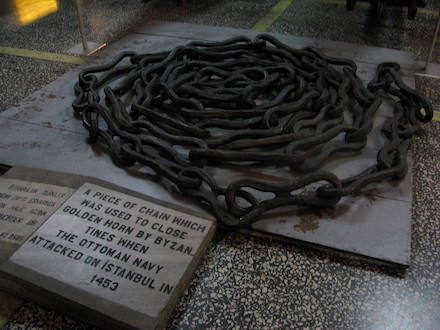
Not content with this ostentatious display of military power, Mehmed then brought to bear the full force of his powerful new fleet. The Byzantines had barred the entrance to the Golden Horn with a giant iron chain suspended on wooden pontoons between two fortified towers, one on each side. (This chain currently resides in the Turkish Naval Museum of Istanbul.)
A squadron of ten Greek warships was stationed outside it, while another sixteen from Genoa, Venice and other western maritime cities guarded it from inside. Previous Ottoman assaults on this defensive cordon had failed, so the sultan circumvented it by building a road of greased wooden logs across Galata Hill behind the Genoese colony of Pera on the side of the Golden Horn opposite the city. He then, on 22 April, had seventy to eighty ‘biremes on wheeled cradles’ hauled over said byway and into the harbour behind the chain. The manoeuvre demoralized the defenders and enabled Mehmed’s naval forces to attack the city’s sea walls from the Golden Horn at the same time that his army assaulted the land walls. Inevitably, Constantinople fell on 29 May 1453. Vanquished were the last vestiges of Byzantine imperial power and its maritime thalassocracy remained only as a distant memory.
Legendary Hungarian outlaw Marci Zöld was executed on this date in 1816.
Zöld — Hungarian link, as are most in this post; we’ve inverted the Hungarian surname-first naming convention for ease — followed his father’s footsteps into outlawry; his heyday comprised the months following a Christmas 1815 escape from a previous imprisonment after which he and a confederate “kidnapped and plundered for several months in Sárrét, and in Bihar, Szabolcs, Heves and Szolnok counties.” (Heves was his native soil, so he’s also known as Marci Hevesen.)
By summer he had teamed up with another bandit named Pista Palatinszky and formed a gang that raided promiscuously throughout Transdanubia, escaping justice until he didn’t.
The allure of the road — moreso than any evident virtue distinguishing the brigand’s actual conduct — qualified him to be taken up by poets of the emerging Romantic age, like Sandor Petofi‘s poem which inaccurately portrays Marci doing Robin Hood wealth redistribution. Mor Jokai, Jozsef Gaal, and Lajos Kormendi are among the many other authors who have paid him tribute.
To some extent, his defiance of the Austro-Hungarian empire expressed an inchoate longing for rebellion, like the Balkan hajduks. Even moreso, it was a matter of good timing — for the 18th-19th century pivot was a peak era for romanticizing highwaymen, now that the species was disappearing into the crucible of modernity. This is the same period for the likes of Schinderhannes and Diego Corrientes Mateos; equally, it’s the moment when artists of various nationalities elevated into the cultural canon decades-dead outlaws like Dick Turpin (England) or Juraj Janosik (Slovakia).
On this date in 1805, Cusco‘s Plaza Mayor hosted the hangings of two colonial Peruvian creoles who had aspired to revive the Incan resistance to Spain.
The devastating Tupac Amaru rebellion lay just 25 years in the background here, but these men were not themselves indigenes. They were, however, New World-born, and thus heirs to a resentment at colonial control from half a world’s distance that would within the coming generation separate Peru from Spain.
“Denizens of the lower strata of creole society,” as D.A. Brading writes, the lawyer Jose Manuel Ubalde and the mining entrepreneur Gabriel Aguilar — close friends from a previous association in Lina —
inhabited a world in which Catholic piety, patriotic fervour and personal ambition were fuelled by visions and dreams. For Aguilar obtained Ubalde’s support for proclaiming him Inca emperor of Peru by informing him of a childhood vision in which he had been assured of a great role in his country’s history. Both men agreed that Spanish rule was oppressive and that St Thomas Aquinas had recognised the right to rebel against tyranny. When they conferred with like-minded priests, one cleric cited the prediction of Raynal,* the 1771 representation of the Mexico City Council,** and the example of the ‘Americans of Boston’. But the current of religious emotion that underlay these arguments surfaced when another cleric fell into an ecstasy in Aguilar’s presence, and claimed later to have seen the pretender crowned in the cathedral of Cuzco.
Unfortunately, the path to such a coronation ran through the actions of sympathetic military men — and one of the officers that these conspirators reached out to shopped the plotters before they could set anything in motion.
After their arrest, Ubalde was reminded of the traditional doctrine that, since the Catholic king was God’s image on earth, any challenge to his authority was an attack on God. By way of reply, he insisted on the right of rebellion against tyranny and argued that natural law did not prescribe loyalty to any particular dynasty. After all, the Papacy had just recognised Napoleon as emperor of the French, despite the claims of the Bourbon dynasty to that throne. He went to his execution convinced that Aguilar had been chosen by providence as a creole Maccabee, called to liberate Peru from Spanish rule.
* French Enlightenment figure Guillaume Thomas Francois Raynal anticipated a rebellion that would destroy colonial slave empires from below: “Your slaves stand in no need either of your generosity or your counsels, in order to break the sacrilegious yoke of their oppression … they will rush on with more impetuosity than torrents; they will leave behind them, in all parts, indelible traces of their just resentment. Spaniards, Portuguese, English, French, Dutch, all their tyrants will become the victims of fire and sword.”
** Mexico submitted a notable May 2, 1771 petition to King Carlos III calling for most of the imperial positions in the New World to be staffed by people from the New World rather than home country cronies — and warning that to do otherwise was to invite “not only the loss of this America, but the ruin of the State.” (Source)
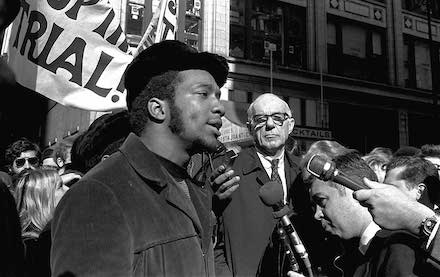
This charismatic — nearly every bio uses this word — 21-year-old star of the Illinois Black Panther Party had in his brief life shown himself a visionary exponent of radicalism; he would end as one of the signal martyrs to his movement’s violent suppression.
Well did he know it.
“If you’re asked to make a commitment at the age of 20 and you say, I don’t want to make a commitment only because of the simple reason that I’m too young to die, I want to live a little bit longer. What you did is, you’re dead already,” Hampton once mused. “You have to understand that people have to pay the price for peace. If you dare to struggle, you dare to win. If you dare not struggle then damnit, you don’t deserve to win … And I think that struggle’s going to come. Why don’t you live for the people? Why don’t you struggle for the people? Why don’t you die for the people?”
Emerging late in 1966 out of Oakland, Calif., the Black Panthers were a revolutionary and pointedly armed movement that fused black power demands with critique of the entire edifice — war, imperialism, capitalism and the rest of it. Although the organization was dissolved in 1982, the Panthers’ actions and legacy are still quite controversial and their mere specter remains a potent bogeyman for much of contemporary white America.
One thing is for sure: in their moment, they scared the shit out of the powers that be. Within months of its founding, the Federal Bureau of Investigation turned upon the Panthers its COINTELPRO program of domestic surveillance, suppression, and assassination. One particularly notorious FBI memo drew a bead on “Black Nationalist-Hate Groups” with an avowed intention to “prevent the rise of a ‘messiah’ who could unify, and electrify, the militant black nationalist movement” — and to “pinpoint potential troublemakers and neutralize them”.
Fred Hampton isn’t mentioned by name in this chilling missive from early 1968; he was just then beginning to emerge onto the FBI’s index of rabble-rousers. (Literally, the feds had a list called the “Rabble Rouser Index”.) He was fresh out of high school in 1966, and subsequently a wildly successful NAACP chapter leader, but gravitated to the new Illinois Panthers organ by 1968 where he quickly became its most outstanding organizer and spokesman, the prospective future face of a stirring cross-racial, class-conscious justice movement that Hampton perceived with a wisdom well beyond his years. Under his leadership the BPP spun out health care programs, legal aid programs, and free breakfast programs; he forged the original Rainbow Coalition* that brought rival street gangs and activist groups from different racial communities into a shared political ambition.
“We’re going to fight racism not with racism, but we’re going to fight with solidarity,” Hampton said. “We’re not going to fight capitalism with black capitalism, but we’re going to fight it with socialism.”
Just as energetically did the FBI work — and succeed, in the end — to break up such alliances, using informers and agents provocateur and false flags to encourage schisms and discredit leaders. Chicago’s police department was a ready collaborator in these operations; its relationship was the Panthers was hostile and often violent. Just three weeks before Hampton’s murder, two Chicago cops and a 19-year-old Black Panther were killed in a shootout. (Hampton was in California at the time.)
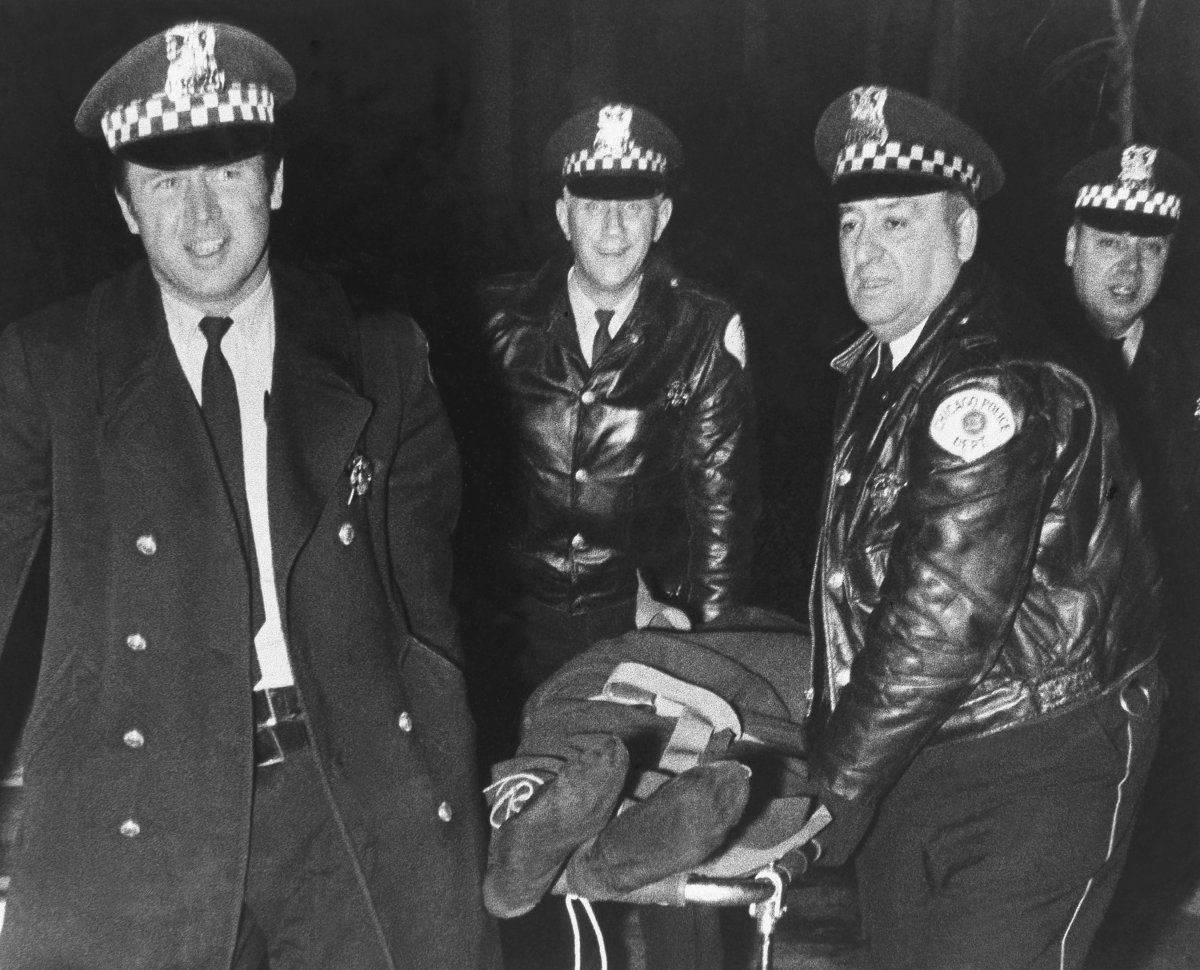
We don’t have the full documentary paper trail with deliberations and countersigned orders, but the known facts (and the smug grins of the cops) admit no reasonable dispute this side of performative naivete that Hampton was assassinated by a state death squad — “executed”, if you like, to fit an admittedly expansive read of this here site‘s mandate.
A compromised Hampton bodyguard named William O’Neal gave his FBI handler — who also happened to be running the Chicago COINTELPRO operation targeting the Panthers — a detailed floor plan of Hampton’s apartment, which the FBI shared with the Chicago police for a raid putatively hunting illegal weaponry. On the night of December 3, O’Neal slipped Hampton a barbituate to dull his reactions for what was to come; surviving comrades would describe Hampton being roused amid the early-morning fusillade only with difficulty, responding barely and in “slow motion” even as Chicago police stormed front and rear entrances and poured nearly 100 rounds into the place. Another Hampton aide named Mark Clark, sitting watch, was blasted dead in the initial barrage, convulsively discharging his shotgun once into the ceiling as he fell. It was the only shot fired that night by any of the Black Panthers.
By the account of Hampton’s eight-months pregnant partner Deborah Johnson, corroborated by other Panthers in the apartment, Fred Hampton was injured by the volley, but alive — and cold-bloodedly finished off with a coup de grace.
First thing that I remember after Fred and I had went to sleep was being awakened by somebody shaking Fred while we were laying in the bed. Saying, “Chairman, Chairman, wake up, the pigs are vamping, the pigs are vamping!” And, um, this person who was in the room with me, kept shouting out “we have a pregnant sister in here, stop shooting”. Eventually the shooting stopped and they said we could come out. I remember crossing over Fred, and telling myself over and over, “be real careful, don’t stumble, they’ll try to shoot you, just be real calm, watch how you walk, keep your hands up, don’t reach for anything, don’t even try to close your robe”. I’m walking out of the bedroom, there are two lines of policemen that I have to walk through on my right and my left. I remember focusing on their badge numbers and their faces. Saying them over and over on my head, so I wouldn’t forget. Um, as I walked through these two lines of policemen, one of them grabbed my robe and opened it and said, “Well, what do you know, we have a broad here.” Another policeman grabbed me by the hair and pretty much just shoved me — I had more hair then — pretty much just shoved me into the kitchen area. It was very cold that night. I guess that it snowed. And, ah, the back door was open. Some people were on the floor in the kitchen area. I think it was Harold Bell was standing next to me in the kitchen area. They, ah, it was a police, ah, plainclothes policeman there, and I asked him for a pin, so I could pin my robe, because it was just open. And he said, “Ask the other guy.” And, ah, then somebody came back and handcuffed me, and Harold Bell behind the back. I heard a voice come from the area, I guess from the dining room area, which was, the kitchen was off from that area. And someone said, “He’s barely alive, he’ll barely make it.” The shooting, I heard some shooting start again. Not much. Just a little shooting, and, um, and someone said, “He’s good and dead now.” I’m standing at the, um, kitchen wall, and I’m trying to remember details of these policemen’s face, say it over and over in my head, and, and badge numbers, so, you gotta remember, gotta remember. And then when I felt like I was just going to really just pass out, I started saying the ten-point program over and over in my head. Um, at one point I turned around, the shooting had continued again, and I saw the police drag Verlina Brewer and throw her into the refrigerator. And it looked like blood was all over her. And she fell to the floor and they picked her up and threw her again. I saw Ronald Satchel bleeding. I kept trying to focus on the ten-point program platform, because I, again, I wanted to take myself out of that place. And I knew I just couldn’t break down there. Because I didn’t know if I would be killed, or what would happen.
Incidentally, Hampton’s killing was also a key catalyst for the terroristic turn of the Weather Underground — whose decisive “war council” meeting occurred later that same month of December 1969, with Hampton’s blood heavy in the air (and his picture prominently displayed on the wall) as an emblem of the futility of pacific resistance within the belly of the beast. “It was the murder of Fred Hampton more than any other factor that compelled us to feel we had to take up armed sturggle,” said David Gilbert, who’s now serving a prison sentence for a deadly bank robbery. “We wanted to create some pressure, to overextend the police so they couldn’t concentrate all their forces on the Panthers. We wanted to create a political cost for what they were doing. And we also felt that to build a movement among whites that was a revolutionary movement, a radical movement … it had to respond when our government in our name was destroying the most promising, exciting, and charismatic leadership to come out of the Black movement in a long time.” (Source) It was a paradoxical inspiration, since Hampton himself had criticized the emerging Weathermen after their “Days of Rage” riot in Chicago as “anarchistic, opportunistic, individualistic,” and even “Custeristic” — as in Indian Wars cavalryman George Armstrong Custer, famous for his defeat — “in that its leaders take the people into situations where they can be massacred. And they call that revolution.”
* The name and concept of the Rainbow Coalition were later revived by Jesse Jackson in his left-wing presidential challenges in 1984 and 1988, but there is not a continuous institutional thread from Hampton’s coalition to Jackson’s. Jackson did, however, deliver a eulogy at Hampton’s funeral on December 6, 1969.

 Aronson (