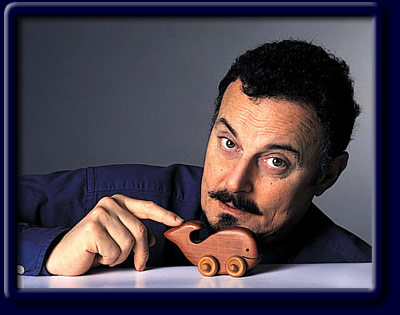
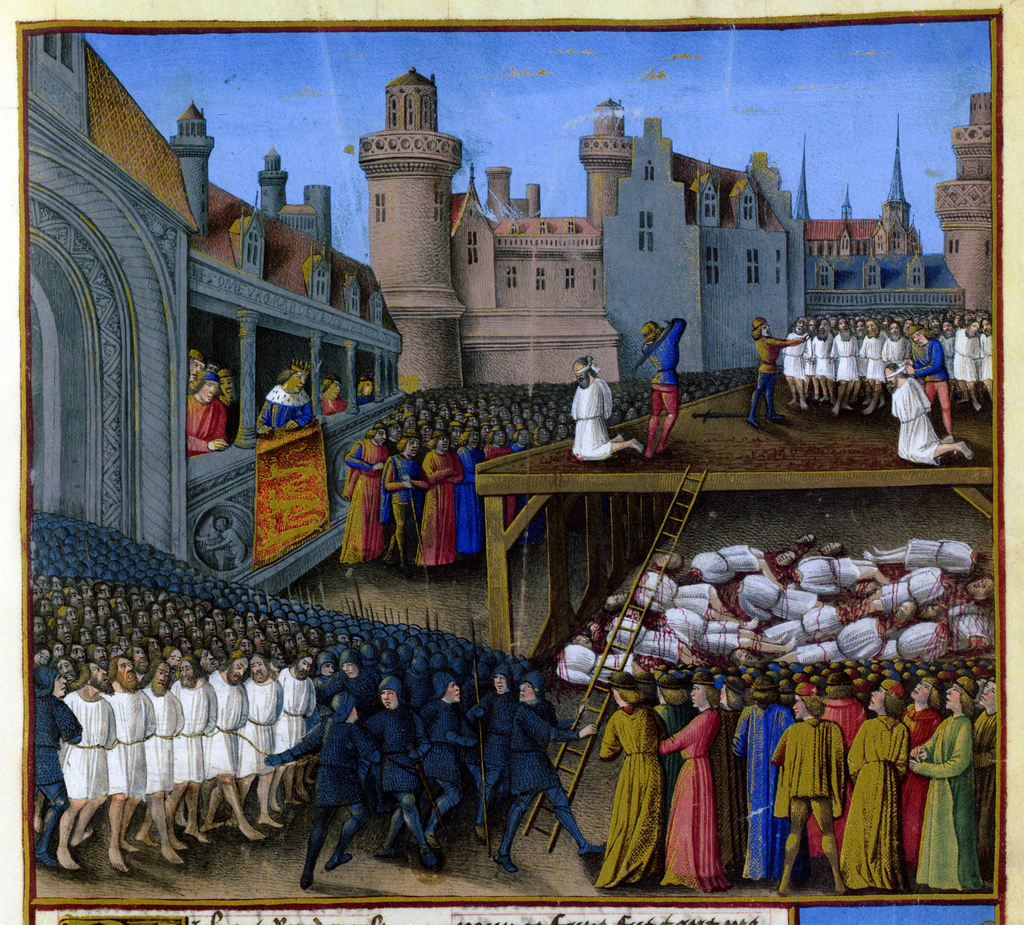
1957: Jacques Fesch: playboy, cop killer, saint?

On this date in 1957, the dissolute son of a wealthy banker went to see Jesus on the guillotine at Paris’ La Santé Prison.

Annoyed that his estranged father wasn’t keen to finance his dream of moving to the South Pacific for a life on permanent vacation, Jacques Fesch robbed a moneychanger on the Rue Vivenne to raise the revenue — and then shot dead a police officer who gave him chase, orphaning a four-year-old girl.

Outrage at the murder of a policeman was redoubled as the callow hedonism — adultery, an abandoned illegitimate kid, and nary a hard day’s work in his life — of its privileged perp became widely known. Then, too, there’s the novelty of a financial sector scion requiring a firearm for larceny.

Fesch’s Catholic lawyer, Paul Baudet, undertook the Dostoyevskyan mission of saving client’s life and soul alike. The disinterested kid called him “Pope Paul” or “Torquemada,” but gradually — and then all of a sudden — something got through there.

Little by little I was led to change my ideas. I was no longer certain that God did not exist. I began to be open to Him, though I did not yet have faith. I tried to believe with my reason, without praying, or praying ever so little! And then, at the end of my first year in prison, a powerful wave of emotion swept over me, causing deep and brutal suffering. Within the space of a few hours, I came into possession of faith, with absolute certainty. I believed, and could no longer understand how I had ever not believed. Grace had come to me. A great joy flooded my soul and above all a deep peace. In a few instants everything had become clear. it was a very strong, sensible joy that I felt. I tend now to try, perhaps excessively, to recapture it; actually, the essential thing is not emotion, but faith. (Source)

Almost overnight he gave himself to monklike asceticism, but the legal situation was not as promising as the spiritual. French President Rene Coty declined to spare him under pressure from police, and on grounds that leniency to a cop-killer would blow back on officers then trying to quell rebellion in Algeria.

Tell your client that he has all my esteem and that I wanted very much to reprieve him. But if I did that, I would put the lives of other police officers in danger. (Source)

Fesch didn’t want to die, but he accepted his penalty with resignation.

Now, my life is finished. ‘Like a little spring flower which the divine Gardener plucks for His pleasure,’* so my head will fall — glorious ignominy — with heaven for its prize! (Source)

His prison writings have filtered out widely since his beheading, and fed a burgeoning personal cult; he is often compared with the penitent “good thief” crucified with Christ. The valence of that conversion for the death penalty as a contentious political or theological issue, however, is not necessarily abolitionist. Fesch himself mused that imminent execution might have been the very thing that moved his soul.

Do you know, sometimes I think, in good faith and with horror, that the only way I can be saved [in God] is perhaps not to be saved [from the guillotine] in the human sense of the word? (Source)

Controversially, the layabout who slew a policeman has been latterly proposed for canonization within the Catholic Church — although Fesch’s defenders here observe that saints from Paul on down have often had unsavory backstories.

The young man is much better known in Romanic lands than among Anglophones — here’s an Italian homily for him:

* Quoting St. Therese of Lisieux, an apt inspiration.

On this day..

1396: Thousands of knights of the Last Crusade

On this date in 1396, Ottoman Sultan Bayezid I put thousands of Christian Crusaders to the sword — and with them, Christians’ zest for holy war against the Turk.

The day after crushing a European Crusading expedition at the Battle of Nicopolis — where Christ’s multinational divisions might have crippled themselves by opting for political reasons to go with gloryhounding French knights’ demand for a heavy cavalry charge as opposed to sneakier tactics — Bayezid was mighty sore to find that the invaders had executed en masse Muslim prisoners from their last engagement.

Barbara Tuchman’s A Distant Mirror relates the result:

The defeat was followed by a frightful sequel. As Bajazet toured the battlefield … he was “torn by grief” at the sight of his losses, which outnumbered the Christian. He swore he would not leave their blood unavenged, and the discovery of the massacre of the prisoners of Rachowa augmented his rage. He ordered all prisoners to be brought before him next morning. … [T]he leading nobles … were … spared [for ransom], as well as all those judged to be under twenty for forced service with the Turks.

The rest, an uncertain figure of several thousand, were marched naked before the Sultan, bound together in groups of three or four, with hands tied and ropes around their necks. Bajazet looked at them briefly, then signed to the executioners to set to work. They decapitated the captives group by group, in some cases cut their throats or severed their limbs until corpses and killers alike were awash in blood. [The Christian nobles being spared] were forced to stand by the Sultan and watch the heads of their companions fall under the scimitars and the blood spurt from their headless trunks…. The killing continued from early morning to late afternoon until Bajazet, himself sickened at the sight or, as some say, persuaded by his ministers that too much rage in Christendom would be raised against him, called off the executioners.

In truth, the era of the Crusade as most readily conceived — a bid to conquer the Holy Land — was long past by this time. But it had been under that tattered old banner that Christendom summoned its vassals to check the rising Ottoman Empire, which by this time had reduced Byzantium to a rump state around Constantinople.

The battle that precipitated this day’s* feast of carrion occurred in Bulgaria, where the Turks’ growing European footprint (and this affair essentially pinched out the Bulgarian Empire of the day) exercised the European courts in figurative as well as literal ways. Though other ventures would hoist the crusading pennant, there would be no major offensive incursions against the Turks until “crusades” had fallen well out of fashion.

None of this gory affair is to be confused with Indiana Jones and the Last Crusade, where a leap of faith proved more felicitous.

* Most sources place the Battle of Nicopolis at September 25, although some say September 28 — the latter date would obviously place this massacre on September 29.

On this day..

1792: Jacques Cazotte, occultist

On this date in 1792, Jacques Cazotte, a writer distinctly out of step with his times, was guillotined for treason in Paris.

The Martinique-born Cazotte (English Wikipedia entry | French) was into his 40s when he launched the writing career that earns him notice enough for this blog.

He wasn’t a liberte, egalite, fraternite kind of guy: Cazotte’s works, like Le Diable Amoureux (The Devil in Love),* were fantastical, Gothic — far from the rationalist fare of the Enlightenment.

And that wasn’t exclusively a literary posture.

Cazotte fancied himself gifted with prophecy — enthusiasts’ accounts have him prophesying the course of the Revolution — and preferred the mystical enlightenment of the illuminati to the Voltairean kind.** He viewed the onset of the French Revolution with horror.

When some scribblings to that effect were discovered in his papers, the mystical goose was cooked. The French Wikipedia entry credits his daughter with saving his life during the September Massacres … buying the 72-year-old only a few weeks of life.

Cazotte’s Le Diable Amoureux has the devil as a young man’s servant girl, endeavoring to seduce him. Here is Cesare Pugni‘s balletic rendition, Satanella, with its grand pas de deux, “Le Carnaval de Venise”:

Cazotte finds his way to us, as the dark arts are wont to do, through more meandering channels as well.

Le Diable Amoureux inspired supernatural mystery The Club Dumas by Spanish author Arturo Perez-Reverte. That novel in turn was riffed by Roman Polanski for the weird 1999 flick The Ninth Gate (review), starring Johnny Depp. (Cazotte’s book is explicitly referenced in both its progeny.)

Although only tangentially related, this digression into the occult gives us leave to notice one of the many cultural ephemera of executions linked to no particularly blog-friendly date. The Club Dumas and The Ninth Gate make use of striking woodcuts of modern vintage but after a style of centuries past that help unlock the central puzzle.

Charged with esoterica, the topical-looking “hanged man” print comes clearly modeled after its tarot cousin … although the tarot version, in most instances, is hoped to be of less deadly effect upon the plot.

* Available free in the original French at Project Gutenberg.

** Voltairean rationalism had its own ways of getting in trouble. It may have been an age of ideas, but it was hardly safe to have them.

On this day..

1822: Four Sergeants of La Rochelle

On this date in 1822, four sergeants from La Rochelle were guillotined at the Place de Greve with “Vive la liberte! on their lips for plotting to overthrow the restored Bourbon monarchy.

In the Restoration following Napoleon, the cautious gouty brother of the Revolution’s most famous guillotinee came to the throne as Louis XVIII.

And in a right-wing reaction following a royal assassination, Louis found himself in the anomalous position of having a government more monarchist than he himself. Though not renowned for his sagacity, the sovereign had the wit to see that completely reversing the Revolution was a nonstarter. His ultra-royalist deputies, however, wanted nothing less than the full restoration of an absolute monarchy.

The new Prime Minister cracked down hard on the Liberal opposition. Here’s the scene as described by The Cambridge Modern History, a Google Books freebie:

The Chief Minister [Villele] had the merit of keeping constantly in mind the fact that his friends owed their power to the forces of reaction and alarm, aroused in the country by the dagger of an assassin who had mortally wounded a member of the royal family. To keep this fear awake, in order to establish his authority, was his first care. In this he succeeded. The Liberals, finding themselves compelled to prudence, organized themselves into secret societies; and the Republcians, imitating the Neapolitans, actually formed in 1821 the Charbonnerie francaise, which avowedly aimed at giving back “to the French nation the free exercise of the right to choose its sovereign.” In order to give battle to the ancien regime and its Bourbon protectors, they recruited their soldiers and captains without hesitation from among the officers, commissioned and non-commissioned, of the old Imperial army. Villele showed particular skill in the discovery, exaggeration, and signal punishment of these conspiracies … With a magistracy obedient to its orders, the Ministry devoted itself assiduously to representing isolated movements no sooner known than crushed, as forming part of a permanent conspiracy organized by the Liberals, not only against the monarchy, but against society itself.

Les quatre sergents de La Rochelle — by the names of Bories, Goubin, Pommier and Raoulx — comprised perhaps the most egregious such case.

Driven underground (the link is French) like the rest of the Liberal opposition, they had joined the charbonnerie, a loose network modeled on Naples’ carbonari. (Lower-level officers were prime recruits for the dissidents, since their career prospects were truncated by aristocratic privilege in the upper brass.)

It was never clear that their subversiveness extended to anything beyond their affiliation with a criminalized ideology, and they kept their own peace to protect other associates in the charbonnerie. Guillotining them on this basis conformed neatly to the principles of, say, an Ann Coulter: “We need to execute [these] people … in order to physically intimidate liberals, by making them realize that they can be killed, too. Otherwise, they will turn out to be outright traitors.”

Back to The Cambridge Modern History:

It seemed that the Ministers were eager to multiply these trials and executions. Since certain deputies of the Liberal Opposition, Lafayette* among others, and D’Argenson, had openly associated themselves with these enterprises, which otherwise were devoid of danger, this supplied a fair pretext for exhibiting them publicly as criminals. The indictment with the King’s Procurator, Marchangy, formulated, in order to obtain the condemnation of the four sergeants of La Rochelle, left no doubt as to the intentions of the Government. Its chief aim was to terrorise the French people “by this vast conspiracy against social order, against the families of citizens, which threatened to plunge them once more into all the horrors of anarchy.” While keeping up the appearance of saving society, Villele gained forthwith the power to govern it in accordance with the wishes of his friends. The threat of anarchy, exploited by the judges in his service, allowed him to organise a despotism.

The public execution reportedly had its onlookers appalled, (more French) and as word of the young men’s heroic deaths got around, they elbowed into the vast host of (somebody’s) martyrs. (In Balzac’s Human Comedy, the courtesan Aquilina is said to have been involved with one of the four sergeants; in her appearances after the executions, she always commemorates him by wearing something red.) The Lantern Tower in their garrison’s city — depicted below in a 1927 Paul Signac painting — was renamed in their honor, Tour de Quatre Sergents.

* Lafayette always seemed to be somebody’s dangerous element. It’s a wonder he never got himself into this blog.

Part of the Themed Set: Counterrevolution.

On this day..

1803: Robert Emmet, “let no man write my epitaph”

On this date in 1803, Irish nationalist Robert Emmet was hanged and posthumously beheaded, a day after his trial for treason against England.

The well-to-do scion of a Protestant family, Robert Emmet followed his older brother into the Republican ferment of the time and led an unavailing uprising in Dublin on July 23, 1803.

Captured a month later when he romantically recklessly moved his hideout closer to his beloved Sarah Curran.*

Emmet won his great laurels in the annals of Irish Republicanism with a stirring “Speech from the Dock” addressed to the courtroom the day before he died. Or better to say that it was addressed in a courtroom, for knowing that his death sentence was a foregone conclusion, the real audience was posterity and a wider world.

Emmet found that audience with one of the great orations of the 19th century.

This clip is a truncated version of a longer speech not set to paper by Emmet, so no single definitive version exists. Versions can be found at this Irish history site, and at SinnFein.ie.

I have but one request to ask at my departure from this world — it is the charity of its silence! Let no man write my epitaph: for as no man who knows my motives dare now vindicate them. let not prejudice or ignorance asperse them. Let them and me repose in obscurity and peace, and my tomb remain uninscribed, until other times, and other men, can do justice to my character; when my country takes her place among the nations of the earth, then, and not till then, let my epitaph be written. I have done.

On the strength of such sentiment — and the public’s learning of his love for Sarah Curran — the 25-year-old became iconic in death. Robert’s own death inspired the mandatory Irish patriotic ditty, “Bold Robert Emmet”:

But that sundered love between Emmet and Sarah Curran — who broken-heartedly accepted another proposal and moved to Sicily — was at least as stirring to the Romantic imagination. Washington Irving dedicated a short story to the lost romance; Emmet’s friend Thomas Moore made Curran the subject of a poem (beware: link opens an auto-playing audio file).


Anti-British terrorist Robert Emmet has a statue on Washington, D.C.’s Massachusetts Ave, and probably an entry on the no-fly list.

* 19th century Irish poet Thomas Moore paid her tribute in “She Is Far From the Land”:

She is far from the land where her young hero sleeps,
And lovers are round her, sighing:
But coldly she turns from their gaze, and weeps,
For her heart in his grave is lying.

She sings the wild song of her dear native plains,
Every note which he lov’d awaking; —
Ah! little they think who delight in her strains,
How the heart of the Minstrel is breaking.

He had liv’d for his love, for his country he died,
They were all that to life had entwin’d him;
Nor soon shall the tears of his country be dried,
Nor long will his love stay behind him.

Oh! make her a grave where the sunbeams rest,
When they promise a glorious morrow;
They’ll shine o’er his sleep, like a smile from the West,
From her ow lov’d island of sorrow.

Part of the Themed Set: Counterrevolution.

On this day..

1599: Beatrice Cenci and her family, for parricide

On the morning this day in 1599, the Cenci family — mother Lucrezia, son Giacomo, and immortal tragic heartthrob Beatrice — were put to death at Sant’Angelo Bridge for murdering the clan’s tyrannous father.

Francesco Cenci, the victim, was more accustomed to making victims of his own: detested around the Eternal City, he indulged his violent temper and fleshy lusts with the impunity of a wealthy cardinal’s son. By all accounts, he enjoyed pushing around his family, too.

This much is stipulated. What lies beyond is legend.

But the legend is why we’re dallying with Beatrice today, so we might as well begin there: in fear that her father would rape her, it goes, Beatrice tried to turn to the authorities, who let mean old dad walk on account of his connections. Desperate to protect herself from incest, Beatrice and family arrange to batter his gulliver and toss him over a balcony to make it look like suicide.

Slight problem: it didn’t look very much like suicide.

So the family was hauled in and tortured, and eventually Lucrezia and Beatrice (both beheaded) and Giacomo (quartered after suffering the mazzolatura of an incapacitating hammer blow to the head followed by gory lethal knifework by the executioner) all paid the price while the youngest child watched, spared death but condemned to life in the galleys.

(The papacy gobbled up the patricides’ estate, which puts a fine point on the ironically-named Pope Clement VIII‘s law-and-order stance on the appeal for mercy, and his subsequent edicts to quash public comment on the affair.)

Then Beatrice’s body — the part below the neck — contrived to disrobe when fumbled by the brethren taking it away for burial.

You’ve got to admit it’s pretty romantic. Some versions even hold that the responsible executioners died violently themselves within a month, or that a ghostly Beatrice returns to the scene of her demise on this anniversary.

And not a word of Italian fluency will be necessary to catch the gist of this excerpt from this 1969 Lucio Fulci film:

It’s a little too Romantic, as in capital-R.

While the case was a true sensation Rome at the turn of the 17th century, the legend as we know it was heavily constructed in the 19th century … and specifically Percy Bysshe Shelley, who heard the story in Italy* where it had persevered as local folklore. A girl who killed her despot-father, executed by the despotic agents of the Divine Father? You don’t get into the canon without knowing what to do with that kind of material.

And he had this charming painting of her to boot:

Shelley amped up the menaced-virginal-purity theme, made the bloodshed a lot more demure, and turned it into a long poem, “The Cenci” (available on Google Books, and on Bartleby.com) which in Melville’s description proceeds from putting its protagonist between the “two most horrible crimes possible to civilized humanity — incest and parricide.”

This doesn’t all actually turn out to be well supported: at a minimum, Shelley inflated an incest allegation of doubtful lineage into accomplished fact. Beatrice’s camp did not raise this claim until just before her execution, when it needed a high card for clemency. The loutish victim eventually got his own biographer, who strongly disputed the incest charges. (Francesco also sports his own Italian Wikipedia page.)

From Shelley’s influential quill** into the DNA of western literature: Stendahl tapped the vein, as did Artaud, and risorgimento figure Francesco Domenico Guerrazzi; both Melville and Hawthorne used that painting so captivating to Shelley as plot devices (Dickens loved the painting, too). American sculptor Harriet Hosmer worked Cenci’s complex sensuality in marble.

Remarkable how the tradition in its modern incarnation proceeds root and branch from Shelley’s apprehension of a single painting, and how his reading stamped itself upon the canvas for later observers — like Hawthorne, writing in his journal:

It is the very saddest picture that ever was painted, or conceived; there is an unfathomable depth and sorrow in the eyes; the sense of it comes to you by a sort of intuition. … It is the most profoundly wrought picture in the world; no artist did it, or could do it again. Guido may have held the brush, but he painted better than he knew. I wish, however, it were possible for some spectator, of deep sensibility, to see the picture without knowing anything of the subject or history; for no doubt we bring all our knowledge of the Cenci tragedy to the interpretation of the picture.

He wrote better than he knew: the painting is no longer attributed to Guido Reni, and it’s doubtful whether it’s a portrait of Beatrice at all. One wonders if it would retain its place in Hawthorne’s estimation as a local washer-woman modeling for an allegory.

* Apparently you can still crash at the same place Shelley first got hep to Cenci.

** Kick back with some polysyllabic literary analysis of Shelley’s Cenci stuff.

On this day..

1977: Hamida Djandoubi, Madame Guillotine’s last kiss

On this date in 1977, the guillotine claimed its last head.

The famous and infamous blade dropped for the last time at Les Baumettes prison in Marseilles on Hamida Djandoubi, a Tunisian immigrant convicted of the torture-murder of the naive young girlfriend he had forced into prostitution. Oddly, he had already had another appendage — a leg — amputated as a result of a work accident; it was while recuperating that he caught the fascination of his hospital roommate’s 19-year-old daughter, Elisabeth Bousquet.

Though the death penalty was grinding to a halt in 1970’s France, Djandoubi was not the last person condemned (the link is French); the guillotine was only abolished with the election of the Francois Mitterand government in 1981.

Today, Executed Today discusses the case with the man who wrote the book on Djandoubi:* expat Canadian writer Jeremy Mercer. Be sure to check his photo series on the Djandoubi case — including discomfiting shots of Djandoubi re-enacting his crime with a police secretary playing the victim, and the killer in happier times.
ET: Thanks for joining us.

JM: Thanks for the opportunity to speak with Executed Today. I moved to Marseille in 2003 and shortly after I stumbled upon the rather arcane fact that the last man guillotined in France was executed at the local prison on September 10, 1977. I thought it was interesting angle on capital punishment and I decided to try and write a book that mixed true crime and death penalty philosophy. As a result, I’ve been immersed in the death penalty debate for the better part of five years.

Let’s start with Hamida Djandoubi himself — 31 years on, he looks like a nasty but fairly run-of-the-mill criminal. Was it strictly coincidental that he became the last man executed?

It was absolutely random fate. It was really odd – during the 1970s, the death penalty debate was raging in France and most capital cases became national news. But the Djandoubi case went completely under the radar, partly because his lawyer didn’t drum up any attention and partly because his victim was a presumed prostitute and the media prefers ‘sexier’ victims – the elderly, little children, a dentist of good standing walking her dog at night.

Even odder, if you surveyed most French people today, they would tell you that Christian Ranucci was the last man guillotined. Ranucci was a young white man who was accused of killing a little girl. He claimed his innocence, but was nonetheless executed in June 1976 (14 months before Djandoubi). Afterward, a best-selling book and major film were released that argued Ranucci was innocent so his name really sticks in the minds of the French.

Obviously, there’s plenty of tension with North African communities in France still today. Djandoubi was Tunisian, and he was convicted of murdering a white woman. How significant was racial marking in the way his case was handled, inside the courts and out?

This is really curious. In the 1960s and 1970s, the French courts were tainted by racism and one of the national papers even ran an editorial saying that it is better to be named “Marius than Mohamed” when appearing before a French judge. But, in this case, it was Djandoubi’s own lawyer who was a member of a far-right party and staunchly anti-Arab so his case was undermined even before it went to court.

It is one of those frustrating moments. You assume that a death penalty case is of such importance that top professionals are involved. Instead, Djandoubi chose the civil lawyer who negotiated his accident benefits after he had an accident at work and ended up with a very poor defence.

As I said above, his murder victim had worked as a prostitute, which diminished some of the public outrage. As well, his three rape victims were all Algerian girls aged 14 – 16. I guarantee you the case would have been much more explosive if those three girls had been white.

Your book is partly about Djandoubi himself, and partly about the history of the death penalty and especially the guillotine in France. How had the guillotine shifted in France’s identity by the time of this execution?

At first, when the guillotine was introduced, it was public sensation and executioners became celebrities with special edition postcards in their honour and fan mail and all that. As late as the 1860s, tour groups like Thomas Cook were actually organizing execution trips so English tourists could see the guillotine at work. But, bit by bit, the French became a little embarrassed by the fame of the machine. First, they removed the scaffolding that raised the guillotine above the crowds so that it would be brought down to earth and spectators’ views would be impaired; then, they stopped holding executions in the afternoon and held them at the less fan-friendly time of dawn; then, instead of guillotining people right downtown, they did it outside a prison in an obscure neighborhood at the edge of Paris; and, finally, in the 1930s they moved the guillotine inside the prison walls and it was no longer a public event. By the 1970s, the guillotine held such a low profile that many people thought it was defunct and that the French government was using the electric chair.

Interestingly enough, the fall from glory of the guillotine mirrors the general attitude toward capital punishment. By the late 1800s, many countries were already abolishing the death penalty and by the 1970s France was the last country in Western Europe to resort to capital punishment. In the end, the guillotine became the country’s dirty little secret that they kept hidden in their closet.

What are the bits of guillotine folklore you found most interesting?

The most popular stories involve the life in the head after it is severed from the body. It all began with the guillotining of Charlotte Corday, who had stabbed Jean-Paul Marat to death as he soaked in his bathtub. After she was guillotined, the executioner held her head up to the crowd and slapped her on the cheek. But, according to newspaper accounts, both cheeks reddened, as if Corday was indignant by this treatment. Suddenly, everyone began to wonder what a severed head can feel or think.

This curiosity became even more intense a few weeks later when the chief executioner, Charles Henri Sanson, guillotined two political rivals one after the other. He told friends that when he looked in the basket where he kept the heads, one politician’s head was biting the other politician’s head!

So, all this got the scientists really excited and the experiments began. One doctor, Dassy de Ligières, was allowed to take a head back to his laboratory where he connected it to a living dog and pumped blood back into it. He kept hoping the head would speak, but alas, no.

The definitive experiment was conducted in 1905 when Dr. Beaurieux was given permission to wait beside the guillotine and examine the head the moment it was cut. Dr. Beaurieux interviewed the condemned man in prison and came up with a pre-arranged set of signals. The day of the execution, the doctor had incredible luck –the head did a little twist when falling and landed on the stump, slowing the loss of blood. Dr. Beaurieux then called the man’s name three times. At 5 seconds, the man was able to look at the doctor and his recognize him; at 15 seconds, the man was able to look at the doctor but his eyes were unfocussed; and at 25 seconds, the man could barely glance at the doctor. So, to the best of our knowledge, a guillotined head maintains some level of consciousness for more than 20 seconds.

You’re working with Robert Badinter — tell us about him, and his upcoming tour in the U.S.

Robert Badinter is simply the greatest man I’ve ever had the honor of working with. He became a dedicated abolitionist after one of his clients was unjustly guillotined in 1972 and dedicated the next decade of his life to fighting the death penalty. In the end, he saved six lives and ultimately wrote the legislation that abolished the death penalty in 1981 when François Mitterrand named him Minister of Justice.

I interviewed Badinter for my own book in 2005 and he asked me if I could look into translating one of his books into English. When I had time in 2007, I set about the task and now Abolition has been released by Northeastern University Press.

Badinter’s Abolition, in French and in Mercer’s translation

To mark the book’s release, Badinter will be holding three conferences in America on the death penalty and strategies to abolish it:

Why, in your judgment, did France abolish the death penalty? And even before abolition, why did its use abate so dramatically in the postwar era?

For many people, it was a tremendous humiliation for France, the birthplace of human rights and the Enlightenment, to be the last country in Western Europe to use the death penalty. The abolition movement began when Portugal abolished the death penalty for common crimes in 1867 and by the late 1970s, nobody was using it in Europe. Even in Spain, one of the first things they did after the death of Franco was abolish the death penalty.

So, the use of the guillotine simply had to abate because the world was becoming aware that the death penalty is a flawed punishment: the risk of executing innocents, the cost of capital trials, the predominance of poor and minorities on death row, the lack of deterrence value. But, as long as there was a right-wing government in power in France, they couldn’t abolish the death penalty because they wanted to appear tough on crime and polls showed a majority of the French people wanted to keep the guillotine.

Once Mitterrand and the Socialists were elected in May 1981, it was clear the death penalty would be abolished, and sure enough, five months later it was gone

Where do you think the death penalty is going in America? And can one really think of worldwide abolition as a legitimate possibility?

I am absolutely convinced we will see almost worldwide abolition by 2050. There will always be a few rogue states, but the death penalty is such an obviously flawed form of punishment it will inevitably be eliminated.

In terms of America, Badinter and I have discussed it at length. He believes the country is ready for abolition and that all is needed is one trigger case: a middle class white guy with a reasonable claim to innocence who is about to executed. This would really instigate a debate on the penalty and as soon as you bring in all stats — the 130 plus people who have been exonerated while on death row, the work of the Innocence Project, the race bias, the cost of capital trials, the overworked public defenders etc etc — I think it would be a slam dunk.

Personally, I think people are selling the abolition the wrong way. Every time I meet a die-hard death penalty supporter who wants a serial killer or a child rapist killed, I ask him or her “Why are you so merciful?” Because, I honestly believe life in prison is a far worse punishment than being executed.

* Here’s a review of Mercer’s book.

On this day..

2004: Enzo Baldoni

On this day four years ago, an Islamic militants in Iraq executed* hostage Enzo Baldoni, an Italian freelance journalist and Red Cross volunteer.


Baldoni had a variegated copyriting career, often working through his company Le Balene Colpiscono Ancora (“The Whales Strike Again”)

Baldoni (English Wikipedia page | Italian) made his writing chops with advertising copy, but also translated (notably the American comic strip Doonesbury, whose creator saluted him “Enzo the miraculous” in this FAQ) and segued into journalism. He was an early adopter of blogging and made a habit of traveling to the world’s hot spots; he had interviews with Subcomandante Marcos and Xanana Gusmao under his belt … but he was no scavenger of human misery.

Some people think I am some sort of a Rambo who loves strong emotions and seeing people die. I am miles away from that mentality. I am a convinced pacifist and for that reason I am curious to understand what make normal people brandish a gun.

Baldoni reported from Iraq for the Italian weekly Diario and kept a blog from the ground as well. On August 21, he was kidnapped after being caught in a firefight between Baghdad and Najaf.** Three days later, Al Jazeera aired his captors’ demand for Italian withdrawal within 48 hours; Baldoni was killed when that demand was ignored.

The day after Baldoni’s death, the black armband-clad Azzurri defeated the upstart Iraqi soccer team for the Olympic bronze medal.

The final legacies of Baldoni’s work well reflected his generous principles. The last entry on his blog Bloghdad (now defunct; here’s how it looked four years ago) was this picture:

And his (translated, obviously) “last testament” as released by a fellow journalist described a man who would not want this blog post to linger on mawkishly.

[At my funeral] I want people to smile — did you notice? Funerals always end up with someone smiling: it’s natural, it’s Life taking over Death. And let people smoke freely anything they like; I’d also be pleased if new love stories would come out, and I’d even consider some casual sex an offer to Life rather than an offense to Death.

At about eight or nine o’clock, with little or no ceremony, bring my coffin quietly to the crematorium, while the party and the music should last until late night.

About my ashes … throw them into the sea. Or do as you want, who fucking cares? Just nothing phony like in The Big Lebowski.

Ciao, Enzo.

* Obviously, this is a case of a borderline execution, owing to the Islamic Army in Iraq’s non-state credentials — in a legal sense, Enzo Baldoni was murdered. But it was precisely the point of his killing to contest legitimate state authority, and according to a later interview with an alleged spokesman of the faction, there was even a juridical proceeding “convicting” Baldoni of espionage.

** According to Reporters Without Borders, a stupefying 142 journalists — Baldoni among them — were killed in Iraq from 2004 through 2007, nearly half the worldwide total of 299 reporters who died in their line of work during that span.

On this day..

408: Stilicho, whose execution let in the barbarians

Sixteen hundred years ago today, the general whose talents were the last bulwark against barbarian conquest of the Western Roman Empire submitted for the sake of civil peace to execution at the hands of a callow boy-emperor.

The half-Vandal patrician Stilicho comes to the notice of posterity late in the reign of Theodosius the Great, the last Roman to rule both Eastern and Western Empires. At Theodosius’s death in 395, his two sons ascended the separate thrones.

Honorius, a 10-year-old child, took the purple in the west and somehow held it for 28 lackluster years that saw Rome’s long erosion finally set the realm on the slide into collapse.*

An apt commander, Stilicho had held Visigoth king Alaric at bay in two invasions of Italy (the crucial Battle of Pollentia stanched the first).


Stilicho and his wife Serena, with their child: two were executed, one was murdered.

Distrusted because of his part-barbarian parentage — and hated by the still-significant pagan community for burning the Sibylline Books — Stilicho’s service never made him popular. Because Alaric had escaped his battlefield defeats, it was whispered that Stilicho had connived with him … and Stilicho’s alliance of his legions with Alaric against other barbarians in Illyrium and Burgundy only heightened the suspicions.

We have little reliable basis to judge the possible truth of these accusations; the fundamental fact was that Rome no longer exercised its accustomed hegemony, and its principals needed to balance interests, cut deals and allocate scarce resources in ways that would have been unthinkable a century or two before.** The army itself was mostly barbarian; Alaric himself had once been a Roman officer.

In the story as related by Zosimus — a later Byzantine historian, a pagan famously abusive towards Christians and elsewhere critical of Stilicho, here softening his stance as he turns to savage his executioners — a wormtongued advisor got the ear of the still-youthful emperor and turned him against the general who was holding back the cataclysm.

Stilicho … was not conscious of any ill intention either against the emperor or the soldiers, [but] Olympius, a native of the vicinity of the Euxine sea, and an officer of rank in the court-guards, concealed under the disguise of the Christian religion the most atrocious designs in his heart. Being accustomed, because of his affected modesty and gentle demeanor, to converse frequently with the emperor, he used many bitter expressions against Stilicho, and stated that he was desirous to proceed into the east, from no other motive than to acquire an opportunity of … placing the empire in the hands of his own son, Eucherius. … Olympius, accustoming himself to visit the sick soldiers, which was the master-piece of his hypocrisy, dispersed among them, likewise, similar insinuations. … they were excited almost to madness … then dispersing themselves about the city, killed as many of the magistrates as they could lay hands on, tearing them out of the houses into which they had fled, and plundered all the town. … The tumult continued till late in the night, and the emperor fearing lest any violence should be committed against his own person also, for which reason he withdrew. … There likewise perished so great a number of promiscuous persons as is beyond all computation.

When intelligence of this reached Stilicho, who was then at Bononia, he was extremely disturbed by it. Summoning, therefore, all the commanders of his confederate Barbarians, who were with him, he proposed a consultation relative to what measures it would be most prudent to adopt. It was agreed with common consent, that if the emperor were killed, which was yet doubtful, all the confederated Barbarians should join together, and fall at once on the Roman soldiers, and by that means afford a warning to all others to use greater moderation and submissiveness. But if the emperor were safe, although the magistrates were cut off, the authors of the tumult were to be brought to condign punishment. Such was the result of the consultation held by Stilicho with his Barbarians. When they knew that no indignity had been offered to the person of the emperor, Stilicho resolved to proceed no further in punishing or correcting the soldiers, but to return to Ravenna. For he reflected both on the number of the soldiers, and that the emperor was not steadfastly his friend. Nor did he think it either honourable or safe to incite Barbarians against the Roman army.

It came to a bad end, Stilicho nobly refusing the prospect of his allies upholding his cause by arms:

Stilicho being therefore filled with anxiety concerning these circumstances, the Barbarians who were with him were very desirous of putting in force their former resolutions, and therefore endeavoured to dissuade him from the measures which he afterwards thought proper to be adopted. But being unable to prevail with him, they all determined to remain in some place until they should be better apprized of the emperor’s sentiments towards Stilicho, … In the meantime Olympius, who was now become master of the emperor’s inclination, sent the imperial mandate to the soldiers at Ravenna, ordering them immediately to apprehend Stilicho, and to detain him in prison without fetters. When Stilicho heard this, he took refuge in a Christian church that was near, while it was night. His Barbarians and his other familiars, who, with his servants, were all armed, upon seeing this expected what would ensue. When day appeared, the soldiers, entering the church, swore before the bishop that they were commanded by the emperor not to kill Stilicho, but to keep him in custody. Being brought out of the church, and in the custody of the soldiers, other letters were delivered by the person who brought the first, in which the punishment of death was denounced against Stilicho, for his crimes against the commonwealth. Thus, while Eucherius, his son, fled towards Rome, Stilicho was led to execution. The Barbarians who attended him, with his servants and other friends and relations, of whom there was a vast number, preparing and resolving to rescue him from the stroke, Stilicho deterred them from the attempt by all imaginable menaces, and calmly submitted his neck to the sword. He was the most moderate and just of all the men who possessed great authority in his time. … he never conferred military rank for money, or coverted the stipend of the soldiers to his own use. … In order that no studious person, or astrologers, may be ignorant of the time of his death, I shall relate that it happened in the consulship of Bassus and Philippus, during which the emperor Arcadius submitted to fate, on the twenty-second day of August.

This date is the end of the line for Stilicho, but hardly the end of the troubles that laid him low. A spasm of mob violence against barbarians on the peninsula ensued; the executed general’s son was among those murdered. Teutons, many of them Roman soldiers, in turn flocked to the banner of Alaric, who promptly swarmed into the enfeebled Italian lands and for the first time in 800 years sacked Rome.

Romans knew just who to blame: Stilicho’s widow, who was herself executed at the order of the Senate. In Gibbon’s relating:

The first emotions of the nobles, and of the people, were those of surprise and indignation, that a vile Barbarian should dare to insult the capital of the world: but their arrogance was soon humbled by misfortune; and their unmanly rage, instead of being directed against an enemy in arms, was meanly exercised on a defenceless and innocent victim. Perhaps in the person of Serena, the Romans might have respected the niece of Theodosius, the aunt, nay, even the adoptive mother, of the reigning emperor: but they abhorred the widow of Stilicho; and they listened with credulous passion to the tale of calumny, which accused her of maintaining a secret and criminal correspondence with the Gothic invader. Actuated, or overawed, by the same popular frenzy, the senate, without requiring any evidence of his guilt, pronounced the sentence of her death. Serena was ignominiously strangled; and the infatuated multitude were astonished to find, that this cruel act of injustice did not immediately produce the retreat of the Barbarians, and the deliverance of the city. That unfortunate city gradually experienced the distress of scarcity, and at length the horrid calamities of famine.

Alaric made out quite a lot better.

* Such, at least, is the conventional assessment of Honorius. For a take friendlier to the emperor (and less so to Stilicho), see here.

** Stilicho, incidentally, called home the second-last legion of Roman troops from Britain for use closer to home, and the island’s remaining Roman presence was cut off by barbarian incursions into Gaul during his lifetime … setting that island on its independent way (into, if you like, the Arthurian age); Honorius would later answer a plea for help from those lands with a note to the effect of, “good luck on your own.”

On this day..

1191: Muslim prisoners at Acre

On this date in 1191, Richard the Lionheart had 2,700 Muslim prisoners of Acre demonstratively executed before his opposite number Saladin, when ransom arrangements dilated.

Courtesy of Project Gutenberg, here is Guizot on this ugly prod to action from the Third Crusade

From the 1st of August, 1191, to the 9th of October, 1192, King Richard remained alone in the East as chief of the crusade and defender of Christendom. He pertains, during that period, to the history of England, and no longer to that of France. We will, however, recall a few facts to show how fruitless, for the cause of Christendom in the East, was the prolongation of his stay and what strange deeds—at one time of savage barbarism, and at another of mad pride or fantastic knight-errantry—were united in him with noble instincts and the most heroic courage. On the 20th of August, 1191, five weeks after the surrender of St. Jean d’Acre, he found that Saladin was not fulfilling with sufficient promptitude the conditions of capitulation, and, to bring him up to time, he ordered the decapitation, before the walls of the place, of, according to some, twenty-five hundred, and, according to others, five thousand, Mussulman prisoners remaining in his hands.

The only effect of this massacre was, that during Richard’s first campaign after Philip’s departure for France, Saladin put to the sword all the Christians taken in battle or caught straggling, and ordered their bodies to be left without burial, as those of the garrison of St. Jean d’Acre had been. Some months afterwards Richard conceived the idea of putting an end to the struggle between Christendom and Islamry, which he was not succeeding in terminating by war, by a marriage. He had a sister, Joan of England, widow of William II., king of Sicily; and Saladin had a brother, Malek-Adhel, a valiant warrior, respected by the Christians. Richard had proposals made to Saladin to unite them in marriage and set them to reign together over the Christians and Mussulmans in the kingdom of Jerusalem. The only result of the negotiation was to give Saladin time for repairing the fortifications of Jerusalem, and to bring down upon King Richard and his sister, on the part of the Christian bishops, the fiercest threats of the fulminations of the Church. With the exception of this ridiculous incident, Richard’s life, during the whole course of this year, was nothing but a series of great or small battles, desperately contested, against Saladin. When Richard had obtained a success, he pursued it in a haughty, passionate spirit; when he suffered a check, he offered Saladin peace, but always on condition of surrendering Jerusalem to the Christians, and Saladin always answered, “Jerusalem never was yours, and we may not without sin give it up to you; for it is the place where the mysteries of our religion were accomplished, and the last one of my soldiers will perish before the Mussulmans renounce conquests made in the name of Mahomet.”

Good thing that Jerusalem issue has since been cleared up.

The BBC treated the scenario — complete with the resultant loss of the last chunk of the supposed True Cross — in a chunk of its 90-minute documentary on the Third Crusade:

On this day..