1539: Don Carlos Ometochtzin, Aztec heretic

On this date in 1539, the Spanish Inquisition had Aztec noble Don Carlos Ometochtzin (or Don Carlos Chichimecatecuhi, or Don Carlos Ahuachpitzactzin) burned at the stake for reverting to the pre-Columbian indigenous religion.

Just another Mesoamerican depredation?

Surprisingly, this execution stands out as an exception in the first generations of its conquest. It even cost the first bishop of Mexico, Juan de Zumarraga, a reprimand for his excess severity. Why?

Certainly any European Christian would have had trouble with the Inquisition if, like Don Carlos (Spanish Wikipedia entry | English), he had been caught with idols of Xipe Totec in his place.

But it was precisely the point that these weren’t Europeans. In 16th century “New Spain,” syncretisms of Christianity and the native Mexican cults still in living memory were the norm, a scenario recalling early Christianity co-opting the pagan rites it supplanted.*


Respect Xipe Totec’s authoritah!

And that created for the Spanish a problem: how stringently to insist upon an alien orthodoxy for its new subjects? The problem was pragmatic at least as much as it was theological, because the business of winning converts for Christ had to coexist with the business of running an empire. No sense provoking civil war just because the newest souls in the fold don’t have the Te Deum down; Cortes himself, in his initial conquest, had prohibited human sacrifice but not risked closing native temples.* That wasn’t done until 1525.

Over the 1530’s, a campaign unfolded to pare down the many holdover native behaviors — polygamy, idolatry — and cement Christianity. Of particular concern were the “converted” elites who had both means (their social position) and motive (privileges lost to the Spanish) to use nostalgia for the old ways to make trouble.

So, a powerful indigenous priest who “converted” and then went about preaching heretically was investigated by Zumarraga, wielding the Inquisitorial authority, in 1536.

But even that didn’t draw a death sentence.

In Zumarraga’s 19 Inquisitorial trials involving at least 75 suspects, the one and only instance of an Indian being “relaxed” to the secular authorities for execution came in 1539, when Zumarraga was tipped that the hereditary ruler of one of the Aztec Triple Alliance‘s principal city-states was a secret idolator, and a public declaimer of treasonable utterances like this:

Who are those that undo us and disturb us and live on us and we have them on our backs and they subjugate us? … no one shall equal us, that this is our land, and our treasure and our jewel, and our possession, and the Dominion is ours and belongs to us.

Don Carlos was ultimately acquitted of the idolatry stuff, but convicted of heretical dogmatizing.

So far, so good, right? Executions for heresy might be horrible in general, but if you live in a world where they’re routine, surely having your colonial satrap out there calling the empire parasitical, and telling the unwashed masses to go ahead and take multiple wives (Aztec elites seem to have been especially piqued by the lifestyle austerity preached by Franciscan missionaries) is the sort of thing that’ll get you burned at the stake.** And there were plenty more like him out there.

But though the Christianizing campaign of the 1530’s would continue in many forms for decades still to come, the bloodletting which Don Carlos figured to presage was abruptly canceled.

According to Patricia Lopes Don’s “Franciscans, Indian Sorcerers, and the Inquisition in New Spain, 1536–1543,” in Journal of World History, Vol. 17, No. 1,

[a] holocaust was most probably at hand in the spring of 1540. However, when the Council of the Indies in Spain learned of Don Carlos’s execution, they reprimanded Zumárraga, sent a visitador, an inspector-auditor, to New Spain to take away the bishop’s inquisitorial powers, and left him in a state of some humiliation until his death in 1548. All indications were that they feared further such executions would lead to widespread indigenous rebellion in New Spain. As was the case with the Muslims in the Old World, although orthodox Christianity was central to the concept of Spain and the monarchy, when the imperial Spanish needed to choose between religious orthodoxy and the security of the state, they could learn very quickly to be flexible and politique, yet express their concerns in judicious language. In a letter of 22 November 1540, Francisco de Nava, bishop of Seville, explained to Zumárraga that while he understood that he had executed Don Carlos “in the belief that burning would put fear into others and make an example of him,” the Indians, he suggested, “might be more persuaded with love than with rigor.”

When the Inquisition was formally instituted in New Spain in 1571, the native populace was explicitly outside its jurisdiction: its job was to monitor the European population for covert Protestants, Muslims, and Jews.

Although this development has to count as a break for the locals, it’s interesting to note that the theological superstructure of the Spanish policy tension between religious conformity and practical colonialism turned at least in part on a condescending dispute over the “capacity” of Indians to truly become Christian. In that dispute, Zumarraga and his Franciscan order were the ones who thought more highly of the indigenous “capacity”, as against the more skeptical Dominicans; the logical consequence of the Franciscan position was to impose upon those capacious natives the fullest severity of God’s law.

* Though not to be underestimated is the persistence within the citadel of Christendom of everyday folk beliefs, and occasional social movements, at odds with ecclesiastical dogma.

** Treasonous quote and details about the investigation and trial from Richard E. Greenleaf, “Persistence of Native Values: The Inquisition and the Indians of Colonial Mexico”, The Americas, Vol. 50, No. 3 (Jan., 1994)

On this day..

1689: Quirinus Kuhlmann, mystic poet

“Seldom is a poet burned alive, no matter how critics may roast his work!”

-Robert Beale

On this date in 1689, German poet and mystic Quirinus Kuhlmann was roasted in Moscow for heresy.

This Silesian millenarian (English Wikipedia entry | German) experienced a mystical conversion and spent his law school hours instead scribbling visionary poetry and devouring visionary texts.

Inflamed with Bohmian fire, I read Bohme with fiery eagerness and capacity. I did not know the Bohmian texts and I knew them the same day. What an admiration (o Jesus!) overcame me when I heard Bohme tell his revelations which I had learned from the universe of nature, with God as my teacher, it were the revelations the first outlines of which I just had begun to delineate in my own works.

-Quoted in Toward the Millennium: Messianic Expectations from the Bible to Waco

Quirinus’s particular vibe was an end-times kingdom of Jesus thing with the Catholic Church as the Antichrist. He cast about Europe vainly imploring princes to ally — Protestants with Orthodox with Mussulmen — to destroy the papal whore of Babylon. This

Prince of Fanatics … wrote a book, entitled Prodromus Quinquennii Mirabilis, and published at Leyden in 1674, in which he set forth his peculiar views. He stated that in that same year the Fifth Monarchy or the Christian Kingdom was about to commence, that he himself would bring forth a son from his own wife, that this son by many miracles would found the kingdom, and that he himself was the Son of God. On account of these mad ravings he was exiled by the Chief of the United Provinces of the Netherlands, and expelled with infamy from the University of Leyden. But his strange mission did not cease. He wandered for some time in France and England … He then proceeded to Turkey on his mission, and presented himself to the Sultan. Although ignorant of the language of the country, he persuaded himself that he could speak in any tongue; but when they led him into the presence of the Sultan he waited in vain for the burning words of eloquence to flow. The Turks dealt with him according to his folly, and bestowed on him a sound thrashing. Thence he proceeded to Russia …

Kuhlmann could have picked a better time to evangelize Russia than the reign of Peter the Great. This progressive despot did indeed look west for Russia’s future: in industry, in law, in war, even in fashion. But certainly not in holy alliances.

It was a fellow-German in Moscow, a Lutheran pastor, who denounced Kuhlmann as a dangerous heretic. He and a follower were duly burned as such.

On this day..

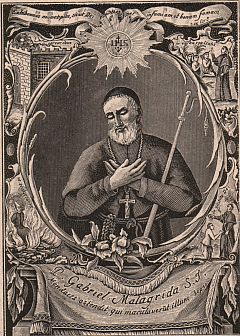
1761: Gabriel Malagrida, Jesuit nutter

On this date in 1761,* the Jesuit Gabriel Malagrida became a late casualty of the Tavora Affair and the Lisbon earthquake when he was garroted for heresy.

Malagrida (English Wikipedia entry | Portuguese) was a 72-year-old Italian with decades of missionary service to the Portuguese New World colonies under his belt.

He had, in his time, been a prominent exponent of the Jesuits missions’ policy in the Amazon, which amounted to asserting their own jurisdiction against the secular government’s attempt to order its overseas territories. (There’s more on that conflict here.)

And this only exacerbated his principal sin of being a Jesuit — an order whose diminution was eagerly sought by the rising statesman of Enlightenment Portugal, the Marquis of Pombal.

The shock of the 1755 Lisbon earthquake would deal Pombal the trump hand he needed to start reshaping both city and society to his liking.

Malagrida, meanwhile, carped that the earthquake’s causes

“are not comets, are not stars, are not vapors or exhalations,** are not phenomena, they are not natural contingencies or causes; but they are solely our intolerable sins … I do not know how a Catholic subject dares to attribute the present calamity of this tragic earthquake to causes and natural contingencies. Do not these Catholics understand this world is not a house without an owner?”

This published pamphlet merely echoed what many of the order were saying in the pulpits, and Pombal was not about to let the backwards, superstitious crowd** own the catastrophe.

Malagrida was banished from Lisbon: and, when the Tavora family was implicated in an attempt to assassinate the Portuguese king, Malagrida, their confessor, found himself clapped in prison.

Though the now-septuagenarian priest did not share the Tavoras’ grisly public butchery, he was left to molder. A couple years in a dungeon saw him go a bit strange, and supposedly he published treatises with such eccentric features as God’s personal instructions to Malagrida, and Malagrida’s fascination with St. Anne’s uterus. Catholic sources, which consider Malagrida a martyr, doubt that he ever published any such thing; if he did, it seems apparent that it was dementia rather than heresy that afflicted the old man.

But Pombal had installed his own brother as judge of the tribunal, so the matter was prearranged. The execution itself was

staged in a dramatic way, even to the point of Malagrida’s appearing on the scaffold in Jesuit habit, to impress upon the Portuguese and the world at large that an old order had come to an end and a new one was to be established … one might say that … symbolism at the cost of one human life was a relatively humane procedure in comparison with the symbolic elimination of whole classes of society in the twentieth century.


Detail view (click for the full image) of Malagrida executed at a Lisbon auto de fe. CC image from Ricardo Mealha, original provenance unknown.

Pitying the superstitious Jesuit at the stake, Enlightenment secularist Voltaire inveighed against Enlightenment secularist Pombal for conducting the execution … just part of Voltaire’s queer ideas about not killing people over their religious beliefs.

“It is all pity and horror,” Voltaire wrote in a private correspondence. “The Inquisition has found the secret to inspire compassion for the Jesuits.”

Voltaire’s appraisal in Candide (already published by this time) of a country in the grip of religious superstition unjustly stands as one of the lasting literary monuments to an event that actually rolled back clerical influence: “the sages of [Portugal] could think of no means more effectual to prevent utter ruin than to give the people a beautiful auto-da-fé; for … the burning of a few people alive by a slow fire, and with great ceremony, is an infallible secret to hinder the earth from quaking.” That the philosophe who penned those words waxed so immoderately outraged at the demonstrative chastisement of a man who preached precisely all that hocus-pocus — that Voltaire ascribed his execution to “the Inquisition” — plants the cherry on the irony sundae.‡

But Pombal’s expedient use of the Inquisition’s medieval machinery to make an example of Father Malagrida would not be the start of a pattern; the Pombaline reforms of the years to come brought the Inquisition sharply to heel, and it was Malagrida himself who was its last victim (pdf) in Portugal in its classical ecclesiastic form.


The house where Malagrida was born in Menaggio, Italy is marked with a plaque. Image (c) kallipyg and used with permission.

* Some sources give September 20 as the date.

** The “God is pissed” hypothesis was posited against theories of earth’s vapors promulgated by the Pombal-sponsored scientist Ribeiro Sanches.

† Anti-Jesuit sentiment was widely abroad in Europe at this time; increasingly resented as political manipulators, the Society would be suppressed by papal order in 1773, only to revive during the post-Napoleonic reaction.

‡ Malagrida was well-known to contemporaries in Europe, but that does not mean sympathy for him was universal. The British pol Lord Shelburne was satirized as “Malagrida” for his putative duplicity.

On this day..

1764: The Sirven family, in effigy

On this date in 1764, Pierre-Paul Sirven and his wife — who lay beyond the reach of the law, in Switzerland — were burned in effigy at Mazamet, France, for murdering their daughter.

The Sirvens actually had three daughters; the purported victim, Elisabeth, was mentally unbalanced. The Protestant Pierre-Paul Sirven had had a recent run-in with the Catholic hierarchy in his native Castres, when Elisabeth was shanghaied to a convent for Catholic indoctrination under a lettre de cachet.

The Sirvens moved away to Saint Alby, near Mazamet, but when Elisabeth turned up dead in a well there early in 1762, the official presumption was that her schismatic parents had done her in to prevent her returning to the true church. It could have been that she just fell down the well accidentally, or went and committed suicide; as often in such cases, investigations commencing from a suspicion of foul play are liable to find that suspicion self-affirming.

To make matters worse, all this transpired during the dangerous run-up to the execution of Jean Calas in Toulouse, another instance where a doubtful criminal case was pursued against a Protestant.

Wisely, the Sirvens (parents and two remaining daughters) blew town.

They made it to Switzerland, where they holed up with Voltaire. Back in Mamazet, the parents were condemned to death and the other two children to exile for participating in the purported murder of Elisabeth. “This judgment was equally absurd and abominable,” Voltaire wrote.

If the father, in concert with his wife, had strangled his daughter, he ought to have been broken on the wheel, like Calas, and the mother to have been burned — at least, after having been strangled — because the practice of breaking women on the wheel is not yet the custom in the country of this judge. To limit the punishment to hanging in such a case, was an acknowledgment that the crime was not proved, and that in the doubt the halter was adopted to compromise for want of evidence.

The death sentences — further compromised by the absence of their objects — were nevertheless carried out in effigy on September 11, 1764.

Meanwhile, Voltaire turned his pen to the service of the Sirven cause; a French pamphlet he wrote vindicating both the Sirvens and Calas can be perused here. (Deadly religious persecution in France kept Voltaire quite preoccupied in the 1760s.)

After spending the decade trying to clear the family name from abroad, Pierre-Paul Sirven sensed an opening to return and gave himself up in 1769. The anti-Protestant hostility of the early 1760s had cooled by this time; the Calas execution was widely regretted.

Pierre-Paul Sirven was officially tried and exonerated in 1771, leading Voltaire to remark,

It only took two hours to sentence a virtuous family to death and it took us nine years to give them justice.

Part of the Themed Set: Executions in Effigy.

On this day..

1714: Maria Mouton and her slave Titus, lovers

On this date in 1714, a slave and his mistress — “mistress” in both senses of the word — were put to death in the Dutch Cape Colony for murdering her husband.

Marie or Maria Mouton had arrived in South Africa in 1699 as a nine-year-old with a refugee Huguenot family.

A decade and a half’s passage finds her a young woman wed to one Franz or Frans Joost/Jooste/Joostens, to whom she bore two sons … and, evidently, a homicidal grudge.

Early in 1714, Maria and her lover, a slave named Titus Bengale, murdered Frans, in consequence of which crime,

[s]he [Maria] is sentenced to be half strangled, after that to be scorched,* and after that strangled unto death. Titus to be empaled and to remain so, until death. After that his head and right hand are to be cut off and fixed on a pole, beyond the limits of his late master’s property. Fortuin, an accomplice, is also to have his right hand cut off, and without receiving the coup de grace, is to be broken on the wheel. After that he is to be placed on a grating until death takes place. After that his head is to be cut off, and with his hand placed on a pole, together with the head and hand of Titus. After that the bodies are to be taken to the outside place of execution, and there left exposed to the air and the vultures.

She’s the only white woman to be executed in 18th century South Africa.

Our Precise of the Archives of the Cape of Good Hope** notices that Titus, despite enduring his grotesque execution for two full days before succumbing, remained terribly jocund amid his public torture. (Not unlike other slaves tortured to death in Dutch colonies):

September 3 — The slave Titus, above mentioned, died about midday, having lived in his misery about 48 hours; something horrible to think of, to say nothing of personally beholding the misery. It is said that 4 hours after his empalement he received a bottle of arrack from which he drank freely and heartily. When advised not to take too much, lest he should get drunk, he answered that it did not matter, as he sat fast enough, and that there was no fear of his falling. It is true that whilst sitting in that deplorable state, he often joked, and scoffingly said that he would never again believe a woman. A way of dying, lauded by the Romans, but damnable among the Christians.

This case is discussed in more detail by Nigel Penn in “The wife, the farmer and the farmer’s slaves: adultery and murder on a frontier farm in the early eighteenth century Cape,” Kronos, vol. 28 (2002) — here’s an excerpt — and by the same author in Rogues, Rebels and Runaways: Eighteenth-Century Cape Characters.

* Literally, blaker. “To ‘blaker’ someone,” notes Nigel Penn in “The wife, the farmer and the farmer’s slaves: adultery and murder on a frontier farm in the early eighteenth century Cape,” Kronos, vol. 28 (2002), “was to hold burning straw to their face and to blacken it … a reference to the earlier practice of burning at the stake victims found guilty of heresy, witchcraft and sodomy. Surely we may also see, in the case of the blackening of Maria Mouton, a reference to her crime of cohabiting with slaves.”

** After another slaveowner was murdered later in the year, the chronicle laments that “crime is rapidly assuming large dimensions, in spite of the means used to prevent or suppress it. A clear proof that this Colony mainly consists of evil disposed, head-strong slaves and the refuse of convicts.”

On this day..

1676: Marie-Madeleine-Marguerite d’Aubray, Marquise de Brinvilliers

This date’s story is amply but succinctly conveyed by the public-domain entry in the 19th century tome Biography, or Third Division of the “English Encyclopedia”.

(Paragraph breaks have been added for readability.)


Brinvilliers, Marie Marguerite, Marquise de (English Wikipedia entry | French) who obtained infamy as a poisoner in the time of Louis XIV, was a daughter of the Dreux d’Aubrai, a lieutenant civil, or judge having a certain limited jurisdiction, at whose hands she received a careful education.

In 1651, whilst still very young, she became the wife of the Marquis de Brinvilliers, with whom she resided at her father’s house, in Paris. Her husband, who was the colonel of the Regiment de Normandie, entertained at his house a young officer of cavalry of the Regiment de Tracy, named Gaudin de Sainte-Croix, a native of Montauban, and the illegitimate member of an illustrious family. He was unprincipled enough to encourage the unlawful passion which the marchioness conceived for him; and her father, in consequence, procured in 1663 a lettre de cachet against Sainte-Croix, who underwent a year’s incarceration in the Bastille.

During his confinement he learned from a fellow-prisoner, an Italian named Exili, the art of preparing subtle poisons; a secret which, upon his enlargement, he communicated to his mistress, who determined to poison her father and the other members of her family. Having first wantonly essayed her art upon the patients of the Hotel-Dieu, she proceeded, with the aid of a servant named Jean Amelin, or La Chaussee, to take the lives of her father, her two brothers, and her sister.

This feat she accomplished gradually between the years 1666 and 1670. More than once she poisoned her husband; but Sainte-Croix, whose prudence shrank from the obligation of marrying the terrible widow, each time preserved the life of the Marquis by the administration of an antidote.

Sainte-Croix died suddenly in July, 1672, in the act, it is said, of compounding a subtle poison, against the effects of which he was left unprotected by the accidental fracture of a glass mask which he wore as a defence against the fumes of his deadly drugs.*

As no relative came forward to claim his property, it was taken possession of by the public authorities, who, instead of complying with the written instructions of Sainte-Croix,** dated May 25th, 1672, that a particular casket should be delivered to Madame de Brinvilliers, examined it, together with above thirty letters which he had received from her. There was also found a promise on her part to pay Sainte-Croix a sum of 30,000 libres, bearing the date of June 20th, 1670, eight days after the poisoning of the “lieutenant civil,” her father. The casket proved to be full of packets of various poisons, to each of which was affixed a label indicating the peculiar effects it was calculated to produce.

The Marchioness, fatally compromised by these and other circumstances, sought safety in flight, repairing first to England, then to Germany, and finally to Liege, where she was apprehended.

Being taken to Paris, she denied her guilt; but after her condemnation made a confession, in which, and in a kind of autobiography, she charged herself with more and greater horrors than had seemed possible to rumour or suspicion.


The Marquise de Brinvilliers, shortly before her execution, by Charles LeBrun

She was executed at seven o’clock on the evening of the 16th of July, 1676, being first beheaded and afterwards burnt. As her application and use of poison, which went by the name of poudre de succession, seemed to be growing prevalent, Louis XIV instituted a special court for the investigation and punishment of this species of crime.


This tale, uniting the attractions of bodice-ripper, true crime, and costume drama, has been adapted to stage and literature numerous times.

Alexandre Dumas pere, a true aficionado of historical crime and scandal, turned it into a much lengthier piece, from which we morbidly excerpt his description of the water torture the criminal endured prior to beheading — beginning with the sentence of the court.


“That by the finding of the court, d’Aubray de Brinvilliers is convicted of causing the death by poison of Maitre Dreux d’Aubray, her father, and of the two Maitres d’Aubray, her brothers, one a civil lieutenant, the other a councillor to the Parliament, also of attempting the life of Therese d’Aubray, her sister; in punishment whereof the court has condemned and does condemn the said d’Aubray de Brinvilliers to make the rightful atonement before the great gate of the church of Paris, whither she shall be conveyed in a tumbril, barefoot, a rope on her neck, holding in her hands a burning torch two pounds in weight; and there on her knees she shall say and declare that maliciously, with desire for revenge and seeking their goods, she did poison her father, cause to be poisoned her two brothers, and attempt the life of her sister, whereof she doth repent, asking pardon of God, of the king, and of the judges; and when this is done, she shall be conveyed and carried in the same tumbril to the Place de Greve of this town, there to have her head cut off on a scaffold to be set up for the purpose at that place; afterwards her body to be burnt and the ashes scattered; and first she is to be subjected to the question ordinary and extraordinary, that she may reveal the names of her accomplices. She is declared to be deprived of all successions from her said father, brothers, and sister, from the date of the several crimes; and all her goods are confiscated to the proper persons; and the sum of 4000 livres shall be paid out of her estate to the king, and 400 livres to the Church for prayers to be said on behalf of the poisoned persons; and all the costs shall be paid, including those of Amelin called Lachaussee. In Parliament, 16th July 1676.

The marquise heard her sentence without showing any sign of fear or weakness. When it was finished, she said to the registrar, “Will you, sir, be so kind as to read it again? I had not expected the tumbril, and I was so much struck by that that I lost the thread of what followed.”

The registrar read the sentence again. From that moment she was the property of the executioner, who approached her. She knew him by the cord he held in his hands, and extended her own, looking him over coolly from head to foot without a word. The judges then filed out, disclosing as they did so the various apparatus of the question. The marquise firmly gazed upon the racks and ghastly rings, on which so many had been stretched crying and screaming. She noticed the three buckets of water prepared for her, and turned to the registrar — for she would not address the executioner — saying, with a smile, “No doubt all this water is to drown me in? I hope you don’t suppose that a person of my size could swallow it all.” The executioner said not a word, but began taking off her cloak and all her other garments, until she was completely naked. He then led her up to the wall and made her sit on the rack of the ordinary question, two feet from the ground. There she was again asked to give the names of her accomplices, the composition of the poison and its antidote; but she made the same reply as to the doctor [namely, that she had no accomplices besides Sainte-Croix and did not know how to make the poison or its antidote], only adding, “If you do not believe me, you have my body in your hands, and you can torture me.”

The registrar signed to the executioner to do his duty. He first fastened the feet of the marquise to two rings close together fixed to a board; then making her lie down, he fastened her wrists to two other rings in the wall, distant about three feet from each other. The head was at the same height as the feet, and the body, held up on a trestle, described a half-curve, as though lying over a wheel. To increase the stretch of the limbs, the man gave two turns to a crank, which pushed the feet, at first about twelve inches from the rings, to a distance of six inches. And here we may leave our narrative to reproduce the official report.

“On the small trestle, while she was being stretched, she said several times, ‘My God! you are killing me! And I only spoke the truth.’

“The water was given: she turned and twisted, saying, ‘You are killing me!’


The torture of the Marquise de Brinvilliers. (Click for a larger image.)

“The water was again given.

“Admonished to name her accomplices, she said there was only one man, who had asked her for poison to get rid of his wife, but he was dead.

“The water was given; she moved a little, but would not say anything.

“Admonished to say why, if she had no accomplice, she had written from the Conciergerie to Penautier, begging him to do all he could for her, and to remember that his interests in this matter were the same as her own, she said that she never knew Penautier had had any understanding with Sainte-Croix about the poisons, and it would be a lie to say otherwise; but when a paper was found in Sainte-Croix’s box that concerned Penautier, she remembered how often she had seen him at the house, and thought it possible that the friendship might have included some business about the poisons; that, being in doubt on the point, she risked writing a letter as though she were sure, for by doing so she was not prejudicing her own case; for either Penautier was an accomplice of Sainte-Croix or he was not. If he was, he would suppose the marquise knew enough to accuse him, and would accordingly do his best to save her; if he was not, the letter was a letter wasted, and that was all.

“The water was again given; she turned and twisted much, but said that on this subject she had said all she possibly could; if she said anything else, it would be untrue.”

* According to Anne Somerset in The Affair of the Poisons: Murder, Infanticide, and Satanism at the Court of Louis XIV, this story of Sainte-Croix’s death by accidental exposure to his own toxins is “a myth” that developed in view of subsequent events.

“In fact,” writes Somerset, “his end was far more prosaic. He died after a long illness, having received the last rites and performed his final devotions with terrible piety.”

** Because Sainte-Croix died in debt, and his possessions were inventoried for his creditors.

On this day..

1285: Tile Kolup, pretender

On this date in 1285, a pretender to the Holy Roman Empire* throne was burned at the stake in Wetzlar, Germany.

Kolup (English Wikipedia page | German) found room to perpetrate his fraud via the “King in the mountain” legend.

This myth of a past hero who sleeps out of sight, awaiting the opportune moment for return, has a wide cultural currency; King Arthur would be the readiest example for most Anglos.

In Germany from the 13th century, a similar myth attached to Emperor Frederick I “Barbarossa”, who had suddenly drowned during the Third Crusade in 1190 after reigning as Holy Roman Emperor for nearly 40 years. It’s a myth with enough resonance for this poem by 19th century German romantic Friedrich Rückert:

The ancient Barbarossa,
Frederich, the Kaiser great,
Within the castle-cavern
Sits in enchanted state.

He did not die; but ever
Waits in the chamber deep,
Where hidden under the castle
He sat himself to sleep.

The splendor of the Empire
He took with him away,
And back to earth will bring it
When dawns the promised day.

The chair is ivory purest
Whereof he makes his bed;
The table is of marble
Whereon he props his head.

His beard, not flax, but burning
With fierce and fiery glow
Right through the marble table
Beneath his chair does grow.

He nods in dreams and winketh
With dull, half-open eyes,
And once an age he beckons
A page that standeth by.

He bids the boy in slumber:
“O dwarf, go up this hour,
And see if still the ravens
Are flying round the tower.

“And if the ancient ravens
Still wheel above us here,
Then must I sleep enchanted
For many a hundred year.”

(To say nothing of the resonance for the Nazis who codenamed their invasion of the Soviet Union Barbarossa.)

Anyway, by the time we lay our scene late in the 13th century, when the Hohenstaufen line has tragically vanished, a version of this myth — the “Emperor of Peace” (German link) — has attached itself to Barbarossa’s grandson, Frederick II. Like Frederick I, he was a great and long-lived consolidator of the Empire; unfortunately, he’s been dead since 1250. Or has he?!

Tile Kolup appears in 1284 claiming to be this Frederick, who would have been going on 90 years old at this time. The good citizens of Cologne are his first audience, and he totally bombs with them; only their conviction that he’s more madman than usurper gets him run out of town with only a taunting.

But he finds a more receptive crowd in Neuss, and for a time keeps a court there and issues documents on Frederick II’s authority. Rudolph I, King of the Romans and butt of reindeer jokes, eventually nabs him in nearby Wetzlar and tortures him into admitting his imposture.

There are some succinct German biographies of this falsche Friedrich here and here.

* “This agglomeration which was called and which still calls itself the Holy Roman Empire was neither holy, nor Roman, nor an empire.” -Voltaire. (And the coffee talk lady.)

On this day..

1533: John Frith and Andrew Hewet, Protestants

Life is all about timing.

Death too.

This date in 1533 saw John Frith and Andrew Hewet burned to ashes at Smithfield for Protestantism … just a week before Henry VIII himself was excommunicated from the Catholic Church.

A Cambridge man who’d picked up some heresy in Lutheran Germany, Frith was a friend of William Tyndale and did a couple of turns in English prisons for his various transgressions of orthodoxy.

He was finally nabbed by a warrant of then-Chancellor Thomas More before he could escape to the continent, and hailed before a doctrinal court for sacramentarianism.

During his examination by the bishops, Frith stated that he could not agree with them that it was an article of faith that he must believe, under pain of damnation, that when a priest prayed during the mass, the substance of the bread and wine were changed into the actual body and blood of our Savior Jesus Christ, even though their appearance remained the same. And even if this was so, which he did not believe it was, it should not be an article of faith.

–Foxe’s Book of Martyrs

(Said transubstantiation hypothesis remains Catholic doctrine to this day, but at least it’s no longer worth your life to dispute it.)

All the pieces were in place for this radical theology to become orthodoxy over the succeeding generation. The newly-designated Archbishop of Canterbury — still for the moment within the Catholic fold — was reformer Thomas Cranmer. Despite his sympathy for a shared evangelical cause, Cranmer passed a guilty verdict after trying to talk Frith out of his belief. In the event, however, it was the Inquisitor who was converted: Cranmer over the course of the 1530s adopted Frith’s own view. He would eventually enshrine it in the Book of Common Prayer.

All of which, of course, was made possible by Henry’s insistence on ditching his first wife in favor of Anne Boleyn, and Cranmer’s support for that action. On July 11, both the king and his pliant prelate were excommunicated by Pope Clement VII.

Still, it must be allowed that this fact scarcely gave carte blanche to Protestant reformers in England. Maybe Frith was made for the flames regardless: as timing goes, the 1530s were great for religious martyrdom.

Andrew Hewet, our poor footnote, had no part in these august affairs save the victim’s. Hewet was a tailor’s apprentice who was just caught up with an anti-heretical accusation at the wrong time. In prison, he too refused to acknowledge transubstantiation — saying, “I believe as John Frith believes.” For so believing, he burned as Frith burned.

On this day..

1591: Euphane MacCalzean, witch

If there’s one thing King James VI of Scotland (eventually to also become James I of England) worried a lot about, it was witches.

The Al Qaeda of the 16th century imagination, those shadowy yet omnipresent necromancers were especially feared around this time for their powers of supernatural mayhem, and you can take your pick on the phenomenon’s psychosocial explanation. (It was hardly limited to Scotland.)

Whatever it was, King James had it in spades.

The son of one executed monarch and father of another, James kept head tightly fixed to shoulders all his own days, and he used it to write the (well, a) book on witch-hunting.

THE fearefull aboundinge at this time in this countrie, of these detestable slaues of the Deuill, the Witches or enchaunters, hath moved me (beloued reader) to dispatch in post, this following treatise of mine, not in any wise (as I protest) to serue for a shew of my learning & ingine, but onely (mooued of conscience) to preasse / thereby, so farre as I can, to resolue the doubting harts of many; both that such assaultes of Sathan are most certainly practized, & that the instrumentes thereof, merits most severly to be punished: against the damnable opinions … not ashamed in publike print to deny, that ther can be such a thing as Witch-craft.

–Daemonologie

You couldn’t fault the guy for a lot of daylight between his principles and his practices.


With a deft political touch, Shakespeare wrote Macbeth after James ascended the English throne as James I.

In 1589, Jamie sailed to Denmark to wed a Danish princess. When ferocious storms nearly wrecked the royal convoy on its return trip, there was only one possible explanation: witchcraft. And security theater for 16th century Scotland wasn’t taking your shoes off when ferrying across the nearby loch — it was publicly burning human beings to death for consorting with the devil.

So once the king made it back home, he initiated the North Berwick Witch Trials, the first notable witch-hunt of his reign.

It was what you’d expect. Seventy people accused, the doomed tortured into confessions like Jack Bauer would do, and a respectable harvest of souls, most famously (because interrogated by the king himself) Agnes Sampson. “Most of the winter of 1591,” writes one chronicler, “was spent in the discovery and examination of witches and sorcerers.”

Our day’s principal, whose name has various different renderings (such as Eufame Mackalzeane), was the last to suffer for some months.

Euphan McCalzeane was a lady possessed of a considerable estate in her own right. She was the daughter of Thomas McCalzeane, lord Cliftenhall, one of the senators of the college of justice, whose death in the year 1581 spared him the disgrace and misery of seeing his daughter fall by the hands of the executioner. She was married to a gentleman of her own name, by whom she had three children. She was accused of treasonably conspiring of the king; of raising storms to hinder his return from Denmark; and of various other articles of witchcraft. She was heard by counsel in her defense; was found guilty by the jury, which consisted of landed gentlemen of note; and her punishment was still severer than that commonly inflicted on the weyward sisters; she was burned alive, and her estate confiscated. Her children, however, after being thus barbarously robbed of their mother, were restored by act of parliament against the forfeiture. The act does not say that the sentence was unjust, but that the king was touched in honour and conscience to restore the children. But to move the wheels of his majesty’s conscience, the children had to grease them, by a payment of five thousand merks to the donator of escheat, and by relinquishing the estate of Cliftonhall, which the king gave to sir James Sandilands, of Slamanno.

As a striking picture of the state of justice, humanity, and science, in those times, it may be remarked, that this sir James Sandilands, a favourite of the king’s, ex interiore principis familiaritate, who got this estate, which the daughter of one lord of session forfeited, on account of being a witch, did that very year murder another lord of session in the suburbs of Edinburgh, in the public street, without undergoing either trial or punishment. (Source

Like any number of other executed “witches,” this one professed innocence at the scaffold.

Before she was strangled and burnt, the poor woman “tooke it on her conscience that she was innocent of all the crymes layed to her charge.”

On this day..

1734: Marie-Joseph Angélique, for burning Montreal

On this date in 1734, a Portuguese-born slave known as Marie-Joseph Angélique was publicly hanged before the burned ruins of old Montreal on an accusation of having set the blaze.

Having recently been caught attempting to abscond with her lover, a white servant named Claude Thibault, Angelique was the instant consensus community suspect when Montreal caught fire on April 10. Forty-six buildings in the still-small frontier town burned; Angelique was arrested the very next morning.

(Thibault fled town, his fate unknown but presumptively no worse than what befell his paramour.)

Nobody died in the fire, but conflagrations were deadly serious back in the bucket brigade era.

The sentence

calls for the said Marie Joseph Angelique in reparation for the Fire caused by Her and other issues brought forward at the trial, to be condemned to make honourable amends Disrobed, a Rope around her Neck, holding in her hands a flaming torch weighing two Pounds before the door and main entrance of the parish Church of the said City of Montreal, where She will be led by the Executor of the high Court And there on her knees state and declare in a loud and intelligible voice that she maliciously and defiantly and wrongly set the Said fire for which She is repentant, [and] ask Forgiveness from God, the King and the Court; this done she is to be taken to the public square of the said City of Montreal to be Hanged until dead at the gallows erected for this Purpose at the said square, and then her dead Body is to be placed on a flaming pyre and burned and her Ashes Cast to the wind, her belongings taken and confiscated by the King; prior to this the said Marie Joseph Angelique is to be subjected to torture in the ordinary and extraordinary ways in order to have her reveal her accomplices …

And so she was.

Although the torture broke Angelique’s now-useless denial of her own guilt, she maintained her defense of Claude Thibault, insisting that she acted alone. It’s up for debate whether she did, in fact, act alone, or act at all — and if Angelique was guilty, what meaning or intent one can ascribe to her action.

There’s a fascinating exploration of this case, including the available primary documents, available in English or French.

On this day..