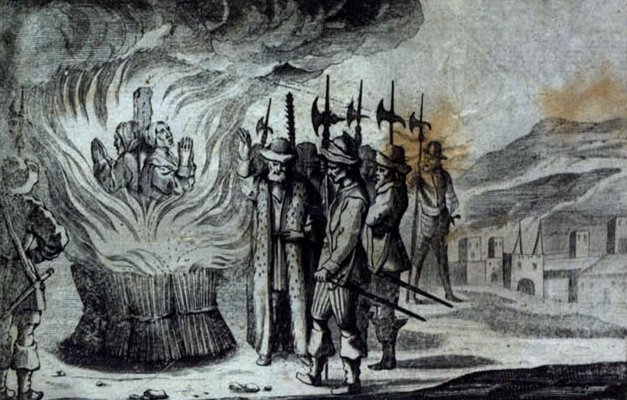
On this date in 1830,* a slave named Jerry was executed in Abbeville, South Carolina … by burning to death.
The slave was the property of a Miss Elizabeth McQuerns, a schoolteacher who hired him out — in which capacity he raped the wife of his subcontracted master.
This case is treated in an April 1990 piece for The South Carolina Historical Magazine by Lowry Ware, titled “The Burning of Jerry: The Last Slave Execution by Fire in South Carolina?” But in addition to being the last execution by fire in South Carolina, it might well be the last in the United States. (The quotes below are all via Ware.)
“Judicial,” for slaves, was of course something less than a robust vindication of the defendant’s rights — and burning sentences imposed in colonial and antebellum America were almost universally used against black slaves. One pictures a context not unlike that of extrajudicial burnings to follow in the decades yet to come.
According to a copy of the trial transcript McQuerns later filed for compensation (the original trial record is lost, Ware says),
the Court acquainted [Jerry] that they were to proceed immediately upon trial and would hear his answer to the charge against him and whatever witnesses he had to produce in his behalf as well as against him.
The witness produced to support the charge against the prisoner was heard and examined and there being no witness in behalf of the prisoner, the court after mature consideration of the case found the prisoner guilty … [and was condemned to] be sent to the Gaol of the said District and there remain until the first day of May next and then be brought back to an old field above West Donald still house, and there burnt to death between the hours of twelve and two o’clock.
…
But previous to awarding and ordering said sentence to be executed appraised and valued said Negro slave man named Jerry at four hundred dollars and direct the sum of ____ to be paid to Elizabeth McQuerns the owner of said Negro and the remainder of the sum of ____ dollars to ____ agreeably to the Act of Assembly made and provided.
Such a dramatically anachronistic sentence surely made its impression.
As remembered, decades later, by a minister named Samuel Leard who witnessed the execution as a teenager,
thousands of men, women and children, both white and colored, assembled together in an old field not far from the residence of Mr. Donald to witness the execution of a beastly criminal by burning alive at the stake. The crime cannot with propriety be named — the name and the memory of the criminal ought to be consigned to eternal oblivion. But there sat the prisoner, the waiting impatient crowd, the immense pile of pitch pine logs and kindling wood scattered around, the sheriff and his posse, the temporary platform for the preacher … for it was determined that the fiendish criminal should hear his own funeral sermon pronounced … As the poor doomed man ascended the pile, he began to pray audibly and this was kept up continuously during the process of chaining him to the stake, and until the mounting flames deprived him of a wretched life. This was the last execution by fire ever seen in South Carolina.
–Abbeville Press & Banner, July 2, 1879
In 1833, the Palmetto State humanely legislated that “that “on the conviction of a slave, or a free person of color, for a capital offence, the punishment shall be by hanging, and not otherwise.”
* The scanty documentation remaining of this case leaves the date less than completely ironclad, but the one issued in sentence attested in this piece will have to do.
On this date in 1655, Catholic forces under the Duke of Savoy carried out a notorious massacre of Waldensians* in the Piedmont.
This interesting, excommunicate sect had persisted for centuries in those hard-to-reach places in Alpine foothills, intermittently ignored and hunted. After Martin Luther, many Protestants inclined to see them as a proto-Reformation movement, or even a counter-papal apostolic succession reaching back to ancient Christianity.
At any rate, they sure weren’t Catholic.
And our friend the Duke decided — perhaps piqued by the murder of a missionary Catholic priest, or for whatever other reason — to mount one of those heresy-extirpating sorties and make them Catholic in 1655.
On April 17, the Marquis of Pianezza appeared with an overwhelming force of mixed Piedmontese, French, and Irish** troops. They conducted a few skirmishes, then made nice with the Waldensian civic leaders and induced them to quartering their troops temporarily further to some expedient pretext.
Alas! alas! these poor people were undone. They had received under their roof the executioners of themselves and their families. The first two days, the 22d and 23d of April, passed in peace, the soldiers sitting at the same table, sleeping under the same roof, and conversing freely with their destined victims …
At last the blow fell like a thunderbolt. At four of the clock on the morning of the 24th April the signal was given from the Castle of La Torre. But who shall describe the scenes that followed? On the instant a thousand assassins began the work of death …
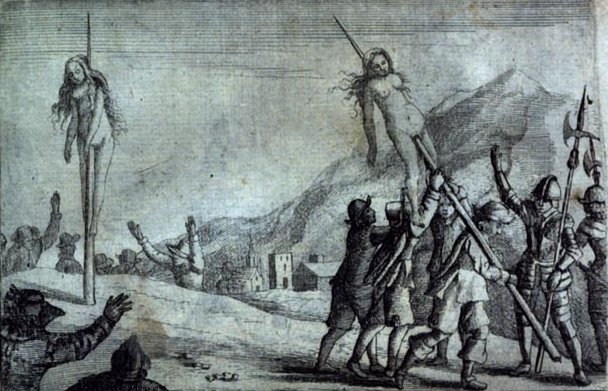
Little children were torn from the arms of their mothers, and dashed against the rocks; or, more horrible still, they were held betwixt two soldiers, who, unmoved by their piteous cries and the sight of their quivering limbs, tore them up into two halves. Their bodies were then thrown on the highways and the fields. Sick persons and old people, men and women, were burned alive in their own houses; some were hacked in pieces; some were bound up in the form of a ball, and precipitated over the rocks or rolled down the mountains … Some were slowly dismembered, and fire applied to the wounds to staunch the bleeding and prolong their sufferings; some were flayed alive; some roasted alive; others were disembowelled; some were horribly and shamefully mutilated, and of others the flesh and brains were boiled and actually eaten by these cannibals.
Without doubting the capacity of man’s inhumanity to man, the cannibalism charge reminds that we’re dealing with propaganda alongside historiography. And what great propaganda — like, babies-torn-from-incubators great.
Thumbnails (click for a larger, disturbing view) of selected images of this date’s atrocities from Samuel Morland’s The History of the Evangelical Churches of the Valleys of Piedmont
And there’s little doubt as to the overall savagery of the affair, which could well have become the opening salvo in a full-scale sectarian cleansing campaign. (A later addendum to Foxe’s Book of Martyrsnarrates the ensuing Piedmontese armed struggle, petering out before any definitive resolution in the field.)
Outrage at this hecatomb spread in Protestant Europe — which would also refer to the day’s doings as the “Bloody Easter,” since it corresponded with the eve of that celebration as reckoned by the Julian Calendar (source).
It was felt especially in Protectorate England, which intervened diplomatically.
A “day of solemn fasting and humiliation” was promulgated in Albion, along with collections for the relief of the survivors. Oliver Cromwell personally put £2,000 into the kitty.
More importantly, he dispatched diplomat Samuel Morland† to force the House of Savoy to lay off the persecution; in fact, he threatened to disrupt high statecraft between England and France unless the French twisted arms on behalf of the Waldensians.
Written correspondence for Morland’s diplomatic tour addressed to Louis XIV of France and various other continental potentates, as well as a fiery bit of oratory that Morland delivered to Savoy, all seem to have originated from the pen of Republican scribbler John Milton — the future author of Paradise Lost.‡
Milton, for whom the whole thing was more than just a day job, was further moved to put his umbrage at the slaughter into sonnet form:
Avenge O Lord thy slaughter’d Saints, whose bones
Lie scatter’d on the Alpine mountains cold,
Ev’n them who kept thy truth so pure of old
When all our Fathers worship’t Stocks and Stones,
Forget not: in thy book record their groanes
Who were thy Sheep and in their antient Fold
Slayn by the bloody Piemontese that roll’d
Mother with Infant down the Rocks. Their moans
The Vales redoubl’d to the Hills, and they
To Heav’n. Their martyr’d blood and ashes sow
O’re all th’ Italian fields where still doth sway
The triple Tyrant: that from these may grow
A hunder’d-fold, who having learnt thy way
Early may fly the Babylonian wo.
* The Waldensians in question here are interchangeably known as the Vaudois for their geographic region, actually above the Piedmont and abutting the Swiss region also known as Vaud. (These pages have visited the latter.)
This date in 1647 marked the execution of five supposed witches in Trentino.
Secular and modernist as this grim site‘s curators confessedly stand, we have perhaps given too little credence to those devout officers of the law who labored in those years to uphold the throne of heaven besieged by Satan’s varied earthly minions.
Montague Summers
In an effort to balance the record, we present this date’s account as rendered by a guy who took the supernatural a bit more seriously: Montague Summers.
Summers is a weird figure, but if he wasn’t really a throwback believer in Rome’s phantasmagoric early modern theology, he was the century’s most sublime performance artist.
Converting to Catholicism as an Anglican deacon, he went about in spooky clerical robes although his ordination status remains unclear to this day, immersed his capacious mind in supernatural arcana, and penned voluptuously eloquent books credulously treating the spectral evidence another era had given against sorcerers, vampires, lycanthropes, and suchlike habitues of the Monster Manual.*
I have endeavoured to show the witch as she really was -– an evil liver: a social pest and parasite: the devotee of a loathly and obscene creed: an adept at poisoning, blackmail, and other creeping crimes: a member of a powerful secret organization inimical to Church and State: a blasphemer in word and deed, swaying the villagers by terror and superstition: a charlatan and a quack sometimes: a bawd: an abortionist: the dark counselor of lewd court ladies and adulterous gallants: a minister to vice and inconceivable corruption, battening upon the filth and foulest passions of the age.
Summers projected (perhaps intentionally) a mysterious and vaguely sinister persona and did not disdain to cultivate a friendship with nefarious occultist Aleister Crowley, his contemporary. There were even rumors of an unwholesome interest in pederasty.
We’re confident that none of this has done his sales a bit of harm. So who are we social pests and parasites of the blogosphere not to batten upon it ourselves?
The below is drawn from Summers’ The Geography of Witchcraft — and as the reader will perceive, Geography at least purports to treat the flying-off-to-infernal-orgy stock in trade of those bygone witch hunters as legitimate evidence of the lead crone’s “attendance at the Sabbat, sometimes, no doubt, an experience on the psychic plane, for she was undoubtedly a medium of unusual powers, and sometimes in actual fact.”
A typical case of Witchcraft, and one which owing to its prominence and the meticulous investigations of the authorities has luckily been reported in full, attracted considerable attention in the winter of 1646 and the following spring. It will, moreover, be found to present so many factors and features, which occur again and again in the contemporary trials of wellnigh every European country, that it may profitably be dealt with in some detail.
A certain old woman of Castelnovo, Maria Salvatori, nicknamed “la Mercuria,” who had long been suspected of sorcery, was arrested on 26 October, 1646, and formally examined. At first the two principal charges, sufficiently damning in themselves, seem to have been that at her communions she did not swallow the Sacred Host, but kept It in her mouth to spit It out secretly and reserve It for some abominable purpose, and also that by her ecbolic spells she had caused the young Marchesa Bevilacqua to miscarry in childbirth. She was again interrogated on 8 November and put to the torture of the cord when she accused Domenica, the widow of a certain Tomaso Camelli, and Domenica’s daughter, Lucia, the wife of Antonio Caveden, both of whom dwelt at the hamlet of Villa, of being rank witches. She also avowed she had taken a Host from her mouth to give to Lucia Caveden, who thereby confected a charm which caused the abortion of the Marcioness. She added that she had also bewitched Cristoforo Sparamani, the son of Cecilia Sparamani, and that a certain Delaito Cavaleri was a necromancer and a worshipper of Satan. A further interrogation followed on 15 November, as a result of which the court, consisting of Paride Madernino, delegate in all criminal and civil cases in the districts of Castelnovo and Castellano, and his assessor Giovanni Ropele, doctor utriusque iuris, promptly gave orders to GiuseppeCoriziano, “bargello di questa turia,” to arrest Domenica and Lucia. This was done, and on Saturday, 24 November, 1646, at Nogaredo, the proceedings against the witches were formally opened. “Processus Criminalis pro destructione lamiarum.” On 27 November Domenica Carnelli was questioned by the judges, but they got little enough out of her. Two days following Lucia Caveden was brought before the tribunal. She vehemently declared that the charges were all malice; the hag Salvatori was her enemy; and with many cries she called Heaven to witness her innocence, repeatedly exclaiming “per grazia del Signor Iddio no son una stria” But the next day she proved less firm and implicated yet another woman, Domenica Gratiadei, who was immediately thrown into prison, a number of suspicious objects being found in her house when it was closely searched by the officers. Certain pots of a dark unguent and a mysterious powder being produced in court, Lucia Caveden confessed that these were for the destruction of human life and cattle. Seeing that the game was up Domenica Gratiadei, upon being put to the torture, soon laid bare all the secrets of the infernal sisterhood. She had made this unguent with which she annointed herself to attend the Sabbat “trasformata in gatto,” she had cast the evil eye on Cristofero Sparamani, she had renounced her baptism, defiled the Blessed Sacrament, adored Satan with divine honours. The judges were filled with horror, and trembled at the hideous tale of diabolism these women poured forth. Cecilia Sparamani, a plain honest woman, was next summoned as a witness and told how her son fell into fits of no ordinary kind. The doctors had acknowledged their skill baffled, and in spite of the prayers of two Capuchin fathers and the exorcisms of Monsignore the Bishop of Brondolo, this preternatural sickness still persisted. She informed the court that as soon as summer came and the roads were passable she intended to take the boy to the shrine of S. Antony at Padua, to whom she had a special devotion.
On 18 December, 1646, Benvenuta, the daughter of Domenica Gratiadei, made a startling confession. She declared that she had been taken by her mother “as if in a dream” to a place where there was dancing and singing, where she had been welcomed by a large number of revellers, and especially by a young man, who having kissed and fondled her awhile afterwards had connexion with her. This was, her mother averred, Satan himself. When closely questioned as to these proceedings the girl could only reply: “Tutto mi sembra, come ho detto, un sogno: e parevami che sempre vi fosse il diavolo in forma di quel giovene.” It would seem from these very striking and significant words that the girl was a hypnotic subject, entirely under her mother’s control, and that on these occasions she passed into a semi-trance state. The case dragged on throughout the months of January and February, 1647. There were interminable interrogations, and a large number of persons were gradually implicated.
On 2 January 1647, Domenica Gratiadei gave a detailed description of the Sabbats she had attended. She and an old warlock named Santo Peterlino always led the coven. “The rest followed in the shape of cats; but the Devil went first of all.” They enjoyed banquets, dances, plays, music, songs, and afterwards all worshipped Satan, presenting him with Hosts which they kept from their last communion. Before attending the Sabbat she anointed herself with an unguent made of “the Blessed Sacrament, the blood of certain small animals, Holy Water, the fat of dead babies” which was mixed with horrible imprecations and blasphemies to confect the charm.
On 10 January, a strange figure, Maddalena Andrei, nicknamed “La Filosofa,” first appears in the case. She confessed that she had assisted in the making of the ointment and had also adored the Devil who frequently appeared to her, “brave, like a gallant captain, dressed all in red.” On 9 March, when Giuseppe Goriziano entered the cell of La Filosofa to summon her to court he found her lying dead upon the floor. The common people believed that she had been carried off by Satan, especially as the Archpriest of Villa, Don Giovanni Bragliardi, shrewdly suspecting that the unhappy woman had committed suicide, refused her sepulture in consecrated ground.
This long and complicated Witchcraft-trial at length came to an end in April 1647. The court was throned with an excited yet hushed crowd, when the judge Paride Madernino and his assessors the Counts of Lodrone and Castel-Romano delivered the sentences. Domenica Camelli, Lucia Caveden, Domenica Gratiadei, Catterina Baroni, Zinevra Chemola, Isabella and Plonia Gratiadei, and Valentina Andrei were condemned to death. Maria Salvatori, “la Mercuria,” and Maddalena Andrei, “la Filosofa” had expired in prison. The condemned were beheaded and their bodies burned. It would seem, however, that Isabella and Polonia Gratiadei and Valentina Andrei managed to escape and could not be traced. The execution of the rest took place on 14 April, 1647, when Leonard Oberrdorfer the common hangman carried out the judicial sentence.
The chief witches here naturally fall into four groups each constituted of one old and one young woman, Domenica Camelli and Lucia her daughter; Domenica Gratiadei and Benvenuta her daughter; Isabella Gratiadei and Plonia her daughter; Maddalena Andrei and her daughter Valentina. The chief of the coven was undoubtedly Domenica Gratiadei, whose vile confessions, a mixture of most horrid blasphemies and lewdest obscenity, convince her of being a wretch wholly devoted to evil, and an active propagandist of the Satanic cult. It was she who had debauched her own daughter to “the Devil,” that young man whose name and individuality do not appear, but who may be guessed to have been a noble of the district, using the witches for his own ends and, presumably, supplying them with money to carry out his dark designs. That the whole gang frequently attended the Sabbat, at which he was not unseldom present, there can, I think, be no question.
This case is recounted in much greater detail in Italian in this Google book; this page has another summary, also in Italian.
* “[I]n every way a ‘character,’ and in some sort a throwback to the Middle Ages,” the London Times blurbed Summers at his death (obituary in the Aug. 11, 1948 issue). But his “preoccupations with the supernatural, however, represented only one side of his nature. His solid services to learning lie rather in his copious editorial and critical work on the English Restoration drama — a field in which he possessed the most comprehensive and expert knowledge.”
For exemplars of the stuff more topical to this post, one can also peruse free online his The Vampire: His Kith and Kin and his translation of the notorious witch-persecution manual Malleus Maleficarum.
Anne may have become a target of her prominent husband’s enemies; she was first implicated for witchcraft in 1575 when her husband’s uncle dropped dead, clearing the way for Absalon to take his place as bishop.
While she repelled that round of allegations, Absalon himself soon followed his kin into the great hereafter, leaving his widow a bit shorter on political pull. She lived on as a near-hermit, forever shadowed by the intimation of infernal intercourse.
In 1590, Anne’s neighbors, and maid, accused her again; her fate was sealed when a forbidding storm broke during her trial. (So says Witch Hunts in the Western World)
Anne Pedersdotter’s execution has become a literary staple in Norway, with a (highly dramatized) play (available free online here) itself re-stylized into other notable cultural products — such as Danish director Carl Theodor Dreyer‘s 1943 Vredens Dag (Day of Wrath) …
On this day in 1669, the Bavarian city of Augsburg executed 67-year-old Anna Ebeler for bewitching a string of infant children and just-delivered mothers.
Detail view of a pictorial history of the “witch” Anna Ebeler: the panels display her mutilated with tongs as she is led to execution; then, beheaded at the scaffold.
Ebeler plied her client with a refreshing bowl of malmsey and brandy soup (I could go for some myself), and the mother fell into a delirium that was bad enough to kill her but not so bad as to impact her credibility when she accused her lying-in maid of culinary devilry.
Once the accusation was “out there,” every other family on Ebeler’s c.v. whose birth experience was less than satisfactory — and there must have been a few of them, since infant mortality was off the charts in the 17th century — came forward with its own tale of woe.
Ebeler confessed when threatened with torture.
According to Lyndal Roper, who uses this affair as the touchstone event in “Witchcraft and Fantasy in Early Modern Germany” (History Workshop, Autumn 1991) — it was one of “just” 18 scattered witchcraft executions in a relatively forward-thinking burg — witchcraft
beliefs rested on a whole economy of bodily fluids. A post menopausal woman, the old witch was in a sense a dry woman who, instead of feeding others well, diverted nourishment to her own selfish ends. Older widows were believed to have the power to ruin young men sexually, and youths were warned against marrying such women because they were sexually ravenous, and would suck out their seed, weakening them with their insatiable hunger for seminal fluid and contaminating them with their own impurities.
I could go for some of that, too.
At any rate, a lying-in maid like Anna Ebeler — a woman hired by the birth mother for a ritualistic period of several post-natal weeks of maternal sequestration — put herself at risk (quoth Roper) of having projected onto her all the delivered mother’s psychological amibiguity about her condition, all her illicit resentment of her progeny, all her own latent fear of death after childbirth. All the ingredients, in short, of post-partum depression … in supernatural form.
[I]nstead of seeking the source of her ills in post-natal depression, within herself, as we [modern people] would, the mother’s anxieties about the child’s fate and her own ability to nourish it were directed outwards, so that harm to either mother or baby was believed to have been caused by another. Here we might make use of what Melanie Klein says about splitting, which allows intolerable feelings of hostility and malice to be projected onto another, so that the mother recognizes only benevolence in herself, projecting the evil feelings about herself onto the ‘other’ mother. The lying-in-maid was thus destined for the role of the evil mother, because she could be seen to use her feminine power to give oral gratification to do the reverse – to suck the infant dry, poison the mother and her milk and, in the most extreme form of witch fantasies, to kill, dismember and eat the child at the witches’ sabbath.
That dish, we’ll pass on.
Roper makes an interesting and nuanced exploration into the psychic space of witchcraft accusations, usually shaped by female-on-female charges. It’s terrain further developed in her Witch Craze: Terror and Fantasy in Baroque Germany.
One last item from Roper, of specific relevance to the lot who haunt these pages:
There is a further collusive dynamic at work in interrogation, that between witch and torturer. Torture was carried out by the town hangman, who would eventually be responsible for the convicted witch’s execution. Justice in the early modern period was not impersonal: the act of execution involved two individuals who, by the time of execution, were well acquainted with each other. Particularly in witch trials, torture and the long period of time it took for a conviction to be secured gave the executioner a unique knowledge of an individual’s capacity to withstand pain, and of their physiological and spiritual reactions to touch. In a society where nakedness was rare, he knew her body better than anyone else. He washed and shaved the witch, searching all the surfaces of her body for the tell-tale diabolic marks – sometimes hidden ‘in her shame’, her genitals. He bound up her wounds after the torture. On the other hand, he was a dishonourable member of society, excluded from civic intercourse, and forced to intermarry amongst his own kind. His touch might pollute; yet his craft involved him in physically investigating the witch, a woman who if innocent was forbidden him. He advised on the mode of execution, assessing how much pain the witch might stand, a function he could potentially exploit to show mercy or practise cruelty. In consequence, a bond of intense personal dependence on the part of the witch on her persecutor might be established. Euphrosina Endriss was greatly agitated when a visiting executioner from nearby Memmingen inspected her. She pleaded that ‘this man should not execute her, she would rather that Hartman should execute her, for she knew him already’.
On this date in 1244, over two hundred Cathar heretics submitted themselves to the stake rather than submit to the Catholic church.
Though not literally the last of the Cathars, that outlawed dualistic sect in the south of France whose extirpation occupied the papacy for much of the 13th century, this date was the last great stand and the signature massacre of the Albigensian Crusade. Afterwards, only minor outposts and isolated individuals would remain available for mop-up duty.
Heretical holdouts, fleeing a malevolent Inquisition established in the Languedoc by victorious Catholic armies, holed up at a few Cathar strongholds of which the most impressive was the mountain citadel of Montsegur.
The spectacular attraction of Montsegur tourists see today is not the legendary Cathar castle — which was razed by its conquerors — but a subsequent rebuild. (cc) image from SarahLouiseHathaway
Finally in 1243-1244, a massive Catholic army invested Montsegur; one can’t help but compare this hopeless confederation of fearless zealouts ranged against the mighty temporal powers to the Jews at Masada — and as with Masada, it were death to succumb to the besiegers.
When Montsegur finally surrendered, two hundred-some — the reported counts differ slightly — were burned at the stake for refusing to renounce their faith; many of them had actually taken sacred vows in the days before Montsegur fell.
They were Nazis, Dude?
The National Socialists’ weird quest to outrace Indiana Jones for mystical artifacts also brought the swastika to Montsegur, under the direction of the occult medievalist Otto Rahn.
Rahn thought the Holy Grail may have been secreted at Montsegur under Cathar protection, a half-literal, half-metaphorical secret goblet carrying the heretics’ forbidden gnostic wisdom from the day of Mani.
(Other Nazis, allegedly including Heinrich Himmler himself, favored the similar-sounding Spanish fortress of Montserrat. Dan Brown prefers the Knights Templar, who could have laid their gauntlets on the cup of Christ when a few Cathars allegedly slipped through Montsegur’s encirclement carrying some unidentified mysterious secret.)
In the year 1554, there was imprisoned at Ghent, in Flanders, for following Christ and living according to God’s commandments, a young brother named David, who, when examined, freely confessed his faith. Being asked what he thought of the sacrament, David said, that he considered it nothing else than idolatry. Then a priest said to him, “Friend, you err greatly, that you so readily confess your faith, for it will cost you your life, if you do not change your mind in time.” Thereupon David sweetly replied, “I am ready to shed my blood for the name of Christ, even though it should be here in this place; for God is my salvation, who will keep me, and preserve me from all evil.” The priest said, “It will not be as good as though you were put to death secretly here in this place; but you will be burnt publicly at the stake, for an everlasting reproach.” He was then brought into the court, where he was condemned to death, and his sentence was read, namely, that he had fallen from the true faith into heresy, and was therefore, according to the imperial edict, sentenced to be strangled and burned. David said, “No one will ever be able to prove by the Scriptures, that the faith for which I must now die is heresy.”
There was also sentenced to death with him a woman named Levina, who rather forsook, not only her six dear children, but also her temporal life, than her dear Lord and Bridegroom Jesus Christ. Arriving on the scaffold, David attempted to kneel down in order to offer up his prayer to God, but he was prevented, and they were immediately driven away to the stakes, standing at which, David said to Levina, “Rejoice, dear sister; for what we suffer here is not to be compared with the eternal good that awaits us.” (Rom. 8:18) When about to offer up their sacrifice, both exclaimed, “Father, into thy hands do we commend our spirits.” A little bag of gunpowder was tied to each of them, whereupon they were strangled and burned. But there happened a manifest miracle of God; for though they were completely burned, and the fire was as good as extinguished, David was seen to move his head, so that the people exclaimed, “He still lives.” The executioner seized the fork, and thrust it three times into his bowels, so that the blood flowed out; yet even after this he was still seen to move, hence, the executioner threw a chain around his neck, and bound him to the stake, and thus broke his neck.
Thus these two valiantly fought their way through, firmly trusting in God, who did not let them be confounded, since they had firmly built their building upon the only foundation; wherefore they shall never perish, but abide forever.
(Thanks to Carl Pyrdum, III, the author of the hilariously incisive blog Got Medieval, for this guest post — which originally appeared as part of his decidedly irreverent Medieval Months stroll through the Catholic Church’s quirky calendar of saintly feast days. -ed.)
While not one of the Holy Helpers proper, St. Agatha, whose feast falls on February 5, has special powers to heal ailments of the breasts, on account of having had hers cut off for refusing to worship pagan idols.
Like Bartholomew, she is usually depicted in the unfortunate after state in iconography, carrying her severed breasts before her on a tray or plate.
Because detached breasts sort of resemble bells, she’s the patron saint of bellfounders, and because they also kind of resemble dough, she works double duty as the patron of bakers, too. Oh, and just to be clear, that last sentence isn’t one of those clearly nonsensical sentences I pepper my writing with for purposes of the comedy. Agatha is the patron saint of severed boobs and everything that kind of looks like a severed boob.
The treats on the left are a traditional Cataniacassata known as “Agatha’s breasts” or “Virgin breasts” (“Minni di Vergini”). Image (c) Gergely Sipos and used with permission.
Four hundred years ago today, on Jan. 7 1611, three servants of the legendary “Countess of Blood” Elizabeth Bathory (Báthory Erzsébet, in the Hungarian) were tried, convicted, and immediately put to death for the noblewoman’s stupendous career of homicide.
This date’s entry is occasioned by the deaths of three subalterns — manservant Janos Ujvary, beheaded; and female attendants Ilona Jo and Dorottya Szentes, fingers ripped off and burned — but the headline attraction is their employer, who was never tried or condemned.
Bathory was rarefied Hungarian nobility, the niece of the King of Poland, which is also the biography of countless aristocrats you’ve never heard of.
The world remembers Elizabeth Bathory because she exploited her rank to butcher hundreds of peasant girls, allegedly to bathe in their rejuvenating blood.
On one occasion, a lady’s-maid saw something wrong in [Elizabeth Bathory’s] head-dress, and as a recompence for observing it, received such a severe box on the ears that the blood gushed from her nose, and spirted on to her mistress’s face. When the blood drops were washed off her face, her skin appeared much more beautiful — whiter and more transparent on the spots where the blood had been.
Elizabeth formed the resolution to bathe her face and her whole body in human blood so as to enhance her beauty.
These scrub-ups are what the Countess of Blood is best remembered for, but however striking the visual, it’s an atrocity that actually doesn’t turn up in the trial records.
But she could hardly complain of the embroidery, having given her interlocutors so much material.
Elizabeth Bathory is supposed to be responsible for over six hundred deaths, starting while her husband was away on campaign, and then carrying on into a wholesale operation after he died. When she and her servants were finally busted at Csejte Castle the end of 1610, their captors found a dead girl, a dying girl, and several others imprisoned and awaiting that fate.
Elizabeth Bathory, a sexually charged 1893 painting by Hungarian impressionist Istvan Csok depicting one of the countess’s victims being drenched in icy water for death by exposure.
So although the confessions the servants made this date to seal their own fates were undoubtedly torture-adduced, the documentary record turns out to be amazingly strong for such a fantastical spree. Hungarian King Matthias II convened a tribunal that examined 200 to 300 witnesses.
One can postulate that the woman ran afoul of a patriarchal culture affronted by her exercise of power or that she became a parable for the “unnatural” lust of a middle-aged woman … but so far as we are left to understand, Erzsebet Bathory really did lure young girls to her castle, and then inflict (pdf) a Nazi doctors’ litany of sadism on them … like jabbing them with needles to drain out their blood. She even kept a log of the victims in her own hand.
So, locals disappearing into the creepy castle, never to be seen again, or possibly to turn up pallid and dead. (Disposing of all those corpses became a logistical problem for the creepy castle.) No surprise to find it associated with the vampire legend.*
And no surprise that the tale became magnified, twisted, and reconfigured by popular culture.
In 1817, as accounts of the testimonies about the alleged murders and sadistic tortures were published for the first time, national and international headlines sensationalized the already misconceived story. From that on [sic], the literary countess took on a life of her own: the Grimm brothers wrote a short story about her, the romantic German writer, Johann Ludwig Tieck (1774 – 1853), cast her as a Gothic femme fatale, Swanhilda, in his short story Wake Not the Dead. It is alleged that Sheridan le Fanu shaped his female vampire Carmilla on Elizabeth Bathory. If we can believe some etymological explanation the compound English word blood-bath is of mid-nineteenth century origin possibly connected to the bloody countess’ rising popularity in England.
-László Kürti, “The Symbolic Construction of the Monstrous — The Elizabeth Bathory Story,” Croatian Journal Of Ethnology and Folklore Research, Jan. 2009
A few books about Erzsebet Bathory
To say nothing of the death porn (link not safe for work).
The noblewoman never faced an executioner herself, owing to her rank; she was shut up in the castle.
On an unspecified date presumably around early December of 1327 — the timeframe is approximated by action’s story’s commencing on “a beautiful morning at the end of November” — the Inquisition burns the nameless peasant lover of the narrator in Umberto Eco’s novel The Name of the Rose.
Adso of Melk is apprenticed to the scientific-minded William of Baskerville — a deliberate allusion to Sherlock Holmes — when the monk is dispatched to an Italian monastery to sniff about for heresy.
The Name of the Rose unfolds a labyrinthine murder mystery around a literal labyrinth (a maze-like library) as William and Adso fight crime and the superstitious dogmatism of the Church. Well … William fights these things. Young Adso mostly comes along for the ride and keeps the action signposted for the reader with his cluelessness.
As a teenage boy, Adso has his own demons to confront.
During their short stay at the monastery, Adso has a chance, and scorching, sexual encounter with a peasant girl from the lands owned by the monks. This subplot intersects with a relentless Inquisitor — the real-life historical figure Bernard Gui* — in pursuit of refugee Dolcinians and other heretical types who were actually running around northern Italy at this time.
The long and short of it is that the girl is condemned to the stake as a sorceress on ridiculous circumstantial evidence that the reason-favoring duo is in no position to repel, and that Gui is eager to trump up further to politically muscling Dolcinian-friendly monks.
The very watchable 1986 cinematic adaptation of the novel, starring Sean Connery as Brother William and Christian Slater as Adso, takes some liberties with Eco’s text on the matter of the girl.
In the novel, her execution happens “off-camera” but with a numbing certitude; it’s an evil in the world that no protagonist can prevent, and Adso just has to get used to the idea.
I was tempted to follow her … William, grim, restrained me. “Be still, fool,” he said. “The girl is lost; she is burnt flesh.”
Directly after convicting the girl for witchcraft, and nabbing two heretical monks in the process, Gui departs the convent towards the papacy’s then-residence at Avignon for a gratifying show trial. The monks are the real prize; Brother William prophesies that the girl
will be burned beforehand, along the way, to the edification of some Catharist village along the coast. I have heard it said that Bernard is to meet his colleague Jacques Fournier (remember that name: for the present he is burning Albigensians, but he has higher ambitions), and a beautiful witch to throw on the fire will increase the prestige and the fame of both.
The smitten Adso is heartbroken over this cruelty.
“So the cellarer was right: the simple folk always pay for all, even for those who speak in their favor … who with their words of penance have driven the simple to rebel!”
…
The only sure thing was that the girl would be burned. And I felt responsible, because it was as if she would also expiate on the pyre the sin I had committed with her.
I burst shamefully into sobs and fled to my cell, where all through the night I chewed my pallet and moaned helplessly, for I was not even allowed — as they did in the romances of chivalry I had read with my companions at Melk — to lament and call out the beloved’s name.
This was the only earthly love of my life, and I could not, then or ever after, call that love by name.
The film indulges a happier and very implausible fate for Adso’s hot little number: in this version, the executions take place on-site at the monastery, and other peasants riot, murder the Inquisitor, and free our oblate’s muse. Hey, in a work that’s all about faith, why not a little deus ex machina?
Warning: SpoilersThe Name of the Rose is a detective story, and the clips below intercut the execution scene with the mystery’s big reveal. Don’t watch them if you want to approach the film or the book without knowing how it all plays out.
The movie’s softhearted approach has the benefit of allowing a more cinematic and literal presentation of Adso’s choice between the life of the mind/soul and the life of the flesh. The clip below is spoiler-safe, since you already know which one he chooses.
To geek out on this book’s complex tapestry of allusions, you could do worse than this archived study guide.
* Played by F. Murray Abraham in the film. Gui wrote a notable tract on examining heretics; dust off your Latin to read it on Google books here, or get the gist with this English-translated excerpt.