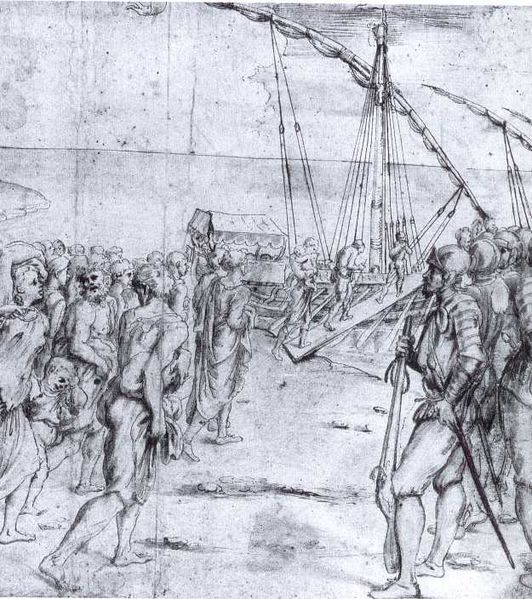
1520: Gaspar Quesada, Magellan’s expedition mutineer

On this date* in 1520, on his famous voyage of circumnavigation, explorer Ferdinand Magellan ordered the immediate execution of a mutinous captain.

Not to be trifled with.

Having alit just days before at the natural harbor of Puerto San Julien on the Brazilian Argentine coast (Magellan named it) with plans to winter there, the overweening Portuguese explorer faced an uprising of grumpy Spanish officers.

Gaspar Quesada, captain of the Concepcion, along with Luis de Mendoza of the Victoria and recently displaced San Antonio skipper Juan de Cartagena, seized some of the expedition’s ships during the night of April 1-2.

Since you know Magellan’s name five centuries later, you already know he quashed it.

As the sovereign of this fragile floating world, Magellan had little choice but to treat a challenge to his authority mercilessly.**

Though accounts are inconsistent, it seems Mendoza was boldly slain by one of Magellan’s men meeting him under color of “negotiation”.


Mendoza’s assassination. From this site.

Mendoza was then posthumously beheaded and quartered along with Gaspar Quesada. Juan de Cartagena was either executed as well, or else caught a “break”: some sources relate that, instead of executing Cartagena, Magellan had him marooned.

the twentieth of June [1578], wee harboured ourselues againe in a very good harborough, called by Magellan Port S. Julian, where we found a gibbet standing upon the maine, which we supposed to be the place where Magellan did execution upon some of his disobedient and rebellious company.

From a member of the Francis Drake expedition. Just 12 days later and at the very same place, Drake visited a similar penalty for a similar offense upon one of his own crew.

* “‘The authorities’ are divertingly divergent on the precise date of these events,” says O.H.K. Spate in The Spanish Lake, referring specifically to the dates of the mutiny. “Denucé puts them on Easter Sunday and Monday, 1–2 April; Merriman on Easter Sunday and Monday, 8–9 April; Nowell on Palm Sunday and the next day, with the trial verdict on 7 April. By the Julian calendar, in use until 1582, the dates would be 1–2 April; by the Gregorian, ten days later. Pigafetta and Maximilian, who slur over the whole affair, give no dates at all. It is not of vast moment.” Clearly, O.H.K. Spate never had to write an almanac blog.

Anyway, there’s some primary sourcing on this affair here.

** Though Magellan made an example of the leaders, he pragmatically spared about 40 others after keeping them in chains and working the pumps for three months. After all, the man still needed to crew his ships.

On this day..

1661: Thomas Venner and the Fifth Monarchy Men

On this date in 1661, the restored English monarchy made an end to the interregnum’s religious crazies.

A few other images of Thomas Venner are available here.

“It is difficult in these days to follow with patience, or even with complete seriousness, all the ramifications of Fifth Monarchy speculation,” writes historian Louise Fargo Brown, whose gratis tome The Political Activities of the Baptists and Fifth Monarchy Men in England proceeds to do just that.

This blog wants for both patience and seriousness, so we’ll sum up that Venner et al were the holy rollers of the day, the true whack-jobs in the millenarian hustle of Cromwellian England.

Venner himself was born in New England, and there’s a zippy bio of him in The New England Historical and Genealogical Register. The North American colonies and Parliamentarian Britain helped to incubate political/religious heterodoxy for one another, and Venner was not the only budding religious zealot in the distant marches to emigrate to London after Charles I lost his head.

There the cooper became an outspoken apostle of the Fifth Monarchists, a part of Cromwell’s coalition made for disappointment with the mundane machinations of statecraft. Relieved in time of any a share in General Ironsides’ burden of helming the state in choppy waters, the men of the Fifth Monarchy were at liberty, to retire with their slide rules and philosopher’s stones to calculate the (imminent) date of the apocalypse foretold by Daniel and pursue the maxim not yet born that, starting with a mistake, a remorseless logician can end up in Bedlam.

All well and good to mock from posterity, and from a country where Left Behind is a bestseller no less. To be fair to the Monarchy Men, one could as well say that the egalitarian political language of these “arrant Radicals and levellers” just happened to be scriptural.* They would hardly be the last to foretell a golden age made ready by the slaying of a king, not by a long shot.

At any rate, our Bostonian tradesman became such an outspoken prophet of the return of “King Jesus” that Cromwell was obliged to clap him in irons.

Venner didn’t take the hint well, nor other more salutary warnings, and Venner instigated a riot of his few dozen followers at the start of January 1661 that took London unawares and did some damage before it was put down.

Diarist Samuel Pepys records of the riots that

[a] thing that never was heard of, that so few men should dare and do so much mischief. Their word was, “The King Jesus, and the heads upon the gates.” Few of them would receive any quarter, but such as were taken by force and kept alive; expecting Jesus to come here and reign in the world presently, and will not believe yet but their work will be carried on though they do die.

Thomas Venner and his compatriot Roger Hodgkins died that traitor’s death this day, along with William Oxman and Giles Pritchard, the latter two having their sentences commuted to simple hanging and posthumous beheading. The remaining survivors of his band climbed the scaffold two days later.

* e.g., “Then shall the Oppressor cease and no more complaining be heard in the streets. Taxes should be no more. And Trade and industry should abound. … The poor should have bread, and the Army no more in Arrears. Prison doors should be open and Debtors satisfied without Arrests … then peace and safety, plenty and prosperity, should overflow the land.” (Cited by Brown)

Part of the Themed Set: Resistance and Rebellion in the Restoration.

On this day..

1676: Joshua Tefft, drawn and quartered in Rhode Island

On this date in 1676, Puritan colonist Joshua Tefft (or Tifft, or Tift) became perhaps the only person ever to suffer the traitor’s death of hanging and quartering in what is now the United States.

The 30-ish Rhode Island farmer got sucked into King Philip’s War and was captured by colonists apparently fighting for the Narragansett Indians during a the Great Swamp Fight.

Lacking a first-person account from Mr. Tefft, we are left to descry (or project) his purpose. Tefft himself claimed that he had been enslaved by the Indians, but he made this claim in the context of trying to avoid a grisly execution; opposing witnesses said he’d been much more enthusiastic in the fight, raising an evident horror of civilized man gone native.

Without English clothes and with a weather-beaten face, he looked like an Indian to the English. Tefft was a troubling example of what happened to a man when the Puritan’s god and culture were stripped away and Native savagery was allowed to take over. (Source)

He was one man caught up in a war, so of course he could have been many things. But Tefft invites speculation on racial self-identification on this still-tenuous New World frontier.

Living immediately adjacent to the Narragansett, Tefft was probably on good terms with the natives, something that at least some Anglos had keenly worked after for fifty-plus years. Some sources report (or charge) that he had taken an Indian wife,* and the Narragansett redoubt attacked in the Great Swamp Fight was a fortified encampment full of non-combatant types, hundreds of whom were eventually slaughtered.

And Rhode Island had a long-running border dispute with its Puritan fellow-colonists that intersected their historical differences on religious toleration. (Tefft is also decried as irreligious, though whether that’s literally true or just an extra heaping of opprobrium is anyone’s guess.) Why, after all, should a man not cohabit among the friendly peoples of his wife, and assist them when attacked — for the Narragansett were not at war until they were attacked — by a bunch of Connecticut and Plymouth colony prigs who’d want to shanghai him into their army?

One colonist able to sympathize with the Indians’ situation wrote of them that “perhaps if Englishmen, and good Christians too, had been in their case and under like temptations, possibly they might have done as they did.” Who knows but that some were, and they did.

Our Scouts brought in Prisoner one Tift, a Renegadoe English man, who having received a deserved punishment from our General, deserted our Army, and fled to the Enemy, where had good entertainment, and was again sent out by them with some of their forces; he was shot in the knee by our scouts, and then taken before he could discharge his musket, which was taken from him and found deep charged, and laden with Slugs: He was brought to our army, and tryed by a counsel of war, where he pretended that he was taken prisoner by the Indians, and by them compelled to bear Arms in their Service; but this being proved to be false, he was condemned to be hanged and Quartered, which was accordingly done. (Source)

But while some Indian tribes allied with some whites, European identification ultimately proved much too strong to admit any possibility of not banding together against the “savages.” When vengeful Narragansett warriors raided Providence the following spring and torched the house of Rhode Island founder Roger Williams, Massachusetts in sympathy lifted its 39-year-old exile on the man they’d have hung as a heretic in days gone by.

By then, it had long been over for Joshua Tefft, whose trial preceded execution by only two days. Joshua’s son Peter and other descendants of the Tefft family, however, would be fruitful and multiply.

By the time these New World settlements became the United States a century later, drawing and quartering was still on the books in England. But the New York legislature expressed (pdf) the sense of that realm’s North American offspring that this sentence even for treason was “marked by circumstances of Savage Cruelty, unnecessary for the Purpose of public Justice, and manifestly repugnant to that Spirit of Humanity, which should ever distinguish a free, a civilized, and Christian People.”

* Joshua Tefft’s previous wife, Sara, had died from childbirth a few years before. For Sara, also notable as the owner of what was once thought to be the oldest marked headstone in New England, it was her second husband … the first, Thomas Flounders, was hanged for murder.

Part of the Themed Set: Resistance and Rebellion in the Restoration.

On this day..

1609: Vicente Turixi, King of the Moriscos

La Expulsión de los Moriscos, by Vincenzo Carducci (Vicente Carducho).

Having taken the trouble over the preceding century to eliminate (or force underground) its substantial Muslim population by forcibly converting it to Christianity, Spain in the early 1600s bethought itself to complete the operation upon its recently minted fellow-Christians by ejecting these Moriscos from Spain altogether.

When the edict for this radical act of expulsion first came down in the heavily Morisco area of Valencia, some of its victims reportedly embraced the prospect of deportation to a land where their dress, language, and religion were no longer forbidden.

Others were less sanguine.

Armed resistance broke out in two wilderness fastnesses, the mountainous Vall de Laguar (Spanish link) and — as narrated by Henry Charles Lea in his freely available The Moriscos of Spain; their conversion and expulsion

the Muela de Cortes (Spanish link), an almost inexpugnable spot, being a deep valley surrounded by precipitous heights, of which the passes were easily defensible. The Moriscoes of that region … were in a state of excitement and were readily persuaded to rise by an outlaw named Pablillo Ubcar. They elected as king Vicente Turixi, who sent a proclamation through the sierra for all to join him under pain of treason. From their strongholds they made raids on the surrounding country, gathering cattle and provisions, burning villages, and desecrating churches.

[Ethnic cleansing coordinator Don Agustin] Mexia, absorbed in the work of embarkation and fearing to interrupt it, for awhile paid no attention to these movements … who could readily be reduced when the time came.

His provisions were justified … those of the Muela de Cortes … lost heart when they heard of the defeat of those of Aguar, and were disappointed as to the appearance of the Moor Alfatami on his green horse, whom tradition reported to be concealed under the mountain since the days of King Jayme … It was agreed that they [the rebels, surrendering] should be safe in person and property, provided they would go to embark within three days.

The rapacious soldiery, who had promised themselves abundant plunder, in their disappointment threw off all discipline; they sacked the village of Royaya, outraged the women and seized numbers of children as slaves. Only three thousand Moriscoes were brought to the port of embarkation, the rest having scattered and taken to the mountains to escape the fury of the soldiers.

These, estimated at two thousand in number, for several years gave infinite trouble, killing all the Christians they met and committing constant depredations. At one time the Governor of Jativa induced many of them to come down, but finding that they were to be enslaved they fled back to the mountains.

A reward was offered for King Turixi, dead or alive; he was tracked to a cave, captured, and brought to the city, when he was sentenced to have hands and ears cut off, to be drawn, torn with pincers, hanged and quartered; but at the execution, December 18th, the cutting of hands and ears was omitted. He had been confessed twice and reconciled twice, and died as a good Christian, making a most edifying end, for we are told that he had been a liberal almsgiver and devoted to the Virgin and the religious Orders.

The miserable remnants were hunted down gradually, the viceroy paying twenty ducats a head for them as galley-slaves.

The armed resistance in Valencia — where Moriscos were most numerous, and the expulsion was first decreed — was actually much less than had been feared, which gave the Spanish authorities all the encouragement they would need to enforce it elsewhere, too.

“Seeing that the whole body of our nation is tainted and corrupt, he applies to it the cautery that burns rather than the salve that soothes; and thus, by prudence, sagacity, care and the fear he inspires, he has borne on his mighty shoulders the weight of this great policy and carried it into effect, all our schemes and plots, importunities and wiles, being ineffectual to blind his Argus eyes, ever on the watch lest one of us should remain behind in concealment, and like a hidden root come in course of time to sprout and bear poisonous fruit in Spain, now cleansed, and relieved of the fear in which our vast numbers kept it.”

-Cervantes, Don Quixote

On this day..

1541: Thomas Culpeper and Francis Dereham, the Queen’s lovers

Indictment:

That Katharine, queen of England, formerly called Kath. Howerd, late of Lambyth, Surr., one of the daughters of lord Edmund Howard, before the marriage between the King and her, led an abominable, base, carnal, voluptuous, and vicious life, like a common harlot, with divers persons, as with Francis Derham of Lambeth and Hen. Manak [Manox] of Streteham, Surr., 20 and 24 May 32 Hen. VIII., and at other times, maintaining however the outward appearance of chastity and honesty. That she led the King by word and gesture to love her and (he believing her to be pure and chaste and free from other matrimonial yoke) arrogantly coupled herself with him in marriage. And the said Queen and Francis, being charged by divers of the King’s Council with their vicious life, could not deny it, but excused themselves by alleging that they were contracted to each other before the marriage with the King;* which contract at the time of the marriage they falsely and traitorously concealed** from the King, to the peril of the King and of his children to be begotten by her and the damage of the whole realm. And after the marriage, the said Queen and Francis, intending to renew their vicious life, 25 Aug. 33 Hen. VIII., at Pomfret, and at other times and places, practised that the said Francis should be retained in the Queen’s service; and the Queen, at Pomfret, 27 Aug. 33 Hen. VIII., did so retain the said Francis, and had him in notable favour above others, and, in her secret chamber and other suspect places, spoke with him and committed secret affairs to him both by word and writing, and for the fulfilling of their wicked and traitorous purpose, gave him divers gifts and sums of money on the 27 Aug. and at other times.

Also the said Queen, not satisfied with her vicious life aforesaid, on the 29 Aug. 33 Hen. VIII., at Pomfret, and at other times and places before and after, with Thos. Culpeper,† late of London, one of the gentlemen of the King’s privy chamber, falsely and traitorously held illicit meeting and conference to incite the said Culpeper to have carnal intercourse with her; and insinuated to him that she loved him above the King and all others. Similarly the said Culpeper incited the Queen. And the better and more secretly to pursue their carnal life they retained Jane lady Rochford, late wife of Sir Geo. Boleyn late lord Rochford, as a go-between to contrive meetings in the Queen’s stole chamber and other suspect places; and so the said Jane falsely and traitorously aided and abetted them.

On this date in 1541, Thomas Culpeper and Francis Dereham paid the penalty for their indiscretions; the former queen would see her lovers’ severed heads mounted on pikestaffs on London Bridge as she was rowed to the Tower.

The onetime court favorite Culpeper was beheaded for cuckolding the royal person, and that’s no more than one would expect. But the political pull-less Dereham — who had slept with (and possibly “pre-contracted” to wed) the willing young Kate before she meant anything to the king — enjoyed the full measure of the traitor’s torture: hanged, emasculated, eviscerated, and dismembered, all of it basically for having failed to anticipate that his little conquest would one day grow up to turn the monarch’s head.

What a time to be alive.

* Catherine Howard’s confessional letter to Henry VIII … desperately attempting to limit her indiscretions to the time before her marriage:

I, your Grace’s most sorrowful subject and most vile wretch in the world, not worthy to make any recommendation unto your most excellent Majesty, do only make my most humble submission and confession of my faults. And where no cause of mercy is given on my part, yet of your most accustomed mercy extended unto all other men undeserverd, most humbly on my hands and knees do desire one particle thereof to be extended unto me, although of all other creatures I am most unworthy either to be called your wife or subject.

My sorrow I can by no writing express, nevertheless I trust your most benign nature will have some respect unto my youth, my ignorance, my frailness, my humble confession of my faults, and plain declaration of the same, referring me wholly unto Your Grace’s pity and mercy. First, at the flattering and fair persuasions of Manox, being but a young girl, I suffered him a sundry times to handle and touch the secret parts of my body which neither became me with honesty to permit, nor him to require. Also, Francis Derehem by many persuasions procured me to his vicious purpose, and obtained first to lie upon my bed with his doublet and hose, and after within the bed, and finally he lay with me naked, and used me in such sort as a man doth his wife, many and sundry times, and our company ended almost a year before the King’s Magesty was married to my Lady Anne of Cleves and continued not past one quarter of a year, or a little above.

Now the whole truth being declared unto Your Majesty, I most humbly beseech you to consider the subtle persuasions of young men and the ignorance and frailness of young women. I was so desirous to be taken unto your Grace’s favor, and so blinded by with the desire of worldly glory that I could not, nor had grace to consider how great a fault it was to conceal my former faults from your Majesty, considering that I intended ever during my life to be faithful and true unto your Majesty ever after. Nevertheless, the sorrow of mine offenses was ever before mine eyes, considering the infinite goodness of your Majesty toward me from time to time ever increasing and not diminishing. Now, I refer the judgment of my offenses with my life and death wholly unto your most benign and merciful Grace, to be considered by no justice of your Majesty’s laws but only by your infinite goodness, pity, compassion and mercy, without which I acknowledge myself worthy of the most extreme punishment.

** Early the next year, parliament declared, “to avoid doubts in future” — read: “retroactively legislated” — that “an unchaste woman marrying the King shall be guilty of high treason.” This also made anyone who knew about said unchastity guilty of (at least) misprision of treason for failing to report it.

Surviving letter from Howard to Culpeper:

Master Culpeper,

I heartily recommend me unto you, praying you to send me word how that you do. It was showed me that you was sick, the which thing troubled me very much till such time that I hear from you praying you to send me word how that you do, for I never longed so much for a thing as I do to see you and to speak with you, the which I trust shall be shortly now. That which doth comfortly me very much when I think of it, and when I think again that you shall depart from me again it makes my heart die to think what fortune I have that I cannot be always in your company. It my trust is always in you that you will be as you have promised me, and in that hope I trust upon still, praying you that you will come when my Lady Rochford is here for then I shall be best at leisure to be at your commandment, thanking you for that you have promised me to be so good unto that poor fellow my man which is one of the griefs that I do feel to depart from him for then I do know no one that I dare trust to send to you, and therefore I pray you take him to be with you that I may sometime hear from you one thing. I pray you to give me a horse for my man for I had much ado to get one and therefore I pray send me one by him and in so doing I am as I said afor, and thus I take my leave of you, trusting to see you shortly again and I would you was with me now that you might see what pain I take in writing to you.

Yours as long as life endures,
Katheryn.

One thing I had forgotten and that is to instruct my man to tarry here with me still for he says whatsomever you bid him he will do it.

Though this letter is far from conclusively inculpatory, Culpeper confessed that he “intended and meant to do ill with the queen and that in like wise the queen so minded to do with him.”

On this day..

1326: Hugh Despenser the Younger, King Edward II’s lover?

On this date in 1326, the power behind Edward II’s throne — and the presumed lover in his bed — was hanged, drawn and quartered and pointedly emasculated in a grisly public execution as the Queen and her lover took control of England.

(Wince.)

The younger Despenser, being carved up in an illustration from Froissart.

Poor King Edward — that’s the swishy princeling gay-baited in Braveheart — would suffer a horrid demise of his own a few weeks later. He’s the one most conveniently read as a gay martyr.

Hugh Despenser the Younger (or Hugh le Despenser) has his fans, but he’s much more likely to be taken for a villain.

An upstart knight who unexpectedly lucked into a jackpot inheritance when his wife’s brother died at Bannockburn — that’s the rumble Robert the Bruce starts at the end of Braveheart — Hugh the younger parlayed his newfound position of feudal magnate into the still better gig of royal favorite.

That job was open because its occupants had a distressing tendency to get dead, a fate obviously ordained for Hugh Despenser as well.

But whereas Edward’s childhood pal Piers Gaveston, the murdered former fave, aroused mostly personal pique among rival nobles, Hugh Despenser meant to use his favor to rule.

Despenser exploited his position to build up his wealth and control the king; with his father (you’ll never guess that he went by “the elder”), he became the de facto if never the de jure ruler of the realm.

At one point, his rivals in the nobility turned the tables and got him exiled. Hugh became a pirate in the English Channel while he maneuvered his way back onto dry land in his customary most-favored-consigliere position.

So although the British barons who wanted Despenser’s head were undoubtedly a distasteful lot themselves, and certainly capable of all manner of depravity in pursuit of their own crass self-interest, it doesn’t take a backwards view of human sexuality to get why Hugh Despenser would raise an early 14th century Briton’s hackles.

But you have to give England this: its politics back then were a damn sight more interesting than you get today. Anyone who uses the term “bloodsport” for the modern electoral charade ought to cross cutlasses with the likes of the dread pirate Despenser.

And it gets better. Meaning, for Hugh Despenser the Younger, worse. Much.

Queen Isabella — that’s Sophie Marceau’s hot-for-barbarian imported princess in Braveheart — became estranged from her Hugh-lovin’ husband,* and established herself back in France with her lover Roger Mortimer.

Then, the lovebirds invaded England.

Edward and Hugh were so unpopular at this point that “their” nobles who should have repelled the incursion went in a landslide for the invading adulterers.

Hugh Despenser’s father had already been hanged for his trouble by the time The Younger was taken; the latter tried to cheat the executioner by refusing all food and drink for days, truly a spartan image of desperate self-mortification in a rough day and age.

When you get a load of the death his royal captors had worked out for him — and which they were obliged to deliver to their starving captive hurriedly in Hereford rather than more ceremoniously back in London — you can understand why. After a perfunctory trial that same morning, they tore the former favorite apart.

Froissart’s rendering:

When the feast was over sir Hugh, who was not beloved in those parts, was brought before the queen and knights assembled; the charges were read to him – to which he made no reply; the barons and knights then passed the following sentence on him: first, that he should be drawn on a hurdle, attended by trumpets and clarions, through all the streets in the city of Hereford, and then conducted to the market-place, where all the people were assembled; at that place he was to be bound on a high scaffold, in order that he might be more easily seen by the people. First, his privates were cut off, because he was deemed a heretic, and guilty of unnatural practices, even with the king, whose affections he had alienated from the queen by his wicked suggestions. His private parts were cast into a large fire kindled close to him; Afterwards, his heart was thrown into the same fire, because it had been false and traitorous, since he had by his treasonable counsels so advised the king, as to bring shame and mischief on the land, and had caused some of the greatest lords to be beheaded, by whom the kingdom ought to have been supported and defended; and had so seduced the king, that he could not or would not see the queen, or his eldest son, who was to be their future sovereign, both of whom had, to preserve their lives, been forced to quit the kingdom. The other parts of sir Hugh thus disposed of, his head was cut off and sent to London.**

It’s reported that Isabella and Mortimer feasted and made merry as they beheld this hideous spectacle. Now that’s bloodsport politics.

Hugh the younger Despenser and his life and times are covered in amazing detail by a couple of active-posting enthusiasts of this particular period who have already been linked elsewhere in this post: the aptly-named Edward II blog (dig his biography of Hugh Despenser, among many other such dramatis personae; also his account of the execution, already cited); and, Lady Despenser’s Scribery (whose entire sidebar is pretty much all about our day’s principal; for the quick tour, see her biography and posts on the “trial” and execution).

* The reason for said estrangement can be situated anywhere one likes along the personal-political spectrum; one recent historical novel speculates (upon no authority but dramatic license) that Hugh raped the queen.

** Remains reportedly discovered last year were speculatively identified as Hugh Despenser’s; the litany of injuries to the body testify to the ghastly death-ritual its owner underwent.

On this day..

1539: Richard Whiting, the last Abbot of Glastonbury

Letter to Thomas Cromwell from his man in Somerset,* Richard Pollard, a local gentry type making out well under the Dissolution of the Monasteries:

Pleaseth it your lordship to be advertised, that … the same 15th day [of November] the late abbot of Glastonbury went from Wells to Glastonbury, and there was drawn through the town upon a hurdle to the hill called the Torre, where he was put to execution; at which time he asked God mercy and the king for his great offences towards his highness, and also desired my servants then being there present to see the execution done, that they would be meane [communicate] to my lord president and to me that we should desire the king’s highness of his merciful goodness and in the way of charity to forgive him his great offences by him committed and done against his grace, and thereupon took his death very patiently, and his head and body bestowed in like manner as I certified your lordship in my last letter. And likewise the other two monks [John Thorne and Roger James, executed with Richard Whiting] desired like forgiveness, and took their death very patiently, whose souls God pardon.

And whereas I at my last being with your lordship at London moved your lordship for my brother Paulett, desiring your lordship to be a mean that he might have the surveyorship of Glastonbury, which I doubt not but he will use and exercise the said office to the king’s most profit and advantage, and your lordship’s goodness herein to him to be shown he shall recompense to his little power, I assure your lordship he hath been very diligent, and divers others by his means, to serve the king at this time, according to his duty and right…

the late abbot of Glastonbury, afore his execution, was examined upon divers articles and interrogatories to him ministered by me, but he could accuse no man but himself of any offence against the king’s highness, nor he would confess no more gold nor silver nor any other thing more than he did before your lordship in the Tower …

From Wells, the 16th day of November.

Your assured to command,

Rychard Pollard

Once one of the greatest religious houses in England (and the legendary burial place of King Arthur), Glastonbury Abbey today is a picturesque ruin. Cornell University has published some 19th century photos of the abbey’s remains in a less manicured, more gorgeously overgrown situation.

Pollard had just a few weeks before exonerated the monastery of any profligacy, and the abbot seems perhaps not to have even been properly charged or attainted … but as one can discern in Pollard’s cloying appeal to keep the surveying position in the family, the practical henchman had no qualms as events unfolded about taking a commercial position on the end of the Abbot of Glastonbury.

For your public domain perusing pleasure: The last abbot of Glastonbury: and other essays, by Cardinal Francis Aidan Gasquet.

* Pollard had been in the thick of the destruction of Henry Courtenay, Marquess of Exeter just the year before.

On this day..

1283: Dafydd ap Gruffydd, Prince of Wales

(Thanks to Jonathan Shipley of A Writer’s Desk for the guest post. -ed.)

Do not cross King Edward I.

If you cross “Longshanks,” as the regal man was called, you’re in for some serious pain. And then, eventually, you’ll die, like Dafydd ap Gruffydd did this day in 1283.

It is Dafydd, a Prince of Wales, who became the first prominent person in recorded history to have been hanged, drawn and quartered.

Yes, Dafydd’s death was particularly gruesome. Having fought alongside King Edward against Dafydd’s own brother and then returning to his brother’s side attacking King Edward’s Englishmen at Hawarden Castle, made the king rather peeved.

The English conquest of Wales: end of an era.

When Longshanks got the better of him, Dafydd was dragged through the streets of Shrewsbury attached to a horse’s tail. He was then hanged, but not enough to kill him, just enough to make it awfully uncomfortable.

More uncomfortable was the emasculation.

Perhaps more uncomfortable than being emasculated was when Dafydd was disemboweled and his entrails burned before his eyes.

Then they cut off his head, which must have been a relief.

Then they cut off his limbs.

Then they parboiled his head for later viewing.

(William Wallace met the same fate from the same king a couple of decades later.)

It wasn’t always so gruesome for Dafydd ap Gruffydd, the well-to-do Welshman. Things were going quite well there for a time -– as good as a bloody power struggle with your brother can be. Prince of Gwynedd, son of Gruffudd ap Llywelyn, grandson of the mightly Llweyln the Great, Dafydd ap Gruffydd was born in 1238 under the English King Henry III. In his teens, that wily rebel, Dafydd joined one brother (Owain Goch ap Gruffydd) to challenge another brother (Llywelyn ap Gruffydd) for power. Llwelyn won at the Battle of Bryn Derwin. In 1263 Dafydd tried again, joining King Henry against his brother. In 1274 he tried once again. This time with the new king, “Longshanks.”

Things were great. Dafydd was favored by the king. He married Lady Elizabeth Ferrers, daughter of the 5th Earl of Derby. He enjoyed a manor in Norfolk, before exchanging it for another in Northampton. Indeed, it was high society living for the Welshman.

But Wales wanted independence from England. In the spring of 1282 Dafydd, with his brother (the one he tried to defeat many times before, Llywelyn) attacked an English castle. Foolish. Compelled to help his brother yet not being prepared for all-out war, Dafydd crossed the king and the king, angered, pursued him with a vengeance. Troops marched out. Fortifications (Caernarfon Castle, Conwy Castle, Harlech Castle, etc.) were thrown up to squash any thoughts of any further Welsh rebellion, and seed the future Welsh tourist industry.

Come December of 1282, Llywelyn, Dafydd’s dear brother, was lured into a trap and killed. Dafydd became prince, for a brief and stressful span, what the pursuit of the Enligh army, and a king behind it all still fuming over being backstabbed by a Welshman.

Whenever the English caught up with him, he escaped. In April he went north to Dolbadarn Castle. In May he moved to Garth Celyn. Then to a bog. It was by Bera Mountain, in said bog, that Dafydd and his younger brother Owain were captured on June 22, 1284. Dafydd’s wife was taken prisoner, as were their seven daughters, and one niece. About a week later Edward proclaimed the last of the ‘treacherous lineage’ were now his. Dafydd’s fate was then discussed by parliament.

He was condemned to death, the first person known to have been tried and executed for what, from that time onwards, would be described as high treason against the King. And treasonous blokes don’t get off very easily when it comes to a peaceful execution. No, his entrails were burned before him for “his sacrilege in committing his crimes in the week of Christ’s passion.” His body was chopped up “for plotting the king’s death.” A gentlemen by the name of Geoffrey carried out the execution of the last native Prince of Wales. His payment? 20 shillings.

On this day..

1540: Three Papists and Three Anti-Papists

On this date in 1540, two days after disposing of his former Vicegerent of Spirituals Thomas Cromwell, the just-wedded Henry VIII wrote a terrifying message of religious conformity in blood and smoke at Smithfield.

Edward Hall (as he did with Cromwell) records the scene.

The thirtie daie of July, were drawen on herdelles out of the Tower to Smithfield, Robert Barnes Doctor in Diuinitee, Thomas Garard, and Wyllyam Jerome Bachelers in Diuinitee, Powell, Fetherston and Abell. The firste three were drawen to a stake, there before set up, and were hanged, hedded, and quartered. Here ye must note, that the first three, wer menne that professed the Gospell of Jesu Christ, and were Preachers thereof … [the first three] were detestable and abhominable Heretickes, and … had taught many heresies, the nomber whereof was to greate in the atteindor to be recited, so that there is not one alleged … in deede at their deathe, they asked the Sherifes, wherefore they were condempned, who answered, thei could not tell: but if I maie saie the truthe, moste menne said it was for Preachyng, against the Doctryne of Stephen Gardiner Bishoppe of Wynchester, who chiefly procured this their death … but greate pitie it was, that suche learned menne should bee cast awaie, without examinaction, neither knowyng what was laied to their charge, nor never called to answere.

The laste three … were put to death for Treason, and in their attaindor, is speciall mencion made of their offences, whiche was for the deniyng of the kynge ssupremacie, and affirmyng that his Mariage with the Lady Katheryne was good: These with other were the treasons, that thei wer attainted of, and suffered death for.

Terrifying and confusing: here were burnt three Protestants (Barnes, Gerrard and Jerome) for heresy under the Six Articles, essentially for excess radicalism; beside them were hanged, drawn and quartered three Catholics (Powell, Fetherston and Abel) for treasonably refusing the Oath of Succession, that is, for refusing to admit the King of England as the head of the Church of England. It was that old dispute about Anne Boleyn, who was three queens ago by now. (All three Catholic theologians were advisors to Anne’s predecessor and rival Catherine of Aragon, back in the day.)

The one thing that couldn’t possibly be confused in the day’s proceedings was that matters of the faith were matters of state, and in them Henry would brook heterodoxy of neither the liberal nor conservative variety.

“Good Lord! How do these people live?” exclaimed a foreign observer (cited here). “Here are the papists hanged, there are the anti-papists burnt!”

Good for the martyr industry all-around, and fodder for contemporaries to imagine their respective hereafters, as in “The metynge of Doctor Barons and Doctor Powell at Paradise gate”. (pdf)

On this day..

1592: Roger Ashton

On this date in 1592, Roger Ashton was hanged, drawn and quartered at Tyburn.

Ashton is a minor martyr on the Catholic rolls, one of many in the age who (as Edmund Campion put it) were called by determinedly Protestant English crown to “enjoy your Tyburn.”

We’ll let the Catholic Encyclopedia take it from here.

He was hanged, drawn, and quartered at Tyburn, 23 June, 1592. His indictment is not preserved. Challoner says it was for procuring a dispensation from Rome to marry his second cousin. Later evidence, while confirming this, shows that it was not the only cause.

In 1585 he had gone to serve in the under the Earl of Leicester against the Spaniards. Sir William Stanley having been placed on guard over the town of Deventer, which had revolted from the Spaniards, he, with the assistance of Ashton, gave the town back to Spain and went over to their side (29 January, 1587).*

Cardinal Allen published a “Defence” of this act** in the form of a letter addressed to one “R.A.”, whose letter to the Cardinal prefixed and under these initials it seems natural to recognize our martyr. Stanley next entrusted to Ashton the difficult task of bringing over his wife from Ireland, but she was already under arrest, and he is said to have been sent Ashton to Rome. At the close of the year 1587 he returned to England and was apprehended in Kent with the marriage dispensation already mentioned. In January, 1588, he was in the Tower, where he lay ill towards the close of the year, when he was transferred to easier confinement in the Marshalsea. From this he managed to escape and fled to his brothers in Lancashire.

He was seized later, at Shields near Newcastle, while trying to escape over the seas. Transferred thence to Durham and York, he was tried and sentenced at Canterbury, and died “very resolute”, making profession of his faith and “… pitied of the people”, though the infamous Topcliffe tried to stir up ill-feeling against him by enlarging on his services to Spain.


Executions at Tyburn in the time of Elizabeth. From Tyburn Tree.

* This event — an English commander betraying a city to the enemy during wartime (in fact, two English commanders, as Rowland York (or Yorke) handed the Spanish the fortress of Zutphen on the same day) — naturally raised a scandal in 1587.

Although this treacherous William Stanley is not to be confused with the contemporaneous fellow-noble of the same name who has a horse in the “who really wrote Shakespeare?” race, Lily Bess Campbell argues that the imprint of events in Deventer and the subsequent volley of pamphleteering informs a discourse of royal prerogative in the Bard’s Henry V, when the disguised monarch goes slumming with the common soldiery on the eve of the Battle of Agincourt.

BATES

… wee
know enough, if wee know wee are the Kings Subiects:
if his Cause be wrong, our obedience to the King wipes
the Cryme of it out of vs

WILLIAMS

But if the Cause be not good, the King himselfe
hath a heauie Reckoning to make, when all those
Legges, and Armes, and Heads, chopt off in a Battaile,
shall ioyne together at the latter day, and cry all, Wee dyed
at such a place, some swearing, some crying for a Surgean;
some vpon their Wiues, left poore behind them;
some vpon the Debts they owe, some vpon their Children
rawly left: I am afear’d, there are few dye well, that dye
in a Battaile: for how can they charitably dispose of any
thing, when Blood is their argument? Now, if these men
doe not dye well, it will be a black matter for the King,
that led them to it; who to disobey, were against all proportion
of subiection

Henry replies that soldiers should look after their conscience on their own time and obey the prince of the realm in wartime. No doubt Queen Elizabeth approved.

if they dye vnprouided, no more
is the King guiltie of their damnation, then hee was before
guiltie of those Impieties, for the which they are
now visited. Euery Subiects Dutie is the Kings, but
euery Subiects Soule is his owne.

(As long as we’re digressing with Shakespeare and anti-Stratfordian candidates, here’s an argument that the jittery national mood post-Deventer and pre-routing the Spanish Armada — the time when Mary, Queen of Scots lost her head — makes a case for dating the Henry plays to that period, which in turn makes a case for Edward de Vere as their true author. Make of that what you will.)

** The obedience due a sovereign as opposed to the obedience due to an abstract standard of Right is a lasting modern question, so it’s no surprise that Cardinal Allen’s justification has a modern ring.

For that to revolt, is of itselfe, lawful or unlawful, honorable or otherwise, according to the justice, or injustice of the cause, or difference of the person, from or to whom the revolt is made … Whensoever thou art armed, & in readinesse for battayle, let this be thy first cogitation, that thy very corporal streingth itselfe, is the gift of God: whereby thou shalt stil be put in minde, never to use the gift of God, against God him selfe, that gave it thee.

Presumably he wouldn’t have supported the “only following orders” defense.

On this day..