On this date in 1306, Scottish patriot Simon Fraser was drawn and quartered in London.
This Norman-descended lord was one of the side-switching nobles during the wars of William Wallace, but after completing the full circuit from Wallace to Edward I and back again, he unexpectedly decided to lash himself to St. Andrew‘s cross for good.
Perhaps he could tell where the wind was blowing, and not just for his historical reputation: Fraser’s former ally, “Red” Comyn, went down the other fork in the road, submitting himself to an irresistible English invasion the better to devote his energies to his longshot horse in the confusing Scottish regnal derby.
But no amount of royal sacrilege could arrest the popular fad for cutting a deal, and as celebrated in this History of the Frasers,
Every man of influence in the Kingdom, except Sir Simon Fraser, Sir William Wallace, and the band of patriots who comprised the garrison of Stirling, followed the example of Cumming [Comyn] … The patriots were proclaimed outlaws and their estates forfeited, and they ultimately sacrificed their noble lives in the undying service of their country. The redoubted Sir William Wallace continued most deservedly to be the idol of his countrymen for the glorious part which he took in establishing the independence of his fatherland, but “if to him be due the glory of being the first to awaken Scotland from her ignominious slumber, his efforts were nobly seconded by Sir Simon Fraser, who alone of the aristocracy was disposed to view with envy the merit which called his hero to command.”
Fraser outlived Wallace by a year, persisting in the field “bold as Caesar” which supposedly led a couple of Scottish knights imprisoned in the Tower to cockily wager their heads that the English would never corral him.*
Fraser suffered the torment of being hanged and cut down still alive for beheading, the spectacle of a double death (with the disemboweling part mercifully saved for posthumous application). His head was set on a spike on London Bridge beside Wallace’s, and his mangled trunk hung in chains under guard lest any soul sensitive to Scotch nationalism or mephitis should undertake to cut it down.
For all that he’s not even the most famous Simon Fraser to be executed by the English.
* Edward collected his prize; you can read all about it as an aside in this ballad on the execution of Fraser.
Sire Herbert of Morham, feyr knyht ant bold,
For the love of Frysel ys lyf wes ysold.
A wajour he made, so hit wes ytold,
Ys heued of to smhyte yef me him brohte in hold,
Wat so bytyde.
Sory wes he thenne,
Tho he myhte him kenne
Thourh the toun ryde.
Thenne seide ys scwyer a word anon-ryht:
“Sire, we beth dede; ne helpeth hit no wyht!”
(Thomas de Boys the scwyer wes to nome.)
“Nou Ychot oure wajour turneth ous to grome,
So Y bate!”
Y do ou to wyte,
Here heued was ofsmyte
Byfore the Tour gate.
Sir Herbert of Morham, a fair and bold knight,
For the love of Fraser his life was sold.
A wager he made, as it was told,
To have his head cut off if they captured Fraser,
Whatever betide.
Sorry was he then,
When he might see him
Ride through the town.
Then his squire spoke a word immediately:
“Sir, we’re dead; there’s no creature to help us!”
(Thomas de Bois was the squire’s name.)
“Now I know that our wager brings us to harm,
So my courage ends!”
I give you to know,
Their heads were cut off
Before the Tower gate.
Perhaps on this date in 1653 — it is, at any rate, the date saluted by a festival that honors him — the peasant Sakura Sogoro was crucified for protesting the oppressive taxation of his local lord.
Sogoro — familiarly known as Sogo-sama — was a village head man who dared to take his complaints about his daimyo‘s heavy hand right to the shogun himself. As punishment for this effrontery, the daimyo had the peasant executed (which punishment the sacrificial Sogoro anticipated in making his appeal) along with his wife and sons (which was an outrage).
As classically described, Sogoro from the cross damns the cruelty of the punishment and promises to revenge himself as a ghost, destroying the daimyo‘s house within three years. A century or so after his death, a shrine was erected to his memory which attracted pilgrims throughout the realm and made Sakura Sogoro “the patron saint of protest” (Anne Walthall, whom we shall hear more from later.) The tale has earned popular staging in Japanese culture from the kabuki stage to television.
The great 19th century kabuki actor Ichikawa Kodanji as the avenging specter of “Asakura Togo”, the Kabuki character based on Sakura Sogoro. Image from this gorgeous collection.
As one might infer from the sketchy account here, the story’s historicity is shaky despite its popularity down the centuries in Japan. According to an academic paper by Walthall,*
“The archetype of the peasant martyr, a man who deliberately sacrificed himself on behalf of his community.”
More has been written about Sakura Sogoro than about any other peasant hero, but the evidence of his existence is extremely circumstantial. Written accounts of him remain fragmentary until the 1770s …
The first mention of the Sogoro legend appears in Sakura fudoki (a record of provincial lore on Sakura), compiled by a Sakura domain bureaucrat, Isobe Shogen. He recounts how an old man had told him that Sogoro’s vengeful spirit caused the downfall of a seventeenth-century lord. This emphasis on revenge after death is common to many Japanese folktales. Its constant recurrence as a theme in Japanese history reflects a widely held belief in the power of strong emotions to wreak havoc after a person has died. At this point Sogoro was hardly a martyr for the peasants — they remembered not his own deeds, if any, but what had happened to the lord.
By the middle of the eighteenth century, the story gains more detail. After the death of the just lord, Hotta Masamori, his retainers take control of domanial administration, treat the peasants unjustly, and increase the land tax. To save the people, Sogoro makes a direct appeal to the shogun … becom[ing] an exemplar of righteous action, a man who placed community welfare above individual self-interest …
In narratives from the late eighteenth and early nineteenth centuries, the plot becomes still more elaborate. Sogoro is described as a man of scholarship, deeply religious, respectful of his superiors, mindful of his subordinates, esteemed by his neighbors. “He was intelligent, tactful, and did not look like he was peasant born. Everyone said he must be the descendant of a warrior” … As the savior of his village, he represented the peasants’ aspirations; as an angry spirit, he reflected their resentment of those in authority.
The most modern version of the legend omits all reference to revenge by angry spirits. Now the story depicts the courage of Sogoro and his supporters among the peasants and his heartrending renunciation of his family when he resolves to sacrifice himself for the community. He still puts his appeal directly in the hands of the shogun, even though modern historians have long argued that a meeting with the shogun was impossible for a peasant. In contrast to the “good king,” (the shogun Ietsuna) the villain, Hotta Masanobu, executes not merely Sogoro, but his four children. Even the cruelty of this command has become further elaborated. To evade the bakufu prohibition on the execution of women, officials pretend that Sogoro’s three daughters are actually sons and cut off their heads. In short, today people know only a lachrymose tale of tyranny and heroism.
English speakers can grab a couple renderings of this story in the public domain:
August 13 is the shared feast date* of third century saint and antipope — two adjectives rarely held in tandem — Hippolytus of Rome, and also the feast of the official pope to whom he reconciled in the end, Pontian.
His legend, including his feast date, has been muddled with another ancient martyr of the same name, and even with the mythological son of Theseus — from which also derives the etymologically apt fancy that St. Hippolytus met his end by the straining of horses.**
But Hippolytus the theologian and cleric was no fable.
Zealous after the correct doctrine in an age of heretical pitfalls like modalism and alogianism, Hippolytus clashed with Pope Zephyrinus and his successor Callixtus over their leniency — not only for heterodoxy but also for sinful conduct like adultery.
This timeless horn-locking between purists and pragmatists led Hippolytus to take his flock out of the Roman communion in opposition to Callixtus, and apparently to maintain himself as antipope for the best part of a generation — the very first recorded antipope, in fact.
Ironically it was the schismatic’s perspicacious quill that would bear to posterity much of our understanding of Christianity in the early third century. Apostolic Tradition, whose attribution to Hippolytus is contested, is a rare source on the early liturgy; Refutation of All Heresies helpfully catalogues dozens of beliefs disfavored of its author among pagan and Christian sects. He wrote a chronicle of the world since its creation, a compendium of ecclesiastical law, and numerous Biblical commentaries.
While world-shaping controversies gripped the sacerdotal space, the temporal world spiraled toward Rome’s Third Century Crisis, a periodization commonly dated to the rise of the cruel barracks-emperor Maximinus in the very year of our rival pontiffs’ martyrdoms, 235.
Maximinus’s years in the purple were short and sanguinary, harbinger of many like decades to come. “Italy and the whole empire were infested with innumerable spies and informers,” Gibbon wrote.
On the slightest accusation, the first of the Roman nobles, who had governed provinces, commanded armies, and been adorned with the consular and triumphal ornaments, were chained on the public carriages, and hurried away to the emperor’s presence. Confiscation, exile, or simple death, were esteemed uncommon instances of his lenity. Some of the unfortunate sufferers he ordered to be sewed up in the hides of slaughtered animals, others to be exposed to wild beasts, others again to be beaten to death with clubs.
Both Pontian and Hippolytus were arrested at Maximinus’s order, which was scarcely an act of pagan reverence on the latter’s part since he was also noted for stripping the traditional temples of valuables that could be melted into currency.
Banished to Sardinia for rough handling that was tantamount to a death sentence, the two men reconciled before attaining the crown of martyrdom.
The free imperial city of Nuremberg has been a regular feature on this site thanks to the detailed journal of executions kept by its legendary executioner Franz Schmidt.
We have profiled many of the more remarkable cases individually. Today, we’ll pause for a few of central Europe’s lesser criminals whose deaths at Schmidt’s hand on various August Fourths were more representative of the everyday malefactors who paid the last penalty on early modern scaffolds. All block text records Schmidt’s own words.
August 4, 1586: Hans Weber and Lienhardt Hagen
Hans Weber, of the New Town, a potter and thief, whom I whipped out of Neunkirchen ten years ago; Lienhardt Hagen, of Teusslen, a bath-keeper, alias der Kaltbader, a thief and robber, who with his companion helped to attack people by night, tortured them, burnt them with fire, poured hot grease on them and wounded them grievously; also tortured pregnant women, so that one died at Schwertzenbach; stole all manner of things everywhere. The potter was hanged, the bath-keeper executed on the wheel. The bath-keeper had broken into the church at Lohndorff and stolen the chalice, also helped once to steal 500 florins. (a list of many other small sums follows.)
August 4, 1607: Margaret Marranti
Margaret Marranti, a country girl from the knackers’ sheds, who was in service with the innkeeper there, had intercourse with a carrier whom she did not know, and became pregnant. Took service with the farmer at Dorrenhof at Candlemas, concealing her pregnancy. When she was haymaking in the meadows, was seized with pains and contortions, and when the farmer’s wife said she would send for the midwife, the girl made an excuse, and remaining behind at night, gave birth to a child near a shed by the river Pegnitz. She immediately threw the child into the water and drowned it, though it stirred and struggled. Beheaded with the sword here on this account.
August 4, 1613: Matthew Werdtfritzn
Matthew Werdtfritzn of Furth, a Landzknecht, alias ‘Eightfingers,’ a robber. With the help of a companion he attacked the carrier from Regensburg in the Neuenwald, wounded him and his son mortally, and took about 800 florins’ worth of money and goods. Took 84 florins from the baker woman of Lauff, and wounded her lad in the same way, so that he was thought likely to die. Took 40 florins from a carter and 18 florins from the fisherman of Fach; in all twelve highway roberies. For these crimes he was executed on the wheel as a robber.
On this date in 1242, the knight, outlaw, and pirate William de Marisco was drawn by a horse to Coventry and put to the pains of disemboweling and quartering — albeit only after he had already been hanged to death.
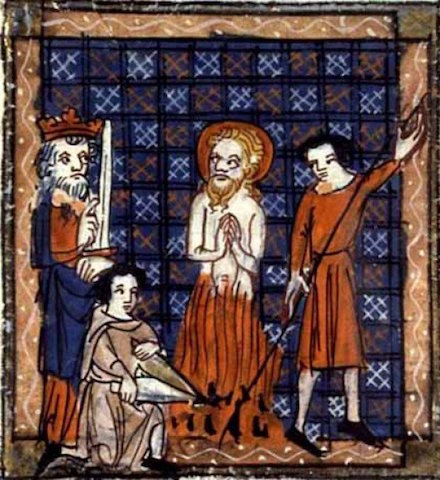
Illustration of William de Marisco’s execution by the amazing 13th century chronicler Matthew Paris.
He’d eventually be damned as a kingslayer but Marisco’s doom began with the 1235 murder of a messenger of King Henry III named Henry Clement, slain at the very gates of Westminster “to our no small dishonour and scandal of the realm.” Suspicion settled on the Mariscos, who might have been motivated by Clement’s boasting of having helped recently lay in his grave the Earl of Pembroke, a magnate and great rival to the king.*
Marisco, whose architectural legacy for us is Coonagh Castle, County Limerick in Ireland, fled the scene of the crime and took refuge on Lundy Island, a gorgeous and remote fingerbone in the westerly Bristol Channel that had once been granted to the Knights Templar.**
There, as our chronicler-illustrator Matthew Paris describes, he made his way thereafter by piracy.
Whilst these occurrences were taking place, William Marsh [“de Marisco” means “of the Marshes” -ed.], son of Geoffrey Marsh, took up his quarters on an island near Bristol, called Lundy, a place impregnable by the nature of its situation, where he lived like a pirate with a number of proscribed and wicked men, indulging in plunder and rapine, and, attended by his companions, traversed the places on the neighbouring coast, despoiling the inhabitants of their property, especially wine and other provisions. By sudden incursions lie frequently carried off vast booty from the country lying near the island, and in many ways injured the kingdom of England both by land and sea, and caused great loss to the native and foreign merchants.
William de Marisco would manage seven years on the lam, seizing victuals and booty and ransomable hostages as he could from his island fastness. He’d been dispossessed of his lands in Ireland and nursed against King Henry the personal grudge of an aggrieved nobleman.
Such injuries were known to heal over time, and amid the tangle of authority and kinship among medieval Europe’s bluebloods, today’s rebel might become tomorrow’s hand of the king. But in 1238, William cut the roads behind him and made himself permanently anathema by allegedly sending an assassin after Henry III. Matthew Paris, again, with a story that will easily bear the interpretation that Marisco’s name was put into a deranged regicide’s mouth by his torturers:
on the day after the Nativity of St. Mary, a certain learned esquire, as it is said, came to the king’s court at Woodstock, pretending that he was insane, and said to the king, “Resign to me the kingdom, which you have unjustly usurped, and so long detained from me;” he also added, that he bore the sign of royalty on his shoulder. The king’s attendants wanted to beat him and drive him away from the royal presence, but the king prevented those who were rushing on him from violence, saying, “Let the insane man rave as becomes him, for such people’s words have not the influence of truth.” In the middle of the night, however, this same man entered the king’s bedchamber window, carrying an open knife, and approached the king’s couch, but was confused at not finding him there, and immediately began to look for him in the several chambers of his residence. The king was, by God’s providence, then sleeping with the queen. But one of the queen’s maids, named Margaret Biseth, was by chance awake, and was singing psalms by the light of a candle (for she was a holy maid, and one devoted to God), and when she saw this madman searching all the private places, to kill the king, and frequently asking in a terrible voice where the king was, she was greatly alarmed, and began to utter repeated cries. At her dreadful cry the king’s attendants awoke, and leaped from their beds with all speed, and running to the spot, broke open the door, which this robber had firmly secured with a bolt, and seized the robber, and, notwithstanding his resistance, bound him fast and secured him. He, after some time, confessed that he had been sent there to kill the king, after the manner of the assassins, by William Marsh, son of Greoffrey Marsh, and he stated that others had conspired to commit the same crime.
Paris has evident contempt for William, but he does note that “William boldly denied all these charges, yet he did not obtain any credit, nor was he listened to; he therefore, however unadvisedly, betook himself to out-of-the-way places, and became a fugitive and an outlaw.” It is not clear to this author that outlawry is “unadvisable” vis-a-vis standing to the judgment of a king who is certain you have attempted his life; nevertheless, it is usually little better than the temporary expedient for the doomed.
On the feast of St. James, by the king’s order, the said William, with sixteen of his accomplices taken with him, was tried and condemned, and, by the king’s order, was sentenced to an ignominious death. He was, therefore, first dragged from Westminster to the Tower of London, and from thence to that instrument of punishment called a gibbet† suspended on which he breathed forth his miserable life. After he had grown stiff in death, his body was let down and disembowelled; his entrails were immediately burnt on the spot, and his wretched body divided into four parts, which were sent to the four principal cities of the kingdom, that the sight of them might strike terror into all beholders.
His sixteen accomplices were all dragged through London at the horse’s tail, and hung on gibbets. The said William, after his condemnation, when about to imdergo the sentence pronounced upon him, invoking the divine judgment to witness, boldly declared that he was entirely free and guiltless of the crime of treason imputed to him, and likewise of the murder of the aforesaid clerk Clement; he also asserted that he had betaken himself to the aforesaid island for no other reason than to avoid the king’s anger, which he had always above all things wished to pacify by submitting to any kind of trial, or by any other humiliation; but that, after he had taken refuge as a fugitive in the said island, he was obliged to prolong his miserable life by seizing on provisions wherever he could find them. He then poured out his soul in confession before God, to J. de St. Giles, one of the brethren of the Preacher order, and confessed his sins with contrition, not excusing himself and giving vent to evil words, but rather accusing himself. This discreet preacher and confessor then administered gentle comfort to him, and dismissed him in peace, persuading him that he underwent the death to which he was doomed by way of repentance. And thus, as before mentioned, horrible to relate, he endured not one, but several dreadful deaths.
Readers of Latin can peruse the transcript of the trial, which has surprisingly survived the ravages of century, in this 1895 English Historical Review article.
* Pembroke’s brother and heir was also suspected initially, but was able to clear himself; however, he was later made to take a vow no longer to protect William de Marisco, suggesting that Pembroke was at least in simpatico with the hit. Both William and Geoffrey de Marisco had been fined previously for adhering to the Pembroke side in a fight with the king.
** The Templars at best barely possessed Lundy and the Mariscos who claimed it opposed those banker-knights’ stake, successfully.
† Paris’s unfamiliar marking of the term “gibbet” is interesting here; according to dictionary.com it was during the 13th century that this word for gallows entered Middle English from French.
On or around this date in 1450 the body of the rebel Jack Cade was posthumously beheaded and quartered.
He’s one of England’s first names in rebellion, and Cade’s Kentish rising indexed England’s catastrophic breakdown under the weak king Henry VI, a milepost between the waning Hundred Years’ War and the onrushing Wars of the Roses.
And for all of these, Cade included, Henry was the chaos-making variable.
He had just about finished squandering the entire French patrimony so gloriously won for him by the sword-arm of his doughty father Henry V, and defeated troops fleeing French advances in Normandy compounded, as they tramped up the southeast beaten and looting, the general fury at the king’s unpopular marriage to the French princess Margaret of Anjou. With shambolic governance allied to a slumping economy, corrupt taxation, and mounting public debt, things were coming unglued.
Like many kings, Henry benefited from the instinct to target overt blame away from the sovereign himself and towards the aides and counselors who surround him. One of the very most hated of those counselors was the man who had negotiated that French marriage — giving away to the French crown the hard-won provinces of Anjou and Maine as its price. William de la Pole, Duke of Suffolk, was so near to being attainted or lynched around London that King Henry exiled him for his own safety to France. But Suffolk didn’t make there: instead, he was captured at sea and murdered.
When his body washed up in Kent, rumors seem to have anticipated a royal reprisal against that region and in favor of the late hated favorite, perhaps the trigger for the events in this post.
Nevertheless, the “rebels” did not conceive themselves engaged in a seditious enterprise; this is apparent from the manifesto of grievances it issued, with moderating tones and language echoing complaints that the Commons was raising to no avail in Parliament.
Item. The law serves of nought else in these days but for to do wrong, for nothing is spread almost but false matters by colour of the law for reward, dread and favour and so no remedy is had in the Court of Equity in any way.
Item. We say our sovereign lord may understand that his false council has lost his law, his merchandise is lost, his common people is destroyed, the sea is lost, France is lost, the king himself is so set that he may not pay for his meat nor drink, and he owes more than ever any King of England ought, for daily his traitors about him where anything should come to him by his laws, anon they take it from him.
…
Item. We will that all men know we blame not all the lords, nor all those that are about the king’s person, nor all gentlemen nor yeomen, nor all men of law, nor all bishops, nor all priests, but all such as may be found guilty by just and true inquiry and by the law.
Item. We will that it be known we will not rob, nor plunder, nor steal, but that these defaults be amended, and then we will go home …
The man at the forefront is a cipher: he went by the potent alias of “John Mortimer”, the surname unmistakably linking his cause to the rival royal claimants over at the the House of York, but neither the name of “Jack Cade” by which history recalls his movement nor the antecedent experiences that thrust him into leadership can be attested with any confidence.
He appears by the half-glimpses we catch of him in the period’s chronicles to be a vigorous and intelligent character. He shied away from battle with a royal army, wisely avoiding the taint of treason that would come with entering the field against the king’s own person; but, it was an organized withdrawal that left his forces capable of ambushing and destroying the detachment from that army that the king had sent to pursue them, a testament to Cade/Mortimer’s adroit command.
Panicked when the news of this reversal resulted in his own forces taking up the rebels’ call to punish traitorous lords, King Henry beat feet for the safety of Kenilworth Castle and abandoned the stage of London to this mysterious new character.
The rebel militia seized it on the third of July that year, visiting its promised popular justice in the process upon several of those “false counsellors” detested among the populace — including the Bishop of Salisbury, the Baron Saye and Sele, and the former sheriff of Kent, William Cromer; Shakespeare gives us a bloody-minded* Cade bantering with his prey Saye and Sele in Henry VI, Part 2 — “Ye shall have a hempen caudle, then, and the help of hatchet … Go, take him away, I say, and strike off his head presently; and then break into his son-in-law’s house, Sir James [sic] Cromer, and strike off his head, and bring them both upon two poles hither.”
Charles Lucy, “Lord Saye and Sele brought before Jack Cade 4th July 1450”
Peasant risings like these are made for eventual failure, but it the unusually high water mark achieved by Cade’s rebellion before receding makes another measure of the crown’s weakness. After ceding the Kentishmen the run of London for several days, it took a desperate nighttime battle on London Bridge to finally push them out.
A general amnesty went abroad to induce the rebels to disperse, but it was not for Cade — who fled to Sussex where he was taken, and mortally wounded in the process, by the new sheriff of Kent, Alexander Iden. (A road called Cade Street now runs in the vicinity; there is a monument to his capture in Heathfield.) It was Cade’s good fortune to succumb to his injuries on the journey back to London but the pains of justice were inflicted upon his remains just the same.
Cade died on Sunday, July 12. The precise date for his posthumous disgrace is not certain from the sources available to us. Many writers report July 15, seemingly based on John Benet’s chronicle, which is a strong source and asserts the 15th unambiguously. I’m here guardedly preferring the 16th based on Gregory’s Chronicle, whose authors were clearly Londoners, and who narrated the progress of the week following Cade’s death with specificity.
And that day was that fals traytoure the Captayne of Kentte i-take and slayne in the Welde in the countre of Sowsex, and uppon the morowe he was brought in a carre alle nakyd, and at the Herte in Sowetheworke there the carre was made stonde stylle, the wyffe of the howse myght se hym yf hyt were the same man or no that was namyd the Captayne of Kente, for he was loggyd whythe yn hyr howse in hys pevys tyme of hys mys rewylle and rysynge. And thenne he was hadde in to the Kyngys Bynche, and there he lay from Monday at evyn [i.e., Monday, July 13] unto the Thursseday nexte folowynge at evyn [Thursday, July 16]; and whythe yn the Kynges Benche the sayde captayne was be-heddyde and quarteryde; and the same day i-d[r]awe a-pon a hyrdylle in pecys whythe the hedde by-twyne hys breste from the Kyngys Benche thoroughe owte Sowthewerke, and thenne ovyr Londyn Brygge, and thenne thoroughe London unto Newegate, and thenne hys hedde was takyn and sette uppon London Brygge.
The Espy file gives June 29 for these executions, but the Wednesday of that week in 1733 (as designated in the court sentence) was June 27.
At a Court called for Goochland County the twenty-fifth day of June MDCCXXXIII, for the tryall of Champion a Negro man slave, Lucy, a Negro woman slave, both belonging to Hutchins Burton, Sampson, Harry, & George, three Negro men slaves belonging to William Randolph, Esq’r, & Valentine, a negro man slave belonging to Bowler Cocke gent.
A commission from the Hon’ble William Gooch Esq’r His Majesty’s Lieut Governor & Commander in chief of this Dominion to John Fleming, Tarlton Fleming, Allen Howard, Edward Scott, George Payne, William Cabbell, James Holman, Ishman Randolph, James Skelton, George Raine, & Anthony Hoggatt, gent to be Justices of Oyer and Terminer for the tryall of Champion a Negro man slave, Lucy a Negro woman slave both belonging to Hutchins Burgon, Sampson, Harry, & George, three Negro men slaves belonging to William Randolph Esq’e & Valentine a Negro man slave belonging to Bowler Cocke gent. being read as also the Dedimus for administering the Oaths & Test therein mentioned George Payne & Anthony Hoggatt gent. administer the oaths appointed by Act of Parliament to be taken instead of the Oaths of Allegiance and Supremacy the Oath appointed to be taken by an Act of Parliament made in the first year of the reign of his late Majesty King George the first Entitled An Act for the further security of his Majesty’s person and Government and the Succession of the Crown in the Heirs of the late Princess Sophia being Protestants and for extinguishing the hopes of the pretended Prince of Wales and his open & secret abettors, unto John Fleming & Daniel Stoner, gent. who Subscribe the Test take the Oath for duly executing the Office of a Commissioner of Oyer and Terminer, and then administer the said Oaths & Test unto Tarlton Fleming, George Payne, James Skelton & Anthony Hoggatt, gent.
Champion being brought to the Barr an Indictment against him for feloniously murdering Robert Allen of this County is read the prisoner confesses himself guilty of the said murder and it is thereupon considered by the court that he return to the place from whence he came and from thence to the place of Execution there to be hanged by the neck on Wednesday next between the hours of eleven and two till he be dead. The Court value the said Negro at thirty pounds Curr’t money.
George, Sampson & Harry, being brought to the Barr several Indictments against them for feloniously murdering Robert Allen of this County are read the prisoners plead not guilty whereupon the Witnesses & the prisoners defence being heard it is the opinion of the Court that they are not guilty and they are thereupon acquitted.
Valentine being brought to the Barr an Indictment against him for feloniously murdering Robert Allen of this County is read the prisoner pleads not guilty whereupon the Witnesses & the prisoners defence being heard it is the opinion of the Court that he is guilty and it is considered that he return to the place from whence he came and from thence to the place of Execution there to be hanged by the neck on Wednesday next between the hours of eleven & two till he be dead. The Court value the said Negro at forty pounds Curr’t money.
Lucy being brought to the Barr an Indictment against her for feloniously murdering Robert Allen of this County is read the prisoner pleads not guilty and whereupon the Witnesses and the prisoners defence being heard it is the opinion of the Court that she is not guilty of the murder but upon Consideration that she is supposed to have known of the murder after it was committed & did not discover the same it is Ordered that she receive on her bare back twenty one lashes well laid on at the Com[m]on whipping post & that she be then discharged.
It was then “Ordered that the heads & quarters of Champion & Valentine be set up in severall parts of this County.”
Whig knight Sir Thomas Armstrong was hanged, drawn, and quartered on this date in 1684, for adhering to Lord Russell‘s treasonable Rye House Plot.
Armstrong had been tempting the executioner for some years: he fell foul of the Cromwell protectorate for shuttling funds to the exiled Charles II, and in 1675 he slew a Mr. Scroope at a theater brawl. Both times he kept his head.
He would not be so lucky when conniving to kidnap the king.
Armstrong was shut out of the leadership clique of the Rye House Plot but he was active scheming with Monmouth and others about “how to surprize the Kings Guards” to get at the royal person, with Armstrong observing that “the Guards were very remiss in their places, and not like Souldiers, and the thing was feasible if they had strength to do it.”*
Briefly escaped to the Low Countries along with a number of other fellow-travelers,** Armstrong was arrested in Leiden and repatriated to face royal justice.
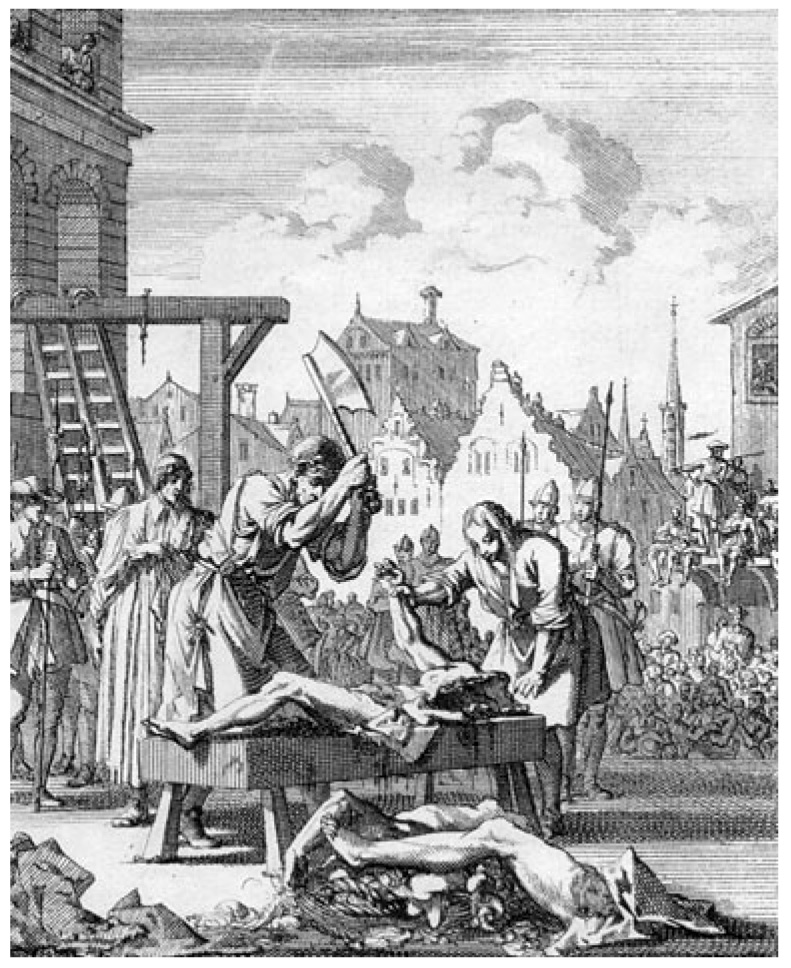
Detail view (click for a larger image) of the dismembering of Thomas Armstrong. Condemned to drawing and quartering, Armstrong was hanged to death and only “after such time the Sufferer had hung about half an Hour, and the Executioner had divested him of his Aparrel, he was cut down according to his Sentence; his Privy Members dissected from his Body, and Burnt; his Head cut off, and shewed to the People as that of a Traytor; his Heart and Bowels taken out, and committed to the Flames; and his Body Quartered into four Parts, which, with his Head, was conveyed back to Newgate, to be disposed of according to his Majesties Pleasure, and Order.” (
In an era of bitter factional politics spiced by burgeoning print culture, Armstrong’s delayed handling gave Tory squibs ample space to gleefully taunt the Whigs through him, and savor in doggerel (via repeat reference to executioner Jack Ketch) the inevitable rending of flesh that ensued.
The Bully WHIG: OR, The Poor Whores Lamentation for the Apprehending OF Sir THOMAS ARMSTRONG.
To the Tune of, Ah! Cruel Bloody Fate! &c.
I.
AH! Cruel Bloody Tom!
What canst thou hope for more,
Than to receive the Doom
Of all thy Crimes before?
For all thy bold Conspiracies
Thy Head must pay the score;
Thy Cheats and Lies,
Thy Box and Dice,
Will serve thy turn no more.
II.
Ungrateful thankless Wretch!
How could’st thou hope in vain
(Without the reach of Ketch)
Thy Treasons to maintain?
For Murders long since done and past,
Thou Pardons hast had store,
And yet would’st still
Stab on, and kill,
As if thou hop’dst for more.
III.
Yet Tom, e’r he would starve,
More Blood resolv’d to’ve spilt;
Thy flight did only serve
To justifie thy Guilt:
While They whose harmless Innocence
Submit to Chains at home,
Are each day freed,
While Traytors bleed,
And suffer in their room.
IV.
When Whigs a PLOT did Vote,
What Peer Justice fled?
In the FANATICK PLOT
Tom durst not shew his head.
Now Sacred Justice rules above,
The Guiltless are set free,
And the Napper’s napt,
And Clapper clapt
In his CONSPIRACY.
V.
Like Cain, thou hast a Mark
Of Murder on thy Brow;
Remote, and in the dark,
Black Guilt did still pursue:
Nor England, Holland, France, or Spain,
The Traytor can defend;
He will be found
In Fetters bound,
To pay for’t in the end.
VI.
Tom might about the Town
Have bully’d, huff’d and roar’d,
By every Venus known,
Been for a Mars ador’d:
By friendly Pimping and false Dice
Thou might’st have longer liv’d,
Hector’d and shamm’d,
And swore and gam’d,
Hadst thou no Plots contriv’d.
VII.
Tom once was Cock-a-hoop
Of all the Huffs in Town;
But now his Pride must stoop,
His Courage is pull’d down:
So long his Spurs are grown, poor Tom
Can neither fly nor fight;
Ah Cruel Fate!
That at this rate
The ‘Squire shou’d foil the Knight!
VIII.
But now no remedy,
It being his just Reward;
In his own Trap, you see,
The Tygre is ensnar’d:
So may all Traytors fare, till all
Who for their Guilt did fly,
With Bully Tom
By timely Doom
Like him, unpity’d die.
Sr. Thomas Armstrongs Last Farewell to the WORLD: He being Condemned for HIGH-TREASON, and Conspiring the Death of the KING and the DUKE, and subverting the Government of these three Kingdoms A SONG.
To the Tune STATE and AMBITION [no embeddable sound file, alas, but for the arrangement see here and here]
A Due to the pleasure of murther and whoring,
Of plotting conspiring the death of a King:
Confound the temptation of Bastard Adoring,
For which I confess I deserve for to Swing.
Poor Monmouth may Curse me, ’twas I over Ruled
In all his Intreagues by Tony’s black spell,
His timerous contrivance I constantly Schooled;
And told him how safe it was then to rebell.
I shew’d him the glimps of a Crown and a Scepter,
The strength of the Crow’d, and applause of the Town
Till glory did dazle his Soul in a Rapture;
That all things inferior appear’d but a Crown:
Then I was in hopes to be second Assistant;
Therefore to unKing him our party would bring:
But now as the Devil wou’d have it I mist on’t,
For which I before the damn’d Doctor must swing.
The Doctor confused three parts of the Nation;
He murthered thirty; I murthered but two,
With long sword and Codpiss I made it the fashion
Rogues Whores to advance, and the Kingdom subdue:
Brave Monmouth I shew’d him all ways of debauching,
And ne’r let him want procurer nor Whore;
Some Aldermens Wives they were proud to approach him,
I often as Grey have stood Pimp at the door.
Nay, many were sure, that their souls would be sainted
Had they but one hour his sweet grace to enjoy
How oft in my Arms they have sighed and panted,
Untill I conveyed ’em to their Princely Boy
But now all those pleasures are faded with glory,
His Grace in Disgrace and Tom is Condemn’d;
Jack Ketch now looks sharp for to shorten my story,
And leaves me no time to murder or mend.
Yet I must confess, I was oft Monmouths taster,
For fear, least some fire-ship might blow up her Prince,
Which caused our party to flock in much faster,
All Officers from the Plot Office advance.
Old Tony took Care too, that nothing was wanting,
In Wapping, the Square, and Algers-gate-street,
I brought in Bess Mackrel, to help out the taping,
And Tony swore damn him, theres nothing so sweet.
Sweet Betty farewell, ’twas for thee I abjured,
My Lady and Children, this fourteen long years;
They always were kind, but I still was obdured,
Seeking the Destruction of King, Church, & Peers
Had I Grey and Mellvin now here to condole with
And their Recommendations to’th’ Cabals below –,
I might have Commissions in Hell to controle with
But sure I shall find some Friends where I go.
The WHIGS laid open, OR, An Honest Ballad of these sad Times.
To a Mery Tune, called Old Symon the King.
Now the Plotters & Plots are confounded,
And all their Designs are made known
Which smellt so strong of the Round-head,
And Treason of Forty One.
And all the Pious Intentions
For Property, Liberty, Laws,
Are found to be only Inventions,
To bring in their Good Old Cause.
And all the Pious, &c.
II.
By their delicate Bill of Exclusion,
So hotly pursu’d by the Rabble;
They hop’d to have made such Confusion,
As never was seen at Old Babel.
The Shaftsbury’s brave City Boys,
And M—ths Countrey Relations,
Were ready to second the Noise,
And send it throughout the 3 Nations.
Then Shaftsbury’s, &c.
III.
No more of the 5th of November,
That Dangerous Desperate Plot;
But ever with horruor remember
Old Tony, Armstrong, and Scot.
For Tony shou’d ne’re be forgotten,
Nor Ferguson’s Popular Rules;
Nor M—th, or G—y, when they’re rotten,
For Popular, Politick Fools.
For Tony shou’d, &c.
IV.
The Murder of Father and King,
And Extinguishing all the right Line,
Was a Good and a Godly thing;
And worthy the Whigs Design:
The Hanging of Prelate, and Peer,
And putting the Guards to the Sword,
And Fleying, and Slashing Lord Mayors,
Was to do the Work o’the Lord.
The Hanging of, &c.
V.
But I hope they will have their Desert,
And the Gallows will have its due,
And Jack Ketch will be more Expert,
And in time be as Rich as a Jew,
Whilst now in the Tavern we Sing,
All Joy to great York and his Right,
A Glorious long Reign to our King;
But when They’ve occasion we’ll Fight.
Whilst now in the Tavern, &c.
VI.
The name of a Whig and a Tory,
No more shall Disquiet the Nation;
We’ll Fight for the Church and her Glory,
And Pray for this Reformation.
That ev’ry Factious Professor,
And ev’ry Zealous Pretender
May humble ’em, to the Successor
Of Charles, our Nations Defender.
That every Faction &c.
An Elegie On the never to be forgotten Sir Thomas Armstrong Knight; Executed for Conspiring the Death of His most Sacred Majesty, and Royal Brother, June 20. 1684. With some Satyrical Reflections on the whole Faction.
Stand forth ye damn’d deluding Priests of Baal,
And found from out each Trumpet Mouth a Call
Let it be loud and shrill, that ev’ry Man
May hear the noise, from Beersheba to Dan;
To summon all the Faction, that they may
In doleful Hums and Haws, bewail this day,
And to their Just Confusion howl and roar,
For the great Bully of their Cause, is now no more.
But now methinks I hear the Faction cry,
Ohone! Where’s all thy Pomp and Gallantry?
Thy Great Commands, thy Interest and thy State?
The many Crouds which did upon thee wait?
When thou like Atlas on thy shoulders bore,
That mighty World which we so much adore
(That Pageant Heroe, Off-spring of a Whore.)
Behold ye stubborn Crew, the certain Fate
That waits upon the hardened Reprobate.
See; the effects of Treason’s Terrible,
In this life Infamy, and i’th’ next a Hell,
While Heav’n attends on Kings with special Care,
The Traitor to himself becomes a snare:
Drove out like Cain, to wander through the World,
By his own thoughts into Distraction hurl’d,
Despis’d by all, perplext with hourly fear,
And by his Friends push’t like the hunted Deer,
Like a mad Dog, still houted as he ran,
A just Reward for th’ base Rebellious man.
How often has kind Heaven preserv’d the Crown,
And tumbled the Audacious Rebel down?
How many Warnings have they had of late?
How often read their own impending Fate?
That still they dare their wicked Acts pursue,
And know what Heaven has ordain’d their due?
That man who cou’d not reas’nably desire
To raise his Fortunes, and his Glories higher,
Who did enjoy, unto a wish, such store,
That all his Ancestors scarce heard of more,
Shou’d by his own procuring fall so low,
As if he’d study’d his own overthrow,
Looks like a story yet without a Name,
And may be stil’d the first Novel in Fame?
So the fam’d Angels, Turbulent as Great,
Who always waited ’bout the Mercy-Seat,
Desiring to be something yet unknown,
Blunder’d at all, and would have graspt the Crown,
Till Heaven’s Great Monarch, saw they wou’d Rebel,
Then dasht their Hopes, and damn’d them down to Hell.
And now methinks I see to th’fatal place
A Troop of Whiggs with Faction in each Face,
And Red-swoln Eyes, moving with mournful pace,
Pitying the Mighty Sampson of their Cause,
Curse their Fates, and Railing at the Laws.
The Sisters too appear, with sniveling Cryes
To celebrate their Stallions Obsequies;
From th’ Play-house and from Change, how they resort,
From Country, City, nay, there’s some from Court,
From the Old C—ss wither’d and decay’d,
To a Whigg Brewers Youthful Lovely Maid.
Gods! What a Troop is here? sure Hercules
Had found enough so many Whores to please.
Repent, ye Factious Rout, Repent and be
Forewarn’d by this bold Traytors Destiny.
Go home ye Factious Dogs, and mend your Lives;
Be Loyal, and make honest all your Wives.
You keep from Conventicles first, and then
Keep all your Wives from Conventicling Men.
Leave off your Railing ‘gainst the King and State,
Your foolish Prating, and more foolish Hate.
Obey the Laws, and bravely act your parts,
And to the Church unite in Tongues and Hearts;
Be sudden too, before it proves too late,
Lest you partake of this bold Traytors Fate.
And if the Faction thinks it worth the Cost,
(To keep this Bully’s Name from being lost)
To raise a Pillar, to perpetuate
His Wond’rous Actions, and Ignoble Fate,
Let’em about it streight, and when ’tis done,
I’le Crown the Work with this Inscription.
Bold Fame thou Ly’st! Read here all you
That wou’d this Mighty Mortal know;
First, he was one of low degree,
But rose to an Hyperbole.
Famous t’ excess in ev’ry thing,
But duty to his God, and King;
In Oaths as Great as any He,
That ever Grac’d the Tripple Tree;
So Absolute, when Drencht in Wine,
He might have been the God o’th’ Vine.
His Brutal Lust was still so strong,
He never spar’d, or old, or young;
In Cards and Dice he was well known,
T’ out-cheat the Cheaters of the Town.
These were his Virtues, if you’d know
His Vices too pray read below.
Not wholly Whig, nor Atheist neither,
But something form’d of both together,
Famous in horrid Blasphemies,
Practic’d in base Adulteries.
In Murders vers’d as black, and foul
As his Degenerated Soul.
In’s Maxims too, as great a Beast,
As those his honest Father drest. [his father was a groom -ed.]
The Factions Bully, Sisters Stallion:
Now Hang’d, and Damn’d, for his Rebellion.
* Per “An impartial and full account of the life & death of the late unhappy William Lord Russel eldest son and heir of the present Earl of Bedford, who was executed for high treason July 21, 1683, in Lincolns-Inn-Fields: together with the original and rise of the earls of Bedford, giving a brief account of each of them.” (1684)
** Notably joining Armstrong in continental refuge — and narrowly escaping recapture with him — were fellow plotters Lord Thomas Grey and Robert Ferguson. Both these worthies returned in power with the rest of the Whig party come the Glorious Revolution … an event for which Ferguson, a prolific pamphleteer, wrote the definitive justification.
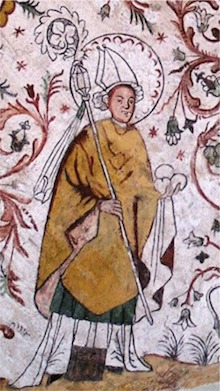
Ol’ “God-kettle” was one of several missionaries known to have been dispatched in the 11th and 12th century from England to Sweden, a traffic in religious conversion across the North Sea crossroads to invert the centuries-past course of Vikingers who put so many British sanctuaries to the sack.
The Northmen realms were ripe to join Christendom but sagas touching the time describe an uneven transitional period where the new and old faiths jostled for primacy.
“Ingi was king for a long time, well-liked and a good Christian; he put down [pagan] sacrificing in Sweden and ordered all the people of the land to become Christian,” runs The Saga of King Heidrek the Wise** (available in pdf translation here), about King Inge the Elder.
But the Swedes had too strong a belief in the heathen gods and held to their ancient ways … the Swedes thought that King Ingi had infringed their rights under the ancient law of the land, when he found fault with many things that Steinkel his [Christian] father had let be; and at a certain assembly which the Swedes held with King Ingi they gave him the choice of two things, either to observe the ancient laws or else to give up his throne. Then King Ingi spoke, and said that he would not leave the true faith; whereat the Swedes cried out, and pelted him with stones, and drove him from the law-assembly.
Svein, the king’s kinsman, remained behind at that assembly, and he offered to make sacrifice for the Swedes if they would grant him the kingdom; all agreed to Svein’s offer, and he was accepted as king over all the Swedish realm. Then a horse was led forth to the assembly, hewn in pieces, and divided up for eating, and the sacrificial tree was reddened with its blood. Thereafter all the Swedes cast off the Christian faith, and sacrifices were instituted, and they drove King Ingi away; he departed into western Gautland. For three years Svein the Sacrificer was king over the Swedes.
King Ingi went with his own bodyguard and some followers, though it was only a small force … into Sweden; he rode by day and night and came upon Svein unawares in the early morning. They seized the house over their heads and set it on fire, and burnt all the company who were inside … Svein came out and was cut down. And so Ingi took the kingship of the Swedes anew, and restored the Christian faith; he ruled the realm till the day of his death.
The “Svein” referred to here is a gentleman whom the historians recall as Blot-Sweyn — “Sweyn the Sacrificer” — and this Norse answer to Julian the Apostate apparently enjoyed his interregnum authority in about the 1080s thanks to Inge’s disrespect of the old rites still honored at the ancient Temple at Uppsala.
The timeline of high statecraft is extremely sketchy, and Saint Eskil’s relationship to events doubly so. Commonly recalled as a victim of the Blot-Sweyn period, Eskil is first marked in the 1120s annals of another Anglo-Saxon monk abroad in Scandinavia, Aelnoth from Canterbury — “Eschillus of sacred memory” who succumbed evangelizing to the “barbarorum feritate.” That’s the whole of it, with nothing like a year or a regnal era to hang one’s hat upon. In the 13th century, with Christianity truly triumphant, a hagiography of Eskil greatly embroidered the martyrdom story and tied it to the land’s most notorious rearguard ruling unbeliever, featuring a cast of heathens so nonplussed at the monk’s interruption of their feast that, notwithstanding his show of divine miracles, Blood-Sweyn has him sentenced to immediate stoning.
The town of Eskilstuna bears his name (it used to just be “Tuna”).
* Though it’s been bumped to June 12 everywhere else, the feast is still marked on its original June 11 date in the diocese Strängnäs, where the saint was supposed to have attained his martyr’s crown. (Strängnäs Cathedral is supposed to mark the very spot of his fatal confrontation with the Aesir followers.)
** This saga’s narrative stretches from an outright legendary prehistory to the Middle Ages. The Ingi-Svein affair is its last episode, but its first locates a more Wagnerian milieu: “Sigrlami was the name of a king who ruled over Gardariki; his daughter was Eyfura, most beautiful of all women. This king had obtained from dwarves the sword called Tyrfing, the keenest of all blades; every time it was drawn a light shone from it like a ray of the sun. It could never be held unsheathed without being the death of a man, and it had always to be sheathed with blood still warm upon it. There was no living thing, neither man nor beast, that could live to see another day if it were wounded by Tyrfing, whether the wound were big or little …”
June 11 is the feast date of St. Barnabas, St. Paul‘s New Testament wingman.
A Cypriot Jew named Joseph, “Barnabas” (“Son of Encouragement”) was so christened in the fourth chapter of the New Testament’s Acts of the Apostles because upon his conversion he sold his land for a donative to the Galileans.
After that, Barnabas reappears throughout Acts as one of the most important of the early Christian missionaries, usually joining St. Paul — whom Barnabas himself introduced to the Christians after Paul got religion — as emissary to the non-Jews, for which purpose the Holy Spirit itself demanded him by name. (Acts 13:2: “Set apart for me Barnabas and Saul for the work to which I have called them.”)
They’re frequently paired thereafter in the narrative although it’s invariably Saint Paul’s honeyed tongue that does the confounding before the companions flee this city or that ahead of a furious mob.* Evidently the Holy Spirit’s labor policies could have used some updating: Barnabas also features in a whinge by Paul in 1 Corinthians 9 against the excess sacrifices the Jesus sect is exacting from its most successful envoys, who get no wages and no sex and (so it seems) have to hustle side jobs to keep up their proselytizing.
Don’t we have the right to food and drink? Don’t we have the right to take a believing wife along with us, as do the other apostles and the Lord’s brothers and Cephas [St. Peter]? Or is it only I and Barnabas who lack the right to not work for a living?
Who serves as a soldier at his own expense? Who plants a vineyard and does not eat its grapes? Who tends a flock and does not drink the milk? … whoever plows and threshes should be able to do so in the hope of sharing in the harvest. If we have sown spiritual seed among you, is it too much if we reap a material harvest from you? If others have this right of support from you, shouldn’t we have it all the more?
But we did not use this right. On the contrary, we put up with anything rather than hinder the gospel of Christ.
Barnabas eventually parted ways with Paul, proceeding to Cyprus with the mysterious John Mark (possibly Mark the evangelist, author of the Gospel, or possibly a different guy) where hagiography holds that Jews angered by his preaching fell on Barnabas and stoned him to death, perhaps around the year 61.
Although obviously a consequential figure in early Christianity, Barnabas’s many Biblical appearances do not capture his voice. The apocrypha preserves at least two tracts** further animating this important character: the Epistle of Barnabas dating to the late first century or early second century; and, the Acts of Barnabas, a 5th century creation which purports to arise from the hand of John Mark and describes a martyrdom by fire, not stone:
And Barjesus, having arrived after two days, after not a few Jews had been instructed, was enraged, and brought together all the multitude of the Jews; and they having laid hold of Barnabas, wished to hand him over to Hypatius, the governor of Salamis. And having bound him to take him away to the governor, and a pious Jebusite, a kinsman of Nero, having count to Cyprus, the Jews, learning this, took Barnabas by night, and bound him with a rope by the neck; and having dragged him to the hippodrome from the synagogue, and having gone out of the city, standing round him, they burned him with fire, so that even his bones became dust. And straightway that night, having taken his dust, they cast it into a cloth; and having se cured it with lead. they intended to throw it into the sea. But I, finding an opportunity in the night, and being able along with Timon and Rhodon to carry it, we came to a certain place, and having found a cave, put it down there, where the nation of the Jebusites formerly dwelt. And having found a secret place in it, we put it away, with the documents which he had received from Matthew. And it was the fourth hour of the night of the second of the week.
Because June 11 formerly fell on/near Midsummer, ere the Gregorian reforms skipped the calendar 10-11 days forward, St. Barnabas’s Day has a festive agrarian history commemorated by the proverb, “Barnaby bright, Barnaby bright, the longest day and the shortest night.” The saint is also the patron of Cyprus, and may be invoked to protect against hailstorms or in service of peacemaking. Numerous schools, churches, and monasteries around the world bear his name.
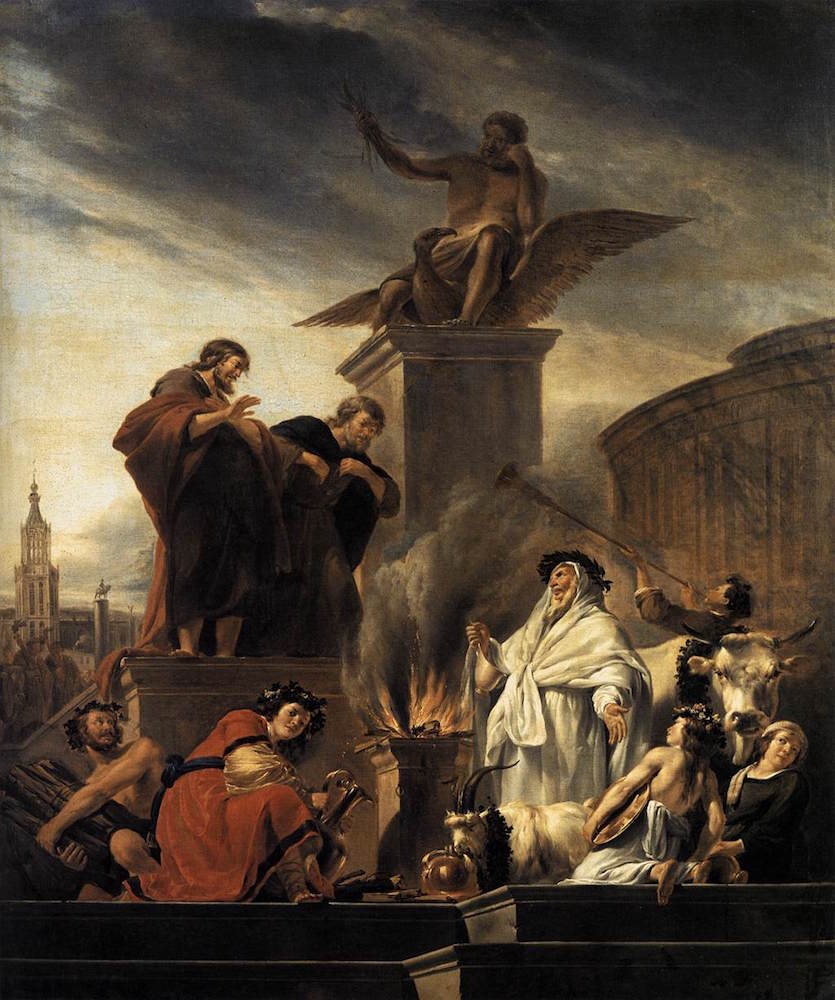
* There’s a comic touch to their preaching travails, too: in one exciting episode (Acts 14), Paul (of course) heals a cripple while the dynamic duo preaches in Lystra, leading excited witnesses to take them for Hermes and Zeus and start sacrificing to them.
No tips, please: Paul and Barnabas refusing the sacrifices of Lystrans in this detail (click for the full image) of a 1650 painting by Nicolaes Berchem.
** Beyond the Epistle and the Acts, there is also a very much later Gospel of Barnabas.


 Ol’
Ol’  A Cypriot Jew named Joseph, “Barnabas” (“Son of Encouragement”) was so christened in the fourth chapter of the New Testament’s