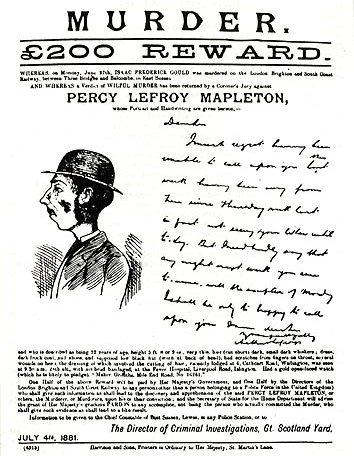
When Percy Lefroy Mapleton plunged through the gallows-trap at Lewes Prison on this date in 1881 for robbing and murdering a train passenger, he had the consolation of a minor milestone in policing history: he was the bobble-headed subject of the first published police sketch.
Mapleton (he gave his name initially as Percy Mapleton Lefroy) entered the annals of crime lore at Brighton‘s Preston Park railway station on the 27th of June, a mere five months before his execution. On that occasion, he presented himself, bloodied and bedraggled, to a ticket agent with a complaint that he’d been assaulted on the train by two unknown men.
Maybe it was the gold watch chain dangling out of his boot (the man said he’d stashed it there for safekeeping) or an unexplained couple of Hanoverian medals he possessed (the man didn’t know anything about those!), or his keen desire to ditch the investigators and return immediately to London for some business (so why take the train to Brighton in the first place?). There wasn’t quite sufficient reason to hold him, but there was ample cause to give him a minder for his ride back to London.
Apparently Sgt. George Holmes hadn’t been fully briefed on suspect escort protocol.
During their ride, police searching the rail line by which the strange bloodied man had arrived turned up the body of an elderly coin dealer named Isaac Gold, the sort of character who would have pocket watches and Hanoverian medals to steal. A telegraph sent from the nearest station arrived ahead of Mapleton’s train, reading
Man found dead this afternoon in tunnel here. Name on papers “I Gold”. He is now lying here. Reply quick.
At this point, explicit instructions to keep eagle eyes on Percy Mapleton would hardly seem to be required — yet they were indeed forthcoming. Despite what headquarters and common sense were telling him, however, Sgt. Holmes allowed the murder suspect to talk him into letting him “change clothes” unsupervised in a house. And so began a nationwide manhunt.
This manhunt would be distinguished by a police sketch of the fugitive created with the help of Mapleton’s acquaintances. London Metropolitan Police’s (then-newborn) Criminal Investigation Department appealed to the press for help and the Telegraph made history by printing the man’s profile, first time such a drawing had hit newsprint for this purpose.
Age 22, middle height, very thin, sickly appearance, scratches on throat, wounds on head, probably clean shaved, low felt hat, black coat, teeth much discoloured … He is very round shouldered, and his thin overcoat hangs in awkward folds about his spare figure. His forehead and chin are both receding. He has a slight moustache, and very small dark whiskers. His jawbones are prominent, his cheeks sunken and sallow, and his teeth fully exposed when laughing. His upper lip is thin and drawn inwards. His eyes are grey and large. His gait is singular; he is inclined to slouch and when not carrying a bag, his left hand is usually in his pocket. He generally carries a crutch stick.
The publicity blitz generated dozens of erroneous reported sightings throughout the country, but successfully put the screws to the wanted man who was hemmed into an untenable boarding house bolt-hole with an increasingly suspicious landlady and a dwindling pool of money. At last he was
apprehended on Friday evening, July 8, at 32, Smith-street, Stepney, where he took lodgings two days after his disappearance from Wallington … He went out very little, and chiefly at night … He described himself as an engraver, and as one who needed quietness. A telegram sent by Lefroy from 32, Smith-street, to his friend Seele was the cause of his arrest. It appears that the suspicions of his landlady, Mrs. Bickers, being aroused by his peculiar mode of living, she sent her daughter to the address indicated on the telegram, which ran as follows: —
From G. Clark, 32, Smith-street, Stepney, to S. Seele, at J.T. Hutchinson’s, 56, Gresham-street, London, E.C. — Please bring me my wages this evening, about eight, without fail. Flour to-morrow. Not 33.
This telegram led some unknown person, it is said, to call at Scotland-yard, and give information.
This spectacle did not un-sticky Davis’s fingers, for she was sentenced in Sydney Cove for again plundering wardrobes to the tune of
four linen shirts of the value of twenty nine shillings and six pence; one cheque shirt of the value of four pence; one linen waistcoat of the value of two shillings; two cambrick handkerchiefs of the value of three shillings; one silk waistcoat of the value of two shillings; one dimety waistcoat of the value of eighteen pence of the goods and chattels of the said Robert Sidaway; and one linen bed gown of the value of two shillings; one linen apron of the value of eighteen pence; two linen caps of the value of sixpence; one piece of a cap of the value of one penny; one muslin handkerchief of the value of six pence; and one pair of linen pockets of the value of one penny of the goods and chattels of Mary Marshall in the same dwelling house.
Davis attempted to plead her belly, failing to impress a jury of matrons impaneled to scrutinize her for pregnancy.
Seaman Jacob Nagle piteously recorded her end:
Some time after this, one of the wimen [Ann Davis] stole some wet clothes and was condemned and hung. She strove to bring a free man in guilty that belonged to our ship that was on duty on shore, it being proved by a number of witnesses that he was innocent and new nothing of it. Otherwise, she might have been saved, as the Governor left it to Captain Hunter, but he would not for give her, and when brought to gallos, leading her by two wimen, she was so much intocsicated in liquor that she could not stand without holding her up. It was dreadful to see heir going to aternity out of this world in such a senceless, shocking manne.
As noted by Australia’s Dark Heart the experience of dispatching this creature might have been especially traumatizing to the colony’s unwilling executioner James Freeman — for he was found roaring drunk a few days later and punished with 100 lashes.
* After discharging its human cargo, the Lady Penrhyn proceeded upon further circulating in the Pacific and the Far East; in 1788, she sighted and named the Cook Islands atoll of Penrhyn.
On this date in 1883, the Boer South African Republic hanged Bapedi chief Mampuru.
Sekukuni
Mampuru is notable as the half-brother and rival — eventually murderous rival — of Sekukuni (also rendered Sekhukhune), the chief of the Pedi or Bapedi people. Their backstory is significant: Mampuru had been the intended heir of their shared father, King Sekwati, but the warlike Sekukuni had seized rulership instead when Sekwati died in 1861.
In 1876, he successfully fought off the Boer Transvaal Republic — which contributed to it becoming in 1877 the British Transvaal instead, at least according to the British.
Less successful was Sekukuni in the war soon prosecuted against him by the British. Extensively narrated here (also see part 1 of this same article sequence here), the upshot was that the British eventually trapped Sekukuni’s last defenders in a rocky hill remembered as the “Fighting Koppie” and captured him. The Swazi, with that displaced rival Mampuru, fought in this war with the British.
Sekukuni and his surviving family would be marched to Pretoria and imprisoned there until 1881.
In the intervening years, power was rebalanced all around among the players. Mampuru had been able to re-establish himself among the Bapedi with no small help from his British allies — but those British allies had been defeated by a Boer rebellion in the First Boer War.* One article in the settlement ending the Boer-British conflict permitted Sekukuni’s release.
As might be expected the ex-chief’s return to his homeland was scarcely welcomed by his brother. After some months of political acrimony, Mampuru settled the feud by having a team of assassins stab Sekukuni to death in his sleep, on the night of August 13, 1882.
For Mampuru, the sibling rivalry win was as Pyrrhic as it surely was satisfying, for he was immediately branded an outlaw by the Boer Transvaal and himself obliged to flee from the countrymen whom he meant to rule. When the Boers captured him, they had him condemned a murderer and hanged him stark naked for an audience of 200-plus white men in Pretoria. As an added indignity, they botched the hanging and dropped Mampuru to the ground on their first go, when the noose snapped. (In 2013, the jail where he hanged was renamed for Mampuru.)
Spanish seaman Joseph Garcia was hanged at Usk Prison on this date in 1872, for the Llangibby Massacre.
It occurred in the Welsh village of that name, inland from the mouth of the Severn where Garcia had alit as a mariner at Newport nearly a year before.
He’d committed a burglary there, and been committed to jail for his pains. His sentence was nine months … followed by release to a foreign land whose language he barely spoke, his ship long gone and no friend or occupation to direct him.
A “short, thin man, just five feet five inches tall, with a swarthy complexion, coarse black hair and beard,” Garcia trudged the road in to the farming town. Several times he was observed loitering there but his presence was really announced by the billows of smoke pouring from the home of William Watkins, a farmworker — and neighbors who rushed to the scene beheld the horror of its owner dead from a stab wound through his throat, his wife similarly dealt with, and all three of their small children also put to the blade — their wee corpses already partly charred from the fire.
The stranger’s foreignness invited attention, of course, and when he was arrested back at Newport circumstantial evidence appeared to confirm the connection: he had some injuries and bloodstains that suggested a scrap, a pair of boots that might have been stolen from Watkins, and some stolen household articles that a surviving daughter of Watkins fortunate enough to be away from the house at the fatal hour recognized as the family’s own. He also possessed a knife that he hadn’t been discharged with.
Then as now the fury for a swarthy outlander come uninvited to go a-viking among law-abiding Britons was potent; while legal proceedings were entirely regular, “the noise outside the court was powerful enough at times to prevent the witness from being heard, and from the character of the exclamations which permeated to the interior of the court the crowd appeared ready to lynch Garcia.” (Period press quoted here.) Indeed, such a sentiment was openly published in at least one broadsheet murder ballad:
May the murderers to justice quickly be brought,
And suffer the penalty they surely have sought,
Lynch law in some countries they would very soon find,
And their bodies be swinging on the trees to the wind.
For Sommersett must love Essex faire wife
by wich his deerest servant lost his life.
losse upon losse, all things grow cleane contrary
and thus our sinfull times themselves doe vary.
On this date in 1615, Anne Turner hanged at Tyburn for a shocking society murder remembered as the Overbury Affair.
Turner was quite a character herself, but her journey to the pages of Executed Today begins in the bedsheets of the nobility. In fact, events revolve around a marriage alliance between two families of notable beheadings, in the persons of Frances Howard — the grandsondaughter of Queen Elizabeth’s enemy Thomas Howard (beheaded 1572) — and Robert Devereux, Earl of Essex — son of Queen Elizabeth’s lover also named Robert Devereux (beheaded 1601).
‘Twas often that noble pairings were cynical, loveless expediencies but this union exceeded most in its deficiencies.
They married so young — 13 to 14 years old as they tied the knot — that they were initially kept apart to prevent them sleeping together but this failure to consummate developed into firm policy. Devereux was impotent with her — even though, per Francis Bacon’s investigation, “before and after the marriage, he hath found an ability of body to know any other woman, and hath oftentimes felt motions and provocations of the Flesh, rending to carnal copullation” — and Howard seemingly systematically refused him. (Devereux was elsewhere heard to note that his virility failed because his wife “reviled him, and miscalled him, terming him a cow, and coward, and beast.”)
By that time — we’re into 1613 here — the missus was also intentionally trying to force an annulment of the marriage, so that she could pursue love and power with the king’s young favorite, Robert Carr. Both spouses agreed that their union had never been consummated, a fact “verified” by a panel of matrons who inspected the wife’s bits to confirm the presence of the hymen. Frances was veiled during this humiliating spectacle to preserve her modesty and/or identity, as widely believed rumor held that she’d swapped in a ringer to pass the exam.
This maide inspected;
But fraud interjected
A Maid of more perfection:
The midwives did her handle,
While the Kn[igh]t held the candle
O there was a clear inspection!
While Frances was orchestrating all this, her lover’s close friend Sir Thomas Overbury was energetically counseling that youth against the match, going so far as to write one of the classics of Jacobean poetry, “A Wife”, expounding on the preferred virtues of such a partner in an apparent attempt to underscore to his chum Frances Howard’s conspicuous want of them, e.g.
Where goodnesse failes, ’twixt ill and ill that stands:
Whence ’tis, that women though they weaker be,
And their desire more strong, yet on their hands
The chastity of men doth often lye:
Lust would more common be then any one,
Could it, as other sins, be done alone.
Long story short, the mistress won the struggle over the valuable Robert Carr and her powerful family arranged to sideline Overbury by means of a royal appointment to Russia. When Overbury refused the post, the outraged King James had him locked up in the Tower of London for his impertinence; Overbury soon died there, and Frances Howard and Robert Carr tied the match before 1613 was out.
Carr should have listened to that poem.
It was no more than months ere that gentleman was being eclipsed in King James’s favor by George Villiers, and his eroding status licensed the interest of court enemies in the surprise death of Carr’s friend.
Suspicions of foul play soon appeared vindicated, and we come at last at this point to our gallows-fruit Anne Turner, a wealthy woman in the train of Frances Howard, for the evidence developed by Bacon indicated that Turner acted as Howard’s agent in arranging for Overbury’s guards to poison him off.
The affair was the ruin of her patron, who was convicted along with her prized new husband.* Both of these blueblooded types were spared, but no such mercy obtained for the four commoners who had been the Lady’s instruments.
Turner, who did a brisk business in saffron supplying the royal court its fashionable yellow accoutrements, arranged for “tarts and jellies” procured from a sinister chemist to be delivered to the men at the Tower for ministration to the imprisoned poet. Really it was just as Overbury had tried to warn Carr:
A passive understanding to conceive,
And judgement to discerne, I wish to finde:
Beyond that, all as hazardous I leave;
Learning and pregnant wit in woman-kinde,
What it findes malleable, makes fraile,
And doth not adde more ballast, but more saile.
She, the chemist, and both Overbury’s jailer and the governor of the Tower of London would all four suffer execution on distinct occasions for doing the Lady Howard’s bidding in this matter. Turner’s hanging at Tyburn had a classic dash of showmanship: both the victim and the executioner were pointedly dressed in the yellow saffron ruffles whose lucrative traffic had empowered Anne Turner with the werewithal to corrupt the king’s dungeon. The design fell speedily out of fashion.
Our intrepid assassin, however, had the consolation of a vigorous literary afterlife as her character became a fixture of the 17th century theater. (So did Overbury’s.)
The Overbury Affair’s rich text touching power, gender, commerce, revenge, social climbing, print culture, and murderous intrigue has continued to fascinate new audiences ever since then, intermittently refreshed by many new volumes both fiction and non-.
* Frances Howard confessed the plot — accurately, as it is generally understood. Robert Carr never did, and he’s often been read as a plausible naif, blind to his pretty new wife’s vengeful treatment of his former bosom friend.
Apartheid South Africa had long been one of the world’s most prolific users of capital punishment. According to Wikipedia it had logged nearly 3,000 executions over the 30 years previous, including a one-year count of 164 as recently as 1987.
But the policy was about to see a sudden reversal — along with the policy of apartheid itself.
Earlier that same year, the South African presidency had been assumed by F.W. de Klerk. Much to everyone’s surprise, the copper-bottomed Nationalist Party conservative set about dismantling the entire white-rule infrastructure. Once he’d secured his term de Klerk moved with alacrity, immediately permitting some anti-apartheid marches that his security services wanted to shut down and proceeding apace to more dramatic reforms that within a few years saw off apartheid altogether.
Shuttering the Pretoria Central Prison gallows was one early gesture in this same campaign, considering the manymartyrs that platform had made of regimeopponents down the years. In 1990, de Klerk pronounced a formal moratorium on executions and he never lifted it; in 1995, the first politically weighty ruling of the post-apartheid Constitutional Court abolished capital punishment.
However, Ngobeni has no assurance of maintaining his milestone distinction in perpetuity. In present-day South Africa, blighted by a great deal of violent crime, reinstatement of capital punishment enjoys the support of several political parties and a sizable majority of the public.
A century ago today, an Armistice Day parade turned the Pacific Northwest logging town of Centralia, Washington into a battlefield. By the time night fell on the Centralia Massacre* four American Legionnaires had been shot dead … and then the cover of darkness was used to revenge them with the lynching that evening of Wobbly labor agitator Wesley Everest.
Before Amazon and Starbucks and Microsoft and even before Boeing, the economic engine of early Washington state consisted of cutting down its mighty ancient trees.
The spruce and fir trees were torn from the verdant Northwest by rough men working dangerous jobs in brutally exploitive conditions. “Loggers dealt with adulterated food, fleas and other vermin in their overcrowded housing, straw for bedding, the smell of disgusting wet socks drying near the bunkhouse’s one heater, latrines located directly next to the dining hall so that they could smell feces when they sat down to eat, etc.,” writes labor historian Erik Loomis. “They were paid next to nothing for their work and frequently ripped off by a collusion of timber operators and employment agencies.”
Small wonder that this part of the world yielded ready soil for radical labor organizers. The syndicalist labor union Industrial Workers of the World (IWW, familiarly nicknamed “Wobblies”) made notable inroads there.
Section of the map of the Northern Pacific rail network (rail lines in red), circa 1900.
In the town of Centralia, inland and convenient to the continent-straddling Northern Pacific Railway which whisked away the produce of her logging camps, Wobblies’ presence dated back at least as far as 1914.
They’d been the locus of violence previous to the events in this post: in 1918, a Red Cross parade addled on wartime jingoism turned into the sack of the IWW’s union hall. Vowing that they’d not suffer invasion again the Wobblies armed themselves, and they were on guard for the large parade Centralia had scheduled for the first anniversary of the Great War’s end — suspiciously routed to pass right in front of the new IWW hall.
Every history of the Centralia Massacre says at this point that the facts are in dispute as to who started what on that day, but it can be fairly said that a deliberate provocation deliberately provoked and before you knew it war veterans of the then-newformed American Legion were storming the Wobblies, under gunfire.
Ere the hive of radicalism was overrun, three Legionnaires had been shot dead.
Meanwhile, fleeing via an adjacent alley as he reloaded his .44 pistol went one of the hall’s armed defenders, Wesley Everest. The enraged mob pursued him, and as the IWW’s (obviously partisan) official site observes, this fact likely saved other Wobblies in the hall from summary execution. Instead they were bundled into jail where they’d soon be joined by Mr. Everest.
Running pell-mell down the alley the mob gave a shout of exaltation as Everest slowed his pace and turned to face them. They stopped cold, however, as a number of quick shots rang out and bullets whistled and zipped around them. Everest turned in his tracks and was off again like a flash, reloading his pistol as he ran. The mob again resumed the pursuit. The logger ran through an open gateway, paused to turn and again fire at his pursuers; then he ran between two frame dwellings to the open street. When the mob again caught the trail they were evidently under the impression that the logger’s ammunition was exhausted. At all events they took up the chase with redoubled energy. Some men in the mob had rifles and now and then a pot-shot would be taken at the fleeing figure. The marksmanship of both sides seems to have been poor for no one appears to have been injured.
DALE HUBBARD
This kind of running fight was kept up until Everest reached the river. Having kept off his pursuers thus far the boy started boldly for the comparative security of the opposite shore, splashing the water violently as he waded out into the stream. The mob was getting closer all the time. Suddenly Everest seemed to change his mind and began to retrace his steps to the shore. Here he stood dripping wet in the tangled grasses to await the arrival of the mob bent on his destruction. Everest had lost his hat and his wet hair stuck to his forehead. His gun was now so hot he could hardly hold it and the last of his ammunition was in the magazine. Eye witnesses declare his face still wore a quizzical, half bantering smile when the mob overtook him. With the pistol held loosely in his rough hand Everest stood at bay, ready to make a last stand for his life. Seeing him thus, and no doubt thinking his last bullet had been expended, the mob made a rush for its quarry.
“Stand back!” he shouted. “If there are ‘bulls’ in the crowd, I’ll submit to arrest; otherwise lay off of me.”
No attention was paid to his words. Everest shot from the hip four times, — then his gun stalled. A group of soldiers started to run in his direction. Everest was tugging at the gun with both hands. Raising it suddenly he took careful aim and fired. All the soldiers but one wavered and stopped. Everest fired twice, both bullets taking effect. Two more shots were fired almost point blank before the logger dropped his assailant at his feet. Then he tossed away the empty gun and the mob surged upon him.
The legionaire who had been shot was Dale Hubbard, a nephew of F.B. Hubbard, the lumber baron. He was a strong, brave and misguided young man — worthy of a nobler death.
“LET’S FINISH THE JOB!”
Everest attempted a fight with his fists but was overpowered and severely beaten. A number of men clamoured for immediate lynching, but saner council prevailed for the time and he was dragged through the streets towards the city jail. When the mob was half a block from this place the “hot heads” made another attempt to cheat the state executioner. A wave of fury seemed here to sweep the crowd. Men fought with one another for a chance to strike, kick or spit in the face of their victim. It was an orgy of hatred and blood-lust. Everest’s arms were pinioned, blows, kicks and curses rained upon him from every side. One business man clawed strips of bleeding flesh from his face. A woman slapped his battered cheek with a well groomed hand. A soldier tried to lunge a hunting rifle at the helpless logger; the crowd was too thick. He bumped them aside with the butt of the gun to get room. Then he crashed the muzzle with full force into Everest’s mouth. Teeth were broken and blood flowed profusely.
A rope appeared from somewhere. “Let’s finish the job!” cried a voice. The rope was placed about the neck of the logger. “You haven’t got guts enough to lynch a man in the daytime,” was all he said.
At this juncture a woman brushed through the crowd and took the rope from Everest’s neck. Looking into the distorted faces of the mob she cried indignantly, “You are curs and cowards to treat a man like that!”
There may be human beings in Centralia after all.
Wesley Everest was taken to the city jail and thrown without ceremony upon the cement floor of the “bull pen.” In the surrounding cells were his comrades who had been arrested in the union hall. Here he lay in a wet heap, twitching with agony. A tiny bright stream of blood gathered at his side and trailed slowly along the floor. Only an occasional quivering moan escaped his torn lips as the hours slowly passed by.
Dead in the fray outside the union hall were three World War I soldiers: Arthur McElfresh, Ben Cassagranda, and Warren Grimm, the last of whom had the distinction of participating in the unsuccessful American invasion of Bolshevik Russia — plus Dale Hubbard, the man shot dead while attempting to apprehend Everest. All four were Legionnaires who have been honored as martyrs by that organ ever since.**
The IWW, conversely, says the same for Everest, for once night fell he was hauled from his cell and lynched to Mellen Street Bridge: “Hangman’s Bridge” as it was later known — although the present-day bridge dates only to 1958, replacing Everest’s gallows.
And even though anyone involved is long dead by now the affair has remained a charged topic for the hundred years from that day to this; a local newspaper marked the centennial by noting that memorial events by the respective factions’ descendants brought “confrontation even now, even about how to memorialize the dead and imprisoned.” (Although Everest was the only Wobbly lynched, a number of his comrades tossed into prison for years on trumped-up charges, prey to the Red Scare run amok in those years; even the union’s lawyer was prosecuted, albeit unsuccessfully. It goes without saying that nobody ever answered for the lynching.)
There has been for many decades a memorial in Centralia’s George Washington Park commemorating the dead Legionnaires; more recently, Centralia’s cityscape was also enhanced by a rival mural celebrating Everest.
“The Resurrection of Wesley Everest” by activist muralist Mike Alewitz (1997). (cc) image by Richard Colt.
* Also sometimes called the “Centralia Tragedy”. It’s not to be confused with the U.S. Civil War’s Centralia Massacre — which occurred in 1864 in a town of the same name in the bloody border state of Missouri. North America has numerous settlements called Centralia including several with no massacre at all, yet.
** Four Legionnaires plus Wesley Everest make five victims for Armistice Day. There’s a sixth man whose death can be attributed to the affair: a sheriff’s deputy who was mistakenly shot dead a couple of days later when he was unable to give the countersign to a paranoid posse.
On this date in 1842, four men hanged in Australia for the mutiny on the Governor Phillip.*
In this abortive rebellion, a dozen prisoners being carried on the aforenamed brig off the coast of Norfolk Island capitalized on the inattention of their guards and attempted to commandeer the vessel. By every account it was an unpremeditated affair, simply an attack of opportunity when the prisoners realized they’d been carelessly left free on the deck with only two guards, who were speedily thrown into the drink. (One drowned.)
Their aspirations at this moment ran along the lines of Fletcher Christian: merely to escape.
“Captain Boyle, I want to make a proposal with you,” one of the mutineers shouted at the momentarily deposed skipper while the latter was barricaded in his cabin. “Give us provisions and sails, and we’ll take the boat and leave you.” No deal was struck; instead, within a matter of minutes, the crew and guards rallied and took back the ship. It was the least they could do since, as one news article put it, “it certainly says little for their vigilance or prowess that such an attempt could have been made with any chance of success by a handfull of unarmed men.”
Five prisoners and the one drowning guard died in the scrap.
The seven surviving mutineers were left to stand trial for piracy, four — John Jones, John Sayers, Nicholas Lewis and George Beaver — of them ultimately consigned to the gallows at Sydney. (Two reprieves and a non-prosecution spared the remainder.) They arrived thence “so firm, yet in so resigned and devotional a state of mind” for they had “gradually become aware of their awful situation and received … those aids and consolations of religion” whilst “fully acknowledging the justice of the law.”
* The ship was named for Arthur Phillip, who commanded the First Fleet that founded the first British penal colony in Australia in 1788 — the germ of the eventual city of Sydney. (Named for Phillip’s patron, the Viscount Sydney.)
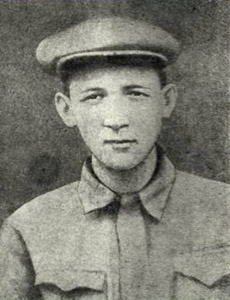
Sixteen-year-old partisan Alexander Chekalin earned his martyrs’ crown as a Hero of the Soviet Union when he was executed by the occupying Third Reich on this date in 1941.
The city of Tula, a transport hub 200 kilometers south of Moscow, was a key target for the German drive on the Soviet capital in those pivotal months; the Wehrmacht’s eventual inability to take it from determined defenders was crucial to thrwarting the attack on Moscow by protecting her from the southern tong of the intended pincer maneuver.*
Chekalin didn’t live long enough to see any of this come to fruition but in his moment he did what any one man could do: ambushes, mining, and other harassment of the occupation army in the Tula oblast (region) with his comrade irregulars. Our principal was found out by the Germans recuperating from illness in a town called Likhvin — see him defending his house of refuge against hopeless odds in the commemorative USSR stamp below — and then suffered the usual tortures and interrogations before he was publicly strung up on November 6. He hung there for 20 days before the Red Army took the town back and buried him with honors
In 1944, the tiny town of Likhvin was renamed in his honor: to this day, it’s still called Chekalin.
* Tula was recognized as a Hero City of the USSR for the importance of its defence.

 Mapleton (he gave his name initially as Percy Mapleton Lefroy) entered the annals of crime lore at


 Suspicions of foul play soon appeared vindicated, and we come at last at this point to our gallows-fruit

 “Shura” (

