1787: John Bly and Charles Rose, Shaysites

On this date in 1787, the only two men to hang for the infant American republic’s seminal post-independence rebellion went to the gallows at Lenox, Massachusetts.

The newborn United States emerged from the American Revolution (1776-1783) in a parlous financial condition. Forever short of gold and credit, it had paid George Washington’s Continental Army in worthless scrip* and promises of goodwill. Instead, many a Cincinnatus returned from Yorktown to discover his debtor farm dunned by creditors and taxmen, as desperate as he for hard currency.

Come 1786, protests against unpayable taxes verged into an outright rural insurrection in western Massachusetts. Known for one of its principals, Daniel Shays — who like so many of his fellows was a Continental Army veteran turned penniless farmer — this rebellion continued for several months and took earnest aim at the hated Massachusetts merchant elites. Some 4,000 “Shaysites” would eventually admit to** taking the field as rebel guerrillas. They mounted an attack on a federal armory, and seized weapons where they could for their own use.

A few books about Shays’s Rebellion

It was this last act which occasions our men’s hangings.

The new American authorities, who had not so many years ago been beckoning this same populace to take up their muskets in revolution, exercised in this moment a brittle authority and they would calculate that the proper balance of due regard for their power without unnecessary resentment entailed only a circumscribed approach.

Instead of charging Shaysites wholesale, most were waved away with a free pardon. And instead of charging treason, the Bay State made its demonstration cases with regular criminal offenses — for burglary when our men John Bly and Charles Rose followed some Shaysite militiaman’s order to confiscate guns and powder from nearby houses. In 1787, that was still a potential hanging offense.

Of course, everyone understood well enough the real offense. On the eve of their executions, someone got the condemned men to sign onto a “Last Words & Dying Speeches” broadsheet with a lesson addressed “To the good People of Massachusetts, more especially to Daniel Shays, and other Officers of the Militia, and the Select men of Towns who have been instrumental in raising the Opposition to the Government of this Commonwealth:”

Our fate is a loud and solemn lesson to you who have excited the people to rise against the Government … Advert to those things — live peaceably with all men — be not too jealous of your Rulers — remember that Government is absolutely necessary to restrain the corrupt passions of men — obey your Honest Governors — be not allured by designing men — pay your honest debts and your reasonable taxes — use your utmost endeavours to give peace to your divided, distracted country …

There was another legacy: the outbreak of Shays’s Rebellion — and the federal government’s impotence to respond to it (it was haltingly suppressed by state militia, with the insurgents at points escaping into New York for breathing room) — helped catalyze the Constitutional Convention from May to September of 1787, and informed its creation of a stronger federal state and of the system of checks upon democratic action that a rebellious populace might wish to undertake.

There’s a podcast episode about Shays’s Rebellion here.

* So widely shunned was the depreciated paper Continental currency issued during the Revolution that the phrase “not worth a Continental” entered the parlance of the times; it was these notes that had been given to revolutionary soldiers by way of aspirational salary like so many stock options from a foundering Silicon Valley startup. In 1791, these Continentals were bought out by the new federal government at one cent on the dollar.

** This census arrives via applications for the free amnesty eventually offered to the Shaysite rank and file.

On this day..

1705: Edward Flood and Hugh Caffery

On this date in 1705, Edward Flood and Hugh Caffery hanged at Dublin’s St. Stephen’s Green for robbing one “Mr. Casey.”

Both men were impugned by a witness who subsequently recanted — at which point the victim’s mother-in-law, Elizabeth Price, stepped in to denounce them instead. In their dying statements (republished in James Kelly’s Gallows Speeches: From Eighteenth-Century Ireland) both men insist upon their innocence of the robbery.

It’s unclear to this reader all these centuries later whether we are meant by these doomed “robbers” to understand something unstated between the lines about Elizabeth Price’s animosity towards them, or whether we simply have a case of unreliable witness testimony and tunnel vision. (Obviously we also can’t know whether Flood’s and Caffery’s protestations are reliable.) Judge for yourself, gentle reader:


THE LAST SPEECHES AND DYING WORDS OF

EDWARD FLOOD AND HUGH CAFFERY

Who was Executed at St. Stephen’s-Green, On Friday the 5th of December, 1707 for Robbing of Mr. Casey, at Cabbra?

Good Christians,

Now that I am brought to so scandalous an End, and within a few Minuts of my last Breathing; I here declare before God and the World, that I was not Guilty of this Fact for which I am now to Dye for; neither was I privy thereto, nor to any other Robbery all my Life-time.

One of the same Company that I belong’d to being Confined in the Castle Guard, and transmitted to New-Gate for stealing Cloaths, was in a starving Condition; and that Mr. Casey, who was Robbed, hearing there was some of the Regiment in New Gate, and being Robb’d by some of the same Regiment, as they suppos’d, came to New Gate, to see if he cou’d hear any thing of this Robbery among them.

Then this Man who belong’d to the same Company that I was in, by name Bryan Mac Couly, being in a starving Condition, and Casey making him Drink, and Bribed him, Swore against Four of the same Company; for which we were Apprehended.

In a considerable time after, his Conscience prick’d him; and sent for the Reverend Mr. Jones, who examin’d Mac Couley, who Declared he Wrong’d us Four … That Elizabeth Price, Mother-in-law to the said Casey, hearing that Bryan Mac Couly had made the second Examination, came to him, and said; If he would not Swear against us, she would swear against Caffery and I; so she desired him to Swear, and that he shou’d have for his Reward two Guineas, but he wou’d not.

Then Mrs. Price Swore against Caffery and I, and said she knew us Both well enough … [and] Mrs. Price pitch’d upon one of Man of the Battallion, and said, that was one of the Men, and would have had him confined only he had good proof to the contrary; and made out where he was that Night.

Likewise I declare once more before God and the World, I know nothing of this Robbery that I am to Die for; altho’ I deserved Death before now, but I thank my God not for Robbing or Stealing, but for keeping Company with Women, and I was much given to that Crime, and do trust that God of his great Mercy will forgive me …

Edward Flood

Christians,

Since it has pleased Almight God, that I should Dye this most unfortunate Death; these few minutes that I have to live, shall be to satisfy the World of what was laid to my Charge. And now that I am to dye, I hope all Good Christians do believe that I have a tender regard for my poor soul, (which I hope God will be Merciful to,) and not think that I will dissemble with the World so as to deprive my self of Eternal happiness.

Dear Christians, these being my last Words, I do declare I never was Guilty of this Crime that I now suffer for, nor was I ever Guilty of so hainous a Crime as Stealing or Robbing; but all other small Vices I have been Guilty of, (and hope my Heavenly Father will pardon the same) Cursing, Swearing, and Women was the only Vice I was Guilty of; And that I do heartily forgive the Persons that hath occasion’d this my untimely End. And do further declare, that I never before knew any that was privy to the fact I suffer for; not did I see Mrs Price for 3 Years to my knowledge, ’till she came to New Gate.

I lived with one Ignatius Taffe, at the sign of the Black Swan in Smite-Field; during which service, I have been often in her House, yet never did her any wrong. I Confess I deserv’d Death long ago for the matter of keeping Company with Lewd Women, and I was as much given to that, which is all that troubles my Conscience.

I never wrong’d any living Soul, except I did my Master when I was sent to Buy small Conveniences for the House, then some small thing or other I often kept for my own use: Which is all I shall answer at the Tribunal. And pray God that all Christians may eschew those Vices of Lewd Women, Cursing and Swearing; God will one time or other revenged on ’em that Practice ’em. I desire the prayers of all that sees my untimely End. So fare well.

Hugh Caffery

These are the true Copies of the Dying Persons as delivered by ’em.
Printed by E. Waters in School-House Lane.

On this day..

1856: Six Tennessee slaves, election panic casualties

On this date in 1856, the white citixens of Dover, Tennessee hanged at least six black slaves in the midst of a regional panic.

They could well sense, as could all Americans, the hollowing authority of slavery in the 1850s with the Civil War looming ahead in 1861. Conflict over the issue had split the country sectionally over the disposition of the huge territory annexed in the Mexican-American War; the matter came to literal blows on the western frontier in the “Bleeding Kansas” bush war.

On the cultural plane, these are the years that germinated the definitive anti-slavery novel Uncle Tom’s Cabin (1852); on the legal plane, they produced the the notorious pro-slavery Dred Scott Supreme Court case (1857).

And on the political plane, the slavery issue tore apart the old Whig Party — and so the 1856 presidential election for the first time featured the new anti-slavery Republican Party as the chief opposition. The very first Republican presidential nominee, John Fremont, carried 11 states on November 4, 1856: not enough to capture the White House, but enough to put the Slave Power in fear for its human chattel and catalyze, in the weeks surrounding the vote, paranoid reactions in various southerly locales to the effect that Fremont-inspired blacks would be coming to dispossess all the masters.

Now it only takes a glance at Twitter to evidence the capacity of a presidential ballot to dominate the public mind, so there can hardly be doubt that seditious rumors of liberty fell from black lips which had never been so close to tasting emancipation. “Wait till Fremont is elected, and den I guess as how, missess, you will have to dew de pots yourself,” a Memphis kitchen-slave supposedly told her mistress on the eve of the election. (New York Herald, December 11, 1856) The masters too would have spoken of the same topic, but with trepidation; nobody knew but what the future could hold, and words overheard would have worked their way to and fro across the color line to shape hope, terror, anticipation. The newspapers from the last weeks of 1856 have reports of rumored insurrections and white vigilance committees in Missouri, in Texas, in Arkansas, in Louisiana.

As is usual in slave rising panics no firm evidence exists that black plots consisted in this moment of anything more substantial than whispered hopes. Whites in scattered localities saw Nat Turner everywhere — and nowhere was this more the case than in western Tennessee. There, slaves around the Cumberland River were believed to be organizing a Christmas Day rising* to cut their masters’ throats, run amok, and rendezvous with an imagined army of Fremont liberators. One correspondent described for northern papers how

the credulity of these poor people is such that, in the belief of the whites who excite them, they imagine that Col. Fremont, with a large army is awaiting at the mouth of the river Cumberland … Certain slaves are so greatly imbued with this fable, that I have seen them smile while they are being whipped, and have heard them say that ‘Fremont and his men can bear the blows they receive.’ (via the Barre (Mass.) Gazette, Dec. 19, 1956)

Against such hope — more blows. A truly horrifying and widely republished editorial in the Clarksville (Tenn.) Jeffersonian that Dec. 3 proposed an overwhelming bloodletting to crush this prospective jacquerie.

It is useless to shut our eyes and deny the facts, or sneer at the developments which have been made. Every hour multiplies the proof and corroborates previous discoveries. It is no Titus Oates affair, but a solemn, fearful and startling reality, and must be dealt with accordingly.

The crimes contemplated should be atoned for precisely as though those crimes had been attmpted and consummated. Fearful and terrible examples should be made, and if need be, the fagot and the flame should be brought into requisition to show these deluded maniacs the fierceness and the vigor, the swiftness and completeness of the white man’s vengeance. Let a terrible example be made in every neighborhood where the crime can be established, and if necessary let every tree in the country bend with negro meat. Temporizing in such cases as this is utter madness. We must strike terror, and make a lasting impression, for only in such a course can we find the guaranties of future security …

The path of future safety must be wet with the blood of those who have meditated these awful crimes. Misplaced clemency, and we believe that any clemency would be misplaced, may at no distant day bring upon this people, the horrors and the inexpressible crimes which marked the enfranchisement of St. Domingo. While retributive justice, sternly and unbendingly enforced, will certainly remove the cause of the evils we now suffer and prove our sure protection against their repetition in all time to come.

So far as this writer can establish it is not certain how many people overall in Tennessee and throughout the Slave Power met the guns and nooses of white vigilantes, but some of the best-established are a sextet hanged at Dover on December 4, 1856. This town on the Cumberland was roiled by rumors that slaves from nearby communities intended to march, armed, on Dover itself, an idea that seems not much less fanciful than that of deliverance by Fremont; it became thereby an epicenter of the suppression, and favors us from a sea of unreliable timelines and misstated figures with a concrete eyewitness description.

Tuesday morning [sic — the writer means Thursday, Dec. 4, having narrated Wednesday, Dec. 3 immediately prior], I went to Dover, and arrived there about 2 o’clock. The people had hung four negroes at 11 o’clock that morning, and two more then in town to be hung. I got to the place of execution in time to see the last one go off. Of the six that were hung, three had been preachers. They were all proved to be ring-leaders. I learned that the men at the forge were at work whipping the truth out of their negroes, so I rode out there that night, and was up with them all night. I never had such feelings in my life. I saw a list of negroes that had been whipped, and was told what they all had stated, and then I heard the balance examined — some taking five and six hundred lashes before they would tell the tale … One of the negroes at the forge died from whipping that night, several hours after the operation.

We are at work here to-day. We have one negro in chains, and will hang him I think, certain; if the committee will not the community are determined to do it. I think we will have quite an exciting time here before we get through. I have no doubt but that it is a universal thing all over the Southern States, and that every negro fifteen years old, either knows of it or is into it … (Louisville Daily Courier, Dec. 29, 1856)

Two key academic sources on this affair are:

  • Harvey Wish, “The Slave Insurrection Panic of 1856,” The Journal of Southern History, May, 1939
  • Charles Dew, “Black Ironworkers and the Slave Insurrection Panic of 1856,” The Journal of Southern History, August 1975

* Shades of Jamaica.

On this day..

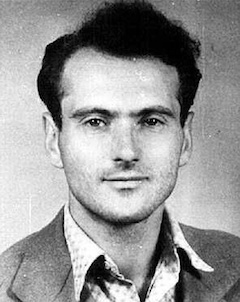
1958: Istvan Angyal, Hungarian revolutionary

On this date in 1958, Angyal Istvan was hanged for the failed 1956 Hungarian revolution.

A working-class Jew who survived Auschwitz as a boy — his mother and sister were not so fortunate — Angyal was a convinced leftist who became disaffected with the Hungarian regime not because of its Communism but because of its failure to realize the democratic and egalitarian aspirations of that ideology.

A fixture on the youthful intellectual ferment in Budapest in the early 1950s, he was one of the leaders of street protests against Soviet domination during the doomed Hungarian Revolution of 1956, even conferring personally with Prime Minister Imre Nagy during its last days. In a gesture that not all of his comrades would have supprted, he set out the hammer and sickle along with the Hungarian national flag on November 7, the very eve of the revolution’s defeat, arguing to Soviet troops that they were fighting against true communism.

He’s commemorated today at an Angyal István Park in Budapest; it’s evidently “a modern social place with free Internet” and a nifty paper plane art installation.

On this day..

1885: Robert Goodale, messily

(Thanks to Richard Clark of Capital Punishment U.K. for the guest post, a reprint of an article originally published on that site with some explanatory links added by Executed Today. CapitalPunishmentUK.org features a trove of research and feature articles on the death penalty in England and elsewhere. -ed.)

45-year-old Robert Goodale was a market gardener who had been married to a lady called Bethsheba for 22 years. He owned a piece of land at Walsoken Marsh, near Wisbech, where he grew fruit and vegetables. On the property was a house that was used only for storage and not lived in, together with a well. The Goodales lived in Wisbech with their two sons, aged 18 and 21. All of them would walk to Walsoken in the mornings and work on the land.

On the 15th of September 1885 Bethsheba did not arrive at the market garden and a search was made for her. Her body was discovered the following day in the well. Examination of the body revealed that she had been struck three times on the head, most probably with a bill-hook, and then thrown down the well, where she drowned.

Goodale was arrested by Sgt. Roughton on suspicion of murder and later charged with the crime. He came to trial at the Norfolk Assizes at Norwich before Mr. Justice Stephen on Friday the 13th of November 1885.

Evidence was presented of the Goodales’ unhappy marriage and of threats of violence made against Bethsheba by her husband. A witness testified that he had heard a quarrel in the Goodales’ house on the afternoon of the murder. Dr. Stevenson the Home Office analyst said he had found traces of mammalian blood on the prisoner’s hat and jacket.

The defence led by Mr. Horace Browne contended that the case against Goodale was very weak. He conceded that husband and wife were not on good terms but insisted that Goodale’s conduct was not consistent with that of a murderer. He rebutted the blood stain evidence and suggested that it had come from the prisoner having a nose bleed. At this time it was not possible to determine the group to which the blood belonged and therefore it could not be certain that it was the victim’s blood, or even that it was human rather than animal blood.

The trial resumed on the Saturday and after the closing speeches and the summing up it took the jury just 20 minutes to reach their verdict of guilty of the wilful murder of his wife. Goodale was sentenced to death and removed to the Condemned Cell in Norwich Castle to await execution on Monday the 30th of November.

He was visited by his two sons and his sister on the Friday. Later that day he asked to see the governor of Norwich Castle, Mr. Dent. He and the Chief Warder went to Goodale’s cell where he told them that the crime had taken place due to extreme provocation. He claimed that his wife had told him that she liked other men. Mr. Dent took Goodale’s statement down in writing and sent it to the Home Secretary. The Rev. Mr. Wheeler and a former Sheriff of Norwich went to London and made representations for a reprieve at the Home Office. On Sunday the 29th of November the governor received a letter saying that the Home Secretary had not found cause to grant a reprieve.

James Berry had arrived at the prison and tested the drop on the Monday morning in the presence of the governor and under-sheriff. The gallows there had been constructed some three and a half years earlier for the execution of William Abigail on the 22nd of May 1882. The trap doors were set level with the floor over an 11′ 5″ deep brick lined pit in the middle of a small yard. This yard was approximately 48 feet long by 15 feet wide near the Castle wall, opposite Opie Street. The gallows consisted of a black painted wooden beam supported by two stout uprights set over the black painted trap doors.

Goodale stood 5′ 11″ tall and was a heavy man at 15 stone (210 lbs.) with a weak neck. Berry considered that a drop of 5′ 9″ should be given. He used a “government rope” that had been used for the hanging of John Williams at Hereford a week earlier.

At 7.55 a.m. on the Monday morning the bell of St. Peter’s church began to toll and the officials proceeded to the condemned cell. A procession then formed consisting of the governor, the Rev. Mr. Wheeler, the surgeon, Mr. Robinson and the under-sheriff, Mr. Hales. Mr. Charles Mackie of the Norfolk Chronicle represented the press. They went down a passage that connected the cell to the gallows yard where Berry met them and pinioned Goodale, after which they continued into the prison yard.

Here Berry strapped Goodale’s legs and applied the white hood and the noose. Goodale several times exclaimed “Oh God, receive my soul.” As the church clock struck for the eighth time Berry released the trap doors and Goodale disappeared into the pit, but the rope sprung back up to the horror of the witnesses.

As they looked down into the pit they could see the body and the head lying separately at the bottom.

The law required that an inquest be held after an execution and this was presided over by Mr. E. S. Bignold, the Coroner. Mr. Dent gave evidence that the machinery of the gallows was in good working order and that Goodale was decapitated by the force of the drop. Mr. Dent did not think that a drop of 5′ 9″ was excessive and in fact thought it was insufficient for a man of ordinary build. He also stated that James Berry was perfectly sober.

Berry himself testified and at the end of this the Coroner absolved him of any blame for what had happened. The jury returned a verdict that Goodale “came to his death by hanging, according to the judgement of the law.” They further said “that they did not consider that anyone was to blame for what had occurred.”

This is the only occasion of a complete decapitation occurring at a hanging in England, Scotland and Wales, although Berry had several partial ones.

Assuming that Goodale actually weighed 15 stones (in some reports it is given as 16 stones) and that Berry had correctly set the drop at 5′ 9½” or 5′ 10″ then the energy developed would have been around 1218 foot lbs. This is around 100 foot lbs. more than would have been given after 1939 for a man of normal build with a normal neck. The “Goodale Mess” as it came to be known, led to a lot of unfavourable comment in the press.

Just one day after the most damning newspaper editorials had appeared, the head of the Prison Commission, Sir Edward Du Cane, wrote to the Home Secretary on the 2nd of December. In his letter he suggested the setting up of a Committee on Capital Punishment (which became the Aberdare Committee).

Footnote:

The Norwich Chronicle published an interview with Goodale’s spiritual advisor, the Rev. Mr. Wheeler, a Baptist minister. He felt that maybe Goodale might not have been convicted of murder if he had said earlier what he said in his confession on the Friday evening. When Bethsheba fell into the well, he fetched a ladder to go down and look for her but that he could not get down the well since the opening was just 18 inches wide and he could not physically fit through it.

Had he spoken up earlier, Mr. Wheeler said, the police would have found the ladder still in the well and the dirt of the well on Goodale’s clothes. It might have led to a verdict of manslaughter.

When Goodale finally came forward with this tale, it was too late.

On this day..

1766: John Clark and James Felton

We resort to a footnote in a Newgate Calendar edition for today’s interesting anecdote:

John Clarke was a watch-case maker, of good repute, in London. He had long been in the habit of occasionally working by himself in a closet; and his apprentice, jealous of the master’s being there employed on some work in which he would not instruct him, secretly bored a hole in the wainscot, through which he saw him filling guineas. He gave information, convicted, and brought his master to the gallows.

Clarke, for this offence, suffered at Tyburn, along with James Felton, an apprentice, on the 26th of November, 1766, who was the first offender convicted on the act which makes stealing bank-notes, &c. out of letters, a felony. It was proved that he stole a bank post-bill out of a letter at Mr. Eaton’s receiving-house, in Chancery Lane.

(There is no Ordinary’s Account for this date: installments of this venerable series were very sparse during the term of Joseph Moore, in the late 1760s. -ed.)

On this day..

1763: Charles Brown, security consultant

This primer appeared in Lloyd’s Evening Post (Dec. 21, 1763) and is also to be found in a 1764 compendium called The polite miscellany: containing variety of food for the mind ; being an elegant collection of moral, humourous, and improving essays, &c. both in prose and verse:

Some Hints, by way of Caution to the Public, to prevent or detect the designs of Thieves and Sharpers.

Left in a manuscript, by Charles Speckman, alias Brown, executed at Tyburn the 23rd of November, for robbing Mrs. Dixon, in Broad-street, Carnaby-market, in September last, of some lace.

  1. Never place many different articles on the counter at one time; nor turn your back on the customers, but let some other person put the different articles up, whilst you are intent upon the business before you.
  2. It is in general to be suspected if a person pulls out a handkerchief, lays it down, and takes it up often, that some ill is intended. This was my constant practice with Milliners and others, with regard to what lay in a small compass. It never failed of success. The following is one instance of my manner of using it: At Reading, in Berkshire, I went to a Milliner’s shop, under pretence of buying some lace, to go round a cap and handkerchief, for my sister. The Milliner asked if I was not too young a man to be a judge of lace? I replied, being young, I should hope for better usage, and left it entirely to her generosity to serve me of that which was best of the kind. At this moment I fixed my eye on a particular piece. Pretending to have a bad cold, I took my handkerchief out to wipe my nose, laid it down on this piece of lace, which repeating again, I took the lace up with my handkerchief, and put it in my pocket, and then told the Milliner I would stay till I was grown older; though it is clear I was too old for her now. I took my leave, and marched gravely off, without the least suspicion; and went directly to the Crown Inn, hired a horse for Maidenhead, but pushed on for London.
  3. The shopkeeper, on seeing such methods as this made use of, should remove the handkerchief from off the goods; which will make the Sharper suspect his design is seen through.
  4. It is common at Haberdashers and other shops, which deal in small articles, that for every article which is wanted to be paid for, the Tradesman applies to his till for change; his eyes being fixed thereon, then is the time something the nearest at hand on the counter is moved off.
  5. Watchmakers and Silversmiths are imposed on principally thus: In a morning or evening the Sharper, well dressed, as a Sea-officer, will go to their shops, look at watches, buckles, rings, &c. when a variety of these are laid on the counter, if opportunity offers, the handkerchief is made use of; should this fail, then the goods are ordered to a tavern, coffee-house, or private house, as best suits for elegance or honesty; then the person is instantly sent back for something omitted, whilst the prize is secured, and the Sharper moved off another way. Though this is an old and stale trick, it is amazing how successful the Practitioners in it still are.

The following is part of the affecting account which this unhappy young man gives of himself:

“During my long course in wickendess, I never was addicted to common or profane swearing, to excess in eating, or to drunkenness, and but little to women. I never was fond of even conversing with thieves and robbers, tho’ at accidental meetings I have met with several, who, guessing I was of their profession, would set forth the advantages of associates, or appearing in company to rob and plunder the honest and unwary. Pallister and Duplex, lately executed at Coventry, who called themselves the heads of a great gang, pressed me to go on the highway with them and their companions, but all they could say was in vain. I never would make use of, or indeed knew, the flash or cant language, in which these two men were very expert. My father, who lived in good reputation in London, where I was born, put me to a boarding-school, and bestowed more money on my education than on all the rest of my brothers and sisters (I was the eldest of 18) for all which I never made any grateful return, which gives me now great affliction, and the most pungent remorse. The misfortunes I have undergone have been, I am certain, entirely owing to the continual state of rebellion that I lived in with my parents; and God, for such unnatural practices, has been pleased to bring me to the most just and deserved punishment I am now shortly to suffer. If children did but properly consider, the very fear of bringing their innocent parents to disgrace and shame, would prevent them from pursuing those wicked practices which end in being publickly exposed to a censorious world, and suffering an ignominious death.”

This youth finished his career at the age of 29: he was about five feet nine inches high, thin and genteel in his person, and affable in his behaviour, with much seeming innocence in his countenance.

On this day..

1928: William Charles Benson

William Charles Benson hanged at Wandsworth prison on this date in 1928, the murderer of his ice cream factory co-worker’s wife.

Benson in 1925 had moved in with his mate Sidney Harbor in Kentish Town where the quarters were so close that everybody shared the same bedroom.

The savings in rent were drawn from the heart’s account, once Sidney’s wife Charlotte — the couple had two children together — took a shine to the boarder in the other bed. Benson in 1927 lost job and side piece alike when he was fired from Wall’s and also kicked out of the house by the suspicious Sidney; Charlotte, however, continued the affair and eventually even took an apartment nearby Benson’s new place to facilitate assignations.

Early on the morning of September 6, 1928, Benson hailed a constable with the words, “I want an ambulance, I have just killed my girl.” Apparently, she had proposed putting the adultery to an end and returning to Sidney.

On this day..

1840: Zachariah Freeman

(Thanks for the guest post to American newsman and reformer John L. O’Sullivan. Best-known as the fellow who coined that potent brand for American empire, “manifest destiny,” O’Sullivan was also a vigorous advocate for abolishing capital punishment as a New York legislator in the 1840s, and made several proposals to that effect. The summary here is one of many reported in O’Sullivan’s appendix to his Report in favor of the abolition of punishment of death, by law, made to the legislature of the state of New York, April 14, 1841. The report did not achieve its objective. -ed.)

Tried in September, 1840, for the murder of Sarah Boyd, his quasiwife, in the town of Lysander, Onondaga county, on the 18th of May, 1840.

Both were negroes. They lived in the same house with his father, 80 years of age, his brother Elihu, and a woman who lived with his brother as his wife. Zachariah was much attached to Sarah, and had taken some steps toward making arrangements for a legal marriage with her.

Jealousy was the motive to the murder — or a combination of jealousy and insanity. They had some trifling dispute, in which she refused to comply with some domestic order of her husband, when he raised a chair, and struck her across the arm, knocking her down. On recovering herself, she declared she would never live with him again. He thereupon went to some woods at a short distance, and made an attempt to hang himself — whether in earnest, or to frighten them, does not appear clear. He was stopped with the rope round his neck, and brought back to the house.

While he was away she expressed great dread of his returning, saying, that if he did, she should be a corpse before morning — that though he had not threatened her, she saw it in his eye. While he was out, before returning to the house, he was praying and singing hymns. He entreated a reconciliation with her, which she refused; — he was willing to go down on his knees to her. She consented to leave it to the rest to decide the next morning, if he would now behave himself.

On this arrangement the rest went to bed — he remained up, smoking a pipe. He had insisted on smoking her pipe, refusing any other. According to his confession of what followed, he after a time leaned his head on the bed, and she kicked him. He then got the knife with which he committed the act, and went to some distance from the house for the purpose of killing himself; but while whetting it, determined to go back to see her once more. She was sitting up in bed. He placed his left hand on her shoulder, and attempted to kiss her. He had no thought of injuring her — “she was young, handsome, and everything that was nice, and it had not occurred to his mind to damage her at all.”

She refused to receive him, and slapped him on the face. He then gave her a stab, which was in a few moments fatal, immediately cutting his own throat also. Though a severe wound, this did not prove fatal.

The family were immediately roused, and eventually he was cured of his wound. He expressed much grief and repentance. He was jealous of his brother Elihu, whom he believed to have criminal intercourse with her. Zachariah had wished her to remove with him to another house, but she had refused. He said, after the affair, that “if she would not lie any more with him, he would not let her with any other man” — “he thought she should never sleep with another man, and he never with another woman.”

He said, he expected to be hanged, but added: “I shall go to the gallows in as good a cause as ever a man went.” His previous general character was good. He was hung November 19th, 1840.

On this day..

1888: Not Sarah J. Robinson

On this date in 1888, Massachusetts almost hanged Sarah J. Robinson.

The reader will easily infer from press appellations such as the “Massachusetts Borgia” or “Sommerville Borgia” that Mrs. Robinson was a prolific poisoner.

The true toll of Robinson’s career remains uncertain to this day but they monstrously included her own son and daughter — the victims that brought her within the shadow of the gallows.

An Irish immigrant, she had discovered the capacity of arsenic for relieving the financial burdens that, then as now, weighed upon the poor. In 1881, her landlord suspiciously died in her care, abating a debt of rent; a few years later, her husband did likewise, leaving her an insurance windfall, and then her sister too.

Still the maintenance of five children — four of her own, plus a nephew — harried her. To keep the wolves at bay she moved frequently, sold off furniture. And last, she enrolled two children in a working-class insurance fraternal and collected so speedily to attract the wrong attention. Her many murders afforded multiple bites at the legal apple, so when a jury hung on a charge of murdering her kids, they just turned around and got her for a nephew instead.

Mrs. Robinson was escorted to the court room … A large rocking chair was provided for her comfort in the rear of the court room outside the prisoner’s iron cage. She languidly sank into it, and as soon as seated requested a drink of water, which was brought her by Sheriff Tidd. Her hands trembled like leaves as she eagerly held the tumbler to her lips. (Boston Journal, June 29, 1888)

Notwithstanding her many victims, the prospect of noosing this trembling-hand, rocking-chair mother discomfited the public. The governor commuted her sentence to solitary imprisonment four days before her scheduled November 16, 1888 hanging.

On this day..