1697: Three at Tyburn, multiply sinning

An account by the Ordinary of Newgate Samuel Smith … in fact,

A True Account of the Behaviour, Confessions, and last Dying Speeches of the Condemned Criminals, that were Executed at Tyburn on Wednesday the 15th of this Instant Sep. 1697.

On the Lords-Day, after the Condemnation of the Condemned Criminals, a Sermon was Preached on this Text, Reve. 2. 21. I gave her a Space for Repentance; yet she Repented not.

In these Words are three Observations

  1. THE Lord gives the worst of Sinners a suffficient Time for Repentance. I gave her, even Jesabel who seduced others to commit Spiritual Fornication, in grose Idoaitry.
  2. The Lord doth not only afford a sufficient Time for Repentance, but adds many advantageous Opportunities, and the assistance of his Spirit to compleat it.
  3. To Sin against all the advantageous Encouragements, which might promote Repentance, by persisting in Impenitency, deeply aggrevates the Sinners Condemnation.

The necessary Ingredients which constitute and compleat the nature of Repentance; without which it cannot be available to Salvation, in.

1st. A strict search into the frame of the Heart; to find out the mistery of Iniquity in our most secret and indulged Lusts. There must be a deep Humiliation for the universal Corruption of the Sinners nature, and the peculiar Sins of every Age of his Life.

2ly. An universal hatred of the least Sin, because it offends God, as contrary to his Holy Nature; and for Ingratitude against all the endearing Obligations of divine Mercies, which should soften the Sinners Heart; yet usually these extinguish all good resolutions of Amendment, and the flood of Afflictions more inflame and irritate Men’s Lusts.

3ly. Sincere Repentance includes not only an universal forsaking every evil Way, but also a watchful Circumspection and fixt Resolution to avoid all the occasions of Sinning.

4ly. A turning to God with the whole Heart, in the constant practice of all those Christian Duties which the Lord requires of us.

The second Query.

What are the fittest and most advantageous Opportunities, wherein to promote the work of Repentance?

1st. Whilst clear and strong Convictions are imprest upon the Conscience, before these be stifled or made ineffectual by the Sinners Corrupting or bribing the sentiments of right Reason; yet many Sinners strive to wear out the Convictions of their Consciences, so that they do no execution on their Lusts.

2ly. When the fond Love of the World is imbittered by sharp Afflictions, now turn the Stream of this Worldly sorrow into the Channel of Sincere Repentance: I affirm that a gracious Person prefers the sharpest and longest Afflictions Sanctify’d, in impressing the divine nature deeper on the Heart, than if the Lord should heap the confluence of worldly injoyments, which usually are abused to Pride, Wantonness, or Slothfulness in his Duty.

3ly. When by an Eye of Faith we behold our Redeemer Crucify’d a fresh in the Sacrament of the Lord’s Supper, as a memorial of his dying Love, to make Sin more bitter to us; now let thine Heart be contrite with Godly sorrow, and pour out the blood of every Lust at the foot of the Altar, as an acceptable Sacrifice to the mortifying Spirit of Christ.

4ly. Comply with the Lord’s design, when he sets out other Sinners as the Monuments and Examples of his severity: The Lord will take this very ill when he writes our Duty in the blood and Destruction of other Sinners Less peccant. and yet such who are spared, have no Impression of an Holy Ingenuity to learn Righteousness in the amendment of their Lives.

5ly. When the Lord makes deep Wounds in thine own Conscience, do not presume to heal them by a few slight Formalities in Relenting, neither let the fountanel of Godly sorrow dry up, which should drain out the malignant Humors of thy defiled Heart.

6ly. When thou undertakest any great Service for God, attended with difficulties and discouragements, now is a Time to renew Godly Sorrow, for offending a gracious Lord who puts an eminent Honour on thee, in that he will employ thee in his Service.
Also when thou desirest success in entring upon any new state of Life, thou can’st not expect any blessing from God unless thou cleanse thy self from all filthiness of Flesh and Spirit, contracted before in any part of thy Conversation.

7ly. When thou observest the wickedness of other Men, mourn by a sad Reflection on thine own corrupt Nature: This is alike if the Lord had not renewed it by his Regenerating Spirit: Mourn that you have not been faithful in reproving Sinners; because hereby you have Adopted their Sins to become your own.

8ly. When good Resolutions are formed up within us in any Duty of Religion, let us step presently into the Pool of Repentance, for our former not Compliance with the blessed motions of God’s Spirit.

Here a Case may offer it self to be stated. It is thus.

Considering that God gives a fit space of time to the worst of Sinners, to accommodate their Repentance; What Time is requisit for the Magistrate to afford Condemned Criminals to prepare them for their Death?

This cannot be stated Absolutely, so as to limit the Power of the Magistrate in this Case. Neither ought any Minister to repine or grudg at the length of Time, as being sparing of his utmost endeavours to save Souls: Yet some think that a compleat Weeks time at least is fit to be granted, if Criminals do not abuse it by being ungovernable, in attempting to break Prison. But much longer Time may make Condemned Persons more secure in presuming that they shall be Pardoned: Hereupon the means of Grace work not so effectually upon them: For when they have no hopes of Respiting their Death, their Convictions are usually the more strengthned, their Prayers more fervent, and their Resolutions to Repent the more settled and confirmed. It is an honourable remark of Piety, and Clemency in the Magistrates of England, that they allow a convenient Time for Reconciling the Souls of Condemned Persons unto God. Yet how strange and deplorable is this, that tho’ a sufficient respiting the execution of the Sentence be indulged; Criminals draw on themselves deeper security in Sinning; a stroke far worse than Death, because not felt.

Hopes of Life, Dead praying, and Men’s promises of Improving the Space for Repentance, are blown away, when the fears of Death are abated. Impenitent Sinners abuse God’s sparing Mercy; and as I have observed, are not so fit to dye upon a long Reprieve: They are more Solicitous in employing their Friends to make intercession for their Pardon, than themselves are careful to set forward their Repentance thereby, to be Reconciled to God, by whose Smiles or Frownes Men’s Souls are disposed of in Happiness or Misery, throw all the Ages of Eternity.

The conclusion was thus Directed to the Condemned.

You have heard discrib’d unto you the fittest and most advantageous Opportunities to set Repentance on Work, that it may be compleated unto Salvation; also the dreadful pernicious Effects of willful Impenitency. Yet you have Presumptuously adventured to multiply Sinning, tho’ this hath sharpned stinging reflections in your guilty Consciences. Your Ears have been very attentive to the Councils of ungodly Associates: But you have out done the deaf Adder, in stoping your Ears against all God’s counter-charmings of your sensual Lusts, by the instructions of Heavenly Wisdom. Do not dare any longer to elude or frustrate the main design of God, in exhibiting the offers of Salvation. How durst any of you cast your Repentance into your last Accounts, which ought to have been the first and choicest Work of your whole Life.

Oh! That you would duly consider that all Supernatural Probationary Acts of Grace, such as Repentance, and the severity of mortifying your corrupt Nature, ought to be swiftest toward the end of your Lives, because it is not possible, and cannot be Available to renew them after Death in the rectifying, of any mistake. Consider that there is great difference ‘twixt a Conscience legally wounded for the dreadful Shameful Punishments of Sinning, and a Conscience Evangelically contrite, out of an Holy ingenuity for offending a gracious God, who hath long waited to overcome the Sinners Stubornness with his Clemency. Fear, least after some short Anguish in your Consciences, you should perish in your delay to compleat Repentance.

Consider the Spiritual benefits which sweeten the difficulties, and austerities of sincere Repentance: Tho’ sensual Sinners despise a contrite Heart, as effeminacy and baseness of Spirit; yet it is the best Demonstration of love to God, and a genuine fear of his long suffering; not to Sin against it by vile ingratitude. It doth not dispirit Men’s Courage in dying, but contemn Life when it cannot be prolonged with the safety of the the Souls integrity and loyalty to Christ’s Laws; it casts forth the oppressing load of sensual Surfeits, which defiled the Souls heavenly Purity. In the midst of National amazing Confusions, penitential Converts to God shall be as safe as Salvation it self can make them: Yet consider how difficult it will be to unravel the Web of Sinning, when Men never Communed with their own Hearts, to search out those Iniquities which are confirmed by a long Custom in Sinning. Familiarize therefore to your selves the severities of sincere Repentance: Justify God in his sharpest Corrections of you, to reduce you from wandring in the Bewildring devices of Sinning, and condemn your selves for the minutest Errors of your Lives. Be not slow and slight in so solemn a work; your whole Life ought to have been a continual exercise of Repentance, and of mortifying your Lusts, as a meet disposition for Eternal Life.

Take heed of dying in an obstinate contempt of God and Godliness, least the Lord harden his Heart against you, so that when you cry for Mercy, under the anguish of your Consciences, the least glance of it should be denied you.

I proceed to give an Account of the Behaviour and Confessions of the Condemned Criminals.

I. John Dewin, Condemned for Counterfeiting the Coin of this Kingdom: Aged thirty four Years. He was born in Norfolk: Was Prentice to a Shoemaker in the Northern parts. He kept Shop four or five Years; but left that Employment to deal in Cheese and Bacon at Waltham-Abby. He confest that tho’ he had not wronged any Man in his Trading; yet, that he had not led a Religious Life towards God: For he neglected the Duty of Praying to him; kept the Sabbath very slightly; that he was guilty of Swearing; but seldom Drunk in excess. He wept and said, That it now grieves him that he hath in many things sinned against the Holy Trinity: And yet that he doth not Repent as he ought, for his being so negligent of his Duty to God. But he begs of him earnestly to change his Heart, and not only to pardon his Sins; and hopes that if he might be spared he should never return to any Customary provoking his most holy Creator, but become a reformed Man.

II. Isaac Blount, Condemned for Stealing a Gelding: Aged twenty three Years. He was born in Gray’s-Inn-lane. He was an Hackny Coach-man , and drove as a Journy-man for some time, till he wrought for himself. He confest that he had many ways offended God, in prophaning the Lord’s Day; in omitting often the Duty of praying that he might be kept from bad Company; that he had kept Company with bad Women, but not lately; that he was not addicted to Swearing nor Drunkenness, yet had at times committed these Sins. He said, that he now is sensible of his evil Courses, and mourns for offending God by them, and hopes that he will so soften his Heart, that the Convictions which are in his Conscience may work to a thorough Repentance.

III. John Chamberlain, Condemned for Felony and Robbery: Aged twenty six Years: Born in Herefordshire. He was Journyman to a Butcher. He left that Employment about three Weeks since; but was joyned to bad Company before. He denied not the Crime. He confest that he did not performe the Duties of the Lord’s Sabbath, but walkt in the Fields with idle and vain Persons; that he was no much given to Swearing, and had somtimes been overcome with excessive drinking; yet he hopes that being now penitent for all his Sins, that God will pardon them. I stated for several days the nature of true and false sorrow for Sinning, also the nature of true saving Faith; wherein it differs from a presumptuous reliance on God’s Mercy and Christ’s Merits, and the danger of Sinning in hopes of future Repentance; so that they desired me to pray for them, that they might not deceive themselves with false hopes of Heaven.

IV. Mary Taylor, Condemned for a Burglary. She was born in Chancery-Lane. Was a Servant for eight Years to several Persons of Quality. She said, That altho’ she knew her Duty to God, yet she had Sinned against the Convictions of her Conscience; whereby she had much wounded it. She confest that she had not taken former warning, altho’ she had been punished for an evil practice, and that therefore God had justly inflicted this dreadful Scourge upon her, to bring her as she hoped to Repentance. She said, That now the chief trouble of her mind is for offending God her Creator and great Redeemer. She said, That she heartily desires that she may be cleansed with the Blood of Christ. O how merciful said she, is God! that he thus Corrects me, and moderates his Justice toward me, in this, that I am Respited from dying, for the space of six Months, till I am delivered of the Child I am quick with; hereby I have time to Repent of my Sins of Presumption, for I knew God’s Will, but obeyed it not; such deserve a more terrible Condemnation.

The other Women Condemned, were also found with Child, as the Jury of Women affirmed; therefore they are reserved for a longer time before they suffer. I am sorry that they make so ill an use of it, that they grow secure; yea, obstinate, in refusing to come on the last Lord’s Day, and at other times to receive Instruction, in order to bring them to a sensibleness of their evil Courses. Callow especially was obstinate, who is Condemned on two Indictments, for picking of Pockets.

On Wednesday the 15th of September, 1697. John Dewin, John Chamberlain, and Isaac Blunt, were convey’d to Tyburn; the first on a Sledge, and the other two in a Cart. But Flora alias Flower, he died in Prison the 12th of September. The Prisoners being brought to the Tree, were tied up. Dewin would not own his Crime, but desired all good People to take warning by him, how they led their Lives, least by their sinful Courses they should come to such untimely ends. Isaac Blunt would not own his Crime, but said, he had been guilty of divers such Crimes; he did not shew any outward appearance of Repentance. John Chamberlain said, That he was a great Sinner, and had been drawn in by evil Company to do the Fact for which he now suffers; he desired all good Christian People to pray for him, and to take warning by him, and eschew evil Company, and have regard to the Sabbath; he said, That he was bred a labouring Man, and one that did use to work hard for his living; but forgetting God and following Idleness brought him to this untimely end. The Ordinary prayed with them for some considerable Time, and sung a Penitential Psalme. And afterwards they were turned off.

This is all the Account that I can give of this Sessions.

Dated Sept. 15.

Sam. Smith, Ordinary .

LONDON, Printed for E. Mallet, in Nevil’s-Court in Fetter-lane, 1697

On this day..

1568: Jan van Casembroot, Lord of Backerzele

The implacable Duke of Alva/Alba bloodily suppressing the Low Countries’ revolt against Spain claimed the head of Flemish nobleman and poet Jan van Casembroot.

Although Catholic himself, the Lord of Backerzele (English Wikipedia entry | Dutch) shared the umbrage of his countrymen at the Spanish King‘s punitive anti-heresy edicts: not only were they brutal, but they infringed the Low Countries’ constitutional rights.

Casembroot/Backerzele was among the 300 lords who in early 1566 set his hand to a petition demanding moderation of an immoderate Spanish crown. Known as the Compromise of Nobles, it was roundly rejected by Spain — and the growing boldness of Protestant evangelists along with the outbreak of iconoclastic attacks on Church symbols soon pushed events past any possible point of compromise.

Appointed by the beloved-of-Beethoven Count Egmont to quell such disturbances as governor of Oudenaarde, Casembroot was held to have made treasonably liberal concessions to the Calvinists — and three months after Egmont himself went to the block, Casembroot lost his head at Vilvoorde.

Several of his Latin verses have reached posterity, although seemingly not the further shores of the World Wide Web.

On this day..

1996: Roberto Giron and Pedro Castillo, televised shootings

Roberto Giron and Pedro Castillo, peasants who raped and murdered a four-year-old girl, were shot at the Guatemalan town of Escuintla on September 13, 1996.

The executions — Guatemala’s first juridical shootings since 1983, although civil war death squads had ravaged the country in the meanwhile — were filmed by the press and televised, and the tape told an troubling tale: both men survived the initial volley and after paunchy doctors hastily conferred by the gasping doomed men, were icily finished off by the squad commander’s pistol.

Warning: Mature Content. This is a snuff film. A slightly longer cut of the same reel can be found here.

Thanks to this ghastly debacle, Guatemala changed its execution method to lethal injection — an application of which was also televised in 2000.

On this day..

1869: An Dehai, beloved eunuch

The imperial eunuch An Dehai was beheaded in Jinan on this date in 1869.

He was so much the favorite that it’s been clained that the redoubtable Empress Dowager Cixi had outright fallen in love with the courtier.

This was a circumstance destined to sharpen both An’s confidence in his position, and the blades of the inevitable enemies within the Forbidden City who were keen to be rid of him.

In 1869, the eunuch was dispatched to Nanjing as Cixi’s envoy to arrange the wedding gowns for the marriage of her son, the titular boy-emperor in whose name Cixi wielded power. On this trip, Cixi openly flaunted the protocol requiring eunuchs keep themselves inconspicuous, and also allegedly used the occasion to feather his bed with a bit of opportunistic extortion.

This, at any rate, was the report that an imperial governor relayed back to Prince Gong, who had once helped Cixi seize power in the state but had now become her rival. Gong got a quorum of the Grand Council to sign off on An’s execution while Cixi was off at the opera. She was so bereaved to discover his fate that she had his belongings lovingly gathered up for permanent safekeeping.

On this day..

1911: Ernest Harrison, Sam Reed, and Frank Howard lynched

Ernest Harrison, Sam Reed and Frank Howard, confessed to the murder of Washington Thomas, an aged, respectable colored man. Thomas was employed in a tobacco factory, and Saturday night [September 10, 1911] the three men waylaid him along the railroad track, killed him and robbed his clothes of his salary. They were speedily captured and placed in jail. During the night the colored people of Wickliffe [Kentucky] held secret meetings and decided to lynch the murderers. Everything was quietly done. The bodies of the lynched men were left hanging until noon today, and there will be no effort by the authorities to apprehend the executioners.

Record Herald, Sept. 12, 1911

On this day..

1941: Viggo Hasteen and Rolf Wickstrom, for the Milk Strike

On September 10, 1941, the German authorities occupying Norway martyred two labor activists.

The Third Reich occupied Norway in the spring of 1940, adding their puppet ruler’s surname to the world’s lexicon.


Rations queue in Oslo, 1941.

Besides the obvious consequences — national humiliation, political executions — the occupation brought terrible economic hardship to ordinary Norwegians. Most of Norway’s western-facing trading relationships were severed by the wartime takeover, and the lion’s share of national output was appropriated by Berlin. Norway’s GDP fell by nearly half during the war years.

“There was a real risk of famine,” Wikipedia advises us. “Many, if not most, Norwegians started growing their own crops and keeping their own livestock. City parks were divided among inhabitants, who grew potatoes, cabbage, and other hardy vegetables. People kept pigs, rabbits, chicken and other poultry in their houses and out-buildings. Fishing and hunting became more widespread.”

And people got more and more pissed off.

On September 8, shipyard workers protesting the withdrawal of their milk rations triggered a large, but brief, labor disturbance. The Milk Strike was violently quashed by September 10 with a declaration of martial law in Oslo and nearby Aker and the arrests of a number of labor leaders, five of whom were condemned to death.

Two of those five sentences were actually carried out:* those of lawyer and Communist Viggo Hansteen (English Wikipedia entry | Norwegian), and labor activist Rolf Wickstrom (English | Norwegian).

They’re honored today in Oslo with a monumental joint tombstone and a memorial.

* Generous commutations awarded to Ludvik Buland and Harry Vestli permitted them to die in prison before the war was out. Their comrade Josef Larsson survived the war and chaired the Norwegian Union of Iron and Metalworkers until 1958.

On this day..

1943: Jarmila Zivcova, correspondent

In the early morning hours on this date in 1943, Jarmila Zivcova, her husband Vaclav Zivec, and their friend Ruzena Kodadova were beheaded in Berlin. These Czechoslovakians had been condemned for complicity in the assassination of Reinhard Heydrich.

Their deaths were part of the mass of executions ordered by the Reich after Allied bombing damaged Berlin’s Plotzensee Prison, but we notice them via this thread on the information-dense Axis History Forum, thanks to the unusual circumstance of having their “last letters to their families” — a palliative exercise whose product was often destroyed rather than delivered — rescued by Karel Rameš. In his Zaluji: Pankracka Kalvarie, he gives the text of Jarmila Zivcova’s heartbreaking last missives, as translated by a forum poster:

9 September 1943:

Dear Mrs Taskova:

We are here with Ruzena in the preparation cell and at 4:30 we will be executed – us two, and my husband. We believed till the last moment that this would not happen, but unfortunately this morning we had to hear the awful truth that we must die. You were deceived if they promised you that we will be saved. Ruzena is very devastated, her hands shake, so she cannot even…

… and, scrawled on the back of a photograph of Vaclav and Jarmila’s son:

9/9/43, from your mom and dad:

My dear Jiri, keep this picture, kissed thousand times, in memory of your mother who found solace in it even in the saddest moments.

These aren’t names rich with search hits, but a German volume called Berufswunsch Henker contributes this letter from friends on the harrowing experience of proximity to the fallbeil:

We have seen our best friends go — Rosa Kodakova, Jarmila Zivcova, and many others. We can hear the severed heads crash onto the floor. We hear every detail in the vicinity of our cell. We hear the gate of the preparation cell open, then the executioner’s footsteps to the door; we hear his helpers grab the victim, shove her on the wooden bench, and cut off the head. Then they carry the body away without a head. They place the body in a rough coffin, their chopped-off head thrown between the dead man’s legs. The whole thing is then transported away somewhere for burning. By now we all know the whole story by heart.

On this day..

1961: Henryk Niemasz, the last hanged at Wandsworth

Wandsworth Prison hosted its 135th and final hanging on this date in 1961.

The star of the show was Henryk Niemasz, who became infatuated with a married woman and shot her dead when she refused to break up her marriage for him. Niemasz was also married himself, to a wife who surely deserved better given that Grypa Niemasz was willing to give her husband a fake alibi for the time he was off shotgunning his paramour.

The death penalty departed English shores in the 1960s, but the Wandsworth gallows was kept in working order until 1993, just in case. (It would have been in case of treason, which was the only remaining capital statute by then.)

The prison itself, which dates to 1851, remains in operation to this day. According to friend of the blog Another Nickel in the Machine, Wandsworth’s former condemned cell “is now used as a television room for prison officers.”

On this day..

1952: Mustafa Khamis and Muhammad al-Baqri, Egyptian labor activists

On this date in 1952, Egypt’s revolutionary military government sent a gallows warning to the labor movement.

The towering political figure of the whole Arab world until his death in 1970, Gamal Abdel Nasser led a coup that toppled Egypt’s monarchy just weeks prior to the execution we mark here. (On July 23, 1952; it’s known for that reason as the July 23 Revolution.)

They had bold plans for their countrymen, these young officers: egalitarian land reform, pan-Arabism, release from the hated grip of colonialism.

But don’t mistake that for an invitation to present just any grievance.

the Free Officers were not willing to tolerate a militant, independent trade union movement. The armed forces and workers clashed in Kafr al-Dawwar, 15 miles south of Alexandria. On August 12 and 13, 1952, the 9,000 workers at the Misr Fine Spinning and Weaving Company conducted a strike and demonstration seeking a freely elected union (a pro-company, yellow union had been established in 1943), removal of several managers considered particularly abusive, and the satisfaction of economic demands. Despite the workers’ proclaimed support for the new regime, the army quickly intervened to crush them. A rapidly convened military tribunal convicted 13 workers. Eleven received prison sentences; Mustafa Khamis and Muhammad al-Baqri were sentenced to death and executed on September 7. (Source)

Nasserite Egypt quashed independent labor organizing in these early years, eventually banning all union activity outside of the state-controlled Egyptian Trade Union Federation.

On this day..

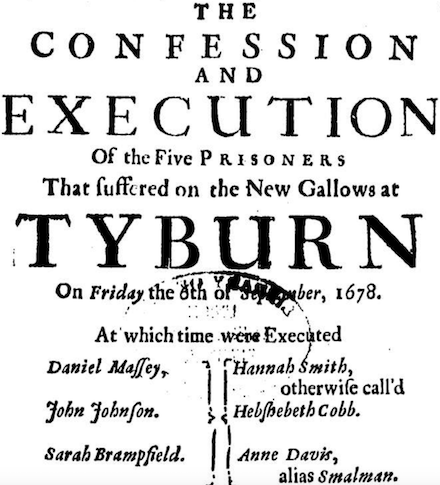
1678: Five at Tyburn

Three men and two women hanged at Tyburn on this date in 1678.

Our text here is one of the earliest of the Ordinary’s Accounts, a far shorter and less ostentatious affair than examples of the genre even a few years later from the hand of a clergyman who has scarcely begun to grasp his true calling, moving copy.


THE CONFESSION AND EXECUTION Of the Five PRISONERS That suffered on the New Gallows at TYBURN On Friday the 6th of September 1678.

At which time were Executed

Daniel Massey. John Johnson. Sarah Brampfield. Hannah Smith, otherwise call'd Hebshebeth Cobb. Anne Davis, alias Smalman.

With Brief Notes of Two SERMONS Preached before them after Condemnation, their Carriage in Prison, and last Speeches at the place of Execution.

The Confession & Execution of the several Prisoners that suffered on the New Gallows at Tyburn, on Friday the 6th of September 1678.

AT the last Sessions there were in all Ten persons Condemned to die; Four menf or Robberies on the Highway, and Six women for Felonies here in Town, either Lifting (as they call it) of Goods out of Shops, or else Robbing those whom they pretended to serve: both which wicked Practises are become so common, and more than once followed by these incorrigible Prisoners, that it was highly necessary to make them Exemplary. Two of the before-mentioned men, viz. those concerned in that barbarous Assault and Robbery, whereof a particular Narrative hath been made publick by the unexpected Mediation of some generous Friends; and the women whose Crimes had not been so great and obstinately continued in as the others, obtained his Majesties gracious Reprieve: and another woman, immediately after she stood attainted, was reprieved by the Court, in reguard she was found by a Female Jury to be quick with Childe.

The Rest came this day to suffer, being charitably indulged in pity to their Souls, so long time to sit and prepare themselves for their great and terrible Change. In order to which, on the Lords-day before, there were two Sermons on most suitable Texts preached before them in the Chappel of Newgate. That in the Forenoon on the fifth verse of the 38 Psalm — My wounds stink and are corrupt, because of my foolishness: Wherein the Minister very pathetically laid open the deplorable Condition such sinners are in by Nature, wallowing not onely in their original Depravity and Corruption, but in continued actual Transgressions against the holy Laws of God; whereby they become abominable, and as a loathsome stench in the Nostrils of that pure Majesty and all good men; and all this occasioned by their own foolishness, that is, their wilful rebellion and obstinacy against all the dictates of Reason, offers of Grace, and impulses of the Holy Spirit upon their Consciences. Which having, like a true Bonaerges, hereby endeavoured to awaken, and put them into a serious sense and apprehension of their lost, undone, and perishing Estate, without speedy and sincere Repentance.

In the Afternoon, as a Son of Consolation, from the 147 Psalm, vers. 3. He healeth the broken in heart, and bindeth up their wounds, he came to shew them the infinite Mercies of God, and Love of Jesus Christ, if they would come in and accept of Pardon and Salvation upon Gospel-terms. That although they had made their wounds to fester and rankle by their foolishness, and had Souls all over bespread with a filthy Leprosie, yet there was Balm in Gilead, an Almighty Physician, both able and willing to heal them, if they would submit to his Prescriptions. In order to which, he gave them divers most necessary and excellent Directions; Not to deceive themselves with a false and palliated Cure, but to close with Christ on his own Terms, and in all his Offices, as their King to Rule them, and their Prophet to Guide them, as well as their Priest to Intercede and make Atonement for them. To hate Sin more, because it was displeasing to God, than because it brought upon them temporal or eternal Punishments. To be as desirous to be Holy as to be Happy; because none can be justified until they are sanctified, Etc.

During the whole time of Religious Worship, and the Sermons, they behaved themselves very Reverently and Attentively; nor was the Minister wanting afterwards, daily to visit them, with pressing Exhortations, and necessary directions to sit them for their last end; especially charging them to disburthen their Consciences, and give glory to God by a free and hearty Confession of their Sins; which had so good an effect, as to bring them to an Acknowledgment; not only in general term, but particularly bewailing the Ill Courses of their past Lives; in neglect of the publick Divine Worship, Violation of the Lords day, Drunkenness, Swearing, and continual practises of Lascivious Debauchery; Two of them above the rest abounding in expressions of Penitence, and endeavouring to improve those few moments of their Lives, to work out their Salvation, and make their peace with God; begging heartily forgiveness from his most holy Majesty, for their Rebellion against his Precepts, and of all those whom they had wronged, by violent taking away their Temporal Goods.

Some of the Women had been Condemned before, and would often bewail the wickedness of their Hearts, that would take no warning thereby: the Men alleadged, they were ignorantly drawn in to that ill Fact, for which they suffer’d, being their first of that kind, and rather by the unhappy operation of too much Drink, than any premeditated design; yet confessed, they had more than once deserved to Dye, and freely acknowledged the justice of the punishment they were to suffer.

At the place of Execution they said little, besides those common, but too much neglected Exhortations, desiring all present to take Warning by them, and remember their Creator in the days of their youth; Not to suffer themselves to be seduced by Ill Company, or sensual pleasures, which had been the means of their destruction, and would be so of all, that did not continually keep a reverent fear of God, and his Worship and Laws in their Hearts.

Thus heartily praying to God for Forgiveness, and to receive their Souls for the alone Merits of his blessed Son; and desiring all good people to joyn with them and for them in those Supplications, they submitted to the Sentence, and taking their leave of all things in this world, were wasted into the unfathomable Regions of Eternity.

FINIS.

On this day..