1765: Andrew Oliver lynched in effigy to the Liberty Tree

On this date in 1765, Boston patriots lynched the merchant designated as the imperial taxman. They only did so in effigy, but the “execution” scared him permanently off the job while also making a gallows-tree into one of the earliest symbols of American independence.

One of the key pre-revolution irritants for the future United States, the 1765 Stamp Act imposed taxes in the form of stamp duties on a variety of printed products, for the purpose of funding the British army deployed to North America. It was a levy long familiar to London lawmakers but it sent the colonies right around the bend, and since the colonies sat no Member of Parliament who could flip an official wig it also popularized the classic revolutionary slogan about “taxation without representation.”*

Enacted in the spring of 1765 and due to take effect in November, the Stamp Act drew immediate outrage in the colonies and especially in that hotbed of subversion, Boston.

There, Andrew Oliver, scion of a shipping magnate clan, was tapped to collect the levy. It figured to be just the latest in a series of lucrative state appointments. How was he to know in advance that this particular legislation would unleash the crazies? Perhaps he should have given more heed to the publication of ominous warnings over the roster of tax collector names.


Boston Post-Boy, August 5, 1765

On the morning of Wednesday, August 14, a crowd of irate Bostonians mobbed the corner of Essex Street and Orange Street (present-day Washington Street) and upon a large elm tree strung up an effigy of Oliver alongside a boot — the footwear comprising a second, punny, effigy of the Stamp Act’s sponsor the Earl of Bute.

“What greater Joy can NEW-ENGLAND see,” ran the menacing note pinned to the mannequin, “Than STAMPMEN hanging on a Tree!” As is clear from the following newspaper account, versions of which circulated widely in New England, these were no mere theatrics but a very proximate physical threat; even the elm’s property owner dared not take down the provocative display for fear that the crowd would pull down his house. Likewise taking the better part of valor, Oliver pledged to anti-tax colonists that he would not take the office, and he kept his word.**


Providence Gazette, August 24, 1765

After this triumphant debut, the elm in question became a common rallying-point for the hotheaded set, a frequent stage for speechifying, rabble-rousing, and fresh instances of popular justice all further to the patriot cause until, as Nathaniel Hawthorne put it, “after a while, it seemed as if the liberty of the country was connected with Liberty Tree.” Of course, it’s all a question of whose liberty; a Tory gloss on this deciduous republican made it “an Idol for the Mob to Worship; it was properly the Tree ordeal, where those, whom the Rioters pitched upon as State delinquents, were carried to for Trial, or brought to as the Test of political Orthodoxy.” When besieged in Boston in 1775-1776, British Tories cut the damned thing down, so for subsequent generations it was only the Liberty Stump.
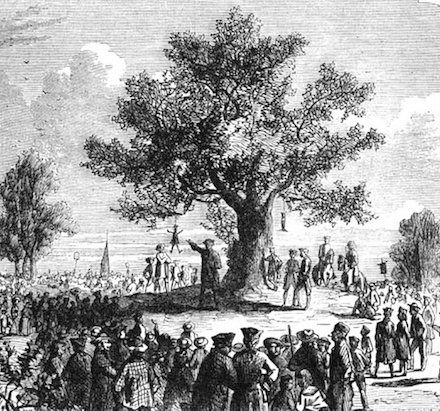

“The Colonists Under Liberty Tree,” illustration from Cassell’s Illustrated History of England, Volume 5, page 109 (1865)

The Liberty Tree is commemorated today at its former site, and forever in verse by revolutionary firebrand Thomas Paine.

In a chariot of light from the regions of day,
The Goddess of Liberty came;
Ten thousand celestials directed the way,
And hither conducted the dame.

A fair budding branch from the gardens above,
Where millions with millions agree,
She brought in her hand as a pledge of her love,
And the plant she named Liberty Tree.

The celestial exotic struck deep in the ground,
Like a native it flourished and bore;
The fame of its fruit drew the nations around,
To seek out this peaceable shore.

Unmindful of names or distinctions they came,
For freemen like brothers agree;
With one spirit endued, they one friendship pursued,
And their temple was Liberty Tree.

Beneath this fair tree, like the patriarchs of old,
Their bread in contentment they ate
Unvexed with the troubles of silver and gold,
The cares of the grand and the great.

With timber and tar they Old England supplied,
And supported her power on the sea;
Her battles they fought, without getting a groat,
For the honor of Liberty Tree.

But hear, O ye swains, ’tis a tale most profane,
How all the tyrannical powers,
Kings, Commons and Lords, are uniting amain,
To cut down this guardian of ours;

From the east to the west blow the trumpet to arms,
Through the land let the sound of it flee,
Let the far and the near, all unite with a cheer,
In defence of our Liberty Tree.

* Visitors to the U.S. capital of Washington D.C., whose 700,000 residents cast no votes in the Congress they live cheek by jowl with, can find this familiar grievance right on the city’s license plates.

** How far this surly bunch was prepared to go on August 14, 1765, one can only guess at; however, in later years, there would be several instances of Bostonians tarring and feathering various tax collectors. These guys did not do civility politics.

On this day..

1997: Ali Reza Khoshruy Kuran Kordiyeh, the Tehran Vampire

Taxi driver Ali Reza Khoshruy Kuran Kordiyeh was publicly hanged on this date for a killing spree that earned him the nickname “the Tehran Vampire.”

For four months, the vampire had preyed on women in the neighborhoods near the place of his ultimate demise. He stalked, abducted, raped and slew nine women and girls, ranging in age from 10 to 47 — including a mother-daughter pair.

He’d been subjected first to court-ordered flogging, many of the 214 strokes administered publicly by relatives of the victims who were cheered on by furious onlookers.

“Innocent blood will always be avenged,” a cleric intoned to the crowd. “This is punishment for the criminal but for us witnesses it is a lesson to be learned … We are responsible for our actions.” Others expressed the lesson less politely.

“Do you see finally that God is greater, you son of a dog?” a man shouted.

“He is not a human,” said Marzieh Davani, a 38-year-old woman.

“I really cannot understand a human can do what he did. He deserves to die surrounded by the hatred of people,” said Amir Ezati, who had taken his place in the crowd at 3 a.m.

“Damn you, you killer,” somebody shouted. The chant was taken up by the others as Kordiyeh, wearing a dark green prison uniform and staring ahead impassively, was led underneath the crane where a noose was tightened around his neck.

A 195-second video of the scene, featuring Mature Content images of Kordiyeh’s flogging and hanging, can be viewed here.

On this day..

1875: Joseph Le Brun, the last public hanging

Joseph Le Brun starred in the U.K.’sthe British Crown Dependencies’ last public execution on this date in 1875.

Although capital punishment had been moved behind prison walls in Great Britain several years earlier, the relevant statute did not apply to Crown dependencies like the Channel Islands. And it is upon one of these rocks, Jersey to be precise, that Joseph Le Brun allegedly killed his sister. The names in this post are Gallic, as was much of the Channel Islands populace.

The milestone case was a strange and unsatisfying one. It entered the view of the judiciary on the evening of December 15, 1874, when a neighbor of Nancy’s reported to the police that Nancy had been murdered and her brother-in-law Philip Laurens wounded in a shooting. The unmarried Le Brun was a frequent dinner companion of this couple as he had been on this night as well, and there was no hatred known to exist among the trio. According to a True Crime Library summary, police

asked Laurens, who had face injuries and an arm wound, who had attacked him, and he replied: ‘My brother-in-law Joseph shot me.’ They found the body of Nancy covered in blood sitting on a sofa. There was a shawl covering her face and her stockinged feet were in a bucket of water.

They arrested Le Brun, who was in bed, and took him to the house where Laurens was awaiting a doctor. Laurens called Le Brun a ‘hangdog,’ and asked, ‘Why did you fire at me?’ Le Brun replied, ‘It wasn’t me.’

At the inquest on Nancy, Philip Laurens said that when he opened his front door on returning home Le Brun pointed a gun at him and shot him in the face. I said to him, ‘What have you done? You have shot me.’ He made no answer.

This evidence of Philip Laurens’s cinched the hemp for Joseph Le Brun. Certainly Philip did know his brother-in-law well. But on the other hand, well, the guy cracked open his front door, in the dark, and immediately got the business end of a rifle in his face. These are circumstances not conducive to the orderly cognitive processes that you’d prefer in a witness.

There was the suggestion that Le Brun might have contemplated such a crime to rob his sister of 28 quid she had recently come into; however, “there was no blood on his clothes, no powder on his hands, and only small change in his pockets” … besides which Nancy was a drunkard who could have been easily relieved of her windfall without the need for homicide. In fact, all three of the principals involved were known to get into their cups.

The crown prosecutor was openly discomfited by the prospect of executing Le Brun on this evidence and the jury likewise. It returned a guilty verdict for the non-fatal shooting of Laurens, but could not come to a unanimous decision about Nancy — the murder charge that would demand the prisoner’s hanging. It was only because Jersey permitted majority verdicts that Le Brun went to the scaffold after the court polled the 24-man panel. Even so, jurors joined the island’s public sentiment and wrote the Home Secretary begging in vain for a reprieve.

Le Brun too maintained his innocence all the way to the end. On the eve of his death, his brother-in-law paid a visit to the man his evidence had doomed, and their queer exchange only deepened the mystery.

Laurens: Joe, I’m sorry to see you here.

Le Brun: And you still wish to say that it was I who did it?

Laurens: Yes, I repeat, you murdered my wife, as you wished to murder me, and no one else but you did it.

Le Brun: You have proof of that?

Laurens: I did not come here to argue with you. I forgive you, but I say that you committed the crime. Adieu!

(Source)

On this day..

1853: Hans McFarlane and Helen Blackwood, married on the scaffold

(Thanks to Meaghan Good of the Charley Project for the guest post. -ed.)

On this day in 1853, Hans M(a)cFarlane and Helen Blackwood were hanged before a crowd of some 40,000 souls in Glasgow, Scotland.

It wasn’t the only civic ceremony the couple would participate in that day.

McFarlane and Blackwood had been convicted of murdering Alexander Boyd, a ship’s carpenter with the merchant navy. On June 11 of that year, they drugged his whiskey, hit him over the head with the chamber pot, stripped him down to his pants and socks and threw his body out the third-floor window.

McFarlane, Blackwood, and two alleged accomplices, Ann Young and Mary Hamilton, were arrested immediately. Although they tried to make Boyd’s death out to be an accident, two children in the room, whom the killers had thought were asleep, had witnessed the whole thing and told on them.

In the end, the case against Hamilton was ruled not proven. Young was convicted, but her death sentence was commuted to transportation. Blackwood and McFarlane had to swing.

Douglas Shelton, in his book Deadlier Than The Male: Scotland’s Most Wicked Women, records,

While in Duke Street Prison, McFarlane asked for permission to marry his lover, Blackwood. Permission was refused but they were determined to be man and wife. As they stood on the scaffold near to Glasgow’s South Prison on the site of the present-day High Court, McFarlane announced to the woman — and the 40,000-strong crowd there to see them hang — “Helen Blackwood, before God in the presence of these witnesses I take you do be my wife. Do you consent?”

The woman replied, “I do.”

McFarlane then said, “Then before these witnesses I declare you to be what you have always been to me, a true and faithful wife, and you die an honest woman.”

The minister officiating the hanging then said, “Amen,” the bolt was drawn and the newly married pair fell to their deaths.

Helen Blackwood was the second-to-last woman to be publicly hanged in Scotland. This broadside was sold to commemorate her and her husband’s deaths.

On this day..

1918: Boris Donskoy, Left SR assassin

One hundred years ago today, the Germans hanged Russian revolutionary Boris Donskoy.

Donskoy was not a Bolshevik but a Left Social Revolutionary — the party faction most closely aligned with Team Lenin. And his offense was a revolutionary crime, but one that events soon swept into irrelevancy.

In March of that same year, Russia’s revolutionary government had fulfilled its promise to exit the charnel house of World War I, ceding in exchange for peace the huge territorial gains that Germany had exacted in the bloodlands in-between empires.

These prospectively gigantic territorial gains were not long held by Berlin, whose wartime government would collapse suddenly before the year was out … but in the short interim where we lay our post, the Baltic States, Belarus, and Ukraine are under firm German control.

The last of these stood under the authority of Field Marshal Hermann von Eichhorn. Donskoy, a radical sailor who had served on the Executive Committee of Kronstadt when it demonstrated against the Revolution’s initial, too-moderate Provisional Government, on July 29 assassinated the field marshal — declaring to his captors that the old Prussian warhorse had been condemned by the Left SRs for suppressing the Ukrainian revolution.

On this day..

1870: William Dickson, the last in Kansas for a lifetime

On this date in 1870, William Dickson’s hanging in the Leavenworth jail yard accidentally put the kibosh on Kansas executions for the next 74 years.

The Sunflower State entered the Union bleeding and had not shown particularly reticent about capital punishment during its first decade of statehood, the 1860s.

Dickson was just an illiterate laborer who murdered a pedlar in Delaware township — but the public hanging brought out the worst in the mob, and “During the execution order was maintained only by the most strenuous efforts, and repeated threats.” (Leavenworth Bulletin, Aug. 9, 1870)

The distasteful scene moved the legislature to revise the state’s capital statutes, unusually placing the responsibility of actually ordering hanging dates directly on the governor instead of a judge. (Such dates also had to be “not less than one year from the time of conviction.”)

The ensuing decades of Gilded Age governors proved perfectly happy never to do so. So, even though courts kept issuing death sentences, they were never carried out. Kansas finally abolished the death penalty outright in 1907. It was restored only in 1935, and the first hanging under the reinstated statute — the first since Bill Dickson — finally took place in 1944.

On this day..

1862: Frisby McCullough, Missouri bushwhacker

On this date in 1862, Confederate soldier Frisby McCullough was shot as a terrorist during the U.S. Civil War’s guerrilla Missouri campaign.

McCullough had a youthful stint in the California gold rush to his back when he returned to Missouri in the mid-1850s to practice law. (He also served in the Missouri State Guard, a pro-slavery militia that had been established in 1861 by the since-exiled secessionist governor.)

With the onset of the Civil War in 1861, McCullough signed up for the pro-slavery Southern army and after a few different assignments became detailed to aid Confederate Col. James Porter in the hasty bush war raging in that frontier state.

We’ve previously detailed that conflict here. For purposes of this post it will suffice to say that the border state of Missouri was fiercely contested during this war, and claimed by North and South alike.

The Union commander John McNeil was not very inclined to charitably reading the treasonable secessionist irregulars who opposed him in the state, whom the Union considered to be operating illicitly behind its lines — in the character of spies and saboteurs, like the British agent John Andre during the Revolutionary War. This very much applied to our man, since McCullough’s particular gift was recruitment — you know, luring loyal citizens into sedition and rebellion.

On August 6, 1862, McNeil’s forces routed Porter’s at the Battle of Kirksville, and they pressed their victory. The very next day after, McNeil had 15 Confederate prisoners taken at Kirksville executed as former POWs who had violated their paroles by returning to the field: “I enforce the penalty of the bond,” McNeil icily reported to Washington.

Not long after, northern sentries also captured the ailing McCullough riding alone near Edina. He wasn’t a parolee — but “he had no commission except a printed paper authorizing the bearer to recruit for the Confederate army,” McNeil would write of him later in a missive to a comrade. At a snap trial on the 8th, “he was found guilty of bushwhacking and of being a guerilla. He was a brave fellow and a splendid specimen of manhood. I would gladly have spared him had duty permitted. As it was he suffered the same fate that would have fallen to you or me if we had been found recruiting within the Confederate lines. He met a soldier’s death as became a soldier.”

A memoir of the southern travails during this conflict titled With Porter in North Missouri; a chapter in the history of the war between the states is in the public domain; chapter XXII relates with umbrage the fate of McCullough whom the author Dr. Joseph Mudd* greatly admired:

Leaning against a fence he wrote a few lines to his wife, and these, with his watch and one or two other articles, he delivered to an officer to be given her, with assurance of his devoted affection in the hour of death. Upon the way to the place of his execution he requested the privilege of giving the order to fire, which was granted to him. All being ready, he stood bravely up, and without a tremor in his manly frame or a quiver in his clarion voice, he called out, ‘What I have done, I have done as a principle of right. Aim at the heart. Fire!’

… He was a good citizen, a high-minded gentleman, of fine presence, brave as a lion, gentle as a woman. Even in his death the strongest Unionists who knew him respected and admired his virtues and entertained the most bitter regrets that what they considered his misconceptions of duty had led him to his fearful fate. At the time of his death he was thirty-three years of age.

* Dr. Joseph Anthony Mudd hailed from Maryland: he was the brother of the Maryland Dr. Samuel Mudd who narrowly avoided execution as a conspirator in the assassination of President Abraham Lincoln.

On this day..

1849: Celigny Ardouin, Haitian Minister of the Interior

Haitian politician Celigny Ardouin was executed on this date in 1849.

The brother of historian Beaubrun Ardouin (and the already-deceased poet Coriolan Ardouin), Celigny Ardouin was the country’s former Interior Minister but was purged when the slave-turned-general-turned-president Faustin Soulouque, appointed as a figurehead president for the country’s elites, mounted a self-coup to establish himself as the emperor.

Ardouin had opposed Soulouque’s initial selection, and the emerging dictator had opportunistically accused his old foe of orchestrating disturbances in support of a senator who was frustratingly safe from Soulouque’s executioners thanks to French diplomatic pressure.

On this day..

1718: Purry Moll and Elizabeth Cave

Tyburn on this date three hundred years ago saw the hanging of two women, both transgressors of the booming capital’s purported sexual mores.

The Ordinary of Newgate Paul Lorrain favored Mary Price (alias Purry Moll) and Elizabeth Cave for the occasion with “A Dehortation from living after the Flesh, that is, after the carnal Desires and sinful Lusts of our Corrupt Nature, which brings forth Death, even Eternal Death.”

Purry Moll‘s sinful Lusts didn’t really have that much to do with her crime; it’s just that she and her husband had walked away from an unedifying union after the banns of marriage were already published. It seems that her post-hubby lover upon putting out to sea had left her a tobacco box as a mark of his affection but — and this gets a little tangled — her mother‘s lover had snatched the box. Moll, clearly in a domestic passion which the scarce words on file at the Old Bailey hardly even attempt to convey, strangled to death a three-year-old girl who was the daughter of mom’s lover. (But not by mom.)

So grief-stricken was she that she insisted on pleading guilty despite the court’s repeated admonition that “if she confess’d it she must be hang’d: To which she replied, if she did confess it, she confess’d nothing but the Truth.”

With her was a woman “about 40 Years of age” of whom the Ordinary noticed — and his narrative is unfortunately truncated by a missing page — “her Face to be extreamly disfigur’d, even to that degree as to have her Nose and Lips eaten up (as it were) with the foul Disease.” Ms. Cave confirmed that “she had been a very lewd Woman, debauch’d.”

She was, in fact, a whore, as would be obvious to any 18th century cad by the cursory narration of her trial: a fellow named Sampson Barret “depos’d, that going through Drury Lane at about 11 o’Clock at Night, there was 6 or 7 Women kind standing together, who divided and made a Lane for him to go through them” whereupon Elizabeth Cave followed him and picked his pocket.

Now, with apologies to the children’s rhyme, there’s really only one reason a guy would be traversing Drury Lane at 11 o’clock at night and that he’d bump into six or seven women on his way … and baked goods weren’t the reason.

This street was a hub of London’s vigorous sex trade. Pronging off “the great thoroughfare running east from the Royal Exchange, along Fleet Street, to St. James’s Park, linking the financial and trade centre of the City with the political power base of aristocratic West London,”* Drury Lane channeled into the far less reputable Covent Garden and from the 17th century had developed into the heart of the red light district that earned this zone the sobriquet “great square of Venus.”

Here, tarts offered their wares amid the bustle of theaters and taverns, often pursuing their profession under the guise of a nominally legitimate street-hawking occupation such as flower-selling.** But little pretense was necessary: from the mid-18th century there was even an annual catalogue of area working girls, Harris’s List of Covent Garden Ladies which by the end of its run in the 1790s was selling 8,000 copies per year. So great a boon was sex work to the economy that a German visitor half-joked that if suppressed, “London would soon be depopulated; the fine arts would be frightened away; one half of the inhabitants would be deprived of subsistence.”


In the “Morning” plate of William Hogarth‘s Four Times of the Day cycle (above), men rendezvous with prostitutes outside a notorious Covent Garden dive, Moll and Tom King’s Coffee House.

We catch an interior glimpse of this same environment in plate three of Hogarth’s A Rake’s Progress, wherein said rake frolics at a Covent Garden brothel (below).

Unsurprisingly, venereal diseases such as that suffered by Elizabeth Cave were quite common among the more proletarian pros to be found at an hour to midnight on Drury Lane; nevertheless, they had no shortage of customers.

If Cave did indeed rob this passing john, it was unfortunate for her that she took currency. In order to save small-time criminals from the gallows, juries routinely applied “pious perjury” to downrate the value of stolen objects below the absurdly low one-shilling (12-pence) threshold for felony larceny; such maneuvers were obviously impossible when it was actual shillings that had been pilfered.

* The trade spilled aggressively out upon that same august thoroughfare, which was the route Defoe alluded to when complaining in the 1720s of “being in full Speed upon important Business, [and] have every now and then been put to the Halt; sometimes by the full Encounter of an audacious Harlot whose impudent Leer shewd she only stopp’d my Passage in order to draw my Observations to her; at other times by Twitches on the Sleeve. Lewd and ogling Salutations; and not infrequently by the more profligate Impudence of some Jades, who boldly dare to seize a Man by the Elbow and make insolent Demands of Wine and Treats before they let him go.” (Source)

** “Flower girl” consequently developed into a euphemism for a tramp. One literary artifact of this history is Eliza Doolittle of the G.B. Shaw play Pygmalion and its musical adaptation My Fair Lady: it’s never overtly stated in the text, but because Eliza begins as a Covent Garden flower girl her virtue is implicitly suspect … hence her repeated insistence, “I’m a good girl I am!”

On this day..

1939: Las Trece Rosas

The Spanish Civil War’s victorious fascists shot Las Trece Rosas — “the thirteen roses” — on this date in 1939.


Plaque at the Cementerio de la Almudena in Madrid in honor of 13 young women shot there by Francoist troops on August 5, 1939. (cc) image by Alvaro Ibanez.

Earlier that 1939, Franco had clinched victory by finally capturing the capital city after a siege of 29 months. A punishing suppression of the Spain’s leftist elements ensued, running to hundreds of thousands imprisoned, executed, or chased into exile.

Our 13 Roses were members of a communist/socialist youth group, JSU, and they had been arrested in rolling-up of that organization. They were crowded into the overflowing dungeons of the notorious women’s prison Las Ventas.

A few Spanish-language books about Las Trece Rosas

And there they resided on July 29, 1939, when their JSU comrades struck back against the dictatorship by assassinating Isaac Gabaldón, the commander of Madrid’s fascist police.* The 13 Roses were immediately court-martialed and executed in revenge. Their names follow; there’s a bit more detail about them in Spanish here:

  • Carmen Barrero Aguado (age 24)
  • Martina Barroso García (age 22)
  • Blanca Brissac Vázquez (age 29)
  • Pilar Bueno Ibáñez (age 27)
  • Julia Conesa Conesa (age 19)
  • Adelina García Casillas (age 19)
  • Elena Gil Olaya (age 20)
  • Virtudes González García (age 18)
  • Ana López Gallego (age 21)
  • Joaquina López Laffite (age 23)
  • Dionisia Manzanero Salas (age 20)
  • Victoria Muñoz García (age 19)
  • Luisa Rodríguez de la Fuente (age 18)

The affair is the subject of a 2007 Spanish film.

* Gabaldon’s predecessor, the police commander under the Spanish Republic, Jose Aranguren, had been removed from his post and executed in April.

On this day..