1941: Henri Honoré d’Estienne d’Orves, the first martyr of Free France

Henri Honoré d’Estienne d’Orves, the “first martyr of Free France”, fell to German guns at the Fort du Mont Valerien on this date in 1941, along with two companions.

A Catholic nationalist naval officer, d’Estienne d’Orves found himself in Egypt in June 1940, when his government capitulated to the devastating German blitz.

Eschewing the accommodationist crowd, d’Estienne d’Orves made his way first to a fleet in Somaliland, and then around the Cape of Good Hope and up to London, to link arms with de Gaulle’s Free French government-in-exile. By December of 1940, he’d infiltrated himself into German-occupied France to set up a spy network. By January of 1941, most of the network had been arrested by the Gestapo.

He and eight others were death-sentenced on May 13 and although the German brass entertained the possibility of clemency as their tribute to an honorable fellow-troop, the growth of partisan attacks against the Reich throughout that summer* eventually dictated a more punitive course. D’Estienne d’Orves, Maurice Barlier, and Jan Doornik were fusilladed together, disdaining blindfolds.


Proclamation in German and French announcing the August 29, 1941 executions of Henri Louis Honore d’Estiennes d’Orves, Maurice Charles Emile Barlier, and Jan Louis-Guilleaume Doornik.

* Germany’s invasion of the USSR in June 1941 forced European Communist parties — and very notably the formerly reticent French Communists — into violent anti-Nazi resistance.

On this day..

1927: Madame Klepikoff, wife of the spy

From the London Times, Aug. 25, 1927. (See also reports from public newspaper archives such as California’s.)

I could not find any source that directly provided the full names of the Klepikoffs. Based on the brief description of events in this Russian book, the husband approached by a foreign agent to spy for Great Britain was one “E. Klepikoff”; this chance genealogy page might relate that name to Efram and Nadezhda Klepikoff.

SOVIET EXECUTIONS.

OFFICER’S WIFE SHOT.

(From our correspondent.)

RIGA, AUG. 24.

The Soviet authorities of Leningrad yesterday, following the rejection of her appeal by the Soviet Government, shot Mme. Klepikoff, who, after a second trial, was condemned to death by a Soviet Court for not betraying to the authorities her husband’s alleged “espionage in favour of England.” The husband, a former captain in the Russian Navy, was shot a few weeks ago.

Yesterday, also, the Soviet authorities shot three Customs officials, Zykoff, Peterleiter, and Borisovsky, and a trader, Kivman, who were condemned last week for defrauding the Customs. They appealed against the sentence, but the Government refused to stay the executioner’s hand.

Meanwhile, officially arranged meetings throughout the U.S.S.R. continue to pass violent resolutions, almost all of which proclaim that August 23 will remain marked in their calendars until they have taken full vengeance for Sacco and Vanzetti.

MOSCOW, Aug. 23. — The Central Executive Committee of the U.S.S.R. has suspended the execution of the sentence on General Annenkov and General Denisov, who, at the sitting of the Military Collegium of the Supreme Court at Semipalatinsk, were condemned to be shot.

The two generals, it was alleged, were implicated in the shooting down of the entire population of villages during the civil war that followed the Russian Revolution. –Reuter.

* On June 16 the tribunal sentenced Klepikoff to death and his wife to three years’ imprisonment. The Soviet authorities, dissatisfied with the sentence on the wife, ordered her re-trial “under conditions involving the death penalty.” The Court assembled on July 12 and passed sentence of death on her.

On this day..

1936: Melquiades Alvarez, a liberal in a revolutionary time

On this date in 1936, the Spanish politician Melquíades Álvarez was shot by the Republicans.

A centrist who disdained “two equally despicable fanaticisms … red fanaticism and black bigotry,” Alvarez (English Wikipedia entry | the more comprehensive Spanish) fell into the chasm torn by the Spanish Civil War.

The Gijon-born former barrister noted for his oratory had been in public life as a liberal back to the last years of the 19th century and in 1912 co-founded the Reform or Reformist Party. Although sympathetic to the democratic aspirations of the Republican movement, the Reform Party was cool to forcing a confrontation with Spain’s monarchy. He was briefly president of the Congress of Deputies before the military coup of Primo de Rivera. Alvarez opposed Primo, judiciously.

I recalled many years ago going to see another vacillating Liberal, the unfortunate Melquiades Alvarez, after he had ventured to criticise Primo at a public dinner. He was shivering in a travelling rug waiting to be arrested while he told with pride that he had made his speech in such guarded, euphemistic and even allegorical terms that no one would have been quite sure what he meant. He vacillated to the end and now the militia have shot him in the Carcel Modelo.

V.S. Pritchett

By the onset of the Republic in the 1930s, Alvarez’s institutionalism and anti-Marxism had his political tendency drifting rightwards in a revolutionary era, to the extent of actually joining the conservative coalition known as CEDA. Alvarez would surely have said that the Republic left him; a liberal to a fault, he even in these years defended the son of Primo de Rivera when this founder of the fascist Falange was arrested for conspiring to overthrow the Republic.

So the start of General Francisco Franco’s rebellion in 1936 found Alvarez in Madrid as a center-right parliamentarian — right in the path of a sharp political repression immediately leveled by the Republicans against perceived internal enemies. Alvarez and other right-leaning politicians were arrested in early August. Many, like Alvarez, were eventually shot by Republican militias after the barest of legal proceedings.

“You kill a man who only did you good,” Alvarez spat at his executioners before they opened up on him. “You slaughter in the worst way any idea of freedom and democracy, you pack of cowards and scoundrels!” (Quote translated from this Spanish-language pdf account of Alvarez’s last days.)


In this 1917 cartoon, Alvarez, a key political player during Spain’s crisis and near-revolution that year, swaps the caps of monarchism and republicanism in an “illusion” … for “everything remains the same”

On this day..

1950: The Hill 303 massacre

North Korean regulars on this date in 1950 committed a notorious mass execution upon 41 U.S. prisoners during the Korean War.

The Hill 303 massacre took place upon a 303-meter hill guarding the northern approach to Waegwan. In mid-August of 1950, said hill was defended by the U.S. Army’s 2nd Battalion, 5th Cavalry Regiment, 1st Cavalry Division, which narrowly escaped encirclement there by the advancing North Koreans.

Most of them escaped encirclement.

It’s a barely remembered atrocity in a war that America has consigned to forgetfulness; the massacre has seemingly never had anything like a thorough investigation. An indelible horror to the five men* who lived to tell the tale, its narrative outline is crude timelessness itself: holding these 42 U.S. POWs for two days, the North Koreans were themselves pummeled by a counterattack on the fiercely-fought hill;** unable to continue guarding the Americans, their captors fusilladed them.

This indiscriminate mass firing mere minutes ahead of the American approach was far from a thorough affair — hence the survivors, who were subsequently able to point out some of the captured Koreans who took part.


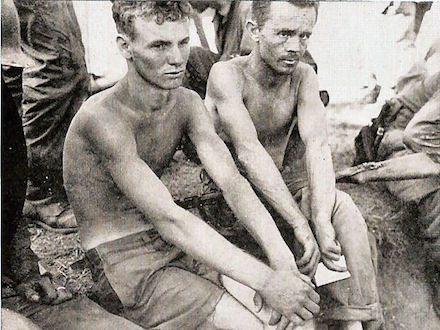
Massacre survivors James Rudd and Roy Day.

As a result of this and other summary battlefield executions, U.S. Gen. Douglas MacArthur addressed a threatening leaflet that was heavily dropped behind North Korean lines, threatening to “hold you and your commanders criminally accountable” according to the recent Nuremberg precedent.

There’s a monument to this gratuitous bloodbath that’s been recently installed, at the site of the shooting which is also nearby to a still-extant U.S. Army base called Camp Carroll. (The stone displays the date “June 25, 1950” — which denotes the start of the war, and not the day of the massacre.)

* Even the exact figures involved are a bit slippery. I believe we have 37 humans killed out of 42 captured, leaving five survivors. Some sources give it as 41 (attempted) executions with four survivors. A private named Frederick Ryan apparently was given last rites and declared dead on the scene but miraculously survived, possibly accounting for the variance.

** Hill 303 changed hands at least seven times.

On this day..

1862: Frisby McCullough, Missouri bushwhacker

On this date in 1862, Confederate soldier Frisby McCullough was shot as a terrorist during the U.S. Civil War’s guerrilla Missouri campaign.

McCullough had a youthful stint in the California gold rush to his back when he returned to Missouri in the mid-1850s to practice law. (He also served in the Missouri State Guard, a pro-slavery militia that had been established in 1861 by the since-exiled secessionist governor.)

With the onset of the Civil War in 1861, McCullough signed up for the pro-slavery Southern army and after a few different assignments became detailed to aid Confederate Col. James Porter in the hasty bush war raging in that frontier state.

We’ve previously detailed that conflict here. For purposes of this post it will suffice to say that the border state of Missouri was fiercely contested during this war, and claimed by North and South alike.

The Union commander John McNeil was not very inclined to charitably reading the treasonable secessionist irregulars who opposed him in the state, whom the Union considered to be operating illicitly behind its lines — in the character of spies and saboteurs, like the British agent John Andre during the Revolutionary War. This very much applied to our man, since McCullough’s particular gift was recruitment — you know, luring loyal citizens into sedition and rebellion.

On August 6, 1862, McNeil’s forces routed Porter’s at the Battle of Kirksville, and they pressed their victory. The very next day after, McNeil had 15 Confederate prisoners taken at Kirksville executed as former POWs who had violated their paroles by returning to the field: “I enforce the penalty of the bond,” McNeil icily reported to Washington.

Not long after, northern sentries also captured the ailing McCullough riding alone near Edina. He wasn’t a parolee — but “he had no commission except a printed paper authorizing the bearer to recruit for the Confederate army,” McNeil would write of him later in a missive to a comrade. At a snap trial on the 8th, “he was found guilty of bushwhacking and of being a guerilla. He was a brave fellow and a splendid specimen of manhood. I would gladly have spared him had duty permitted. As it was he suffered the same fate that would have fallen to you or me if we had been found recruiting within the Confederate lines. He met a soldier’s death as became a soldier.”

A memoir of the southern travails during this conflict titled With Porter in North Missouri; a chapter in the history of the war between the states is in the public domain; chapter XXII relates with umbrage the fate of McCullough whom the author Dr. Joseph Mudd* greatly admired:

Leaning against a fence he wrote a few lines to his wife, and these, with his watch and one or two other articles, he delivered to an officer to be given her, with assurance of his devoted affection in the hour of death. Upon the way to the place of his execution he requested the privilege of giving the order to fire, which was granted to him. All being ready, he stood bravely up, and without a tremor in his manly frame or a quiver in his clarion voice, he called out, ‘What I have done, I have done as a principle of right. Aim at the heart. Fire!’

… He was a good citizen, a high-minded gentleman, of fine presence, brave as a lion, gentle as a woman. Even in his death the strongest Unionists who knew him respected and admired his virtues and entertained the most bitter regrets that what they considered his misconceptions of duty had led him to his fearful fate. At the time of his death he was thirty-three years of age.

* Dr. Joseph Anthony Mudd hailed from Maryland: he was the brother of the Maryland Dr. Samuel Mudd who narrowly avoided execution as a conspirator in the assassination of President Abraham Lincoln.

On this day..

1849: Celigny Ardouin, Haitian Minister of the Interior

Haitian politician Celigny Ardouin was executed on this date in 1849.

The brother of historian Beaubrun Ardouin (and the already-deceased poet Coriolan Ardouin), Celigny Ardouin was the country’s former Interior Minister but was purged when the slave-turned-general-turned-president Faustin Soulouque, appointed as a figurehead president for the country’s elites, mounted a self-coup to establish himself as the emperor.

Ardouin had opposed Soulouque’s initial selection, and the emerging dictator had opportunistically accused his old foe of orchestrating disturbances in support of a senator who was frustratingly safe from Soulouque’s executioners thanks to French diplomatic pressure.

On this day..

1939: Las Trece Rosas

The Spanish Civil War’s victorious fascists shot Las Trece Rosas — “the thirteen roses” — on this date in 1939.


Plaque at the Cementerio de la Almudena in Madrid in honor of 13 young women shot there by Francoist troops on August 5, 1939. (cc) image by Alvaro Ibanez.

Earlier that 1939, Franco had clinched victory by finally capturing the capital city after a siege of 29 months. A punishing suppression of the Spain’s leftist elements ensued, running to hundreds of thousands imprisoned, executed, or chased into exile.

Our 13 Roses were members of a communist/socialist youth group, JSU, and they had been arrested in rolling-up of that organization. They were crowded into the overflowing dungeons of the notorious women’s prison Las Ventas.

A few Spanish-language books about Las Trece Rosas

And there they resided on July 29, 1939, when their JSU comrades struck back against the dictatorship by assassinating Isaac Gabaldón, the commander of Madrid’s fascist police.* The 13 Roses were immediately court-martialed and executed in revenge. Their names follow; there’s a bit more detail about them in Spanish here:

  • Carmen Barrero Aguado (age 24)
  • Martina Barroso García (age 22)
  • Blanca Brissac Vázquez (age 29)
  • Pilar Bueno Ibáñez (age 27)
  • Julia Conesa Conesa (age 19)
  • Adelina García Casillas (age 19)
  • Elena Gil Olaya (age 20)
  • Virtudes González García (age 18)
  • Ana López Gallego (age 21)
  • Joaquina López Laffite (age 23)
  • Dionisia Manzanero Salas (age 20)
  • Victoria Muñoz García (age 19)
  • Luisa Rodríguez de la Fuente (age 18)

The affair is the subject of a 2007 Spanish film.

* Gabaldon’s predecessor, the police commander under the Spanish Republic, Jose Aranguren, had been removed from his post and executed in April.

On this day..

1938: Mikhail Viktorov, Soviet naval commander

Soviet admiral* Mikhail Viktorov fell in the purges on this date in 1938.

A young officer fresh from the Naval Academy when World War I broke out, Viktorov (English Wikipedia entry | Russian) made a timely switch to the Bolshevik side during the Civil War and scaled the heights of the Soviet navy.

He commanded the Baltic Fleet in the latter 1920s, and the Pacific Fleet in the 1930s, and finally — fleetingly — became chief of the Soviet navy in 1937, filling dead man’s boots when his predecessor was arrested and executed.**

The same fate awaited Viktorov, a perilous occupational hazard in those days.

He was rehabilitated posthumously in 1956.

* Viktorov’s rank was “Fleet’s Flag Officer, First Rank”; in 1938, this was the equivalent of admiral, and after a 1940 reorganization it was replaced full stop with admiral.

** It appears to me that fully seven consecutive heads of the Soviet Navy eventually ended up executed in the 1930s and 1940s (not all of them directly deposed from running the navy). Pantserzhanskiy, Zof, Muklevich, Orlov, our man Viktorov, and also his successors Smirnov and Frinovsky.

On this day..

1961: Rokotov and Faibishenko, black marketeers

On this date in 1961,* two 22-year-old Soviet men were — very much to their surprise — shot as black market currency speculators.

Ian Timofeyevich Rokotov and Vladik Petrovich Faibishenko were leaders of a small ring of illicit currency traders who made their bones swapping Soviet rubles with foreign visitors at a handsome markup, earning “wealth” on the scale of moderate personal ease that seems laughable compared to their homeland’s present-day oligarchy. Among this nine-person ring, authorities recovered 344,000 Russian rubles plus about $19,000 in gold coins and a few thousands each of various western European currencies.

These deeds augmented the inherently parasitic act of profiteering by the inherently subversive act of making unchaperoned contact with foreign visitors, at a moment when the Soviet state was particularly sensitive to both infractions. This was nearly the exact apex of the Cold War, in the tense months between the U-2 Crisis and the Cuban Missile Crisis.** “Peaceful coexistence,” Soviet premier Nikita Khrushchev said in a 1961 address, means “intense economic, political, and ideological struggle between the proletariat and the aggressive forces of imperialism in the world arena.”

In a 13-day trial concluding on June 15, Rokotov and Faibishenko were sentenced along with another of their circle, Nadia Edlis, to 15 years in prison. You might think that’s a stern message sent, but the excitable Khrushchev took an almost personal offense to their behavior and on viewing the intentionally nettlesome exhibition of the black marketeers’ banknote heaps, exclaimed, “They need to be shot for this!”

The minor matter of having no capital statute on the books for the occasion was resolved on July 1 by the Presidium of the Supreme Soviet, which introduced the death penalty for major economic crimes; the statute was then immediately deployed to retroactive effect in a new trial before the Russian Republic Supreme Court.

Many people more would face capital punishment for economic crimes under that 1961 law.

* The official execution date is elusive but press reports indicate that the Soviet news agency TASS announced it on July 26. Given that their final condemnation had occurred only five days previous, we fall at worst within a narrow margin of error.

** Also of note: the USSR had just revalued the ruble as of January 1, 1961.

On this day..

1951: Arno Esch, liberal

On this date in 1951, liberal East German activist Arno Esch was shot in Lubyanka Prison outside of Moscow.

Plaque at the University of Rostock honoring Esch. (cc) image by Schiwago.

Just 17 when World War II ended, Esch emerged as a leading student activist for the Liberal Democratic Party in the postwar Soviet Occupation Zone — a pacifist who advocated political liberalization and civil rights.

These weren’t times for any common fronts: “a liberal Chinese is closer to me than a German communist,” Esch remarked, denoting a clear and present danger in the communist zone: his party attempted in vain to form a coalition across the nascent Iron Curtain with its like-minded brethren in the western zones.

Esch was arrested in 1949 and prosecuted as a spy and counterrevolutionary by a Soviet military tribunal.

On this day..