1944: Ernst Thälmann, German Communist

On this date in 1944, German Communist Ernst Thälmann was shot at the Buchenwald concentration camp.

A true proletarian turned proletarian leader (and reliable adherent to Moscow’s line), Thalmann stood for election to the German presidency no the Communist Party ticket against Hindenburg and Hitler in 1932 (he’d also run in 1925).

Hitler wasn’t a very good winner.*

The Gestapo nabbed Thalmann in its sweep for leftists following the Reichstag Fire. Eleven years he waited in prison — being tortured, naturally — for his turn on the stage of a show trial. Or any trial at all.

It never took place.

Instead, the Weimar Communist leader languished in detention as the horror of Naziism swallowed Germany, with nothing to give the anti-fascist cause but his name — here adopted by a Spanish Civil War battalion.

We have such cinematic treatment of the man because after the war, the legitimately proletarian, demonstrably antifascist, ideologically unsullied, and conveniently dead Thalmann made ideal material for the Communist East German state’s national pantheon.

The myth employed all of the media available to a modern industrialized state. In addition to the scholarship produced by professional historians, popular works with a similar agenda also appeared. Irma, the slain party leader’s daughter, wrote a biography of her father intended for children. Max Zimmering wrote one of several children’s novels about Thalmann, and East German poets lionized the martyred communist leader. … Thalmann memorials were built, and membership in the SED’s youth organization, the Free German Youth (FDJ), began with the Thalmann Pioneers. Finally, Thalmann’s life was the topic of several films and television movies, the most important being the two features, Ernst Thalmann – Sohn seiner Klasse (Ernst Thalmann – Son of His Class, 1954) and Ernst Thalmann – Fuhrer seiner Klasse (Ernst Thalmann – Leader of His Class, 1955).

And something else, too: a barely-there Caribbean island ceremonially gifted to East Germany by Cuba in 1972. Is it the last outpost of the German Democratic Republic?

* Yes, this is glib; Hindenburg, not Hitler, won the 1932 election. However, the Nazis’ plurality victory in that year’s Reichstag election also gave Hitler the juice to demand the Chancellorship and set himself up to wield total power in Germany. Whatever the ballot boxes on any particular day had to say, Hitler obviously won the early 1930’s.

On this day..

1909: Madanlal Dhingra, Indian revolutionary

A century ago today, the first Indian revolutionary martyr to be hanged in England was put to death at Pentonville Prison.

Madanlal Dhingra (or Madan Lal Dhingra) was a bright young scion of a loyalist Indian family that disowned him when he took to radical politics.

As an engineering student in London, Dhingra quaffed the martyr’s cup by assassinating Sir William Curzon Wyllie, a career imperial official spending his golden years keeping tabs on nationalist types among England’s Indian students. (Evidently, he could have been doing his job better.)

Dhingra rejected the legitimacy of the British court, disdained a defense, and was sentenced to death on the first day of trial. His martyrdom being the shared object of both the prosecutors and the offender, he was not long for the world — supposedly checking out with the well-turned last words,

My only prayer to God is that I may be re-born of the same mother and I may re-die in the same sacred cause till the cause is successful.

Dhingra is a noteworthy martyr to the cause of Indian independence now, but like anything else things weren’t so black and white at the time. Gandhi was not down with Dhingra — Gandhi’s own differences with Hindu extremists would eventually cost him his life — and plenty of Indian liberal types shared his abhorrence.

On the other hand, a subversive Brit like poet Wilfrid Scawen Blunt filled his blog-like diary with admiration for the assassin during the weeks of his celebrity — writing of this date, for instance:

They have done me the honour of choosing [my birthday] for Dingra’s execution, thus making of it an anniversary which will be regarded as one of martyrdom in India for generations.

And reflecting later, after the hanging:

People talk about political assassination as defeating its own end, but that is nonsense; it is just the shock needed to convince selfish rulers that selfishness has its limits of imprudence.

Other subjects of the Empire were inclined to agree.


From the Aug. 19, 1909 London Times.

On this day..

1972: Mohamed Oufkir

When last we met Mohamed Oufkir in these pages, he was violently suppressing an attempted coup against Morocco’s King Hassan II.

Mohamed Oufkir’s wife and six children were “disappeared” to a desert prison, not to emerge for 18 years. Daughter Malika, a royal favorite in happier times, wrote Stolen Lives about that ordeal. (Interview | Another)

We find him today, 13 months later as the arrow of time flies, in the same story — on the other end of the gun-barrel.

At around 4 o’clock this afternoon, a stunning attempt on the monarch took place as he flew back to Morocco from France. The king’s 727 was attacked by F-5 fighters of the Moroccan Air Force, surviving, it is said, when the quick-thinking king himself took the radio, pretended to be a flight engineer, and informed the attacking fighters that the pilots were dead and the king mortally wounded.

The ruse tricked the attacking pilots into allowing the crippled plane to make its landing in Rabat; they returned too late to strafe the airfield when they realized their mistake.

This quashed coup was swiftly laid at the door of Oufkir, the powerful Defence Minister.

Oufkir was declared to have committed suicide late this night, or else in the small hours of August 17; this still-standing official explanation has always had its doubters, with more extravagant versions implicating the offended sovereign himself in dealing out the punishment. Probably not, but here’s foreign correspondent Stephen O. Douglas’s reconstruction in Morocco Under King Hassan:

[Interior Minister Mohamed] Benhima said that when Oufkir arrived at the Skhirat palace at 11 p.m. he was met in an anteroom by General Mawlay Hafid and Colonel Dlimi, and when he realised that the king knew he had masterminded the plot he pulled out a revolver saying, ‘I know what to expect.’ Benhima added, ‘The two witnesses tried to stop him. In the struggle he fired three shots, one wounding him in the chest, the second I don’t know where, but the third was the most fatal.’ He said this was ‘the truthful and authentic version’.

‘General Oufkir committed suicide. He was not killed. It has been asked if it was a suicide of loyalty or a suicide of treason. Well then, I am authorised to tell you, to certify that since 1 p.m. today, and considering the elements of inquiry we have in our possession, I can affirm that it was a suicide of treason and not a suicide of loyalty,’ Benhima said.

Later at the same news conference, Benhima indicated he was just as astonished as most of the journalists. He said he and Oufkir were ‘great friends. We appreciated each other very much and had confidence in each other. We had a common denominator: our loyalty, and I think we wore the same decoration, given to us on the same day for the same reasons. He was a great patriot, a great minister. As I just told one of your colleagues, I cannot figure how he could have done what he did. But he is one of the most attractive people I have known, and what I have said about him today is painful to me, but the truth had to be told.’

I learned later that during the fatal night a military ambulance took Oufkir’s blood-stained body back to his Souissi house where it was placed on the floor of a playroom. His wife Fatima was away on vacation on the Mediterranean coast and there were very few people in the house. They found Oufkir had four bullet wounds, three in the back and the fourth having gone through the nape of his neck and out through his left eye, shattering his glasses, the coup de grace. Suddenly someone decided it was a mistake to send the corpse back to his family and it was hastily retrieved the same night. Thus evidence that he may have been ‘suicided’ disappeared.

Hassan somehow escaped the day with his crown, but with two attempts to overthrow him over the previous 13 months and a need to purge the many unreliable Oufkir loyalists in the armed forces — well, as the London Times put it (Aug. 22, 1972), “short of his incredible good fortune there is little else that can be cited in real terms to guarantee the perpetuation of his rule.” You could have made good coin wagering informed observers of the time that Hassan would live and reign another 27 years and be internationally saluted at his peaceful death at age 70.

On this day..

1952: Night of the Murdered Poets

As night fell this evening in Moscow, 13 prominent Soviet Jews were shot in Lubyanka Prison on trumped-up charges of treason and espionage.

“The Night of the Murdered Poets”, as it’s come to be remembered, wasn’t so much about the poetry; “only” five of the victims fit that description.

But as Joshua Rubenstein put it, “only the martyred Yiddish writers are mentioned at August 12 commemorations; the other defendants who lost their lives, as well as the sole survivor Lina Shtern, are rarely if ever remembered, perhaps because their careers as loyal Soviet citizens do not fit comfortably into an easy category for Westerners to honor … Stalin repaid their loyalty by destroying them.”

Falling victim to Stalin was such a particularly tragic fate because they were, in the main, good Communists:* good enough to have been part of the Jewish Anti-Fascist Committee, a World War II organ dedicated to rallying support for the Soviet Union against Nazi Germany.

Such national particularism — any port in a storm! — was all well and good when Moscow had the Wehrmacht at its gates and a short supply of friends, but it increasingly ran dangerously afoul Soviet officialdom as the 1940’s progressed. It was a bastion of sectarian identity rather than socialist universalism; its celebration of the Jewish soldier and of Jewish wartime travails cut against the narrative of Soviet sacrifice and heroism; its overseas links to the United States (where it toured in wartime) and the new state of Israel made it suspect, or at least vulnerable.

Thin excuse for mass execution, to be sure, but in a structure of generalized antisemitism run by a trigger-happy dictator …

In 1948-49, fifteen JAC members were arrested. One would die in prison; the aforementioned Lina Stern, a scientist, would receive a term of exile and return to Moscow when this purge’s victims were rehabilitated after Stalin’s death.

The thirteen others were tortured and condemned by a rigged (but secret, since many of the accused wouldn’t cop to public self-denunciations) trial

Years before his arrest, Markish would write words to make a eulogy for many a disillusioned Soviet citizen … and literally so in his case, since the verse was cited at his trial as evidence of his “pessimism”:

Now, when my vision turns in on itself,
My shocked eyes open, all their members see
My heart has fallen like a mirror on
A stone and shatters, ringing, into splinters.

Piece by piece I’ll try to gather them
To make them whole with stabbed and bleeding fingers.
And yet, however skillfully they’re glued,
My crippled, broken image will be seen.

* Naturally, being a good Communist did not keep one safe from Uncle Joe.

On this day..

1922: Joseph O’Sullivan and Reginald Dunne, helping spark the Irish Civil War

(Thanks to Rob at Another Nickel In The Machine, a delectable blog about 20th century London, for this post. It originally ran on Another Nickel October 4, 2008.)

“I do not approve, but I must not pretend to misunderstand” – Eamon de Valera

The arrest of Reginald Dunne and “James Connolly” (Joseph O’Sullivan) in 1922

On December 1921 at 22 Hans Place in Knightsbridge, a treaty was signed between a provisional Irish Government and the British to create what was called the Irish Free State. However only six months later, a few hundred yards away in Eaton Place, an assassination occurred, the reverberations of which could be said to have helped start the Irish Civil War in 1922.

Sir Henry Hughes Wilson in 1918

Sir Henry Hughes Wilson in 1921

At around midday of 22 June 1922, Field-Marshall Sir Henry Wilson unveiled a war memorial at Liverpool Street Station. He made a speech, quoted some relevant Kipling poetry and soon after returned by taxi to his home at 15 Eaton Place in Knightsbridge. Two 24 year old men, Reginald Dunne and Joseph O’Sullivan, were surreptitiously waiting for his arrival. They watched while Wilson paid for his taxi before running up to him and killing him in cold blood on the footsteps leading up to his front door. In Dunne’s words:

I fired three shots rapidly, the last one from the hip, as I took a step forward. Wilson was now uttering short cries and in a doubled up position staggered towards the edge of the pavement. At this point Joe fired once again and the last I saw of him he (Wilson) had collapsed.

Joseph O’Sullivan

Reginald Dunne

The Field Marshall had half withdrawn his sword in a futile effort to protect himself but after being shot seven times he fell face first on to the pavement with blood running profusely from his body and mouth. Dunne and O’Sullivan started to run but O’Sullivan had been seriously wounded at Ypres during WW1 (both men had fought for the British) and his wooden leg severely hindered their escape. Dunne and O’Sullivan both attempted to shoot their way out of trouble and shot and injured two policemen and a civilian in the process but were soon surrounded by an angry and hostile crowd and the two men were quickly arrested. They actually had to be protected by the police from a mob who wanted instant revenge for Wilson’s death.

The steps of 36 Eaton Place where the Field Marshall fell fatally wounded.

The killing of Field-Marshall Wilson in Eaton Place turned out to be pivotal in an extraordinarily complex political period of Ireland’s history when a national liberation struggle turned into a civil war. However much of Britain was outraged with the murder and The Times wrote:

Field-Marshall Sir Henry Wilson, the famous and gallant soldier, was murdered yesterday upon the threshold of his London home. The murderers were Irishmen. Their deed must rank among the foulest in the foul category of Irish political crimes.

Six months earlier at 2.20 am 6th December 1921 the Anglo-Irish Treaty was signed between an Irish delegation, led by Michael Collins, and the British Government at 22 Hans Place. Incidentally, there is nothing on the outside of the building commemorating the historical event and today, in what is probably one of the most expensive property areas of London, seems to be unused and empty with security boards up in the windows.

22 Hans Place in Knightsbridge and where the Anglo-Irish Treaty was negotiated

Signing the Anglo-Irish treaty in 1922

Michael Collins in London October 1921

11th October 1921

Collins outside Downing Street 1921

The treaty envisaged an independent Ireland that would be known as the Irish Free State but the agreement was hugely controversial, especially back in Ireland. For a start, de Valera, the President of the Irish Republic and who had a difficult relationship with Collins at the best of times, was angry that the treaty was signed without his authorisation (although it was at his insistence that Collins went, with de Valera considering it wrong to be involved in the negotiations if Britain’s King George V wasn’t either). Also controversial was both the British insistence that they continued to control a number of ports, known as the Treaty Ports, for the Royal Navy and that Northern Ireland (which had been created in the Government of Ireland Act 1920) was able to leave the Irish Free State within one month, which of course it duly did.

In April 1922 a group of 200 anti-treaty IRA men had occupied the Four Courts in Dublin in defiance of their Government. Collins, wanting to avoid Civil War at all costs, decided to leave them alone. However after the Field Marshall’s assassination and the subsequent Fleet Street outrage this all changed. It was assumed by the British that Dunne and O’Sullivan were anti-treaty IRA men and after the shock of the Field Marshall’s murder Winston Churchill wrote to Collins threatening that unless he moved against the Four Courts anti-treaty garrison he (Churchill) would use British troops to do so for him. After a final attempt to persuade the men to leave the Courts, Collins borrowed two 18 pounder Artillery guns from the British and bombarded the Four Courts until it’s garrison surrendered. A surrender which almost immediately led to the Irish Civil War with fighting breaking out over Dublin and subsequently the rest of the country.

The Four Courts siege, Dublin 1922

Sackville Street, Dublin 1922

Meanwhile back in London at the Old Bailey, and before Mr Justice Shearman, Dunne and O’Sullivan were both tried together for the murder of Sir Henry Wilson on 2 July 1922. Dunne stood with his arms folded while the charge was being read while O’Sullivan stood stiffly at attention. When Dunne was asked, “Are you guilty or not guilty?” he replied “I admit shooting Sir Henry Wilson.” “Are you guilty or not guilty of the murder?” the Clerk of Arraigns repeated. “That is the only statement I can make,” was the response. O’Sullivan made a similar reply and after some discussion the plea was treated as one of “Not guilty.”

Towards the end of the trial, which lasted just three hours, the defence Counsel handed the judge a double sheet of blue official paper given to him by Dunne. After perusing the contents Mr Justice Shearman said – “I cannot allow this to be read. It is not a defence to the jury at all. It is a political manifesto…I say clearly, openly, and manifestly it is a justification of the right to kill.”*

Dunne’s hand written statement

Dunne and O’Sullivan were sentenced to death by hanging and sent to Wandsworth gaol where they were both hanged together by the executioner John Ellis on the 10th August 1922.

Less than two weeks later Michael Collins was ambushed and shot dead in his home county of Cork by anti-treaty IRA members.
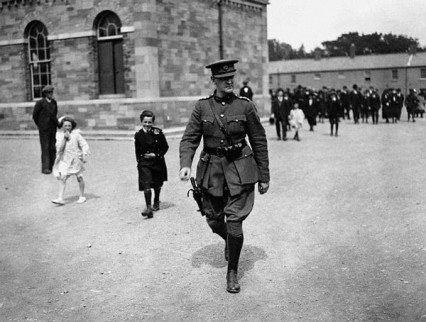
Commander in Chief Michael Collins in July 1922, two or three weeks before he was assassinated in Cork.

Michael Collins' funeral, O'Connell Street August 1922
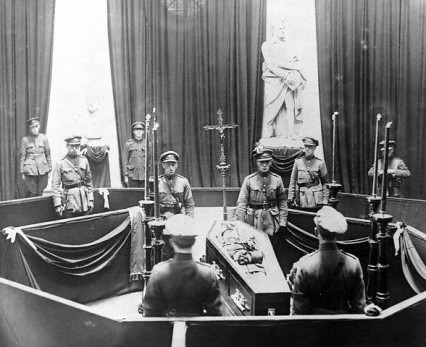
The coffin bearing the body of Michael Collins lying in state in the City Hall, Dublin. September 2, 1922 Dublin, Ireland

Michael’s brother Sean Collins

It was never really established whether Dunne and O’Sullivan acted on their own (the assassination seemed pretty badly organised for an official assassination so this was likely) or with the approval and help of Michael Collins. Collins had been a friend of Dunne’s while Sir Henry Wilson was responsible for establishing the Cairo Gang (a group of experienced British Intelligence agents who met frequently at Dublin’s Cairo Cafe) twelve of whom were murdered by the IRA acting under Collins command in 1920. The Cairo Gang killings provoked the British Auxiliaries in Dublin to shoot trapped innocent civilians at Croke Park in not the bloodiest but perhaps the nastiest of the various historical Bloody Sundays.

The infamous Cairo gang

Perhaps the ironic aspect to the story of the murder of Sir Henry Hughes Wilson was that Reginald Dunne and Joseph O’Sullivan were both born and bred in London, whereas Field-Marshall Wilson was born smack bang in the middle of Ireland at Ballinalee in County Longford.

A letter sent to O'Sullivan while waiting for his execution

Sinéad O’Connor – She Moves Through The Fair

* The text of Dunne’s intended last statement, as transcribed from the images in this post.

Lord and Members of the Jury. My friend and I stand here before you today charged with the offense of murder; and I have no doubt that, from the evidence placed before you by the prosecution, you will find us both guilty. With respect to the charges of attempted murder, we merely tried, as everyone must know, to try and escape arrest.

The offence of murder is a very serious matter; so much so, that any act which results in loss of human life requires very grave and substantial reason. We have never until now been charged with any crime. As you have heard from the Police Officer, who gave evidence as to our character and our previous records, we have both been in the British Army. We both joined voluntarily, for the purpose of [making Europe safe?] in order that the principles for which this country stood, should be upheld and preserved. These principles, we were told, were Self-Determination and Freedom for Small Nations. We both, as I have said, fought for these principles, and were commended for doing so; and I imagine that several of you gentlemen of this jury did likewise. We came back from France to find that Self-Determination had been given to some Nations we had never heard of, but that it had been denied to Ireland, We found, on the contrary that our Country was being divided into two Countries; that a Government had been set up for the Belfast district, and that under that Government outrages were being perpetrated, that are a disgrace to civilization — many of the outrages being committed by men in uniform and in the pay of the Belfast Government. We took our part in supporting the aspiration of our fellow Countrymen, in the same way as we took part in supporting the nations of the world who fought for the right of small nationalities.

Who was Sir Henry Wilson? What was his policy? And what did he stand for? You have all read in the newspapers lately, and been told, that he was a great British Field Marshal; but his activities in other fields are unknown to the men of the British public. The nation to which we have the honour to belong, the Irish nation, knows him, not so much as the British Field Marshal, but as the man behind what is known in Ireland as the Orange Terror. He was at the time of his death the Military Advisor to what is colloquially called the Ulster Government, and as Military Advisor he raised and organized a body of men known as the Ulster Special Constabulary, who are the principle agents in his campaign of terrorism.

My Lord and Members of the Jury, I do not propose to go into details of the horrible outrages committed on men, women and children of my race in Belfast and other places under the jurisdiction of the Ulster Government. Among Irishment it is well known that about 500 men, women and children have been killed within the past few months, nearly two thousand wounded, and not one offender brought to justice. More than 9000 persons have been expelled from their employment; and 23,000 men, women, and children driven from their homes. All the big cities of this country and even those of Northern France are now receiving these refugees. Sir Henry Wilson was the representative figure and the organiser of the system that made these things possible.

At his suggestion and advice the Ulster Parliament passed an Act authorising the [purging?] of political opponents and this power is now exercised and enforced by the Courts in Ulster.

There is and can be no political liberty in a country where one political party outrages, oppresses, and intimidates not only its political opponents, but persons whose religious opinion differ from those of the party in power. The same principle for which we shed our blood on the Battle Field of Europe led us to commit the act we are charged with.

My Lord and Members of the Jury, you can condemn us to death today, but you cannot deprive us of the belief that what we have done was necessary to preserve the lives, the homes, and the happiness of our countrymen in Ireland. You may by your verdict find us guilty, but we will go [to] the scaffold justified by the verdict of our own Conscience.

Dunne truncated his statement to “cut out the patriotic adjectives I feel inclined to use under the present circumstances” (as well as his specific delineation of the atrocities of Henry Wilson and the Ulster government). -ed.

On this day..

1864: Romuald Traugutt and the January Uprising leaders

On this date in 1864, the leadership of Poland-Lithuania’s abortive January Uprising against the Russian tsar was hanged before 30,000 at Warsaw Citadel.


Romuald Traugutt depicted (somewhat ironically) on the 20-zloty note of Soviet bloc Poland.

Romuald Traugutt (English Wikipedia link | Polish) had been a decorated Lieutenant Colonel in the Tsarist army, and a heretofore apolitical man — but he resigned shortly after the outbreak of the doomed national uprising to take up sides against Russia.

This installment of the venerable Russians vs. Poles series was characteristically nasty.

In 1863 – Polonia by Jan Matejko, an allegory for the Polish nation is manacled by the Russians.

And it ended the way these affairs have ended these last 400 years or so: Russian victory.

The fallout was severe.

In addition to this day’s batch — Traugutt along with (all Polish Wikipedia links) Rafal Krajewski, Jozef Toczyski, Roman Zulinski and Jan Jezioranski — a further 391 were put to death after the war; tens of thousands were deported to Siberia or otherwise scattered in the vast Romanov empire; a war indemnity tax was imposed; and over three thousand estates in Poland and Lithuania were confiscated.

Traugutt has gained some latter-day support in the Catholic Church for beatification.

On this day..

1904: Heinrich, a Herero

The Times of London reported thus, on Aug. 30, 1904:

GERMAN SOUTH-WEST AFRICA.

(FROM OUR OWN CORRESPONDENT.)

BERLIN, AUG. 29.

It is intended to hold Courts-martial in German South-West Africa for the trial of natives who have been implicated in the massacre of German colonists or who have rendered assistance to the insurgents. The first of these trials resulted in the condemnation of a Herero named Heinrich, alias Egbert, who had been concerned in the murder of a German farmer, and who had also acted as a spy in the interest of the rebels. Heinrich, who is described as “a schoolmaster and Evangelist,” was sentenced to death, and, according to intelligence just received, was hanged at Swakopmund on August 2. This case will produce a painful impression in German missionary circles, which have lately been in bad odour with the Government owing to the criticisms they had passed upon the conduct of some of the whites.

This “Heinrich” was thereby the first judicial execution for the January 1904 Herero raid that touched off the Herero genocide. Germany would secure the military scene just nine days later by routing Herero warriors at the Battle of Waterberg … and then proceed to drive almost the whole of the Herero nation into the deserts on pain of instant execution. (Jolly postcards were made of such scenes.)

Estimated body count: tens of thousands. Germans feel just awful about it.

On this day..

1997: Norio Nagayama, spree killer and author

On this date in 1997, the wait was over for a writer who had spent his entire adult life awaiting the noose.

Norio Nagayama witnessed another (eventually executed) murderer‘s Tokyo shooting spree in 1965, and three years later popped four people (two security guards and two cabbies) himself. The killing spree shocked Japan.

Only 19 at the time, which made him a juvenile by Japanese law, Nagayama was sentenced, unsentenced, re-sentenced. Twenty-eight years he spent from his arrest until his execution, not necessarily an atypical span for Japan.

It’s what Nagayama did with those years that makes him so remarkable: entering the criminal justice system from an impoverished background, Nagayama became a literary figure and a prominent public spokesman for social justice. He’s still commemorated years after his death.

Nagayama is credited with nine works, the first (Tears of Ignorance) about the poverty he blamed for his murders; the last (Hana) published posthumously from his manuscripts; he donated proceeds to victims’ families and poor children, especially in Peru. In fact, all these years dead, he’s still raising money for children.

Some books by Norio Nagayama
(all in untranslated Japanese)

Nagayama’s death was triggered, at last, by apprehension of a 14-year-old for a sensational crime barely a month prior to this date; in hanging Nagayama, the government aimed “to foster support for legislation that would ‘get tougher’ on juvenile offenders. Indeed, in 2000 Japan’s Juvenile Law was revised to make it easier to transfer minors to adult court.”

Nagayama was hanged in Tokyo with another murderer, Hideki Kanda; a husband-wife convict couple were executed the same day in Sapporo.

On this day..

1959: Cho Pong-am, Presidential runner-up

A half-century ago today, South Korean strongman Syngman Rhee, winner of that country’s 1956 presidential election, had the runner-up hanged for treason.

Cho Pong-am (or Cho Bong-am), who cut his teeth as a young Communist in the 1920’s and 30’s but had become an independent socialist since, won over 2.1 million votes as the Progressive Party candidate in 1956, on a platform of peaceful reunification with North Korea — the outstanding political issue in South Korea at the time.

The position had some popularity as against Rhee’s “march North” policy of conquering North Korea by force. Peaceful unification and support for the Progressive Party continued to grow after 1956, to Rhee’s fury.

Probably in fear of the increase in popular sentiment favourable to ‘peaceful unification’, the Rhee regime was determined to destroy the Progressive Party. On 13 January 1958, Cho Pong-am was arrested, together with other party officials, on charges of espionage and violation of the National Security Act … Given the fact that the government had suspected Cho’s ideological orientation, and that Communist infiltration of the South was increasing at that time … the arrest of the progressive leader might have been caused partly by the government’s genuine fear of Communist subversion. Cho’s trial, however, clearly indicated that the main purpose of Rhee’s action was to suppress political opposition, and especially to control the idea of ‘peaceful unification’.

Cho Pong-am was indicted on charges that his advocacy of ‘peaceful unification’ by elections in North and South Korea denied the sovereignty of the ROK and consequently was subversive in nature, and that he had been in secret contact with North Korean agents. … police and prosecution officials admitted that the espionage case against Cho was ‘very weak’, and indicated that they were expending considerable effort on analysing his concept of ‘peaceful unification’ in order to classify it as a crime against the ROK.

… Seoul district court, in July, sentenced him to five years’ imprisonment … [and] found that the Progressive Party’s platform did not violate the National Security Law. Three months later, however, the appellate court, reversing the decision of the district court, sentenced Cho to death … [and] ruled that his unification formula represented a plan to overthrow the ROK government.

Cho was hanged just one day after the Supreme Court rejected his appeal — “sudden and highly questionable,” to the American embassy that hurriedly attempted to impress Rhee’s Foreign Minister with the damage this execution could do to South Korea internationally. Cognizant, perhaps, of such concerns, Seoul imposed press censorship from August 1 on further reporting about the case.

Rhee himself would be forced from office by popular outcry the following year after attempting to steal the 1960 election, but “the tragic end of Cho Pong-am and his Progressive Party made it unequivocally clear that a serious leftist movement could not be openly promoted in South Korea without falling victim to violent suppression by the Government.” (Source)

Update: He was posthumously rehabilitated in 2011.

On this day..

1540: Three Papists and Three Anti-Papists

On this date in 1540, two days after disposing of his former Vicegerent of Spirituals Thomas Cromwell, the just-wedded Henry VIII wrote a terrifying message of religious conformity in blood and smoke at Smithfield.

Edward Hall (as he did with Cromwell) records the scene.

The thirtie daie of July, were drawen on herdelles out of the Tower to Smithfield, Robert Barnes Doctor in Diuinitee, Thomas Garard, and Wyllyam Jerome Bachelers in Diuinitee, Powell, Fetherston and Abell. The firste three were drawen to a stake, there before set up, and were hanged, hedded, and quartered. Here ye must note, that the first three, wer menne that professed the Gospell of Jesu Christ, and were Preachers thereof … [the first three] were detestable and abhominable Heretickes, and … had taught many heresies, the nomber whereof was to greate in the atteindor to be recited, so that there is not one alleged … in deede at their deathe, they asked the Sherifes, wherefore they were condempned, who answered, thei could not tell: but if I maie saie the truthe, moste menne said it was for Preachyng, against the Doctryne of Stephen Gardiner Bishoppe of Wynchester, who chiefly procured this their death … but greate pitie it was, that suche learned menne should bee cast awaie, without examinaction, neither knowyng what was laied to their charge, nor never called to answere.

The laste three … were put to death for Treason, and in their attaindor, is speciall mencion made of their offences, whiche was for the deniyng of the kynge ssupremacie, and affirmyng that his Mariage with the Lady Katheryne was good: These with other were the treasons, that thei wer attainted of, and suffered death for.

Terrifying and confusing: here were burnt three Protestants (Barnes, Gerrard and Jerome) for heresy under the Six Articles, essentially for excess radicalism; beside them were hanged, drawn and quartered three Catholics (Powell, Fetherston and Abel) for treasonably refusing the Oath of Succession, that is, for refusing to admit the King of England as the head of the Church of England. It was that old dispute about Anne Boleyn, who was three queens ago by now. (All three Catholic theologians were advisors to Anne’s predecessor and rival Catherine of Aragon, back in the day.)

The one thing that couldn’t possibly be confused in the day’s proceedings was that matters of the faith were matters of state, and in them Henry would brook heterodoxy of neither the liberal nor conservative variety.

“Good Lord! How do these people live?” exclaimed a foreign observer (cited here). “Here are the papists hanged, there are the anti-papists burnt!”

Good for the martyr industry all-around, and fodder for contemporaries to imagine their respective hereafters, as in “The metynge of Doctor Barons and Doctor Powell at Paradise gate”. (pdf)

On this day..