On this date in 1776, Revolutionary spy Nathan Hale was hanged by the British in Manhattan — allegedly uttering the immortal last words, “I only regret that I have but one life to lose for my country.”
Nathan Hale statuary (with bound feet and hands) ironically stationed at Washington D.C.’s Department of Justice. Like statues are at the Chicago Tribune building and the Yale University campus; dueling plaques in New York contend to mark the execution spot.
Two years out of Yale when the Revolution broke out in 1775, the Connecticut-born Hale hitched onto the Continental Army and was directly promoted to captain.
When British Gen. William Howe landed at New York in the summer of 1776, Nathan Hale volunteered to slip behind enemy lines and reconnoiter enemy strength for George Washington. It turned out to be his mission into eternity.
As one might suspect, there’s a great deal more to Nathan Hale than his last words — and a fair bit of uncertainty about what his last words really were. Hale’s Wikipedia page retails many versions of the line from many sources.
The sentiment commonly attributed him (formulated in slight variations, e.g., “I only regret that I have but one life to give to my country”) was supposed to have been reported by a British officer attending him; it’s certainly a punchier version than, e.g., a Revolutionary War era report of “I am so satisfied with the cause in which I have engaged, that my only regret is, that I have not more lives than one to offer in its service.” Gah.
If all these presumably paraphrased reports have the gist right, it’s possible the 21-year-old recited an identical sentiment in the tragic play Cato:*
How beautiful is death, when earn’d by virtue!
Who would not be that youth? What pity is it
That we can die but once to serve our country.
There’s much more about this short-lived character and his larger-than-life transfiguration in mythologia Americana. The Library of Congress has a collection of links, and William Phelps recently penned this new (and surprisingly, first) biography of the revolutionary legend.
* The play was all the rage among patriots; Patrick Henry might have plucked his immortal “give me liberty or give me death” line from it, too. (“It is not now time to talk of aught/But chains or conquest, liberty or death.”)
On this date in 1803, Irish nationalist Robert Emmet was hanged and posthumously beheaded, a day after his trial for treason against England.
The well-to-do scion of a Protestant family, Robert Emmet followed his older brother into the Republican ferment of the time and led an unavailing uprising in Dublin on July 23, 1803.
Captured a month later when he romantically recklessly moved his hideout closer to his beloved Sarah Curran.*
Emmet won his great laurels in the annals of Irish Republicanism with a stirring “Speech from the Dock” addressed to the courtroom the day before he died. Or better to say that it was addressed in a courtroom, for knowing that his death sentence was a foregone conclusion, the real audience was posterity and a wider world.
Emmet found that audience with one of the great orations of the 19th century.
This clip is a truncated version of a longer speech not set to paper by Emmet, so no single definitive version exists. Versions can be found at this Irish history site, and at SinnFein.ie.
I have but one request to ask at my departure from this world — it is the charity of its silence! Let no man write my epitaph: for as no man who knows my motives dare now vindicate them. let not prejudice or ignorance asperse them. Let them and me repose in obscurity and peace, and my tomb remain uninscribed, until other times, and other men, can do justice to my character; when my country takes her place among the nations of the earth, then, and not till then, let my epitaph be written. I have done.
On the strength of such sentiment — and the public’s learning of his love for Sarah Curran — the 25-year-old became iconic in death. Robert’s own death inspired the mandatory Irish patriotic ditty, “Bold Robert Emmet”:
But that sundered love between Emmet and Sarah Curran — who broken-heartedly accepted another proposal and moved to Sicily — was at least as stirring to the Romantic imagination. Washington Irving dedicated a short story to the lost romance; Emmet’s friend Thomas Moore made Curran the subject of a poem (beware: link opens an auto-playing audio file).
* 19th century Irish poet Thomas Moore paid her tribute in “She Is Far From the Land”:
She is far from the land where her young hero sleeps,
And lovers are round her, sighing:
But coldly she turns from their gaze, and weeps,
For her heart in his grave is lying.
She sings the wild song of her dear native plains,
Every note which he lov’d awaking; —
Ah! little they think who delight in her strains,
How the heart of the Minstrel is breaking.
He had liv’d for his love, for his country he died,
They were all that to life had entwin’d him;
Nor soon shall the tears of his country be dried,
Nor long will his love stay behind him.
Oh! make her a grave where the sunbeams rest,
When they promise a glorious morrow;
They’ll shine o’er his sleep, like a smile from the West,
From her ow lov’d island of sorrow.
On an uncertain date around this time — sort of — in 46 B.C.E., the Gallic chief Vercingetorix was marched as Julius Caesar’s star captive in Rome, then strangled in prison.
A nobleman who in the course of things would have been destined for that class of domestic elites bought off by Rome for orderly management of conquered provinces, Vercingetorix instead mounted a massive and effective semi-guerrilla resistance. A few months after Caesar had declared “Mission Accomplished” and Gaul at peace, it rose in arms … and, as Vercingetorix rolled out a scorched-earth defense, in flames.
Julius Caesar, then serving a long and lucrative career as Governor of Gaul, managed only with difficulty — and staggering bloodshed — to pacify the province at the Battle of Alesia. It was a signal military engagement in the development of the Roman Empire, cementing Roman power in Gaul for centuries to come.
The wily barbarian’s revolt and the very serious danger it posed to Caesar’s ambitions are the subject of a five-part BBC documentary.
Vercingetorix’s allegedly theatrical surrender to Caesar essentially ended the Gauls stubborn, centuries-long resistance to Roman dominion.
Yes, that’s the Highlander, Christopher Lambert, playing the French Braveheart version of barbarian heroism in Druids. HBO’s series Rome went with a less romantic version:
Either way, the once-intractable province became the bastion from which Caesar would overthrow the foundering Roman Republic.
Political rivals in the capital for whom Caesar’s Gallic campaign was nothing to celebrate denied Caesar a ceremonial Triumph and maneuvered to check the ambitious general. When the conflict came to a head in 49 B.C.E., Caesar’s bold move from the provincial borders of Gaul into Italy — crossing the Rubicon — ignited civil war in Rome.
Vercingetorix languished in Roman chains all along, until Caesar finally mopped up his enemies in the field and returned to Rome, where he celebrated an extravagant quadruple Triumph for his various military achievements.
when he returned to Rome he had four triumphs together: one for his Gallic wars, in which he had added many great nations to the Roman sway and subdued others that had revolted; one for the Pontic war against Pharnaces;* one for the war in Africa against the African allies of L. Scipio, in which the historian Juba (the son of King Juba), then an infant, was led a captive. Between the Gallic and the Pontic triumphs he introduced a kind of Egyptian triumph, in which he led some captives taken in the naval engagement on the Nile.** Although he took care not to inscribe any Roman names in his triumph (as it would have been unseemly in his eyes and base and inauspicious in those of the Roman people to triumph over fellow-citizens), yet all these misfortunes were represented in the processions and the men also by various images and pictures, all except Pompey, whom alone he did not venture to exhibit, since he was still greatly regretted by all. The people, although restrained by fear, groaned over their domestic ills, especially when they saw the picture of Lucius Scipio, the general-in-chief, wounded in the breast by his own hand, casting himself into the sea, and Petreius committing self-destruction at the banquet, and Cato torn apart by himself like a wild beast. They applauded the death of Achillas and Pothinus, and laughed at the flight of Pharnaces.
It is said that money to the amount of 60,500 silver talents was borne in the procession and 2822 crowns of gold weighing 20,414 pounds, from which wealth Caesar made apportionments immediately after the triumph, paying the army all that he had promised and more. Each soldier received 5000 Attic drachmas, each centurion double, and each tribune of infantry and perfect of cavalry fourfold that sum. To each plebeian citizen also was given an Attic mina. He gave also various spectacles with horses and music, a combat of foot-soldiers, 1000 on each side, and a cavalry fight of 200 on each side. There was also another combat of horse and foot together. There was a combat of elephants, twenty against twenty, and a naval engagement of 4000 oarsmen, where 1000 fighting men contended on each side. He erected the temple to Venus, his ancestress, as he had vowed to do when he was about to begin the Battle of Pharsalus, and he laid out ground around the temple which he intended to be a forum for the Roman people, not for buying and selling, but a meeting-place for the transaction of public business, like the public squares of the Persians, where the people assemble to seek justice or to learn the laws. He placed a beautiful image of Cleopatra by the side of the goddess, which stands there to this day. He caused an enumeration of the people to be made, and it is said that it was found to be only one half of the number existing before this war.
War is hell.
At the Gallic triumph, Vercingetorix — by far the most fearsome enemy Caesar had to display vis-a-vis a five-year-old child and the sister of his lover — was at last the center of attention again for a day. Still defiant, he was marched through the Eternal City, then strangled at the Tullianum, or Mamertine Prison.
But which day? The bare fact is that we just don’t know, but this one has more than the typical imprecision that characterizes dating ancient events. This footnote on a page about Egyptian royalty grapples with the timing.
four times in one month, each Triumph succeeding the former by an interval of a few days.
Since Cassius Dio claims that Caesar dedicated the Temple of Venus (datable to late September of 46) on the last day of the last Triumph, that presumably makes September the “one month” of the various celebrations.
That’s about as close as it gets, but even “September” comes with a caveat. During his few months in Rome between campaigns, Caesar accomplished a frenetic civil agenda (it helps to be dictator). Perhaps none is of such recognizable consequence for posterity as reform of the wacky solar-lunar hybrid Roman calendar — and 46 B.C.E. was the very year he implemented it.
Disdaining incrementalism, Caesar tackled the mess the Roman calendar had become at once, by stuffing the year 46 up to 445 days. As a result, 365 days after the execution of Vercingetorix was not September of 45, but July (or possibly June) — and those months are sometimes given for the dates of Caesar’s Triumphs on this basis. Since Caesar actually won his decisive battle in April of 46 B.C.E. and returned to Rome that July, the potential for confusion multiplies: if you’re not accounting for the exceptional calendar, July Triumphs appear initially plausible.
It is here that one beholds the essential subjectivity behind a putatively mechanistic device like a calendar: if Vercingetorix was executed in spring or summer, was he executed in September?
Whenever it was that he was throttled in the Mamertine, Vercingetorix did not go quietly. If his cause of resistance to Roman authority was doomed for the time being, the eternal allure of rebellion — and, as the Gallic lands later germinated France, the proto-nationalism of his cause — secured him his own symbolic immortality.
Napoleon III, with his complex relationship to the Gallic and Italic dreams of another age, was just the man to put up this statue of Vercingetorix where the barbarian was thought to have made his last stand. Its inscription reads:
La Gaule unie
Formant une seule nation
Animée d’un même esprit,
Peut défier l’Univers.
On this date in 1560, a French peasant was hanged outside the home he had made with another man’s wife in the southwestern French village of Artigat (or Artigues).
A poignant, perplexing tale of identity and social place — and possibly even of love — the story of Martin Guerre is at once exactingly local to its time and place, and timeless in its principals’ humanity.
As told in Natalie Zemon Davis’ captivating social history The Return of Martin Guerre, the restless (or ill-tempered) young titular peasant — impotent with his wife Bertrande, tense living with his father-in-law, chafing in rural Artigat — got out of town in 1548, joined one of the soldiering companies crisscrossing Europe, and was heard of no more.
In the centuries before fingerprints, credit cards, cell phones and Facebook, Guerre just disappeared. Constrained by Catholic law not to remarry without proof of his death, Bertrande just had to wait.
Until “Martin” returned in 1556 simply by reappearing at Artigat — moved in with Bertrande — resumed the vanished man’s name and with it his place in the village. There were suspicions from the first that he wasn’t quite right … but this man had Martin’s stories, and the villagers didn’t have so much as a photograph to test him against.
Martin was accepted in Artigat for three-plus years, fathered two children with Bertrande, and managed the estate as head of household. In Davis’s telling, he appears much the better husband and father than the pre-1548 version, and this bolsters her case that Bertrande must have been complicit in the fraud that unraveled in 1560.
Property and inheritance conflicts with Martin Guerre’s uncle (now married to Bertrande’s widowed mother) brought to the courts the novel case: was this man really Martin Guerre?
The inconclusive tools for establishing identity and a deft defense by “Martin” must have made for a riveting legal drama (French link) — with villagers taking up competing sides and the man put to the test of his memory of Martin’s life, which he impressively aced. So thoroughly did the man command the role that
the gesture, deportment, air, and mode of speaking of the prisoner were cool, consistent, and steady; while those who appeared in the cause of truth were embarrassed, hesitating, confused, and on certain points contradictory in their evidence. (Source)
On the point, perhaps, of acquittal, the case was resolved like any legal potboiler should be: with the dramatic reappearance of the real Martin — for so all the conflicting witnesses quickly agreed him to be, and so confessed the imposter husband, Arnaud du Tilh (or Arnaud du Tilb), a peasant from a nearby village also nicknamed “Pansette”. A onetime army buddy of Guerre’s, the enterprising du Tilh had been mistaken for Guerre, and had pieced together enough of the absconded husband’s life that by dint of total recall and superhuman audacity, he made for his own the place in the world that Martin Guerre disdained.
The sentence of the court was that Martin Arnaud
make amende honorable in the marketplace of Artigat, in his shirt, his head and feet being bare, a halter about his neck, and holding in his hands a lighted torch; to beg pardon of God, the king, and the justice of the nation; of the said Martin Guerre, and de Rols his wife; and this being done, the said du Tilh shall be delivered into the hands of the executioner, who after making him pass through the streets, and other public places in the said town of Artigat, with a rope about his neck, at last shall bring him before the house of the said Martin Guerre, where, on a gallows set up for that purpose, he shall be hanged and strangled, and afterwards his body shall be burnt. (Source of the translation, slightly tidied up based on the French version here)
Arnaud du Tilh, and Martin Guerre with him, passed thereupon into the historical memory, for in assigning names to bodies, had the court really sorted out who was who? What does it mean to drop out of one’s society … and what rights can one expect to command upon returning? What did it mean to be Martin Guerre but to live in the house of Martin Guerre and manage the affairs of Martin Guerre? And the characters: Arnaud with his mysterious spark of bravado; Martin and his sudden and unexplained reappearance; the two of them as if cast for one another’s roles in life and crossed up by the gods.
And the mysterious Bertrande — what did she do, and what did she want?
A bit of Rorschach history, then, which accounts for the still-robust liveliness the tale enjoys four and a half centuries later. And let’s admit: a bit of wistfulness for the time you could start on a clean sheet just by changing your name. (Although illiterate 16th century peasants had achieved TSA-quality security protocols in this respect.)
Natalie Zemon Davis, whose own account has been criticized for overclaiming Bertrande’s role and motivations, also consulted as she was writing it for a Gerard Depardieu film of the same title.
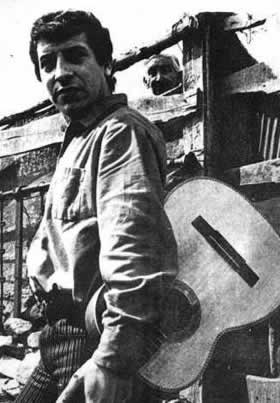
At an unknown time on this evening in 1973, or else the early hours of the following day, Chilean putschists ushering in the Pinochet dictatorship machine-gunned folk singer Victor Jara near the Santiago stadium that today bears his name.
“I don’t see why we need to stand idly by and let a country go communist due to the irresponsibility of its own people,” said Henry Kissinger of Allende’s election. Victor Jara had another idea.
Four days before, Chile’s September 11 had seen General Augusto Pinochettopple the elected leftist government of Salvador Allende, murdering the president in his palace. (Or, go some accounts, Allende committed suicide — “pausing only twice to reload.”)
A long pall of evil settled over the country, with all the accustomed chilling familiars: “disappeared” people, mirrored shades, Jeane Kirkpatrick.
The day after the CIA-backed coup, popular folk singer and activist Victor Jara, a pioneer of the Nueva Cancion (“New Song” movement) then teaching at Santiago’s Technical University, was among thousands of undesirables rounded up and packed off to a makeshift prison camp at the city’s Chile Stadium — a stadium Jara had performed at.*
Left there to the tender mercies of a thuggish Chilean officer, Jara was beaten and tortured over the intervening days — evocative but possibly undependable tradition holds that the guitarist’s hands were cut off, shattered or otherwise destroyed. According to the U.S.-based United States Institute of Peace,
[t]he the last day Víctor Jara was seen alive was September 15. During the afternoon he was taken out of a line of prisoners who were being transferred to the National Stadium. In the early morning of the next day, September 16, shantytown dwellers found his body, along with five others, including that of Littré Quiroga Carvajal, near the Metropolitan Cemetery. As the autopsy report states, Víctor Jara died as a result of multiple bullet wounds (44 entry wounds and 32 exit wounds).
The Commission came to the conviction that he was executed without due process of law by government agents, and hence in violation of his fundamental human rights.
To say the least.
And as the text implies, Jara was only the most recognizable name among unknown hundreds killed as the military cemented its control of the country.
Jara remains larger-than-life martyr figure in Latin America and liberation movements worldwide, but he’s almost unknown north of the Rio Grande. Pinochet was our bastard; in the weird way history writes its own geography, Jara became a political emblem behind the Iron Curtain for the perfidy of the capitalist powers: obscure in Peoria, but a household name in Potsdam, as the credit roll from this 1978 East German film suggests.**
That’s Jara himself on the soundtrack, of course. The pat conclusion for such a figure is that his art is his legacy, and that Jara’s body of work as against Pinochet’s will be a walkover in posterity. Is that enough? Pinochet died in his bed at age 91; earlier this year, the Jara case was closed in underwhelming fashion. Thirty-five years down the road, most authors of Pinochet’s human rights depredations are dead or lost or decrepit. Justice delayed is justice denied.
Victor’s widow, Joan Jara — today director of the Fundacion Victor Jara (it’s a Spanish-only site); you can hear her interviewed on Democracy Now! for the 25th anniversary of her husband’s death in 1998 — managed to leave the country with some of his works.
Her publication of a poem he wrote while imprisoned, an untitled, unfinished work generally known as “Estadio Chile,” made it a signature cry of hope amid desperation. Here it is in the Spanish rough-hewn under the shadow of death; there’s an English translation here.
Somos cinco mil
en esta pequena parte de la ciudad.
Somos cinco mil
¿Cuantos seremos en total
en las ciudades de todo el pais?
Solo aqui, diez mil manos que sembran
y hacen andar las fabricas.
¡Cuanta humanidad
con hambre, frio, panico, dolor
presion moral, terror y locura!
…¡Y Mexico, Cuba y el mundo?
¡Que gritan esta ignomonia!
Somos diez mil manos menos
que no producen.
¿Cuanto somos en toda la Patria?
La sangre del companero Presidente
golpea mas fuerte que bombas y metrallas.
Asi golpeara nuestro puno nuevamente.
¡Canto que mal me sales
cuando tengo que cantar espanto!
Espanto como el que vivo
como el que muero, espanto.
De verme entre tanto y tantos
momentos de infinito
en que el silencio y el grito
son las metas de este canto.
Lo que veo nunca vi,
lo que he sentido y lo que siento
hara brotar el momento…
Whether or not it’s enough, his work is his legacy after all.
* Some 7,000 people were held at Chile Stadium in the days after the coup, most later moved in with other detainees at the larger Estadio Nacional. The USIP excerpt alludes to Jara being pulled out for execution during such a move.
** In a similar vein, Stanford has a small online exhibit of Jara-themed East German propaganda art. Not to be outdone, there’s a Soviet rock opera about Jara, and an asteroid discovered by a Soviet astronomer was named in Jara’s honor within a week of his execution.
On this date in 1860, a kid from Tennessee who had made himself President of Nicaragua got his grateful subjects’ comeuppance in the form of a fusillade.
It was westward the wagons that first bestirred the pioneering blood of William Walker, a scion of privilege with an Ivy League medical degree, who uprooted for San Francisco in 1849.
But the “grey-eyed man of destiny” had an altogether grander gold rush in mind, as he stared pensively into the middle distance.
The air was fervid with Manifest Destiny, and most Americans reckoned that the entire hemisphere was its rightful Manifestation. In a time when private settlers effected the statecraft of conquering the Great Plains, was it really any crazier for Walker to fancy privately conquering some distracted European power’s American colonies?
Walker was one of — soon to be the most famous of — a whole class of such characters: filibusters, a word etymologically rooted in piracy but now claimed by the bustling ranks of soldiers of fortune with private militias bent on detaching some parcel of land from south of the border, for money or glory or what have you.*
Oh, and “what have you”? That means slavery.
Nicely dovetailing the individual spur to derring-do, the South’s structural impulsion to expand slaveholding territories to maintain political parity encouraged — and often bankrolled — filibuster adventuring.
It is to these unwholesome fellows that the United States likely owes its sovereignty over Texas, which was pelted with Anglo filibustering expeditions in the early 19th century, helping set the table for the revolution that severed the Lone Star state from Mexico; arguably, the Texas Revolution itself was a (fantastically successful) filibuster.
So Walker had the glittering destinies manifest before his grey eyes when he put off the white collar career to play soldier. After an abortive 1853 attempt to set up his own country in Mexico’s Baja California — a jury instantly acquitted him of waging war on a neutral power; filibustering, and damn near anything that promised America more Manifestly Destined land, was as popular as it was illegal — Walker moved on war-torn Nicaragua under the guise of a “colony”. With a few hundred men, he was able to conquer the capital and set himself up as head of state.
Who knows whether he could have had a future if he’d done it differently. In the actual fact, he wasn’t as hot an administrator as his ego might then have been telling him. He revoked Nicaragua’s anti-slavery edicts, of course; though this sparked resistance, more damaging may have been revoking a Vanderbilt trade concession and bringing a tycoon into the private warfare game on the opposite team.
Cornelius Vanderbilt-backed opponents drove Walker out of Nicaragua in 1857. Not knowing when he was beat, the ex-Presidente kept knocking around stateside piecing together several expeditions, each sadder than the last … until in 1860, when a landing at Honduras collapsed, and he surrendered himself to a British (rather than American) officer. Europeans with colonies to exploit didn’t have much use for filibustering, and Walker had made everyone nervous by openly aspiring to conquer Nicaragua’s neighbors — including British assets. Rather than return him home where he could continue scheming to meddle in the future canal zone, the Brits handed him over to the Hondurans, who stood him in a court-martial, then stood him up against a wall.
And for a corner of Americana little-known to most in the U.S. — well, the colorful, nigh-unbelievable quality of the action has overridden its obscurity when it comes to the written word.
Various books about William Walker and Filibustering
* More familiar for most Americans is “filibuster” as a legislative maneuver — refusing to yield the floor during debate to forestall the passage of a bill. Not surprisingly, this usage came online at the same time mercenary filibusters were active, and proceeds from the word’s original sense of “piracy”.
On this date in 1990, deposed Liberian strongman Samuel Kanyon Doe was tortured and summarily executed in Monrovia by the putschists that overthrew him … and gruesomely filmed in the process.
Doe had come to power killing his predecessors — personally murdering, some sources say, President William Tolbert in 1980, then executing his chief aides.
That coup toppled civilian authority in the west African country now permanently prefixed with the adjective “troubled.” “The first of the monsters,” the War Nerd called him: Doe’s murderous rule through the 1980’s set up the succession of current war crimes prisoner Charles Taylor.
Samuel Doe’s turn in the obituaries arrived in particularly grisly fashion, with Taylor rival/semi-ally* Prince Johnson swilling beer as he interrogated — and ordered the ear sliced off — the groveling former head of state before having him executed. (Or if you like, just plain murdered.) The video shot of Doe’s ordeal became an international sensation … so it’s a little surprising that only this paltry excerpt seems to be readily available online:
* And current Liberian Senator! He feels just awful about the whole torturing-the-President-to-death thing.
On this date in 1593, a would-be assassin of France’s King Henri IV was broken on the wheel.
An Orleans boatman turned Catholic League soldier in France’s internecine Catholic-Huguenot wars, he was among the numerous Catholics who looked askance at victorious Huguenot Henri IV‘s expeditious conversion to Catholicism.
In the months while Henri IV still held Paris under siege, the Jesuit father Jacques Commolet had called for his assassination from the pulpit. The Bourbon’s (nominal) switch to Catholicism with the words “Paris is worth a mass” had not persuaded hard-core Catholic partisans of the king’s sincerity.
Henri was a practical guy. And with civil slaughter afoot for most of the late 16th century, he took a dim view to loose talk about assassinations, especially his.
The safety of the king’s person was a paramount consideration of magistrates during this period. Thirty years of political assassinations during which the rule of law proved largely ineffective in bringing the guilty to justice had ultimately left a fundamental law of France, the inviolability of the king’s person, subverted. Magistrates … focused their attention on re-establishing the enforcement of this law …
Pierre Barriere was nabbed for planning to subvert that inviolability — arrested August 27, tried August 30, horribly broken on the wheel August 31.
Henri would keep the throne 17 more years, laying the basis for French absolutism. But continual assassination bids — nearly 20 documented — would pursue him throughout his reign … until one finally got him.
On this date in 1966, author and intellectual Sayyid Qutb was hanged for plotting to overthrow the Egyptian state.
Qutb — whose names can be transliterated many ways (Saïd, Syed, Seyyid, Sayid, or Sayed; Koteb, Kotb, Qutub or Kutb) — was one of the most influential Islamist thinkers of the 20th century, and helped shape the ideas of Osama bin Laden.
A traditionally-minded Muslim civil servant in a westernizing Egypt, Qutb’s journey to radicalism is traditionally dated to his late 1940’s study abroad in the U.S. at what is now the University of Northern Colorado, where the decadence, materialism, and lax morality of the global hegemon saw him seeing existential evil in the everyday all around him:
The American girl is well acquainted with her body’s seductive capacity. She knows it lies in the face, and in expressive eyes, and thirsty lips. She knows seductiveness lies in the round breasts, the full buttocks, and in the shapely thighs, sleek legs — and she shows all this and does not hide it.
Qutb left Greeley, Colo., in 1950 with a master’s degree and an intention to mount an Islamic revolution in his home country that would implement sharia and keep shapely thighs safely under wraps. (Qutb never married, bemoaning the scanty pickings of pure fish in the sea. He may have faced the gallows a virgin.)
He hooked up with the outlawed Muslim Brotherhood, landed in Egypt’s famously savage prisons (future president Anwar Sadat was one of his judges), and the experience of torture hardened his commitment to a vanguard-led revolution. He kept up his prolific writing output, penning perhaps his most notable work, Milestones (the text was later used against him at his capital trial).
Qutb’s release in 1964 was only for a few months, before Egyptian security got wind of a new Muslim Brotherhood plot to overthrow the government and rounded up Qutb as the supposed ringleader — or just railroaded him because it didn’t like where he was going with passages like
there are many practical obstacles in establishing God’s rule on earth, such as the power of the state, the social system and traditions and, in general, the whole human environment. Islam uses force only to remove these obstacles so that there may not remain any wall between Islam and individual human beings.
With the benefit of hindsight, one can readily imagine that his martyr’s death did not squelch his movement, but greatened his stature to admiring eyes.
But it was hardly a direct path into an un-critiqued hall of martyrs in an undifferentiated “radical Islam”. While Qutb had his own influence in Egypt, Cairo has managed to keep the lid on the Muslim Brotherhood. Qutbism, however, was exported to Saudi Arabia — which intentionally imported it for various practical and geopolitical reasons — where it flourished, often in a fractious relationship with official Saudi Wahhabism.
One of Qutb’s students was the uncle of Ayman al-Zawahiri, and the hanged intellectual greatly influenced Zawahiri’s own path into radicalism and to al-Qaeda. Since September 11, of course, the path Qutb himself followed has become of much more pressing interest to the West as well as within the Muslim world.
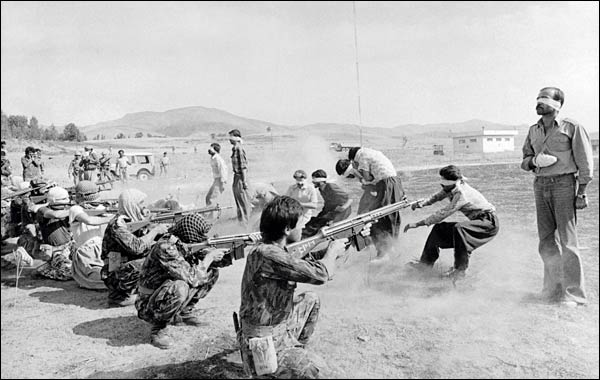
On this date in 1979, the only anonymous photograph to win a Pulitzer Prize captured nine Kurdish rebels and two of the Shah’s policemen executed by firing squad in revolutionary Iran.
This shot, one of a series taken of the event with the permission of the judge who condemned the men to immediate death in a half-hour trial at the Sanandaj airfield, ran the next day in the Iranian paper Ettela’at, whose editor prudently kept the photographer’s identity secret. Within two days, the stunning photo had rocketed around the world.
It won the Pulitzer Prize for Spot News Photography the following spring, still credited anonymously.
Two years ago, the Wall Street Journalrevealed — with the photographer’s permission — the identity of the man who shot this indelible image: Jahangir Razmi, who had gone on to a career as one of Iran’s top photographic journalists. He came to New York to collect the prize 27 years late.