1948: Tessie Hutchinson, Lottery winner

June 27 — of 1948, implicitly — was the setting for Shirley Jackson‘s classic short story “The Lottery”.


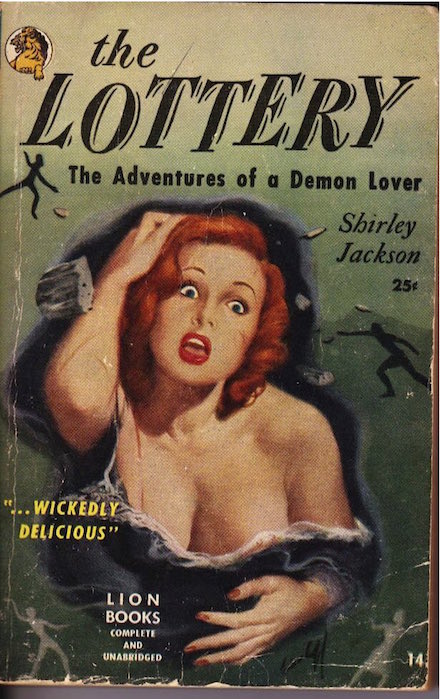
Before we dive into the grim stuff, here’s a hilariously campy pulp cover (mis)interpretation.

Less an “execution” than a human sacrifice — the village old feller’s folksy “Lottery in June, corn be heavy soon,” evokes a primal flash of blood trickling off the maize-god’s altar — the titular event is an annual tradition for a tiny American town. Though unnamed, the town and some of its denizens were patterned on North Bennington, Vermont, where Jackson was living as the wife of a professor at Bennington College.

The setting was entirely contemporary to the story’s publication, right down to the day: it hit print in the June 26, 1948 edition of The New Yorker magazine. And what took Jackson two hours to write has continued to disturb and perplex generations of readers.

In “The Lottery” (available online here (pdf)), friendly townsfolk gather “in the square, between the post office and the bank” to enact a curious civic ritual dating to a time and purpose they no longer even remember.

We see each household’s father draw a slip of paper from a battered old box and although we do not understand the reason we grasp from the dark atmosphere afoot in the crowd that something ominous is unfolding.

After the last slip is drawn,

there was a long pause, a breathless pause, until Mr. Summers. holding his slip of paper in the air, said, “All right, fellows.” For a minute, no one moved, and then all the slips of paper were opened. Suddenly, all the women began to speak at once, saving. “Who is it?,” “Who’s got it?,” “Is it the Dunbars?,” “Is it the Watsons?” Then the voices began to say, “It’s Hutchinson. It’s Bill,” “Bill Hutchinson’s got it.”

“Go tell your father,” Mrs. Dunbar said to her older son.

People began to look around to see the Hutchinsons. Bill Hutchinson was standing quiet, staring down at the paper in his hand. Suddenly. Tessie Hutchinson shouted to Mr. Summers. “You didn’t give him time enough to take any paper he wanted. I saw you. It wasn’t fair!”

“Be a good sport, Tessie.” Mrs. Delacroix called, and Mrs. Graves said, “All of us took the same chance.”

“Shut up, Tessie,” Bill Hutchinson said.

Tessie has good cause to fear. A second drawing now ensues among the five members of the Hutchinson family — Tessie and Bill, plus their three children.

And as soon as Tessie reveals the slip of paper with the black spot, her friends and even her family (“someone gave little Davy Hutchinson a few pebbles”) immediately turn on her and stone her to death.

“I hoped, by setting a particularly brutal ancient rite in the present and in my own village to shock the story’s readers with a graphic dramatization of the pointless violence and general inhumanity in their own lives,” Jackson explained.

On this day..

1621: Christenze Kruckow, philanthropic witch

On this date in 1621, Christenze (or Christence) Kruckow was beheaded as a witch — the only known noblewoman to suffer that fate in Danish history.

Kruckow first came under the witchsmeller’s nose in the 1590s. As a young woman, she lived in the household of a man named Eiler Brockenhuus — common practice at the time in Danish high society. The supposition is that when the lady of the house died in 1582, Kruckow might have aspired to make a permanent move. Instead, the position of wife no. 2 went to another woman named Anne Brille.

From the sound of it, Anne Brille spent the ensuing decade-plus in a state of continual pregnancy, punctuated only by periods of mourning as all 15* of her prospective progeny miscarried or died in infancy. Pick your environmental toxin or genetic abnormality of choice, but it’s no surprise this started to give the poor would-be mother the heebie-jeebies. Eventually, two of the estate’s servants got caught up in a 1596 witchcraft interrogation and were burned at the stake — but not before implicating Christenze Kruckow as part of the coven.

On that occasion, the usual reticence to visit on elites the sanctions intended for their lessers prevailed, and Christenze simply had to relocate to a sister’s household in Alborg.

But a reputation for black magic wasn’t the best thing to have to one’s name in early 17th century Europe, when witch-hunting reached a horrifying acme. Like his brother-in-law James VI of Scotland (also James I of England), the long-reigning Danish king Christian IV developed a personal obsession with the diabolical, leading to an effusion of witchcraft trials in the 1610s and early 1620s.

Now, Kruckow’s elite status served to attract instead of deflect attention; it didn’t help that she was become a never-married hexagenarian. When a neighbor’s wife fell ill in witch-spooked Alborg, the accusations against her snowballed into their customary colorful forms, such as that she’d been seen delivering a pregnant woman (Danish link) of a troll or ogre at some fell sabbath. King Christian took a personal interest in seeing her case prosecuted, and in the end it was his own Privy Council that tried her, and then sentenced her to the privileged death by the sword instead of the stake: the last deferences to her social rank. She confessed at that time to having attempted to lay a curse on the wedding-bed of her long-ago rival, Anne Brille.

In between her witch episodes, Christenze Kruckow had taken an interest in education for poor children in Alborg. She carried her philanthropy (more Danish) even beyond the scaffold, bequeathing 1,000 rigsdalers to a university scholarship that the University of Copenhagen was still awarding into the 20th century — popularly known as the “beheaded virgin grant”.

* Or 17. Sources vary, but you’d lose count too.

On this day..

1886: John W. Kelliher lynched in Becker County, Minnesota

(Thanks to Meaghan Good of the Charley Project for the guest post. -ed.)

On this day in 1886, John W. Kelliher, known as “Reddy” or “Big Red”, was lynched by a mob of some five hundred people in Becker County, Minnesota.

Kelliher had gotten into a fight with a rival pimp and gambler and the village marshal of Detroit (today, Detroit Lakes), John Conway, tried to intervene. Conway was shot dead for his pains, shortly before his wedding day.

Marshal Conway had been very much liked in the village. Though his killer was instantly chased down and handed over to the constabulary,

little business was done in Detroit that day. Men were to be seen in small groups in every part of the town, upon the streets, in the stores, saloons and alley-ways earnestly discussing the tragedy, and the many threatening countenances were ample indications that further developments might be expected, while many appeared anxious, apprehensive and excited, as though waiting for and fearing some terrible event. At precisely ten o’clock in the evening, several taps were made upon the fire bell in quick succession, and the fierce yell, which immediately followed, breaking harshly upon the oppressive stillness, was ample evidence that this was the understood signal for an execution by Judge Lynch. Farmers for many miles around had been coming into town all day, and many men arrived by the evening train from points both east and west; the town was thronged with men and at the ringing of the bell a mass of humanity surged toward the court house; a sledge hammer was brought into use; the sheriff and jailer were overpowered and the keys to the jail taken from them, and Kelliher was quickly brought face to face with his unlawful but determined executioners; a rope was thrown over his head and the cry “go ahead” was given; with probably fifteen men having hold of the rope, and pulling with frenzied zeal the mob left the jail and ran wildly down the street leading west, to the house that had been occupied by Big Red as a bagnio, and in a twinkling the rope had been thrown over the limb of an oak tree, and the body of Big Red was swinging in the air; the victim was doubtless dead long before the tree was reached, or if not dead certainly unconscious.

The scene was one of wildest confusion, but all had been done so quickly and so effectually that the terrible affair could scarcely be realized, but the deed over, the excited crowds melted away and in a short time the village streets were practically deserted. (Original source)

According to John D. Bessler’s Legacy of Violence: Lynch Mobs and Executions in Minnesota, the Minneapolis Tribune took a vehement editorial line against this “barbarous and disgraceful act,” and urged that jails fit themselves out with “a Gatling gun, intended for business” as proof against Judge Lynch. However, the St. Paul Daily Globe demurred, editorializing that “Society owes it to itself to get rid of such tough characters as Kelliher” — and if attaining that end via lynch law was in principle less than ideal, “it was past all human endurance to have a defiant desperado walk the streets of a respectable town and shoot down its citizens in cold blood. Nobody is surprised that he was taken from jail by a mob and swung to the nearest tree. It would have been a surprise if it had not been so.”

On this day..

1600: John Rigby, lay martyr

Most of Catholicism’s “40 Martyrs of England and Wales” were priests executed as traitors for preaching the Old Faith.

John Rigby, drawn and quartered on this date in 1600, is distinguished as the rare layman among their number.

The guy should be the patron saint of dutiful employees. He was in the service of Sir Edmund Huddleston when the master’s daughter was summoned to the Old Bailey on suspicion of Catholic backsliding. (“Recusancy”)

The daughter was sick, so Rigby appeared on her behalf … and since they were all dressed up for the occasion, Queen Elizabeth’s Javerts just started asking Rigby about his religious scruples.

Rigby owned that he had gone Catholic and stopped attending Anglican services two or three years before and was immediately thrown into Newgate, tortured, and condemned to die.

Repeatedly offered his life to apostatize, even en route to his scaffold, Rigby cheerfully refused.

When the rope was to be put about his neck, he first kissed it, and then began to speak to the people, but was interrupted by More, the sheriff’s deputy, bidding him pray for the queen, which he did very affectionately. Then the deputy asked him, what traitors dost thou know in England? God is my witness, said he, I know none. What! saith the deputy again, if he will confess nothing, drive away the cart; which was done so suddenly, that he had no time to say any thing more, or recommend his soul again to God, as he was about to do.

The deputy shortly after commanded the hangman to cut him down, which was done so soon, that he stood upright on his feet, like to a man a little amazed, till the butchers threw him down: then coming perfectly to himself, he said aloud and distinctly, God forgive you. Jesus receive my soul. And immediately another cruel fellow standing by, who was no officer, but a common porter, set his foot upon Mr. Rigby’s throat, and so held him down, that he could speak no more. Others held his arms and legs whilst the executioner dismembered and bowelled him. And when he felt them pulling out his heart, he was yet so strong that he thrust the men from him who held his arms. At last they cut off his head and quartered him, and disposed of his head and quarters in several places in and about Southwark. The people going away, complained very much of the barbarity of the execution; and generally all sorts bewailed his death.

On this day..

1816: Peter Lung, uxoricide

(Thanks to Meaghan Good of the Charley Project for the guest post. -ed.)

On this date in 1816, middle-aged uxoricide Peter Lung was hanged in Middletown, Connecticut for the murder of his wife the previous year.

The facts of the case are simple: both Mr. and Mrs. Lung were alcoholics. Peter, a laborer, thought it was all right for him for drink as much as he wanted, but he was violently opposed to his wife Lucy doing any tippling of her own. But tipple she did, and she and her husband had frightful quarrels about it.

On July 15, 1815, Peter came home late. He found the front door wide open, no dinner on the table, and Lucy passed out cold in her bed and reeking of liquor. Her husband violently kicked her awake and then told her to make him some dinner. She told him to go fix his own food if he was so hungry.

Things went downhill from there and the argument ended with Peter punching his wife several times and then kicking her in the backside. He then went out to the garden and dug up some vegetables for the family dinner. The couple passed the rest of the night normally — for their argument, violent though it was, was typical for them.

A day or so later, Lucy began complaining that her right side was hurting her. Her side hurt too badly for her to lie down two days after the beating and she fell asleep in her rocking chair, and never woke up. The autopsy showed she’d died of internal injuries: evidently Peter’s kicks had ruptured something inside her.

He was charged with capital murder. He had a long-standing habit of mistreating his wife, and everyone knew it. The jury was decidedly unsympathetic to his protests that he’d never meant to kill her.

The Lung case is one of those miscarriages of justice that people often don’t think about: where a person is indeed culpable, but not necessarily guilty as charged. Peter obviously did not intend homicide when he and his wife had their last fight, and neither of them were aware that he’d seriously injured her until it was far too late. Certainly he was responsible for Lucy’s death, but was it manslaughter more than murder?

Connecticut’s judiciary was aware of this issue, and Lung’s original conviction in September 1815 was actually overturned as a result. But he was re-convicted of the same charge at his second trial in December. It was probably his bad reputation that ultimately doomed him.

He was hanged before “a multitude, amounting as was supposed to eleven or twelve thousand.” It was the third execution in Middlesex County.

Poulson’s American Daily Advertiser, July 1, 1816.

The deportment of the prisoner on this awful occasion, was such as to justify a strong hope that by a sincere and timely repentance, he had found the mercy of his Saviour equal to the greatness and enormity of his guilt. He conversed freely on his past life — declared that he believed his wife died in consequence of the wounds he gave her, but denied that he ever intended her death — He fully acquiesced in the justice of his sentence; — that his life was justly forfeited and that it was an atonement due from him to the offended laws of society.

During the religious solemnities previous to his execution, his deportment manifested resignation and composure. He marched with the guard to the fatal spot, ascended the Gallows, warned the silent and solemn auditory, against the evils of intemperance, and ungoverned passions; and a few minutes before four o’clock, was launched into eternity. The official duty of the execution was performed with great propriety and with such fatal exactness that the unfortunate sufferer sunk into the arms of Death without a single struggle, and almost in the same moment, was a tenant of both worlds. The day was pleasant, and few occasions of this kind we believe, have drawn together a greater concourse of spectators.

Among the immense crowd assembled in this place to witness the execution last week, a regular company of pick-pockets was present, which must have enriched their finds very considerably, as a number of gentlemen were deprived of their Pocket Books, containing money and notes to a large amount, with a dexterity which would do honor to the most regular bred gentry in the streets of London. A very valuable horse was also taken from a stable in this city, the night succeeding.

On this day..

1857: George Sharpe and John Johnson, Edwardsville murderers

From the Alton Weekly Courier, June 25, 1857, under a June 20 dateline.

Yesterday being the day appointed for the execution of the murderers of Jacob Barth, we dispatched one of our Assistants to Edwardsville, in order that from personal observation we might be able to correctly report the proceedings of this melancholy occasion at the earliest moment. The following is as full and concise a sketch as could be prepared after his return late yesterday evening, and contains, we believe, all the particulars in which our readers would likely feel an interest.

The Day and The Crowd

The weather was very favorable, the day being mild and pleasant. The sun shone clear and warm, but not oppressively so; the recent rains had settled the dust, but had not made any mud, and the roads were consequently in good traveling condition. The rarity of capital executions in this part of the country, together with the recent and very exciting history of this case, conspired to draw out a tremendous crowd of people to witness this the last and severest penalty of the law. It was estimated that there were between seven and eight thousand persons present, some of whom had come from a distance of fifty miles. They were of all ages, sexes, conditions and complexions. A large portion of them were Germans* — friends, relatives and countrymen of the murdered man. Very much to our surprise, mortification and sorrow, we observed a large number of females among the spectators — we say “females,” for we scarcely feel at liberty to designate them as either women or ladies, for we have always thought, and had good reason to think, that every feeling and attribute of a true woman’s nature would generate in her bosom an unconquerable repugnance to voluntarily witnessing any such revolting scenes under any circumstances in the world. Many of the females who were at the place of execution yesterday, and who witnessed the infliction of the dreadful death penalty with the same coolness and indifference as the men generally manifested, were young, and would have been pretty anywhere else and under ordinary circumstances. Why they attended, or what could have induced them to be present at all, we cannot possibly conceive; and in recording the fact that they were there, we feel that their loving, and noble, and gentle sex is by that fact disgraced.

The Prisoners

It is already known to our readers that Robert Sharpe, the younger of the two brothers condemned, has been sent to the State’s Prison for life, under commutation of sentence by Gov. Bissell. The other two – George W. Sharpe, tried and condemned under the name of George Gibson, and John Johnson, who, until after his trial bore the false name of Edward Barber — have been closely attended by Rev. E. M. West and other clergymen, and have appeared to be truly penitent for their crimes. For several days before their execution, they both seemed fully resigned to their fate, and prepared to meet and try the dread realities of eternity; but yesterday morning Sharpe yielded to despondent and despairing feelings, and seemed to suffer dreadfully with fear and terror during the last few hours of his life. The prisoners were both young, heavy set, and rather good-looking men. They evidently had been possessed of healthy and vigorous frames, capable of performing much labor. In preparation for the last scene of their lives. Sheriff Job had arrayed the unfortunate men in very neat suits of clothing, of the ordinary style and fashion, and of perfect snowy whiteness in every particular; they were also cleanly shaved and looked extremely well. Sharpe had two sisters and two brothers, including the one now in the Penitentiary; Johnson had four sisters and four brothers; the parents of both are all living yet; but no relative or even acquaintance who knew them before they committed the murder was beside them in their last trying hour.

The Procession

At half past one o’clock the Sheriff placed the prisoners in a neat and comfortable hack which had been provided, and in which they were conveyed at a slow pace to the place of execution. The carriage was escorted by a portion of the Madison Guards, under command of Captain J. Sloss, fully armed and equipped. A large concourse of spectators followed, but observed good order and decorum. The procession passed along the main street of the town, through its entire length. The prisoners occupied themselves in singing and prayer all the time after they left the prison.

The Scaffold

The spot chosen for the execution was in a ravine east of town, and on the County Poor House Grounds. The scaffold was a neat and substantial structure, as perfectly adapted to its use as anything could be. It was surrounded by rising ground in every direction, so that every person in the vast assemblage could obtain a perfect and near view of the awful tragedy. An area had been laid off by a temporary enclosure, which was guarded by a detachment of the Madison Guards, under command of Lieut. J. G. Robinson, no one being allowed to enter without the permission of the Sheriff.

The Scene at the Scaffold

After those whose duty or privilege it was had ascended to the platform of the scaffold, Sheriff Jon briefly addressed the assembled multitude. He said he was there in his official capacity to perform an unpleasant duty, in executing upon two of his fellow men the severest penalty provided by our laws for the violation of its enactments. Exceedingly unpleasant as was this duty, it was yet a duty, and should be faithfully performed. The example thus set ought not to be lost upon those who had come to witness it. The persons — and specially the youth — of that vast assemblage should take warning from the terrible fate of the two young men so soon to be hurried to the dread presence of an offended God, and avoid the crimes that so justly and so certainly lead to this terrible end. Rev. E. M. West then spoke at some length in explanation of the manner in which and the reasons why the commutation of the sentence of Robert Sharpe had been petitioned for and granted. We cannot possibly give even a skeleton of his remarks in this issue; perhaps we may do so tomorrow. Mr. West then closed with a brief and earnest admonitory exhortation suited to the occasion. The Sheriff then extended a permission — even an invitation — to the prisoners to address the audience, of which Johnson immediately availed himself. He said he stood before his hearers a cold-blooded murderer, of which crime he had been found guilty, and for which he was soon to be so terribly yet so justly punished. In a few minutes, he and one of his companions in guilt would be suddenly launched into eternity, and sent into the presence of the great God whose laws they had violated, with the blood of their victim yet red upon their hands. But he had a humble hope that he had made his peace with God, and that although his crime had been great, his salvation was sure. His soul was at peace; he had no malice in his heart, and he was ready and willing to meet the Judge of all the earth. His punishment although terrible was just, and he was prepared to meet it. If he had remained at home during his early youth and obeyed the pious instructions of his mother, he would not now have been on the scaffold a condemned murderer. He hoped all the youth who heard him would take warning by his example, he influenced by the counsels of their good and pious mothers, keep out of bad company and bad habits and thus avoid the terrible fate that had so soon overtaken him Johnson spoke with much feeling and earnestness and manifested deep emotion while speaking. His remarks were very appropriate to the occasion, and were listened to with respectful attention. Sharpe seemed to desire to speak but was so overcome with the horrors of his situation he was unable to do so. Rev. J. B. Corrington then addressed to the audience a few very appropriate remarks. He had once thought that a saving repentance in view of the certainty of death was almost if not quite an impossibility, but in the two interviews he had had with the condemned in prison, he had received grounds for hope that their repentance was thorough and sincere, and of course acceptable. He hoped, however, none of his hearers would trust their salvation to a death-pending repentance. We have positive evidence of the efficacy of but one such; and God had placed this one case on record in His Holy Word that none might despair, and but the one that none should presume. Mr. Corrington closed with a brief but earnest and heart stirring prayer, in which the prisoners, standing and with clasped hands, joined audibly.

The Execution

The prisoners then shook hands with and took an affectionate leave of each other, the Sheriff and his deputies and the attending clergymen. Johnson seemed perfectly composed and met his fate without exhibiting the least symptom of fear or even regret. He stood erect and without trembling, retained the ruddy natural glow of health in his face, and as much firmness and calmness of mind as in an ordinary business transaction. Often he would clasp his hands, and a smile of apparently perfect happiness would overspread his features. He seemed perfectly willing — even anxious, for his last moment to come. When the Sheriff told them to step on the drop, he turned to his companion and said, “George, which side would you rather stand on?” Sharpe was terribly affected, and was really a pitiable object to behold. His eyes seemed to have almost lost all expression, and exhibited nothing but a glassy, death-like stare; his face was ashy pale, and showed no color save a livid purple hue; his hands were alternately and convulsively clasped and raised in supplication, and he constantly gave utterance to heart-rending moans or incoherent prayers. When requested to step forward upon the drop, he obeyed, exclaiming, “O Lord! have mercy on me! I dare not die! I’m afraid I’m not prepared!” The ropes were adjusted round their necks, their arms were pinioned together across their backs, their hands tied, white muslin caps were drawn over their heads, and when all was ready, at a single stroke, Sheriff Jon severed the cord which held the supporters of the drop, and in an instant the unfortunate murderers were suspended in mid air in the agonies of death. They both struggled very much for more than a minute. In about two minutes after, they fell, Johnson ceased to manifest any signs of life. Sharpe continued to struggle, though less and less, for full five minutes. The knot of the noose had slipped round to the back of his head, and the fall had failed to break his neck; he therefore lived until he was literally choked to death. They both fell about five feet, and if the knot had remained in the right position, his neck would have been instantly broken, of course. After having hung full thirty minutes, the bodies were taken down, placed in handsome walnut coffins, and decently buried. Too much praise cannot be awarded to Sheriff Jon for the kind and considerate, yet firm and prompt manner in which he discharged the unpleasant duty that devolved upon him. The independent, manly and conscientious course he has pursued during the exciting and trying scenes that have occurred at our county seat during the past few weeks has won for him a still greater share of the popular favor of his constituents of which he before enjoyed so much.

* The victim was German; the young men, deep in their cups, murdered him because they took umbrage at Barth’s refusing them a ride. According to the New York Daily Tribune (May 29, 1857), a mob of some 400 lynch-minded Germans assembled in Edwardsville when the accused were granted a change of venue to a more “American” county — and even went so far as to throw up a gibbet before the Sheriff Job who eventually conducted the legal execution dissuaded his immigrant neighbors from effecting an extrajudicial one.

** Bissell was the first Republican governor of Illinois: in fact, one of the first Republican elected officials anywhere. He had previously distinguished a term in Congress (he was elected as a Democrat, before the 1854 founding of the GOP) with his naked contempt for the South’s delegates. For having the temerity to rebut exaggerated claims of Mississippian valor in the Mexican-American War, Bissell at one point prompted the future Confederate president Jefferson Davis to challenge him to a duel: surprisingly (to Davis) Bissell accepted, but word of the affair circulated in Washington and the sectional hotheads were made to cancel their rendezvous.

Here’s an 1858 letter to Bissell by Abraham Lincoln seeking (successfully) the pardon of two Logan County men convicted of stealing a few hogs.

On this day..

1660: Jan Quisthout van der Linde condemned to drown in New Amsterdam

On this date in 1660, in the Netherlands’ little settlement on the tip of Manhattan Island, New Amsterdam, Jan Quisthout van der Linde was sentenced “to be taken to the place of execution and there stripped of his arms, his sword to be broken at his feet, and he to be then tied in a sack and cast into the river and drowned until dead.”

We do not have an indication of the date this sentence was carried out, if it were not immediate.

It was an unusual execution for an unnatural crime: Quisthout had been found guilty of sodomizing his servant.

New Amsterdam is here just four years away from its seizure by the English, who rechristened it New York;* dour, peg-legged Calvinist Peter Stuyvesant had been hustling for 13 years to put the tenuous little settlement on some sort of sustainable, defensible footing even as its neighbor English colonies in Massachusetts, Connecticut, and Rhode Island grew to dwarf little Manhattan.

Stuyvesant was a crusty boss.** He’d been crestfallen on arrival to his new assignment to find New Amsterdam a rough-edged melting pot city with livestock roaming the streets, a slurry of languages (and religions), and dockside brawls spilling out of seedy taverns.†


The “Castello Plan” map from 1660 shows the germ of Manhattan’s present-day layout. The defensive wall spanning the island on the right gives us Wall Street.

His horror was practical as well as moral: the little colony, a few hundred souls when he took over and perhaps 1,500 when the English finally deposed him, was in danger on all sides and the cash-strapped West India Company was both slow and miserly in response to Stuyvesant’s desperate pleas for men and material. But the horror was also moral. Stuyvesant enforced a whole slew of unpopular injunctions against drunkenness, fisticuffs, and fouling public streets with refuse, and actually had to be reined in by the West India Company board when he got so overbearing as to try shouldering out Jews and prying into the devotional habits of suspected Quakers.

A paragon of rectitude like Stuyvesant was in no way about to turn a blind eye to casual Atlantic-world buggery.

Even his lax predecessor had come down hard on a previous sodomy case, viewing that sin as an existential threat to their depraved port: “such a man is not worthy to associate with mankind and the crime on account of its heinousness may not be tolerated or suffered, in order that the wrath of God may not descend upon us as it did upon Sodom.”

The crime that we might see here with modern eyes, rape, was in no way foremost to Stuyvesant et al. The boy, an Amsterdam orphan named Hendrick Harmensen, stayed out of the drowning-sack — but he was whipped for same-sex contact and ordered “sent to some other place by the first opportunity” even though that very sentence acknowledged that it was Quisthout who had “committed by force the above crime” on the lad.


View of Dutch Manhattan … and its gallows.

* In honor of the then-Duke of York, the future King James II.

** Try a web search on “Peter Stuyvesant martinet” to see what we mean.

† And slavery.

On this day..

1899: John Headrick and Carroll Rice, Missourians

On this date in 1899, young John Headrick was hanged outside Cape Girardeau‘s courthouse for murdering James Lail.

The 19-year-old Headrick was an embittered ex-farmhand of his victim, James Lail — who fired the youth for stealing a buggy.

In July of 1898, he turned up on the farm and found Lail in the barn. Lail’s wife and daughter both saw young Headrick arrive; they would testify that within half a minute of him entering the barn, they heard gunshots.

At trial, Headrick would claim that he shot in self-defense when Lail menaced him with a deadly currycomb (a brush used for horses), offering the prosecutor the opportunity for a bit of sport on the cross-ex:

Q: “You want the jury to understand that you are afraid of your life when a man assaults you with a curry comb?”

A: “Yes, sir, when I am in a place where I can’t get away.”

Q: “Especially if you are armed?”

A: “If I wasn’t armed I would have been killed.”

Q: “He aimed to curry you? He didn’t strike you with the curry comb?”

A: “No, sir, he did not. He struck at me mighty hard.”

Jokes aside, Lail’s surviving family had a terrifying ordeal still to come. As Headrick blasted away at his fallen boss, Lail’s wife Vernie arrived and threw herself over her husband protectively.

The young assailant shot her, too, then began beating her. By now, 19-year-old Jessie Lail was on the scene too. “John Headrick, what do you mean!” she shrieked. “You have wrecked my life forever! You have killed Papa, now you are killing Mother!”

In the ensuing chaos, Vernie Lail tried to make a run for it only for Headrick to chase her down and stab her — to death, or so he thought. Then the young assailant marched Jessie Lail off at gunpoint. Somehow, Vernie Lail survived a slashed throat, a shot through the back, and numerous other injuries to rise yet again and make it a quarter of a mile down the road to her mother-in-law’s house.

“By God, the old woman is gone, you can’t kill her, can you?” Headrick exclaimed to the daughter when they re-crossed the spot where mom’s body should have been. Headrick at this point wisely abandoned the scene of his carnage after trying and failing to extract a pledge from his hostage not to give evidence against him. A posse found him shortly afterwards, hiding in a barn.

The sturdy and surprisingly low-to-the-ground tree on which Headrick was hanged just outside the Cape Girardeau courthouse still stands, or did as of 2010 when it was endangered by a proposed traffic roundabout. Have a gander at the old gallows-tree in this post by Cape Girardeau journalist Ken Steinhoff, here.


Headrick’s hanging took place behind jail walls, but on the same date in Alton, Carroll Rice was hanged before a reported crowd of 5,000 for the murder of his wife.

“Just before the black cap was adjusted, and while his legs were being pinioned, the condemned man broke away form the sheriff and attempted to escape,” press reports ran.

It was worth a try.

On this day..

1662: Sir Henry Vane, Commonwealth parliamentarian

On this date in 1662, Parliamentarian Sir Henry Vane the Younger was beheaded on Tower Hill for his service of Oliver Cromwell‘s Protectorate.

Adopting Puritan beliefs to the irritation of his politically connected father,* Vane emigrated to that sect’s Massachusetts colony and was elected governor at the ripe old age of 23, backed by the faction forming around religious dissident Anne Hutchinson.

He served for less than a year before the anti-Hutchinson side took the office from him and he, Vane, sailed for the mother country — but even in his short tenure the young gentleman left a mark in New England sufficient for a statue in the Boston Public Library:

  • He was “an instrument in the hand of God for procuring” Rhode Island from Indians;
  • He signed the legislation creating the “New College” eventually to become Harvard;
  • And, he launched the Pequot War

Back in Old England, the Young Vane’s energy served the Roundheads well during the English Civil War. Though never a soldier, he rose to the Republicans’ statum of political leadership, and moved the money and legislation that loosed Cromwell’s armies.

Vane served on the Parliament’s wartime military counsel, the Committee of Safety and — after Vane himself played a crucial diplomatic role bringing the Scots into the fight** — on its successor body, the Committee of Both Kingdoms. Vane’s experience in the New World also gave him a bent for religious liberty that was unusually staunch for his time, and made him a key figure of the church “Independents”, one of the Interregnum’s dominant factions.

John Milton, the great literary champion of the Commonwealth, celebrated Vane in verse (1652):

VANE, young in years, but in sage counsel old,
Than whom a better senator ne’er held
The helm of Rome, when gowns, not arms, repelled
he fierce Epirot and the African bold,
Whether to settle peace, or to unfold
The drift of hollow states hard to be spelled;
Then to advise how war may best, upheld,
Move by her two main nerves, iron and gold,
In all her equipage; besides, to know;
Both spiritual power and civil, what each means,
What severs each, thou hast learned, which few have done.
he bounds of either sword to thee we owe:
Therefore on thy firm hand Religion leans
In peace, and reckons thee her eldest son.

Vane’s sage counsel — and what he would later describe as “my tenderness of blood”† — made him unwilling to participate in the execution of King Charles: it was as a spectator and not an M.P. that he watched Parliament try the deposed sovereign. But whatever his scruples on regicide he remained an enthusiastic legate of the state and wheeler-dealer of the Rump Parliament.

This parliament had an active‡ four-year run. Few were more active in it than Vane, one of its leading figures until the very day Oliver Cromwell forcibly dissolved the body — an act, Vane protested, “against morality and common sense,” prompting the exasperated Lord Protector to sputter, “Sir Harry Vane, sir Harry Vane — the Lord deliver me from sir Harry Vane!” Vane, aware that the increasingly disaffected army might strike Parliament at any time, had before Cromwell’s intervention been attempting to enact electoral legislation whose intended correction of misrepresentative parliamentary allotments anticipated the Great Reform Act by 180 years.

After April 20 1653, Vane’s political career was essentially done bar a momentary recrudescence when the old Rump Parliament was briefly retrieved from mothballs after Cromwell’s death. He diverted himself with the retired statesman’s traditional amusement, the creation of manifestos.

He might have been better served to resume his association with the colonies. When the Stuarts returned in 1660, and notwithstanding our man’s distaste for the regicide, Vane was exempted by name from the amnesty of the Indemnity and Oblivion Act.

His was a close case; the “Convention Parliament” tasked with re-inviting the exiled king initially sought, and Charles granted, clemency for Vane. But the successor “Cavalier Parliament”, more ultra-royalist than its antecedent, decided it had not had done with Sir Henry Vane the Younger, who had not allowed house arrest to deter him from continuing to pop off on the political primacy of Parliament and the validity of the late beheaded ex-king’s overthrow. In his pamphlet “The People’s Case Stated”, Vane avers,

The Coercive, or, Executive Power is placed in one Person, under the Name and Style of a King, to be put forth not by his own, single, personal command, but by the signification of his Will and Pleasure, as the Will of the whole State, in and by his Courts and Justice, and stated publick Councils and Judicatures, agreed on for that purpose, between him and his People, in their Parliamentary Assemblies.

The Will of the whole State, thus signified, the law itself prefers before the personal Will of the King, in distinction from the law, and makes the one binding, the other not.

This idea had legs, even though Charles I (“a subject and a sovereign are clean different things”) had given his head to reject it. The Cavalier Parliament made him answer charges of treason “for compassing the death of King Charles the 2nd, and intending to change the kingly government of this nation”: like most such cases, the verdict was ordained by the charge, no matter how eloquently Vane sustained himself.

He was granted the gentleman’s favor of beheading rather than the drawing-and-quartering torture that true regicides endured.

Rightly anticipating that the Will of the King would not permit him to address the crowd from the scaffold — a battery of drummers and trumpeters repeatedly interrupted his intended address, and finally the sheriff tore the notes from Vane’s hands§ — Vane had wisely given to friends some copies of the speech he intended to deliver. They saw it posthumously published.

There are freely available public-domain biographies of Henry Vane here, here, and here.

* Vane’s father, Henry the Elder, was noted among other things for the damning evidence given against the Earl of Strafford by Henry the Elder’s personal notes, which were communicated to Strafford’s enemies by Henry the Younger and proved instrumental in causing Strafford’s execution. Upon attaining that Earldom, Strafford “would needs in that patent have a new creation of a barony, and was made baron of Raby, a house belonging to sir Henry Vane, and an honour he made account should belong to him too; which was an act of the most unnecessary provocation (though he contemned the man with marvellous scorn) that I have known, and I believe was the loss of his head.”

** The “Solemn League and Covenant” that in the 1640s sealed the alliance between English Puritans and Scottish Presbyterians with an (apparent) pledge to privilege Presbyterianism on the entire island, north and south. Cromwell failed to do this after the Civil War, driving Presbyterians into the arms of the royalists; then, Charles II also failed to do it after the Restoration, driving the truest believers to embrace martyrdom. It was the Solemn League and Covenant that gave these martyrs their appellation: the Covenanters.

† In a parliamentary speech that nevertheless vindicates the regicide: “If you be not now satisfied with this business, you will put a strange construction upon that action, and upon all that has been done by the generals and soldiers. If you, here, will now doubt this right to be in you, you draw the guilt upon the body of the whole nation … It will be questioned whether that was an act of justice or murder.”

“If you be minded to resort to the old government, you are not too many steps from the old family,” Vane presciently observed in this same address for the benefit of those who still pined for a return to monarchy. “They will be too hard for you, if that government be restored.

‡ One product of the Rump Parliament of interest for these pages was the Adultery Act of 1650: “in case any married woman shall … be carnally known by any man (other them her Husband) (except in Case of Ravishment) and of such offence or offences shall be convicted as aforesaid by confession or otherwise, every such Offence and Offences shall be and is hereby adjudged Felony: and every person, as well the man as the woman, offending therein, and confessing the same, or being thereof convicted by verdict upon Indictment or Presentment as aforesaid, shall suffer death as in case of Felony, without benefit of Clergy.”

§ Vane handled his executioners’ “very indecent” nastiness with such grace that Bishop Gilbert Burnet later remarked that “it was generally thought, the government had lost more than it had gained by his death.”

Indeed, Burnet wrote, this had become true of executing regicides in general.

tho’ the Regicides were at that time odious beyond all expression, and the trials and executions of the first that suffered were run to by vast crouds, and all people seemed pleased with the sight, yet the odiousness of the crime grew at last to be so much flatten’d by the frequent executions, and most of those who suffered dying with much firmness and shew of piety, justifying all they had done, not without a seeming joy for their suffering on that account, that the King was advised not to proceed farther.

On this day..

1873: A day in the death penalty around the U.S., courtesy of the New York Herald

Dispatches to the New York Herald from 1873 give us today’s post: a little portrait of public hangings in Reconstruction Dixie.

Isham Belton O’Neill, 32 at his death, hanged in Atlanta on this date in 1873; the Herald reported it in the next day’s edition.

O’Neill grew up on a farm outside Atlanta but was taken to the city by service in the Confederate army.

Postwar, he started a short-lived painting business with a fellow veteran, John Little: short-lived, because within a few months the courts were sorting out the partnership’s dissolution. Little, evidently, felt hard done by their rulings and “met O’Neill on the street several times after the snit, and even visited him at his shop, always urging him to let him have a sash, which he claimed to be his own property.”

On September 5th, 1871, they bumped into each other again by accident and after a few pleasantriles, Little started in on the sash again. “You got it be swearing a damned lie,” he insisted.

The testimony is that O’Neill then struck him in the face, and [Little] seized O’Neill first by the collar and then by his hands, which he endeavored to hold firmly; but O’Neill, by turning and exerting himself, wrenched his right hand from Little’s grasp, put it behind him and drew from under his coat a large Bowie Knife and quickly stabbed Little in the abdomen, the knife penetrating six inches deep, making a surface cut of two inches long, the sides of which were jagged, as if the sharp, two-edged knife, after having been plunged in, had been twisted round and drawn out.

Enough about the sash, okay?

O’Neill was a respectable fellow in the community (apart from the unpleasantness), and he stuck to a shaky “self-defense” story long enough that he might have started to believe it himself. So even though Little gurgled his last that night with five feet of bowel hanging out of the jagged fissure O’Neill had carved, the killer felt inordinately confident of an executive reprieve.

O’Neill even eschewed the opportunity to escape during a general jailbreak in February 1872, obediently remaining in his spot even with the cell door popped wide open in front of him. Several fellow prisoners successfully absconded on this occasion and avoided recapture.

O’Neill only received word of the governor’s final rejection of his petition at 1 in the morning on the date of his hanging, when “he was awakened out of a sound sleep to receive it.”

Up to that moment he had been confident in the belief that his life would be spared by the Governor, and had refused to listen to the advice of his counsel and spiritual advisers to prepare for death. When he was told that the last hope was gone he felt very bad and was convinced. For the first time he seemed to realize the awful situation, broke down and gave way to piercing cries and lamentations — “Oh! is it all over with me? My God! it is terrible. Does the Governor refuse even a respite? O merciful God, is there no other chance!” and he ended with long heartrending, choking sobs.

We turn now to the Herald‘s June 17 report of a public execution from Lebanon, Virginia.

A steady, sharp stroke of a hatchet, a rope is cut, the crash of a falling drop follows, another rope is stretched to its utmost tension, there is a rebound and the body of Archie Johnson, a negro, is swinging in the air, a solemn warning to an immense multitude of spectators that “he that sheddeth man’s blood by man shall his blood be shed.”

Archie Johnson, “a copper-colored negro, about twenty-eight years of age” with a countenance “regular and well cut for a negro” was the former slave of a local Russell County gentleman.

Upon liberation, the correspondent charges, he “began a career of dissipation and vice,” driving away a wife with his wantonness before he “totally abandoned himself to all that was degraded, vicious and criminal.” At last, he murdered a man named Hunt.

This story is particularly intriguing for the writer’s detailed — often editorializing — reportage of the hanging details.

Not only all Russell county were on the grounds, but from Washington, Scott and other surrounding counties many thousands came to behold the death struggles of a condemned felon. The number of females in the vast throng was somewhat astonishing, and their complexions were as varied as the costumes they wore. Some were as black as a traditional ace of spaces, others as fair as the whitest lily, while the intermediate embraced every imaginable shade between the two. A large number of these came on horseback, their long, dark riding skirts forming a happy contrast with the innumerable bright and gaudy colors worn by the pedestrians. As to horses, all the available racks, trees and fences in town were thickly lined with them, and then it seemed that the surrounding woods were densely picketed with them. The prevailing costumes of the men were blue and gray jeans. The valleys, the knobs, the peaks and plains, the huts and houses, seemed to have poured themselves out to-day, all actuated by the same common, morbid curiosity, and it can safely be said that scarcely a score of them were solemnly impressed by the terrible scene they witnessed. The number present was estimated at six thousand people.

Turning from sociology to engineering, our observer sketches the construction of the lethal apparatus:

THE SCAFFOLD

was a very ordinary, rude affair, consisting of the usual two main uprights, a narrow platform in the rear, in front of which was the drop, supported by a rope. This ran through the crossbeam near the centre, and was secured to a peg driven in one of the uprights, about four feet from the ground. It allowed of a fall of six feet, and was in all respects as thorough and effective as a majority of the clumsy, murderous machines* generally used in such instances in the South. The structure was situated in the old field to the north of the town and about half a mile distant from the jail.

As for Johnson himself, he signed off on a written confession blaming for his downfall those usual suspects: liquor, cards, loose women. Then he puffed a nonchalant cigar as he rode on his coffin to the gallows, “neatly and tastefully attired in a suit of entire black cloth, black cap, with gloves and gaiters”; he sat on a chair beside his noose for two different sermons (Methodist and Baptist), then a hymn which Johnson “joined with great spirit and religious zeal,” asked one last cigar which he puffed happily for ten minutes in which “his coolness just at this time excited the wonder of many and the admiration of more,” and finally at 2:24 p.m. — 48 minutes after he arrived at the gallows — submitted to his fate.


There was a third U.S. hanging on June 13, 1873: Joseph Duncan, in a public execution at Paris, Ky., for murder. All I have been able to learn in particular of Duncan’s hanging was that his first rope broke, necessitating the ol’ do-over.

* Presumably the Yankee’s judgment of the gallows here is informed by New York’s having “progressed” to upward-jerking hangings.

On this day..