1864: The Andersonville Raiders

It’s not hard to understand why the Andersonville Raiders turned criminal. But on this day in 1864, the group was decapitated when six of its leaders were hanged in a quasi-legal action at the most inhospitable prisoner of war camp in the Confederacy.*

Andersonville Prison was opened in February 1864, 26.5 Georgian acres (about 0.1 square kilometers, or about the size of a square 4 city blocks on a side) of tightly-packed tents with a ditch of water flowing through its center. Its design population was 10-15,000 prisoners; its true population at one point was almost 30,000.** Some 45,000 Union soldiers went in, passing first the outer stockade, then the so-called “dead line” that demarcated the line outside of which they could be shot summarily, and finally into a mass of malnourished, often sickly humanity. Of these, 13,000 never emerged.

The Confederacy, you may recall, was not the war’s winner. As an aspiring nation, the CSA borrowed heavily to fund its arms, then found itself strapped for basic supplies as the war dragged on. By 1863 the nation was already economically depressed, and when a CSA-USA prisoner exchange agreement broke down, the Confederacy found itself with a lot of Union soldiers to house and nowhere to put them. Enter Andersonville: far enough from the North to be “safe”, easily defensible, and in the heart of slave labor to build it. All the Confederacy needed to build some basic housing was wood, which should be … oh wait … war update!…the Union controlled lumber supplies. Guess there won’t be housing.

Prisoners instead got lumped in with their brigade, and (at least initially) basic materials to make some sort of shelter.† New arrivals often showed up without being thoroughly checked over, so they might come in with food and supplies that weren’t already available to other internees.‡ Very quickly, the grounds were littered with Union POWs from around the country, people with vastly different backgrounds and goods. As the camp’s population breached 10,000 and then 20,000,§ there were, of course, inmates with designs on better living.

It’s not hard to see where this is going.

Sometime around May 1864, dozens of them assembled into a loose affiliation. The Raiders were headed by about a half dozen men: Charles Curtis, Patrick Delaney, John Sarsfield, William Collins (“Moseby”), a guy known only as “A. Munn”, and W.R. Rickson (or possibly Terry Sullivan; there’s an unusual disparity in diary accounts on the person’s name, but first-hand diary entries from the moment prefer Rickson) were considered the principal offenders. Each headed a small band of thieves who would trick new entrants, burgle tents, or use violence or threats of violence to amass “wealth” and keep themselves well-fed, well-clothed, and, most importantly to them in this hostile place, alive.

The Raiders had some huge advantages when they committed these crimes. Thanks to their amalgamated resources, they had good odds of being better armed and more fit than their victims — unless those victims were green, in which case they just knew the place better. The thieves started out as midnight raiders who turned tail at the first sign of genuine resistance unless they thought they could readily overpower the victim. By mid-June they were brazen, according to John Ransom: “Raiders … do as they please, kill, plunder and steal in broad day light, with no one to molest them.”

The victims were soldiers who, even if they weren’t killed, were left without resources in a deadly environment. Even the robberies and beatings were, in many cases, a prolonged form of murder, and Union inmates knew it. Indeed, Collins was thought by most to have never directly assaulted anyone, but he was known to steal blankets from the ill.

It’s unclear what the full Raider population was (estimates range from 100 to 500, but most people settle on the 100-200 range). What we can say definitively is that it was large enough to be a problem. Late in June of that year, a group called “the regulators” began taking police-like action against the perpetrators. Inmates brought their complaints to the group, which sought out and punished — usually through head shaving or other non-destructive means — those they found responsible.

On June 29, that problem started getting a real solution when the Raiders assaulted and robbed a prisoner now known only as Dowd. Dowd complained to the guards, and Andersonville’s overseer, Captain Henry Wirz, officially endorsed the Regulators as a police force/tribunal to maintain order. But first he announced an end to inmate rations until the Raiders were given up. (What a guy!)

The Regulators, headed by a man called “Lumber” (or maybe “Limber”) Jim, quickly had 80-100 inmates to deal with. Jury trials were implemented in the spirit of (but without most of the protections of) common law, and most punishments ranged from setting in the stocks to running the gauntlet.
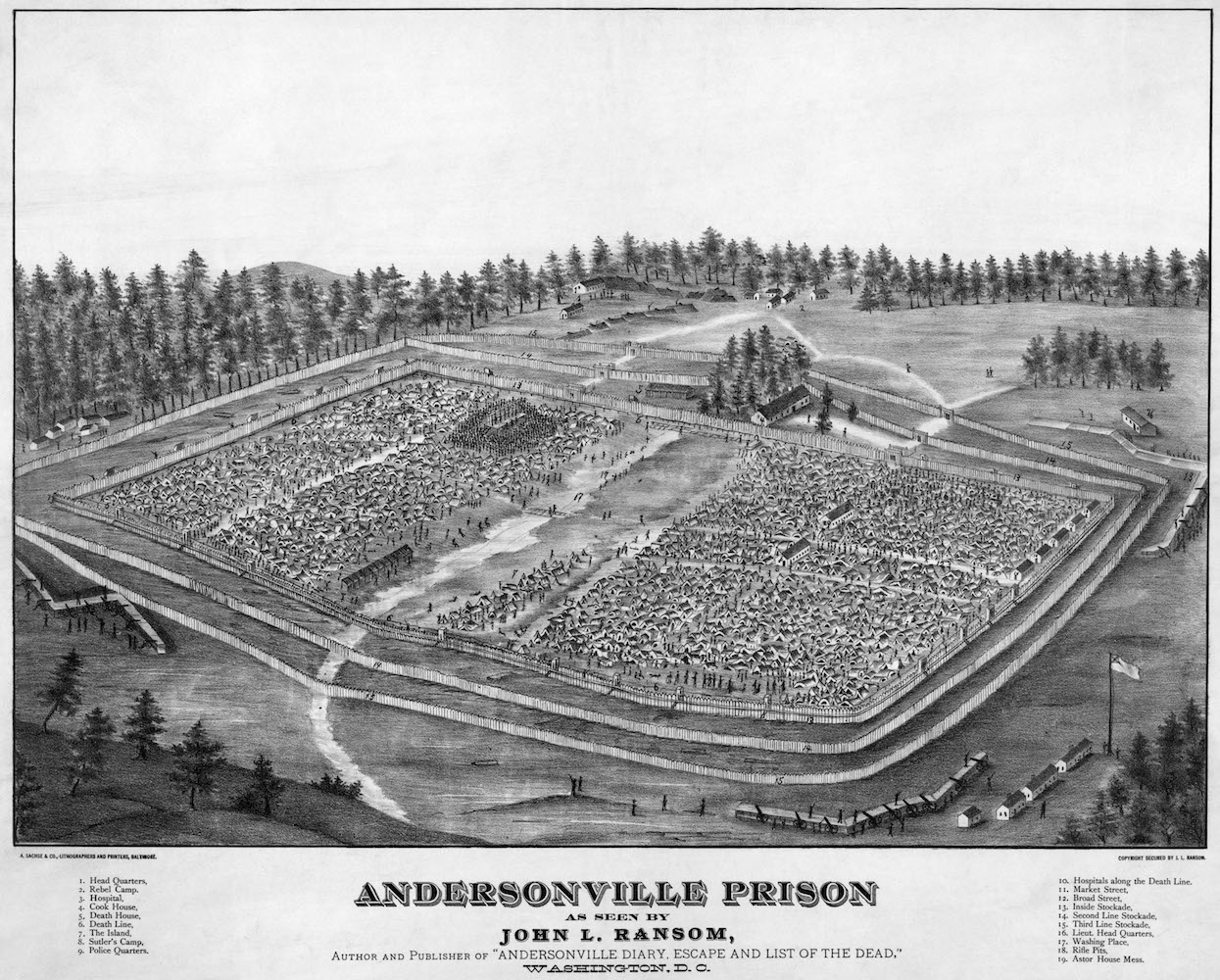

Detail of a panorama sketch of Andersonville (click to see it) makes space for a certain well-attended sextuple hanging.

The ringleaders were also among this bunch. They were assembled on July 11 and executed at a hastily-erected gallows on the north end of camp. As far as the POWs were concerned, the ultimate crime of the Raiders was a violation of the soldier code of death before dishonor. Their bodies were buried separately from other inmates, and the US makes a point of placing no memorial flags at their graves.

To be clear, the Andersonville Raiders were, for most inmates, not the primary problem but an obviously controllable one. Remember that 30% of the interned died, and for the most part those deaths were borne of bad sanitation, hunger, and disease. The removal of the Raiders was a morale boost at best, as Andersonville was still a pee-pee soaked heckhole in which another 10,000 soldiers would die before liberation in May 1865, most of them before the summer’s end.

* It was also known as Camp Sumter, named after the county it resided in.

** The population density at peak was 330,000 people per square kilometer. For comparison, the world’s densest city is Manila, at about 71,000 people per square kilometer.

† It turns out the term “shebang” wasn’t widely-used camp lingo. Drawings and photos of the camp illustrate the variety of dwellings: open sleeping, simple V-tents, structured tents, lean-tos, huts, and shacks were all scattered about the grounds.

‡ They also came with new diseases.

§ The original camp was actually only 16.5 acres, and the population ballooned to 20,000 in early June and 33,000 in August of that year. Ransom notes that the stockade was “enlarged” on July 6. Fall transfers dropped the number to 1,500 and it bumped back up to 5,000 until war’s end. Sanitation issues persisted throughout.

On this day..

1530: Johnnie Armstrong, border reiver

Scottish “border reiver” John Armstrong of Gilnockie was hanged on this date in 1530 with his followers at Caerlanrig, without benefit of trial.

The job description of the border reiver was to, well, reave the border. These mounted raiders exploited the wide gaps in sovereignty that opened along the ill-controlled England-Scotland border throughout the 16th century (their heyday) and indeed for centuries prior. They plundered vulnerable* farmers both north and south of the notional line. Sometimes the prize was livestock; other times, the “black rent” due your basic protection racket would suffice.

Their presence left an indelible imprint on the Anglo-Scottish marches, from the farmhouse fortresses called bastle houses to provisions in the “March Law” governing the manner of permissible counter-raiding.

Nettlesome as they were, they also stood useful mercenaries hired out for a number of the era’s battles; notably, English-hired reivers held off a much larger Scottish incursion in 1542. Only with the union of the crowns under James VI of Scotland/James I of England were the reivers finally suppressed.**

Johnny/Johnnie Armstrong, the younger brother of Thomas, Laird of Mangerton, is perhaps the most lasting legend among them — thanks to the signal boost he would later receive from Sir Walter Scott. Chief of a reiver band 160 strong, Armstrong made himself enough of a headache for English-Scottish diplomacy that the Scots king James V resorted to treachery to eliminate him. Having dialed up the frontier “prince” for a meeting, James simply had the sharp-dressed marauder arrested and summarily hanged when the reiver came to call. Thirty-six of his fellow reivers died with him.

Johnny Armstrong is the subject and the title of a notable child ballad (no. 169) whose lyrics can be perused in their entirety here; several renditions of its climactic third chapter can be found in the usual places.

John murdred was at Carlinrigg,
And all his galant companie;
But Scotlands heart was never sae wae,
To see sae mony brave men die.

Because they savd their country deir
Frae Englishmen; nane were sae bauld,
Whyle Johnie livd on the border-syde,
Nane of them durst cum neir his hald.

* “Vulnerable” mostly meant, neither in the ambit of a powerful protector, nor of the reiver’s own clan.

** A subsequent echo of the border reivers — in the same vein and the same region, but clearly distinct from them — emerged later in the 17th century in the form of the moss troopers.

On this day..

1798: Father John Murphy, Wexford Rebellion leader

Catholic priest John Murphy was executed on this date in 1798 for his part in the Irish Rebellion of 1798.


The Black 47 jam “Vinegar Hill” celebrates Father Murphy, imagining him confronting and embracing the choice to rebel …

I return to my prayers
And reflect upon Your tortured lips
But not a word do I hear
Just a veil of silence around the crucifix
And I remember the Bishop’s words
“When faith is gone, all hope is lost”
Well, so be it
I will rise up with my people
And to hell with the eternal cost!

An exemplar of that rare type persuadable to follow his moral commitments all the way out of the safety of a status quo sinecure, Father Murphy initially eschewed the trend towards armed rebellion in 1798.

This outbreak was itself a response to a violent martial law-backed campaign of repression to crush Ireland’s growing United Irishmen movement for self-rule, republicanism, and Catholic emancipation — each of them scarlet fighting words to the Crown. The risings that finally broke out had only scanty success, weakened as they were by months of arrests.

By far the strongest rising occurred in Wexford, so much so that the Wexford Rebellion is nearly metonymous for the Irish Rebellion as a whole. And our man, John Murphy, was a priest in Wexford Town.

Giving due heed to Ecclesiastes, Murphy pivoted quickly from his previous counsel that prospective rebels surrender their arms once he saw an enemy patrol gratuitously torch some homes, a decision that would immortalize his name at the cost of greatly shortening his life.

During the brief existence of the Wexford Republic, the padre surprisingly became one of its prominent combat commanders, and also one of the signal martyrs after the rebels were shattered at the Battle of Vinegar Hill on June 21, 1798.*

Murphy escaped that tragic battlefield only to have his remnant definitively routed a few days later.

He had only a few days remaining him at that point, days of hiding out with his bodyguard, James Gallagher. At last they were captured at a farm on July 2, and subjected that same day to a snap military tribunal and execution delayed only by the hours required to torture him.

After hanging to death, Murphy was decapitated so that the British could mount his head on a pike as a warning.

This 1798 rebellion they were able to crush, but Murphy has survived into legend. He flashes for only an instant in the sweep of history, springing almost out of the very soil into the firmament as an allegory of revolutionary redemption, brandishing together (as Black 47 puts it above) both his missal and his gun.


The ballad “Boolavogue” by Patrick Joseph McCall for the 1898 centennial of the rebellion pays tribute to Father Murphy:

At Vinegar Hill o’er the River Slaney
our heroes vainly stood back to back
And the yeos of Tullow took Father Murphy
and burned his body upon the rack
God grant you glory brave Father Murphy
and open heaven to all your men
The cause that called you may call tomorrow
in another fight for the Green again.

* There was a “Second Battle of Vinegar Hill” … comprising Irishmen but not in Ireland, for it was a convict rebellion in Australia in 1804. One of its leaders, Phillip Cunningham, was a survivor of the 1798 Irish Rebellion.

On this day..

1685: Richard Rumbold, owner of the Rye House

On this date in 1685, Roundhead militant Richard Rumbold — known affectionately to his comrades from the English Civil War as “Hannibal”, since he shared with the great Carthaginian general the distinction of an eye lost on campaign — was beheaded at Edinburgh‘s Mercat Cross.


J.M.W. Turner watercolor of the Rye House circa 1793.

Rumbold was the owner of the Rye House in Hertfordshire, the manor which in the 1680s would become famous as a regicidal adjective: the titular epicenter of the Rye House Plot. Hannibal Rumbold had intended to station a force of armed men on his grounds with the intent to kidnap/assassinate King Charles II and his Catholic brother and heir presumptive, James as they returned to London from horse races at Newmarket. When fire struck Newmarket, the royal party’s plans changed and the plot never came off … but it was discovered some weeks later and yielded an ample harvest of heads. Rumbold escaped to the continent for a time but was none repentant about it when taken, saying “he did not neither durst repent for it, but on the contrair that if all the hair of his head were men, he would venture them all for the cause.”

In this instance, it also yielded some edifying scaffold oratory, and this man’s parting sentiment that “this is a deluded generation, veiled with ignorance … for none comes into the world with a saddle on his back, neither any booted and spurred to ride him” was of interest to British Whigs and American revolutionaries a century later. It plays much better lo these many years later with ellipsis in place of the “popery” stuff which occurs between, but judge for thyself: here follow Rumbold’s erudite owns in context via an open source volume which has the address titled “Against Booted and Spurred Privilege”

Gentlemen and Brethren: —

It is for all men that come into the world once to die; and after death the judgment! And since death is a debt that all of us must pay, it is but a matter of small moment what way it be done. Seeing the Lord is pleased in this manner to take me to himself, I confess, something hard to flesh and blood, yet blessed be his name, who hath made me not only willing, but thankful for his honoring me to lay down the life he gave, for his name; in which, were every hair in this head and beard of mine a life, I should joyfully sacrifice them for it, as I do this. Providence having brought me hither, I think it most necessary to clear myself of some aspersions laid on my name; and, first, that I should have had so horrid an intention of destroying the King and his brother … It was also laid to my charge that I was antimonarchical. It was ever my thoughts that kingly government was the best of all where justly executed; I mean, such as it was by our ancient laws; — that is, a King, and a legal, free-chosen Parliament, — the King having, as I conceive, power enough to make him great; the people also as much property as to make them happy; they being, as it were, contracted to one another! And who will deny me that this was not the justly-constituted government of our nation? How absurd is it, then, for men of sense to maintain that though the one party of his contract breaketh all conditions, the other should be obliged to perform their part? No; this error is contrary to the law of God, the law of nations, and the law of reason. But as pride hath been the bait the devil hath caught most by ever since the creation, so it continues to this day with us. Pride caused our first parents to fall from the blessed state wherein they were created, — they aiming to be higher and wiser than God allowed, which brought an everlasting curse on them and their posterity. It was pride caused God to drown the old world. And it was Nimrod‘s pride in building Babel that caused that heavy curse of division of tongues to be spread among us, as it is at this day, one of the greatest afflictions the Church of God groaneth under, that there should be so many divisions during their pilgrimage here; but this is their comfort that the day draweth near where, as there is but one shepherd, there shall be but one sheepfold. It was, therefore, in the defense of this party, in their just rights and liberties, against popery and slavery —

[Being here interrupted by drum beating, he said that they need not trouble themselves, for he should say no more of his mind on that subject, since they were so disingenuous as to interrupt a dying man. He then continued: –]

I die this day in the defense of the ancient laws and liberties of these nations; and though God, for reasons best known to himself, hath not seen it fit to honor us, as to make us the instruments for the deliverance of his people, yet as I have lived, so I die in the faith that he will speedily arise for the deliverance of his Church and people. And I desire of all you to prepare for this with speed. I may say this is a deluded generation, veiled with ignorance, that though popery and slavery be riding in upon them, do not perceive it; though I am sure there was no man born marked of God above another; for none comes into the world with a saddle on his back, neither any booted and spurred to ride him; not but that I am well satisfied that God hath wisely ordered different stations for men in the world, as I have already said; kings having as much power as to make them great and the people as much property as to make them happy. And to conclude, I shall only add my wishes for the salvation of all men who were created for that end.

After hanging, they quartered his parts and pinned them up as a warning.

On this day..

1942: Gordon Cummins, the Blackout Ripper

It was a black hood for the Blackout Ripper on this date in 1942.

Charming Royal Air Force serviceman Gordon Frederick Cummins gave rein that February to a theretofore unarticulated inclination to femicide, attacking six women in the course of a single week, four of whom were killed by strangulation. The pattern of perverse post-mortem mutilations led one examiner to characterize the wanted man as “a savage sexual maniac”. This predator’s opportunistic use of the city’s protective cloak of air raid darkness reminds a similar spree perpetrated on the Berlin S-Bahn: truly, all men are brothers.

For a few days, this special horror gripped the wartime capital, so recently under enemy blitz. As fingerprint expert Frederick Cherrill, whose evidence would help to tie up Gordon Cummins’ noose, wrote in his now-out-of-print autobiography,

Women police in ordinary clothes strolled about the streets in the hope of being accosted by the unknown killer. So great was the terror which swept like a wave over the square mile in which these crimes had been committed that the regular street-walkers who haunted the area were too scared to venture out. [several of the victims were prostitutes -ed.] Small wonder, for nobody knew when or where the killer would strike again. That he would strike again seemed certain, for the lust of killing appeared to have siezed him in a merciless grip

Unlike his permanently elusive Whitechapel namesake, the Blackout Ripper was not long at his liberty once he loosed the beast within: crime scene forensics were still coming of age in this period, but the ample evolution of the bureaucratic state did for Cummins. On lucky Friday, February 13, Greta Hayward had fought off her attacker with the help of a passerby’s interruption. Cummins, when he fled, abandoned his RAF gas mask case … which was helpfully stamped with a serial number identifying its owner. He was arrested on February 16, just eight days after the start of his spree. (Scotland Yard, however, would later claim that his fingerprints connected him to two previous London murders, from October 1941.) It took a jury 35 minutes to convict him.

On this day..

1779: Henry Hare, Tory spy

On this date in 1779, American Revolution patriots hanged Henry Hare as a spy at Canajoharie in upstate New York.

In the first years of the revolution, this district was plagued (from the revolutionists’ standpoint) by raids of Tory loyalists and their allied indigenous Six Nations confederation: the latter had sided with the British against the land-hungry colonists in hopes of better retaining their rights against settlers.

An irritating situation became an intolerable one when loyalists and Mohawks descended on the village of Cherry Valley November 11, 1778, and massacred not only its defenders but about 30 non-combatants.


The slaughter of Jane Wells during the Cherry Valley Massacre. Engraving by Thomas Phillibrown from an original image by Alonzo Chappel (1828-1887).

In retaliation, Gen. George Washington ordered a retaliatory foray that history remembers as the Sullivan Expedition, after its leader, Gen. John Sullivan.

“The Expedition you are appointed to command is to be directed against the hostile tribes of the Six Nations of Indians, with their associates and adherents,” Washington instructed his man.

The immediate objects are the total destruction and devastation of their settlements, and the capture of as many prisoners of every age and sex as possible. It will be essential to ruin their crops now in the ground and prevent their planting more.

I would recommend, that some post in the center of the Indian Country, should be occupied with all expedition, with a sufficient quantity of provisions whence parties should be detached to lay waste all the settlements around, with instructions to do it in the most effectual manner, that the country may not be merely overrun, but destroyed.

But you will not by any means listen to any overture of peace before the total ruinment of their settlements is effected. Our future security will be in their inability to injure us and in the terror with which the severity of the chastisement they receive will inspire them.

But the first chastisements were issued to no Indian, but to Tory skulks.

Sullivan took command of one column, and ordered Gen. James Clinton to march another force down the Mohawk River Valley to Canajoharie. The following narration from the very specific chronicle History of Schoharie County, and border wars of New York gives us two Tory spies along with at least one patriot deserter all executed in those precincts; however, another Clinton letter dates only the Hare hanging specifically to Monday, June 21 (precise dates for the other two executions appear to be lost to history).

While Gen. Clinton was waiting at Canajoharie for his troops and supplies to assemble, and also for the construction of bateaus, two tories were there hung, and a deserter shot. The following letter from Gen. Clinton to his wife, dated July 6th, 1779, briefly narrates the death of the two former:

I have nothing further to acquaint you of, except that we apprehended a certain Lieut. Henry Hare, and a Sergeant Newbury, both of Col. Butler’s regiment, who confessed that they left the Seneca country with sixty-three Indians, and two white men, who divided themselves into three parties — one party was to attack Schoharie, another party Cherry-Valley and the Mohawk river, and the other party to skulk about Fort Schuyler and the upper part of the Mohawk river, to take prisoners or scalps. I had them tried by a general court martial for spies, who sentenced them both to be hanged, which was done accordingly at Canajoharie, to the satisfaction of all the inhabitants of that place who were friends to their country, as they were known to be very active in almost all the murders that were committed on these frontiers. They were inhabitants of Tryon county, had each a wife and several children, who came to see them and beg their lives.

The name of Hare was one of respectability in the Mohawk valley, before the revolution. Members of the Hare family were engaged for years in sundry= speculations with Maj. Jelles Fonda, who, as already observed, carried on an extensive trade with the Indians and fur traders at the western military posts; his own residence being at Caughnawaga [the region north of the Mohawk] Henry Hare resided before the war in the present town of Florida, a few miles from Fort Hunter. At the time he left the valley with the royalist party to go to Canada, his family remained, as did that of William Newbury, who lived about 3 miles from Hare, toward the present village of Glen.

If Hare had rendered himself obnoxious to the whigs of Tryon county, Newbury had doubly so, by his inhuman cruelties at the massacre of Cherry Valley, some of which, on his trial, were proven against him. Hare and Newbury visited their friends, and were secreted for several days at their own dwellings. The former had left home before daylight to return to Canada, and was to call for his comrade on his route. Maj. Newkirk, who resided but a short distance from Hare, met a tory neighbor on the afternoon of the day on which Hare left home, who either wished to be considered one of the knowing ones, or lull the suspicions resting upon himself, who communicated to him the fact that Hare had been home — and supposing him then out of danger, he added, “perhaps he is about home yet.” He also informed him that Newbury had been seen.

Hare brought home for his wife several articles of clothing, such as British calicoes, dress-shawls, Indian mocasons, &c., and on the very day he set out to return to Canada, she was so imprudent as to put them on and go visiting — the sight of which corroborated the story told Newkirk. The Major notified Capt. Snooks, who collected a few armed whigs, and in the evening secreted himself with them near the residence of Hare, if possible, to give some further account of him.

Providence seems to have favored the design, for the latter, on going to Newbury’s, had sprained an ankle. Not being willing to undertake so long a journey with a lame foot, and little suspecting that a friend had revealed his visit, he concluded to return to his dwelling. While limping along through his own orchard, Francis Putman, one of Snook’s party, then but 15 of 16 years old, stepped from behind an apple tree, presented his musket to his breast, and ordered him to stand. At a given signal, the rest of the party came up, and he was secured. They learned from the prisoner that Newbury had not yet set out for Canada, and a party under Lieut. Newkirk went the same night and arrested him. They were enabled to find his house in the woods by following a tame deer which fled to it.

The prisoners were next day taken to Canajoharie, where they were tried by court martial, found guilty, and executed as previously shown. The execution took place near the present village of Canajoharie. The influence exerted by the friends of Hare to save him would have been successful, had he declared that he visited the valley solely to see his family. He may have thought they dared not hang him; certain it is, that when he was interrogated as to the object of his visit, he unhesitatingly said that he not only came here to see his family, but also came in the capacity of a spy. A deserter, named Titus was shot at Canajoharie about the time the spies were hung, as I have been informed by an eye witness to all three executions. — James Williamson.

Deserters were shot for the first, second, or third offence, as circumstances warranted. Newbury and Titus were buried near the place of execution, and the bones of one of them were thrown out at the time of constructing the Erie Canal [which cut through the Mohawk Valley -ed.], by workmen who were getting earth for its embankment. The body of Hare was given to his relatives for interment. Previous to burial the coffin was placed in a cellar-kitchen, before a window, in which position a snake crawled over it. This circumstance gave rise to much speculation among the superstitious, who said “It was the Devil after his spirit.”

On this day..

1916: Henri Herduin and Pierre Millant, “cry against military justice”

Cry, after my death, against military justice!

-Henri Herduin, in his last letter to his wife

On this date in 1916, which happened to be Pentecost, two French lieutenants were shot on the Western Front for not surrendering.


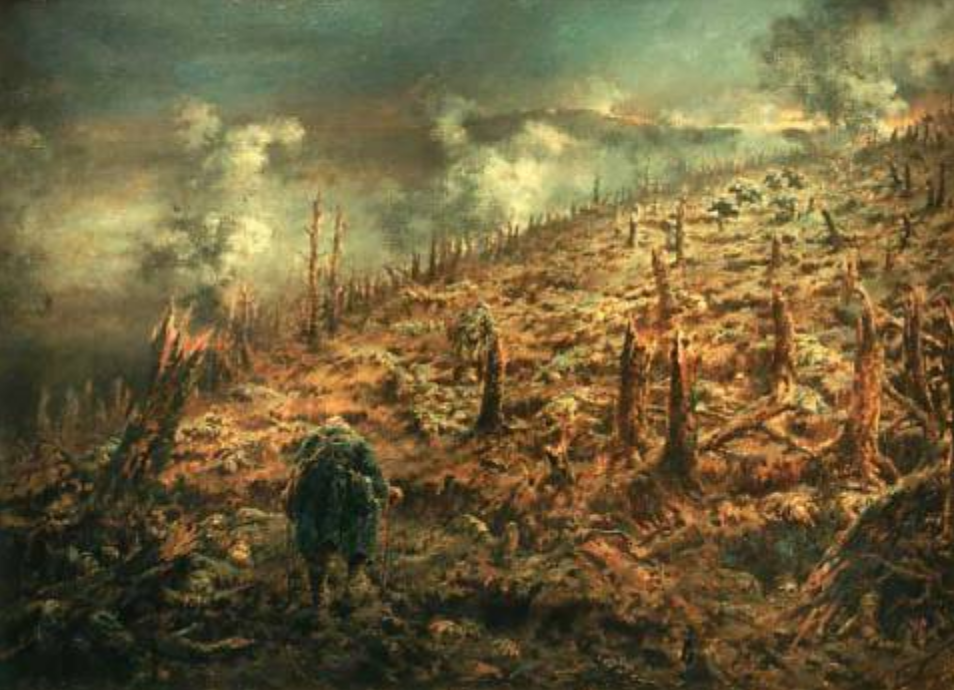
“Le ravin de la mort a Verdun”, by Ferdinand Gueldry.

During the endless Battle of Verdun, which spanned most of 1916, the Germans at one point overran a French bunker called Fort Vaux. German bombardment of the Thiaumont Farm area during this attack smashed the 347th Infantry Regiment to which both Henri Herduin and Pierre Millant belonged. With the regiment commanders killed into the bargain, Herduin and Millant found themselves at the head of a remnant of 40 or so survivors spent of both energy and ammunition, forced to fall back to avoid German encirclement.

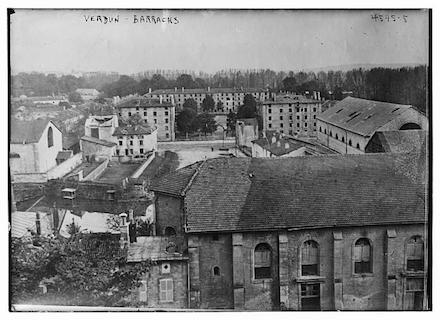
“Our division is broken, the regiment annihilated; I have just lived five terrible days, seeing death at every moment,” Herduin wrote to his wife Fernande on June 9th after he had presented himself at Anthouard barracks. He had not yet any inkling that he too would be a casualty of those terrible days. “Four days without drinking or eating, among the mud and the shells, what a miracle that I’m still here!”


Anthouard barracks during World War I. (U.S. Library of Congress)

Fate and the brass had a perverse sense of humor, for when the two lieutenants presented themselves and their fellow survivors to the reassembled remains of their regiment, about 150 men strong, they discovered that they’d survived all that mud and shelling only to die for France at the stake.

Their unit’s captain held a standing order to execute Herduin and Millant on sight for deserting their post: no need for even the pro forma proceedings of a tribunal. Indeed, the extrajudicial command might have been a fuck-you to civilian authorities who had recently attempted to curtail the army’s enthusiasm for executions. The captain, having no pleasure himself in this order, suffered Herduin to write a hasty explanation/appeal, to which the captain appended his own attestation of good character. Their missive was returned unopened, coldly marked Pas d’observation. Exécution immédiate. Had they not endured those privations to retreat but simply surrendered to the Hun, they would have been better off.

Herduin, a career soldier aged 35, gave his last service as an officer steadying the nerves of his own younger comrades in the firing squad with a demand to “hold to the end for France” — before issuing the firing command from his own lips.

Fernande made good on her husband’s own dying plea to her, and once the Great War’s guns fell silent she waged a public, and embarrassing for the army, fight to clear the men’s names. She eventually achieved a formal posthumous exoneration in 1926, as well as the honor- and pension-clinching appellations “Mort pour la France” applied to their death certificates. She even got a still-extant Rue Lieutenant Herduin christened in that man’s native city of Reims. On Armistice Day 2008, a marker to both men was unveiled on that street; yet another memorial stands to them in Fleury-devant-Douaumont, near the place they were shot.

On this day..

1584: Samuel Zborowski, dangerous precedent

On this date in 1584, Samuel Zborowski was beheaded at Krakow’s Wawel Hill for treason and murder committed ten years before.

A monument to the timeless abuse of the prosecutor’s discretion, Zborowski (English Wikipedia entry | Polish) was a powerful nobleman who got into a snit when nobody of equal stature would enter the lists with him at a tournament.

Instead, his challenge was answered by a common trooper in the retinue of the castellan of Wojnice,* one Jan Teczynski. Pissed at the affront, and doubly so when his own retainer was defeated by Teczynski’s, Zborowski went right after Teczynski right there in the presence of the newly elected Polish king, Henry de Valois.** The affront of lese-majeste was compounded when Zborowski’s flailing mace mortally wounded another castellan who attempted to intervene.

The outlawed Zborowski fled to the protection of Stephen Bathory,† Voivode of Transylvania.

That might have been that, and left Zborowski to join Europe’s forgettable ranks of exiles, adventurers, and pretenders playing out the string under the patronage of some foreign prince.

But when the elective throne of mighty Poland came open soon thereafter, Zborowski’s patron decided that he liked the look of it — and he obtained the result, with the help of a dynastic marriage into Poland’s Jagiellon dynasty of illustrious memory.

Since the Zborowskis had been big supporters of Stephen Bathory, Samuel returned as well, justifiably anticipating not merely pardon but elevation. To their dismay, they found themselves frozen out … and they responded with a series of insubordinations: plotting with the invading Russians, fomenting an unwanted diplomatic crisis with freelance attacks upon the Ottomans.

In the end, our man was undone by the same violent highhandedness that had forced his flight from Poland in the first place. Zborowski’s ill treatment of the young lute composer Wojciech Dlugoraj left the latter so desperate to escape Zborowski’s court that Dlugoraj stole some treasonable correspondence between Zborowski and his brothers and sent it to Zborowski’s enemy, Jan Zamoyski.‡ Those letters indicated that Samuel was contemplating assassinating the king.

Zamoyski found, and Bathory agreed, that the most expedient way to remove this troublemaker was simply to execute the 1574 sentence, from that bludgeoned castellan. The new regime had conveniently never bothered to lift it.

Although legal, Zborowski’s execution was obviously quite irregular and it outraged many in the nobility who perceived it a potential precedent for absolutism; recrimination over the action tore apart the 1585 meeting of the Polish Sejm. (In later years, this body formally endorsed Zamoyski’s actions but only after enacting a Lex Zborowski to better govern the handling of treason cases.)


Jan Matejko‘s 19th century rendering of Samuel Zborowski en route to beheading.

* At the time an important fortified city, Wojnice or Wojnicz was ravaged by a Swedish army in the 1650s and never recovered; today, it’s a town — having only re-promoted itself from “village” status in 2007 — of fewer than four thousand souls.

** This youngest son in the French royal house had seemed to the Valois safe to make available on the transfer market for foreign sovereigns. However, his brothers’ uncanny talent for dying young without issue very soon required his return to his homeland to take up the throne of France as Henri III during that country’s Wars of Religion. There Henri proved not to be exempt from the family curse: we have previously explored the circumstances of his own violent death — which was also the end of the House of Valois — during the War of the Three Henrys.

† A legendary surname in the annals of horror. This Stephen Bathory was the maternal uncle of the infamous “Countess of Blood”.

‡ The gambit did indeed get the scared lutenist free from Zborowski’s control, but he had to flee to Germany for fear of Zborowski kinsmen’s vengeance.

On this day..

1863: Zygmunt Padlewski, January Uprising rebel

On this date in 1863, Zygmunt Padlewski was shot for rebelling against the Russian empire.

A young St. Petersburg-trained tsarist officer with a patriotic bent — his father had taken part in the November [1830] Uprising against Russian domination — Padlewski (English Wikipedia entry | German | the surprisingly least detailed Polish) spent the early 1860s organizing revolutionary exiles in Paris.

He then put his neck where his mouth was by returning to Warsaw to agitate and, eventually, to assume the leadership of Polish rebels in that area during his own generation’s doomed revolution, the January [1863] Uprising.

Padlewski’s carriage was detained at a checkpoint when he tried to sneak back to Warsaw after a defeat, and his too-liberal bribes excited the suspicion of the Cossack sentries — who searched the traveler and discovered they had a man well worth the capturing.

He was shot at Plock, where a street and a school today bear his names (numerous other cities around Poland also honor Padlewski).

On this day..

1916: Eamonn Ceannt, Michael Mallin, Con Colbert, and Sean Heuston

On this date in 1916 — following a Sunday respite — executions in the aftermath of the Irish Republican Easter Rising against British power resumed with four more shootings at Dublin’s Kilmainham Gaol.

Eamonn Ceannt was an Irish Republican Brotherhood leader and was the fifth of the seven men who signed the Proclamation of the Irish Republic to be executed. (The remaining two, James Connolly and Sean Mac Diarmada, were shot on May 12th.) On the night before his execution, he wrote a ferocious although arguably counterproductive summons to future Irish revolutionaries

never to treat with the enemy, never to surrender at his mercy but to fight to a finish. I see nothing gained but grave disaster caused by the surrender which has marked the end of the Irish Insurrection of 1916 — so far at least as Dublin is concerned. The enemy has not cherished one generous thought for those who, with little hope, with poor equipment, and weak in numbers, withstood his forces for one glorious week. Ireland has shown she is a nation. This generation can claim to have raised sons as brave as any that went before. And in the years to come, Ireland will honour those who risked all for her honour at Easter in 1916 …

I wish to record the magnificent gallantry and fearless, calm determination of the men who fought with me. All, all, were simply splendid. Even I knew no fear, nor panic ,nor shrank fron no risk [sic], even as I shrink not now from the death which faces me at daybreak. I hope to see God’s face even for a moment in the morning. His will be done.

His firing squad failed to kill him cleanly, necessitating a gory coup de grace.

Michael Mallin was the co-founder with the pacifistic Francis Sheey-Skeffington of the Socialist Party of Ireland, and the second-in-command for the aforementioned James Connolly of the socialist union militia Irish Citizen Army. In the latter capacity Mallin led the detachment which seized St. Stephen’s Green during the Easter Rising.

A devout Catholic as well as a revolutionary militant, Mallin’s last letter to his family urged two of his children to take up holy orders. They indeed did so, and his youngest son, Father Joseph Mallin SJ, died only days ago as of this writing at the age of 104.

Con Colbert was another deeply religious rebel; an Irish Republic Brotherhood officer, he commanded rebels at several locations including the Jameson’s whiskey distillery at Marrowbone Lane.

The youngest of the group — who were, like all the Easter Rising rebels, shot sequentially rather than en masse — was 25-year-old Sean Heuston, also known as Jack or J.J. James Connolly had dispatched him to hold the Mendicity Institution for a few hours to delay the British advance; Heuston’s garrison of 26 ended up defending it for two days against several hundred enemy troops until, food and ammunition exhausted, they surrendered at British discretion.

His confessor cast the young patriot in a positively beatific light at the end:

A soldier directed Seán and myself to a corner of the yard, a short distance from the outer wall of the prison. Here there was a box (seemingly a soap box) and Sean was told to sit down upon it. He was perfectly calm, and said with me for the last time: ‘My Jesus, mercy.’ I scarcely had moved away a few yards when a volley went off, and this noble soldier of Irish Freedom fell dead. I rushed over to anoint him; his whole face seemed transformed and lit up with a grandeur and brightness that I had never before noticed

Never did I realise that men could fight so bravely, and die so beautifully, and so fearlessly as did the Heroes of Easter Week. On the morning of Sean Heuston’s death I would have given the world to have been in his place, he died in such a noble and sacred cause, and went forth to meet his Divine Saviour with such grand Christian sentiments of trust, confidence and love

On this day..