1916: Not Constance Markievicz, “I do wish your lot had the decency to shoot me”

On this date in 1916, the British field court meting out death sentences to Irish Easter Rising rebels announced eighteen commutations — most notably including Countess Constance Markievicz.

Markievicz has long been one of the most remarkable and compelling personalities of the Irish independence struggle. As her biographer noted, many other women of that cause are best-known “mainly because of their connection with more famous men.” Markievicz, notably, “stood alone, self-driven and self-confident. She was more than a muse or an enabler or a facilitator, the preferred roles for women to play.”

She was the privileged daughter of a baronet turned polar explorer who came to her distinctive name by marrying a Polish nobleman.** In her girlhood, she’d been presented at court to Queen Victoria.

She trained as a painter and her material circumstances put within her reach that charmed state of comfortable avant-garde consciousness. The Countess gave that up, for Ireland. The abhorrence of the daughter of the Provost of Trinity College Dublin is perhaps her most definitive epitaph: “the one woman amongst them [Irish republicans] of high birth and therefore the most depraved … she took to politics and left our class.”

By the late 1900s and into the 1910s she was a mainstay of hydra-headed radicalism: nationalist, suffragist, socialist. (She was a close friend and comrade of James Connolly.) In those years she could have spent in a pleasant Left Bank garret, she walked picket lines, burned flags, faced arrest, and sold jewelry to fund the soup kitchen she worked in.†

Markievicz co-founded the Fianna Eireann youth organization as a response to Baden-Powell‘s imperial scouting project. It would become an essential feeder for the republican organs (like the Irish Volunteers); Fianna itself was also well-represented among the Easter Rising fighters, and contributed that conflagration’s youngest martyr.

Bust of Constance Markievicz on St. Stephen’s Green, where she served in the Easter Rising.

But for her sex Markievicz would probably have been among the martyrs herself for her role on the St. Stephen’s Green barricade, and perhaps she wished it were so; she greeted the news of her May 6 commutation with the retort, “I do wish your lot had the decency to shoot me.” She’s been slated with having personally shot a constable during the Rising, although her defenders consider this a baseless smear.

While again in prison — she’d been amnestied from the Easter Rising stuff, but was arrested anew for anti-war activism — Markievicz successfully stood for election to Parliament, and in fact has the distinction of being the first woman elected a British M.P. … although she complied with Sinn Fein policy and refused to take the seat. She was also a member of the First Dail (parliament) of the revolutionary Irish Republic and was the first Irish female cabinet minister (Ministry of Labour).

Constance Markievicz died in 1927 at the age of 59, penniless in a public ward having disbursed the entirety of her wealth. A quarter-million of her fellow peoples of the Irish Free State thronged the streets of Dublin for her funeral.

* The other commutations (with their associated non-capital sentences) as published by the London Times of May 8, 1916:

Penal servitude for life. — Henry O’Hanrahan.

Ten years’ penal servitude. — Count George Plunkett, John Plunkett (his son).

Five years’ penal servitude. — Philip B. Cosgrave.

Three years’ penal servitude. — R. Kelly, W. Wilson, J. Clarke, J. Marks, J. Brennan, P. Wilson, W. Mechan, F. Brooks, R. Coleman, T. Peppard, J. Norton, J. Byrne, T. O’Kelly.

** It turned out that although Casimir Markievicz went by “Count Markievicz” there wasn’t actually any such title. But “Count” and “Countess” stuck nevertheless.

† She does perhaps forfeit some wokeness points for complaining of her post-Easter Rising imprisonment at Aylesbury that she was lodged with “the dregs of the population … no one to speak to except prostitutes who have been convicted for murder or violence. The atmosphere is the conversation of the brothel.”

On this day..

1246: Brandur Kolbeinsson, Age of the Sturlungs beheading

On this date in 1246, Brandur Kolbeinsson suffered a summary beheading.

The chieftain of Iceland’s powerful Ásbirningar clan — it was powerful until April 19, 1246 — Brandur lost a pivotal battle during Iceland’s decades-long era of civil strife in the 13th century, the Age of the Sturlungs.

The victor, Thordr Kakali Sighvatsson, wisely offered leniency to his vanquished foes inducing many to swear oaths that helped Thoror cement his hold on the north of Iceland. But two chiefs are too many, and when Brandur was overtaken fleeing the battlefield, he was beheaded summarily. A crucifix erected in the 21st century now marks the spot.

On this day..

2004: Fabrizio Quattrocchi, “I’ll show you how an Italian dies!”

On this date in 2004, Italian mercenary Fabrizio Quattrocchi was executed by Iraqi insurgents.

A former Italian army corporal turned baker, Quattrocchi (English Wikipedia entry | the vastly more detailed Italian) hired on with an American contractor in the Iraq fiasco as a private security guard at €8,000 per month, intending to save enough to start a family.

Instead, Quattrocchi was seized as a hostage outside Baghdad with three comrades on April 13, 2004, by the “Green Brigades,” one of that era’s many ephemeral bodies of militants. The other three* were held (and eventually freed unharmed via a June 2004 special forces raid) further to an unsuccessful ultimatum demanding Italian withdrawal. Quattrocchi, by contrast, was executed the very next day after capture — seemingly to prove that the kidnappers meant business after Italian Prime Minister Silvio Berlusconi greeted news of the men’s capture with a vow that he would never give in to “blackmail.”

A video of the murder was delivered to Al Jazeera TV, which has never aired it in its entirety. However, it became known via second-hand reports of those who had viewed it, and eventually from a partial airing of the video, that just prior to being shot Quattrocchi spat defiant last words to his executioners:

'I'll show you how an Italian dies'
From the London Times, April 16, 2004.

Then he was shot dead,** and dumped in the grave he’d been forced to dig for himself.

Thanks to these last words, which Berlusconi and his foreign minister Franco Frattini immediately pinned to a bloody banner, Quattrocchi’s memory has been the subject of partisan rancor in Italy. The left has disdained to celebrate a gun for hire in a disastrous imperial foray; the right has honored his patriotism and conferred a medal of valor upon him in 2006 — arousing some protest since this recognition has not been extended to regular Italian soldiers who fell to terrorist attacks in Iraq, nor to less bellicose murdered hostages like Enzo Baldoni.

* The other captives were Salvatore Stefio, Maurizio Agliana, and Umberto Cupertino, all like Quattrocchi Italians in their mid-thirties. Stefio would later be prosecuted and acquitted for unauthorized recruitment of security contractors.

** About a month after Quattrocchi was slain by gunfire, the grisly beheading of hostage Nick Berg inaugurated a different epoch in Iraq’s stagey hostage murders.

On this day..

1818: Juan Jose Carrera and Luis Carrera

Juan Jose Carrera and Luis Carrera were shot together in Mendoza as traitors on this date 200 years ago.

They two of the Hermanos Carrera, a generation of siblings that played a prominent role in the Chilean War of Independence during the 1810s. We have already detailed them through the entry on their more notable brother Jose Miguel Carrera … who would go on to share their fate in 1821.


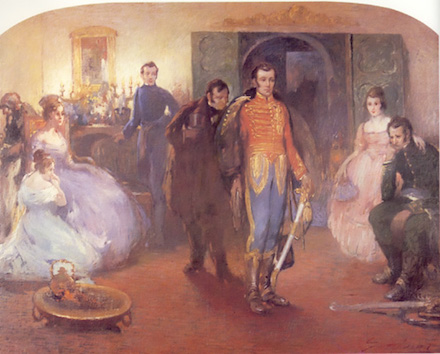
The Carrera Family, by Arturo Gordon Vargas (early 20th c.) features patriarch Ignacio, who was part of Chile’s first independent junta, along with Jose Miguel, flanked by brooding brothers Juan Jose and Luis, as well as their sister Javiera Carrera, the “Mother of Chile” and creator of the Chilean flag.

Said Jose Miguel had established a dictatorship in 1811-1812, with his brothers as trusted lieutenants. But Chile’s initial flower of independence from 1810-1814 was crushed by Spanish reconquest thanks in part to a deadly rift that had opened between the Carreras and fellow independentista Bernardo O’Higgins: prior to the decisive loss to the Spanish, Luis Carrera and O’Higgins had fought a literal battle with one another. They patched things up well enough to fight the Spanish together a few weeks later, but once in exile in Mendoza, Argentina, after their defeat they hurled recriminations at one another for the outcome. Luis even killed O’Higgins’s aide Juan Mackenna in a duel.

In the fullness of time it was the destiny of O’Higgins to be the father of a (permanently) independent Chile … and the destiny of the Carreras to be antagonists he overcame to do it.

O’Higgins attained leadership of the independence movement from exile and after elevated himself to dictator of free Chile in 1817. The Carreras promptly began scheming against him lead in old times, resulting in the arrest of Luis and Juan Jose in Mendoza. They were executed there hours after word reached the city that the Chilean patriot army had finished off the royalists.


The Carreras on their way to execution.

On this day..

1489: Hans Waldmann, mayor of Zurich

An equestrian monument to Hans Waldmann at Zurich’s the Münsterhof plaza reminds of that onetime mayor’s beheading on this date in 1489.


(cc) image from Roland zh.

His city’s most outstanding personality of the age, Waldmann (English Wikipedia entry | the far more detailed German) sprang from merchant stock. He’d soared to the top in his Swiss city-state via his gift for military command, which stood Zurich in good stead during the Burgundian Wars.

Despite his war heroism, the peasantry of Zurich’s rural proximities soon grew to hate Waldmann as the spear tip of the urban oligarchy. Notoriously, he ordered the destruction of peasants’ dogs to preserve the hunting privilege for the powerful.

On the first of April, a revolt toppled Waldmann’s authority. He was arrested on a diverse slate of accusations including treason, peculation, and sexual corruption.

For the four days intervening, he endured “ceaseless torture, hanging, and stretching,” but the mayor retained enough vigor to walk “manly” and “proud” (in the words of a Bernese observer) to his scaffold.


Waldmann’s Farewell, by Johann Caspar Bosshardt (1847).

Detail view (click for the full-page illustration) of Hans Waldmann’s beheading, from the Lucerne Chronicle (1513).

On this day..

1525: Jakob Wehe, rebel priest

On this date in 1525 the radical priest Hans Jakob Wehe was beheaded.

Wehe led a muster of 3,000 Bavarian peasants which briefly seized the town of Lepheim, during Germany’s bloody Peasants War, ere it was routed by the Swabian League.

On the 5th of April towards evening, they [Wehe and some other captives] were taken to a flowery meadow lying between Leipheim and Budesheim to be executed. As Master Jakob was led forward to the block, Truchsess turned to him with the words: “Sir paster, it had been well for thee and us hadst thou preached God’s word, as it beseemeth, and not rebellion.” “Noble sir,” answered the preacher, “ye do me wrong. I have not preached rebellion, but God’s word.” “I am otherwise informed,” observed Truchsess, as his chaplain stepped forward to receive the confession of the condemned man. Wehe turned to those around, stating that he had already confessed to his Maker and commended his soul to Him. To his fellow-sufferers he observed: “Be of good cheer, brethren, we shall yet meet each other to-day in Paradise, for when our eyes seem to close, they are really first opening.” After having prayed aloud, concluding with the words: “Father, forgive them, for they know not what they do,” he laid himself on the block, and in another moment his head fell in the long grass.

The preacher of Günzburg, who had also taken part in the movement, and an old soldier of fortune, who had joined the rebels, were brought forward in their turn to submit to the same fate, when the old soldier, turning to Truchsess, observed: “Doth it not seem to thee a little late in the day, noble lord, for one to lose one’s head?” This humorous observation saved the lives of himself and the preacher. The latter was carried about with the troops in a cage, until he had bought his freedom with eighty gulden. He lost, however, the right of preaching and of riding on horseback!

On this day..

1794: Madame Lavergne and Monsieur Lavergne, united in love

The below will be found in Elizabet Starling’s Noble Deeds of Woman, Or, Examples of Female Courage and Virtue; similar glosses on the same narrative are afoot in several other public domain volumes.

As will be affirmed by a glance at a converter for France’s revolutionary calendar, this text badly botches its translation of the date of “11 Germinal” — another reminder that nobody cares about the dates. “Germinal” means “seed” and so is of course a spring month; there are rosters of the Paris Terror victims available which confirm that March 31 is the correct execution date for both Monsieur and Madame Lavergne.

CONSTANCY OF MADAME LAVERGNE.

Mightier far
Than strength of nerve or sinew, or the sway
Of magic potent over sun and star,
Is love, though oft to agony distrest,
And though his favorite seat be feeble woman’s breast.

WORDSWORTH.

Madame Lavergne had not long been married when her husband, who was governor of Longwy, was obliged to surrender that fort to the Prussians. The French however, succeeded in regaining possession of the place, when M. Lavergne was arrested and conducted to one of the prisons in Paris. His wife followed him to the capital: she was then scarcely twenty years of age, and one of the loveliest women of France. Her husband was more than sixty, yet his amiable qualities first won her esteem, and his tenderness succeeded to inspire her with an affection as sincere and fervent as that which he possessed for her. While the unfortunate Lavergne expected every hour to be summoned before the dreaded tribunal, he was attacked with illness in his dungeon. At any other moment this affliction would have been a subject of grief and inquietude to Madame Lavergne; under her present circumstances, it was a source of hope and consolation. She could not believe there existed a tribunal so barbarous as to bring a man before the judgment-seat who was suffering under a burning fever. A perilous disease, she imagined, was the present safeguard of her husband’s life; and she flattered herself that the fluctuation of events would change his destiny, and finish in his favor that which nature had so opportunely begun. Vain expectation! The name of Lavergne had been irrevocably inscribed on the fatal list of the 11th Germinal, of the second year of the republic, (June 25th, 1794,) [sic; see above -ed.] and he must on that day submit to his fate.

Madame Lavergne, informed of this decision, had recourse to tears and supplications. Persuaded that she could soften the hearts of the representatives of the people by a faithful picture of Lavergne’s situation, she presented herself before the Committee of General Safety: she demanded that her husband’s trial should be delayed, whom she represented as a prey to a dangerous and afflicting disease, deprived of the strength of his faculties, and of all those powers, either of body or mind, which could enable him to confront his intrepid and arbitrary accusers. ‘Imagine, oh citizens!’ said the agonized wife of Lavergne, ‘such an unfortunate being as I have described dragged before a tribunal about to decide upon his life, while reason abandons him, while he cannot understand the charges brought against him, nor has sufficient power of utterance to declare his innocence. His accusers, in full possession of their moral and physical strength, and already inflamed with hatred against him, are instigated even by his helplessness to more than ordinary exertions of malice: while the accused, subdued by bodily suffering and mental infirmity, is appalled or stupefied, and barely sustains the dregs of his miserable existence. Will you, oh citizens of France! call a man to trial while in the phrensy of delirium? Will you summon him, who perhaps at this moment expires upon the bed of pain, to hear that irrevocable sentence, which admits of no medium between liberty or the scaffold? and, if you unite humanity with justice, can you suffer in old man — ?’ At these words, every eye was turned on Madame Lavergne, whose youth and beauty, contrasted with the idea of an aged and infirm husband, gave rise to very different emotions in the breasts of the members of the committee from those with which she had so eloquently sought to inspire them. They interrupted her with coarse jests and indecent raillery. One of the members assured her, with a scornful smile, that, young and handsome as she was, it would not be so difficult as she appeared to imagine to find means of consolation for the loss of a husband, who, in the common course of nature, had lived already long enough. Another of them, equally brutal and still more ferocious, added, that the fervor with which she had pleaded the cause of such a husband was an unnatural excess, and therefore the committee could not attend to her petition.

Horror, indignation, and despair, took possession of the soul of Madame Lavergne; she had heard the purest and most exalted affection for one of the worthiest of men condemned as a degraded passion; she had been wantonly insulted, while demanding justice, by the administrators of the laws of a nation; and she rushed in silence from the presence of these inhuman men, to hide the bursting agony of her sorrows.

One faint ray of hope yet arose to cheer the gloom of Madame Lavergne’s despondency. Dumas was one of the judges of the tribunal, and him she had known previous to the Revolution. Her repugnance to seek this man, in his new career, was subdued by a knowledge of his power and her hopes of his influence. She threw heiself at his feet, bathed them with her tears, and conjured him, by all the claims of mercy and humanity, to prevail on the tribunal to delay the trial of her husband till the our of his recovery. Dumas replied, coldly, that it did not belong to him to grant the favor she solicited, nor should he choose to make such a request of the tribunal; then, in a tone somewhat animated by insolence and sarcasm, he added, ‘And is it, then, so great a misfortune, madame, to be delivered from a troublesome husband of sixty, whose death will leave you at liberty to employ your youth and charms more usefully?’

Such a reiteration of insult roused the unfortunate wife of Lavergne to desperation; she shrieked with insupportable anguish, and, rising from her humble posture, she extended her arms towards Heaven, and exclaimed, ‘Just God! will not the crimes of these atrocious men awaken Thy vengeance? Go, monster!’ she cried to Dumas; ‘I no longer want thy aid, — I no longer need to supplicate thy pity; away to the tribunal! — there will I also appear; then shall it be known whether I deserve the outrages which thou and thy base associates have heaped upon me.’ From the presence of Dumas, Madame Lavergne repaired to the hall of the tribunal, and mixing with the crowd, waited in silence for the hour of trial. The barbarous proceedings of the day commenced, and on M. Lavergne being called for, the unfortunate man was carried into the hall by the gaolers, supported on a mattress. To the few questions which were proposed to him, he replied in a feeble and dying voice, and the fatal sentence of death was pronounced upon him.

“Scarcely had the sentence passed the lips of the judge, when Madame Lavergne cried, with a loud voice, ‘Vive le roi!’ The persons nearest the place whereon she stood eagerly surrounded, and endeavored to silence her; but the more the astonishment and alarm of the multitude augmented, the more loud and vehement became her cries of ‘Vive le roi!’ The guard was called, and directed to lead her away. She was followed by a numerous crowd, mute with consternation and pity; but the passages and staircases still resounded every instant with ‘Vive le roi!’ till she was conducted into one of the rooms belonging to the court of justice, into which the public accuser came to interrogate her on the motives of her extraordinary conduct.

‘I am not actuated,’ she answered, ‘by any sudden impulse of despair or revenge for the condemnation of M. Lavergne, but from the love of royalty, which is rooted in my heart. I adore the system that you have destroyed. I do not expect any mercy from you, for I am your enemy; I abhor your republic, and will persist in the confession I have publicly made, as long as I live.’

Such a declaration was without reply, and the name of Madame Lavergne was instantly added to the list of suspected persons: a few minutes afterwards, she was brought before the tribunal, where she again uttered her own accusation, and was condemned to die. From that instant, the agitation of her spirits subsided, serenity took possession of her mind, and her beautiful countenance announced only the peace and satisfaction of her soul.

On the day of execution, Madame Lavergne first ascended the cart, and desired to be so placed that she might behold her husband. The unfortunate Lavergne had fallen into a swoon, and was in that condition extended upon straw in the cart, at the feet of his wife, without any signs of life. On the way to the place of execution, the motion of the cart had loosened the bosom of Lavergne’s shirt, and exposed his breast to the scorching rays of the sun, till his wife entreated the executioner to take a pin from her handkerchief and fasten his shirt. Shortly afterwards, Madame Lavergne, whose attention never wandered from her husband for a single instant, perceived that his senses returned, and called him by his name; at the sound of that voice, whose melody had been so long withheld from him, Lavergne raised his eyes, and fixed them on her with a look at once expressive of terror and affection. ‘Do not be alarmed,’ she said; ‘it is your faithful wife who called you; you know I could not live without you, and we are going to die together.’ Lavergne burst into tears of gratitude, which relieved the oppression of his heart, and he became once more able to express his love and admiration of his virtuous wife. The scaffold, which was intended to separate, united them forever.

On this day..

1901: George Parker, drunk marine

From John Sadden’s Portsmouth Book of Days (via):

Elizabeth Rowland, of Prince Albert Street, Eastney, Portsmouth, received this letter [on January 19, 1901] from 22-year-old George Hill [George Parker], whom she had been seeing while her soldier husband was serving in India.

Hill was a marine at Eastney Barracks until he was convicted of stealing there.

He was later arrested for murdering a man on a train during an armed robbery.

Dearest Lizzie,

It makes my heart bleed, as I am writing these few lines, to think I shall never see you again, and that you will be alone and miserable now … I always loved you dearly … I am truly sorry and penitent for having, in an evil moment, allowed myself to be carried away into committing murder.

I went and purchased a revolver so that when I came down to Portsmouth I could end both our lives if I had not been successful in obtaining money from my father.

I know you were not happy at home, nor I either, for I have been very unhappy of late, mostly on account of the false charges brought against me at the barracks.

I shall get hung now. I believe I was mad; I know I was drunk.

God help me!

My days are numbered, but I will bear it unflinchingly.

Your broken-hearted sweetheart,

Geo H Hill

Hill was hanged at Wandsworth Prison on March 19, 1901

On this day..

1915: Wenseslao Moguel, “El Fusilado”, survives the firing squad

On this date in 1915, Wenseslao Moguel, a soldier of Pancho Villa during the Mexican Revolution, was captured and immediately stood in front of a firing squad.

Miraculously, Moguel survived their volley, and even survived the coup de grace shot to the head afterwards delivered by the squad’s commander.

Although badly disfigured, he managed to crawl away from the execution grounds and went on to live a full life with the nickname El Fusilado (“the executed one”). He died around 1975.


In 1937, Wenseslao Moguel appeared on the Ripley’s Believe It Or Not! radio program.

On this day..

1957: Larbi Ben M’Hidi, in the Battle of Algiers

On this date in 1957, Algerian revolutionary Larbi Ben M’Hidi — more familiarly referred to as Si Larbi or Ben M’Hidi — was extrajudicially executed in French custody.

He was one of the founders of the militant nationalist National Liberation Front (FLN) and was a critical commander in the guerrilla war against French occupation, the Battle of Algiers. Small wonder he also features prominently in the cinematic masterpiece of the same name, where he and his opposite number, the French Col. Mathieu, are bracingly clear-eyed as to their respective sides’ necessary forms of terror.

In this scene,* for instance, the captured Ben M’Hidi is asked by a journalist whether it is not cowardly to have women kill people with bombs hidden in their baskets.

“Isn’t it even more cowardly to attack defenseless villages with napalm bombs that kill many thousands of times more?” the shackled M’Hidi replies. “Obviously, planes would make things easier for us. Give us your bombers, sir, and you can have our baskets.”

This exchange adapts a conversation that “Col. Mathieu’s” real-life model, Marcel Bigeard, reportedly had with his prisoner over dinner.

Bigeard respected Ben M’Hidi too much to torture him but the French brass was not so sanguine — perceiving that the Algerian would present a great danger to the occupation as a political prisoner. This was a dirty war, and men like Ben M’Hidi met dirty fates.

Major Paul Aussaresses,** the officer eventually tasked with dispatching the revolutionary, described how it happened in his The Battle of the Casbah: Terrorism and Counterterrorism in Algeria 1955-1957.

Ben M’Hidi didn’t want to cooperate and Bigeard knew full well what the consequences of such a refusal would be … would he have talked under torture? We knew that Ben M’Hidi was responsible for most of the attacks and that he deserved the gallows ten times over, yet it wasn’t absolutely certain that he would be found guilty in court.

On March 3, 1957, [General Jacques] Massu and I discussed the problem in the presence of [Massu’s second-in-command Roger] Trinquier. We agreed that a trial of Ben M’Hidi was not a good idea. There would have been international repercussions …

“So what do you think?” asked Massu.

“I don’t know why Ben M’Hidi should get preferential treatment compared to the other rebels. When it comes down to terrorism the leaders don’t impress me any more favorably than their underlings. We’ve already executed many poor devils who were carrying out this guy’s orders and here we are hesitating for three weeks just to find out what we’re going to do about him!”

“I agree with you completely, but Ben M’Hidi is not just some cipher who will be quickly forgotten. We can’t just make him simply disappear into thin air.”

“There’s no way we can hand him over to the police either. They claim they’ll give him the third degree to make him talk but I’m convinced he won’t say a word. If there were to be a trial and he hasn’t confessed, he could actually walk away free, along with the entire FLN cadre. So let me take care of him before he becomes a fugitive, which is bound to happen if we keep on hesitating.”

“Very well, go ahead and take care of him,” answered Massu with a sigh. “Do the best you can. I’ll cover you.”

I understood that Massu already had the government’s approval to proceed.

I picked up Ben M’Hidi the following night at El-Biar. Bigeard made sure he was somewhere else because he had been told ahead of time that I was coming to take the prisoner away. I came with a few Jeeps and a Dodge pick-up. There were about a dozen men from my first squad, all of them armed to the teeth. Captain Allaire was in charge and had a little combat group lined up and presenting arms. I asked him to go get Ben M’Hidi and hand him over to me.

“Present arms!” ordered Allaire, when Ben M’Hidi, who had just been awakened, was escorted out of the building.

To my amazement the paratroopers of the 3rd RPC gave the defeated FLN leader his final honors. It was Bigeard in effect paying his respects to a man who had become his friend. This spectacular and somewhat useless demonstration didn’t make my job any easier. Obviously at that instant Ben M’Hidi fully understood what was in store for him. I quickly shoved him into the Dodge. We traveled very fast since an ambush to free him was always a possibility. I gave very strict orders to the NCO guard sitting next to the FLN leader:

“If we’re ambushed, you shoot him immediately, even if we come out unharmed. Make sure you knock him off without hesitating!”

We stopped at an isolated farm that was occupied by the commando unit belonging to my regiment and located about twenty kilometers south of Algiers, on the left off the main road. A pied-noir had placed the farm at our disposal. It was a modest building and the living quarters were on the ground floor. My second team was waiting for us there.

The commando unit of the 1st RCP included about twenty men, some of whom were draftees, but all of them were completely reliable. Captain Allard, nicknamed Tatave, who was very much devoted to me, was in charge. I had told him what was going on and he had been briefed. I told him to have his men set up in a corner of the room where Ben M’Hidi would be placed. The farm was messy and they had to move a few bales of hay around and sweep the floor. While this was taking place the prisoner was kept isolated in another room, which had been prepared. One of my men was standing guard at the door.

Then I entered with one of the soldiers and together we grabbed Ben M’Hidi and hanged him by the neck to make it look like suicide. Once I was sure he was dead, I immediately had him taken down and brought the body to the hospital. Following my orders, the NCO who was driving left the engine running while the car was parked, in order to be able to drive off at top speed without volunteering any explanations as soon as the emergency room doctor appeared. It was about midnight.

I immediately phoned Massu.

“General, Ben M’Hidi has just committed suicide. His body is at the hospital. I will bring you my report tomorrow.”

Massu grunted and hung up the phone. He knew full well that my report had been ready since early afternoon, just to make sure. Judge [Jean] Berard was the first one to read it. It described in detail the suicide that was to take place the next night. Berard was impressed:

“Well, this is very good! You know, it does make sense!”

Actually the report didn’t make sense for very long. Massu called me to his office a few days later.

“Aussaresses, I’m in the shit. District Attorney [Jean] Reliquet [a torture foe -ed.] has called me in.”

“What? He dared summon you!”

“Yes, to discuss the suicide of Ben M’Hidi.”

“But that’s an outrageous thing to do! Because of your position you shouldn’t have to answer the summons. I’ll go, since I’m your representative to the legal authorities.”

I therefore paid a visit to the judge’s office.

“Mr. District Attorney, I am here to represent General Massu. Because of my position I can discuss the circumstances of Ben M’Hidi’s death. I’m also the author fo the report that you’ve seen.”

The district attorney was absolutely enraged.

“Yes, of course! Let’s discuss your report! What you state in it is purely circumstantial. And only circumstantial! There’s no proof. Can you military types offer any proof at all?”

“I can offer our good faith.”

I think that had I slapped Reliquet across the face it would have had less of an impact than that answer.

“Your good faith!” he answered, choking on the words. “Your good faith as soldiers. Soldiers who are suddenly being candid?”

I put my beret back on, saluted him, clicking my heels, and walked out of the room.

We never heard from the district attorney again after that. The death of Ben M’Hidi was a decisive blow to the FLN in Algiers. The attacks died down and the bulk of the rebels began retreating toward the Atlas Mountains near Blida.

We used the farmhouse again where Ben M’Hidi had been executed. I had the men dig a long ditch and some twenty bodies, including that of a woman, were buried there.

The French military’s success by 1957 in the Battle of Algiers did not clinch its fight to retain Algeria — which attained its independence in 1962, to the horror of the far right. But it did put the army in such a vaunting position vis-a-vis the civilian authorities — one can see it in Aussaresses’s disdainful treatment of Reliquet — that the generals would author a 1958 coup led by Gen. Massu himself which called Charles de Gaulle out of retirement and initiated France’s Fifth (and current) Republic.

Larbi Ben M’Hidi’s name today graces one of the main thoroughfares of Algiers.

* The full film is a must-watch and can often be searched up in the usual places. This press interrogation occurs about 88 minutes in … closely followed by a scene of a spokeman announcing that M’Hidi “hanged himself” and Col. Mathieu allowing that he “appreciated the moral fiber, courage and commitment of Ben M’Hidi to his own ideals. Notwithstanding the great danger he represented, I pay tribute to his memory.” Game recognizes game.

** Eventually, General Paul Aussaresses … although he’d be stripped of this rank (and of his Legion of Honor) for celebrating the use of torture in Algeria in The Battle of the Casbah.

On this day..