1525: Cuauhtémoc, the last Aztec emperor

Although the primary accounts — those by conquistadors Hernán Cortés and Bernal Díaz del Castillo, and historian Francisco Lopez de Gomara* — did not explicitly record the date, February 28 is the traditionally recognized anniversary of the execution of the last Aztec emperor, Cuauhtémoc.

A monument to Cuauhtemoc in Mexico City. (Author’s photo; public domain)

Cuauhtemoc (English Wikipedia entry | Spanish) was enthroned early in 1521, in a Tenochtitlan already in the train of devastation brought by the Spanish, which had over the preceding months laid low the Emperor Moctezuma II (by violence) and his brother Cuitlahuac (by smallpox, a disease that halved the city’s population within a year).

He was about 23 or 24 years old, a nobleman who must have distinguished himself in war — “a handsome man, both as regards his countenance and his figure,” in Bernal Diaz’s estimation; “a valiant man and a good warrior” by Gomara’s account.

And it would fall to him to bear his proud kingdom’s ruin.

Having previously been welcomed to Tenochtitlan as guests, Cortes and the Spanish had fought their way out and now returned as besiegers, joined by most of the Aztecs’ resentful former subject kingdoms. They soon had Tenochtitlan in a stranglehold, undaunted by the frightening sacrifice of captured prisoners.

all in a moment the large drum of Huitzilopochtli again resounded from the summit of the temple, accompanied by all the hellish music of shell trumpets, horns, and other instruments. The sound was truly dismal and terrifying, but still more agonizing was all this to us when we looked up and beheld how the Mexicans were mercilessly sacrificing to their idols our unfortunate companions, who had been captured in Cortes’ flight across the opening.

We could plainly see the platform, with the chapel in which those cursed idols stood; how the Mexicans had adorned the heads of the Spaniards with feathers, and compelled their victims to dance round the god Huitzilopochtli; we saw how they stretched them out at full length on a large stone, ripped open their breasts with flint knives, tore out the palpitating heart, and offered it to their idols. Alas! we were forced to be spectators of all this, and how they then seized hold of the dead bodies by the legs and threw them headlong down the steps of the temple, at the bottom of which other executioners stood ready to receive them, who severed the arms, legs, and heads from the bodies, drew the skin off the faces, which were tanned with the beards still adhering to them, and produced as spectacles of mockery and derision at their feasts ; the legs, arms, and other parts of the body being cut up and devoured!

In this way the Mexicans served all the Spaniards they took prisoners; and the entrails alone were thrown to the tigers, lions, otters, and serpents, which were kept in cages. These abominable barbarities we were forced to witness with our own eyes from our very camp; and the reader may easily imagine our feelings, how excessively agonizing! the more so as we were so near our unfortunate companions without being able to assist them. Every one of us thanked God from the bottom of his soul for His great mercy in having rescued us from such a horrible death!

Bernal Diaz

Wracked by famine after Cortes successfully cut off its food and water, Tenochtitlan succumbed that August. (The conquistadors found they could barely endure the stench of countless rotting bodies as they took control of the famished city.) When captured, Cuauhtemoc implored Cortes through tears (again according to Bernal Diaz),

I have done what I was bound to do in the defence of my metropolis, and of my subjects. My resources have now become entirely exhausted. I have succumbed to superior power, and stand a prisoner before you. Now draw the dagger which hangs at your belt, and plunge it into my bosom.

There would be no bosom-daggering. Cortes had a much worse fate in mind.

He saluted Cuauhtemoc for his intrepidity in defense, vowing to maintain the latter as the ruler of Mexico … Cortes’s ruler, to ratify the dictates of the conquerors, beginning with commanding his remaining loyalists to surrender. Cuauhtemoc obeyed, with what posterity can only guess must have been fathomless shame and sorrow.

Upon humiliation, Cortes heaped physical torture when the invaders’ ransack of their captured city turned up far less lesser quantities of material loot than they had anticipated — torture which Cuauhtemoc and a cousin-king of a loyal Aztec ally both endured heroically without augmenting the Spanish bottom line. Bernal Diaz once again:

The next thing which Cortes did was to collect all the gold, silver, and jewels that had been found in Mexico, of which, however, there was very little; for Quauhtemoctzin, it was said, had ordered all the treasures to be thrown into the lake four days previous to his capture. A great quantity had likewise been purloined by the Tlascallans, Tezcucans, Huexotzincans, Cholullans, and other auxiliary troops which had assisted us in the siege, besides what had fallen into the hands of the troops on board the brigantines.

The crown officials were positive that Quauhtemoctzin had concealed the greater part, and asserted that Cortes was very pleased that the monarch refused to say a word where it was hidden; for he would then be able to get the whole treasure into his own possession.

The officers then proposed that Quauhtemoctzin and the king of Tlacupa, his most intimate friend and cousin, should be put to the torture, in order to extort from them a confession as to what had become of the treasures: but Cortes could not make up his mind to insult so great a monarch as Quauhtemoctzin, whose territory more than trebled that of Spain, and that for mere lust after gold. Moreover, the monarch’s household assured us they had given up all the gold they possessed to the officers of the crown, which, it was well known, amounted to 380,000 pesos, the whole of which had been melted into bars; and one thing is certain, that the emperor’s and Cortes’ fifths were deducted from that sum; but the conquistadores were not at all satisfied, and considered this sum much below the real amount, and several expressed their suspicion to Alderete, the royal treasurer, that Cortes’ only reason for not wishing to put the monarch to the torture was, that he might secretly take possession of all his riches. Cortes, not willing that such a suspicion should any longer he upon him, or that he should afterwards be called to an account on this score, at last consented that both should be put to the torture.
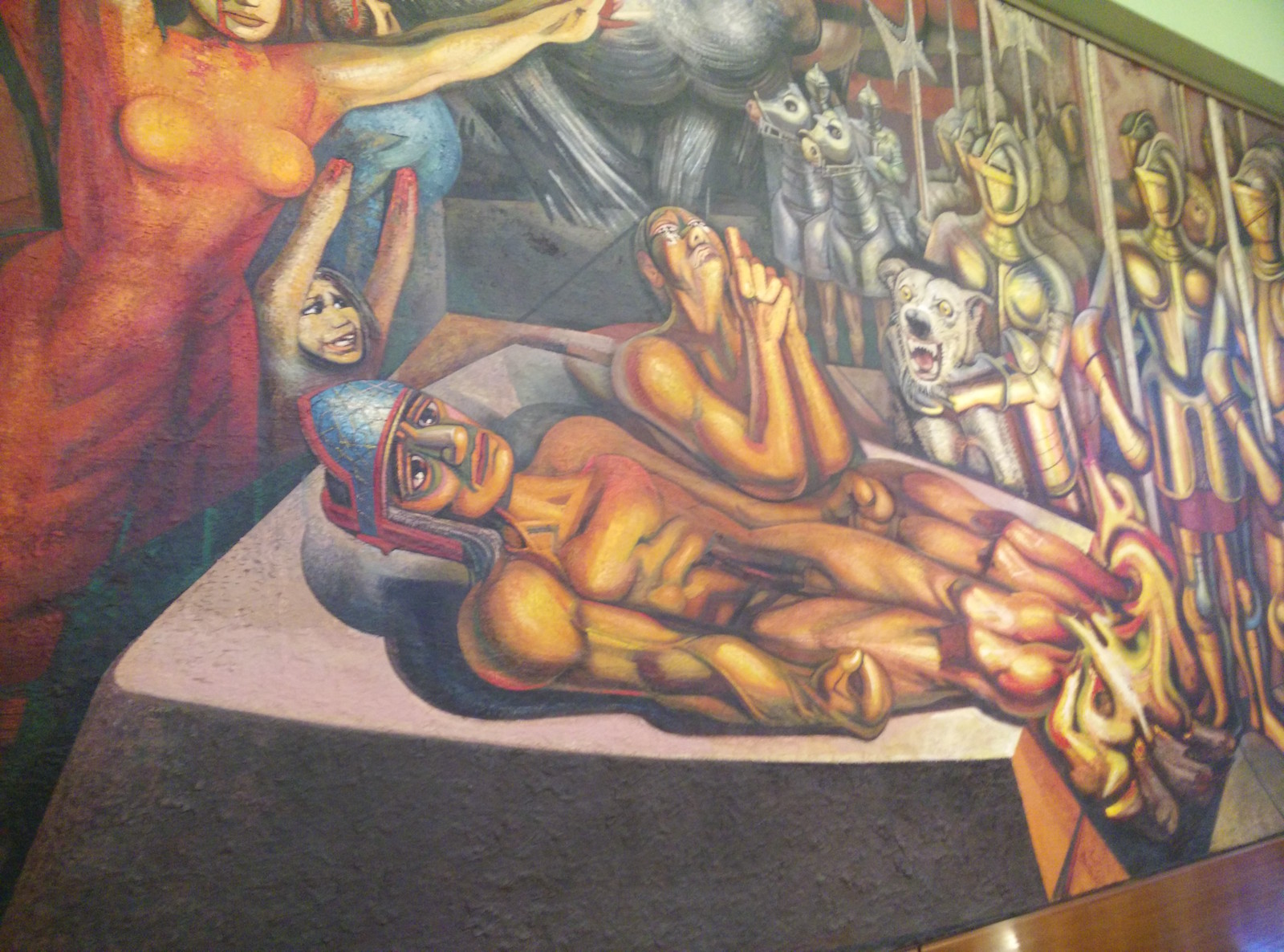

Detail view (click for the full image) of David Alfaro Siquieros‘s monumental 1950-51 mural, The Torment of Cuauhtemoc.

Boiling hot oil was then applied to their feet; upon which they confessed that, four days prior to Quauhtemoctzin’s capture, all the gold, with the cannon, crossbows, and muskets, which we had lost in the night of sorrows, when we retreated from Mexico, besides those which had been taken in Cortes’ last defeat on the causeway, had been thrown into the lake. A number of good swimmers were then sent to dive for the treasure in the spot they pointed out, but nothing was found. Yet there was some truth in the statement; for I was myself present when Quauhtemoctzin led us to a large and deep reservoir of water, built of stone, which lay near his palace. From this reservoir we fished up a sun of gold similar to the one sent us by Motecusuma, besides many jewels and other trinkets, though all of little value. The king of Tlacupa also informed us that he had hidden all manner of valuable things in some large houses, about twelve miles from Tlacupa, and he would accompany us there to point out the spot where he had buried them.

Alvarado was then despatched thither with six soldiers, among which number I also was; but when we arrived at the spot, this king assured us he had merely invented all this in the hopes that we would have killed him in a moment of anger at our disappointment.

(Diaz later added that “the suspicion was become pretty general that he [Cortes] had concealed the greater part of Quauhtemoctzin’s treasure,” and indeed some disgruntled companions — unsatisfied with the share they had been allotted for so magnificent a conquest — would come to lodge this charge against Cortes formally with Emperor Charles V.)

Cortes eventually brought both these hostages/puppet kings/torture victims along with him on a 1524-1525 expedition to Honduras, perhaps to deprive them of any opportunity to rebel in his absence.

On the evening of February 27, Cortes received a report or a rumor that the Indian kings had rebellion on their mind just the same. The timetable from this report to execution is uncertain from the records, but if it was not within 24 hours it cannot have been much longer. Diaz, a hostile-to-Cortes witness here whose narrative indicates his dismay at proceedings, describes it thus:

I have now to relate a circumstance of a very different nature, which occasioned much grief to us all. Quauhtemoctzin and other Mexican chiefs who accompanied our army had, it would appear, spoken among themselves, or secretly determined to put the whole of us to death, then march back to Mexico, and assemble the whole armed power of the country against the few remaining Spaniards, and raise an insurrection throughout the whole of New Spain. This circumstance was discovered to Cortes by two distinguished Mexican chiefs, one of whom was named Tapia, and the other Juan Velasquez. This latter personage had been Quauhtemoctzin’s captain-general during our war with Mexico, and his testimony was borne out by the investigation which Cortes made into the matter, and by the confession of several of the caziques themselves who were implicated in the conspiracy. These men fearlessly declared, that seeing how carelessly and dispiritedly we roamed about; that numbers of the men were ill from want of food; that four of our musicians, with the buffoon and five soldiers, had died of hunger; and that three other men had turned back, more willing to run the risk of reaching Mexico again than of moving forward, the thought struck them that they could not do better than fall suddenly upon us while we were crossing some river or marsh, particularly as they were upwards of 3000 in number, all armed with lances, and several of them with swords. Quauhtemoctzin did not hesitate to acknowledge that these men had spoken the truth, but added that the conspiracy did not emanate with him, and that he himself had never for a moment contemplated carrying it into effect, but had merely spoken about it with the other caziques. All the cazique of Tlacupa confessed was, his having declared to Quauhtemoctzin that it was better to die at once than daily to have death before their eyes on these fatiguing marches, and see their countrymen and relations perish with hunger.

These were sufficient proofs for Cortes, and without any further ceremony he sentenced Quauhtemoctzin and his cousin the king of Tlacupa to the gallows. Before, however, this sentence was executed, the Franciscan monks, with the assistance of Dona Marina, strove to comfort these unfortunate men, and commended their souls to God. When they were being led to the place of execution, Quauhtemoctzin turned to Cortes, and said: “Oh Malinche! I have for a long time perceived, from your false words, that you had destined me for such a death, because I did not lay violent hands on myself when you entered my city of Mexico! Why are you thus going to put me unjustly to death? God will one time ask this of you!”

The king of Tlacupa said, he could only rejoice in a death which he would be permitted to suffer with his monarch Quauhtemoctzin.

Previous to their being hung, both these unhappy caziques confessed to father Juan, who understood the Mexican language, and they begged of him to commend their souls to God. For Indians they were good Christians, and they died in the true faith, and fully believed in our holy religion.

The death of these two monarchs grieved me excessively, for I had known them in all their glory, and on our march they honoured me with their friendship, and showed me many little attentions; for instance, they would often order their servants to go in quest of fodder for my horse; besides which, they were innocent of the guilt imputed to them, and it was the opinion of all who accompanied this expedition that they were put to death unjustly.

But I will leave this miserable subject, and return to our march, on which we henceforth observed the utmost vigilance, for we greatly feared the Mexicans might rise up in arms against us, after they had thus beheld their monarch ignominiously hung by the neck from a tree. But hunger, fatigue, and sickness weighed heavier upon their minds than the misfortune of Quauhtemoctzin.


Detail view (click for the full image) of the “rebel” kings hanged from a tree.

Gomara and, of course, Cortes characterize the accusations against the Indian kings as true and the proceedings against them lawful. From the footnotes in this same Bernal Diaz volume, we have this from the later Jesuit historian and ethnographer Juan de Torquemada, who was fluent in Nahuatl:

I find it differently represented in a history written in the Mexican language, and which I believe to be perfectly correct. While Cortes (the Mexican author says) was quartered in a certain township, the Mexican chiefs one evening began to discourse among themselves about the recent hardships they had suffered, and Cohuanacotzin said to Quauhtemoctzin, to Tetlepanquetzaltzin, and to other distinguished Mexicans, ‘Thus you see, gentlemen, from kings we are become slaves, and we suffer ourselves to be led about by Cortes and this handful of Christians. If we were other people than we are, and would break through the promise we have made these Spaniards, we could play them a pretty trick here, and revenge ourselves upon them for all they have done to us, and the ill-treatment my cousin Quauhtemoctzin has suffered at their hands.’ To this the Mexican monarch replied, ‘I beg of you Cohuanacotzin to drop this subject, lest some one should overhear us, and imagine we were in earnest.’ It appears (continues Torquemada) that they were indeed overheard, for the whole of this discourse was reported to Cortes by a low-minded Mexican of the lower classes.

By law, Mexican flags fly at half-staff in his honor on February 28.

* These texts are cited throughout the post, but for ease of reference … Bernal Diaz: Memoirs of the Conquistador Bernal Diaz del Castillo, vol. 1, vol. 2 | Gomara: The Pleasant Historie of the Conquest of the West India; now called New Spaine | Cortes: History of New Spain, which is a Spanish text as I could not locate an English translation. However, even the Anglophone is liable to appreciate (from p. 225) the illustrations of Indian material culture observed by the Spaniards.

On this day..

1794: The Comte de Feuillide, Jane Austen in-law

To Madame la Comtesse de Feuillide this novel is inscribed by her obliged humble servant The Author.

-Jane Austen’s author’s dedication in Love and Freindship

On this date in 1794, the guillotine brought tragedy to Jane Austen’s family.

The blade’s more immediate victim was Jean Gabriel Capotte, the Comte de Feuillide and the husband of Eliza de Feuillide (nee Hancock), Jane Austen’s “outlandish cousin.”

Fourteen years the novelist’s senior, Eliza was born in India to Jane’s Aunt Philadelphia who went abroad seeking a mercenary marriage and landed an unhappy one to a surgeon twice her age, Tysoe Saul Hancock. Eliza Hancock might possibly have been the illegitimate daughter of colonial administrator Warren Hastings, who stoked rumors by establishing a trust for the young woman. (Eliza also later named her only son “Hastings”.)

Either way, she didn’t grow up in the colonies but in England and France, where her vivacity conquered the heart of a prosperous French officer on the make, a barrister’s son who self-aggrandized his rank of Comte de Feuillide. As a gadabout exile “French countess” during the French Revolution, the charming Eliza de Feuillide was a hit both with London society and with her debutante cousin Jane, “whose kind partiality to me” Eliza would write in a letter “indeed requires a return of the same nature.”

Eliza exerted a magnetic influence on her kinswoman, and she’s popularly suspected to be the model for the Mansfield Park character Mary Crawford.* There’s even a book theorizing that this peripatetic polyglot was the true author of Jane Austen’s canon.


Lucy Cohu as Eliza de Feuillide makes some guillotine banter in Becoming Jane.

Back in France, where he served in the army, the hubby with an emigre wife and an aristocratic pretension made a decidedly poorer impression upon the Jacobins, as Maggie Lane observes in Jane Austen’s Family:

On 22 February 1794 the Comte de Feuillide fell victim to the guillotine. He had foolishly, if gallantly, tried to bribe one of the Secretaries of the Committee of Safety to secure the liberty of the widow of an army colleague, Jacques Marboeuf, Marquis and Marechal-de-camp. The fifty-five-year-old Marquise stood accused of laying down certain arable lands on her estate to fodder crops, with the idea of producing a famine in an effort to undermine the Republic.

De Feuillide was double-crossed by the Secretary and arrested at his lodging in the rue Grenelle et St Honore, where incriminating documents and sums of money parcelled up for the bribery were seized. The Marquise, the Comte and the Marquise’s man of business who had acted as a go-between in the attempt, all were sentenced to death.

After a few years as a merry widow, Eliza wed her cousin Henry Austen — Jane’s brother and Eliza’s “perpetual sunshine”. Eliza Austen died in 1813, with Jane Austen at her bedside.

* In Jane Austen and the French Revolution, Warren Roberts argues that the Comte de Feuillide has his own literary doppelganger in the unfinished Austen novel Catherine, in the form of Edward Stanley.

On this day..

1938: Vladimir Antonov-Ovseyenko, Winter Palace stormer

Communist revolutionary and Soviet military leader Vladimir Antonov-Ovseyenko (or -Ovseenko) was purged on this date in 1938.

Portrait of Antonov-Ovseyenko by Yuri Annenkov.

The Ukrainian was a radical agitator from youth; he was expelled from military college in 1901 at age 17 for refusing to swear loyalty to Nicholas II and proceeded thereafter upon a cursus honorum of revolutionary tribulations — albeit, until World War I, as a Menshevik.

He stood in some danger of achieving these pages by the hand of the tsarist government rather than the Soviet one, on account of helping orchestrate the Sebastopol mutiny during the 1905 revolution, but his death sentence was commuted to hard labor.

Nothing chastised, Antonov-Ovseyenko escaped and returned to that life of militancy suitable to his badass underground nickname “Bayonet”, organizing workers and publishing illegal newspapers while dodging Stolypin‘s police. After several arrests, he finally fled for exile abroad.

According to Harold Walter Nelson’s Leon Trotsky and the Art of Insurrection, 1905-1917, it was in Paris writing for the red paper Nashe Slove (aka Golos) that the former cadet drew close to Trotsky, finding a common “conviction that the relationship between military events and the development of the revolution was critical,” and thereafter “Antonov-Ovseenko’s enthusiasm for columns on military topics opened the pages of Nashe Slovo to Trotsky’s articles” ultimately amounting to “several hundred pages of commentary on the war [World War I].” Ere long both figures would have opportunity to implement their doctrines on the battlefield.

Nashe Slovo was suppressed in 1916 after mutinying Russian soldiers were found to have read it, an event that also led to Trotsky’s being expelled from France to New York City.*

But the time for revolutionists’ exile was drawing to a close. Barely a year after the indignity of having his subversive exile ‘zine shuttered by the Third Republic, Antonov-Ovseenko — as secretary of the Petrograd Military Revolutionary Committee — led a posse of soldiers and sailors into the Winter Palace and arrested the Provisional Government, consummating the October Revolution.


Despite Sergei Eisenstein‘s epic re-creation in October: Ten Days That Shook the World, and the 1920 live re-enactment staged by Nikolai Evreinov, the Winter Palace was barely defended and Antonov-Ovseenko entered and found the Provisional Government without meeting resistance. He offered amnesty for the surrender of the remaining Winter Palace holdouts, and the offer was accepted.

Now a key military figure in the infant Communist state, Antonov-Ovseyenko helped clinch Soviet victory in the ensuing civil war, routing White armies in the Ukraine in 1918-1919 and putting down the Tambov Rebellion of peasant anti-Bolsheviks in 1920-1921.


Antonov-Ovseyenko (center) chills with Red Army officers.

By the later 1920s his Trotsky affiliation had significantly dimmed his star,** though he was still entrusted in the 1930s as a Soviet consul to several countries — the last of them the Spanish Republic during the Spanish Civil War, before falling prey to the purges mere months after his return.

His son, the lately deceased Anton Antonov-Ovseyenko, survived 13 years in the Gulag to become a dissident historian; his The Time of Stalin, published abroad in 1981 after being smuggled out of the USSR by Russia scholar Stephen Cohen, was one of the milestones along the way toward the public reckoning with Stalinism. “An embattled personality and fearless” in Cohen’s estimation, Anton Antonov-Ovseyenko died in 2013, still directing a Gulag museum in Moscow even though he had long since gone blind.

* Via Spain.

** In The Time of Stalin, Anton Antonov-Ovseyenko alleges that his father considered betting on the loyalty of the army in a coup against the Stalin faction, back when control of the post-Lenin state was still uncertain. “This cannot go on for long,” runs one letter the young Antonov-Ovseyenko quotes. “There remains one alternative — to appeal to the peasant masses dressed in Red Army greatcoats and call to order the leaders who have gone too far.” Trotsky also wrote in his memoir that such a coup was mooted within their circle.

On this day..

1707: Baron Otto Arnold Peikel

A few line breaks have been removed for readability, and most of the author’s original footnotes excised, from this source text.

CHARLES XIIS TREATMENT OF
LIEUTENANT-GENERAL BARON PEIKEL.

By Charles Dalton, Esq.,
Editor of English Army Lists and Commission Registers, 1661-1714.

BARON PEIKEL (or Pykul) has been mistaken by several writers for his kinsman the better-known Count Patkul, the famous Livonian patriot, who was executed, after being mercilessly broken on the wheel, at a village near Casimir, in Great Poland, October 10th, 1707, by order of Charles XII. The confusion occasioned by the similarity in names may also be traced to the remarkable fact that both Peikel and Patkul held the rank of lieut.-general in the Polish Army; and the former succeeded the latter in command of the Saxon contingent which fought on the side of Augustus, King of Poland, against Charles XII. Fate decreed that both Peikel and Patkul should fall into the hands of the iron-hearted King of Sweden, and after a long imprisonment be executed within a few months of each other.

Here the parallel between these two Livonian patriots stops, as Peikel (English Wikipedia entry | Latvian) was neither a great commander nor a diplomatist, but he possessed one remarkable talent which alone makes him intrinsically interesting and worthy of a niche in the Temple of Fame. Baron Peikel claimed, and was allowed by impartial and trustworthy witnesses, to have discovered the secret of making gold!

The Province of Livonia [present-day Latvia and Estonia -ed.], which had been a bone of contention between the northern countries of Europe for centuries, was ceded by Poland to Sweden in 1660. The confiscation of Livonian estates, and the heavy taxes imposed by Charles XI, alienated the Livonian nobility and people from Sweden and Swedish rule.

The sympathies of the conquered province were with Poland, and thus it came to pass that when Russia and Poland engaged in war with Sweden, in 1700, some of the leading Livonian noblemen were found ranged against Charles XII, whose proclamation summoning them to return to their allegiance was treated with open defiance. Prominent among the Livonian revolters was Baron Peikel, who sided with Augustus II, King of Poland and Elector of Saxony.

Passing over the fluctuating fortunes of the Polish arms under Augustus the Strong (who was deposed in 1704, but re-elected some years later to the Polish Crown), we find that a battle was fought near Warsaw, in the summer of 1705, between the Saxons and Poles on one side, and the Swedes on the other. In this engagement the Saxons are said to have fought well, but not being supported by the Poles, who fled on the first discharge, had to retire. The loss on both sides was equal. General Bond (the Swedish commander) was killed, and Baron Peikel (the Saxon general) was taken prisoner. Peikel and several other Saxon officers taken on this occasion were sent to Stockholm, where they suffered a rigorous imprisonment.

In November, 1706, a treaty was concluded between Charles XII and Augustus II The cessation of hostilities only hastened Peikel’s doom. He was tried by the Advocate Fiscal in Stockholm as a traitor to his country, and being found guilty was sentenced to death. On the face of the evidence against Peikel, this sentence was doubtless a just one. But the prisoner had a strong argument in his favour against his condemnation, as appears from a contemporary MS.

Peikul (sic) happened to be born in Poland about three miles from the Livonian border, and this fact was used against him in a law-suit he had with an uncle for a considerable estate. After going through all the Livonian Courts it was, as is customary, brought to the King for decision, for to him is the last appeal in all civil causes. The King gave judgment against Peikul for this only reason because he was an alien and not his natural-born subject. However, this determination, unjust as it was, afterwards was brought as a good argument for Peikul against the King, when his Majesty condemned him as a natural-born subject of Sweden. But it seems, though his being born out of the King’s dominions proved a good reason for depriving him of his estate, it proved ineffectual to the saving of his life.

The sympathy of the Queen of Sweden (who was acting as Regent of the Kingdom during her grandson’s absence with the army), her ineffectual efforts to obtain a pardon for Peikel, the condemned nobleman’s extraordinary offers to the Queen and Senate for filling the Swedish Treasury, then at a very low ebb, provided his life were spared, and the remarkable proof he gave before witnesses of his ability to perform what he promised, are fully and graphically detailed by the British Envoy at Stockholm in his official letters to the Right Hon. Robert Harley, Secretary of State:

Mr. Robert Jackson to the Secretary of Stale.
Stockholm, January 5th, 1707.

An order is now come from the King to suffer all the Saxon officers now prisoners in Sweden to go where they please, except one Lieutenant General Pykull (sic), a native of Liefland [Livonia], who was taken about two years ago in Poland, and in November last was condemned here as a traitor for serving against this Crown, which sentence the King not only lately confirmed, but gave also at the same time express order for his execution as on the 7th instant; but the Queen-Mother and all the Royal family here having interceded for him, and not yet got his Majesty’s answer, her Majesty has therefore by her own authority reprieved him for a month, yet it is thought his pardon will not be granted at last.


Mr. Robert Jackson to the Secretary of State.
Stockholm, January 30th, 1707.

The King has renewed his former orders for the execution of Lieutenant-General Pykull, not having thought fit to hearken to the Queen-Mother’s intercession on that gentleman’s behalf.


Mr. Robert Jackson to the Secretary of State.
Stockholm, February 9th, 1707.

The Saxon Lieutenant-General Peikel was beheaded on Monday last;* he chose to be executed with an axe (though it be esteemed very dishonourable in this country) rather than with a sword, by reason of the unskilfulness of the executioner. There was no other crime laid to his charge in the Fiscal’s accusation than that he, being a native of Liefland, presumed in disobedience to his Majesty’s avocatoria** to serve his enemy, wherefore it was thought here that the King’s neither hearkening to the many high intercessions made on his behalf, nor the advantageous proposals he made to save his life, proceeded from the knowledge his Majesty must have of some other crimes of a blacker nature.

But the morning Peikel suffered he told the divines which assisted him, and administered the Sacrament to him, that having heard of a report spread as if he had been one who had particularly encouraged King Augustus to begin this war, on the prospect of the Lieflanders, his countrymen, revolting from Sweden; and also of another that he had been engaged in a design upon the King of Sweden’s person, he therefore took that opportunity to declare in that solemn manner that all such reports were false, and that he never had acted anything against his Swedish Majesty’s person, or Kingdom, contrary to the principles of a man of honour. And since his one crime was that he was born in the Swedish dominions, he could not allow to have deserved death merely for that reason.

But he added that it having pleased God some time ago to bring him wonderfully to the knowledge of a great secret in Nature, whereby he could not only himself have lived in the greatest happiness, but likewise have been capable of doing much good in the world. Yet he nevertheless suffered his ambition to prevail against his reason, which led him to accept the command of those troops amongst which he was taken prisoner, and for that he said he had justly incurred the punishment which was to be inflicted on him.

The secret he speaks of was making gold to a prodigious advantage; and he actually gave such proofs to the archiater at the Court, as well as some other knowing persons, of his profound knowledge in chemistry, that nobody now doubts of his having been able to perform what he pretended, and also proposed in case the King would have given him his life; and for your Honour’s curiosity I shall presume in my next humble account to send your Honour an extract of the said proposals (whereby, if he could have fulfilled his promise, would have arose a yearly revenue of five hundred thousand ducats to this Crown), and also an authentic relation of an experiment of his having had that secret performed by the Advocate Fiscal, and one Colonel Hugo Hamilton, a native of Ireland, who is Commandant of this city, and had the custody of Monsr. Peikel during his imprisonment, which papers being but lately come to my hands I have not yet had time to translate them.


Mr. Robert Jackson to the Secretary of State.
Stockholm, February 16th, 1707.

Having in my last presumed to mention several things relating to the lately executed Baron Peikel, I therefore now further presume to transmit, along with this, the translation of his proposals together with Colonel Hamilton’s relation of the experiment he made, both which papers I humbly take the liberty to beg may be managed with a little secrecy for fear of injuring some persons here, who are thought to have employed themselves too much in favour of the said Baron.

Translation of the extract of Lieut.-General Peikel’s proposals to the Queen and Senate.

That it having pleased God to bless his study and labour for bringing him to the knowledge of a great secret; and he now laying under sentence of death was willing, in case he could thereby save his life, not only to reveal the said secret to any one person, to be under an oath of secrecy, whom his Majesty should think proper to appoint, but would likewise oblige himself to make at his own charge this year four hundred thousand ducats for his Majesty; and in case he performed not he then desired no mercy, but that not only the punishment of death might be inflicted upon him by virtue of the sentence lately pronounced against him, but that also there might be added any further punishment, as a just reward, for his demerits in presuming to abuse his Majesty.

He further obliged himself to make yearly, so long as he lived, the same quantity of gold for the King’s use, his Majesty building only a proper house for carrying on the work, and being at the charge of providing materials, and maintaining the servants which should be found necessary to be employed therein, the whole charge of which he computed would not amount to twenty thousand ducats yearly.

When he had performed what he thus proposed two years he then desired to have a reasonable enlargement, but in the meantime to be under the strictest confinement that was possible, and besides he would bind himself by the most solemn oath never to endeavour to make his escape, neither during the time of his confinement nor when he should have his liberty; and for further security he would forthwith dispose of his estate in the Brandenburg country and buy other lands of like value in Sweden and establish his family here.

And to confirm the probability of his being able to perform what he proposed, he desired that Colonel Hugo Hamilton and the Advocate Fiscal might be commanded to give an account of the experiment they were eye-witnesses to, or rather had themselves performed by his directions, he only having now and then been present during the operation. The whole charge of which operation cost not above twelve crowns and yet produced the weight in gold of forty-nine ducats, and the officers of the Mint attested the gold to be perfectly fine as any they ever saw.

These proposals were presented along with a petition to the King, January 4th, 1707.

Translation of Colonel Hugo Hamilton’s relation.

To the Queen’s Majesty most humble relation:—

Whereas Peikel, who lies under the sentence of death, has, in all humility, informed your Majesty of his having the knowledge of making gold and likewise offered to reveal the said secret, agreeable to what I also in all humility lately had the honour to acquaint your Majesty; wherefore in obedience now to your Majesty’s most gracious commands that I should in writing give a further humble account of that matter, therefore with the same humble intention for the service and advantage of my most gracious Sovereign as in all humility I formerly represented, I do now, by the oath and duty wherewith I am bound, declare that when Peikel first intimated to me his having that secret I suspected the truth of it a long time, and looked on his making me that confidence as a design he had the better by one means or other to make his escape.

Wherefore I also took care to have him the better guarded; but he several times after repeating the matter, and withal offering in my presence to make a proof thereof, to convince me that what he said was a real truth, I thought that such an opportunity of serving my most gracious King ought not to be neglected, and therefore I asked him if he was willing that I might take a second person to be also present, whereto he agreeing I thought none could be more properly employed than the Advocate Fiscal, Thomas Fehman, his accuser, whom, Peikel approving of, I acquainted the said Advocate Fiscal therewith and requested him to be a witness at the operation, who thereupon expressed himself that in case there was any reality in the thing he could not be a faithful subject who would not endeavour to forward so important a work; yet for his own person he was unwilling to be concerned therein lest he should thereby incur too many undeserved censures, however I importuned him till he at length promised to be present.

I forthwith permitted Peikel to begin the operation, which he did by dissolving of a powder of mineral antimony and winestone from Montpelier; this was set forty days in digestion, and afterwards was burnt with a prepared spirit that produced a greyish-coloured metal, which being beaten to powder was likewise set forty days in fermentation; when that time was expired it was taken out and mixed with powdered common antimony, brimstone, and a little lead, and was afterwards melted in a melting-pot and cast into a pot of brass metal, at the bottom whereof it left a weighty and substantial white metal, which being afterwards again melted in a melting-pot produced the same pure and fine gold that I showed your Majesty; and lest that any other than the true powder should be conveyed into the said pot, the Advocate Fiscal and I did by ourselves make the experiment, and found that the like quantity of the powder by us weighed produced the same effect as when Peikel was present.

I must acknowledge that during this operation I always suspected some deceit would be therein practised, and therefore more narrowly observed everything that Peikel undertook, as did likewise the Advocate Fiscal, whereto we frequently admonished each other. And whereas the best opportunity to practise the deceit seemed to be by conveying gold among the common antimony wherewith the chemical prepared powder was to be mixed, I therefore directed Peikel, the evening before, to weigh the same, but when he was gone I cast it away and took the same quantity of other common antimony, and the effect the virtue of the other powder produced both the Advocate Fiscal and I were witnesses to; and I do further declare upon my salvation, and the disfavour of my most gracious Master, that I do firmly believe, and do not otherwise know, but he the said Peikel is really possessed of the knowledge he pretends, and this the Advocate Fiscal must likewise, as a faithful servant of his Majesty, confirm whenever he is called upon.†

It was further between us agreed and resolved on, according to the oath and duty wherewith we are bound, to make a discovery of this affair, whatever sentence Peikel should receive; that this has thus been transacted I own, but the great secret, which consists in a very small composition, and which he prepared in an hour’s time, and is laid at the last melting amongst the other powder, I neither know, nor desire to know, it only having been both our sincere intentions to promote what we judged might conduce to the advantage and service of our most gracious King.

(Signed) Hugo Hamilton.‡

The refusal of Charles XII to entertain the proposals made to him by Baron Peikel, or to allow the Queen Regent’s intercession to turn him aside from his fixed resolve, does not in any way throw discredit on Peikel’s honesty of purpose or belief in his ability to carry out what he had undertaken. Charles’s utter recklessness where money was concerned is a matter of history. When this monarch ascended the throne in 1697, at the age of fifteen, he found a full treasury and the country at the height of prosperity. In a few years’ time the treasury was well-nigh exhausted, and Sweden was engaged in a gigantic struggle with Russia.

Any other monarch, at the period in question, would have taken Peikel at his word and put him to the crucial test. Had the promised gold not flowed from Peikel’s crucible, Charles could have satisfied his own revengeful spirit by putting Peikel to death in the same barbarous manner that disgraced the execution of the unfortunate Count Patkul. The Lutheran minister who attended Patkul in his last hours, and who wrote a MS. narrative of the Count’s chequered career and miserable death, has left on record the following anecdote regarding Baron Peikel, which story, if true, leaves an indelible stain on the character of Charles XII whose many noble qualities were marred by an implacable spirit which neither knew how to forgive nor how to forget.

After King Charles had entirely got the better of Augustus (King of Poland), and the latter was forced to comply with everything required of him, Augustus, in order to put the best face he could on a bad matter, made great entertainment for the King of Sweden at a very fine pleasure-house not far distant from Dresden. Peikul’s poor lady and children had taken a great journey from Stockholm, on purpose to solicit for her husband’s pardon; and King Augustus with his courtiers, as well as several of the King of Sweden’s officers, had promised her to make use of the utmost of their interest in his behalf; and had contrived the matter so, that after the usual jollity and good humour, caused by a great feast, she, with her children, should unexpectedly come into the dining-room, and fall at the King of Sweden’s feet, imploring his mercy for her husband; to which King Augustus, with all the other noble guests, were to join their intercession.

So far matters were well concerted; but the King of Sweden, having by some means or other got an inkling of this design, after he was come to the place appointed for the feast, and being resolved that nothing should prevent his intention, desired leave to retire for a few minutes before dinner, into a private closet, where he called for pen, ink, and paper, and wrote and signed an order which he sent by express for Peikul’s immediate execution upon receipt of it. After this he came out to dinner, which being ended, the poor woman and her children came in and flung herself at King Charles’s feet, as it had been forecasted, in the midst of the mirth, King Augustus with all the company mixing their intercessions with her tears.

The King of Sweden, after some seeming struggle, granted the pardon which was desired, and signed an instrument to that purpose, which by Peikul’s friends was presently despatched away. But the King’s courier arrived first at Stockholm, and poor Peikul was beheaded about four hours before the second got thither.§

Voltaire tells us in his History of Charles XII that when King Augustus (whose Saxon subjects had been heavily subsidised by the Swedish monarch) heard that Peikel had been executed, he said “he did not wonder that the King of Sweden had so much indifference for the Philosopher’s Stone as Charles had found it in Saxony.”

Baron Peikel’s great secret died with him. By his own showing he had expected the greatest happiness from his chemical discovery, but the path he pursued was not the “golden mean” which Horace recommended when he wrote the lines:—

Auream quisquis mediocritatem
Diligit, tutus caret obsoleti
Sordibus tecti, caret invidenda
Sobrius aula.

[Whoever cultivates the golden mean avoids both the poverty of a hovel and the envy of a palace. -ed.]

* We’ve grappled often with calendar ambiguity in these pages, but this one is a fun case. England was still on the Julian calendar at this point so the most recent Monday as of Jackson’s letter would have been Monday, February 3.

However, Sweden in the first years of 18th century was trying its own calendar: a strategy to “catch up” to the Gregorian calendar gradually over a period of 40 years instead of all at once. So, locally in Sweden, the calendar was off from both the Julian (one day ahead) and the Gregorian (ten days behind) and the beheading occurred on Monday, February 4. This is also the date supplied by Swedish volumes that have primary source access; by the same token, correspondence on the same event from a German perspective reports (p. 234) the equivalent Gregorian date of Monday, February 14. (Protestant German states, together with Denmark and the Netherlands, had adopted the Gregorian calendar in 1700.) Any of the 3rd, 4th, or 14th are defensible as the execution date from these various perspectives; this post is riding with the local-to-the-execution-jurisdiction date.

Incidentally, Sweden’s strange attempt at calendar incrementalism proved a massive bust. A few years after Baron Peikel lost his head, Charles XII gave the Nordic calendar the chop too — ordering Sweden reverted back to the Julian schedule by the expedient of doubling the next leap-day. As a result, Sweden had a February 30, 1712. A free pack of Executed Today playing cards for anyone who can document a February 30 execution for the annals!

** Dalton’s original footnote on this word reads: “Royal Proclamation for all the King of Sweden’s subjects to return out of foreign service.”

† Sweden’s Royal Coin Cabinet still preserves the medal that was struck by the triumphant alchemist or prestidigitator out of his transmutation, stamped hoc aurum arte chimica conflavit holmle 1706 O. A. V. paykhull. (O. A. Von Paykhull cast this gold by chemical art at Stockholm, 1706.) This post badly wants an image of said artifact.

‡ A Scots-Irish officer, heir to the long tradition of Celtic involvement in Sweden.

§ Dalton’s footnote sources this anecdote to vol. 13 of Lord Somers’s Tracts by Walter Scott.

On this day..

1782: Jose Antonio Galan, for the Revolt of the Comuneros

Ni un paso atrás, siempre adelante, y lo que fuere menester … sea!

-Jose Antonio Galan

On this date in 1782, Comunero rebel Jose Antonio Galan was executed in Bogota, New Grenada (present-day Colombia).

Spain’s New World precincts had risen in response to intensified taxation exacted by the empire’s modernizing reforms and particularly accelerated when Spain went to war against Great Britain in 1779; similar pressures likewise helped to trigger the 1780-1781 Tupac Amaru insurrection in Peru.

In New Grenada, spontaneous resistance to new viceregal edicts coalesced into one of the most serious rebellions of the Spanish colonial era — albeit one that aimed at reform, not revolution.

Shouting demands for tax reductions and greater local autonomy, a force of 10,000-20,000 rebels marched on Bogota in the spring of 1781, routing a column of government soldiers sent to disperse them and forcing authorities to terms that the latter had no intention of honoring. This is one of the oldest ploys: offer concessions to end the rebellion, then declare the concessions null and void as obtained under duress when the rebels are safely out of arms.

An illiterate mestizo peasant, our man Galan (the cursory English Wikipedia entry | the much more satisfactory Spanish) was not the principal captain of this rebellion but he seems to have exceeded them in foresight — for Galan and his more radical followers continued the revolt even after the main body of Comuneros went home satisfied with the government’s specious pledges. North of Bogota, Galan threatened a more Tupac Amaru-like experience, attracting a multi-racial lower-class force* which he turned against hacienda landowners.

Captured in October of that same year after reinforcements arrived at Bogota to begin laying down imperial law, Galan was so popularly admired that no free blacksmith would accept the contract to forge his irons — all the more reason for his exemplary sentence:

We condemn José Antonio Galán to be removed from jail, dragged and taken to the place of execution, where he is hanged on the gallows until dead; when lowered, his head is to be cut off, his body divided into four parts and passed through the flames (for which a bonfire will be lit in front of the scaffold); his head will be taken to Guaduas, theater of his scandalous insults; the right hand placed in the Plaza del Socorro, the left in the town of San Gil; the right foot in Charalá, place of his birth, and the left foot in the place of Mogotes; his descendants are declared infamous, all his goods are confiscated to the treasury; his house is to be pulled down and sown with salt, so that his infamous name may be lost and consigned to such a vile reputation, such a detestable memory, that nothing remains of him but the hate and fright that ugliness and crime inspire.

Despite the sentence, it’s said that an unskillful executioner not knowing how to hang his man shot him dead instead, so that he could proceed to the butchery.

* The main insurrection that had so meekly disbanded itself was heavily led by Creole local elites with a clear inclination towards deal-making.

On this day..

1857: Dedea Redanies, immigrant soldier

On New Year’s Day of 1857, Serbian Dedea Redanies was hanged in front of the Maidstone gaol for the shocking, out-of-nowhere murder of two English sisters he was close with.

Hailing from Belgrade, capital to the autonomous Serbian proto-state at the fraying fringes of Ottoman Europe, Redanies numbered among the thousands of subjects of central and southern European polities recruited by England as Crimean War cannon fodder. Relocated to England for training, a great many of these Germans, Italians, and Swiss were never deployed before the war ended in March 1856.

Though empires seek young men for their trigger-fingers they obtain also their passions and dreams so it is no surprise that a number of these import soldiers made time with the women near their posts. Our man Dedea Redanies was one of these; he became intimate with a Dover family near his garrison at Shorncliffe Camp and began to pay court to its eldest daughter, Caroline Back. Caroline liked Dedea too. Some of the young soldier’s letters to his inamorata, in touchingly fractured English, were published. (This is from Jackson’s Oxford Journal, Aug. 23, 1856)

My dear Caroline, —

I receive your portress and letter. I am glad and happy unto death. I am glad that you me not forgotten, and I beg you rit me every week one letters.

I have since that time than I from you to depart must, no happy hour to live to see can, and I thanks you for yours truth love.

I hoppe next month to see you. I do wish God spead you well. Me complaments on all familie 6000 tousend kisses.

Good bie mi dear Caroline, you truth,

Mi not forgotten.

Dedea Redanies

That letter was dated the 28th of June.

Barely a month later a passerby would find Caroline and her sister Maria (ages 18 and 16, respectively) stabbed to death on the road to Folkstone. They’d been last seen by their family gaily conversing with Dedea as he escorted them on the nine-mile walk; some others would describe noticing them on their way that morning, all of them in apparent high spirits.

Dedea Redanies said little after his arrest other than to embrace his (already obvious) responsibility for the murders but as could be best understood from a German letter* that he posted to the victims’ mother shortly before his capture, he had perceived a slip in Caroline’s affections and decided to do the whole tragic murder-suicide thing rather than live another day without her. Attaining a secluded glen facing the sea, he effected his plan in the most mawkish fashion imaginable. (This is from Jackson’s Oxford Journal, Aug. 23, 1857)

To Mother Back, —

On the first lines I pray to forgive the awful accident to the unlucky Dedea Redanies, which I committed on my very dear Caroline and Maria Back yesterday morning at five o’clock. Scarcely I am able to write; my heart break for my ever memorable Caroline and Maria. The cause of my deed is — 1, As I heard that Caroline is not in the family way, as I first believed; 2, because Caroline intends to go to Woolwich; 3, as I cannot stay with my very dear Caroline it made my heart so scattered that I put into my mind at last that Caroline rather may die from my hands than to allow Caroline’s love being bestowed upon others. However, I did not intend to murder also Maria, her sister, but, not having other opportunity, and as she was in my way, I could not do otherwise. I must stab her, too.

Dear Mother, — Saturday evening, when I came, I had not at least any intention to commit this awful act; but as I learned that my dear Caroline gave me back my likeness, and as she told me she would leave, I did not know any other way than that leading to the cutler, where I bought a poignard which divided the hearty lovers.

Sketch of Dedea Redanies committing murder by … Dedea Redanies. (Some stories indicate this was a repeated hobby of his as he awaited hanging.)

Arm by arm I brought my dearest souls in the world over to the unlucky place, neear the road before Folkestone, and requested them to sit down. But the grass being wet, they refused to do so, and I directed then Caroline to go forward, and I went behind Maria, into whose breast I ran the dagger. With a dull cry she sank down. With a most broken heart I rushed then after Caroline, lifting the poignard in my hand towards her. ‘Dear Dedea,’ cried she, with a half-dead voice, and fell down with weeping eyes. Then I rushed over her, and gave her the last kisses as an everlasting remembrance.

I could not live a more dreadful hour in my life than that was, and my broken heart could not feel when my senses were gone. And I took both the black capes of Maria and dear Caroline, as a mourning suit for me, leaving the awful spot with weeping eyes and a broken heart. Never I shall forget my dear Caroline and Maria, and the poignard will be covered with blood until it will be put in my own breast, and I shall see again my dear Maria and Caroline in the eternal life.

Farewell, and be not unhappy about the blissful deceased; they are angels of God, and forget the unhappy ever-weeping

Dedea Redanies

Wandering onward toward Canterbury, Redanies self-inflicted three stab wounds (one of them tearing into his left lung) that would have been fatal but for the timely arrival of a party of laborers and a surgeon they were able to summon. That enabled the crown to do the inflicting for him. Impassive in the face of his approaching death, he kept on roleplaying the romance in his head to the very end — “In a few moments I shall be in the arms of my dear Caroline; I care not for death” — “Now I write no more — I prepare myself to go meet my dear Caroline” — etc.

There’s more detail about this case as well as a hanging ballad to be found at PlanetSlade.com; the crime also inspired a folk tune, “The Folkestone Murder”

One final senseless death remained to the tragedy: according to the London Morning Chronicle (Jan. 2, 1857), one of the workmen disassembling the scaffold after it had served its turn “fell from a considerable height upon his head, and was killed upon the spot.”

* The quoted text is the English as it was originally published; I’m not positive whether to attribute its clunky prose more to the writer or the translator.

On this day..

1793: Armand Louis de Gontaut

Armand Louis de Gontaut, duc de Lauzun and later duc de Biron, an officer in the American Revolution and and the French Revolution, was guillotined during the Paris Terror on this date in 1793.

Born in 1747, Lauzun had some youthful finding-himself years “wasting his fortune in dissipation in various parts of Europe” before he got serious about being an Enlightenment Man, penned an essay on British colonial defenses, and went and fought them in a colonial skirmish.

Satisfactory performance in West Africa qualified him to twist the lion’s tail again by raising a legion of hussars for the American Revolution. Lauzun fought at the independence-clinching upset of Yorktown, winning promotion back in the home country to marechal de camp.

That Lafayette-like package of liberal sensibility, blue blood, and battlefield competence was just the thing for the more moderate early years of the French Revolution, and just the thing to cost his head by the time of the Terror. Our man found himself by 1793 transferred from the French army on the Rhine to the against War in the Vendee where he arrived already too milquetoast for the extreme violence being demanded for pacification. The Jacobin firebrand Marat had already petitioned for the ex-nobleman’s removal; it was effected by Jean-Baptiste Carrier who in 1793 was busily blackening his name by pacifying the Vendee with indiscriminate slaughter.

Lauzun/Biron/Gontaut was arrested at Carrier’s behest for incivisme, that want of revolutionary ardor that in this moment stood tantamount to treason. Vainly he protested (pdf) from his confinement that “my conscience reproaches me for nothing.” Still, he met the inevitable fate at the Revolutionary Tribunal’s hands with peace and was reported to have gone calmly to the guillotine, the last words upon his lips a self-recrimination:

“I die punished for having been false to my God, my King and my order.”

On this day..

820: Not Michael the Amorian, conquer or die

On this date in 820, holiday sentiment cost the Roman emperor his life.

In the unsettled aftermath of Byzantium’s devastating 811 defeat at the Battle of Pliska, the military took the lead in the person of the formerly disgraced general Leo the Armenian.

Leo forced the abdication of a short-reigning predecessor and in this enterprise he was aided by a brother-officer named Michael, known as Michael the Amorian or more colorfully, Michael the Stammerer.*

Both these men had had careers of opportunistically shifting alliances and their friendship did not withstand the intrigues of the palace. (Perhaps the falling-out was aided by ill feeling when Leo put aside his wife, who was Michael’s wife’s sister.)

In 820, Leo got suspicious of Michael and had him condemned to death for plotting against him. But since this grim judgment came down just ahead of Christmas, the emperor graciously gave his comrade-turned-prey a holiday respite. This leniency was one of the very last acts of his life.

When your head ends up on the currency instead of a spike.

It has been famously said that the prospect of imminent execution concentrates the mind wonderfully and that was never truer than for Michael the Amorian. Leo had been right to suspect him of treason — and Michael was able to get word to his co-conspirators to act immediately, lest he betray the lot of them to his inquisitors.

On Christmas morning, Michael’s cronies did just that, ambushing the emperor as he prayed in the chapel of St. Stephen where they cut him down dead — then raced to the palace dungeons to liberate Michael and hail him emperor so hurriedly that he was still partially manacled.

Michael would rule capably for nine years and pass the throne to his descendants, initiating the Amorian or Phrygian dynasty.

The events surrounding this dramatic regime change are covered on the History of Byzantium podcast in episodes 98 and 99 (all about Leo’s reign, culminating with Michael’s coup), and episodes 101 and 102 (all about Michael’s reign).

* Leo also restored the controversial policy of iconoclasm, a policy that Michael continued in his own turn to the profit of this here site.

On this day..

638: The garrison of Gaza, by their Muslim conquerors

By the early 600s, Roman and Persian armies had been trading blows for so many centuries that an eternal continuation of their Near East derby must have seemed a certainty. Here a raid into Mesopotamia, there a clash in the Taurus Mountains, border provinces shifting back and forth … countless dynasties had come and gone, world religions risen and fallen, and always there were the Romans and the Persians. It was the way of the cosmos ever since Carrhae.

Tribes boiling out of the Arabian desert were about to reorder the firmament.

After an exhausting and pointless struggle* stretching back generations, Byzantium under the emperor Heraclius had rallied in the late 620s to re-establish its formerly longstanding control of the Levant — incidentally pushing Persia’s Sassanid Empire to the brink of collapse.

Neither polity would enjoy much leave to lick its wounds.

The Byzantines’ first passing skirmish with Muslim warriors had occurred in 629, when the Prophet Muhammad was still alive. By the time of Muhammad’s death and the succession of the Caliphate in 632, Islam had all of Arabia firmly in hand and would begin the dazzling expansion destined within a single lifetime to carry the Quran from the Pillars of Hercules to the Indus valley — greatly facilitated by the scanty resistance offered by is battle-wearied neighbors in Constantinople and Ctesiphon.

You will come upon a people who live like hermits in monasteries, believing that they have given up all for God. Let them be and destroy not their monasteries. And you will meet other people who are partisans of Satan and worshippers of the Cross, who shave the centre of their heads so that you can see the scalp. Assail them with your swords until they submit to Islam or pay the Jizya.

-Words of Caliph Abu Bakr to his armies setting out for Syria in 634

After striking Mesopotamia (and crushing an internal rebellion), Caliphate armies pressed into Byzantine Syria and Palestine in 634 and soon controlled it — eventually delivering a decisive, nay world-altering, defeat to the Byzantine Christians at the Battle of Yarmouk in August 636.

The martyrology of Christians said to have been put to death on this date in 637 or 638 may be rated among the artifacts left to the shocked Romans; the victims would have numbered among the garrison in Gaza which would not fall to the Muslims until September 637.

The below is excerpted from Robert Hoyland‘s Seeing Islam as Others Saw It: A Survey and Evaluation of Christian, Jewish and Zoroastrian Writings on Early Islam. Although the author is skeptical of the account’s historicity — preserved as it was only by a centuries-later third-hand fragment — the traumatic cultural memory it speaks to can hardly be doubted.


A Vatican manuscript of the tenth or eleventh century preserves for us an account of the martyrdom of the Byzantine garrison of Gaza at the time of the Arab conquests. It is written in crude Latin, but many of its expressions reveal it to be a translation from Greek. It informs us that the incident occurred “in the Christ-beloved city of Gaza … in the twenty-seventh year of the God-crowned emperor Heraclius” (636-37), then continues:

It happened at that time regarding the godless Saracens that they besieged the Christ-beloved city of Gaza and, driven by necessity, the citizens sought a treaty. This was done. The Saracens indeed gave to them a pledge, except to the soldiers who were captured in that city. Rather, marching into the city and seizing the most Christian soldiers, they put them in prison. On the next day ‘Amr (Ambrus) ordered the Christ-holy soldiers to be presented. Once brought before him, he constrained them to desist from the confession of Christ and from the precious and life-giving cross of our Lord Jesus Christ. Since they would not consent, ‘Amr ordered their wives, children and weapons to be separated from them, and again to put them in prison.

Thirty days later they were transferred to a prison in Eleutheropolis for two months, then to a prison in “Theropolis” for three months before being taken to Jerusalem. There they are urged by the patriarch Sophronius to stand firm and accept martyrdom. After a further ten months incarceration ‘Amr wrote to “Ammiras who was commander in the holy city,” recommending that he execute a number of them if they still refused to deny Christ. Finding them obdurate, Ammiras has their chief Callinicus and nine others beheaded on 11 Novebember 638 “outside the city in front of the gates,” where they are buried by Sophronius. The rest are sent back a month or so later to ‘Amr in Eleutheropolis and given a final chance to comply. Unanimously, however, they witness that they are “servants of Christ, son of the living God” and “prepared to die for him who died and rose for us,” thus sealing their fate. Their bodies were bought for 3000 solidi and the church of the Holy Trinity was erected over their burial place at Eleutheropolis. The date given for their martyrdom is Thursday 17 December (which tallies for 638), indiction 13 (639-640), year 28 of Heraclius (September 637-September 638).

Since the choice of conversion or death seems mostly to have been reserved for Arab Christians and apostates from Islam, one is immediately suspicious of this account. It may be that these soldiers were made an example of for some particular cause, but there are other reasons for being wary of this text. In the first place, its provenance is unknown, since the Vatican manuscript containing it is our only witness. Secondly, it is very likely that we have merely a summary of a much longer piece. The changes of venue occur at a bewildering pace and with no explanation or elaboration, ‘Amr’s identity is not indicated, and the manner of death of the 50 remaining soldiers is not mentioned at all, even though this is usually a subject of much interest in martyrologies. Furthermore, one would expect the impassioned exhortation to martyrdom by the revered Sophronius and the emotive scene of him burying the martyrs to be accorded more than the paltry eight lines found in our version.

Perhaps most likely of all is that the garrison was put to death simply for resisting the Muslims, a fate meted out to Byzantine soldiers elsewhere, and that this was taken up by a later writer and recasted as a tale of martyrdom. So a kernel of truth may well lie behind the text, but later reworking and crude translation into Latin has obscured it beyond recognition. The only feature still clear in our epitome is the apologetic intent. For example, ‘Amr is labelled as “impious,” “devil,” “hateful to God” and “most cruel,” and the Arabs themselves described as “impious” and “godless.”

* Robin Pierson covers these years of backstory in depth in his History of Byzantium podcast; he’s interviewed for an overview of the Byzantine-Sassanid War(s) in a premium episode of the War Nerd podcast here.

On this day..

1747: Serjeant Smith, deserter

By this time in 1747, England’s season of crowd-pleasing spectacular punishments for the Jacobite rising of 1745 had all but run its course; indeed, the very previous day, one of the last of the rebels had been disappointingly disposed of via exile instead of scaffold.

But, reports London in the Jacobite Times,

there was an exulting crowd the next day [December 11, 1747], lining the road from the barracks and military prison, in the Savoy, to the parade, St. James’s Park, and from the latter place to Hyde Park, where savages had come ‘in their thousands,’ and assembled round a gibbet in the centre of the Park.

From the Savoy was brought a stalwart sergeant, in gyves, marching, without music, and eagerly gazed at as he passed on his way to the Parade. He was a good soldier, something of a scholar, knew several languages, and was utterly averse from serving any other sovereign than King James or his friend King Louis.

Sergeant Smith had deserted, had been caught, and was now to suffer, not a soldier’s death by shooting, but the ignominious one of a felon. On the Parade, he was received by his own regiment, in the centre of which he was placed, and so guarded went slowly on to Hyde Park, to a dead roll of the drums.

He was dressed in a scarlet coat, all else white. In token of his Jacobite allegiance, he wore, and was allowed to wear, a rosette of tartan ribbons on his bosom, and similar bunches of ribbons on each knee. The sergeant went on with a smile. His self-possession made the hangman nervous, and Smith bade his executioner pluck up a spirit and do his duty. And so he died; what remains of him may perhaps still lie in the Park, for the Jacobite sergeant was buried beneath the gibbet.

The quality of the newspaper reporting at this time is illustrated by the fact that, in some of the journals, Jacobite Smith is said to have been shot.

In December 1747, a new paper was started, called the ‘Jacobite’s Journal.’ It was eminently anti-Jacobite, and was adorned with a head-piece representing a shouting Highlander and his wife on a donkey, to whose tail is tied the shield and arms of France; and from whose mouth hangs a label ‘Daily Post;’ the animal is led by a monk with one finger significantly laid to the side of his nose. The journal joked savagely at the idea of the above-named Sergeant Smith, being compelled to listen to his own funeral sermon in the Savoy Chapel, and hoped there was no flattery in it. As to the gay rosettes of tartan ribbons which he wore, the journal was disgusted with such a display on the part of a traitor.

Smith seems to have been a restless soul whose desertion to rebel colors in ’45 had followed a career of flexible loyalty in German service. The Newgate Calendar says of Smith that he “was a man of extraordinary abilities, and as vicious in his principles,” who had by his wandering life acquired several languages and thereby earned a lucrative appointment as an interpreter for officers and the rank of paymaster-serjeant. “A man thus caressed must be truly a villain who could be base enough to desert his duty; but Smith was of a roving turn, and could not keep long in a place, the excuse he gave for his crimes.”

On this day..