1799: Ettore Carafa

On this date in 1799, a nobleman turned republican was turned into a martyr.

Fruit of the distinguished Carafa family, Ettore Carafa (English Wikipedia entry | Italian) was the Count of Ruvo but preferred the ennoblement of all mankind.

After a youthful trip to Paris on the verge of the French Revolution, Carafa returned to make himself the scandal of the Neapolitan aristocracy by such behaviors as translating the Declaration of the Rights of Man and of the Citizen and wearing the republican tricolor to the opera. Carafa was eventually obliged to break out of prison and take sanctuary in the Cisalpine Republic but he returned in glory (and no little satisfaction) with the 1799 Parthenopean Republic, when Naples briefly went republican, too. Commissioned an officer in revolutionary Naples’s army, he besieged his hometown of Andria.

Alas, this democratic interlude did not even live out the year, and many of its leading lights paid the forfeit to a violent reaction. Naples’s briefly-exiled queen was Marie Antoinette‘s sister and nowise forgiving when it came to Jacobin types and certainly not “such a man as Carafa, fit match as he was to Caracciolo, and held in almost equal terror by the Court.”

Carafa was one of its last holdouts, defending Pescara from siege well after Naples itself had fallen.

On September 4, 1799, Carafa mounted the guillotine with aplomb, his last words a command to the executioner Tommaso Paradiso, “You will tell your queen how a Carafa can die!” Then he slid himself under the knife on his back, boldly looking up at the instrument of death as it crashed through him.

On this day..

1941: Henri Honoré d’Estienne d’Orves, the first martyr of Free France

Henri Honoré d’Estienne d’Orves, the “first martyr of Free France”, fell to German guns at the Fort du Mont Valerien on this date in 1941, along with two companions.

A Catholic nationalist naval officer, d’Estienne d’Orves found himself in Egypt in June 1940, when his government capitulated to the devastating German blitz.

Eschewing the accommodationist crowd, d’Estienne d’Orves made his way first to a fleet in Somaliland, and then around the Cape of Good Hope and up to London, to link arms with de Gaulle’s Free French government-in-exile. By December of 1940, he’d infiltrated himself into German-occupied France to set up a spy network. By January of 1941, most of the network had been arrested by the Gestapo.

He and eight others were death-sentenced on May 13 and although the German brass entertained the possibility of clemency as their tribute to an honorable fellow-troop, the growth of partisan attacks against the Reich throughout that summer* eventually dictated a more punitive course. D’Estienne d’Orves, Maurice Barlier, and Jan Doornik were fusilladed together, disdaining blindfolds.


Proclamation in German and French announcing the August 29, 1941 executions of Henri Louis Honore d’Estiennes d’Orves, Maurice Charles Emile Barlier, and Jan Louis-Guilleaume Doornik.

* Germany’s invasion of the USSR in June 1941 forced European Communist parties — and very notably the formerly reticent French Communists — into violent anti-Nazi resistance.

On this day..

476: Orestes, father of the last Roman Emperor

On this date in 476, the father of the very last Roman emperor was put to death by a Germanic chief … a week before that last emperor was forced to abdicate his throne and the whole Roman experiment with it.

The final generation of Roman Emperors comprise a parade of nondescript interregnums, but the very last regnum fell to 16-year-old Romulus Augustulus whose destiny it was to seal the long fall of the (western) Roman Empire.

This youth with the apt nomen had been plopped in the purple by his dad, a Pannonian-born general named Orestes. Orestes had made his bones in the court of Attila the Hun before signing on as a free agent with Rome when the Hunnic polity collapsed after Attila’s death; he accordingly enjoyed the regard of the heavily-Germanic enlistees of Rome’s armies — a simpatico that constituted a great asset for Rome and a great danger for her sovereign. Our opportunistic general was able to turn this force against the previous emperor,* but as Gibbon notes, “having now attained the summit of his ambitious hopes,” Orestes encountered the danger of his disloyal soldiery from the opposite end of the spear.

[H]e soon discovered, before the end of the first year, that the lessons of perjury and ingratitude, which a rebel must inculcate, will be resorted to against himself; and that the precarious sovereign of Italy was only permitted to choose, whether he would be the slave, or the victim, of his Barbarian mercenaries. The dangerous alliance of these strangers had oppressed and insulted the last remains of Roman freedom and dignity. At each revolution, their pay and privileges were augmented; but their insolence increased in a still more extravagant degree; they envied the fortune of their brethren in Gaul, Spain, and Africa, whose victorious arms had acquired an independent and perpetual inheritance; and they insisted on their peremptory demand, that a third part of the lands of Italy should be immediately divided among them. Orestes, with a spirit, which, in another situation, might be entitled to our esteem, chose rather to encounter the rage of an armed multitude, than to subscribe the ruin of an innocent people. He rejected the audacious demand; and his refusal was favorable to the ambition of Odoacer; a bold Barbarian, who assured his fellow-soldiers, that, if they dared to associate under his command, they might soon extort the justice which had been denied to their dutiful petitions. From all the camps and garrisons of Italy, the confederates, actuated by the same resentment and the same hopes, impatiently flocked to the standard of this popular leader; and the unfortunate patrician, overwhelmed by the torrent, hastily retreated to the strong city of Pavia, the episcopal seat of the holy Epiphanites. Pavia was immediately besieged, the fortifications were stormed, the town was pillaged; and although the bishop might labor, with much zeal and some success, to save the property of the church, and the chastity of female captives, the tumult could only be appeased by the execution of Orestes.

As for the young puppet-emperor Romulus Augustulus himself, the conqueror who now proclaimed himself King of Italy wasn’t a vindictive man. “The life of this inoffensive youth was spared by the generous clemency of Odoacer; who dismissed him, with his whole family, from the Imperial palace, fixed his annual allowance at six thousand pieces of gold, and assigned the castle of Lucullus, in Campania, for the place of his exile or retirement.” This gesture of charity did not save Odoacer from suffering a violent death in his own turn.

* Julius Nepos has a claim on being the last Western Roman Emperor, insofar as Orestes’s revolt did not kill him but chased him to an exile where he pathetically maintained an ineffectual claim to the purple until his assassination in 480. It was only with Nepos’s death that the Western Roman Empire was formally abolished.

On this day..

Feast Day of St. Alexander of Bergamo

Saint Alexander, patron of the Lombardy city of Bergamo, has his feast date on August 26 which is also the anniversary of his execution.

A character for the muscular Christianity required by the rising religion’s imminent conquest of imperial leadership, the purported Alexander was a soldier — indeed, he was said to have been a part of the legendary all-Christian Theban Legion, which was violently discharged during the Diocletian Persecution.

Despite a supposed post-military career preaching the outlaw faith on the run from the authorities, Alexander invariably appears in iconography in his martial aspect, dressed in the armor that signified his station and the ambitions of his cult’s later promoters.

One such depiction, ready to stride into battle with the pennant of his faith, surmounts the Bergamo Cathedral which is dedicated to Saint Alexander.

On this day..

1927: Madame Klepikoff, wife of the spy

From the London Times, Aug. 25, 1927. (See also reports from public newspaper archives such as California’s.)

I could not find any source that directly provided the full names of the Klepikoffs. Based on the brief description of events in this Russian book, the husband approached by a foreign agent to spy for Great Britain was one “E. Klepikoff”; this chance genealogy page might relate that name to Efram and Nadezhda Klepikoff.

SOVIET EXECUTIONS.

OFFICER’S WIFE SHOT.

(From our correspondent.)

RIGA, AUG. 24.

The Soviet authorities of Leningrad yesterday, following the rejection of her appeal by the Soviet Government, shot Mme. Klepikoff, who, after a second trial, was condemned to death by a Soviet Court for not betraying to the authorities her husband’s alleged “espionage in favour of England.” The husband, a former captain in the Russian Navy, was shot a few weeks ago.

Yesterday, also, the Soviet authorities shot three Customs officials, Zykoff, Peterleiter, and Borisovsky, and a trader, Kivman, who were condemned last week for defrauding the Customs. They appealed against the sentence, but the Government refused to stay the executioner’s hand.

Meanwhile, officially arranged meetings throughout the U.S.S.R. continue to pass violent resolutions, almost all of which proclaim that August 23 will remain marked in their calendars until they have taken full vengeance for Sacco and Vanzetti.

MOSCOW, Aug. 23. — The Central Executive Committee of the U.S.S.R. has suspended the execution of the sentence on General Annenkov and General Denisov, who, at the sitting of the Military Collegium of the Supreme Court at Semipalatinsk, were condemned to be shot.

The two generals, it was alleged, were implicated in the shooting down of the entire population of villages during the civil war that followed the Russian Revolution. –Reuter.

* On June 16 the tribunal sentenced Klepikoff to death and his wife to three years’ imprisonment. The Soviet authorities, dissatisfied with the sentence on the wife, ordered her re-trial “under conditions involving the death penalty.” The Court assembled on July 12 and passed sentence of death on her.

On this day..

1650: Four condemned and one reprieved on appeal from the Wiltshire Assizes

From the Journals of the House of Commons

Die Mercurii, 21 Augusti, 1650

PRAYERS.

A LETTER from Henry Roll, Lord Chief Justice, and Robert Nicholas, one of the Justices of the Upper Bench, from Taunton, of the Fourteenth of August 1650; and a Certificate from them of the whole State of the Matter, and Cause of Condemning of Nicholas Westwood, Samuel Cowdry, and Walter Goff, at the last Assizes, in the County of Wiltes, were this Day read; viz.

In Obedience to the Vote of the honourable Parliament, on Thursday the Twenty-fifth of July last; whereby we were required to certify the whole State of the Matter concerning the Condemning of Nicolas Westwood, Samuel Cowdry, and Walter Goffe, at the last Assizes held in the County of Wiltes, for the Murdering of one Joel Swettingham (a very honest Man, and had been a Soldier and Drummer in the Service of the Parliament), at the Town of the Devises, in the said County of Wiltes, and continued faithful unto the Parliament until his Death;

We humbly certify, that the Evidence appeared before us to be thus:

That the said Westwood, Cowdry, and Goff, amonst divers other Soldiers, and new-raised Men, for Ireland, were quartered at Cannyngs, some Two Miles from the Devises: And some of the said Soldiers coming to the Devises, some Three Days before the said Murder committed, and offering some Incivilities unto the People of the Town, they were questioned for it by the Constable and Officers of the said Town; and were detained in Custody for some time; but were the same Day released; and so went back to their Quarters at Cannyngs; and from thence, within a Day or two after, the said Soldiers removed their Quarters to Bromham, about Two Miles likewise distant from the said Town of the Devizes: And, the next Day, being the Day when the Murder was committed, the said Westwood, Cowdry, and Goff, amonst divers other Soldiers, came to the said Town of the Devises, and expressed some Dislike against the said Townsmen, for Imprisoning of some of their Company, the Day or Two before: And the said Goff, coming into the Mayor’s Shop of the Devises, and talking with John Imber his Apprentice, cast out some Words of Dislie concerning the Imprisoning of the Soldiers a Day or Two before; and then asked of the said Apprentice, whether there were not a fat Constable in the Town; meaning one Fitzell, a very honest Man and who had been ever faithful to the Parliament: And the said Goff expressed himself to be much discontented with the said Constable, for Imprisoning of the Soldiers some Two Days before: Then, saying, That he would be revenged to the Death of the said Constable, calling the said Constable Rogue: And, shortly after, the same Day, the said Goff, meeting with one Thomas Street, a Youth of the Devises, asked the way to some Place in the Town: The said Street told him, He might go which way he would: And the said Goff presently drew his Sword, and run the said Street into the Thigh: Whereupon the said Street’s Brother took the said Goff’s Sword, and endeavoured to break it; but, could not: Yet he bended it very muh: Whereupon the said Goff run after the said Street’s Brother, with his Sword in his Hand: And, the said Street’s Foot slipping, he fell: And the said Goff laid on the said Street with his Sword very much: Which some of the Townsmen seeing, came to rescue the said Street from Goff: Whereupon the said Goff, Westwood, and Cowdry, and Two or Three Soldiers more unknown, fell on the said Swettingham, who had nothing to do with them, being then Gathering up of Monies for the Rent of the Butcher’s Shambles; and, having only a wooden Hilt of a Hatchet in his Hand, defended himself as well as he could; but, in short Space, he was run into the Groin by the said Goffe; and received another Wound in the Buttock, by the said Cowdry: And, feeling himself so wounded, run away very feebly, from them, into a House: And they all Three followed him: And there the said Westwood gave the said Swettingham a great Wound on the Shoulder: But Swettingham got into the House, and shut the Door, to keep out the said Westwood, Goff and Cowdry; for that they thrust very hard at the Door, to come in after him: But the said Swettingham, and some others, which were in the House, kept the Door fast, and kept them out: But the said Swettingham was so mortally wounded by them, that, within a short Time after, the same Night, he died. Upon which Evidence the Jury found them all guilty of the Murder: Upon which, Sentence of Death was given on all Three, in regard they were all Three present and Actors in the said Murder.

All which we humbly submit to the Consideration of the Honourable Parliament.

Taunton, 14 Augusti 1650.
Hon. Rolle, Robert Nicholas

Resolved, by the Parliament, That the Sheriff of the County of Wiltes be, and is hereby, required to proceed to the Execution of Nicholas Westwood, Samuel Cowdry, and Walter Goff, according to Law; notwithstanding the Order of Parliament of the Twenty-fifth of July last, for respiting their Execution.

A Certificate from Henry Rolle, Lord Chief Justice, and Robert Nicholas, one of the Justices of the Upper Bench, of the whole State of the Matter, and Cause of Condemning of Thomas Dirdo, at the Assizes for the County of Wiltes, was this Day read; viz.

In Obedience to the Vote of the Honourable Parliament, dated the Twenty-fifth of July last; whereby we were required to certify the whole State of the Matter concerning the Condemning of one Thomas Dirdo, at the last Assizes held in the County of Wiltes;

We humbly certify, that the Evidence appeared to be thus:

That the said Dyrdo, with some other Persons, came to the House of one John Pitt, an Innkeeper in Wiltes, somewhat late in the Night: and desired Entertainment; and, having set up their Horses, and prepared something for their Suppers, finding most Part of the People gone to Bed, set on the rest of the People of the House, and bound them: And then the said Dirdo, as the said Pitt affirmed, on his Oath, to be one of the said Robbers, took, of the Goods of the said Pitt, a Sack and Three Shillings Eight-pence in Money: And the said Pitt affirmed further, That the said Dyrdoe, and the rest of the Company, went into a Chamber in the said House, where one Matthew Kynton, a Carrier then lay, with their Swords drawn; and demanded of the said Kynton his Money: And thereupon the said Kynton delivered them a Bag of Money, wherein, he said, was Ten Pounds: And then the said Dirdoe, and the rest of the said Company, cut the Packs of the said Carrier, and took thence certain Broad Cloths; a Part of which said Cloth one Coombes sold to one Blake, who shewed the said Cloth, in a Suit on his Back, at the Tryal of the said Dirdoe, and the said Coombe, and one Hussey; and also took his oath, That the said Coombes affirmed he had the said Cloth, at the time of the said Robbery: And he also affirmed, on his Oath, That the said Coombes and Hussey told him, That they did the said Robbery: Upon which Evidence, the Jury found them all Three guilty of the said Robbery: And thereupon, Sentence of Death was given against the said Dirdoe and the said Coombes and Hussey: And we further certify, That we were credibly informed, That the said Dirdoe was burnt in the Hand, at the Sessions at Newgate, for a Felony by one Levendon Blisse and him committed.

All which we humbly submit to the Consideration of the Honourable Parliament.

Taunton, 14 Augusti 1650.
Hon. Rolle, Robert Nicholas

Resolved, That the Sheriff of the County of Wiltes be, and is hereby, required to proceed to the Execution of Thomas Dirdo, according to Law, notwithstanding the Order of Parliament of the Twenty-fifth of July last, for respiting his Execution.

The humble Petition of Edward Hussey, now a condemned Prisoner in the Gaol at Sarum, lately a Soldier in the Service of the Parliament, was this Day read.

The Certificate from the Justices of Assizes, upon the former Order, touching Thomas Dirdo, was again read.

Resolved, that Edward Hussey, who stands condemned at the Assizes for the County of Wiltes, be reprieved, until the Parliament take further Order: And that Mr. Speaker do issue a Warrant to the Sheriff for that Purpose.

Ordered, that the Judges of Assizes for the County of Wiltes be required and enjoined to make Certificate to the Parliament of the whole State of the Matter of Fact touching Edward Hussey, who was condemned at the last Assizes in the County of Wiltes.

On this day..

1950: The Hill 303 massacre

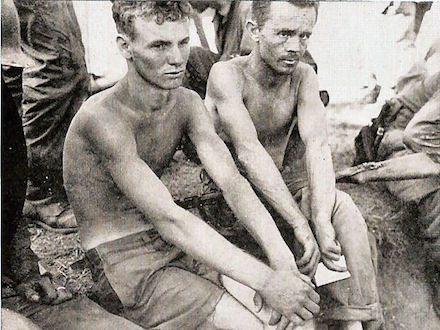
North Korean regulars on this date in 1950 committed a notorious mass execution upon 41 U.S. prisoners during the Korean War.

The Hill 303 massacre took place upon a 303-meter hill guarding the northern approach to Waegwan. In mid-August of 1950, said hill was defended by the U.S. Army’s 2nd Battalion, 5th Cavalry Regiment, 1st Cavalry Division, which narrowly escaped encirclement there by the advancing North Koreans.

Most of them escaped encirclement.

It’s a barely remembered atrocity in a war that America has consigned to forgetfulness; the massacre has seemingly never had anything like a thorough investigation. An indelible horror to the five men* who lived to tell the tale, its narrative outline is crude timelessness itself: holding these 42 U.S. POWs for two days, the North Koreans were themselves pummeled by a counterattack on the fiercely-fought hill;** unable to continue guarding the Americans, their captors fusilladed them.

This indiscriminate mass firing mere minutes ahead of the American approach was far from a thorough affair — hence the survivors, who were subsequently able to point out some of the captured Koreans who took part.


Massacre survivors James Rudd and Roy Day.

As a result of this and other summary battlefield executions, U.S. Gen. Douglas MacArthur addressed a threatening leaflet that was heavily dropped behind North Korean lines, threatening to “hold you and your commanders criminally accountable” according to the recent Nuremberg precedent.

There’s a monument to this gratuitous bloodbath that’s been recently installed, at the site of the shooting which is also nearby to a still-extant U.S. Army base called Camp Carroll. (The stone displays the date “June 25, 1950” — which denotes the start of the war, and not the day of the massacre.)

* Even the exact figures involved are a bit slippery. I believe we have 37 humans killed out of 42 captured, leaving five survivors. Some sources give it as 41 (attempted) executions with four survivors. A private named Frederick Ryan apparently was given last rites and declared dead on the scene but miraculously survived, possibly accounting for the variance.

** Hill 303 changed hands at least seven times.

On this day..

1704: Roland Laporte, posthumously, and five aides, humously

On this date in 1704, the great Camisard commander Pierre Laporte was publicly burned. He was already two days dead, but the same could not be said by five comrades-in-rebellion who were quite alive as they were broken on the wheel.

Familiarly known by the nom de guerre “Roland”, Laporte (English Wikipedia entry | the far more detailed French) was a whelp of 22 when entrusted with command of about 400 Protestant guerrillas operating around Lassalle, and his native Mialet.

These were rebels in a very dirty regional civil war in France’s heavily Protestant southeast, following the crown’s revocation of tolerance for the heretics. Roland proved himself one of its ablest prosecutors, putting Catholics to fire and sword be they enemy troops or wrongthinking neighbors.

By 1704 the insurgency was circling the drain as Camisard officers were either killed off or bought off. Our self-proclaimed “general of the children of god” was not the type to be had for 30 pieces of silver plus an army commission,* and so only violence would do for him. On August 14, betrayed by an informer who was amenable to purchase, Roland was slain in a Catholic ambush at Castelnau-les-Valence. Five officers escorting him opted not to go down fighting and surrendered instead, which proved a regrettable decision.

But even death could not slake the vengeance of his foes. “On the 16th August, 1704, the body of Roland Laporte, general of the Camisards … was dragged into Nimes at the tail of a cart and burnt, while 5 of his companions were broken on the wheel around his funeral pyre.”

For the unusually interested reader, there’s a 1954 French biography by Henri Bosc — who also authored a multi-volume history of the Camisard war — titled Un Grand Chef Camisard Pierre Laporte dit Roland, 1680-1704. It’s long out of print and appears to be difficult to come by.

* Not long before Roland’s defeat, just such a deal had shockingly induced fellow Camisard commander Jean Cavalier to turn coat.

On this day..

1862: Frisby McCullough, Missouri bushwhacker

On this date in 1862, Confederate soldier Frisby McCullough was shot as a terrorist during the U.S. Civil War’s guerrilla Missouri campaign.

McCullough had a youthful stint in the California gold rush to his back when he returned to Missouri in the mid-1850s to practice law. (He also served in the Missouri State Guard, a pro-slavery militia that had been established in 1861 by the since-exiled secessionist governor.)

With the onset of the Civil War in 1861, McCullough signed up for the pro-slavery Southern army and after a few different assignments became detailed to aid Confederate Col. James Porter in the hasty bush war raging in that frontier state.

We’ve previously detailed that conflict here. For purposes of this post it will suffice to say that the border state of Missouri was fiercely contested during this war, and claimed by North and South alike.

The Union commander John McNeil was not very inclined to charitably reading the treasonable secessionist irregulars who opposed him in the state, whom the Union considered to be operating illicitly behind its lines — in the character of spies and saboteurs, like the British agent John Andre during the Revolutionary War. This very much applied to our man, since McCullough’s particular gift was recruitment — you know, luring loyal citizens into sedition and rebellion.

On August 6, 1862, McNeil’s forces routed Porter’s at the Battle of Kirksville, and they pressed their victory. The very next day after, McNeil had 15 Confederate prisoners taken at Kirksville executed as former POWs who had violated their paroles by returning to the field: “I enforce the penalty of the bond,” McNeil icily reported to Washington.

Not long after, northern sentries also captured the ailing McCullough riding alone near Edina. He wasn’t a parolee — but “he had no commission except a printed paper authorizing the bearer to recruit for the Confederate army,” McNeil would write of him later in a missive to a comrade. At a snap trial on the 8th, “he was found guilty of bushwhacking and of being a guerilla. He was a brave fellow and a splendid specimen of manhood. I would gladly have spared him had duty permitted. As it was he suffered the same fate that would have fallen to you or me if we had been found recruiting within the Confederate lines. He met a soldier’s death as became a soldier.”

A memoir of the southern travails during this conflict titled With Porter in North Missouri; a chapter in the history of the war between the states is in the public domain; chapter XXII relates with umbrage the fate of McCullough whom the author Dr. Joseph Mudd* greatly admired:

Leaning against a fence he wrote a few lines to his wife, and these, with his watch and one or two other articles, he delivered to an officer to be given her, with assurance of his devoted affection in the hour of death. Upon the way to the place of his execution he requested the privilege of giving the order to fire, which was granted to him. All being ready, he stood bravely up, and without a tremor in his manly frame or a quiver in his clarion voice, he called out, ‘What I have done, I have done as a principle of right. Aim at the heart. Fire!’

… He was a good citizen, a high-minded gentleman, of fine presence, brave as a lion, gentle as a woman. Even in his death the strongest Unionists who knew him respected and admired his virtues and entertained the most bitter regrets that what they considered his misconceptions of duty had led him to his fearful fate. At the time of his death he was thirty-three years of age.

* Dr. Joseph Anthony Mudd hailed from Maryland: he was the brother of the Maryland Dr. Samuel Mudd who narrowly avoided execution as a conspirator in the assassination of President Abraham Lincoln.

On this day..

1938: Mikhail Viktorov, Soviet naval commander

Soviet admiral* Mikhail Viktorov fell in the purges on this date in 1938.

A young officer fresh from the Naval Academy when World War I broke out, Viktorov (English Wikipedia entry | Russian) made a timely switch to the Bolshevik side during the Civil War and scaled the heights of the Soviet navy.

He commanded the Baltic Fleet in the latter 1920s, and the Pacific Fleet in the 1930s, and finally — fleetingly — became chief of the Soviet navy in 1937, filling dead man’s boots when his predecessor was arrested and executed.**

The same fate awaited Viktorov, a perilous occupational hazard in those days.

He was rehabilitated posthumously in 1956.

* Viktorov’s rank was “Fleet’s Flag Officer, First Rank”; in 1938, this was the equivalent of admiral, and after a 1940 reorganization it was replaced full stop with admiral.

** It appears to me that fully seven consecutive heads of the Soviet Navy eventually ended up executed in the 1930s and 1940s (not all of them directly deposed from running the navy). Pantserzhanskiy, Zof, Muklevich, Orlov, our man Viktorov, and also his successors Smirnov and Frinovsky.

On this day..