As top officials of the Ba’athist government both men’s hands were well-imbrued in blood: Awad Hamed al-Bandar had been a judge who issued death sentences to 143 people charged with complicity in a failed attempt on Saddam’s life during the Dujail Massacre; Barzan Ibrahim al-Tikriti, Saddam’s half-brother, had been his intelligence chief with all that entails. Al-Tikriti was also one of the authors of the terrifying 1979 Ba’ath Party purge in which the doomed were culled from the ranks of the party congress while video rolled and the un-culled were forced to execute them. He also achieved the dubious honor of a place in the U.S. invasion army’s playing card deck of most wanted Iraqis.*
They had initially been slated to hang on the same occasion as Saddam (December 30, 2006) but were briefly respited so that the dictator would have the spotlight to himself on his big day. It’s a good job they did that, because the al-Tikriti’s hanging was badly botched by an excessively long drop, and the noose tore his head clean off.
U.S. serial killer Earle Nelson hanged in Winnipeg, Canada on Friday the 13th of January in 1928.
A disturbed and preternaturally balding 30-year-old, Nelson grew up in San Francisco “a psychotic prodigy. He was expelled from primary school at the age of 7. His behavior included talking to invisible people, quoting Bible passages about the great beast and peeking at his cousin Rachel while she undressed.”
Monsterhood beckoned via a compounding of destabilizing influences: venereal disease, a religious obsession, and a collision with a streetcar that left him in a weeklong coma and with a permanent vulnerability to headaches and dizzy spells. By the latter 1910s he was rotating shifts of institutionalization: jail in Los Angeles (mere burglary), the Army (subsequently deserted), and commitments to the state mental ward (“He has seen faces, heard music, and at times believed people were poisoning him. Voices sometimes whisper to him to kill himself.”)
From the start of 1926 until mid-1927, he gave over to a homicidal spree that claimed 22 lives all around the U.S. and ranging — obviously — into Canada. They were all women, bar 8-month-old Robert Harpin, the infant son of a mother whom he targeted; while his second-last victim was just 14, the predominant victim profile was a matronly landlady whose lodgings he could enter at invitation as a prospective lodger — and there put her at ease with his Biblical facility while maneuvering her into some circumstance suitable for wrapping his hands around her throat. Most were also posthumously raped after strangling.
Those noticeably large hands were among the first descriptors that witnesses had given of the suspect from the scenes of his earliest killings in San Francisco, and this together with a swarthy mien gave newsmen the nickname “Gorilla Killer” or “Dark Strangler”. They’d have frequent cause to use it as the terrifying killings migrated north from the California Bay to Portland, Ore.; Vancouver, Wash.; Seattle … and then east, leaving outraged corpses in Council Bluffs, Iowa; Kansas City, Mo.; Philadelphia; Buffalo, N.Y.; Detroit; Chicago.
Public alarm naturally followed each new report of his signature killings. After several homicides in Portland, the police there cautioned landlords from showing rooms unaccompanied with the grim words, “I do not wish to unduly alarm the people of Portland. But there is no denying the situation is grave.”
The Dark Strangler’s situation finally became grave when he took his act international. In Winnipeg he killed a teenage girl selling flowers and a housewife in quick succession, and this time the police A.P.B. was quick enough to catch up with him — gruesomely discovering the mutilated cadaver of the flower girl in his boarding house room. Public tips zeroed in on him a few miles before he reached the North Dakota border, and fingerprints courtesy of the San Francisco Police Department confirmed the identity.
Easily convicted in an atmosphere of great public outrage, Nelson mounted a credible but hopeless appeal for clemency on grounds of insanity.
Alfred Hitchcock’s 1943 Shadow of a Doubt apparently began as a pitch for a Nelson-inspired screen treatment.
Associated Press story from the Gastonia (North Carolina) Gazette, Dec. 30, 1949:
RALEIGH, Dec. 30 (AP) — Two Indian farm workers died today in the gas chamber after a futile effort by one to save the life of his companion in crime.
Leander Jacobs, 28, and Hector Chavis, 29, were executed for the robbery-murder of Martin L. Blackwell, 79-year-old Lumberton storekeeper.
Jacobs yesterday told Prison Warden Joe Crawford and Paroles Commissioner T.C. Johnson that although Chavis participated in the robbery, he took no actual part in the killing.
For this reason Chavis did not learn until about 3:30 a.m. today that he was going to die at 10 a.m.
Crawford told him that Governor Scott had decided not to intervene.
“All he said was, ‘Thank you’.” Crawford said.
Chavis entered the chamber calm. Jacobs walked briskly. They both were pronounced dead in less than 12 minutes.
The governor’s decision followed conferences at the mansion last night and this morning with Paroles Commissioner T.C. Johnson to whom Jacobs made his statement.
Jacobs made his confession to Johnson and Central Prison Warden Joe Crawford. Johnson said Jacobs’ story was a “full confession” and was the first detailed account obtained from either of the men.
The two Indian farmers were convicted last April in Robeson superior court of the robbery-murder of Martin L. Blackwell, 79-year-old Lumberton storekeeper.
Jacobs’ statement came yesterday shortly after he heard that governor [sic] would not intervene. The condemned man said he only wanted to clear his conscience before he died.
Johnson said “He told us that he didn’t want to take another man with him.[“]
However, the paroles commissioner pointed out that despite Jacobs’ attempt to take the full blame the fact remained that both men were present at the murder scene and both shared in the ensuing robbery.
(Thanks to Robert Elder of Last Words of the Executed — the blog, and the book — for the guest post. This post originally appeared on the Last Words blog. Fans of this here site are highly likely to enjoy following Elder’s own pithy, almanac-style collection of last words on the scaffold. -ed.)
Gentlemen, it was said that I killed Richards over a girl. That is not so. It was pure passion. I had thought the man wanted to take everything away from me and now I am to pay for his life. Good-bye.
—Joseph Cadotte, convicted of murder, hanging, Montana.
Executed December 27, 1895
According to rumor, Cadotte shot his hunting partner, Oliver Richards, in the middle of an argument about hunting proceeds and a pretty girl who preferred Richards to Cadotte. Cadotte later claimed that Richards drew a knife on him during the fight. During his trial, the prosecuting attorney pointed to a birthmark around Cadotte’s neck that looked like a rope burn and said, “Nature evidently intended the man to die. He was born to be hung.”
On this date in 1953 — six months after the execution of a more notorious couple, the Rosenbergs — two Missouri kidnappers were gassed together for the abduction-murder of a millionaire car dealer’s son.
Robert Greenlease owed his millions to a string of midwestern GM dealerships planted at the very flowering of America’s interstate system and suburbanization.
Carl Hall and Bonnie Brown Heady reckoned he’d owe some of those millions to them, too.
On September 28 of 1953, those two snatched little Bobby Greenlease Jr from the grounds of a Catholic school in Kansas City via the all-too-easy expedient of Heady presenting herself as Bobby’s aunt.
Then they extorted Sr. to the tune of $600,000, and after several days’ negotiations, Greenlease paid it through an intermediary — a record US ransom sum that would not be surpassed until 1971.
But the motor magnate never saw his son again. Even by the time they’d sent their first ransom note, the kidnappers had shot little Bobby dead at a deserted farm just over the state line in Kansas.
Although this audacious attack on a minor oligarch made national headlines — it couldn’t help but remind of the Lindbergh baby case — the crooks basically had an opportunity to get away scot-free with all their ill-gotten gains. Bobby Greenlease’s body wasn’t discovered until a couple of days after the ransom was paid, and nobody knew who the abductors were at that point.
Hall and Heady absconded to St. Louis but the wealth, like the crime itself, was just too much for these small-time shoulders to bear. Instead of lying low, Hall — after ditching Heady and taking most of the ransom with him, a reckless provocation of his co-conspirator that might itself have blown up his cover in short order — took up residence in an expensive hotel and started throwing money around. A cabbie reported the shabby character’s suspicious spending, and in no time at all the two were in custody.
A further mystery, never solved, entered the case on the night of Hall’s arrest: half the ransom money disappeared. The mob-connected lieutenant who collared Hall and brought him to the station less $300,000 of the score eventually resigned from the force in disgrace and faced federal prosecution for misappropriation and perjury; the cop indicted with him earned a presidential pardon by turning on his comrade. Other ideas were that the criminals had buried half the money (they claimed this, for a while) and that better-connected figures higher up the food chain had taken in. All the bills’ serial numbers had been recorded but only a few were ever known to have surfaced again in later years, in Michigan and Mexico; where these trace remains of a family tragedy might rest today is anybody’s guess.
As for Hall and Heady, they emerged into the glare of national infamy and — because they had crossed the Kansas-Missouri state line — a federal prosecution. Heady remains to this day the last woman executed under U.S. federal auspices.
The St. Louis Post-Dispatch has a detailed photographic retrospective here.
On this date in 1668, Walter Peake or Pake was hanged in front of his own inn, for the drunken murder of his friend (and his occasional lawyer).
Our narrative below comes from an 1855 volume determined to establish the ancient presence (if not perhaps the consistently laudable behavior) of Catholics in Maryland. The distractingly jagged interposition of microquotes is original to the piece; these all allude to the record of the trial preserved in the Archives of Maryland, Volume 57. The indictment appears on p. 352 and after a couple of additional interceding indictments touching unrelated cases, the record of Peake/Pake’s trial unfolds from p. 354-356.
A genealogist’s take on this dangling ancestor is also available here.
It still remains for us, to notice the life of another Assembly-man of 1649; but one upon whose memory, is cast the shade of sin and shame; whose fate it was, under the stern laws of that period, to look forward, as the consequence of his own deed, to the forfeiture of all his lands, and to the beggary of his children; and, about the sixtieth year of his age, to suffer a felon’s death. The time of his arrival is not exactly known; but it is probable, he came in 1646; and that, in 1648 and 1649 (when he sat in the Assembly, apparently one of the most respectable members), he resided in Newtown hundred; as he certainly did soon afterwards, and for a period of many years later. From his association with Governor Calvert, we cannot doubt the sincerity of his attachment to the proprietary’s government. There is also further evidence of his faith in the Roman church, derived from the fact, that he did not sign the Protestant Declaration; from the composition of the jury, which tried his painful case; from his intimacy with many of the noted members of the Roman church, from more than one of whom did his children, at different times, receive those gifts, which it was so much the practice of the early colonial god-fathers to present; from the well-known Roman Catholic family of Peake, living in St. Mary’s, as late as the American Revolution, whose ascent indeed cannot be clearly traced (such has been the destruction of our records), but who, we have but little ground to doubt, were either his lineal or his collateral descendants; from the names given to his children; and from the marks borne by the tracts, he had taken up. His eldest daughter was named after the Virgin Mother; his son, in remembrance of him who is regarded as the chief of the Apostles, and the founder of the universal primacy of the Roman see. The names of his wife, of a second daughter, of a third member of his family, and of a friend, were, each of them, given to corresponding tracts, all of which had the prefix of St. More estates were surveyed for him, with the Roman Catholic mark, than for Governor Calvert, for Capt. Cornwallis, for Mr. Lewger, for Doctor Gerrard, or for any other Roman Catholic colonist in the whole province of Maryland. The evidence is conclusive.
At St. Mary’s city, in the month of December, during the year 1668, sat the high Provincial Court of the Right Honorable Cecilius, the lord proprietary. Charles Calvert, the governor, subsequently the third baron of Baltimore, was the chief justice. Before the bar of this tribunal, appeared this Assembly-man, indicted for the murder of William Price, by piercing him, with a “sword,” “on the left,” “through, to his right side, under the shoulder;” and then cutting his “throat,” to “the depth of three inches.” His plea (the usual one in such cases) was Not Guilty. Thomas Sprigg was the chief member of the grand jury; and Christopher Rowsby (destined, himself, many years afterwards, to die by the hand of violence*), the foreman of the panel summoned to try the case. No technical objection is made to the indictment; no attorney appears on the prisoner’s behalf; no testimony is offered in his defence; no witness for the proprietary, in any way, crossexamined.” The jury retire; but soon return with their verdict. Asking the court to say, whether the deed was manslaughter, or murder; they find he “is guilty of the death,” but “was drunk” at the time, and knew not “what he did.” He addresses no appeal to the sympathy of the judges; he submits no objection to the form of the verdict; but still remains in silence. “The whole bench, then,” decide, he is guilty of “murder.” But neither against the decision of the court, nor the impending sentence of death, does he utter a word. Once, and once only, did he open his mouth. It was the moment after the sentence. Then, he “desired,” as a favor (and the request was not denied), that “he” might “suffer death before his own house, where he” had “committed the fact.” Thus perished and passed away, upon the gallows, in the spirit of a Catholic penitent, after a life of toilsome, heroic sacrifice in the wilderness, one of the men so honorably connected with the most sublime and magnificent conception of the seventeenth century! Pope Alney was the name of his executioner — the only fact, which gives him a claim to any place upon the page of our country’s history.
* Rowsby (alternatively, Rousby) was fatally stabbed by George Talbot, a nephew of Lord Baltimore. (There’s a Talbot County, Maryland, which isn’t named for him personally but whose existence testifies to his family’s pull.) Talbot hid out in a cave that still bears his name on Garrett Island (aka Watson’s Island) — diligently fed by falcons, per local legend — before surrendering himself to judgment and the pardon of his kinsman, the governor. -ed.
On this date in 1994 — the ten-year anniversary of the robbery-murder that earned him his death sentence — Raymond Carl Kinnamon died to lethal injection despite his loquacity.
A career criminal with 17 felony convictions and three prison stints previously to his name, Kinnamon robbed a Houston bar at gunpoint on December 11, 1984. The crime escalated to murder when one of the patrons, Raymond Charles Longmire, smacked the gunman’s hand away from his pocket.
On this unusual Sunday-morning execution, the death warrant specified the execution be completed before dawn. Kinnamon received a last-minute stay that was subsequently overturned by an appellate court, but the legal chicanery ate up most of the window. Seeing an angle, Kinnamon delivered a rambling, 30-minute last statement looking to run out the clock on his executioners. According to the Associated Press (here via the Paris News of Dec. 12, 1994), prison officials eventually forced the start of the lethal drugs while the prisoner was still mid-filibuster, to the complaints of Kinnamon’s family.
“I’ve got a few things to say,” Kinnamon said as witnesses filed into the death chamber about 5:15 a.m. CST.
Thirty minutes later, after thanking dozens of people, criticizing capital punishment, expressing love for his family and getting a drink of water from the prison warden, he was still talking.
“I can see no reason for my death,” he said, then began squirming, lifting his head and shoulders and tried sliding his right arm from a leather strap.
Warden Morris Jones and a prison chaplain, Alex Taylor, both stationed a few feet away at opposite corners of the gurney, stepped in to control the inmate and executioners behind a one-way mirror in an adjacent room began the lethal dose.
Kinnamon’s niece, standing with her mother and a friend behind a clear plastic shielded window, began sobbing loudly.
“They didn’t let him finish,” Natasha Fremin cried out. “I didn’t get to say goodbye.”
The dispatch notes that “it was not clear what would have happened if Kinnamon had continued to speak past sunrise.”
(Thanks to Robert Elder of Last Words of the Executed — the blog, and the book — for the guest post. This post originally appeared on the Last Words blog. Fans of this here site are highly likely to enjoy following Elder’s own pithy, almanac-style collection of last words on the scaffold. -ed.)
“You see an innocent man dying tonight. Thank you, warden. You have been a kind man.”
— Joseph Usefof, convicted of murder, electric chair, New York. Executed December 9, 1920.
Usefof was executed along with three other men for the 1918 murder of subway ticket agent Otto Fialo in the Bronx. Joseph Milano, one of Usefof’s co-defendants, exonerated Usefof in a written confession, which he later retracted. Usefof maintained his innocence; he was the first of his group to be executed because he was considered the most likely to suffer a breakdown.
[Executed with Usefof and Milano were James Cassidy and Charles McLaughlin, along with a fifth man electrocuted for an unrelated murder, Howard Baker. -ed.]
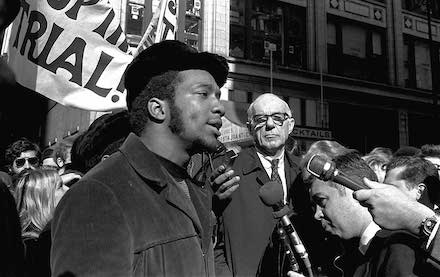
This charismatic — nearly every bio uses this word — 21-year-old star of the Illinois Black Panther Party had in his brief life shown himself a visionary exponent of radicalism; he would end as one of the signal martyrs to his movement’s violent suppression.
Well did he know it.
“If you’re asked to make a commitment at the age of 20 and you say, I don’t want to make a commitment only because of the simple reason that I’m too young to die, I want to live a little bit longer. What you did is, you’re dead already,” Hampton once mused. “You have to understand that people have to pay the price for peace. If you dare to struggle, you dare to win. If you dare not struggle then damnit, you don’t deserve to win … And I think that struggle’s going to come. Why don’t you live for the people? Why don’t you struggle for the people? Why don’t you die for the people?”
Emerging late in 1966 out of Oakland, Calif., the Black Panthers were a revolutionary and pointedly armed movement that fused black power demands with critique of the entire edifice — war, imperialism, capitalism and the rest of it. Although the organization was dissolved in 1982, the Panthers’ actions and legacy are still quite controversial and their mere specter remains a potent bogeyman for much of contemporary white America.
One thing is for sure: in their moment, they scared the shit out of the powers that be. Within months of its founding, the Federal Bureau of Investigation turned upon the Panthers its COINTELPRO program of domestic surveillance, suppression, and assassination. One particularly notorious FBI memo drew a bead on “Black Nationalist-Hate Groups” with an avowed intention to “prevent the rise of a ‘messiah’ who could unify, and electrify, the militant black nationalist movement” — and to “pinpoint potential troublemakers and neutralize them”.
Fred Hampton isn’t mentioned by name in this chilling missive from early 1968; he was just then beginning to emerge onto the FBI’s index of rabble-rousers. (Literally, the feds had a list called the “Rabble Rouser Index”.) He was fresh out of high school in 1966, and subsequently a wildly successful NAACP chapter leader, but gravitated to the new Illinois Panthers organ by 1968 where he quickly became its most outstanding organizer and spokesman, the prospective future face of a stirring cross-racial, class-conscious justice movement that Hampton perceived with a wisdom well beyond his years. Under his leadership the BPP spun out health care programs, legal aid programs, and free breakfast programs; he forged the original Rainbow Coalition* that brought rival street gangs and activist groups from different racial communities into a shared political ambition.
“We’re going to fight racism not with racism, but we’re going to fight with solidarity,” Hampton said. “We’re not going to fight capitalism with black capitalism, but we’re going to fight it with socialism.”
Just as energetically did the FBI work — and succeed, in the end — to break up such alliances, using informers and agents provocateur and false flags to encourage schisms and discredit leaders. Chicago’s police department was a ready collaborator in these operations; its relationship was the Panthers was hostile and often violent. Just three weeks before Hampton’s murder, two Chicago cops and a 19-year-old Black Panther were killed in a shootout. (Hampton was in California at the time.)
We don’t have the full documentary paper trail with deliberations and countersigned orders, but the known facts (and the smug grins of the cops) admit no reasonable dispute this side of performative naivete that Hampton was assassinated by a state death squad — “executed”, if you like, to fit an admittedly expansive read of this here site‘s mandate.
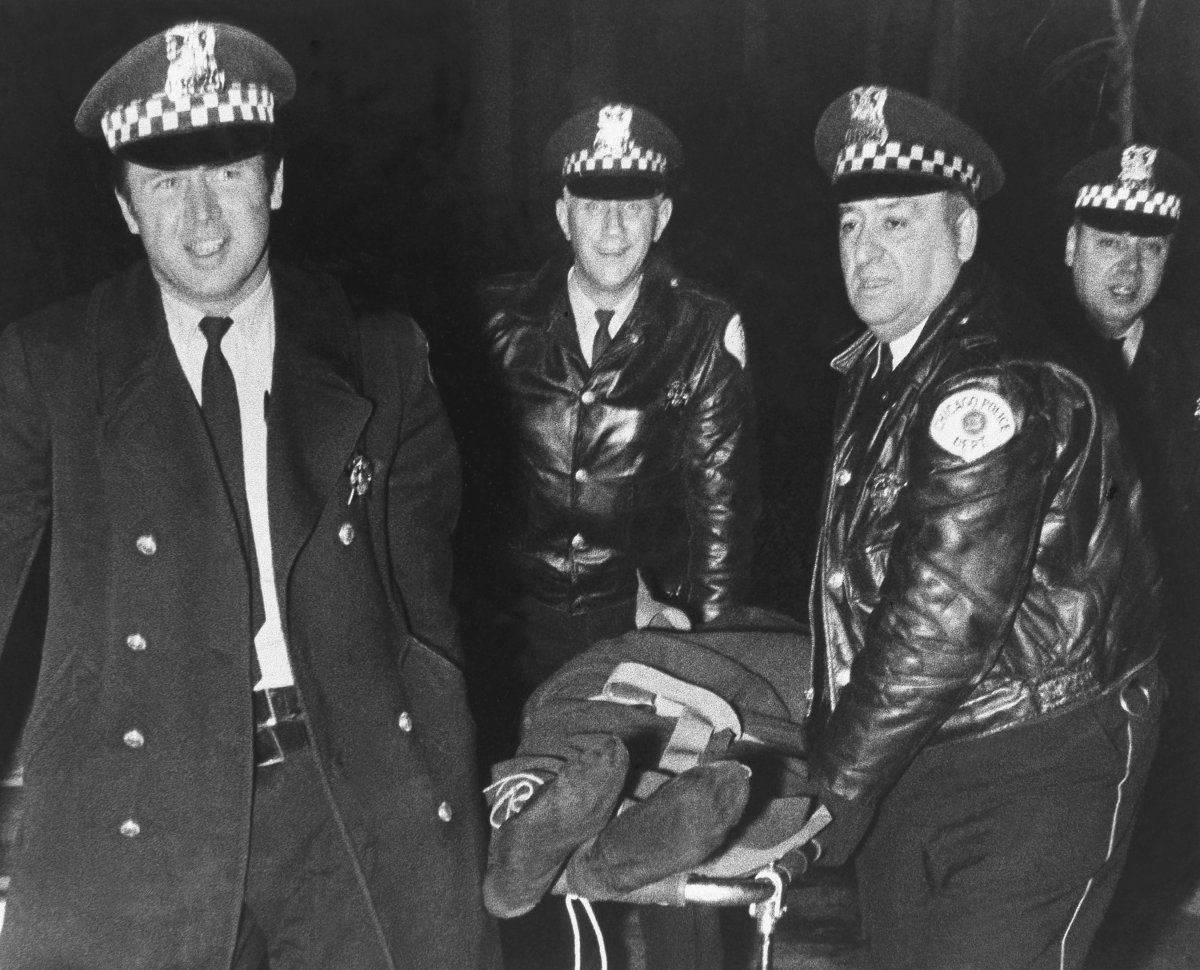
A compromised Hampton bodyguard named William O’Neal gave his FBI handler — who also happened to be running the Chicago COINTELPRO operation targeting the Panthers — a detailed floor plan of Hampton’s apartment, which the FBI shared with the Chicago police for a raid putatively hunting illegal weaponry. On the night of December 3, O’Neal slipped Hampton a barbituate to dull his reactions for what was to come; surviving comrades would describe Hampton being roused amid the early-morning fusillade only with difficulty, responding barely and in “slow motion” even as Chicago police stormed front and rear entrances and poured nearly 100 rounds into the place. Another Hampton aide named Mark Clark, sitting watch, was blasted dead in the initial barrage, convulsively discharging his shotgun once into the ceiling as he fell. It was the only shot fired that night by any of the Black Panthers.
By the account of Hampton’s eight-months pregnant partner Deborah Johnson, corroborated by other Panthers in the apartment, Fred Hampton was injured by the volley, but alive — and cold-bloodedly finished off with a coup de grace.
First thing that I remember after Fred and I had went to sleep was being awakened by somebody shaking Fred while we were laying in the bed. Saying, “Chairman, Chairman, wake up, the pigs are vamping, the pigs are vamping!” And, um, this person who was in the room with me, kept shouting out “we have a pregnant sister in here, stop shooting”. Eventually the shooting stopped and they said we could come out. I remember crossing over Fred, and telling myself over and over, “be real careful, don’t stumble, they’ll try to shoot you, just be real calm, watch how you walk, keep your hands up, don’t reach for anything, don’t even try to close your robe”. I’m walking out of the bedroom, there are two lines of policemen that I have to walk through on my right and my left. I remember focusing on their badge numbers and their faces. Saying them over and over on my head, so I wouldn’t forget. Um, as I walked through these two lines of policemen, one of them grabbed my robe and opened it and said, “Well, what do you know, we have a broad here.” Another policeman grabbed me by the hair and pretty much just shoved me — I had more hair then — pretty much just shoved me into the kitchen area. It was very cold that night. I guess that it snowed. And, ah, the back door was open. Some people were on the floor in the kitchen area. I think it was Harold Bell was standing next to me in the kitchen area. They, ah, it was a police, ah, plainclothes policeman there, and I asked him for a pin, so I could pin my robe, because it was just open. And he said, “Ask the other guy.” And, ah, then somebody came back and handcuffed me, and Harold Bell behind the back. I heard a voice come from the area, I guess from the dining room area, which was, the kitchen was off from that area. And someone said, “He’s barely alive, he’ll barely make it.” The shooting, I heard some shooting start again. Not much. Just a little shooting, and, um, and someone said, “He’s good and dead now.” I’m standing at the, um, kitchen wall, and I’m trying to remember details of these policemen’s face, say it over and over in my head, and, and badge numbers, so, you gotta remember, gotta remember. And then when I felt like I was just going to really just pass out, I started saying the ten-point program over and over in my head. Um, at one point I turned around, the shooting had continued again, and I saw the police drag Verlina Brewer and throw her into the refrigerator. And it looked like blood was all over her. And she fell to the floor and they picked her up and threw her again. I saw Ronald Satchel bleeding. I kept trying to focus on the ten-point program platform, because I, again, I wanted to take myself out of that place. And I knew I just couldn’t break down there. Because I didn’t know if I would be killed, or what would happen.
Incidentally, Hampton’s killing was also a key catalyst for the terroristic turn of the Weather Underground — whose decisive “war council” meeting occurred later that same month of December 1969, with Hampton’s blood heavy in the air (and his picture prominently displayed on the wall) as an emblem of the futility of pacific resistance within the belly of the beast. “It was the murder of Fred Hampton more than any other factor that compelled us to feel we had to take up armed sturggle,” said David Gilbert, who’s now serving a prison sentence for a deadly bank robbery. “We wanted to create some pressure, to overextend the police so they couldn’t concentrate all their forces on the Panthers. We wanted to create a political cost for what they were doing. And we also felt that to build a movement among whites that was a revolutionary movement, a radical movement … it had to respond when our government in our name was destroying the most promising, exciting, and charismatic leadership to come out of the Black movement in a long time.” (Source) It was a paradoxical inspiration, since Hampton himself had criticized the emerging Weathermen after their “Days of Rage” riot in Chicago as “anarchistic, opportunistic, individualistic,” and even “Custeristic” — as in Indian Wars cavalryman George Armstrong Custer, famous for his defeat — “in that its leaders take the people into situations where they can be massacred. And they call that revolution.”
* The name and concept of the Rainbow Coalition were later revived by Jesse Jackson in his left-wing presidential challenges in 1984 and 1988, but there is not a continuous institutional thread from Hampton’s coalition to Jackson’s. Jackson did, however, deliver a eulogy at Hampton’s funeral on December 6, 1969.

 As top officials of the Ba’athist government both men’s hands were well-imbrued in blood: Awad Hamed al-Bandar had been a judge who issued death sentences to 143 people charged with complicity in a failed attempt on Saddam’s life during the Dujail Massacre; Barzan Ibrahim al-Tikriti, Saddam’s half-brother, had been his intelligence chief with all that entails. Al-Tikriti was also one of the authors of the terrifying 1979 Ba’ath Party purge in which the doomed were culled from the ranks of the party congress while video rolled and the un-culled were forced to execute them. He also achieved the dubious honor of a place in the U.S. invasion army’s playing card deck of most wanted Iraqis.*
 A disturbed and preternaturally balding 30-year-old, Nelson grew up in San Francisco “
 A career criminal with 17 felony convictions and three prison stints previously to his name,