2008: Anandrao Sainu Koram, Naxalite informer

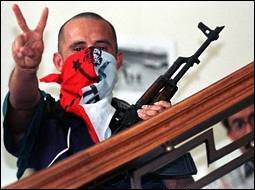
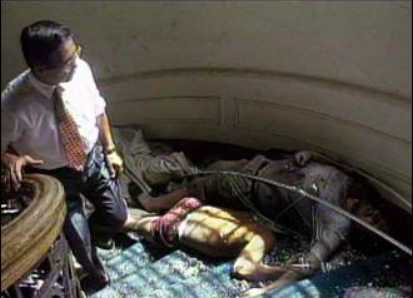
Last year on this date, India’s Maoist “Naxalites” publicly beheaded a former comrade who had surrendered and collaborated with police.

Naxalites.

The incident that occurred in village Murgaon of Dhanora sub district has the entire Maoist-affected region in the grip of tension because of the manner in which the reprisal has been carried out.

A group of 40 to 50 Maoists went to the village Saturday night, called out Anandrao Sainu Koram from his house, tied him to a tree and beheaded him in full view of the villagers who had gathered at the spot, deputy superintendent of police Anant Rokde said Sunday.

“They also warned Anandrao’s colleague Shantaram Gawde, who too had surrendered to the police in April this year along with three others, that he would meet the same fate if he did not desist from acting as an informer,” Rokde told IANS on the basis of the complaint lodged by Anandrao’s wife.

The 23-year-old Koram was reportedly the fourth surrendered Naxalite slain by insurgents in as many months of the long-running and escalating conflict … which, needless to say, has been dire for civilians.

On this day..

1942: The village of Lidice, for the assassination of Reinhard Heydrich

On this date in 1942, the Germans visited upon the Czechoslovakian village of Lidice one of the most notorious butcheries of World War II: the physical destruction of the town, and the execution of most of the adult population, in revenge for the assassination of Reichsprotektor Reinhard Heydrich.

Heydrich had power of life and death in Nazi-occupied Bohemia and Moravia, and did not scruple to use it.

“The Hangman of Prague” was no mere functionary, but a Nazi grand wizard from way back, who’d had a hand in the Third Reich’s most terrifying greatest hits — the Night of the Long Knives, Kristallnacht. Just four months before this date, Heydrich had chaired the Wannsee Conference.* (Watch Kenneth Branagh as Heydrich ride herd over a gaggle of bureaucrats to get the Final Solution up and running in Conspiracy.) Hitler called him his “man with the iron heart.”

So he was a natural target for the Czechoslovakian army-in-exile and their British handlers, made more so by his lordly disdain for common-sense security safeguards.

Zipping along a predictable route in an open car, he was a sitting duck for a hit squad, who gave the Nazi bastard a mortal shrapnel wound from a grenade that had him lingering painfully at death’s door for several days before he finally died of blood poisoning.

The 1964 Czechoslovakian film Atentat (“Assassination”) chronicles the plot to kill Heydrich and its aftermath.

For this effrontery, Czechoslovakians would pay a dreadful price.

Naturally, the Nazis mercilessly hunted down and slaughtered those with any connection to the plot.

But the Reich also exacted collective reprisals to make plain that the entire “protectorate” could be considered hostage against such plots in the future.

Special transports of Jews marked “Attentat auf Heydrich” were shipped to the camps, and 152 were executed on the day Heydrich succumbed. But then, the Nazis were brutalizing Jews anyway. Something more headline-grabbing would be needed.

Enter Lidice.

After gaudy funerals for the slain Reichsprotektor, the Reich settled upon the small town of Lidice north of Prague — trumping up a few connections to resistance to “justify” collective punishment.

On this date, German troops stormed it, summarily executed all the men and boys** old enough to bear arms and a fair number of women, deported the others, and then physically destroyed and buried the town.

Lidice was intended as a demonstration — boldly published to the world as proof against a repeat,† it became the byword of Nazi cruelty towards subject nations. Though not by quantitative standards the greatest crime of the occupation, not even the greatest crime in reprisal for Heydrich, its three syllables distill all the evil of Hitler’s conquest for Czechoslovakia.

Lidice did live, and does yet, as an emblem par excellence those terrible years.

Less alive: Heydrich’s right-hand man Karl Hermann Frank, who was hanged in Prague after the war for engineering this monstrous crime. Those survivors of Lidice able to make the trip enjoyed priority seating.

* Heydrich’s aide at the Wannsee Conference, and taker of cleaned-up minutes, was Mr. Banality of Evil himself, Adolf Eichmann.

** Only three men of Lidice survived the destruction: two who were in England at that time, and one who was imprisoned in Prague for killing his son. The sentence for this crime, it turned out, was life.

† An effective proof — the calculated wholesale slaughter apparently did cool both the conquered populace and the enemies of Germany on enthusiasm for further assassinations.

On this day..

1832: Not Javert, spared by Jean Valjean

On this, the second day of the abortive 1832 June Rebellion in Paris, police inspector Javert is faux-executed — and mercifully released — by his longtime quarry Jean Valjean in Victor Hugo’s classic Les Miserables.


Javert depicted in an theatrical poster, from the Les Miserables Gallery. The site identifies this as an 1899 poster, which may be mistaken since the actor billed for Javert died in January 1898.

Hugo’s monumental novel is structured by the implacable policeman’s pursuit of Jean Valjean, an absconded ex-con with a heart of gold.

Fate brings them together accidentally at the barricade of the (historical, but now forgotten) student uprising — Javert to spy on the student revolutionaries, who unmask him, and Jean Valjean to keep an eye on his adoptive daughter’s idealistic lover.

Jean Valjean’s timely contribution to the hopelessly outgunned revolutionaries gives him the pull to ask the favor of being the one to execute the spy.* Since Valjean has been hunted relentlessly by the lawman since breaking parole nearly two decades before, the hero has ample motivation to turn executioner.

Instead…

When Jean Valjean was left alone with Javert, he untied the rope which fastened the prisoner across the middle of the body, and the knot of which was under the table. After this he made him a sign to rise.

Javert obeyed with that indefinable smile in which the supremacy of enchained authority is condensed.

Jean Valjean took Javert by the martingale, as one would take a beast of burden by the breast-band, and, dragging the latter after him, emerged from the wine-shop slowly, because Javert, with his impeded limbs, could take only very short steps.

Jean Valjean had the pistol in his hand.

In this manner they crossed the inner trapezium of the barricade. The insurgents, all intent on the attack, which was imminent, had their backs turned to these two.

Marius alone, stationed on one side, at the extreme left of the barricade, saw them pass. This group of victim and executioner was illuminated by the sepulchral light which he bore in his own soul.

Jean Valjean with some difficulty, but without relaxing his hold for a single instant, made Javert, pinioned as he was, scale the little entrenchment in the Mondetour lane.

When they had crossed this barrier, they found themselves alone in the lane. No one saw them.

Jean Valjean thrust the pistol under his arm and fixed on Javert a look which it required no words to interpret: “Javert, it is I.”

Javert replied:

“Take your revenge.”

Jean Valjean drew from his pocket a knife, and opened it.

“A clasp-knife!” exclaimed Javert, “you are right. That suits you better.”

Jean Valjean cut the martingale which Javert had about his neck, then he cut the cords on his wrists, then, stooping down, he cut the cord on his feet; and, straightening himself up, he said to him:

“You are free.”

Javert was not easily astonished. Still, master of himself though he was, he could not repress a start. He remained open-mouthed and motionless.

Jean Valjean continued:

“I do not think that I shall escape from this place. But if, by chance, I do, I live, under the name of Fauchelevent, in the Rue de l’Homme Arme, No. 7.”

Javert snarled like a tiger, which made him half open one corner of his mouth, and he muttered between his teeth:

“Have a care.”

“Go,” said Jean Valjean.

Javert began again:

“Thou saidst Fauchelevent, Rue de l’Homme Arme?”

“Number 7.”

Javert repeated in a low voice: — “Number 7.”

He buttoned up his coat once more, resumed the military stiffness between his shoulders, made a half turn, folded his arms and, supporting his chin on one of his hands, he set out in the direction of the Halles. Jean Valjean followed him with his eyes:

A few minutes later, Javert turned round and shouted to Jean Valjean:

“You annoy me. Kill me, rather.”

Javert himself did not notice that he no longer addressed Jean Valjean as “thou.”

“Be off with you,” said Jean Valjean.

Javert retreated slowly. A moment later he turned the corner of the Rue des Precheurs.

When Javert had disappeared, Jean Valjean fired his pistol in the air.

Then he returned to the barricade and said:

“It is done.”

Or, has played in the modern hit musical adaptation:

In saving his own soul, Jean Valjean (conveniently!) manages to kill his pursuer just the same: the cognitive dissonance for such a hard, emotionless man being on the receiving end of this bit of redemptive mercy leads Javert to break character so far as to allow his man to escape. The inspector then commits suicide.

Les Miserables is available free several places online, including Gutenberg.org and The Literature Network.

* While the recent musical production of Les Miserables soft-pedals what was planned for Javert, Hugo leaves no room for doubt: as the students prepare for the fatal onslaught, their leader Enjolras decrees that “[t]he last man to leave this room will smash the skull of this spy.”

On this day..

1098: Yaghi-Siyan, commander of Antioch

On this date in 1098, the Turkish commander of Antioch put to flight by the invading Crusader army was seized and beheaded as a trophy of the victory.

Yaghi Siyan, the Seljuk governor known to European chroniclers as Acxianus, Gratianus or Cassianus, found himself in a bad way when Christian forces of the First Crusade laid siege to Antioch late in 1097.

Although the Europeans were famished, they maintained the siege for the best part of a year, finally surging into Antioch on the night of June 2-3, 1098, with the help (as so often the case in siege warfare) of an inside man who agreed to open a gate.

Arab historian Ali ibn al-Athir described the city’s fall.

Yaghi Siyan showed unparalleled courage and wisdom, strength and judgment. If all the Franks who died had survived they would have overrun all the lands of Islam. He protected the families of the Christians in Antioch and would not allow a hair of their head to be touched.

After the siege had been going on for a long time the Franks made a deal with one of the men who were responsible for the towers. He was a cuirass-maker called Ruzbih [or Firuz, or Firouz] whom they bribed with a fortune in money and lands. He worked in the tower that stood over the river-bed, where the river flowed out of the city into the valley. The Franks sealed their pact with the cuirass-maker, God damn him! and made their way to the water-gate. They opened it and entered the city. Another gang of them climbed the tower with ropes. At dawn, when more than 500 of them were in the city and the defenders were worn out after the night watch, they sounded their trumpets … Panic seized Yaghi Siyan and he opened the city gates and fled in terror, with an escort of thirty pages.

Yaghi-Siyan fell from his horse in flight; his

companions tried to lift him back into the saddle, but they could not get him to sit up, and so left him for dead while they escaped. He was at his last gasp when an Armenian* shepherd came past, killed him, cut off his head and took it to the Franks at Antioch.**

A borderline “execution” at best, but close enough for our purposes; the Turkish garrison Yaghi-Siyan left behind to face the music was receiving similar treatment from the Crusaders, as were civilians, Muslim and Christian alike.

The month following Yaghi-Siyan’s death was a strange and pivotal one in the strange and pivotal history of the Crusades.

The city of Antioch was almost immediately invested again — by a relief force of Turks who had arrived too late. Facing seemingly long odds on the other end of the siege, and still near to starvation, the Crusaders discovered the “Holy Lance”† and managed to repel the Turks, enabling the upstart Christian army to march on to Jerusalem.

* Having had their homelands overrun by the Seljuks during the preceding decades, there was no small tension in the Armenian relationship with their Turkish rulers; the man who betrayed the city was himself said to be an Armenian who had been forced to convert to Islam. The account of the city’s capture by Raymond d’Aguiliers reports that our day’s victim “was captured and beheaded by some Armenian peasants, and his head was brought to us. This, I believe, was done by the ineffable disposition of God, that he who had caused many men of this same race to be beheaded should be deprived of his head by them.”

** Different accounts give slightly different versions of how Yaghi-Siyan came to his end — whether thrown from his horse or caught attempting to take refuge — and the station in life of the Armenian (everyone seems to agree on the nationality of the executioner) who decapitated him.

† The spear supposed to have pierced Christ on the cross, whose discovery was directed by Peter the Hermit at the direction, he said, of St. Andrew. Ibn al-Athir had a more skeptical take:

a holy man who had great influence over them, a man of low cunning … proclaimed that the Messiah had a lance buried in the Qusyan, a great building in Antioch … Before saying this he had buried a lance in a certain spot and concealed all trace of it. He exhorted them to fast and repent for three days, and on the fourth day he led them all to the spot with their soldiers and workmen, who dug everywhere and found the lance as he had told them.

On this day..

1871: The Paris Commune falls

On this date in 1871, the last barricade of the Paris Commune fell to the onslaught of the army — and a legion of Parisians fell to the army’s firing squads.

On the evening of that bright Sunday when the insurrection finally collapsed, a Sunday when the streets of central Paris were crowded with returning bourgeois, all expressing their satisfaction that the struggle was at last over, the city’s walls were placarded with a proclamation emanating from MacMahon. “Inhabitants of Paris,” said he, “the Army of France has come to save you. Paris is delivered. At four o’clock our soldiers carried the last position occupied by the insurgents. Today the struggle is over, order, work and security will now revive.

I read that announcement in the Rue de Rivoli, not far from the Hotel-de-Ville. A moment later, however, I heard a discharge of musketry … Several insurgents who had been taken fighting were being shot. (My Adventures in the Commune, Paris, 1871, an anti-Commune source)

The day was climax and curtains for the first working-class seizure of power in industrial Europe, but in truth indiscriminate reprisal executions had been underway since troops of the conservative Versailles government first breached rebellious Paris on May 21.

What followed was semaine sanglante, the “bloody week” — each barricade’s surviving defenders executed summarily, and anyone in the city liable to a similar fate if the nearest French officer disliked the cut of his or her jib. Rumors swept the city that women of the Commune were torching buildings, for instance, and suddenly any woman in the street could be killed as an arsonist; some firefighters were shot as saboteurs when the “water” they threw on such flames failed to speedily quench them,* and was consequently adjudged to be kerosone.

And heaven help he who should chance to resemble one of the wanted Communard leaders!

Any passer-by calling a man by a revolutionary name caused him to be shot by soldiers eager to get the premium … Members and functionaries of the Commune were thus shot, and often several times over, in the persons of individuals who resembled them more or less.


Un rue de Paris en 1871, by Maximilien Luce.

The total body counts are guesswork: the killing ran far ahead of the record-keeping. Twenty thousand, or thirty, or more are thought to perished by summary execution. Even the press of the bourgeoisie, whose sword arm the Versailles men comprised, was aghast. London’s Times filled its broadsheets with calumnies upon the Commune, but noted on May 29:

“The Revolution is crushed;” but at what a cost, and amid what horrors! … the Communists seem not very much worse than their antagonists. It sounds like trifling for M. Thiers to be denouncing the Insurgents for having shot a captive officer “without respect for the laws of war.” The laws of war! They are mild and Christian compared with the inhuman laws of revenge under which the Versailles troops have been shooting, bayoneting, ripping up prisoners, women and children, during the last six days.

Whatever the true death toll, it massively surpassed that of the much more eagerly commemorated Revolutionary Terror.

Not for Executed Today to number what the butchers themselves could not. In a city turned charnel house in the midst of a Week of Blood, a few scenes of mortality from the day the Commune fell. (Heavily sourced to the very pro-Commune — hence potentially sensational — History of the Commune of 1871)

This people, heroes in the face of the foreigner, must therefore by called assassins, criminals, wretches, because they died for the Universal Republic, because in defense of their beliefs, their conscience, their idea, they preferred, in their fierce enthusiasm, to bury themselves in the ruins of Paris rather than abandon it to the coalition of despots a thousand times more cruel and more lasting than any foreigner.

-Lissagaray

The 147 Fédérés at Communards’ Wall

At a wall still consecrated to leftists in the Pere Lachaise cemetery of Belleville, 147 were summarily shot.

The 147 are acclaimed as the last defenders of the Commune.

the Commune is in its death throes. Like the dragon of fairy lore, it dies, vomiting flames … What must these men feel who are killing and being killed in the cemetery! To die among the dead seems horrible. But they never give it a thought; the bloody thirst for destruction which possesses them allows them only to think of one thing, of killing! Some of them are gay, they are brave, these men. That makes it only the more dreadful; these wretches are heroic! Behind the barricades there have been instances of the most splendid valour. A man at the Porte Saint-Martin, holding a red flag in his hand, was standing, heedless of danger, on a pile of stones. The balls showered around him, while he leant carelessly against an empty barrel which stood behind. — “Lazy fellow,” cried a comrade. ‘”No,” said he, “I am only leaning that I may not fall when I die.”

Paris Under the Commune, an anti-Commune source

Communard Eugene Varlin

Varlin, alas! was not to escape. On Sunday the 28th May he was recognized in the Rue Lafayette, and led, or rather dragged, to the foot of the Buttes Montmartre before the commanding general. The Versaillese sent him to be shot in the Rue des Rosiers. For an hour, a mortal hour, Varlin was dragged through the streets of Montmartre, his hands tied behind his back, under a shower of blows and insults. His young, thoughtful head, that had never harboured other thoughts than of fraternity, slashed open by the sabres, was soon but one mass of blood, of mangled flesh, the eye protruding from the orbit. On reaching the Rue des Rosiers, he no longer walked; he was carried. They set him down to shoot him. The wretches dismembered his corpse with blows of the butt-ends of their muskets.

Varlin was shot along with a nameless batch of others to whom the March 18 execution of Generals Lecomte and Thomas had been hastily imputed (they were held at the generals’ execution site, to contemplate their sin). A pro-government paper allowed that Varlin “died game.”
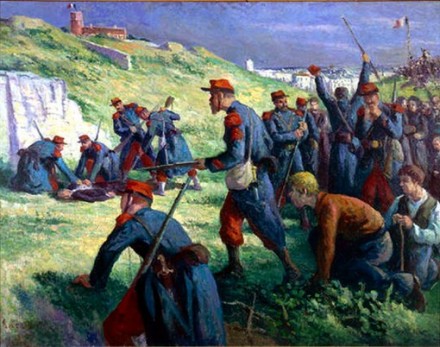

L’execution de Varlin, another Maximilien Luce scene.

Many at the stock exchange

According to the Paris Francais as quoted by this Marxist review of the events

It is at the Bourse that there was to-day the largest number of executions. The doomed men who attempted to resist were bound to the iron railing.

The stock exchange is “a fit place, to be sure, for this sort of business,” observes our interlocutor.

Eighty-plus defenders of Belleville, at the Arc de Triomphe

The London Times editorialized on May 31 upon this incident when the Marquis de Gallifet plucked from the mass of Belleville’s May 28 captives “eighty prisoners, principally soldiers of every arm, linesmen, artillerymen, and Zouaves, [who] were set apart and afterwards led to the right of the rampart to be shot.”

The French are filling up the darkest page in the book of their own or the world’s history. The charge of ruthless cruelty is no longer limited to one party or to one class of persons. The Versailles troops seem inclined to outdo the Communists in their lavishness of human blood. The Marquis de Gallifet is escorting a column of prisoners to Versailles or Satory. He “picks out eighty-two of them, and shoots them at the Arc de Triomphe.” Next came a lot of 20 firemen, then a dozen women, one aged 70. On another spot our Correspondent came upon “80 corpses, piled upon each other, a mass of arms and legs and distorted faces, while the roads and gutter literally flowed with blood.” About 1,000 are said to have thus suffered. By this wholesale and summary execution of prisoners in batches of 50 and 100, not only must the innocent perish with the guilty, but many must bear the penalty of imaginary guilt.

An utterly disconnected Englishman, according to the paper’s correspondent, was accidentally among the four score at the Arc, and only saved by the fortuitous intervention of a Belgian attache.

an English officer somehow got mixed up in the procession, and was forced to keep in it by the escort, who, out of 5,000 prisoners, could not, of course, be expected to recognize one innocent man … it so happened that some of the prisoners tried to escape, and to make an example the leader of the cavalry escort, the Marquis de Gallifet, a man who is not prone to err on the side of mercy, had then and there 81 shot, and the English officer was all but one of them, his explanations being at first refused the slightest attention. Human life has, in fact, become so cheap that a man is shot more readily than a dog.

Socialist physician Tony Moilin

One single fact was Tony Moilin reproached with: that of having on the 18th March taken possession of the mairie of his arrondissement, and having thus had a share in giving the signal for the insurrection …

The court-martial condescended to tell him that the fact of the mairie, the only one he could be reproached with, had in itself not much importance, and did not merit death, but that he was one of the chiefs of the Socialist party, dangerous through his talents, his character, and his influence over the masses; one of those men, in short, of whom a prudent and wise Government must rid itself when it finds a legitimate occasion to do so

[A] respite of twelve hours was granted him in order that he might make his testament, write a few words of farewell to his father, and finally [marry his pregnant lover] … on the 28th May, in the morning, Tony Moilin was led into the garden a few steps from the palace and shot. His body, which his widow claimed, the surrender of which had been at first promised, was refused her. (History of the Commune of 1871)

The unnumbered dead of Lobau Barracks

Since morning a strong cordon is being formed round the theatre (Châtelet); where a court-martial is permanently established. From time to time one sees a band of fifteen to twenty individuals coming out, composed of National Guards, civilians, women and children fifteen to sixteen years old.

These individuals are condemned to death. They march two by two, escorted by a platoon of chasseurs, who lead and bring up the rear. This cortege goes up the Quai de Gevres and enters the Republican Barracks in the Place Lobau. A minute after one hears from within the fire of platoons and successive musketry discharges; it is the sentence of the court-martial which has just been executed.

The detachment of chasseurs returns to the Chatelet to fetch other prisoners. The crowd seems deeply impressed on hearing the noise of the shootings.

This is another publication’s story cited in the History of the Commune of 1871, which itself also details the court-martial procedures of this drumhead tribunal:

Thousands of prisoners who were led there were first of all penned in upon the stage and in the auditorium, under the guns of the soldiers placed in the boxes; then, little by little, like sheep driven to the door of the slaughter-house, from wing to wing they were pushed to the saloon, where, round a large table, officers of the army and the honest National Guard were seated, their sabres between their legs, cigars in their mouths. The examination lasted a quarter of a minute. ‘Did you take arms? Did you serve the Commune? Show your hands.’ If the resolute attitude of a prisoner betrayed a combatant, if his face was unpleasant, without asking for his name, his profession, without entering any note upon any register, he was classed. ‘You?’ was said to the next one, and so on to the end of the file, without excepting the women, children, and old men. When by a caprice a prisoner was spared, he was said to be ordinary, and reserved for Versailles. No one was liberated.

The classed ones were at once delivered to the executioners, who led them into the nearest garden or court. From the Châtelet, for instance, they were taken to the Lebau Barracks. There the doors were no sooner closed than the gendarmes fired, without even grouping their victims before a platoon. Some, only wounded, ran along by the walls, the gendarmes chasing and shooting at them till they fell dead. … There were so many victims, that the soldiers, tired out, were obliged to rest their guns actually against the sufferers. The wall of the terrace was covered with brains; the executioners waded through pools of blood.


Summary executions — death squads — continued for days or weeks afterwards in Paris; martial law throttled left organizing in the city; and those “fortunate” enough to have been captured alive were processed in a steady stream of judicial executions over the months yet to come.

The Commune, a palpably subversive example even in the present day, was destroyed in every way possible for the Versailles government. But its example could hardly be forgotten.

Marx would write The Civil War in France of the only proletarian revolution he would actually witness in his lifetime.

The next generation’s subversives also took inspiration from the Parisian example … and lessons from its mistakes. Lenin — a fond student of the Commune, who was eventually buried wrapped in a Communard banner — said that

two mistakes destroyed the fruits of the splendid victory. The proletariat stopped half-way: instead of setting about “expropriating the expropriators”, it allowed itself to be led astray by dreams of establishing a higher justice in the country united by a common national task; such institutions as the banks, for example, were not taken over … The second mistake was excessive magnanimity on the part of the proletariat: instead of destroying its enemies it sought to exert moral influence on them; it underestimated the significance of direct military operations in civil war, and instead of launching a resolute offensive against Versailles that would have crowned its victory in Paris, it tarried and gave the Versailles government time to gather the dark forces and prepare for the blood-soaked week of May.

“The lesson learnt by the proletariat will not be forgotten,” Lenin vowed, and his own revolution gained a vital object lesson in the Bloody Week of Paris, and an anthem besides: Communard Eugene Pottier, fleeing the Versailles army’s slaughter, wrote the verses that have been sung ever since by millions dreaming of a better world — the Internationale.

* Water can accelerate a fire, under the right circumstances.

On this day..

1297: Marion (Murron) Braidfute, bride of The Wallace

May of 1297 marks the first appearance in the historical record of Braveheart hero William Wallace … so we mark today the undated (and presumably fictional) execution/murder of his wife that, by the most cinematic account possible, set Wallace on his own path to the scaffold.

The face that lifted a thousand claymores: Catherine McCormack as Braveheart‘s version of Marion, Murron MacClannough. Murron’s “execution” inspires William Wallace.

Marion (or Marian) Braidfute, she’s called by the Scottish poet Blind Harry in the epic dating near two centuries after famed rebel’s rising. Not wanting audiences to confuse her with Robin Hood sweetie Maid Marian, the Braveheart script renamed her Murron MacClannough.

In Mel Gibson’s gory silver screen epic, Wallace is, at this point, a determinedly apolitical commoner — a stance contrasting markedly with a backstory of nationalistic identity-forming experiences, like having his father and brother killed by the English. He’s radicalized only after his attempt to protect Murron from rape results in her demonstrative summary execution.

And of course, Wallace then wreaks a bloody revenge (complete with summary execution of his own) that soon has the country in flames.

Hollywood’s avenging-his-woman angle exploits a folkloric embroidery of a female character perhaps created by Blind Harry, writing in the 15th century. In “The Wallace”, the titular hero is already well along his conflict with the English crown when he weds Marion — whose story arc differs greatly from that of the peasant eye candy Mel Gibson taps. In the poem, Marion is exposed to the vengeance of the Sheriff of Lanark, William Heselrig, when Wallace goes off to fight and refuses to take her along.

Now fierce with Rage the cruel Foe draws near,
Oh does not Heaven make Innocence its Care!
Where fled thy guardian Angel in that Hour
And left his Charge to the fell Tyrant’s Power,
Shall his fierce Steel be redned with thy Gore
And streaming Blood distain thy Beauties o’er?

But now awaken’d with the dreadfull Sound
The trembling Matron threw her Eyes around,
In vain alace were all the Tears she shed
When fierce he waves the Fauchion o’er her Head
All Tyes of Honour by the Rogue abjur’d
Relentless deep he plung’d the ruthless Sword;
Swift o’er her Limbs does creeping Coldness rise
And Death’s pale Hand seal’d up her fainting Eyes.

Wallace slays Heselrig the next day, according to the poem — the actual historical event of May, 1297,* that marks Wallace’s emergence from the dim fogs of history. (In the film Braveheart, the chronology is unstated, but Wallace is revenged before Murron’s burial.)

John of Fordun, writing in the 14th century, tells the tale.

The same year William Wallace lifted up his head from his den — as it were — and slew the English sheriff of Lanark, a doughty and powerful man, in the town of Lanark. From that time, therefore, there flocked to him all who were in bitterness of spirit, and weighed down beneath the burden of bondage under the unbearable domination of English despotism; and he became their leader. He was wondrously brave and bold, of goodly mien, and boundless liberality … So Wallace overthrew the English on all sides; and gaining strength daily, he, in a short time, by force, and by dint of his prowess, brought all the magnates of Scotland under his sway, whether they would or not.

* “In the month of May the perfidious race of Scots began to rebel.” (Walter of Hemingborough)

On this day..

1450: William de la Pole, Duke of Suffolk

Henry VI, Part 2 — Act IV, Scene 1

The Coast of Kent.

[Alarum. Fight at sea. Ordnance goes off. Enter a Captain, a Master, a Master’s Mate, WALTER WHITMORE, and others; with them SUFFOLK, and others, prisoners.]

SUFFOLK.
Obscure and lowly swain, King Henry‘s blood,
The honourable blood of Lancaster,1
Must not be shed by such a jaded groom.
Hast thou not kiss’d thy hand and held my stirrup?
Bare-headed plodded by my foot-cloth mule
And thought thee happy when I shook my head?
How often hast thou waited at my cup,
Fed from my trencher, kneel’d down at the board,
When I have feasted with Queen Margaret?2
Remember it and let it make thee crest-fallen,
Ay, and allay thus thy abortive pride,
How in our voiding lobby hast thou stood
And duly waited for my coming forth.
This hand of mine hath writ in thy behalf,
And therefore shall it charm thy riotous tongue.

WHITMORE.
Speak, captain, shall I stab the forlorn swain?

CAPTAIN.
First let my words stab him, as he hath me.

SUFFOLK.
Base slave, thy words are blunt and so art thou.

CAPTAIN.
Convey him hence, and on our long-boat’s side
Strike off his head.

SUFFOLK.
Thou dar’st not, for thy own.

CAPTAIN.
Yes, Pole!

SUFFOLK.
Pole!

CAPTAIN.
Pool! Sir Pool! lord!
Ay, kennel, puddle, sink, whose filth and dirt
Troubles the silver spring where England drinks.
Now will I dam up this thy yawning mouth
For swallowing the treasure of the realm;3
Thy lips that kiss’d the queen shall sweep the ground;
And thou that smil’dst at good Duke Humphrey‘s death4
Against the senseless winds shalt grin in vain,
Who in contempt shall hiss at thee again.
And wedded be thou to the hags of hell,
For daring to affy a mighty lord
Unto the daughter of a worthless king,
Having neither subject, wealth, nor diadem.
By devilish policy art thou grown great
And, like ambitious Sylla, overgorg’d
With gobbets of thy mother’s bleeding heart.
By thee Anjou and Maine were sold to France,
The false revolting Normans thorough thee
Disdain to call us lord, and Picardy
Hath slain their governors, surpris’d our forts,
And sent the ragged soldiers wounded home.5
The princely Warwick, and the Nevils all,
Whose dreadful swords were never drawn in vain,
As hating thee are rising up in arms;
And now the house of York, thrust from the crown
By shameful murther of a guiltless king6
And lofty proud encroaching tyranny,
Burns with revenging fire, whose hopeful colours
Advance our half-fac’d sun, striving to shine,
Under the which is writ ‘Invitis nubibus.’
The commons here in Kent are up in arms;7
And, to conclude, reproach and beggary
Is crept into the palace of our king,
And all by thee.–Away! convey him hence.

SUFFOLK.
O that I were a god, to shoot forth thunder
Upon these paltry, servile, abject drudges!
Small things make base men proud; this villain here,
Being captain of a pinnace, threatens more
Than Bargulus the strong Illyrian pirate.8
Drones suck not eagles’ blood but rob bee-hives.
It is impossible that I should die
By such a lowly vassal as thyself.
Thy words move rage and not remorse in me.
I go of message from the queen to France;
I charge thee waft me safely cross the Channel.9

CAPTAIN.
Walter,–

WHITMORE.
Come, Suffolk, I must waft thee to thy death.

SUFFOLK.
Gelidus timor occupat artus; it is thee I fear.

WHITMORE.
Thou shalt have cause to fear before I leave thee.
What, are ye daunted now? now will ye stoop?

1 GENTLEMAN.
My gracious lord, entreat him, speak him fair.

SUFFOLK.
Suffolk’s imperial tongue is stern and rough,
Us’d to command, untaught to plead for favour.
Far be it we should honour such as these
With humble suit; no, rather let my head
Stoop to the block than these knees bow to any
Save to the God of heaven and to my king,
And sooner dance upon a bloody pole
Than stand uncover’d to the vulgar groom.
True nobility is exempt from fear;
More can I bear than you dare execute.

CAPTAIN.
Hale him away, and let him talk no more.

SUFFOLK.
Come, soldiers, show what cruelty ye can,
That this my death may never be forgot!
Great men oft die by vile bezonians:
A Roman sworder and banditto slave
Murther’d sweet Tully; Brutus’ bastard hand
Stabb’d Julius Caesar; savage islanders
Pompey the Great; and Suffolk dies by pirates.10

1 Shakespeare brackets Suffolk clearly into the political faction that would become the winning contestant in the War of the Roses and give rise to the Tudor dynasty that ruled England at the time of the play’s writing. Suffolk’s key ally, Somerset, was slain in 1455 at the first battle of the generation-long conflict.

2 Margaret of Anjou was wed to the feebleminded King Henry VI by William de la Pole’s offices. Shakespeare portrays Suffolk and Margaret as maybe a little too close. When Suffolk’s head is posthumously retrieved for her, she laments,

… who can cease to weep and look on this?
Here may his head lie on my throbbing breast;
But where’s the body that I should embrace?

3 William de la Pole had a serious popularity problem, on several scores (as we shall see). Endemic corruption that had dissipated the wealth of the crown during Henry VI’s reign was among the most explosive, and laid at his door because of his proximity to power (and because Suffolk had not failed to exploit the revenue opportunities afforded by his position).

4 Another grievance: Humphrey, Duke of Gloucester, the popular uncle to the king and onetime Lord Protector, had been arrested for treason at the Suffolk-Beaufort faction’s instigation in 1447. He died shortly thereafter, which naturally gave rise to suspicions of assassination.

5 Perhaps most damaging of all for Suffolk, England’s foothold in northern France from which it had maintained itself during the Hundred Years’ War preceding, had suddenly collapsed in the 1440s. Maine was handed directly over to Charles VII — the price, critics charged, of the king’s marriage to Anjou. Then an ill-advised offensive had invited a French counterattack that rousted the English from Normandy and brought furious domestic recriminations for the debacle.

Incidentally, as a younger man, this day’s victim had been one of the commanders besieging Orleans when Joan of Arc famously relieved the city. He was captured by the Maid shortly thereafter, and eventually ransomed.

6 Again, a clear identification of the the factions taking shape for the Wars of the Roses. Richard, Duke of York, the standard-bearer of (obviously) the Yorkist cause in the coming conflict, had been Suffolk’s main rival at court, and is a key suspect in engineering Suffolk’s death. The guiltless king referred to is Richard II, overthrown a half-century before by Henry Bolingbroke which gave rise to the competing claims of legitimacy that would color the York-Lancaster contest.

7 Weeks after Suffolk’s death, Jack Cade’s rebellion erupted in Kent, an infamous affair whose dubious connection to York was great fodder for Tudor propaganda like, well, Henry VI, Part 2. Be that as it may, the Bard placed one of his immortal lines in the mouth of one of Cade’s peasants:

The first thing we do, let’s kill all the lawyers.

8 This reference may be an anachronism. Pirates operating from Illyria — the uskoci (or uskoks) — plagued the Adriatic Sea in Shakespeare’s time.

9 As a royal minister, Suffolk was essentially immune from Parliament as long as the king backed him … unless he could be hit with a treason charge. Given his unpopularity, a great many mostly outlandish charges of treason were duly conjured early in 1450, and Suffolk had not the political support to repel them. Henry VI, still Suffolk’s supporter, exiled the noble to protect him from possible execution. He was intercepted as he left England for France, however, and what the House of Commons had wanted done by a bill of attainder was simply handled extrajudicially upon the seas instead.

10 The duke was beheaded (“within half a dozen strokes” of “a rusty sword”) upon one of the pirate vessel’s small boats.

On this day..

1997: Hostage-takers in Lima

On this date in 1997, Peruvian paramilitaries stormed the Japanese ambassador’s residence held hostage for 126 days by leftist rebels.

Peace out.

All 14 of the Tupac Amaru Revolutionary Movement (MRTA) were slain in the raid,* along with two of the commandos and one hostage. Officially, there were no “executions” at all.

Unofficially?

It’s pretty well-documented that some — perhaps most — of the terrorists were taken alive, and thereafter summarily executed. (pdf of Defense Intelligence Agency cable hosted by the National Security Archive)

However untoward the outcome and however unimpressive the foe, the operation was a master stroke for then-President Alberto Fujimori. Peru’s neoliberal taskmaster had introduced the world to the auto-golpe, the “self-coup”, a Cromwellian maneuver of shuttering parliament in order to rule as dictator, and he thereafter made ruthless suppression of Peru’s ruinous internal conflict the calling card of his presidency.

The DIA cable linked above claims Fujimori himself ordered the commandos to take no prisoners. He did not scruple to show himself in the middle of the bloodbath.


Alberto Fujimori made sure to get himself snapped standing over the bodies of the guerrillas, including MRTA leader Nestor Cerpa Cartolini.

El Presidente banked the political capital from having restored civic order, but it wasn’t the only capital he was banking. Three and a half years later, with a corruption scandal darkening his door, Fujimori absconded to Japan, faxed in his resignation, and became a fugitive.

Even there, he continued to justify his authoritarian governance.

Many Peruvians have always agreed with Fujimori’s self-assessment, even many who regret his well-publicized disregard for human rights.

But human rights researcher Michael Baney calls this day’s executions “pointless.”

“The MRTA was a spent force by the time of the embassy takeover,” said Baney. “The takeover was an act of total desperation, which is evidenced by the fact that the leader of the movement, Nestor Cerpa Cartolini, personally participated in it.”

After spending the best part of a decade in exile, Fujimori returned to the headlines by boldly returning to the hemisphere — to Chile, specifically, which arrested him and extradited him on a Peruvian warrant.

Just days ago as of this writing, Fujimori was convicted in his own former courts of authorizing death squads,** and sentenced to 25 years in prison. (Here’s some legal analysis.)

In the court of public opinion, it’s a different matter.

Fujimori’s daughter Keiko, a Peruvian congresswoman, figures to be a leading contender for the presidency in 2011, and has said she would pardon her father if given the opportunity.

“A majority of Peruvians think that Fujimori was guilty of serious human rights violations, but a majority also believe that he was a good president,” Baney observed. “And Fujimori really does believe that he single-handedly saved his country from economic and political collapse, and that Peru needs him around.”

* “Operation Chavin de Huantar”, profiled in several Spanish-language documentary videos available online. (Such as this one.)

** Not specifically related to this day’s MRTA killings, although these could be prosecuted in the future.

On this day..

1994: Rwandan Queen Dowager Rosalie Gicanda, and six attendants

When the Rwandan genocide erupted following the April 6, 1994 assassination of President Juvenal Habyarimana, the southern province of Butare went initially unscathed. Its large and powerful Tutsi population had limited the foothold of violent Hutu paramilitaries.

That calm lasted a mere fortnight, however, and was shattered this date in 1994 when the aged widow of Rwanda’s last monarch was hauled to Butare city’s national museum and shot along with several of her caregivers.

Taken in marriage in 1942 (French link) by King Mutara III, Rosalie Gicanda had stayed out of politics after he died mysteriously and Rwanda became a republic.

Being an emblematic Tutsi in April 1994, however, was all the political involvement needed to doom her. According to Human Rights Watch.

At 11 a.m. … a detachment of soldiers commanded by Lt. (jg) Pierre Bizimana, acting under the orders of Capt. Nizeyimana, invaded the modest home of Rosalie Gicanda … About eighty years old, she lived a quiet life as a devout Catholic, sharing her home with her bed-ridden mother and several women and girls who cared for them both. Because she eschewed any involvement in politics and behaved with discreet dignity, even the most anti-Tutsi politicians had left her largely undisturbed throughout the thirty years of Hutu rule…. The soldiers passed through the wooded enclosure that protected the house from the main street and entered the little house with its air of faded respectability. They seized the former queen and six others, leaving her bed-ridden mother and one girl to care for her. The soldiers passed by the ESO and then took Gicanda and the others to a place behind the national museum where they shot them. One teenaged girl, left for dead, survived to recount the murders. The soldiers returned to pillage Gicanda’s home in the afternoon and, two days later, they killed her mother. …

The news that this gracious lady and others from her household had been taken away by soldiers in the back of a pickup truck spread rapidly and alarmed Tutsi and all others who opposed the genocide. They concluded that if soldiers dared to seize even this revered person, then no one was safe.

That conclusion, of course, was well-founded. Over 200,000 Butare Tutsis are thought to have suffered Gicanda’s fate (or worse) in the ensuing months, making it the Rwandan genocide’s bloodiest province.

Pierre Bizimana was sentenced to death for Gicanda’s killing in 1998; I have been unable to document whether that sentence was ever carried out. His commanding officer, Idelphonse Nizeyimana, was arrested in October 2009.

On this day..

1178 B.C.E.: Penelope’s suitors, by Odysseus

On this date in 1178 B.C.E., according to some enterprising astronomers, the Greek hero Odysseus returned home to Ithaca from a 20-year absence and slaughtered the suitors who had taken up lodgings in his palace.

The date was asserted in 2008 based on astronomical clues in the text of Homer’s Odyssey.

This sort of putative historical specificity extracted from what could as well be read as literary devices — e.g., an eclipse — for a literary episode might gratify an advocate of “the higher naivete”, but the reader is well entitled to doubt.

Similarly, and more specifically for this venue, is the problem of whether the summary justice exacted by a Bronze Age chieftain meets the definition of an “execution”. This dubious case is resolved here by the unique subject matter.

Crafty quasi- (or altogether) mythical hero Odysseus (aka Ulysses), having left a generation before for the decade-long Trojan War which he finally resolved with the famous Trojan Horse strategem, then spent the next decade wandering about the sea en route to his home island.

When he gets there, he finds that 108 ill-mannered suitors have moved in, dissipated his fortune in merrymaking, and have ceaselessly dogged his faithful wife (and presumed widow) Penelope to remarry one of them.*

Together with his now-grown son Telemachus, Odysseus punishes them terribly .

“Dogs, did you think that I should not come back from Troy? You have wasted my substance, have forced my women servants to lie with you, and have wooed my wife while I was still living. You have feared neither God nor man, and now you shall die.”

They turned pale with fear as he spoke, and every man looked round about to see whither he might fly for safety, but Eurymachus alone spoke.

“If you are Ulysses,” said he, “then what you have said is just. We have done much wrong on your lands and in your house. But Antinous who was the head and front of the offending lies low already. It was all his doing. It was not that he wanted to marry Penelope; he did not so much care about that; what he wanted was something quite different, and Jove has not vouchsafed it to him; he wanted to kill your son and to be chief man in Ithaca. Now, therefore, that he has met the death which was his due, spare the lives of your people. We will make everything good among ourselves, and pay you in full for all that we have eaten and drunk. Each one of us shall pay you a fine worth twenty oxen, and we will keep on giving you gold and bronze till your heart is softened. Until we have done this no one can complain of your being enraged against us.”

Ulysses again glared at him and said, “Though you should give me all that you have in the world both now and all that you ever shall have, I will not stay my hand till I have paid all of you in full. You must fight, or fly for your lives; and fly, not a man of you shall.”

The suitors fight back, and most of the resulting deaths occur in the fray. But it’s about as one-sided as the contest on any proper scaffold.

As eagle-beaked, crook-taloned vultures from the mountains swoop down on the smaller birds that cower in flocks upon the ground, and kill them, for they cannot either fight or fly, and lookers on enjoy the sport — even so did Ulysses and his men fall upon the suitors and smite them on every side. They made a horrible groaning as their brains were being battered in, and the ground seethed with their blood.

And if many of the doomed die with their boots on, there are at least a couple of specific instances that clearly have a summary-execution character.

Leiodes then caught the knees of Ulysses and said, “Ulysses I beseech you have mercy upon me and spare me. I never wronged any of the women in your house either in word or deed, and I tried to stop the others. I saw them, but they would not listen, and now they are paying for their folly. I was their sacrificing priest; if you kill me, I shall die without having done anything to deserve it, and shall have got no thanks for all the good that I did.”

Ulysses looked sternly at him and answered, “If you were their sacrificing priest, you must have prayed many a time that it might be long before I got home again, and that you might marry my wife and have children by her. Therefore you shall die.”

With these words he picked up the sword that Agelaus had dropped when he was being killed, and which was lying upon the ground. Then he struck Leiodes on the back of his neck, so that his head fell rolling in the dust while he was yet speaking.

The minstrel Phemius, whose services had been procured by force, has better luck pleading for clemency when Telemachus intervenes before Odysseus can give him the chop. But the explorer’s son has no use at all for twelve corrupt handmaids who have abetted the suitors’ predations. I like this version in the chilling verse form quoted by Dr. Samuel Haughton in an 1866 paper on hanging that weirdly goes on to produce the physics necessary to demonstrate the intuitively obvious point that this must have required the main rope to anchor to pillars between each suspended noose, rather than all twelve on a single line.

…leading forth
The women next, they shut them close between
The lofty wall and scullery, narrow, straight,
And dreadful, whence no prisoner might escape.
Then, prudent, thus Telemachus advised:
 The death of honour would I never grant
To criminals like these, who poured contempt
On mine and on my mother’s head, and lay
By night enfolded in the suitors’ arms.
 He said, and noosing a strong galley rope
To a huge column, led the cord around
The spacious dome, suspended so aloft,
That none with quivering feet might reach the floor.
As when a flight of doves entering the copse,
Or broad-winged thrushes, strike against the net
Within; ill rest, entangled, there they find;
So they, suspended by the neck, expired
All in one line together. Death abhorred!
With restless feet awhile they beat the air,
Then ceased.

On whatever date imagined, or strictly as fiction, this whole bloodbath fixes the climax of one of seminal works of the western literary canon.

The excerpts quoted here are from the Internet Classics Archive; multiple versions of both The Odyssey and The Iliad are available on Gutenberg.org … they’ve even done The Odyssey as a TV miniseries.

* This site claims that there’s at least one alternate tradition in which the famously virtuous Penelope — wasn’t.

On this day..