On this date in 1931, Italian anarchist Severino di Giovanni was shot in Buenos Aires for a terroristic bombing campaign.
Having just cracked his twenties, the young Abruzzo native fled to Argentina with the rise of Benito Mussolini.
Argentina was a popular destination for Italian emigrants, so Giovanni landed right in a yeasty community of emigre anarchists. And Argentine anarchists, for that matter: anarchism burgeoned in early 20th century Buenos Aires.
Giovanni was among the most active — and most vocal. He founded his own paper, Culmine, to advocate his brand of propaganda of the deed.
Iconoclasts! Rebels against all oppression and injustice! Young temperaments uncowed by all the storms of life, the time has come when we must COOPERATE with all our powers in order to save the lives of Sacco and Vanzetti, and the revolutionary dignity which moves us. Let us light the fuse on the dynamite of vengeance! Let us destroy the obscene caste of slavers and let us commit ourselves to the most desperate struggle for the complete liberty of the two inmates of the jail at Charlestown!”
And Giovanni wasn’t just messing around.
Though little-known to present day Anglophones, Severino Di Giovanni was one of the most energetically committed anarchist terrorists in history, and a giant (and controversial, among his comrades) on the Argentine anarchist scene.
Further to Sacco and Vanzetti’s cause, Giovanni bombed the U.S. embassy in Buenos Aires (withstanding police torture upon his subsequent arrest), a George Washington statue, a Ford Motor Company concession, a tobacco firm attempting to commercialize the Sacco and Vanzetti name, and U.S. banks as part of his campaign. After Sacco and Vanzetti’s execution, Giovanni attempted to orchestrate a strike on the American President-elect Herbert Hoover during his state visit to the southern cone.
The Braintree martyrs were far from Giovanni’s sole concern, however; late in the 1920s his circle authored a number of bombing attacks on various targets of reactionary violence and bourgeois complacency, including the Italian embassy, locally-based fascists, and possibly even the editor of one of the rival anarchist journals that opposed his dynamite-oriented politics.
Spending monotonous hours among the common people, the resigned ones, the collaborators, the conformists; that isn’t living, that’s a vegetative existence, simply the transport, in ambulatory form, of a mass of flesh and bones. Life needs the exquisite sublimity experienced by rebellion of mind and arm.
Haters gonna hate, and collaborators gonna collabor-ate.
The anarchists who’d been complaining that Giovanni’s bomb-chucking would only make a right-wing coup more likely must have been in full I-told-you-so mode when a right-wing coup happened in 1930. Weeks later, Giovanni was finally taken in a firefight, along with his comrade Paulino Scarfo.
In a drumhead military tribunal, their lawyer was so impolitic in his advocacy that he himself was arrested after the sham proceedings, and eventually deported.
Giovanni met his firing squad fusillade with an energetic “Evviva l’Anarchia!” Scarfo shared his fate a few hours later.
Wanted: corpses. Apply to Doctor Robert Knox, MD, FRSCEd, Professor of Medical Studies, Barclay’s Medical College, Surgeon’s Square, Edinburgh. Reference William Burke, hanged Jan. 28, 1829.
Robert Knox was a noted physician in his prime, in the early 1800s.
A surgeon, anatomist, and zoologist, Knox studied anatomy in London, then headed off to Africa in the army. Field surgery was a brutal business, and the poor anatomical knowledge at the time made it even more terrifying for those involved.
In 1821, Knox moved to France to work in the shadow of his heroes, Georges Cuvier and Étienne Geoffroy Saint-Hilaire; a year later, he was back in Edinburgh, making himself a career academic.
When his old professor came calling in 1826 with an opportunity to teach at Surgeon’s Square in Edinburgh, Knox jumped at the chance. As a partner to Barclay and curator of the school’s museum, Knox was well aware of the significant problem that faced the school: corpses were hard to come by.
And since the Royal College of Surgeons at Edinburgh certified the school as a prep course for entrance to University, coming up with bodies became a very important task.
If there’s one way to ruin your career, it’s to be caught paying a few pounds for fresh murder victims.
So it was for Knox, who gave out 7 pounds, 10 shillings for the body of an itinerant lodger who died in William Burke’s building in 1827.
This transaction led Burke to realize that such lodgers weren’t paying as much alive as dead. As a collector of bodies, Knox also had a strict no-questions-asked policy, and Burke and his partner William Hare exploited that to its fullest extent.
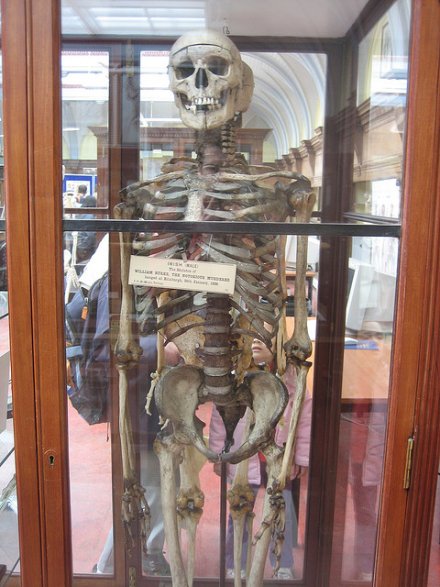
Almost a score of suspicious bodies later (and after the price had inflated to 10 pounds per), the pair was found out, given away as suspects by the lame and mentally disabled “Daft Jamie” Wilson, then caught when the late Marjory Campbell Docherty was found by a fellow tenant under one of Burke’s lodge’s beds.
Hare copped to a string of murders* and played stool pigeon in exchange for a lighter sentence.
Burke went to the gallows to “vehement cheering from every quarter, mingled with groans and hisses.” (London Times, Feb. 2, 1829)
“When the cheers had subsided, the wretched man was assailed with every epithet of contempt and abhorrence,” the Times continued. “Not a single indication of pity was observable among the vast crowd: on the contrary, every countenance wore the lviely aspect of a gala-day.”
William Burke’s hanging.
As a corpse himself, Burke made one final contribution to science’s insatiable desire for bodies: his cadaver went straight from the gallows to the practiced hands of one Dr Alexander Monro, who performed a complete lecture while dissecting the murderer’s corpse.
Knox, for his part, paid not with his neck but with his reputation.
Though never charged with a crime, the doctor was run out of the the lecturing business, first by subtle and not-so-subtle actions by the University, and eventually by the passage of the Anatomy Act of 1832.
He was also unable to obtain any surgical post after the incident and spent his later years writing academic books and papers, none of which have lasted like the doggerel that shadowed his steps.
Burke’s the butcher, Hare’s the thief,
Knox, the boy who buys the beef.
A few books about Burke and Hare
Anatomy of Anatomy
Robert Knox was operating under the Murder Act of 1751, which expressly forbade the burial of an executed murderer while permitting the malefactor’s dissection.
The Act had the dual effect of allowing the state to gibbet executed criminals (both hanging in chains and dissection were considered an added ignominy, beyond the punishment of the gallows), and of supplying the budding medical community with an immediate source of fresh bodies.
As courses in anatomy became more commonplace, though, the need for cadavers increased dramatically, and the business of selling bodies for science was born.
Typically, these sales manifested themselves in body-snatching — wherein “resurrectionists” illicitly exhumed a freshly buried corpse and conveyed it to some physician’s ready scalpel.
This grim trade in turn spawned a variety of security measures. The favored dead were defended by fences, watchtowers, and human lookouts. But nothing could eliminate the industry.
In particular, those with little money or no immediate relatives were unlikely to be buried in these gated graves; that left their remains ripe for the remaindering. As well, the increase in demand made so-called anatomy murder a possibility. Burke and Hare may have been notorious for the offense,** but they did not invent it.
In that case, two nurses (Jean Waldie and Helen Torrence) on death watch bartered a decent price of two shillings to sell the body of an ill child to a local surgical college. His death was delayed, and the nurses smothered him, possibly through simple carelessness.
Shortly after the Murder Act, simple economics made pikers of Torrence and Waldie. In the 17th century, England executed hundreds of prisoners a year, each a potential dissection. As Dr D.R. Johnson writes in his Introductory Anatomy:
The dissections performed on hanged felons were public: indeed part of the punishment was the delivery from hangman to surgeons at the gallows following public execution, and later public exhibition of the open body itself. …
Agents representing surgeons would bargain with condemned prisoners not under sentence of dissection (remember this only happened for murder: hanging was in vogue for stealing a sheep or even a loaf): occasionally prisoners struck a bargain to pay expenses, to provide for a family or to buy the customary decent apparel for the hanging.
Supply was unreliable, however: riots at public hangings became common, partly because of the paltry nature of hanging events, partly from superstition. The body was often reclaimed by relatives and the unpopular anatomists stoned, defeated and out of pocket. Competition was often so fierce that a rival anatomy school carried off the body.
Dissection was unpopular and other medical uses were to be found for a recently hung body – the cure of scofula, goitre, wens, ulcers, bleeding tumours, cancers and withered limbs for example. To prevent riots and disorder the Sheriff of London took all bodies of hanged men, except those sentenced to dissection, into his own custody and handed them to the relatives for burial.
Human Trafficking
Hanoverian Britain sure did keep the gallows busy. But the pace of hangings had abated by the 19th century just as demand boomed. The math didn’t add up.
Anatomy schools (officially) dissected some 592 corpses in 1825; at the time of the Burke and Hare murders, only about 50 executions were carried out annually, and each college was guaranteed just one a year.
That meant a shortfall of close to 550 bodies. With limited supply and significant demand, surgical colleges and anatomical lecturers were willing to pay top dollar for new cadavers … and the anatomical murder business really got legs.
And while the execution of Burke was met with applause from the community, in London, another group was already hard at work both body snatching and murdering its way into the classroom.
The London Burkers were caught in 1831 and convicted of murdering a 14-year-old whose cadaver they sold to St Bartholemew’s Hospital for 9 guineas.† The killers, Thomas Williams and John Bishop, had offed several others prior to the lad in question, making about the same price on each body.‡ In the grand, Burkean tradition of anatomical murderers, these miscreants were also dissected after their execution.§
Williams and Bishop were just two of a group of resurrectionists known collectively as the London Burkers, who claimed to have stolen upwards of 1,000 bodies from nearby cemeteries. That made the Burkers the largest known exploiters of the anatomical trade.
Over the decades after the Murder Act, though, resurrectionists were walking a dangerous line in their communities.
Reverence for the dead sparked community outrage when graves were found empty or disturbed, and it was often the anatomists themselves who felt the wrath of crowds.§§ In Glasgow in 1803, surgeons were threatened by an unruly mob and were forced to seek police protection; in 1813, an empty grave caused a similar furor. Punishments moved from fines to jail time as the surging demand made body-snatching an ever more lucrative trade.
A few books about body-snatching
By the time of the Burkers, anatomists were generally presumed to be body thieves in some capacity, a hostile sentiment graphically underscored during the Aberdeen riots of 1831. When a dog unearthed what looked like a human bone behind the Aberdeen surgical college, a mob coalesced and stormed the lecture hall.
The lecturer (“Dr Moir” — little else is known about the man) fled in terror as the hall was burned to the ground. Soldiers and police clashed with the crowd, which was thought to be over 10,000 strong. Hours later, the riot subsided, but Aberdeen was no longer a friendly place for a prospective medical talent.
And where Burke and Hare were still not quite sufficient to convince the House of Lords to take up a measure providing anatomists with alternatives for corpse acquisition, the Burkers and the Aberdeen riots apparently were.
The underground economy of resurrectionists was supplanted by the Anatomy Act of 1832, which allowed individuals to donate themselves or their unwilled kin to science for a pittance of compensation.
Anatomy murder is, of course, still the subject of horror movies. Like this one, or for the more classically inclined, this 1945 Boris Karloff/Bela Lugosi vehicle adapted from a Robert Louis Stevenson story inspired by Burke and Hare:
* The murders included at least one husband/wife pair, a mother and, later, her (adult) daughter, and a grandmother and her young grandson. They are also known as the West Port Murders.
** Burke entered the English language as a verb meaning … well, pretty much exactly what Burke got up to.
Dr. Murray, in the new English Dictionary, gives the following definition of the verb to ‘burke.’ ‘To murder in the same manner or for the same purpose as Burke did: to kill secretly by suffocation or strangulation, or for the purpose of selling the victim’s body for dissection,’ and the familiar lines are quoted from the Ingoldsby Legends: —
But when beat on his knees, that confounded De Guise
Just whipped out the “fogle” that caused all the breeze,
Pulled it tight round his neck until backwards it jerked him,
And the rest of the rascals jumped on him and burked him.
† 9 pounds, 9 shillings; by the time of the transactions, the guinea was no longer technically in use, but the term had stuck at the 21-shilling mark.
‡ Over the course of their 6 active months, the pair went from asking 8 guineas to asking 12 guineas; apparently 9 was the negotiated price with St Bartholemew’s.
§ The Burkers are the subject of the song “The Resurrectionist” by the Pet Shop Boys. (Lyrics)
§§ Edinburgh also had trouble as far back as 1742, when several surgeons’ homes were attacked by locals; a local beadle suspected of the crimes also had his home, dubbed resurrectionist hall, burned during the mob incident.
On this date in 1550, the leaders of England’s Prayer Book Rebellion were hanged, drawn, and quartered at Tyburn.
When Henry VIII dropped dead in 1547 and pitched his contentious realm and dubious progeny into the mid-Tudor crisis, Henry’s old theological henchman Thomas Cranmer really got to work.
During the unsteady regency of Henry’s sickly heir, Cranmer would push frenetically to make the religious reformation that his former boss never completely backed. The Archbishop sent to the continent for Protestant theologians like Peter Martyr who could help him “do away with doctrinal controversies and establish an entire system of true doctrine.”
The piece de resistance of Cranmer’s project was his Book of Common Prayer — a reformed liturgy, and in English, to go with the new English Bible. Many centuries — and revisions — later, it’s still the basis of Anglican services and of rites in many other Protestant denominations.
In 1549, it debuted to decidedly mixed reviews.
Enforced by Parliament’s Act of Uniformity, the Book of Common Prayer replaced all Latin liturgies on Whitsunday 1549, and for many of England’s Catholics, it was one affront too many. (The country’s bumpy economic realignment couldn’t have helped matters.)
On Whitmonday, traditionally-minded parishioners in West Devon unimpressed* with this newfangled vernacular service forced their local cleric to break out the old vestments and say Mass in Latin. State attempts to enforce the ban soon produced a martyr for the cause — one William Hellyons, melodramatically impaled on a pitchfork — and a march to Exeter that spiraled into outright revolt, heavy with suppressed Cornish nationalism.
We, the Cornishmen, whereof certain of us understand no English, utterly refuse this new English.
Religion, theology, the liturgy, the text of the Scripture … these were things that early modern Europeans were ready to fight and die for.
Since this considerable plunder of Church wealth had been widely redistributed to the English gentry, talk about repossessing it really emptied the pews of potential allies.
At any rate, neither Latin nor monastic restoration would be provided as carrots; London under Lord Protector Edward Seymour instead put down the rising with the more customary stick.
Such principals as remained were reserved a more awful fate: drawing and quartering at Tyburn. These seem to be the chaps who endured it:
Henry Bray, Mayor of Bodmin
Landowner and military leader Humphrey Arundell
Landowner John Wynslade
Thomas Holmes
John Bury
Bill Ind, Anglican Bishop of Truro, made news in 2007 acknowledging “that the English government behaved brutally and stupidly” in crushing the rebellion.
We wyll haue the Sacrament hang Oller the hyeghe aulter, and there to be worshypped as it was wount to be, and they whiche will not thereto consent, we wyll haue them dye lyke heretykes against the Holy Catholyque fayth.
We wyll haue . . . images to be set vp again in euery church, and all other auncient olde Ceremonyes vsed heretofore, by our mother the holy Church.
We wyll not receyue the newe seruyce because it is but lyke a Christmas game, but we wyll haue oure old seruice of Mattens, masse, Euensong and procession in Latten as it was before.
On this date in 1400, English aristocrat John Holland, Earl of Huntingdon and (formerly) Duke of Exeter, lost his head for the Epiphany Rising.
John Holland’s coat of arms.
Half-brother to (and staunch ally of) Richard II, the violentJohn Holland prospered during the king’s acme in the 1390s. A variety of lucrative posts accumulated as honoraria for Holland’s exertions in the military and political fields.
Unfortunately for “Exeter”, a fellow Lord Appellant named Henry Bolingbroke was about to successfully depose Richard II, and style himself Henry IV.
Holland’s loyalty to the former King Richard, now held under lock and key, became distinctly impolitic.
Having been dispossessed of the Exeter title, earned by service the new sovereign did not consider meritorious, John Holland got in on a plot to kidnap Henry IV during a tournament at Windsor … which devolved, when Henry found out about it, into an abortive rising with a number of executions. Richard FitzAlan’s sister (also Henry IV’s mother-in-law) had the satisfaction of ordering Holland’s beheading at Pleshy Castle, Essex.
Holland’s loyalty to Richard II ultimately did them both in: because the Epiphany Rising so graphically illustrated the danger that a living rival claimant posed to Henry IV, the king had his imprisoned predecessor murdered behind dungeon walls that February.
And of course, while that act secured Henry’s throne, Bolingbroke could never entirely chop his way to uncontested legitimacy: the rival successions of Henry IV and Richard II came to blows decades later in the War of the Roses. (Much to the profit of this site.)
On this date in 1905,* the last bastion of the abortive 1905 Russian Revolution was smashed with mass executions of the radical Russian proletariat who constituted Moscow’s Presnia district.
The long, uphill struggle of tsarist Russia to adapt its economy and political institutions to modernity was nearing its final failure.
A shadow play of that approaching cataclysm would unfold in 1905, when popular dissatisfaction won a short-lived period of constitutional government.
Radicals disdained these half-measures, however, and shook the realm with a general strike in December 1905 — a small quake only, since Russia’s proletariat was still too small to constitute a real threat to the state.
And the capital of insurrectionary labor was Muscovite factory district of Presnia or Presnya. There, a botched attempt to suppress strikers resulted in an armed standoff; “Red Presnia” (Krasnaia or Krasnaya Presnia) ended in carnage when the overmatched workers were besieged by the Semyonovsky Guard.
A political cartoon trilogy on the annihilation of Red Presnia: from the top, The Entrance, The Battle, and The Pacification (picturing the Kremlin sinking in blood). They’re from this public domain Google book; scroll up from the link to pp. 35-38 for more unflattering drawings of the tsar as a tinhorn murderer.
On the night of the sixteenth Presnya was encircled in an iron ring of government troops. Soon after 6:00 a.m. on the seventeenth these troops opened a remorseless cannonade. Guns were fired as much as seven times a minute. This continued, with an hour’s respite, until 4:00 p.m. Many factories and houses were destroyed and set on fire. The barrage was conducted from two sides. Houses and barricades were in flames, women and children darted about the streets in clouds of black smoke, the air was filled with the roar and clatter of firing.
Detail view (click for the full image) of an illustration of a Red Presnia barricade under fire from the Semenovsky Guard. (Source)
The glow was such that miles away it was possible to read in the streets late at night, as though it were day. Until noon the druzhiny [the workers’ militia] conducted successful operations against the troops, but continuous enemy fire forced them to stop. Only a small group of druzhinniki remained under arms on their own initiative and at their own risk.
By the morning of the eighteenth Presnya had been cleared of barricades. The “peaceful” population were allowed to leave Presnya; the troops were careless enough to allow people to leave without searching them. The druzhinniki were the first to leave, some of them still with arms. Later, there were shootings and other violence by the soldiers, but by then not a single druzhinnik remained in the area.
The “pacification troops” of the Semyonovsky regiment, who were sent to “pacify” the railway, were ordered not to make arrests and to proceed with out mercy.** They met with no resistance anywhere. Not a single shot was fired against them, yet they killed approximately 150 persons on the railway line. The shootings were carried out without investigation or trial. Wounded men were taken from ambulance wagons and finished off. Corpses lay around without anyone daring to carry them away. One of those shot by the Petersburg guards was the engine-driver Ukhtomsky, who saved the lives of a group of druzhinniki by driving them away on his engine at colossal speed under machine-gun fire. Before they shot him, he told his executioners what he had done: “All are safe,” he concluded with calm pride, “you’ll never get them now.”
“No single act during this period of governmental vengeance,” one chronicle remarked, “stands out more senseless than the punitive expeditions of the Semyonovsky Regiment on the Moscow-Kazan railroad.”
In the course of my inquiries about the activities of the Semyonovski regiment along the Moscow-Kazan line, I heard many stories about Engineer Ukhtomski, who showed heroic firmness in the last moments of his life. Part of this information was given by the captain of the Semyonovski regiment which executed him in Lubertzy,† together with three other workingmen. The captain, who observed him in his last moments, was charmed by his personality; the soldiers felt a deep reverence for him, their esteem being expressed in the fact that after the first volley he remained untouched. Not one bullet had grazed him.
His appearance was in no way striking. Of medium height, with vivid, clever eyes, he gave the impression of a very modest, almost bashful, man.
It was a mere accident that he fell into the hands of the punitive expedition. He was traveling in a carriage, when he stopped in the Lubertzy inn, ignorant of the presence of soldiers at the station. He was searched and a revolver was found in his pocket, which caused his arrest. He was brought before the officer in charge.
Questioned as to his name, he refused to reveal it. The officer went over the lists and the photographs of the revolutionists, comparing them with the live original before him. then he exclaimed:
‘You are Engineer Ukhtomski; you will be shot!’
‘I thought so,’ Ukhtomski answered coolly.
This happened in the afternoon, about three o’clock. He was asked whether he did not want to take the communion, and expressed his desire to do so.
After the communion he was taken, together with three workingmen of the Lubertzy brake-factory, to the place of execution. He made the following statement, addressing the officer:
‘I knew that, once in your hands, I should be shot; I was prepared for death, and that is why I am so calm. … ‘
At the place of execution they wanted to blindfold Ukhtomski. He asked the favor of meeting death squarely, face to face. He also refused to turn his back to the soldiers.
…
The soldiers fired. The workingmen dropped. Ukhtomski was not hurt. He stood erect, arms folded on his breast.
The soldiers fired again. He fell on the snow, but he was still alive and fully conscious. He looked around, with eyes full of anguish.
Standing just thirteen years later over the remains of that vanquished tsarism, V.I. Lenin paid the martyrs of Presnia tribute for sacrifices “not in vain”:
Before the armed insurrection of December 1905, the people of Russia were incapable of waging a mass armed struggle against their exploiters. After December they were no longer the same people. They had been reborn. They had received their baptism of fire. They had been steeled in revolt. They trained the fighters who were victorious in 1917 and who now, despite the incredible difficulties, and overcoming the torments of hunger arid devastation caused by the imperialist war, are fighting for the world victory of socialism.
Long live the workers of Red Presnya, the vanguard of the world workers’ revolution!
* New Year’s Eve by the Gregorian calendar; tsarist Russia was still on the archaic, 13-days-slower Julian calendar, so the dates within Russia were (as reflected in the Trotsky passage) Dec. 17 for the storming of Red Presnia, and Dec. 18 for this date’s slaughter.
† Summary executions continued for some days, but a Jan. 2, 1906 London Times wire dispatch datelined Jan. 1 appears to situate the particular slaughter that would have claimed Ukhtomsky:
The majority of the revolutionaries in the Presnia quarter succeeded in escaping. About 100 surrendered to General Min to save the houses of the poor from destruction. Artillery and troops are clearing the Kazan railway and are capturing station after station. Three hundred railwaymen have been killed and yesterday 70 were summarily shot at Lubertsy. Moscow is becoming quiet.
“The river Moskva at the Presnia Verck,” the correspondent observed, “is covered with corpses of revolutionaries scattered over the ice.”
On this date in 1883, Fenian Patrick O’Donnell was hanged at Newgate for the murder of James Carey.
O’Donnell — or Padraig O Domhnaill, more Gaelically — was a casualty of the Irish nationalist struggle; his path to the gallows began on May 6, 1882, when an Irish republican group known as the Invincibles stabbed to death two prominent officials of the British crown as they walked through Dublin’s Phoenix Park.
The Invincibles were ultimately collared — and then hemp-collared — with the assistance of one of their own number who turned queen’s evidence and put five of his former confederates in the noose.
Now in peril of life and limb himself, the turncoat James Carey got a new identity and a ticket on a passenger ship from his recent British enemies. But Carey either got sloppy and blew his cover — provoking O’Donnell to take the opportunity to kill him — or was found out by the Fenians before he left — and O’Donnell sent to stalk him.
The matter is still disputed, and it was disputed at O’Donnell’s trial (further to the question of motive and premeditation; the defense claimed that O’Donnell killed in self-defense during an affray).
That defense didn’t fly. Even advancing it, O’Donnell’s defenders would rather celebrate the intrepidity of his action than plead its extenuating circumstances; riotous celebrations with Carey burned in effigy were reported in Ireland when the news of Carey’s murder broke.
O’Donnell was apparently an American citizen, and his case generated a considerable groundswell from the ample Irish immigrant community stateside.*; he had lived in the anthracite mining regions of Pennsylvania and the Pennsylvania O’Donnells were big players in the shadowy Irish labor-terrorist-revolutionary Molly Maguires.
Now he’s dead, he’s laid to rest,
Let honour be his name,
Let no one look upon him
With scorn or disdain;
His impulse it is human,
Which no one can deny,
I hope he’ll be forgiven
By the infinite Lord on high.
If every son in Erin’s Isle
Had such a heart as he,
Soon they’d set their native land
Once more at liberty;
They’d unfurl their flag unto the British,
Their rights they would redeem
In unity and friendship,
In the lands far over the sea.
O’Donnell was one of the very few hanged by the great English executioner William Marwood‘s subpar successor Bartholemew Binns. Binns and his assistant were arrested in the process, having attempted to skip the fare for the train to London.
* For instance, the Dec. 10, 1883 Freeman’s Journal and Daily Commercial Advertiser in Dublin reported that President Chester A. Arthur received a deputation urging him to press for clemency consisting of congressmen “Cox and Robinson, New York; Mirrosn, Springer, and Sinertz, Illinois; Lefevre and Foran, Ohio; Murphy, Iowa; Mabury, William Lamb, Indiana; M’Adoo, New Jersey; Collins, Massachusetts, and O’Neill and Burns, Missouri.”
On this date in 1965, 24 Burundians were shot following mass trials in the stormy aftermath of an attempted coup.
Burundi met post-colonial independence deprived by an assassin’s bullet of the popular, unifying figure who might have kept ethnic conflict under control, and many years of living dangerously ensued as Hutu and Tutsi grappled for power.
On October 18, 1965, a group of Hutu officers attempted a coup d’etat against Burundi’s monarchy — and failed.
the events of October 1965 carried momentous consequences. The mutineers took a huge gamble and lost … power became the exclusive monopoly of Tutsi elements.
… In the capital, virtually every Hutu leader was apprehended.
While the putschists were unsurprisingly executed, the Tutsi-authored backlash cast a much wider net, ultimately claiming up to 5,000 lives. (It was only a dress rehearsal for a similar scenario — Hutu rebellion triggering massive Tutsi crackdown — that resulted in a full-on genocide in 1972.)
Various executions peppered the weeks after the intended coup; this date’s was one of the last of the particularly noteworthy. The New York Times (Dec. 21, 1965) described those “executed in the Central African kingdom Wednesday after mass trials” as “Joseph Bamina,* a former Burundi Premier … [and] 23 others included two prominent political leaders.”
Burundi did not live happily ever after.
* Lamarchand calls Bamina one of the “hard-core Hutu opposition.”
On this date in 1828, Argentine independence hero Manuel Dorrego was shot in Buenos Aires — a casualty of that country’s unfolding civil war.
Dorrego (English Wikipedia entry | the more detailed Spanish), the youngest son of a Portuguese merchant, became a brilliant soldier of his country with an adventuresome career in the Argentine War of Independence, at one point taking refuge in exile in Baltimore, U.S.
If one likes, that sojourn in a functioning republic firmed up Dorrego’s commitment to federalism — the principle that would animate a decades-long internal conflict over division of power in the newly independent state.
Argentina’s federalists approved a distribution of power to its constituent regions; the opposing unitarians wanted a strong central government in Buenos Aires.
And they did not confine their disputes to pamphlets.
Resistance from the provinces to overweening Buenos Aires and Argentina’s unitarian first president Bernardino Rivadavia helped precipitate that gentleman’s fall from power and the dissolution of the national government.
Dorrego became Governor of Buenos Aires in August 1827, and exercised de facto head of state powers — for instance, he formally accepted the treaty ending hostilities in the Argentina-Brazil War.*
But a rough customer of the unitarian camp, Gen. Juan Lavalle, overthrew Dorrego’s government and mounted a terrifying purge of federales.**
Beginning, of course, with Dorrego himself, who was given one hour’s advance notice of his entirely extrajudicial shooting.
Most of the detailed information available online about this martyr is in Spanish — see here, here, here, and here, for instance.
* The fruit of this treaty was the independent state of Uruguay, as each side gave up trying to take that territory from the other by force.
** Until Lavalle was ousted by the next great unitarian leader, Juan Manuel de Rosas.
The year was 1603, the first in the reign of James I. (However, he’d been James VI of Scotland since the tender age of 13 months, when his mother Mary, Queen of Scots had been forced to abdicate. He made himself quite a reputation for witch-hunting.)
With the death of the Protestant Queen Elizabeth and all her schismatic Anne Boleyn mojo, hard-pressed English Catholics greeted Jamie’s ascension hopeful of relief from official persecution. Although raised Protestant, both his parents had been Catholic.
Watson was one of these hopeful adherents, and hastened himself to Scotland as Queen Elizabeth lay ailing to extract from the future English monarch the soothing blandishments of good favor that future monarchs make.
When toleration was not extended to Catholics upon the new king’s elevation in late March 1603, the disenchanted Watson almost immediately embarked on a preposterous scheme to
assemble force and strengthe, and on Midsommer-day last, in the night, to come to the Parke pale at Grenewich, to enter in by the gardein with a key, that should be borowed; and when the numbers were come in, there should be a watche set at the dores of principall persons, and at the passages; and then to goe up to the KING’S loding. And when they cam to the KING, they should surprise his person, and carry him to the Tower, and they would move him for 3 things: — 1, for there pardon; 2, for tolleration of relligion; 3, for assuraunce thereof, to preferre Catholiques to places of credit, as WATZON the priest to be Lord Keper; GREY, Erle Marshall; GEORGE BROOKE, Lord Treasorer; and MARCAM, Secretary. They concluded to cutt of many of the Privy Councill, and to have made a Proclamation, purporting howe the KING had bene misled, and to have had many things reformed. They determined to have possessed the principall ports of the realme, and to have kept the KING in the Towre a quarter of a yeare.
The Bye Plot was ironically busted by other Catholics — Jesuits, as distinct from “secular clergy” (clergy not affiliated with an order) like Watson. Jesuits and secular clergy were at loggerheads in this period over tactics, church structure … more or less everything. The need to steal the thunder of whatever restore-the-Church scheme the Jesuits might be cooking up might have helped precipitate Watson into such immediate and desperate disaffection.
At any rate, these other more respectable fathers of the church blew the whistle on the Bye Plot lest it provoke anti-Catholic pogroms, and you’d have to concur with their estimate that taking the king hostage is the sort of thing that would have prompted some blowback.
In the course of rolling up the now-exposed Bye Plot, investigators also caught wind of the parallel Main Plot, courtesy of one conspirator who was involved in both and unable to hold his tongue under torture.
The Main Plot was a sketchier affair to a similar end, allegedly among Catholic-sympathizing nobles to depose James for his cousin. As befits its title, the Main Plot implicated much bluer blood than Watson’s: Lord Cobham,* Baron Grey, and the knighted soldier Griffin Markham.
Oh, and a guy you might have heard of by the name of Walter Raleigh.
All these Main Plot gentlemen were likewise condemned to death. December 9, 1603 was the date appointed for Watson and Clark to expiate the Bye Plot in the grisly manner that commoner priests were wont to suffer in that age — they as the undercard to the beheadings of Cobham, Grey, and Markham. (Raleigh was on deck for a later date.)
The drama that unfolded on the Winchester scaffold that day was wonderfully narrated in the correspondence of Sir Dudley Carleton and well worth extracting at length.
The two priests that led the way to the execution were very bloodily handled; for they were both cut down alive; and Clarke, to whom more favour was intended, had the worse luck; for he both strove to help himself, and spake after he was cut down. They died boldly both … Their quarters were set on Winchester gates, and their heads on the first Tower of the castle.
…
Warrants were signed, and sent to Sir Benjamin Tichborne, on Wednesday last at night, for Markham, Grey, and Cobham, woh in this order were to take their turns … A fouler day could hardly have been picked out, or fitter for such a tragedy. Markham being brought to the scaffold, was much dismayed, and complained much of his hard hap, to be deluded with hopes and brought to that place unprepared. One might see in his face the very picture of sorrow; but he seemed not to want resolution … [and] prepared himself to the block. The sheriff, in the mean time, was secretly withdrawn … whereupon the execution was stayed, and Markham left upon the scaffold to entertain his own thoughts, which, no doubt, were as melancholy as his countenance, sad and heavy. The sheriff, at his return, told him, that since he was so ill prepared, he should yet have two hours respite, so led him from the scaffold, without giving him any more comfort, and locked him into the great hall … The lord Grey, whose turn was next, was led to the scaffold by a troop of the young courtiers … and thereupon entered into a long prayer for the king’s good estate, which held us in the rain more than half an hour; but being come to a full point, the sheriff stayed him, and said, he had received orders from the king, to change the order of the execution, and that the lord Cobham was to go before him … he had no more hope given him, than of an hour’s respite; neither could any man yet dive into the mystery of this strange proceeding.
The lord Cobham, who was now to play his part, and by his former actions promised nothing but matiere pour rire, did much cozen the world; for he came to the scaffold with good assurance, and contempt of death. … [he] would have taken a short farewel of the world, with that constancy and boldness, that we might see by him, it is an easier matter to die well than live well.
He was stayed by the sheriff, and told, that there resteth yet somewhat else to be done; for that he was to be confronted with some other of the prisoners, but named none. So as Grey and Markham being brought back to the scaffold, as they then were, but nothing acquainted with what had passed, no more than the lookers-on with what should follow, looked strange one upon the other like men beheaded, and met again in the other world. Now all the actors being together on the stage (as use is at the end of a play,) the sheriff made a short speech unto them, by way of the interrogatory of the heinousness of their offences, the justness of their trials, their lawful condemnation, and due execution there to be performed; to all which they assented; then, saith the sheriff, see the mercy of your prince, who, of himself, hath sent hither to countermand, and given you your lives. There was then no need to beg a plaudite of the audience, for it was given with such hues and cries, that it went from the castle into the town, and there began afresh, as if there had been some such like accident. And this experience was made of the difference of examples of justice and mercy; that in this last, no man could cry loud enough, ‘God save the King;’ and at the holding up of [the previously executed] Brookes’s head, when the executioner began the same cry, he was not seconded by the voice of any one man, but the sheriff. You must think, if the spectators were so glad, the actors were not sorry; for even those that went best resolved to death, were glad of life … Raleigh, you must think (who had a window opened that way), had hammers working in his head, to beat out the meaning of this strategem. His turn was to come on Monday next; but the king has pardoned him with the rest, and confined him with the two lords to the Tower of London, there to remain during pleasure.
Turns out that James wanted to do only the minimum amount of butchery necessary to establish his bona fides, and it sure seems like the mercy play proved a public relations triumph.** Raleigh was left by this reprieve languishing in the Tower for years, before his own final adventure saw him to the block after all in 1618.
Would you like some bootless speculation that Raleigh’s being caught up in this mess led him to nurture during his imprisonment a decade-long grudge against William Shakespeare and eventually murder the playwright? Of course you would.
In the world of more demonstrable historical consequences, the failure of these plots and continuing frustration with Catholics’ lot under a new boss who seemed a lot like the old led two years later to the ne plus ultra of English sectarian terrorism, Guy Fawkes‘s Gunpowder Plot to blow King James and his court straight to kingdom come.
* Cobham was a descendant of John Oldcastle and is supposed to have forced Shakespeare to redact the family name in his Henry V plays — giving us, instead, the character of Falstaff.
** One is obliged to notice Carleton’s disquieting footnote indicating that the entire affair was staged so well that someone almost actually lost his head:
… there was another cross adventure; for John Gib could not get so near the scaffold, that he could speak to the sheriff, but was thrust out amongst the boys, and was fain to call out to sir James Hayes, or else Markham might have lost his neck.
Topical sourcing: Mark Nicholls, “Treason’s Reward: The Punishment of Conspirators in the Bye Plot of 1603” The Historical Journal, Vol. 38, No. 4 (Dec., 1995).
On this day in 1499, Perkin Warbeck, pretender to the English throne, was hung at Tyburn for treason. He didn’t fare as well as the previous royal pretender, Lambert Simnel, who was pardoned by King Henry VII and made a spit-turner in the royal kitchens.
Warbeck claimed he was Richard, Duke of York, the younger son of King Edward IV. Richard and his older brother, the would-be Edward V, mysteriously vanished around 1483, allegedly murdered by their allegedly evil uncle Richard III, who had already had them declared illegitimate. (Shakespeare made this version — which was congenial to the ruling Tudor dynasty of his time — the standard in Richard III; the play channeled Thomas More‘s history of Richard.)
The murder story has never been proven and the princes’ bodies were never identified, leaving a yeasty petri dish for pretenders to grow and multiply — and so they did.
Warbeck, who later admitted he was actually born in Tournai, in Flanders, in approximately 1474 (his father is described by one source as “a renegade Jew”) first claimed to be the Duke of York either while at the court of Burgundy in France in 1490, or while serving a silk merchant in Ireland in 1491.
He did bear a strong resemblance to Edward IV, but there is no evidence that he was really Richard of York or that he and the late king were related in any way.
Nonetheless, his claim was soon recognized by Charles VIII, King of France … and it naturally appealed to the fledgling Tudor dynasty’s potential internal rivals, too.
Margaret of Burgundy, who was Edward IV’s sister and the disappeared Duke of York’s aunt, was one of these educated the pretender about “his” history and the ways of the English court, and she helped finance Warbeck’s attempted conquest of England in 1495. It went badly from the beginning: Warbeck’s army was trounced and 150 of his troops were killed on the beach in Kent before he even made it ashore. Warbeck fled to Ireland and then Scotland.
Warbeck had more success in his second invasion attempt, in Cornwall in 1497 on the heels of the Cornish Rebellion.
Warbeck promised an end to the exorbitant taxes levied on the citizenry, which welcomed both pretender and promise with open arms. His army grew to 6,000 or 7,000 men, and Warbeck began calling himself Richard IV of England, but when he found out King Henry was after him he panicked and deserted his men.
He was captured and imprisoned at the infamous Tower of London, but not before being “paraded through the streets on horseback amid much hooting and derision of the citizens.”
The execution was not until 1499, and only after it was alleged that Warbeck tried to escape with a real royal claimant, Edward Plantagenet, Earl of Warwick. On November 23, Warbeck was taken from the Tower to Tyburn, where he read out a confession and was hanged. His wife, Lady Catherine Gordon, a cousin of the King of Scotland, had a better fate; she was given a pension and a job of lady-in-waiting to the Queen.

 Having just cracked his twenties, the young Abruzzo native fled to Argentina with the rise of Benito Mussolini.
 Almost a score of suspicious bodies later (and after the price had inflated to 10 pounds per), the pair was found out, given away as suspects by the lame and mentally disabled “Daft Jamie” Wilson, then caught when the late Marjory Campbell Docherty was found by a fellow tenant under one of Burke’s lodge’s beds.


 Dorrego (
 Warbeck, who later admitted he was actually born in Tournai, in Flanders, in approximately 1474 (his father is described by