Sunday, Nov. 21 in 1920 was “Bloody Sunday” in Ireland, a date begun with the IRA execution of British agents in Dublin, and concluded with three IRA men killed in British custody.
Thirty-one people lost their lives on this 1920 Bloody Sunday, a signal event of the Irish War of Independence; the thirteen of them who were British intelligence officers or assets targeted for an en masse morning liquidation suffices to qualify the affair for these grim pages.
“Executions”, assassinations or otherwise, the killings were ordered by Irish revolutionary Michael Collins in the escalating dirty war between his Irish Republican Army and the Black and Tans dispatched by London to crush the IRA.
My one intention was the destruction of the undesirables who continued to make miserable the lives of ordinary decent citizens. I have proof enough to assure myself of the atrocities which this gang of spies and informers have committed. If I had a second motive it was no more than a feeling such as I would have for a dangerous reptile. By their destruction the very air is made sweeter. For myself, my conscience is clear. There is no crime in detecting in wartime the spy and the informer. They have destroyed without trial. I have paid them back in their own coin.
-Michael Collins, on the executions
There were a couple of hitches in the plan: most particularly, that out of an initial list of 50 targets, Collins had been forced by his own government to trim to 35 … and then his hit teams “only” actually managed to get about a third of them.
And, of course, it drew a British rampage that day, most famously at a football match at Croke Park* concluding when Dirk McKee, Peadar Clancy and Conor Clune were killed that evening in a British police station — “trying to escape.”
But in all, the day was a coup for the Republicans, who crippled British intelligence in Dublin and gave any future recruits grave reason to think twice about the engagement, while reaping a public relations bonanza both domestic and international from the indiscriminate English response against civilians.
Occurring as it did while the fight for Ireland everywhereintensified — and that fight culminating in Ireland’s independence** — 1920’s Bloody Sunday is a sacred day for Irish nationalism.
Just to be clear, however, this is not the Bloody Sunday of U2 “Sunday Bloody Sunday” fame, which was an altogether different bit of carnage in 1972. “Bloody Sunday” actually has a disturbingly populous Wikipedia disambiguation page, with at least four Ireland-related entries and others from Turkey, Canada, South Africa, and points beyond.
* An England-Ireland rugby match in that stadium in 2007 grabbed headlines for its associations this date; you can see the respective anthems played before a respectful Irish crowd here.
On this date in 1808, the former, and now deposed, Ottoman Sultan Mustafa IV was strangled at the command of his successor and brother.
The Ottoman Empire, once the veryterror of westernChristendom, entered the 19th century in a stagnation that had it well on its way to its way to “sick man of Europe” status.
Its fate would be defined by the political — and sometimes literal — battle between its entrenched interests and forward-looking reformers who struggled to restructure the empire for the challenges that lay ahead.
And at this point, it wasn’t only the Ottoman polity that had to fret for its survival. Its very namesake dynasty was in danger of extinguishing itself. There hadn’t been a male born to the House of Osman in twenty years, and in the events herein narrated, internecine conflict would winnow the Osmans down to their very last man.
Aggressive Progressive
Reform was the project of our principal’s predecessor, Selim. In the years around the turn of the century, Selim endeavored to get Turkey out of its wasteful foreign conflicts to gain maneuvering room for more urgent domestic projects.*
Chief among the many oxes Selim proposed to gore were the Janissaries, the Ottomans’ powerful and increasingly archaic military elite, much given to destructive use of their martial prowess in various factional conflicts within the Empire.
Possessive Regressive
The Janissaries deposed Selim in 1807, elevating his cousin — our man, Mustafa, a mere handmaiden of the hidebound. (His contemporaries in Europe more commonly transliterated the name “Mustapha”)
They didn’t kill Selim … just left him alive within the palace where armed men could find him in a pinch.
That pinch arrived in June in the form of Mustafa Bayrakdar, a reformist official who marched on Istanbul to overthrow the reactionary elements. As Bayrakdar took the city in hand, Mustafa desperately ordered the executions of Selim and of Mustafa’s own brother, Mahmud.
Selim was disposed of. Mahmud got tipped off, and the servants — most famously, a Georgian harem girl named Cevri Kalfa — helped him escape to the roof. Mustafa Bayrakdar ousted the ousters before anyone who meant Mahmud ill could find him.
Impressive Successive
That left Mahmud the only choice for Sultan, and he followed his brother’s own questionable policy of consanguinary clemency. Mustafa’s demotion back to crown prince after having once ordered the now-sultan’s death must have made for some awkward chit-chat around the family table.
It didn’t last long. The London Times of January 16, 1809 reported** that
[o]n the 14th of November, at day-break, the Janissaries were seen assembling from all quarters, and being reinforced by those who were in the vicinity of Constantinople, they … massacred all the partisans of the Grand Vizier that came in their way. The contest spread to eveyr street in Constantinople … On the 15th, the Janissaries assaulted the high walls of the Seraglio; and it was at this moment that the Grand Vizier, after causing the unfortunate Mustapha IV, who was a prisoner there, to be strangled, blew himself up in his own Palace with gunpowder, of which he purposely provided a large quantity before-hand, to prevent his falling alive into the hands of his enemies.
Sauce for the goose was sauce for Mustafa, and on this same desperate day when he lost Bayrakdar to a vault of gunpowder, Mahmud had his brother put to death. This maneuver left Mahmud the last surviving male Osman.
Passive Aggressive?
The legacies of this date were varied and ambiguous.
Mahmud II remained on the Ottoman throne for the next three decades, ample time to secure the Osman line.
But Mahmud too was chastened by the experience — or else, too encumbered by the apparatus of the state, or too cautious of his legacy before that heir appeared (it took years), or simply too unskillful — and his reformist vision proceeded haltingly until the very end of his life, even as breakawaynations continued to erode the Porte’s influence.
Over a century and a half after his death, Mahmud II remains the most puzzling of the thirty-six Ottoman Sultans … Was he a despot or a reformer, a capricious betrayer of trust or a dedicated ruler of a vision, a muddler who plunged into disastrous wars or a shrewd statesman who preserved his Empire from rapacious neighbors? Should we think of him as the ‘Infidel Sultan’ who imposed European ways on the Islamic faithful, or as Mahmud Adli (‘Mahmud the Just’), like Turks today? The contrasts seem endless. Mahmud is one of history’s most enigmatic figures …
* Selim was sucked back into armed conflict by the Napoleonic wars.
** Though two months after the fact, the report is in media res, since it was transcribing German papers from mail dispatched out of the Ottoman capital on Nov. 16 when “the utmost confusion still prevailed there.”
(Thanks to Michael Baney for the guest post. -ed.)
On this date in 1991, a Peruvian death squad showed up at the wrong party, and altered its country’s history.
In 1980 the Communist Party of Peru, better known as the Shining Path, launched its “People’s War,” which was never actually supported by the majority of Peruvians. Latin America had had its share of Marxist revolts, but this one was different from the others. There was nothing romantic about the revolutionaries, who wore plain clothes rather than uniforms, attacked the civilian population rather than invest significant capital to win them over to the Shining Path cause, and rose up in an effort to overthrow a democracy rather than a dictatorship.
The Shining Path was based mainly in Andean villages, but once they began to take serious losses in their own territory, they made a concerted effort to accelerate the war by pushing into the capital city, Lima. Both the Shining Path and the Peruvian military were committing deplorable human rights violations by the time Alberto Fujimori was elected president in 1990, although the vast majority of the violence had been confined to the hinterlands of the country up until then.
With Fujimori’s election, more urban-based death squad activities began. Perhaps the most famous was the November 3, 1991 massacre in the Barrios Altos neighborhood of Lima, a poor barrio only a few minutes’ drive away from the Congress and the Presidential Palace.
This date’s incident occurred when members of Grupo Colina (English Wikipedia entry | Spanish), a death squad that was part of the Army Intelligence Service, believed that they had identified a group of Shining Path militants having a pollada, which is a traditional fundraiser in Peru where a party is held so that chicken and beer can be sold to the neighbors. (Here’s a description, in Spanish)
A Grupo Colina squad drove to the building where this terrorist pollada was supposed to be taking place, lined the partygoers up, and extrajudicially executed them with submachine guns with silencers that the army had provided the group for the operation. Then the leader of the group, Santiago Martin Rivas, shot a young child who came running over to the body of his father. The troops got back into their vehicles, turned on their sirens to appear like they were the police in an effort to shift blame over the killings, and got drunk at the beach to celebrate.
Almost immediately it became clear that the death squad members had completely screwed up their hit.
The people who had been murdered were indeed having a pollada … not to fund the Shining Path’s Maoist agrarian war, but to fix the pipes in their building
And it transpired that that fateful night of Nov. 3, there was a differentpollada being held on a different floor in the very same building. The participants of that other party fled the building, never to return. There were reports that upon searching the rooms of those who fled, police uncovered many issues of El Dario, the Shining Path newspaper.
If Grupo Colina indeed crashed the wrong party, then it not only slaughtered a bunch of innocent people — it helpfully tipped the Shining Path to the fact that the army was onto them.
In any event, the executions became a media spectacle and the police had to at least go through the motions of investigating them. At first, the government suggested that the murders might have been actually carried out by the Shining Path, and as evidence of this theory they showed that one of the people who had been killed was previously a member of a Ronda, which is a peasant patrol group that fought against cattle rustling and, in some cases, the Shining Path. But it later turned out that the man had been a member of the Rondas many years before and hundred of miles away from the killings, and it seemed extremely improbable that the Shining Path would even bother to target him.
By December 4, 1991, the US embassy in Lima was informing the Secretary of State that the Peruvian government lacked the political will to investigate the murders, and had lied about whether or not the guns used in the extrajudicial executions were equipped with silencers in “an apparently deliberate attempt to obfuscate the situation.”
The Congress created a committee to investigate the crimes, which was a real threat to the Fujimori government because the Fujimoristas did not have a majority in Congress.
This ceased to be a problem on April 5, 1992, when Fujimori suspended the Congress, permanently disbanded the Senate, and fired a good number of the judges in the country, all in total violation of the Constitution. That ended the investigation.
Under pressure from the international community, a new Congress stacked with Fujimoristas was convened to write a new Constitution, and the investigation of the Barrios Altos killing nominally restarted. When the Congress called Nicolas Hermoza Rios de Bari, the Chairman of the Joint Command of the Armed Forces to testify, he took the oppotunity to remind the Congress that the military would never tolerate being “insulted.” When hearings continued, Hermoza Rios held an impromptu tank parade directly in front of the Congress. The few brave Congressmen and women who actually desired to expose the truth about the killings got the message loud and clear: the case would never go anywhere as long as Fujimori remained president.
When it finally looked like the perpetrators might be punished, for example, Fujimori rammed a law through the Congress that provided a general amnesty to everyone who had violated human rights “in defense of the fatherland.” When a judge ruled the amnesty law unconstitutional, Fujimori’s Congress stripped the power of judicial review from the courts in cases of amnesty laws.
In a very real sense, the Peruvian government had legalized illegality. Fujimori created a system in which there was no way to punish — or even investigate — murder so long as someone, somewhere considered the crime to have been committed for patriotic reasons.
All that changed in 2000, however, when Fujimori’s government collapsed amid scandal.
An opposition figure who vowed to create a Truth and Reconciliation Commission was sworn in as into office, and Peru reaffirmed its commitment to the American Convention on Human Rights. In 2001, in a groundbreaking decision, the Inter-American Court of Human Rights ruled in its Barrios Altos case that countries cannot issue an amnesty for “serious human rights violations.” The amnesty was thrown out and Grupo Colina members were arrested.
In 2007, Alberto Fujimori was extradited from Chile, where he had traveled, to Peru. In 2009, the Peruvian courts convicted Fujimori of a number of human rights abuses, including ordering the Barrios Altos murders. Just last month, justice was finally served when the members of Grupo Colina were convicted of murder, kidnapping, forced disappearance, and conspiracy, and were given various sentences ranging up to 25 years of prison. After 19 years, the Peruvian government has finally acknowledged that the extrajudicial executions that took place during that country’s cold war were crimes that must not go unpunished.
It was a conflict uniquely suited for dividingcomrades; little wonder that it also divided comrades in arms.
Having lately bled for His Majesty in the War to End All Wars, plenty of Irish enlistees were nonplussed to see troops deployed to their own neighborhoods, Black and Tans shooting up their friends and family.*
From June 1920, a number of Irish Connaught Rangers “grounded arms” for their brethren in Eire, refusing to serve Britain while British troops occupied Ireland. One thing led to another, and a group (led by Daly, and his brother William) ended up trying to rush an armory to recover its weapons, opposed by other Rangers who remained loyal to the crown.
Fourteen death sentences were handed down for this show of indiscipline, but Daly’s was the only one actually carried out. The Rangers were disbanded two years later with the formation of the Irish Free State. And everyone lived happily ever after.
* Connaught Rangers had been used (without incident) to suppress the Easter Rising in 1916.
Top to bottom: Proskurov, Rychagov, Shtern, and Smushkevich.
“Quantity has a quality all its own.”
-Stalin
The aphoristic Uncle Joe doomed Soviet officers in both quantity and quality on this date in 1941, shooting 20 Soviet officers at the very moment when Mother Russia could have used them most.
This wouldn’t seem like the ideal time for a purge, but old habits are hard to break.
As the Wehrmacht closed in on Moscow, these prisoners had been evacuated to the Volga city of Kuybyshev (today, Samara). In this, they were already treated more courteously than some.
But any semblance of consideration for these fallen brass — to say nothing of bourgeois indulgences like due process — went out the window when an order arrived from Lavrenty Beria:
“Investigation to be stopped, all to be executed by firing squad without delay.”
They were.
Those “all” included:
Fighter ace Lt. Gen. Pavel Rychagov, who had sealed his fate by undiplomatically characterizing Soviet planes as “coffins.” (His wife was shot, too.)
Lithuanian pilot Yakov Smushkevich, a veteran of the Spanish Civil War and the Battle of Khalkhin Gol. Smushkevich’s daughter talks about him in this interview.
Gen. Grigori Shtern, who commanded the Battle of Khalkhin Gol.
Baltic commander Aleksandr Loktionov
Ivan Proskurov, an air force officer who’d forewarned of the impending German invasion, without effect. (He had good company.)
Many of this day’s victims were rehabilitated after Stalin fell.
Cold comfort, perhaps, but for their survivors there was bloodier satisfaction: the personal order Beria gave to execute them was in turn used against Beria when he was purged.
It’s a bit tangential, but here‘s an interesting interview with one of their contemporaries in Soviet combat aviation, who managed to survive those terrible years (despite being “taken out to be shot on three occasions” while a POW in Spain). There are some pictures of the planes these men would have used in this thread of a Spanish-language military forum.
Seventeen army officers were shot this day on the outskirts of Mogadishu for attempting to overthrow Somali dictator Siad Barre.
“The executions were carried out by by a firing squad formed of soldiers of the armed forces and were witnessed by thousands of people from all areas of Mogadishu,” said Mogadishu radio.
The abortive April 9 coup attempt seems to have been precipitated by Somalia’s ill-fated intervention in neighboring Ethiopia’s Ogaden region, a bloody little Cold War sideshow that saw both the U.S. (from Ethiopia, to Somalia) and Soviet Union (from Somalia, to Ethiopia) switch sides. Some of the officers concerned feared that Siad would come a-purgin’ after the last Somali forces slunk home on March 15, 1978.
Col Mohamed Sheikh Osman “Cirro”
Maj Siad Mohamed Jama
Maj Ibrahim Mohamed Hersi
Maj Siad Jama Nur
Capt Mohamed Ahmed Yusuf Aganeh
Capt Abdisalan Elmi Warsame
Capt Bashir Abshir Isa
Capt Abdillahi Hasan Nur
Lt Abdi Osman Ugas
Lt Abdirahman Maalin Bashir
Lt Adan Warsame Abdillahi
Lt Abdillahi Mahamud Guled
Lt Mohamed Abdullahi Husein (Gorod)
Lt Abdulwahab Ahmed Hashim
Lt Abdulqadir Gelle Omar
Sgt Farah Mohamed Halwo
Director Abdulqafar Warsame Abdilleh
But they’re perhaps most memorable for a coup participant not among their number, Abdullahi Yusuf Ahmed, who fled to Kenya and founded from exile the Somali Salvation Democratic Front, eventually one of the principal entities resisting the Barre regime. Ahmed served as President of Somalia from 2004 to 2008, but his government was unable to gain control of the notoriously fractious state or to end Somalia’s ongoing civil war.
On October 22, 1895, Cree warrior Almighty Voice was arrested for the considerable crime of killing a cow without the right permit. When a white guard japed that workmen were “erecting a scaffold from which you will be hanged next morning” — actually, they were putting up a building — it set off one of the longest and bloodiest manhunts in Saskatchewan history.
Almighty Voice took the prospect of having his neck stretched this date seriously enough to break out of prison the night of October 22-23.
A week later, a Mountie tried to arrest Almighty Voice and was shot dead for his trouble. From a spurious criminal complaint that likely would not have been pursued, the specter of the gallows had sent Almighty Voice into wanted-outlaw status.
For a year and a half he mostly avoided detection, and if the other Cree on his reservation had knowledge of his whereabouts, the government’s $500 reward was not enough to induce them to supply it.
In May 1897, Almighty Voice and two fellow-travelers were finally caught in a shootout. The Cree did just fine in this exchange, but two more Mounties and (for some reason) a postmaster were not so lucky.
The next day, the Mounties turned cannon on the Indians’ position, finally killing the three of them in the bombardment — or else inducing them to kill themselves.
Nineteen months on, seven men were dead on account of our guard’s ill-chosen bit of gallows “humor.” Hardy-har-har. But Almighty Voice remains a legendary name in Saskatchewan.
On this date in 1999, Yemen executed (in its own inimitable style) terrorist Zein al-Abidine al-Mihdar, for orchestrating a kidnapping of western tourists.
A Xerox executive among the party of kidnapped tourists relates her post-captivity search to understand her ordeal.
The very next day, a massive Yemeni army raid busted up the kidnappers and freed the hostages — all, except for the four who were killed in the affray.
Tried for the kidnapping (a capital crime itself) and those resulting deaths — although some victims slated the army and its aggressive response for those lost souls — three men were condemned death.
“The only dialogue,” al-Mihdar told his judges, “should be with bullets.” And so for him, a bullet had the last word. (The other two condemned men drew commutations.)
Later in the war, American advances in the Pacific would enable the Yankee to do this regularly. In 1942, it was all but a suicide mission.
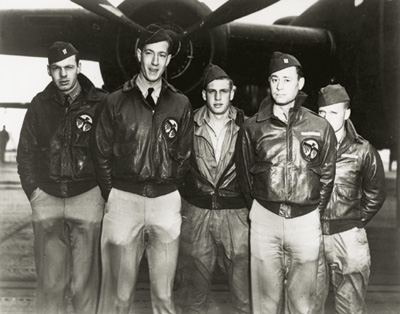
The plan involved launching 16 B-25s from an aircraft carrier — an unprecedented feat in itself — to fly light with arms and heavy with fuel to just make it 400 miles to Honshu, and with any luck on to China before the tanks ran dry.
Considering that the bombers had to launch in a panic when the carrier group was spotted a couple hundred miles too early, the raid’s success was downright miraculous: all 16 bombers made it on to (or near enough) the mainland without being shot down, where the crews bailed out and, for the most part, escaped to allied forces. Jimmy Doolittle would title his autobiography I Could Never Be So Lucky Again.
But not all were quite as lucky as Lt. Col. (later, General) Doolittle.
Farrow (left) and Hallmark. Spatz was a member of Farrow’s crew, and is pictured center in that plane’s crew shot here.
Two (out of eighty) drowned when their ride was ditched in the drink. Eight others were captured by the Japanese.
Four of those eight captives would survive the war to tell the tale. A fifth died in captivity. And the other three — pilots William Farrow and Dean Edward Hallmark, and (for somewhat unclear reasons) gunner Harold Spatz — were shot this day in a Shanghai cemetery following a sketchy military trial which condemned them for hitting civilian targets.
Designed largely for its psychological effect, the morale-boosting Doolittle raid has attracted interest from countless other sources who treat it in greater depth. DoolittleRaid.com and DoolittleRaider.com both provide detailed online information about the raid.
For more traditional media, one could do worse than bomber pilot Ted Lawson’s book, and its subsequent propaganda film adaptation, Thirty Seconds Over Tokyo.
On this date in 1565, the French Huguenot New World settlement plan was nipped in the bud when Spaniards executed en masse the inhabitants of Fort Caroline in present-day Jacksonville, Fla.
Jean Ribault.
During the late 16th century’s fractiousFrench Wars of Religion, far-sighted Protestant admiral Gaspard de Coligny sponsored this like-minded colony in Florida — a sort of side bet on a satellite Protestant presence overseas, while the party in the mother country fought for its life.*
Jean Ribault (or Ribaut) was the loyal naval aide chosen to lead this colony. After an abortive attempt to plant a settlement in Charlestown, S.C., Ribault set up Fort Caroline and claimed greater Jacksonville for France.
Historical marker of Jean Ribaut/Ribault’s landing place, in Jacksonville, Fla. (cc) image from POsrUs.
French colonial projects further north enjoyed better success.
Down in Florida, both geopolitical and religious rivalry set Fort Caroline up for trouble. Ponce de Leon, questing for the Fountain of Youth, had planted the Spanish flag in Florida half a century before, and that country was none too pleased to find its continental rival jumping its claim. That it was Calvinist Frenchmen doing the usurping would prove downright intolerable to more-Catholic-than-the-Pope Spanish ruler Philip II.
The Spaniards attacked [Fort Caroline], hanged the colonists, and fastened above the heads of the corpses a placard on which was written, “Not because they were Frenchmen, but because they were heretics.” A French Catholic, de Gourgues, moved with righteous indignation, fitted out a ship and avenged this act by hanging their murderers, over whose bodies he put a similar placard, bearing the inscription, “Not because they were Spaniards, but because they were assassins.” But Coligny’s efforts failed, and he had to leave to the English race the realization of his dream of a great American Protestant state. (Source)
* It’s another country, another creed, and another century, but it reminds of the traffic between English New World settlements and England proper during the English Revolution.

 The Ottoman Empire, once the


 Almighty Voice took the prospect of having his neck stretched this date seriously enough to break out of prison the night of October 22-23.