1927: Martyrdom of Five Christeros

Artist unknown. The inscription reads:

Execution of Cristeros by federal soldiers on the outskirts of San Gabriel, Jalisco, October 8, 1927. On the same site, the soldiers were ambushed, suffering the same fate.

On this day..

1586: Anthony Babington and fellow plotters, Walsingham’d

The recently completed papal visit to England has summoned many a recollection of that country’s traumatic break from the Church. (As well as more recent embarrassments.)

While we know the schism from the comfort of retrospection, those present for its 16th century inception (and long afterward) had the task of sorting out winners and losers on blood-soaked scaffolds.

So we pause this date to note the extirpation September 20 and 21 of the Babington Plot, a half-baked scheme to re-establish the Old Faith that turned into one of history’s signature achievements of espionage.

Its namesake, young Sir Anthony Babington, was a secret Catholic with more money than sense; like many a Catholic of this time, he bristled under the rule of Elizabeth I, the daughter of the very woman who started all this English Reformation trouble.

Besotted with fellow-Catholic Mary Queen of Scots after having served as her page in his youth, Babington was easy prey for the fellow invariably described as Elizabeth’s “spymaster”Francis Walsingham.

Not one for scruples where his own security or his sovereign’s was concerned, Walsingham had long considered Mary Queen of Scots too dangerous to be left alive: every Catholic plot against Elizabeth intended to replace her on the throne with this Catholic cousin.

Trying to overcome Elizabeth’s reluctance to off fellow royalty — dangerous precedent, in these dangerous times — Walsingham entrapped Babington and a coterie of other Catholics into designing and documenting a scheme to assassinate Elizabeth and support a Spanish invasion.

And most importantly to Walsingham, they got Mary to sign off on it.

Though the design was grandiose, the real danger was pretty much nil — since Walsingham, a Renaissance reconnaissance man famous for his continent-spanning intelligence network, had penetrated the circle months before.* Walsingham let the conspiracy ripen long after he had the goods on the likes of Babington, intending to make it the instrument of Mary’s destruction. He succeeded.

Coded correspondence that Mary thought she was smuggling in and out of her cell was in fact being intercepted and decrypted.

When Babington wrote to her, alluding to his intent with “six noble gentlemen” to murder Queen Elizabeth, Mary doomed herself with a favorable reply:

The affair being thus prepared, and forces in readiness both within and without the realm, then shall it be time to set the six gentlemen to work; taking order upon the accomplishment of their design, I may be suddenly transported out of this place.

Within days, all — Mary, Babington, six gentlemen, and more — were in chains, and the commoners were being tortured into confessions and implications.**

The reckoning for Mary Queen of Scots would not arrive for some months yet.

But those of lesser breeding were dispatched with dispatch. Tried in two bunches, there were 14 in all condemned; on this date, Babington, was hanged, drawn and quartered for treason, along with accomplices John Ballard, Thomas Salisbury, Robert Barnewell, John Savage, Henry Donn and Chidiock Tichborne — the last of these leaving behind this doleful poetic adieu:

Elegy

My prime of youth is but a frost of cares,
My feast of joy is but a dish of pain,
My crop of corn is but a field of tares,
And all my good is but vain hope of gain;
The day is past, and yet I saw no sun,
And now I live, and now my life is done.
The spring is past, and yet it hath not sprung;
The fruit is dead, and yet the leaves be green,
My youth is gone and yet I am but young,
I saw the world and yet I was not seen;
My thread is cut and yet it is not spun,
And now I live, and now my life is done.
I sought my death and found it in my womb,
I looked for life and saw it was a shade,
I trod the earth and knew it was my tomb,
And now I die, and now I am but made;
My glass is full, and now my glass is run,
And now I live, and now my life is done.

-Chidiock Tichborne

(Hear this bummer of a verse read aloud here and here.)

The torture these first seven unfortunates endured as their entrails were ripped from their still-living bodies was so horrible that Elizabeth ordered the seven others awaiting execution the next day simply to be hanged to death before all the disemboweling business.†

A few books about spymaster Francis Walsingham

* Walsingham had plenty of plots to contend with, but did Elizabeth even greater service keeping tabs on the buildup of the Spanish Armada through a spy network in Italy — even using it to delay the invasion by a crucial extra year by drying up Spain’s credit line with Italian bankers. (Source, via (pdf))

Incidentally, and completely off topic: the subversive, forward-thinking philosopher Giordano Bruno — an Italian who was eventually executed by the Inquisition — has been alleged to be one in Walsingham’s employ.

** Luckily for Elizabeth, the treasonous Protestants who supported her back when she was at the mercy of her Catholic half-sister Mary Tudor were better able to hold their tongues under duress.

† One of those executed on September 21, Charles Tilney, has an oblique Shakespeare connection: he’s one possible author of the play Locrine, which Shakespeare might have revised and/or staged; Locrine is in the Shakespeare Apocrypha.

On this day..

1878: Max Hödel

On this date in 1878, journeyman tinsmith Max Hödel was beheaded in Berlin’s New Prison for taking a potshot at Kaiser Wilhelm I.

Nothing daunted by the prospect of trading his life for an 81-year-old* man’s, this propagandist of the deed tried to kill the conservative German emperor in May of 1878. He missed his target, but killed a bystander.

(Hodel’s cover story that he was just trying to blow his own brains out, not shoot the emperor, was belied by a number of hints he had given to others prior to the attack — e.g., telling a photographer who took his picture that the photo would soon be worth thousands.)

Just weeks after Hodel’s miss, another unsuccessful attempt to kill the emperor was undertaken by Karl Nobiling. Though Nobiling died of self-inflicted injuries, Hodel had to make do with decapitation.

Reichstag fire-like, these two outrages provided the Reich sufficient pretext to outlaw the Social Democratic Party** — even though the gunmen were much more radical types than this. (Hodel himself had previously been booted from the SDP.)

Germans having taken a front-row seat to the Paris Commune just a few years before, Chancellor Otto von Bismarck had no intention of allowing radical organizing of any variety to pick up any steam.

Coincidentally, our day’s protagonist shares an execution date with the next generation’s (better) anarchist assassin, Sante Geronimo Caserio — guillotined 16 Aug. 1894 for killing the French president.

* And he was right: nature didn’t take its course with Kaiser Wilhelm for nine more years; he missed outliving his own son and heir by a mere three months.

** Engels — writing polemically, of course — reckons over 11,000 political prisoners arrested from 1879 to 1880 alone.

On this day..

1795: Pomp, a Negro

On this date in 1795, an African-American near-slave (slavery’s official 1783 abolition in the state seems not to have constituted a completely bright line) was hanged in Ipswich, Mass. for murdering his master-slash-employer.

Thanks to Laura James at CLEWS, we are drawn to this story reproduced here at the University of North Carolina-Chapel Hill’s Documenting the American South site. Pomp was perhaps mentally “touched”; he was certainly physically “touched” for any perceived inadequacy at his labors, and eventually chopped off his master’s head while the latter slept beside his wife. (The wife summoned the police, without molestation from Pomp.)

The victim, Captain Charles Furbush, was a minuteman who fought at Lexington, one of the opening skirmishes of the Revolutionary War.

Reprinted in full below (complete with breaks in the text where the original document is damaged) is the “Dying Confession of Pomp,” a broadsheet produced by a local merchant — who does not scruple to append some classified ads to the end of the text.*


I POMP now under sentence of death in Ipswich Jail, was born in [illegible], and brought from that place, so soon after I began my existence, that together with my Parents, I arrived at Boston when I was about three months old. My Father died soon after and my Mother has since had two husbands, and is now a widow. I have three sisters and three brothers now living in Boston, for whom a well as for my Mother I have a great regard.

My Mother soon after our arrival in this Country gave me away to Mr. Abbot of Andover. With this Gentleman I lived till I was sixteen years of age, but he being then on the point of moving back into the country some distance, told me if I chose it that I might then live with one of his sons, who was still to reside in Andover. I took up with his offer: choosing rather to continue in Andover, than to accompany my old master, to his new abode.

With young Mr. Abbot I lived not long, before I grew uneasy with the place. I told him that I meant to leave him soon, but he informed me that I was not free. About this time I was seized with convulsion fits which continued to oppress me at times ever after, to the fatal night that I murdered Capt. Furbush. Continuing still unreconciled to the new place, I went to the Select men of Andover to know whether I had not a right to leave it, and by their advice continued there a considerable time longer. But after a while it came to pass that Capt. Furbush took a notion to have a black man; and applying to the Select men, obtained their consent that I should be his servant. In compliance with the wishes [illegible] him; but soon found that I did not like him any better than the man with whom I had last lived. Furbush had a considerable farm and when I first began to live with him did some work himself, but I did not like the way he carried on his business, and after a while he left off work entirely, and by my desire left the whole management of the farm to me. I performed nearly all the work that was done on the place, cut all the hay, and with a trifle of help from the boy, whom my master desired to asist me a few days in a season, raised an hundred and seventy bushels of corn in a year. But my master still continued unkind to me, never letting me go to meeting on Sundays, and forcing me to clear out the cattle on those sacred days. When I asked him for money, he commonly gave me no more than four pence half peny, at a time: and even on Election day he gave me no more, nor would he suffer me on those days to go to frolicing till after one o’clock in the afternoon.

Though I did the best that I was able to do on the farm, my master was so far from seconding my endeavors, that he often brought whole droves of horses home with him in the night, and turned them in among the standing corn, that I had taken so much pains to plant, and hoe, and on the succeeding mornings he would charge me with the guilt of turning these horses into the corn field. In this way he often caused corn enough to be broken down in one night to fat a hog, and keep him fat a whole winter. I thought I found that he was a bad man, and a cheating horse jockey, and finally being unable to like him, I ran away from him, but was pursued, found, brought back, and severely flogged, by him for my pains. I afterwards ran off again but again met with the same fate. In this manner I went on ten or a dozen years, not liking my place, and not able to get away from it. I was frequently troubled with convulsion fits and sometimes crazy in such a degree, that I was generally bolted in to a chamber every night, in order to hinder me from getting into the chamber where my masters daughters slept. I worked very hard all the time. My master had one weakle son who was unable to work, and who often shed tears while he saw me labor and told me that he wished he was able to help me. I told him that perhaps I should contrive something after a while but did not explain myself. Continuing still uneasy I thought I would try once more the benefit of my legs. I accordingly ran off, but after a weeks absence, I was again brought back by my master, stripped naked, tied up by both hands, and unmercifully flogged. This was in the evening, and though it was late in the fall, and cold, frosty, icy weather, my master left me thus naked, and tied up, till the morning. My sufferings during the tedious hours of this lengthy night, by reason of cold and nakedness, a sore back and wounded spirits, were extremely great, and while under this torture, I thought it likely that my master would sometime or other feell the effect of his cruelty. My conjectures were so far right that it was the last time, that Furbush ever struck me.

My master used to tell me I might stay as long as I pleased at his house, adding that he should not stay in the world forever. From this I entertained an idea that Mrs. Furbush and the farm would be mine, after the death of my master. The hopes of being master, husband and owner, on one hand, and the cruel treatment I had received from Furbush on the other, prompted me to wish for his death and produced an idea of hastening [illegible] by [illegible] him myself.

In this state of mind the morning of the fatal day arrived. I arose considerably disordered having a great singing noise in the ears, and something whispering strange things to me I however went about my work as usual, cut up bushes all the day, near where there was another man to work but revealed nothing concerning my designs to him, at night went home, eat a beef steak for supper, and went to bed. Soon after I was seized with a fit, bit my tongue almost through, and after coming out of the fit, was delirious. I continued not long after this in bed, being impressed with an idea that I must get up and kill Capt. Furbush. The Lord a massy! said I to myself what is a going to take place now! The door of my chamber not being bolted as usual, I left my apartment and went down to the fire place. I was struck with horror by my reflections; but something still kept whispering in my ear, that now is your time! kill him now! now or never! now! now! I took an axe and went softly into the bed room of my master, and the moon shining bright, distinguished him from my mistress, I raised the ax before he awaked and at two blows, I so effectually did the job for him, that he never after even stretched himself.

My mistress being roused from sleep by the sound of the blows, said are you dead you? But receiving no answer she immediately left the bed, and called in a near neighbor. I did not try to escape not knowing that there was any necessity of it. I was told that I had but to go up to my chamber, I went there and perceived that somebody had bolted the door after me. Company soon began to croud into the house, and I was soon told that I should certainly be hanged. I was now very much frighted, nnd expected to be hung immediately, but my grief wore off considerably w [illegible] found that I was not to be hung there. I [illegible] soon brought to this Jail, and here enjoy mys [illegible] considerable well, though at Court time I [illegible] ry unhappy, and now some times, the idea [illegible] I have no friends, makes me dull.

The Ministers have been kind to me here, and I believe they are clever people: Mr. Stanniford too the Ja [illegible] keeper is kind and humane, and his wife and daughters clever people and pretty women. ([illegible] ndantly amiable ladies he ought to have said [illegible] whole family are clever folks.) The Ministers have told me to pray to God, and to the blood of Christ, for a new heart. I approve of [illegible] advice, and spend great part of my time in prayer, even ten or twenty times in a day I pray though I find it hard work, I do not however find fault with the hardness of the task, for [illegible] ieve it has been attended with great success. I have good hopes that I have got a new hear [illegible] the one that I used to have, used to ache [illegible] d, but the one I now have feels easy. I never [illegible] so well and hearty in my life as I now am, [illegible] fits and lunacy have left me entirely [illegible] hope to behave cleverly and graciously in this world.

I have prayed so much, that I have got all the minister’s [illegible] of praying and am not afraid to pray with [illegible] black coated man on the Continent. I [illegible] d make a very extraordinary priest, and inde [illegible] am turning very fast into one. When I [illegible] here, I was as black as any negro in the country, but now I have scarcely a drop of negro blood left in me, my blood having so far [illegible] ed into the blood of a Minister, that I am a [illegible] y nearly as white as a Mulatto. Minist [illegible] people and they can turn [illegible]

Some acc [illegible] the hapless POMP with some reflections [illegible] fate by J. PLUMMER, Jun.

Illustration of Pomp's hanging from the broadsheet

POOR POMP was a well made, considerable large, likely looking Negro. [illegible] e was very capable of contriving business on a farm, and such was his strength and industry, that besides the [illegible] which he received for his labour, Capt. Furbush could very well have afforded him 50 dollars per year–With such wages, or even with half that salary he might soon have acquired money enough to purchase 50 acres of excellent [illegible] land, and to have enabled him to clear and improve the same–In that situation some unfortunate white woman might possibly have sought [illegible] assylum in his arms, or at least the likelie [illegible] to girl that fell within the line of his ac [illegible] nce would have sprung like nimble doe [illegible] his marriage bed–The animating sweets of freedom, and of domestic life, had then been all his own–He would neither have sullied his hands with innocent blood, nor have been forced with unutterable woe, to breathe his last in a h [illegible] . But alas! instead of running this happy course, for want of understanding, and skill [illegible] him, to wife and laudable pursuits, we have seen him experience the sad reverse.

I ha [illegible] endeavored to preserve the ideas of poor Pomp, in the above speech, though I have taken the liberty to arrange the matter in my own way, [illegible] to word his thoughts more elegantly and [illegible] than he was able to express them. As to [illegible] said of something telling him to kill his [illegible] er, I believe it to be a falsehood of his ow [illegible] hing contrived by him to excuse his conduct, but as to the rest of his speech, I fancy that he believed it himself; though in several particulars he was pretty much mistaken. His [illegible] capacity was below the common pitch, and his understanding was undoubtedly considerably injured by convulsion fits, though his parts were vastly superior to those of an ideot. But for a rational being his mental improvements were extremely small; though when we consider the situation that he has lived in, this is not so very strange as we at first should think it. He lived either alone in the field, in bed, or in the kitchen of some people, who were too much above him to be his associates: and probably was never learned to read–There were few Negroes in Andover or any where near him, and all there was were unlearned people. From whom then or in what manner was it in his power to gain knowledge? ‘Tis true that he had some intercourse with his white neighbours, but very little that was profitable for instruction;– the discourse generally turning on domestic business, the raising country produce, the age, and strength, of oxen, and horses, the bulling of cows, or the lambing of sheep.– Of knowledge like this Pomp had a large stock. He knew all his master’s cattle, sheep, and hogs, and pretty exactly the age of each creature: and likewise the horses and oxen of many of his neighbours: could tell when such a particular cow of a certain neighbour had been bulled, and when his sow had pigged; but no man thought it worth his while to talk much upon other matters with him, nor would he have been much pleased with the discourse had it been otherwise. He knew not the names of the Seven Sciences, nor even that there were such things or names–knew nothing of ancient or modern history, nor even the late revolution in France, or the consequences of it so often rung through the universe–So little [illegible] ears–Of philosophy [illegible] , geography, good breeding, honor, politics, [illegible] he never heard, or heard with little attention, and less improvement– To crown his ignorance he lost his life by not knowing that murder was a sin: he expecting that he should immediately rise to a good estate and great felicity whenever he should be fortunate enough to kill his master. He knew nothing of the Laws of the United States or of this Commonwealth; and after the murder when he was told that he would be hung, he dreamed nothing of any previous imprisonment or trial: when he heard the sentence of death in Court, he expected to be hung the same hour but finding he was not to be executed that day, he conceived hopes that he never should be. He had seen others and been himself corrected in anger. He had observed that whenever his master was angry with him he either flogged immediately, or he for that time escaped correction, and that after the wrath of his master had subsided there was no danger. He thought the People of Andover and the Court at Ipswich would hang him in the same angry frame of mind, that his master used to flog him in, or that they would not hang him at all: he having no idea of the calm, but irrefutable ire, the deliberate, but vindictive, vengeance of the offended Justice, and of Heaven.

N. B. The reader will take notice that I do not attest to the truth of Pomp’s dying speech, but I affirm that he related to me as matters of fact the particulars [illegible] ted in this speech– Unfortunately for me [illegible] Jail keeper was absent when I visited the prisoner, [illegible] on his name does not appear a [illegible] tness: his lady was present, but perceiving that she was rather timorous, I did not trouble her with a request to be a witness; though I believe she will readly, orally attest to the truth of it.

Printed for and sold by JONATHAN PLUMMER, JUN. price 6d, who still continues to [illegible] various branches of trifling business–Underbeds filled with straw and wheeled to the ladies doors — Any person wanting a few dollars at any time may be supplied by leaving a proper adequate in pawn–Wanted 1000 junk bottles.

A certain secret disorder cured privately and expeditiously– Love-letters in prose and verse furnished on the shortest notice–The art of gaining the object beloved reasonably taught–

Nymphs and swains bow’d down with care
By cupid wounded to the heart,
Quick, O quick to me repair
For soon I ease the dreadful smart.


To Tell a Free Story: The First Century of Afro-American Autobiography, 1760-1865 characterizes the dueling interpretations of Pomp and his white interlocutor as “[pitting] two explanations of black criminal behavior against each other for the first time in Afro-American autobiography. Plummer’s argument is based on the notion of the Negro as absence. His lack of remorse for murder shows that he has no moral sense, and in justifying his crime with the “whispering” voices, he proves that he lacks truthfulness. Pomp’s narrative, on the other hand, insists that there was something at work in the black man’s psyche, a dynamic whose manifestations in the actions and language of Pomp resisted Furbush’s methods of control and Plummer’s system of reference.”

* By the way, click on my sidebar ads, why don’t you?

On this day..

1419: The (first) Defenestration of Prague

(Thanks to Meaghan Good of the Charley Project for the guest post. -ed.)

On this day in 1419, an angry mob of Hussite peasant rebels stormed the town hall on Charles Square in Prague and threw the judge, the mayor and several city council members (either seven or thirteen; accounts differ) out the window. They all either died in the fall or were killed by the crowd outside.

The event has been the subject of several paintings, as well as being beautifully illustrated in Lego form and also reenacted.

Hussites followed a Christian reformer, Jan Hus, who was one of the forerunners of the Protestant Reformation. Hus was eventually excommunicated and burned as a heretic. The cause of the July 30 riot was the city council’s refusal to release from custody several Hussite prisoners.

The mob, led by the Hussite priest Jan Želivský and future general Jan Žižka, marched to the town hall, but they only became violent after someone inside the building threw a stone at them. After that there was no stopping them.

The riot had far-reaching consequences, inasmuch as it is seen as the start of the Hussite Wars, which lasted until 1434 or so and involved government-sponsored military action against the Hussites as well as Hussites fighting amongst themselves.

This event has come to be known as the First Defenestration of Prague. That is, I’m sure we all can agree, an AWESOME name, and probably the principal reason the riot is still remembered today. The word “defenestration” comes from Latin: de-, meaning “out of,” and fenestra, “window.”

The Czechs have a habit of throwing people out of windows at critical junctures in history; since 1419 there has been at least one more (nonfatal, but more famous) Defenestration of Prague, in 1618. A couple of similar events since then have sometimes been called the Third Defenestration of Prague, though this is not universally agreed upon.

On this day..

1872: Jose Balta, former President of Peru

On this date in 1872, four days after he was deposed as President of Peru, Jose Balta was summarily shot by the would-be dictatorship of Tomas Gutierrez.

Balta (English Wikipedia entry | Spanish) made his name as a soldier, an ironic background for a martyr to constitutional government.

As a colonel, Balta in 1867 led a revolt against President Mariano Ignacio Prado in Chiclayo (mirrored by a similar revolt by Gen. Pedro Diez Canseco Corbacho in Arequipa). The resistance forced Prado’s resignation, and Balta won the ensuing 1868 election.

(Notably, it was under Balta’s administration that unprincipled American railroad speculator Henry Meiggs got his prolific track-building operations going in Peru. Basically, the government took all the capital it raised on its guano-export contract — appropriate source — and plowed it into Meiggs’ well-hyped railroads, whose returns rarely justified the outlay to construct them. Wealthy and influential at his zenith, this adventurer was widely considered culpable for the disastrous state of the Peruvian economy by the time of his 1877 death, since in the interim the guano market had crashed and Peru found itself buried in debt it would ultimately default on. Oh, and: reason Meiggs was in Peru? He had to flee California after perpetrating a real estate scheme.)

Back to Balta. The soldier-President was adamant about an orderly departure from office (with a handover to an opposition party*) when his term came up in 1872, but others around him were less keen on constitutional precedents when there was power to be kept or lost.

On July 22, 1872, War Minister Tomas Gutierrez and his brother, Col. Silvestre Gutierrez, arrested the president. Tomas Gutierrez proclaimed himself dictator.

He was surely expecting a more appropriately cowed reaction from the country than he got: the President-elect got away on a warship, whose crew declared for him; the Peruvian Congress passed a resolution outlawing the Gutierrez coup; and the public reaction against him was chilly enough that someone gunned down Silvestre Gutierrez in a railway station on July 26.

News of this turn for the worse reached brother Marcelino, who had (ex-)President Balta in his charge at Callao … and Marcelino had Jose Balta immediately shot. This event meets the definition of an execution better by its circumstances than by its ceremony, since there was none of the latter; Balta was simply blasted while lying sick in bed, perhaps even still asleep, and not with the least sense of occasion.

And by no standard did it meet the usurpers’ definition of utility.

Neither of the remaining two Gutierrezes would outlive Jose Balta by so much as a day, and news of Balta’s murder only helped fan the incipient uprising: both were killed by mobs as the would-be dictatorial party collapsed in the hours ahead. All three of Tomas, Silvestre and Marcelino wound up on lampposts in Lima (and then burned to ashes in a public square) as recompense for their four days’ sovereignty.

As one report given out in North America recounted it:

The events of the past week will forever be remembered in Peruvian history. The spectacle of a Constitutional President deposed and imprisoned by a military usurper; of a Congress dispersed at the point of the bayonet, after the members, irrespective of partisan feeling, had united in signing a solemn protest, declaring the new officers of the so-called Government criminals and outlaws; of an entire country gathering together its strength to repel the attack made upon its liberties and legal rights; of the rising of the people when their indignation could no longer be restrained on the news of the cowardly assassination of Balta by the Dictator; of the triumph of moral force and justice over bayonets and a bastard cause; of the terrible vengeance of the populace on their tyrants; of the final re-establishment of peace, order and good government. This wonderful series of events has been witnessed by Lima in the space of five days. The Peruvian people have nobly vindicated their name and their national honor; the country is now on a firmer basis, and presents greater hopes for prolonged tranquility, prosperity and progress than it has for many years past.

(Not exactly. The economy, as mentioned, crashed in the 1870s, and there was a successful coup in 1879.)

* The guy set to succeed Balta was Manuel Pardo — not to be confused with Mariano Prado, whom Balta had supplanted.

On this day..

1943: Eight from the Krasnodar Trials

On July 18, 1943, eight Soviet citizens who were among 11 tried for collaboration with the recently expelled German occupiers were hanged before tens of thousands in the main square Krasnodar.

The proceedings from July 14-17 were the first major, open war crimes tribunals of World War II … which, of course, was still ongoing at this point.

But the previous winter, the Soviet Union had turned the tide by winning the Battle of Stalingrad, which victory presaged the liberation of the nearby north Caucasus city where we lay our scene.

The Russians proceeded to put the murderous Nazi occupation on trial, but did so not by trying Germans or their allies — but by trying eleven Soviet citizens for collaboration. Indeed, until the end of the war, thousands of Russians were prosecuted for crimes of collaboration, but only a relative handful of Germans for actually authoring those crimes.

These eleven were mostly* men who had served the Sonderkommando 10a (part of Einsatzgruppe D) in “guarding Gestapo buildings that held arrested Soviet citizens, executing arrests, going on military searches and expeditions against the partisans and peaceful Soviet citizens, [and] exterminating Soviet citizens by hanging, mass shootings, and use of poison gases.”

That “Soviet citizen” stuff, technically accurate, soft-pedaled the Einsatzgruppe‘s predictable primary target: local Jewry.

Sonderkommando 10a arrived in the town of Krasnodar when it fell to the Germans on August 12, 1942. On August 21 and 22, all the Jews were ordered to report for transfer to a certain neighborhood in the city. They were taken to the Pervomaisk woods, where they were shot. Many of the city’s Jews did not obey the order, but they, too, were eventually caught and shot. According to a Soviet committee of inquiry report, the number of civilians — women, old people, and children — murdered in Krasnodar was in excess of 13,000. Almost all were Jews. (Source)

This in a city that was occupied for only six months.

Under any description of the victims, these depredations were plenty to condemn collaborators with even the vaguest of associations. Only a few of the men had specific acts charged against them; evidence establishing frightful Nazi atrocities in the region (not hard to find) plus confessions to having worked for the Nazis (not hard to wring out) forged a sufficient evidentiary chain without getting lost in the weeds of such minutiae as: was the collaboration really voluntary? did these collaborators themselves actually carry out war crimes? was that confession actually reliable? (good luck with that one.)

In this military tribunal, the public prosecutor had a free hand for grandstanding, the defense had almost no scope of action, and (the USSR being an old hand at the show trial game) the accused knew their own part to play with craven self-denunciations and pleas for the “mercy” of being sent to the most dangerous part of the front. This made great headlines in Pravda and Izvestia (and update memos straight to the Kremlin) about Nazi bestiality,** and great copy with inquisitorial slam dunks like,

Today Soviet law will mete out justice to the traitors, fascist hirelings, and boot-lickers now in the prisoners’ dock. Tomorrow the court of history, the court of freedom-loving nations of the world, will pronounce its inexorable verdict on the bloodthirsty rulers of Hitlerite Germany and all its associates — on the enemies of mankind who have plunged the world into the welter of the present war. Not one of them will escape stern retribution! Blood for blood, death for death!

All were convicted; three drew long prison sentences and eight hanging, and since the tribunal permitted no appeal, those sentences were executed the day after the court finished its business.

The period quotes, and much of the information about this otherwise somewhat inaccessible trial, comes from Ilya Bourtman’s 2008 article for Holocaust and Genocide Studies, “‘Blood for Blood, Death for Death’: The Soviet Military Tribunal in Krasnodar, 1943.”


It may have been a first, but one need hardly add that it was hardly the last such prosecution.

Several others war crimes show trials took place in other Soviet cities over the next few months, and these would obviously continue after the war.

Long, long after the war.

* The one exception was a 60-year-old former kulak who had illicitly escaped the deportation prescribed for this class in the 1930s. His “collaboration” consisted of having been a doorman whom a German soldier asked a question of.

** e.g., “Death to Hitler’s Butchers and Their Vile Accomplices”

On this day..

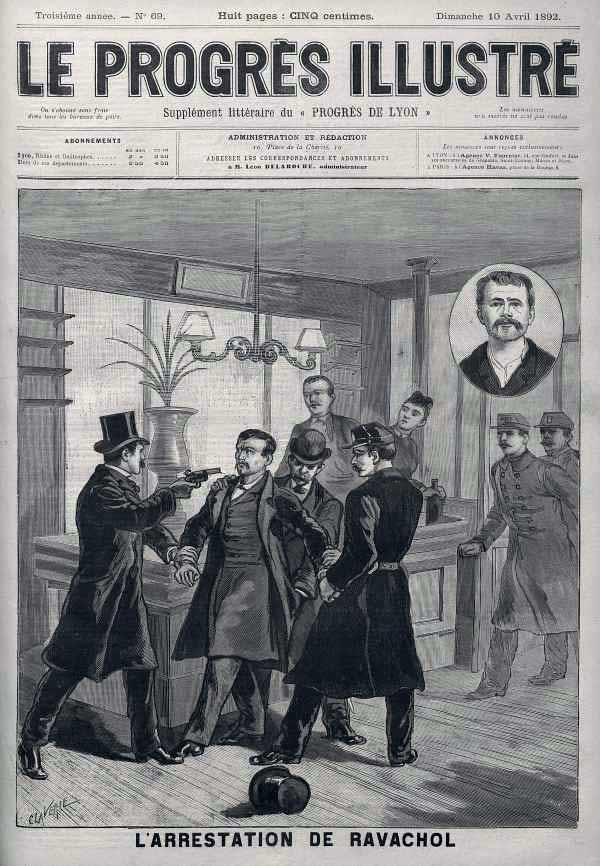
1892: Ravachol, anarchist terrorist

On this date in 1892, French anarchist François Claudius Koenigstein — better known as Ravachol — was guillotined at Montbrison for a series of bomb attacks on right-wing judges.

He took the name “Ravachol”, his mother’s, after his Dutch father ditched his mom, leaving the family in poverty.

Young Ravachol supported himself as best he could in proletarian labor and crime, as he attempted to observe* at his trial.

Ravachol, as painted by Charles Maurin.

There are many people who will feel sorry for the victims, but who’ll tell you they can’t do anything about it. Let everyone scrape by as he can! What can he who lacks the necessities when he’s working do when he loses his job? He has only to let himself die of hunger. Then they’ll throw a few pious words on his corpse. This is what I wanted to leave to others. I preferred to make of myself a trafficker in contraband, a counterfeiter, a murderer and assassin. I could have begged, but it’s degrading and cowardly and even punished by your laws, which make poverty a crime. If all those in need, instead of waiting took, wherever and by whatever means, the self-satisfied would understand perhaps a bit more quickly that it’s dangerous to want to consecrate the existing social state, where worry is permanent and life threatened at every moment.

Personal want segued into political conviction for Ravachol, whose crimes were justified by the principle of reprise individuelle.

And the political led him to reprisals of a less individual nature, when French state violence against radicals caused him to dynamite several magistrates’ homes.

He was caught in a restaurant,** brought to trial, and let off with penal servitude for life. Then another jury, intimidated by public outcry, reversed the decision and sent him to the guillotine.

The Banquet Years: The Origins of the Avant-Garde in France 1885 to World War I, which argues that anarchists “unsettle[d] the political smugness of the Third Republic … [and] challenge[d] any formulated aesthetic. The dynamism of prewar artistic activity ran a close parallel to anarchism; postwar Dada and surrealism look like its artistic parodies†.”

Anarchism, that revolutionary specter stalking fin-de-siecle Europe, burnt its fuse at both ends, but Ravachol’s falling head‡ left a legacy for his fellow-travelers. The next year, Auguste Vaillant tossed a bomb into the French Chamber of Deputies to avenge Ravachol. (Vaillant was himself guillotined, and himself avenged by Emile Henry and Sante Geronimo Caserio.)

Ravachol was also honored in a song, La Ravachole — set to the jauntily menacing tune of La Carmagnole, it cheers, “Long live the sound of the explosion!”

* This incendiary speech was cut off by the court.

** The table where the terrorist was nabbed got its own inscription: “Here ate Ravachol the day of his arrest.”

† e.g., Dadaist Marcel Janco‘s recollection:

We had lost confidence in our culture. Everything had to be demolished. We would begin again after the ‘tabula rasa’. At the Cabaret Voltaire we began by shocking common sense, public opinion, education, institutions, museums, good taste, in short, the whole prevailing order.

‡ Ravachol was guillotined midway through a parting exclamation, “Vive la Re-“. Initial newspaper reports implausibly rendered this as the patriotic classic “Vive la Republique!” rather than a much more in-character word like, oh, “Revolution”.

Weeks of controversy ensued over some witnesses’ claims that the head post-severing had actually completed the word “-publique”, a notion of a piece with the idea that the severed head survives decapitation by a few seconds. Scienticians countered that obviously excited witnesses were maybe hearing air escaping from the headless trunk and filling in the rest of the scene in their heads.

On this day..

1538: Diego de Almagro, explorer of Chile

On this date in 1538, Spanish conquistador Diego de Almagro was executed* at Cuzco by his vengeful rivals, the Pizarro brothers.

Conquistadoring with the rapacious Pizarros was a good way to get rich, get dead, or possibly both.

Almagro, a soldier, got to the New World in 1514 and soon fell in with alpha male Pizarro Francisco.** He’d become an adjunct to the latter’s conquest of the Incan Empire in the 1520s and 1530s; sent to capture the Incan city of Quito, Almagro found it razed by its defenders, and he sycophantically re-founded it as San Francisco de Quito.†

Things weren’t buddy-buddy for long.

The Iberian mothership divided Spain’s putative New World possessions north and south, putting Almagro in command of the southern cone. Great news … now all he had to do was actually take control of it.

Personally financing an expedition on the expectation of fabulous riches to be seized, Almagro instead foundered in Chile’s northern valleys in a frustrating environment of natives equally hostile and impecunious. After a couple years, he gave up and returned to Peru, angrier and poorer for his trouble — and there found that he could exploit the Spanish preoccupation with intransigent Incan chief Manco Inca to nick the capital city of Cuzco for himself.

Almagro actually had the lesser Pizarros — Gonzalo and Hernando — prisoner for a while, but he bartered them away to Francisco for a hill of beans (that is, a promise not to attack), and the Pizarros took their city back by routing Almagro at the Battle of Las Salinas.

The sentence of death against as august a personage as the appointed ruler of Nueva Toledo shocked many, and it was carried out against Almagro’s own entreaties for an appeal to the crown.


Detail view of a print of Almagro’s capture and execution. (Click for the full image.)

Francisco Pizarro would redeem his want of clemency towards his former partner in his own blood: in 1541, Almagro’s son, Diego de Almagro II or el Mozo, murdered Pizarro in an attempted coup d’etat. (Almagro the Younger, too, would be executed for his trouble.)

Although he was an important conquistador who spent most of his time at points further north, Almagro is best remembered today not in Peru but in Chile — for his abortive and disappointing expedition made him that land’s first European “discoverer”.

* Either beheaded or garroted.

** Almagro also rubbed shoulders with Vasco Nunez de Balboa.

† He pulled a similar trick with Trujillo, naming it after Francisco Pizarro’s birthplace.

On this day..

1917: Gasim, by Lawrence of Arabia

“With Major Lawrence, mercy is a passion. With me, it is merely good manners. You may judge which motive is the more reliable.”

-Alec Guinness as Prince Faisal in Lawrence of Arabia

This date in 1917 was the eve of the Battle of Aqaba, wherein a force of Arabs with famous British officer T.E. Lawrence emerged from the desert to surprise and capture the Ottoman Red Sea port today located in Jordan.*

And that makes this, in the cinematic masterpiece Lawrence of Arabia, the date on which the titular character kept the peace within his fragile coalition by personally executing a malefactor to prevent a tribal blood feud.

The victim, Gasim, is a real figure described in the real T.E. Lawrence’s memoirs

a gap-toothed, grumbling fellow, skrimshank in all our marches, bad-tempered, suspicious, brutal, a man whose engagement I regretted, and of whom I had promised to rid myself as soon as we reached a discharging-place.

Gasim is most famous as the beneficiary of the movie scene in which Lawrence boldly turns back into the desert to rescue this worthless retainer when Gasim’s camel is found riderless in the caravan. This, too, is based on an actual incident in Lawrence’s memoir, albeit heavily dramatized on celluloid.

In the film, Lawrence’s godlike power to give Gasim life is soon mirrored by the godlike power to deprive it.

Effectively exploiting dramatic license, Lawrence of Arabia portrays the Englishman surveying the scene of the coming triumph when a disturbance breaks out in his camp. Hastening thither, he discovers clan lining up against clan over the destructive right of blood vengeance because of a murder in the camp — a murder committed by the man he has saved.

To forestall a “tribal bloodbath” on the very eve of victory, Lawrence himself volunteers to execute the culprit. Having once risked everything to save Gasim, Lawrence sacrifices him ruthlessly when the occasion demands.** This act underscores the chameleon-like other-ness of the character, one of the film’s principal leitmotifs: “I have no tribe, and no one is offended!”

Though the real Lawrence did no such thing to the real Gasim, this astonishing scene is also related in the memoirs — just at an earlier point, and with a different, less dramatically integral character.

My followers had been quarrelling all day; and while I was lying near the rocks a shot was fired. I paid no attention; for there were hares and birds in the valley; but a little later Suleiman roused me and made me follow him across the valley to an opposite bay in the rocks, where one of the Ageyl, a Boreida man, was lying stone dead with a bullet through his temples. The shot must have been fired from close by; because the skin was burnt about one wound. The remaining Ageyl were running frantically about; and when I asked what it was Ali, their head man, said that Hamed the Moor had done the murder. I suspected Suleiman, because of the feud between the Atban and Ageyl which had burned up in Yenbo and Wejh; but Ali assured me that Suleiman had been with him three hundred yards further up the valley gathering sticks when the shot was fired. I sent all out to search for Hamed, and crawled back to the baggage, feeling that it need not have happened this day of all days when I was in pain.

As I lay there I heard a rustle, and opened my eyes slowly upon Hamed’s back as he stooped over his saddle-bags, which lay just beyond my rock. I covered him with a pistol and then spoke. He had put down his rifle to lift the gear; and was at my mercy till the others came. We held a court at once; and after a while Hamed confessed that, he and Salem having had words, he had seen red and shot him suddenly. Our inquiry ended. The Ageyl, as relatives of the dead man, demanded blood for blood. The others supported them; and I tried vainly to talk the gentle Ali round. My head was aching with fever and I could not think; but hardly even in health, with all eloquence, could I have begged Hamed off; for Salem had been a friendly fellow and his sudden murder a wanton crime.

Then rose up the horror which would make civilized man shun justice like a plague if he had not the needy to serve him as hangmen for wages. There were other Moroccans in our army; and to let the Ageyl kill one in feud meant reprisals by which our unity would have been endangered. It must be a formal execution, and at last, desperately, I told Hamed that he must die for punishment, and laid the burden of his killing on myself. Perhaps they would count me not qualified for feud. At least no revenge could lie against my followers; for I was a stranger and kinless.

I made him enter a narrow gully of the spur, a dank twilight place overgrown with weeds. Its sandy bed had been pitted by trickles of water down the cliffs in the late rain. At the end it shrank to a crack a few inches wide. The walls were vertical. I stood in the entrance and gave him a few moments’ delay which he spent crying on the ground. Then I made him rise and shot him through the chest. He fell down on the weeds shrieking, with the blood coming out in spurts over his clothes, and jerked about till he rolled nearly to where I was. I fired again, but was shaking so that I only broke his wrist. He went on calling out, less loudly, now lying on his back with his feet towards me, and I leant forward and shot him for the last time in the thick of his neck under the jaw. His body shivered a little, and I called the Ageyl, who buried him in the gully where he was. Afterwards the wakeful night dragged over me, till, hours before dawn, I had the men up and made them load, in my longing to be set free of Wadi Kitan. They had to lift me into the saddle.

Peter O’Toole’s Lawrence almost palpably manifests the conflicting aspects of his character as he shoots Gasim to death — and he confirms the transformative effect of his first homicide in subsequent dialogue with Gen. Edmund Allenby.

Lawrence: I killed two people. One was … yesterday? He was just a boy and I led him into quicksand. The other was … well, before Aqaba. I had to execute him with my pistol, and there was something about it that I didn’t like.
Allenby: That’s to be expected.
Lawrence: No, something else.
Allenby: Well, then let it be a lesson.
Lawrence: No … something else.
Allenby: What then?
Lawrence: I enjoyed it.

* Actually, Aqaba is Jordan’s only port. This battle was not so epic as the film depicts.

** In a bit of complex foreshadowing, the cinematic Gasim has told Lawrence at the outset of the expedition that “Allah favors the compassionate.”

On this day..