The Roman outlaw-slash-rebel Tiburzio di Maso was executed on this date in 1460, with seven other members of his band.
Tiburzio’s father had been put to death seven years before for joining in the anti-papal intrigues of his kinsman (by marriage) Stefano Porcaro. Theirs was the old populist dream of Cola di Rienzi, to throw off the depraved overlordship of Rome’s patricians and resume the tribune of the people.
Their enemy in this endeavor, to speak a bit more specifically, must be the pope himself — for as Gibbon observed, “the policy of the Caesars has been repeated by the popes; and the bishop of Rome affected to maintain the form of a republic, while he reigned with the absolute powers of a temporal, as well as a spiritual, monarch.” It was this throne that had destroyed Tiburzio’s father, and upon which he proposed to revenge himself.
White breast, sweet tongue, kind eyes and ready wit! You marble limbs, full of vigour, when shall I see you again? When again shall I bite those coral lips, or feel again that tremulous tongue murmuring in my mouth, or ever handle those breasts.
Why, Achates, you have scarcely seen this woman. Where she is most feminine, there she is most lovely. I wish you could be me! Not the beautiful wife of Candaules, King of Lydia, was more beautiful than she. I cannot wonder that he wished to show his wife naked to his friend, to give him the greater pleasure. I would do the same myself. If it were possible, I’d show you Lucretia naked, for otherwise I cannot describe to you how beautiful she is, nor can you imagine how full and substantial was my pleasure. But rejoice with me, because my delight was greater than words can tell.
By the time the son Tiburzio came to avenge his father,* the pope in question was Pius II, once so much the gentleman-humanist that he is the only pontiff to byline an epistolary erotic novel. Come election to the seat of St. Peter, however, he had predictably discovered a newly illiberal affinity for the overweening prerogatives customarily asserted by his office
Among the lesser of these prerogatives was the option to make his residence in the less miasmatic confines of his native Siena, and his extended absence from Rome surely gave some air by which the brash youth could kindle a rebellion. Tiburzio attracted a gang who alternately caroused together and sallied together as highwaymen on the famously dangerous roads. “If in Porcaro the democratic movement had already generated to the level of Catiline, in Tiburzio and Valeriano, the heroes of 1460, it had sunk to that of mere brigandage,” wrote the German historian Ferdinand Gregorovius. (Via)
“Mere” brigandae posed a real danger to papacy’s safety, however, enough so that the governor’s running skirmishes with this most dangerous gang eventually required the returned of Pope Pius to steady the situation: a captured informant gave information that Tiburzio’s band was in league with Ghibelline nobles and had even arranged with the condottieroJacopo Piccinino to throw open the city gates for his army.
But our man, well into the history-repeating-as-farce cycle, squandered his opportunity and his life by recklessly sallying into the city from refuge in nearby Palombara once one of his party was arrested. The Roman masses turned deaf ears on his calls to arms, and papal gendarmes captured Tiburzio and several misadventuring comrades. Without the inducements of torture, he too admitted the conspiracy with Piccinino — and the whole bunch hanged together on Capitoline Hill.
One of the signal outrages of Bleeding Kansas was avenged with a hanging on this date in 1863.
“Bleeding Kansas” was the guerrilla war over slavery in the late 1850s that presaged the conflagration about to consume the Republic; here on the frontier, pro- and anti-slavery partisans traded atrocities in their respective campaigns to secure Kansas’s imminent entry to the Union as either a slave or a free state. The stakes, had America continued her antebellum course, were vital Congressional votes on which the continuance of the peculiar institution might one day hang.
The naked brutality of the conflict shocked its contemporaries; as one particularly notorious example, the sons of abolitionist crusader John Brown executed pro-slavery captives with broadswords.
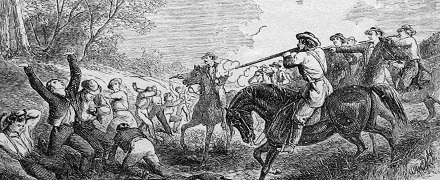
The Marais des Cygnes massacre was one of the last major horrors of that conflict: a party of 30 or so pro-slavery men led by Charles Hamilton seized 11 Free-Staters. They were mostly people who knew Hamilton personally, and seem to have gone along without resistance not anticipating what he had in store for them.
But Hamilton had told his men that on this campaign, “we are coming up there to kill snakes, and will treat all we find there as snakes.” (Source)
Much to their chagrin, these “snakes” were driven into a narrow ravine and lined up before Hamilton’s men’s guns. The volleys they delivered before fleeing back over the porous border into equally restive Missouri “only” killed five of their hostages: the other six survived by playing dead.
Five years later, one of those survivors, William Hairgrove, supplied the identification that damned William Griffith — whose claim that he only helped capture the Marais des Cygnes victims, and didn’t help shoot them was an especially lame offering at the height of the Civil War.
[a] little after noon Griffith was conveyed to the wood where he stepped onto the wooden platform a few inches above the ground. His wrists, knees and ankles were bound and the noose was adjusted. The black cap was pulled over his face at 1:07 p.m., and in but a moment William Hairgrove, one of the survivors of the massacre, cut the restraining rope with a hatchet; the four hundred pound weight dropped, jerking Griffith upward. The body rebounded and hung motionless while the attending physicians monitored his vital signs, and in twenty-five minutes they pronounced him dead.
A blush as of roses
Where rose never grew!
Great drops on the bunch-grass,
But not of the dew!
A taint in the sweet air
For wild bees to shun!
A stain that shall never
Bleach out in the sun!
Back, steed of the prairies!
Sweet song-bird, fly back!
Wheel hither, bald vulture!
Gray wolf, call thy pack!
The foul human vultures
Have feasted and fled;
The wolves of the Border
Have crept from the dead.
From the hearths of their cabins,
The fields of their corn,
Unwarned and unweaponed,
The victims were torn,—
By the whirlwind of murder
Swooped up and swept on
To the low, reedy fen-lands,
The Marsh of the Swan.
With a vain plea for mercy
No stout knee was crooked;
In the mouths of the rifles
Right manly they looked.
How paled the May sunshine,
O Marais du Cygne!
On death for the strong life,
On red grass for green!
In the homes of their rearing,
Yet warm with their lives,
Ye wait the dead only,
Poor children and wives!
Put out the red forge-fire,
The smith shall not come;
Unyoke the brown oxen,
The ploughman lies dumb.
Wind slow from the Swan’s Marsh,
O dreary death-train,
With pressed lips as bloodless
As lips of the slain!
Kiss down the young eyelids,
Smooth down the gray hairs;
Let tears quench the curses
That burn through your prayers.
Strong man of the prairies,
Mourn bitter and wild!
Wail, desolate woman!
Weep, fatherless child!
But the grain of God springs up
From ashes beneath,
And the crown of his harvest
Is life out of death.
Not in vain on the dial
The shade moves along,
To point the great contrasts
Of right and of wrong:
Free homes and free altars,
Free prairie and flood,—
The reeds of the Swan’s Marsh,
Whose bloom is of blood!
On the lintels of Kansas
That blood shall not dry;
Henceforth the Bad Angel
Shall harmless go by;
Henceforth to the sunset,
Unchecked on her way,
Shall Liberty follow
The march of the day.
On this date in 1862, Union Gen. John McNeil had ten Confederate soldiers shot in what history has recorded as the Palmyra Massacre.
The Slave Power’s northern salient, Missouri was surrounded to the east, north, and west by free soil — which made it an antebellum flashpoint since the days of the Missouri Compromise.*
In the 1850s, the Missouri conflict spilled into neighboring Kansas as the enemy sides of the slavery question fought to determine whether Kansas would enter the Union as slave state or free. The Missouri borderlands of Bleeding Kansas was where the radical abolitionist martyr John Brown made his name, commanding free state militia in a guerrilla war that presaged the coming clash of North and South.
By the time we lay our scene in 1862, John Brown has exited courtesy of Virginia’s gallows, and the dragon’s teeth sown in Missouri and Kansas and everywhere else had sprung to horrible life. Missouri’s own civil war pitted neighbor against neighbor throughout the state in a bushwhacking conflict that extended locally for many years after Appomattox.**
The nastiness of the years to come is aptly suggested by this date’s events.
Like neighboring Kentucky, Missouri was a border state with a Union government, albeit one contested by a rival Confederate government. From the standpoint of the North, all Confederate activity there was behind its lines and the perpetrators therefore potentially subject to treatment (up to and including execution) as spies, saboteurs, and the like.†
Joseph Chrisman Porter, a Confederate officer, was one such possible client of this here site, tapped as he was for recruiting and raiding operations in northeast Missouri. His Union adversary Gen. John McNeil saw Porter as basically a terrorist. In August of 1862, Porter’s aide Frisby McCullough fell into McNeil’s hands: the Union general had McCullough shot.
On September 12, Porter raided the town of Palmyra, where McNeil held a number of Confederate prisoners. In the course of the raid, he kidnapped Andrew Allsman, a 60-year-old Palmyra resident. “It was said of him that he was able to inform the military authorities of certain movements of the enemy, and that he gave definitive information as to the homes and whereabouts of many men of Confederate leanings,” in the words of this pro-Confederate 1902 pamphlet on the incident. “Naturally, this placed him in disfavor with the Southern sympathizers and those who were fighting in that cause.”
What happened next — though it was not known to the Union at the time — was that Allsman was shot. The pamphlet just cited attempts to obfuscate this event into the fog of war and not really Porter’s fault. The bare fact is that his raiders had gone out of their way to seize an aged non-combatant and then summarily executed him.
Not knowing Allsman’s fate, McNeil responded with an ultimatum to his opposite number.
Palmyra, Mo., Oct. 8, 1862.
To Joseph C. Porter.
Sir: — Andrew Allsman, an aged citizen of Palmyra and a non-combatant, having been carried away from his home by a band of persons unlawfully arraigned against the peace and good order of the State of Missouri, and which band was under your control, this is to notify you that, unless Andrew Allsman is returned unharmed to his family within ten days from date, ten men, who have belonged to your band, and unlawfully sworn by you to carry arms against the government of the United States, and who are now in custody, will be shot as a meet reward for their crimes, amongst which is the illegal restraining of said Allsman of his liberty, and if not returned, of presumptively aiding in his murder. Your prompt attention to this will save much suffering.
Yours, etc.,
W.R. Strachan
Provost Marshal General Northeast District of Missouri
By order of Brigadier General commanding McNeil’s column
The Confederates, of course, could not produce Allsman.
So, on the evening of Oct. 17, five rebel prisoners in the Palmyra stockade plus five more held in Hannibal were informed that they would be shot the next afternoon, in ruthless enforcement of the threat.
The men who died this date in 1862 by a volley of musketry at the Palmyra fairgrounds were:
Captain Thomas Sidenor
William T. Baker
Thomas Humston
Morgan Bixler
John McPheeters
Hiram Smith
Herbert Hudson
John Wade
Marion Lair
Eleazer Lake
Their names adorn the base of a monument erected in Palmyra in 1907 commemorating the so-called “Palmyra Massacre”. The state of Missouri as a digital archive of original documents relating to the affair available here.
* Missouri was where the slave Dred Scott lived; his owner taking him to the neighboring free state of Illinois and thence points north occasioned the notorious Supreme Court case that bears his name.
** Frank and Jesse James were Confederate partisans for William Quantrill in the Missouri war; they segued directly into their more celebrated career in outlawry right after the war ended — robbing banks whilst settling scores with pro-Union men for the rest of the 1860s, before branching out to other points on the frontier.
† The Union might obviously have chosen to treat the entire Confederacy as a treasonable enterprise rather than a legitimate enemy belligerent. As a historical matter, it did not take this perspective.
(Thanks to friend of the blog Sonechka for research, translation, and background information touching this post. -ed.)
October 14 (October 1 O.S.) is a liturgical feast celebrating the protective intercession of the Virgin Mary, a date of particular significance in Russia and Ukraine. Indeed, Red Square’s St. Basil’s Cathedral is actually the Cathedral of the Intercession of the Most Holy Theotokos [i.e., Mary] on the Moat, just one of many Orthodox churches so named.
Also known as Pokrov — a quaint Slavic term for covering, denoting safeguarding — the holiday celebrates an incident from 10th century Byzantium when a saint beheld Mary descend through the dome of the church, then spread her garment protectively over the entire congregation.
It is of special significance in Ukraine where the ecclesiastical celebration pulls double duty as the Day of the Ukrainian Cossacks. And it is in honor of Pokrov that we dedicate this post.
17th century icon of the Madonna’s broad cloak protecting Ukrainians.
On an unspecified date in 1638, a Cossack named Ostryanin was broken on the wheel in Warsaw … maybe.
The Ostryanin Uprising of 1638 was one of the ongoing cycle of Cossack disturbances in the southern reaches of the Polish-Lithuanian Empire — modern-day Ukraine. Like many of these, it was a short-lived affair considered on its own, but the pattern of disaffected Cossacks struggling against the Polish crown for some combination of recognition, largesse, and autonomy was an ongoing pattern in the 17th century — and by the 1650s it would begin tearing apart the formerly mighty Polish-Lithuanian realm and transferring Ukrainian territory from Polish to Russian domination.
Tradition held that after the rising was stamped out in the summer of 1638, Stepan Ostryanin himself was treacherously seized and taken to Warsaw for execution. A late 18th century chronicle* of a distinctly patriotic bent called Istoriya Russov embroiders upon that death by breaking-wheel with racist gusto:
in accord with their treachery, insidious and duplicitous, having learned through their Jew spies that hetman Ostryanin’s would travel unguarded … the Lyakhs [term for “Poles”; it’s derogatory in present-day Russian but may have been less so at the time -ed.] surrounded him in Kanev monastery with a host of men. They, having tied the hetman and his men, altogether thirty seven people, … prepared an execution for them in Warsaw unprecedented in its cruelty, which posterity will scarcely believe to be true, because it would not occur to even the most barbarous and ferocious Japanese (!) and the reality of which would terrify the very beasts and monsters.
On the other hand, a Cossack named Yakiv Ostryanin was to be found on Russian soil in the subsequent years, until he was murdered in 1641. Some historians think that he was the very same namesake Cossack rebel escaped from Polish vengeance, and the story about him being broken on the wheel in Poland is pure sentimental folklore; alternatively, Stepan and Yakiv might have just been two different Cossacks named Ostryanin who met two different fates.
Quite a difference for our supposed Stepan Ostryanin, but a minor mystery from this distance in time. Nevertheless, our man, whoever he was, had a posthumous contribution yet to make to the letters of his Slavic brethren.
Polish historian Szymon Okolski rode along with the Polish commander Mikolaj Potocki in Potocki’s successful campaign of the spring-summer 1638 to suppress this rebellion. Okolski’s field diaries of the campaign are a key historical source on the Cossacks and are thought to have been used extensively by the Cossack-descended writer Nikolai Gogol in composing his short story Taras Bulba.
A product of Gogol’s youth, Taras Bulba has a rough romanticism — and a romanticism for the Cossack (read: national Ukrainian) cause specifically that nonplussed Russian authorities at the time. (And probably now, too.)
Taras Bulba‘s title character is a mature Cossack patriot who with his two sons joins the Cossack risings against Poland. Its location in time is indeterminate, not unlike the unending cycle of risings themselves. Taras Bulba is a nearly eternal character, almost a fixture of nature, because his war seemed eternal too.
And of course it contains some cracking execution scenes. The execution by breaking-wheel of Taras Bulba’s son might havebeen inspired by the Istoriya Russov‘s outraged account of that full Japanese barbarism. The excerpt below hails from this public-domain English translation.
Ostap had been seized and bound before his very eyes, and that he was now in the hands of the Lyakhs. Grief overpowered him. He pulled off and tore in pieces the bandages from his wounds, and threw them far from him; he tried to say something, but only articulated some incoherent words. Fever and delirium seized upon him afresh, and he uttered wild and incoherent speeches. Meanwhile his faithful comrade stood beside him, scolding and showering harsh, reproachful words upon him without stint. Finally, he seized him by the arms and legs, wrapped him up like a child, arranged all his bandages, rolled him in an ox-hide, bound him with bast, and, fastening him with ropes to his saddle, rode with him again at full speed along the road.
“I’ll get you there, even if it be not alive! I will not abandon your body for the Lyakhs to make merry over you, and cut your body in twain and fling it into the water. Let the eagle tear out your eyes if it must be so; but let it be our eagle of the steppe and not a Polish eagle, not one which has flown hither from Polish soil. I will bring you, though it be a corpse, to the Ukraine!”
Thus spoke his faithful companion. He rode without drawing rein, day and night, and brought Taras still insensible into the Zaporozhian Setch itself. There he undertook to cure him, with unswerving care, by the aid of herbs and liniments. He sought out a skilled Jewess, who made Taras drink various potions for a whole month, and at length he improved. Whether it was owing to the medicine or to his iron constitution gaining the upper hand, at all events, in six weeks he was on his feet. His wounds had closed, and only the scars of the sabre-cuts showed how deeply injured the old Cossack had been. But he was markedly sad and morose. Three deep wrinkles engraved themselves upon his brow and never more departed thence. Then he looked around him. All was new in the Setch; all his old companions were dead. Not one was left of those who had stood up for the right, for faith and brotherhood. And those who had gone forth with the Koschevoi in pursuit of the Tatars, they also had long since disappeared. All had perished. One had lost his head in battle; another had died for lack of food, amid the salt marshes of the Crimea; another had fallen in captivity and been unable to survive the disgrace. Their former Koschevoi was no longer living, nor any of his old companions, and the grass was growing over those once alert with power. He felt as one who had given a feast, a great noisy feast. All the dishes had been smashed in pieces; not a drop of wine was left anywhere; the guests and servants had all stolen valuable cups and platters; and he, like the master of the house, stood sadly thinking that it would have been no feast. In vain did they try to cheer Taras and to divert his mind; in vain did the long-bearded, grey-haired guitar-players come by twos and threes to glorify his Cossack deeds. He gazed grimly and indifferently at everything, with inappeasable grief printed on his stolid face; and said softly, as he drooped his head, “My son, my Ostap!”
…
The square on which the execution was to take place was not hard to find: for the people were thronging thither from all quarters. In that savage age such a thing constituted one of the most noteworthy spectacles, not only for the common people, but among the higher classes. A number of the most pious old men, a throng of young girls, and the most cowardly women, who dreamed the whole night afterwards of their bloody corpses, and shrieked as loudly in their sleep as a drunken hussar, missed, nevertheless, no opportunity of gratifying their curiosity. “Ah, what tortures!” many of them would cry, hysterically, covering their eyes and turning away; but they stood their ground for a good while, all the same. Many a one, with gaping mouth and outstretched hands, would have liked to jump upon other folk’s heads, to get a better view. Above the crowd towered a bulky butcher, admiring the whole process with the air of a connoisseur, and exchanging brief remarks with a gunsmith, whom he addressed as “Gossip,” because he got drunk in the same alehouse with him on holidays. Some entered into warm discussions, others even laid wagers. But the majority were of the species who, all the world over, look on at the world and at everything that goes on in it and merely scratch their noses. In the front ranks, close to the bearded civic-guards, stood a young noble, in warlike array, who had certainly put his whole wardrobe on his back, leaving only his torn shirt and old shoes at his quarters. Two chains, one above the other, hung around his neck. He stood beside his mistress, Usisya, and glanced about incessantly to see that no one soiled her silk gown. He explained everything to her so perfectly that no one could have added a word. “All these people whom you see, my dear Usisya,” he said, “have come to see the criminals executed; and that man, my love, yonder, holding the axe and other instruments in his hands, is the executioner, who will despatch them. When he begins to break them on the wheel, and torture them in other ways, the criminals will still be alive; but when he cuts off their heads, then, my love, they will die at once. Before that, they will cry and move; but as soon as their heads are cut off, it will be impossible for them to cry, or to eat or drink, because, my dear, they will no longer have any head.” Usisya listened to all this with terror and curiosity.
The upper stories of the houses were filled with people. From the windows in the roof peered strange faces with beards and something resembling caps. Upon the balconies, beneath shady awnings, sat the aristocracy. The hands of smiling young ladies, brilliant as white sugar, rested on the railings. Portly nobles looked on with dignity. Servants in rich garb, with flowing sleeves, handed round various refreshments. Sometimes a black-eyed young rogue would take her cake or fruit and fling it among the crowd with her own noble little hand. The crowd of hungry gentles held up their caps to receive it; and some tall noble, whose head rose amid the throng, with his faded red jacket and discoloured gold braid, and who was the first to catch it with the aid of his long arms, would kiss his booty, press it to his heart, and finally put it in his mouth. The hawk, suspended beneath the balcony in a golden cage, was also a spectator; with beak inclined to one side, and with one foot raised, he, too, watched the people attentively. But suddenly a murmur ran through the crowd, and a rumour spread, “They are coming! they are coming! the Cossacks!”
They were bare-headed, with their long locks floating in the air. Their beards had grown, and their once handsome garments were worn out, and hung about them in tatters. They walked neither timidly nor surlily, but with a certain pride, neither looking at nor bowing to the people. At the head of all came Ostap.
What were old Taras’s feelings when thus he beheld his Ostap? What filled his heart then? He gazed at him from amid the crowd, and lost not a single movement of his. They reached the place of execution. Ostap stopped. He was to be the first to drink the bitter cup. He glanced at his comrades, raised his hand, and said in a loud voice: “God grant that none of the heretics who stand here may hear, the unclean dogs, how Christians suffer! Let none of us utter a single word.” After this he ascended the scaffold.
“Well done, son! well done!” said Bulba, softly, and bent his grey head.
The executioner tore off his old rags; they fastened his hands and feet in stocks prepared expressly, and—We will not pain the reader with a picture of the hellish tortures which would make his hair rise upright on his head. They were the outcome of that coarse, wild age, when men still led a life of warfare which hardened their souls until no sense of humanity was left in them. In vain did some, not many, in that age make a stand against such terrible measures. In vain did the king and many nobles, enlightened in mind and spirit, demonstrate that such severity of punishment could but fan the flame of vengeance in the Cossack nation. But the power of the king, and the opinion of the wise, was as nothing before the savage will of the magnates of the kingdom, who, by their thoughtlessness and unconquerable lack of all far-sighted policy, their childish self-love and miserable pride, converted the Diet into the mockery of a government. Ostap endured the torture like a giant. Not a cry, not a groan, was heard. Even when they began to break the bones in his hands and feet, when, amid the death-like stillness of the crowd, the horrible cracking was audible to the most distant spectators; when even his tormentors turned aside their eyes, nothing like a groan escaped his lips, nor did his face quiver. Taras stood in the crowd with bowed head; and, raising his eyes proudly at that moment, he said, approvingly, “Well done, boy! well done!”
But when they took him to the last deadly tortures, it seemed as though his strength were failing. He cast his eyes around.
O God! all strangers, all unknown faces! If only some of his relatives had been present at his death! He would not have cared to hear the sobs and anguish of his poor, weak mother, nor the unreasoning cries of a wife, tearing her hair and beating her white breast; but he would have liked to see a strong man who might refresh him with a word of wisdom, and cheer his end. And his strength failed him, and he cried in the weakness of his soul, “Father! where are you? do you hear?”
“I hear!” rang through the universal silence, and those thousands of people shuddered in concert. A detachment of cavalry hastened to search through the throng of people. Yankel turned pale as death, and when the horsemen had got within a short distance of him, turned round in terror to look for Taras; but Taras was no longer beside him; every trace of him was lost.
Despite his cunning escape on this occasion, Taras Bulba himself is also in the end put to death: the story ends with him going to the stake as his soul summons the brethren he can still see in the distance to resume the fight, again and again.
[A] band of Lyakhs suddenly rushed up, and seized him by the shoulders. He struggled with all might; but he could not scatter on the earth, as he had been wont to do, the heydukes who had seized him. “Oh, old age, old age!” he exclaimed: and the stout old Cossack wept. But his age was not to blame: nearly thirty men were clinging to his arms and legs.
“The raven is caught!” yelled the Lyakhs. “We must think how we can show him the most honour, the dog!” They decided, with the permission of the hetman, to burn him alive in the sight of all. There stood hard by a leafless tree, the summit of which had been struck by lightning. They fastened him with iron chains and nails driven through his hands high up on the trunk of the tree, so that he might be seen from all sides; and began at once to place fagots at its foot. But Taras did not look at the wood, nor did he think of the fire with which they were preparing to roast him: he gazed anxiously in the direction whence his Cossacks were firing. From his high point of observation he could see everything as in the palm of his hand.
…
“Farewell, comrades!” he shouted to them from above; “remember me, and come hither again next spring and make merry in the same fashion! What! cursed Lyakhs, have ye caught me? Think ye there is anything in the world that a Cossack fears? Wait; the time will come when ye shall learn what the orthodox Russian faith is! Already the people scent it far and near. A czar shall arise from Russian soil, and there shall not be a power in the world which shall not submit to him!” But fire had already risen from the fagots; it lapped his feet, and the flame spread to the tree…. But can any fire, flames, or power be found on earth which are capable of overpowering Russian strength?
Broad is the river Dniester, and in it are many deep pools, dense reed-beds, clear shallows and little bays; its watery mirror gleams, filled with the melodious plaint of the swan, the proud wild goose glides swiftly over it; and snipe, red-throated ruffs, and other birds are to be found among the reeds and along the banks. The Cossacks rowed swiftly on in the narrow double-ruddered boats—rowed stoutly, carefully shunning the sand bars, and cleaving the ranks of the birds, which took wing—rowed, and talked of their hetman.
* The Istoriya Russov had a great influence on young writers in the early 19th century. The text can be read as advancing a nationalism of all the Russias, or as speaking in a more specifically Ukrainian voice. See The Cossack Myth: History and Nationhood in the Age of Empires.
On this date in 1567, Huguenots in revolt in Nimes put to death dozens of Catholics in a courtyard butchery to climax a massacre remembered as La Michelade (English Wikipedia entry | the much more detailed French)
This name of sinister memory derives from one of the church calendar’s great autumnal feast, Michaelmas — and the sword-arm of its titular archangel would have been required to keep the peace between the rival religionists in the Languedoc.
Nimes went heavily for the Protestants, with the region’s royal governors unable to restrain the conquest of Catholic neighborhoods and churches by the predominant Huguenots through the 1560s: “the very wind which blew upon Nimes breathed heresy,” in the words of Dumas.
The years running up to our events of 1567 feature one of the numerous rancorous truces pocking France’s intractable Wars of Religion: this one is known as the “Armed Peace”, which gives you an idea where everyone’s heads were at. And in Nimes, the heresy in the wind was not such as to prevent the restoration of Catholic authorities to control of the civic institutions — to the undoubted irritation of the Huguenot grandees who endured the indignity of displacement alongside the sure knowledge of the popular weight that supported them.
This ripening conflict appropriately came to fruition via a vegetable market at a city fair on Michaelmas — September 29, 1567 — where an altercation turned into a sectarian riot and soon transformed into a municipal Protestant insurrection.
Huguenots still maintaining the preponderance of force in Nimes, they perpetrated the expected outrages during the excitement: sacking the cathedral, murdering some particularly hated Catholics. But the overall organization of the Huguenots and the organized participation of the city’s Huguenot elites suggests a good deal of advance orchestration, and perhaps coordination with the Huguenot attempt to kidnap the king just days before.
In the disturbance, Nimes’s first consul Guy Rochette — Catholic, naturally — sought refuge in the palace of Bishop Bernard d’Elbene; a Huguenot captain forced the door and arrested them, confiscating from Rochette the keys to the city. Though the bishop managed to escape, other prominent Catholics were systematically detained, too. According to Allan Tulchin’s That Men Would Praise the Lord: The Triumph of Protestantism in Nimes, 1530-1570, “[i]t seems clear that the Protestant leadership intended to conduct a general roundup of Catholic lay and clerical leadership. Protestant forces targeted at least half of the sixteen men who had served as consul between 1564 and 1567 … of the nine Catholic members of the presidial, only two did not appear among the victims.”
Captive Catholics were detained in several buildings around the city, notably in the city hall. It is not known to what extent the kill lists to cull from these unfortunates were preordained and to what extent they were improvised in the moment, but on the night of September 30, summons for specific victims went out, and Protestant squads complied by dragging them out of the city hall basement or wherever else they were held to the courtyard of the bishop’s palace. This would be the makeshift abattoir.
In the narration of Dumas,
when night came the large number of prisoners so imprudently taken began to be felt as an encumbrance by the insurgent chiefs, who therefore resolved to take advantage of the darkness to get rid of them without causing too much excitement in the city. They were therefore gathered together from the various houses in which they had been confined, and were brought to a large hall in the Hotel de Ville, capable of containing from four to five hundred persons, and which was soon full. An irregular tribunal arrogating to itself powers of life and death was formed, and a clerk was appointed to register its decrees. A list of all the prisoners was given him, a cross placed before a name indicating that its bearer was condemned to death, and, list in hand, he went from group to group calling out the names distinguished by the fatal sign. Those thus sorted out were then conducted to a spot which had been chosen beforehand as the place of execution.
This was the palace courtyard in the middle of which yawned a well twenty-four feet in circumference and fifty deep. The fanatics thus found a grave ready-digged as it were to their hand, and to save time, made use of it.
The unfortunate Catholics, led thither in groups, were either stabbed with daggers or mutilated with axes, and the bodies thrown down the well. Guy-Rochette was one of the first to be dragged up. For himself he asked neither mercy nor favour, but he begged that the life of his young brother might be spared, whose only crime was the bond of blood which united them; but the assassins, paying no heed to his prayers, struck down both man and boy and flung them into the well. The corpse of the vicar-general, who had been killed the day before, was in its turn dragged thither by a rope and added to the others. All night the massacre went on, the crimsoned water rising in the well as corpse after corpse was thrown in, till, at break of day, it overflowed, one hundred and twenty bodies being then hidden in its depths.
Dumas is indulging poetic exaggeration of the scene, and later estimations of the number of victims range well below 120 — but Tulchin quotes a leather worker who saw the courtyard on the following day and described it as “all covered with blood and the water of the well all red.” Even “merely” twenty or thirty victims slashed to death would have been a gory work.
In the days following, Huguenots would cement their control of Nimes with the systematic pillage of churches and (after a six-week siege) the capture of the city’s royal garrison. There was no general massacre after the Michelade; in the main, Catholics were forced into submission or exile instead of the grave.
But the effusion, combined with Huguenot attacks further north, helped to trigger the (very brief) “Second War” within the Wars of Religion which gave way after a short truce to the much bloodier “Third War” of 1568-1570 … whose peace would be broken by a Catholic sectarian massacre much better remembered to history than the Michelade.
According to a UPI wire story from Saigon which ran in American newspapers beginning Monday, September 27,
The Viet Cong said they executed two American prisoners Sunday … Although the broadcast did not say so, the executions apparently were in retaliation for the deaths Thursday of three anti-American demonstrators. The demonstrators were convicted by a military tribunal of engaging in terrorist activities and put before a firing squad in a soccer stadium at Da Nang.
An earlier execution of a Viet Cong terrorist by the government June 24 brought an announcement from the Communists that they had executed Sgt. Harold G. Bennet[t], a captive from Arkansas.
On this date in 1923, two anarchists were garroted in the Catalan city of Terrassa.
Terrassa was unwillingly under new management, having been occupied by the Captain-General of Catalonia Miguel Primo de Rivera* upon the latter’s coup just days prior to the events in this post.
In historical periodization, Primo de Rivera’s six-year dictatorship marks a last stage of the Restoration, a decades-long social struggle bridging the span between Spain’s twilight years in the imperial-powers club and the onset of the Spanish Civil War.
Spain and especially the notoriously insurrectionary Catalonia had been riven by conflict in the first years of the 1920s. One of our principals for this day’s execution, Jesus Saleta, had been a leader of the intermittently outlawed anarchist trade union CNT,* whose gunmen fought ferocious street battles with police and company enforcers.
He was not averse to dirtying his own hands. In 1922, Saleta had stood trial (he was acquitted both times) for running a bomb factory and for orchestrating an attack on businessman Joan Bayes. After the murder of CNT executive Salvador Segui early in 1923, Saleta helped organize the reprisals. Tension and bloodshed rose throughout the year.
On September 18, he committed the crime for which he would die less than a week later: together with Pascual Aguirre and several other anarchists, he robbed a bank to finance his underground operations; a man was shot dead in the process. Saleta, Aguirre, and a third collaborator, Joaquin Marco, were arrested in the ensuing chase.
Marco was acquitted — he had not been identified clearly enough — but both Saleta and Aguirre were condemned to the firing squad, a sentence the military unilaterally amended to the garrote on the grounds that shooting was too honorable a death for these terrorists.
Both went boldly to the scaffold on this date. (There’s a full narration of proceedings in a Spanish newspaper (pdf) here, and a plain-text equivalent here) “This is the way anarchists die!” a proud Saleta exclaimed to the executioner as he was seated.**
The cry “Viva anarchy!” was the last thing each man uttered as the metal ring wrung the life from his throat.
* We’ve already met Primo de Rivera’s Falangist son in these pages.
Three perpetrators of Europe’s most spectacular terrorist attack were hanged on this date in 1925 in Bulgaria’s capital Sofia — after each stood on the gallows for forty minutes while the names of their victims were read to them.
Those 40 minutes of victims had unknowingly begun their path to Calvary two years before, when the Bulgarian military overthrew the post-World War I civilian government.
Though the Communist party stayed out of this putsch — it was a peasants‘ party that was toppled from power — the reds responded a few months later with their own countercoup: the September Uprising.
The eventual Cold War Communist government of Bulgaria would officially regard September 1923 as “the first anti-fascist uprising” — an ex post facto interpretation that would be aided by the Bulgarian dicator‘s eventual affinity for the World War II axis, and by the “White Terror” unleashed by the military after it routed the Communist revolt.
Harried and hunted, and their underground leadership succumbing to assassinations, the Communists conceived a punchback as devastating as it was contrary to the standard Leninist line on terrorism.
Memorial marker for Konstantin Georgiev. Photograph by Miko (Own work) [CC BY-SA 3.0].
Shocking as this murder was, it was only the overture — and Gen. Georgiev was only the bait.
Two days later — Holy Thursday — a huge crowd turned out for the general’s funeral in Sveta Nedelya Church, perhaps Bulgaria’s most important cathedral. Unbeknownst to them, they shared the sacred vault with 25 kilograms of explosives packed into a column under the church’s dome.
When detonated during the service, it brought the dome down on the congregation.
“A tremendous explosion occurred and all became dark,” a former War Minister told the London Times correspondent. “Fortunately, I was standing almost below a pair of arches and I escaped without injury, not even losing my balance. A minute later the fumes began to disperse and, with six or seven others, I found myself standing while every one else was lying on the ground. Fragments of masonry were falling from the walls and the roof.”
One hundred fifty people died and another 500 were injured when Sveta Nedelya’s roof fell in — though amazingly, none of the many top state officials attending were killed. (And Tsar Boris III was not even in attendance.)
Sveta Nedelya after the explosion.
Like Samson, the bombers brought the walls down on their own heads, too.
Already none too lenient with the subversive element, the dictatorship directly implemented martial law and began rounding up suspected fellow-travelers, “disappearing” hundreds in the process. (One notable victim was poet Geo Milev, who never returned from a May 15 police interview; his remains were discovered 30 years later in a mass grave.)
The lucky ones managed to escape to Yugoslavia and thence to the Soviet Union. But three men* implicated in the plot remained to face the more decorous vengeance of the judiciary: Lieutenant-Colonel Georgi Koev, Marko Fridman, and Petar Zadgorski. The last of these was a sexton at Sveta Nedelya whose role as the inside man was essential to infiltrating the deadly package into the sanctuary.
* There were actually eight death sentences at this proceeding, but five of them were delivered in absentia … an absentia caused, for three of the five, because they had already been murdered during the post-bombing crackdown.
England held its last-ever public execution on this date in 1868, and made it big game indeed: Fenian Michael Barrett, whose Clerkenwell Prison bombing long remained one of the most infamous atrocities of the Irish nationalist cause.
The bill certifying the end of that distinctive institution, the public hanging, would be finalized three days hence, so the occasion’s milestone was anticipated in advance. Elites increasingly disdained the boorish carnivals that unfolded under the gallows, like Dickens who complained that “no sorrow, no salutary terror, no abhorrence, no seriousness; nothing but ribaldry, debauchery, levity, drunkenness, and flaunting vice in fifty other shapes” redeemed the 1840 hanging of Courvoisier.
“The Great Moral Lesson at Horsemonger Lane Gaol”, Punch magazine’s view of the notoriously rowdy mob at Frederick and Marie Manning execution.
“The crowd was most unusually orderly,” ran the Times‘ report of Barrett’s death — a sort of dual eulogy — “but it was not a crowd in which one would like to trust.”
It is said that one sees on the road to the Derby such animals as are never seen elsewhere; so on an execution morning one see faces that are never seen save round the gallows or near a great fire. Some laughed, some fought, some preached, some gave tracts, and some sang hymns; but what may be called the general good-humoured disorder of the crowd remained the same, and there was laughter at the preacher or silence when an open robbery was going on. None could look on the scene, with all its exceptional quietness, without a thankful feeling that this was to be the last public execution in England. Towards 7 o’clock the mass of people was immense. A very wide open space was kept round the gallows by the police, but beyond this the concourse was dense, stretching up beyond St. Sepulchre’s Church, and far back almost, into Smithfield — a great surging mass of people which, in spite of the barriers, kept swaying to and from like waving corn. Now and then there was a great laughter as a girl fainted, and was passed out hand over hand above the heads of the mob, and then there came a scuffle and a fight, and then a hymn, and then a sermon, and then a comic song, and so on from hour to hour, the crowd thickening as the day brightened, and the sun shone out with such a glare as to extinguish the very feeble light which showed itself faintly through the glass roof above where the culprit lay. It was a wild, rough crowd, not so numerous nor nearly so violent as that which thronged to see Muller or the pirates die. In one way they showed their feeling by loudly hooting a magnificently-attired woman, who, accompanied by two gentlemen, swept down the avenue kept open by the police, and occupied a window afterwards right in front of the gallows. This temporary exhibition of feeling was, however, soon allayed by coppers being thrown from the window for the roughs to scramble for. It is not right, perhaps, that a murderer’s death should be surrounded by all the pious and tender accessories which accompany the departure of a good man to a better world, but most assuredly the sight of public executions to those who have to witness them is as disgusting as it must be demoralizing even to all the hordes of thieves and prostitutes it draws together. Yesterday the assembly was of its kind an orderly one, yet it was such as we feel grateful to think will under the new law never be drawn together again in England.
Michael Barrett’s ticket to this last assembly was punched by a different execution six months previous — the hanging of the Manchester Martyrs. This trio of Irish patriots were part of a mob who liberated some comrades from a police van, shooting a policeman in the process — though it was far from certain that any of these three actually fired shots.
Of importance for our purposes today was the crackdown on other Fenians occasioned by the Manchester affair. In November of 1867, a Fenian agent named Richard O’Sullivan Burke was arrested with his companion Joseph Casey in London purchasing weapons for the movement. They were clapped in Clerkenwell Prison pending trial.
The bombing that brought Michael Barrett to the gallows was a bid to liberate these men … and it did not pause for subtlety. The conspirators simply wheeled a barrel of gunpowder up to the wall of the facility when they expected the inmates to be at exercise in the adjacent yard. The explosion blasted a 60-foot gap in the wall; the inward-collapsing rubble might easily have been the death rather than the salvation of the prospective beneficiaries, except that they weren’t actually in the yard at all — nobody was there, and nobody escaped Clerkenwell.
But numerous working-class families lived in little tenements opposite the prison and were there, and in fact Clerkenwell had a reputation for political radicalism and Fenian sympathy. This monstrous new “infernal machine” tore through Clerkenwell homes, leaving 12 people dead and numerous buildings near to collapse, while windows and chimneys shivered to pieces all up and down the block.
Improvised struts shore up damaged buildings opposite the wall of Clerkenwell Prison reduced to rubble by the December 13, 1867 Fenian bombing.
Karl Marx, a strong supporter of the Irish cause, despaired this counterproductive turn towards terrorism: “The London masses, who have shown great sympathy towards Ireland, will be made wild and driven into the arms of a reactionary government. One cannot expect the London proletarians to allow themselves to be blown up in honour of Fenian emissaries.”
English reformer Charles Bradlaugh agreed. “The worst enemy of the Irish people could not have devised a scheme better calculated to destroy all sympathy,” he wrote.
Punch magazine depicts the Clerkenwell bomber(s) as the “Fenian Guy Fawkes“.
Considering the magnitude of the crime, someone would have to pay for it. That Barrett was that someone did not sit well for many.
Five men and a woman stood trial at the Old Bailey in April for the Clerkenwell outrage, but Barrett was the only one of them convicted, a terribly inadequate investigation/prosecution outcome given the infamy of the crime.
That conviction stood on the basis of disputed eyewitness identifications: Barrett produced witnesses who said he was in Glasgow when the bomb went off, while the crown found others who would swear he was actually in London. (The length of Barrett’s whiskers on specific dates in late November and early December forms a running subplot of the dueling testimonies.)
The reliability and even the good faith of all such winesses might well be impugned. A highly questionable stool pigeon named Patrick Mullany who ducked prosecution by turning crown’s evidence, charged that Barrett personally set off the ordnance.
Despite his certain doom, Barrett eloquently vindicated himself at his sentencing
To give me credit for such an undertaking is utterly absurd; being, as I am, a total stranger to acts of daring, and without any experience which would in any way fit me for engaging in such an enterprise. Is it not ridiculous to suppose that in the City of London, where … there are ten thousand armed Fenians, they would have sent to Glasgow for a party to do this work, and then select a person of no higher standing and no greater abilities than the humble individual who now stands convicted before you? To suppose such a thing is a stretch of imagination that the disordered minds of the frightened officials of this country could alone be capable of entertaining.
…
If it is murder to love Ireland more dearly than life, then indeed I am a murderer. If I could in any way remove the miseries or redress the grievances of that land by the sacrifice of my own life I would willingly, nay, gladly, do so. if it should please the God of Justice to turn to some account, for the benefit of my suffering country, the sacrifice of my poor, worthless life, I could, by the grace of God, ascend the scaffold with firmness, strengthened by the consoling reflection that the stain of murder did not rest upon me, and mingling my prayers for the salvation of my immortal soul with those for the regeneration of my native land.
Benjamin Disraeli’s government could not in the end realistically entertain the agitation from liberal and radical circles for sparing Barrett, because that would mean that nobody would hang for Clerkenwell. But as the next day’s edition of Reynold’s News noted, “Millions will continue to doubt that a guilty man has been hanged at all; and the future historian of the Fenian panic may declare that Michael Barrett was sacrificed to the exigencies of the police, and the vindication of the good Tory principle, that there is nothing like blood.”
Three months after Barrett made that expiation, England officially began its era of fully private hangings behind prison walls.
* James Joyce hung out with a (much-older) Joseph Casey in Paris in the early 20th century. Yes, that’s in Ulysses too: “He prowled with Colonel Richard Burk, tanist of his sept, under the walls of Clerkenwell and crouching saw a flame of vengeance hurl them upward in the fog. Shattered glass and toppling masonry. In gay Paree he hides, Egan of Paris, unsought by any save by me.”
Algerian rebel Areski El Bachir was guillotined on this date in 1895 at Azazga with five of his companions.
Our man emerged in the 1880s bedeviling the French from Kabilya where the French had already had to suppress a rebellion. Collective punishment for that rising, onerous taxes, and the empire’s confiscations to benefit colonists all fired continuing resentment.
To French eyes, El Bachir was simply a bandit. But for periods of his nearly 15 years’ activity his word was next to law where the triclor could not reach. Kabilya’s colonial officials lived in fear of his revenge.
It required a dedicated military expedition mounted by the Governor-General of Algiers in order to capture El Bachir and disperse his band. Many of his followers were deported to the New Caledonia penal colony.

 The men who died this date in 1862 by a volley of musketry at the Palmyra fairgrounds were:


 Our man emerged in the 1880s bedeviling the French from Kabilya where the French had already had to