1944: Olavi Laiho, the last Finn executed in Finland

Olavi Laiho was the last Finn executed in Finland, on September 2, 1944.

Laiho (English Wikipedia entry | Finnish) was conscripted to the Finnish Navy to fight in Finland’s theater of war against the Soviet Union.

As a Communist himself — Laiho had been imprisoned in the 1930s for his labor agitation — Laiho inclined better to the cause of the other side, and fled to the woodlands near Turku where he gathered intelligence to pass to the Soviets and aided other war deserters. He spent the best part of two years winding towards his date with a military police firing detail after being arrested in December 1942.

While Olavi Laiho was the last Finn executed in Finland, on September 2, 1944, a trio of Soviet paratroopers caught behind Finnish lines were shot as spies on September 3, 1944. Those three men are the last ever put to death in Finland.

Laiho doesn’t technically have the distinction of being the last in all of Finnish history, but he’s the one remembered as the milestone moreso than the Russian paratroopers. Laiho is the last one of the Finns’ own, the last who emerges as an individual with a fate that speaks to the fate of his countrymen in those times. “Through Olavi Laiho, we empathize with the with the story of the first half of the 20th century,” this dissertation put it.

Readers with Finnish proficiency might enjoy the Laiho biography En kyyneltä vuodattanut (I Never Shed a Tear).

On this day..

Daily Double: The last executions in Finland

Days before tapping out of the “Continuation War”, a bid to retake lost territory from the Soviets that put Finland in the discomfiting World War II position of Third Reich ally, its military conducted the last executions in that country’s history.

Finland had fought the bitter Winter War against the USSR in 1939-1940, a war that stalemated in the field but saw the Soviets push back the Finnish border — most particularly out of Finnish Karelia, which for Russia had always been worryingly close to Leningrad.

The cost of the USSR’s cozier security perimeter was, for Finland, 26,000 dead,* 420,000 refugees, about one-eleventh of the Finnish land mass, and one hell of a grudge. The period following the Winter War is known as the “Interim Peace,” and the interim lasted until Nazi Germany attacked the USSR on June 22, 1941. As German tanks raced across the frontier further south, the Finns — who had been armed by the Germans during the temporary peace — surged back into the Karelian isthmus. The reader will notice, as many did at the time, that despite the “continuation” branding, this installment of the conflict was an offensive war of Finland’s choosing, which put it in a different light from the foregoing heroic defense of the homeland.

In the three years that followed, while all of Europe fell into a bloodbath, Finland fought the Soviet Union almost privately, a side event in which the respective countries’ allied coalitions only barely intervened. Finland had been banking on the German attack delivering a quick knockout that would leave the Russian-controlled territories of a prospective greater Finland there for the gathering. When that proved not to be the case, the two old adversaries were back into the same brutal slog they’d had in the Winter War, heavy with irregular warfare. (Future Soviet Premier Yuri Andropov fought as a partisan in this conflict.)

In terms of the military-political outcome, Finland managed to extricate itself from the war much more gracefully than most of the Axis-allied countries who tangled with the Red Army. It struck a September 19, 1944 armistice that restored most of Karelia to the USSR (along with some new territory) and cut ties with Berlin, while avoiding postwar Soviet occupation. As a western democracy, Finland was still quite friendly with the many western Allies with which it was formally at war, and everyone — except the Russians, of course — preferred to keep the country out of Stalin’s orbit for the years to come.

But almost up the eve of that armistice, Finnish forces conducted hundreds of executions — the true number is uncertain — both of their own deserters and draft-resisters, and of captured Soviet irregulars.** In the field, these were often summary or nearly so, just as they had been when the Russian Revolution spilled over into a Finnish civil war with Communist “Red Guards”.

As rude as these last-second executions were, they turned out to be the very last executions in Finnish history: that country’s postwar turn towards social democracy where capital punishment is practically unthinkable is well-known. Finland abolished the death penalty for all peacetime crimes in 1949, for all crimes full stop in 1972, and wrote the abolition into its constitution in 2000.

* The Soviets lost far more — something like 5 times the number dead — to the rugged Finnish defenders. Had Finland’s defenses broken, it’s possible Moscow could have overrun and annexed the whole country.

** Finland captured over 60,000 Soviet soldiers. Some 30% of them died in Finnish POW camps, and some were executed by the Soviets upon repatriation.

On this day..

1948: Ragnar Skancke, the last executed in Norway

On this date in 1948 at stately Akershus Fortress, a firing squad carried out the last execution in Norwegian history — that of Ragnar Skancke.

Skancke (English Wikipedia entry | Norwegian) was an electrical engineer in academia, and the very first posts he held in his political life were the ministries that Vidkun Quisling named him to in the wartime Third Reich client government. That doesn’t exactly mean the man was apolitical; he had joined Quisling’s Nasjonal Samling fascist movement in 1933.

As Minister for Church and Educational Affairs for most of the war years, Skancke got to do things like purge books in service of a fascist-friendly curriculum, and maneuver Norway’s reluctant Lutheran clergy into better compliance with the new order.

Since he was just an academic, and in matters of state an administrator outside the security apparatus — not a guy ordering executions or deploying the paramilitaries — Skancke wasn’t really expected to draw the severest punishment at the postwar trials of collaborators. Skancke himself shared this view, and mounted a slight and indifferent defense that he would come to regret when he heard the shock sentence.

A two-year appeals process would explore in numbing (literally so, for Skancke) detail the precise legal stature of Norway’s 1940 capitulation to the invading Germans, and whether or not that document cast the pall of treason over further collaboration with the Nazis. In fine, the government and the king fled the country and delegated a general to make the knuckling-under arrangements recognizing German victory, but simultaneously averred that Norway as a state — meaning its exiled remnants — remained at war with Germany. All well and good for the so-called “London Cabinet” strolling gardens in Buckingham Palace, but what’s that supposed to mean for the Norwegians still in Norway? As a minister, Skancke’s collaboration was considerable in degree; the question remained, was it treasonable in kind? The reader may discern the answer given by courts, but the conduct of the purge trials as a whole has remained a going controversy long after the last gavel fell.

As public distaste for the death penalty in general was also mounting, and the entire legal apparatus by which Norway conducted its postwar purges came under some scrutiny — among other things, Norway’s “capitulated” government had specifically reintroduced the already-abolished death penalty from exile with a view to these proceedings — Skancke’s increasingly frantic appeals were mirrored by a public campaign for clemency among the clergy that he had so recently pushed around.

Norway fully abolished the death penalty in 1979 and today registers consistently overwhelming public opposition to its reintroduction.

On this day..

1962: James Dukes, philosophical

(Thanks to Robert Elder of Last Words of the Executed — the blog, and the book — for the guest post. Fans of this here site are highly likely to enjoy following Elder’s own pithy, almanac-style collection of last words on the scaffold. -ed.)

A circled passage in the section “He Is Sentenced to Death,” in Plato’s Apology:

The hour of departure has arrived and we go our ways, I to die and you to live. Which is better God only knows.

— James Dukes, convicted of murder, electric chair, Illinois.
Executed August 24, 1962

Dukes was executed for killing Detective John Blyth Sr., who had pursued him after he had beaten his girlfriend in church and shot two other men who tried to stop him. On Dukes’s execution day, Detective Daniel Rolewicz, who took part in the final gun battle, told a newspaperman, “I’ve been waiting a long time for this night.”

Dukes made no oral statement but left behind a copy of the Apology for the press.

(Dukes was the last person executed in Illinois prior to the national death penalty hiatus of the late 1960s. He was also the last person electrocuted in Illinois, and the last put to death in Chicago’s Cook County. -ed.)

On this day..

1851: John McCaffary, the last hanged by Wisconsin

On this date in 1851, the domestic abuser John McCaffary (or McCaffrey) was publicly hanged in Kenosha, Wisconsin.* His crime — singularly ill-concealed — was a noisy row with his wife Bridgett that ended with him tipping her into a rain barrell and holding her in it until she stopped moving.

Neighbors alerted by Bridgett’s shrieks arrived to find the newly-minted widower redwet-handed, and his late wife stuffed in the backyard butt.

There had been a few executions in Wisconsin before McCaffary’s, but this was the first one after Wisconsin attained statehood in 1848. It was attended by a large crowd of 2,000 to 3,000 onlookers — a third of them female, to the special chagrin of newsmen.

And those 2,000 to 3,000 onlookers, as it turned out, witnessed something never to be repeated. From that day until this, the state of Wisconsin has never again put a human to death.**

The crowd played a part in that eventuality. Wisconsin was a reforming northern state — in a few years, the anti-slavery Republican Party would be founded there — and the spectacle of public enjoyment under the gallows struck as regrettable the sorts of people who, say, write Madison Democrat editorials. (“Murder before the people, with its horrors removed by the respectability of those engaged in its execution.” (Source))

Christopher Latham Sholes, a Kenosha publisher whose main claim to historic fame was later inventing the first commercially successful typewriter,† was seated in the Wisconsin State Assembly in 1852 as a Free Soiler. He too had denounced the execution in his newspaper — “the crowd has been indulged in its insane passion for the sight of a judicially murdered man … we hope this will be the last execution that shall ever disgrace the mercy-expecting citizens of the State of Wisconsin.” (See It Happened In Wisconsin, 2nd, or this link.) As a legislator, he put his political capital where his editorials were and spearheaded a successful campaign to get rid of capital punishment.

On July 12, 1853, Wisconsin followed the example of its neighbor, Michigan, and abolished the death penalty full stop.


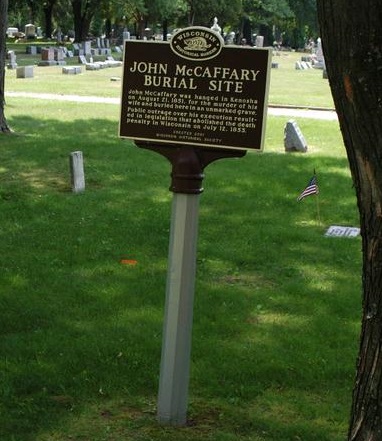
Burial marker for McCaffary in Kenosha’s Green Ridge Cemetery, erected in 2001. ((cc) image from Matt Hucke.) The McCaffary house on Court Street is also a registered historic landmark, and possibly haunted by Bridgett’s ghost.

There’s a handy roundup of resources related to the McCaffary execution here.

* The present-day name. Kenosha was then known as Southport.

** According to Invitation to an Execution: A History of the Death Penalty in the United States, there was an 1868 Wisconsin execution under Oneida (not Wisconsin) law, conducted on tribal lands.

† Said typewriter also debuted the now-standard QWERTY keyboard layout.

On this day..

1738: Helena Curtens and Agnes Olmans, inviolable dignity

On this date in 1738, the last victims of witch trials in the Lower Rhine were burned at the stake in Gerresheim, an ancient German city today subsumed by Düsseldorf.

More eccentric than demoniacal, the sicky 14-year-old Helena Curtens reported having seen some ghostly apparition during a curative pilgrimage to Kevelaer, and received from him some towels with weird occult inscription. (She actually did have such towels.)

This adolescent attention-seeking turned into a whole thing when judge Johann Weyrich Sigismund Schwarz’s long ears caught hold of Gerresheim’s wagging tongues.

The whole idea of witches and witchcraft was trending ever less fashionable at this time, but not for Schwarz: he routed Curtens’s occult encounter into the judicial Hexenprozess and got on record an accusation against her neighbor Agnes Olmans as well as the usual stuff about playing the harlot with a visiting devil.

Their case extended for more than a year; Helena Curtens was 16 by the time she burned.

In that time, Curtens stayed curiously committed to her crazy story, even knowing that it was putting her under the shadow of the stake.

Olmans, by contrast, fought with every fiber the allegations that her young neighbor kept confirming. Olmans even fell ironic victim to the uneven development of rational witch-law reform when she tried to demand that she be put to the ordeal of water to prove her innocence: it turned out that this backwards practice of pseudo-forensics had been barred in 1555, so Schwarz could not order it. At trial, her denials were easily overcome by the gossip of neighbors, and even her own husband — who recalled that the mother-in-law had a distinctly witchy reputation. Hey, ’til death do us part, babe.

Today, there’s a public stone monument to these milestone sorceresses, the Gerresheimer Hexenstein (“Gerresheim witches’ stone”)

Its inscription reads:

Human dignity is inviolable.
For Helene Mechthildis Curtens and Agnes Olmanns.
Burned in Gerresheim on August 19, 1738.
After the last witch trial in the Lower Rhine
and for all those tortured and outcast

On this day..

1883: Ah Yung

(Thanks to Meaghan Good of the Charley Project for the guest post. -ed.)

On this day in 1883, Chinese immigrant Ah Yung, aka Ah Kee, was hanged in Missoula, Montana.

As Tom D. Donovan notes in his book Hanging Around The Big Sky: The Unofficial Guide to Lynching, Strangling and Legal Hangings of Montana, his execution had three distinctions:

  • The first (of nine) legal executions in Missoula County;
  • The first Chinese person hanged in Montana;
  • The quickest reported hanging, with death declared in only a minute and a half.

Ah Yung was condemned for the January 29, 1883 murder of Chung Yu, the paymaster of the Wing See Company.

However, the authorities believed his murder was the least of Ah’s crimes; he was suspected of killing no fewer than seventeen people, two whites and fifteen Chinese.

Ah Yung shot and killed Chung Yu and wounded another man during a botched robbery, then fled the scene. The authorities offered a $400 reward for his arrest, and he was captured a month after the murder at Frenchtown, Montana. But, as Donovan records, “because of some bizarre reason, there was a question whether or not the reward was going to be paid for his captor released the prisoner.”

Fortunately, the murderer remained free for only a few days and didn’t have the opportunity to commit any more crimes before he was captured again, and this time sent to jail in the newly incorporated city of Missoula.

Chinese immigrants, especially drawn by gold strikes,* were a sizable constituent in frontier Montana as throughout the American West. A Montana travelogue in the Nov. 25, 1882 Utah Salt Lake Tribune

“Gangs of Chinamen clearing away the forest and underbrush … laboring with pick, shovel and wheelbarrow.” This was the Northern Pacific then under frenetic construction through forbidding Rocky Mountain terrain in subzero temperatures. In Missoula itself, “Celestials” were “numerous enough to form a Chinese quarter. They have an eye to business, and where you find a live, busy camp or town in this remote region, there, too, you find the inevitable Chinaman.”

A Presbyterian minister and a Catholic priest attempted to offer pastoral counsel to the condemned man, only to discover that he was utterly ignorant of religion. Pressed to confess, Ah Yung refused and kept repeating, “Me no kill him,” — a statement he held to his dying moments.

* Welcomed initially, the Chinese were an increasingly contentious presence in Montana (and elsewhere) in the 1880s. Still, there were over a hundred independent Chinese mining operations known in Montana at this time.

On this day..

1973: Mimi Wong Weng Siu, jealous hostess

On this date in 1973, former cabaret star Mimi Wong Weng Siu and her husband Sim Woh Kum were hanged for the murder of Wong’s Japanese lover’s wife.

“Overwhelmed by a consuming jealousy” (her prosecutor’s words) for Hiroshi Watanabe, a land reclamation engineer from Osaka who was in Singapore working to prepare Bedok for development, Wong recruited her estranged husband to help her get rid of the competition. (Sim was just in it for the payment Wong promised him.)

On the evening of January 6, 1968, the two broke into the home when Ayako Watanabe was alone there. Sim threw bleach in the victim’s eyes to incapacitate her, as Wong fatally gashed her neck and abdomen with a small knife.

The resulting 26-day trial riveted Singapore with the risque details of the dance hostess’s adulterous trysts. (And said dance hostess’s two courtroom fainting episodes.) But their manifest guilt plus their confessions — each vainly attempting to blame the other — assured their convictions.

While Sim situates as a side character of little lasting interest, Mimi Wong’s hanging was among the few that would really stick with long-tenured Singapore hangman Darshan Singh.

The title character, if you like, of Alan Shadrake’s Singapore death row critique Once a Jolly Hangman, Singh executed more than 850 people in more than four decades on the job and never wavered in his support for the policies that kept him occupied. Even so, Singh felt compassion for the individual humans he was called upon to kill; he was known to go out of his way to get to know condemned prisoners and to comfort them in their distressing situation.

According to an October 2013 AsiaOne profile, Singh had an unusually close pre-execution relationship with the first woman hanged in the only recently (since 1965) independent Singapore.

In prison, she was a difficult inmate who would at times strip naked and refuse to put on her clothes even when ordered by prison guards. She even threw urine at the wardens, said Madam Jeleha.

“Darshan was the only one who could control her. He would say ‘Mimi, wear the blanket and cover yourself. Don’t do this or you won’t be beautiful any more’, and she would listen to him,” Madam Jeleha said.

The two forged an unlikely friendship and other prison officers even joked that Wong was his girlfriend. Mr Singh never minded.

Before her execution, Wong told Mr Singh they should be lovers in the next life and she wanted to take him with her.

“After he hanged Mimi Wong, he fell very sick for a month. He was in Toa Payoh Hospital for more than two weeks,” his wife said.

Even when probed, he refused to tell his wife about Wong’s final moments.

On this day..

1936: Arthur Gooch, the only execution under the Lindbergh Law

This date in 1936 marks the first and only occasion that the federal government hanged a (non-murdering) kidnapper under the Lindbergh Law.

Even before the notorious Lindbergh baby kidnapping case, the “snatch racket” of kidnappings for ransom had claimed a firm foothold among Depression-era America’s moral panics. The bill that would become known as the Lindbergh Law was actually introduced in Congress three months before little Charles Lindbergh, Jr. disappeared out the window of his New Jersey nursery. Its sponsors were Missouri lawmakers concerned that gang-ridden St. Louis was becoming a kidnapping hub, like the high-profile 1931 abduction of Dr. Isaac Kelley.*

The theory behind the bill — and this was particularly relevant to St. Louis, a border port right across from Illinois and accessible via the Mississippi River to the whole Midwest — was that kidnappers could more easily ply their nefarious trade by carrying their hostages over a convenient border and exploiting the respective states’ inability to coordinate with one another. By elevating interstate kidnapping to a federal felony, the idea was to put manhunts into the hands of the FBI, whose jurisdiction was the entire United States.

The Lindbergh case provided just the right impetus for Congress to advance into law a bill that might otherwise have died quietly in committee. There’s just something to be said for being the one with a plan at the right time … even though the Lindbergh baby was found dead four miles away from the house he was plucked out of, and probably never crossed a state line himself.

At any rate, the Lindbergh Law also made kidnapping alone a capital crime, even if the abductee was not harmed. And it is for this that Arthur Gooch ascended into barstool trivia.

Gooch’s life and case are the focus of this 125-page Master’s thesis (pdf), but the long and short of it is that Gooch and a buddy named Ambrose Nix were on the lam after busting out of the Holdenville, Okla., jail, and ended up heading south to Texas.

They committed a robbery in Tyler, Texas on November 25, 1934. The next day, while stopped with a flat at a service station in Paris, Texas — close by the Texas-Oklahoma border — two policemen approached the suspicious vehicle. In the ensuing struggle, Nix managed to pull a gun on everyone and force the subdued cops into the back of their own patrol car, which the fugitives then requisitioned to high-tail it over the Oklahoma border. There they released their captives unharmed. There had never been a ransom attempt.

A month later, Gooch was arrested in Oklahoma — while Nix died in the shootout, leaving his partner alone to face the music.

Arthur Gooch was a career criminal, and the fact that he violated the Lindbergh Law was easy to see, but his crime also wasn’t exactly the scenario that legislation’s drafters had foremost in mind. In fact, Gooch also underscores one of the oft-unseen dimensions of the death penalty in practice: the discretionary power of prosecutors and judges at the intake end of the whole process.

Gooch attempted to plead guilty to his charge sheet, but his judge, former Oklahoma governor Robert Lee Williams, refused to accept it. Williams was explicit that his reason was that the Lindbergh Law’s language required a jury verdict to impose a death sentence.

By contrast, in October of 1934 — a month before the legally fateful confrontation at the Paris service station — a black farmhand named Claude Neal suspected of the rape-murder of a white girl was dragged out of protective custody in Alabama and taken across the adjacent Florida state line, where an angry mob lynched him. Despite the urging of the NAACP, FDR’s Attorney General Homer Stille Cummings completely refused to interpret Neal’s abduction as a Lindbergh Law kidnapping. The two cases even turned on the same phrase of the Lindbergh statute: interstate kidnapping “for ransom or otherwise.” While Cummings decided pre-emptively that “or otherwise” didn’t cover lynch law, one of his U.S. attorneys would go to the Supreme Court in January 1936 to argue for a broad interpretation of that phrase in the context of Gooch’s appeal.

But even without a comparison to Claude Neal’s murder, the justice of executing Arthur Gooch was hotly disputed by a vigorous clemency campaign. The chance intercession of a state line had elevated a small-time crime committed further to avoiding arrest into a capital offense, basically on a technicality. “It would be a rotten shame to hang that boy when a short jail term is his desert,” one Oklahoma City society woman argued to the Jeffersonian Club. “Gooch was given an application of the poor man’s law.” It seems clear that for Judge Williams as for President Roosevelt (who denied Gooch’s clemency appeal) the result was heavily influenced by the political exigencies of pushing a tough-on-crime standard, and by Gooch’s previous history as a crook. (He’d broken out of jail in the first place because he was a member of a group of local hoods in Okmulgee that committed several armed robberies.)

Gooch was philosophical at the end. “It’s kind of funny — dying,” he mused. “I think I know what it will be like. I’ll be standing there, and all of a sudden everything will be black, then there’ll be a light again. There’s got to be a light again — there’s got to be.” We can’t speak to what Gooch saw after everything went black, but it definitely wasn’t “all of a sudden”: Oklahoma’s executioner, Richard Earnest Owen, was an old hand with his state’s electric chair, but the federal execution method was hanging, which Owen had never before performed (and never would again). Gooch took 15 minutes to strangle at the end of the rope.
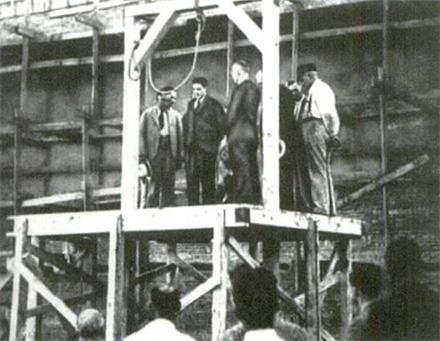

Arthur Gooch on the gallows

* The Kelley kidnapping, unsolved for several years, eventually traced to the strange character Nellie Muench. Readers (at least stateside ones) who follow that trailhead should be sure to keep an eye out for the cameo appearance of Missouri judge Rush Limbaugh, Sr. — grandfather of the present-day talk radio blowhard.

On this day..

1989: Stefan Svitek, the last in Czechoslovakia

The last execution in the history of the former state of Czechoslovakia occurred on this date in 1989.

Staggering home extremely drunk late one autumn night, Štefan Svitek (English Wikipedia entry | Czech) found the door locked and the pregnant Roma wife he regularly battered disinclined to open it.

So Svitek opened it himself by grabbing an obliging ax and splintering it to pieces.

Then he turned the ax on poor Marie and the family’s two daughters.*

Even the most aggressive executioners — and Czechoslovakia was not that — don’t hang every homicide. Svitek might have doomed himself in the final analysis with his disturbing sexual proclivities, especially since they surfaced during his rampage. He reportedly carved up the bodies, sliced off his late wife’s breasts and even cut the still-stirring embryo of his next child out of her womb, and pleasured himself over all the fresh gore. He would later describe it as the most intense sexual experience of his life.

It emerged at trial that Svitek’s youth in an alcoholic home had warped his animal urges so severely that he turned his lust upon animals, taking special gratification in castrating them.

This last operation Svitek also perpetrated on his own self as he fled in panic from his domestic charnel house. He also attempted to commit suicide by hanging.**

Svitek broke that rope. On the 8th of June in 1989, he did the same (metaphorically) to Czechoslovakia’s.

Svitek’s hanging June 8, 1989, was not only the last ever in the soon-to-be-defunct Czechoslovakia, but the last associated with either of Czechoslovakia’s successor states, neither of which have the death penalty on the books. (Svitek was hanged in Bratislava, the Slovakian capital; the last execution in the Czech half was that of Vladimir Lulek earlier in 1989.)

Update: Documentary, in Slovak (via the Twitter machine).

* One was Svitek’s own child, the other was his wife’s by her previous marriage. They were four and six years old.

** Another possible kink?

On this day..