On this date in 1859, five to six hundred folks braved a dreary Portland morning to witness the first execution in the state of Oregon — Oregon having graduated into statehood just that very year, as it says on the flag.
Danford Balch, who would surely merit an entry in these pages for his name alone, had staked out a 345-acre land claim near the small settlement of Portland, but all that money couldn’t buy his daughter’s love.
Anna, the eldest of nine kids at a blossoming 15, was amenable to a suit by the farmhand, one Mortimer Stump — this is a Dickensian roster of characters — and in the face of Papa Balch’s opposition, eloped with him over the Columbia River to Vancouver, Wash.
So Danford Balch stewed, and drank, and was allegedly incited by his shrewish wife Mary Jane — this one has an ironically innocent moniker — until, encountering the Stumps in town for supplies one day, Danford Balch tried to retrieve his daughter and ended up shotgunning his unwanted son-in-law, right in the face.
Ka-blamo.
Bystanders tackled Balch immediately, though it took nine more months to bring the killer to trial: in these sparsely-populated frontier precincts justice was being administered on the old “assize” model of wandering judges who dropped in for a spell to try everything at one go. It was enough time for Balch to bust out of a rain-rotted jail cell once and get recaptured (once on the lam, he returned to his own home).
When court was finally in session, conviction was a mere formality. He’d done the deed in public, after all. But the offended father seemed genuinely bewildered by the outcome: apart from the shooting being accidental (so he said), he clearly expected that a court would uphold the dominion of the family patriarch over his wayward progeny.
Heaven knows what fumes he was fuming by the time he climbed the scaffold and beheld that naughty daughter Anna turned up to witness his hanging — sitting in the front row with the [rest of the] Stump family in what you have to think was a somewhat uncomfortable party for all concerned.
Little more affectionate was the post-mortem behavior of the allegedly un-alienated part of the Balch clan.
That widow Mary Jane, whom Danford hinted gave him quite a goading over their wanton daughter, shafted the remaining rugrats out of inheriting their chunks of the family land and instead routed most of it to her next husand.
Balch Creek in Lower Macleay State Park. (cc) image from Brad Reber.
Though pretty difficult to admire by the yardstick of human decency, that behavior turned out to be Danford Balch’s redeeming legacy.
Having passed through several hands, the lion’s share of his former land was in 1897 donated to the city by its then-owner Donald Macleay, who was sick of paying taxes on the unprofitable parcel. That was the time the famously green PDX received its first land gift designated by the donor for parkland: Macleay Park. (Including a Balch Creek.)
Today, it’s all part of the larger Forest Park, and it’s a lovely hiking space for a city that grooves on its outdoor rec … complete with a gorgeously ruined Depression-era stone ranger station that’s popularly believed to be haunted, maybe by the spirit of poor old Danford Balch himself.
On this day in 1843, 84-year-old Allan Mair was hung in Stirling, Scotland.
He was condemned for the murder of his wife. Mair is notable not only for being the oldest person ever executed in Scotland, but also for his unusually long, bitter scaffold speech, as recorded in Alex Young’s book The Encyclopaedia of Scottish Executions 1750 to 1963.
The meenister o’ the paarish invented lees against me. Folks, yin an’ a, mind I’m nae murderer, and I say as a dyin’ man who is about to pass into the presence o’ his Goad. I was condemned by the lees o’ the meenister, by the injustice of the Sheriff and Fiscal, and perjury of the witnesses. I trust for their conduct that a’ thae parties shall be overta’en by the vengeance of Goad, and sent into everlasting damnation. I curse them with the curses in the Hunner an’ Ninth Psalm: “Set thou a wicked man o’er them” — an haud on thee, hangman, till I’m dune — “An’ let Satan stand at their richt haun. Let their days be few, let their children be faitherless, let their weans be continually vagabonds”; and I curse them a —
At this point, the executioner drew the bolt, but Allen wasn’t done raging against the dying of the light. The old fella got his hands free and grabbed the rope, delaying his strangulation; the slipshod executioner had to fight off his prey’s clutches to hang him.
There’s an original broadside from this execution here.
On this date in 1902, a hanging in Alaska capped a gold rush story fit for Jack London.
“A leetle favor … I gif my husky-dog, Diable, to de devil. De leetle favor? Firs’ you hang heem, an’ den you hang me.” Illustration from Jack London’s short story “Diable” (or “Batard”).
Actually, this tale is set not in London’s characteristic Klondike gold rush, but a subsequent one centered on remote Nome. There, in the words of the Rex Beach novel The Spoilers, “a frenzied horde of gold-seekers paused in their rush to the new El Dorado. They had come like a locust cloud, thousands strong, settling on the edge of the Smoky Sea, waiting the going of the ice that barred them from their Golden Fleece — from Nome the new, where men found fortune in a night.”
The victims in this case of mercenary arctic brutality were a party of four who set up prospecting camp on Unimak Island, in the Aleutians. Their impression that they were safely alone on this large territory was refuted with the inexorable cruelty of a slasher flick.
After being caught out by the elements in a secondary camp, the party returned to its unsecured main base to discover “that their tent had been torn down in their absence and their stores taken away.”
Here the ominous overture fades in, and by the time it hits crescendo the mysterious robbers will have visited a cold-blooded massacre on our quartet of prospectors.
“Suddenly a man, who had been hid by the tall coarse grass, jumped up several hundred yards away, and took aim with a rifle at Florence. He fired and Florence fell with a scream. ‘Con’ and I ran for the boat, jumped in, and Rooney started to shove her off. The next moment a shot came from somewhere in the cliff above our heads.
“Rooney grabbed hold of his right knee, cried ‘They’ve got me too,’ and sank into the surf. Con and I saw that there was no use trying to get away in the boat, and so took it on the run for the shelter of the cliffs. We hadn’t gone twenty steps when another shot rang out; Con threw up his hands and fell headlong upon the beach, stone dead, with a shot between the shoulders. I kept on running, hearing shot after shot fired at me and striking about me with dull thumps like pieces of heavy hail.”
That’s from the riveting account of the lone survivor, one Jackson, who managed to escape into the island’s interior and after tramping about for two weeks, near to starvation and in continual terror of his stalkers, was finally found at death’s door by a friendly hunter.
Jackson’s information was able to tip off an investigation that led to the capture of two suspects. By the time Fred Hardy and George Aston were nabbed, they had “taken possession of” a fishing village and “kept [the fishers] in a terrified state.” They also happened to have the late prospectors’ booty, including personal items like an inscribed watch.
Aston wisely turned on his confederate, saving his own neck at the cost of stretching Hardy’s.
Hardy, a veteran of America’s colonial adventure in the Philippines and a nephew (so he said) of department store magnate John Wanamaker, denied guilt all the way to the scaffold but got no help from appellate courts or from President Teddy Roosevelt. (Since Alaska was still a territory, executive clemency was up to the White House.) He was put to death “in an addition built to the ice-house on the lot opposite the jail” (according to Washington state’s Morning Olympian, Oct. 3, 1902) at Nome City itself.
It wasn’t actually the first execution in Alaska, or even American-run Alaska, but Hardy’s hanging was a significant milestone. Prior to 1900, the vast territory was next door to lawless, order enforced in the interior by miner’s meetings or not at all, while a smattering of coastal military and customs outposts projected vague federal authority. Data on executions from this period is sketchy and incomplete.
In 1900, with the Alaskan population booming from that locust cloud of gold-hunters, promulgation of a civil code set Alaska on the way to something resembling normal government. Hardy’s execution was the first under legal judicial authority — the first of eight in the first half of the 20th century. Alaska abolished capital punishment shortly before attaining statehood in 1959.
“I set off upon a very good Horse; it was then about 11 o’Clock, and very pleasant. After I had passed Charlestown Neck, and got nearly opposite where Mark was hung in chains, I saw two men on Horse back, under a Tree. When I got near them, I discovered they were British officers.”
This useful Cambridge landmark* so nearly catastrophic for the cause of American liberty had been supplied this date in 1755 by the fruit of American liberty’s original sin: slavery.
“Mark” was a Massachusetts slave who, for the crime of offing his master Captain John Codman — “willfully felloniously and Traiterously put a Deadly Poison called Arsenick into a Vial of Water” because Captain John had separated Mark from his family — was entombed in colonial cartography by means of hanging, tarring, and gibbeting in an iron cage.
This exceptional sentence was mirrored by the rare-for-North-America fate of burning alive meted out to Mark’s fellow-slave and co-conspirator, Phillis.
They were adjudged to have committed not merely murder, but that archaic offense of petty treason — betraying not their sovereign but their natural superior.
Besides Mark’s becoming a literal landmark, theirs was a landmark case: Mark and Phillis were the only people ever convicted (pdf) for petit treason in Massachusetts.
The records of this trial are preserved in a public domain volume available from Google books; we’re particularly drawn to a tangential mention in this tome of a British governor‘s defense of capital punishment as a specifically oligarchical strategy: “Whilst the people of this country lived from hand to mouth, and had very little wealth … capital punishment might in a great measure be avoided; but when by the acquisition, diffusion, and general intercourse of wealth, the temptations to fraud are abundantly increased, the terrors of it must be also proportionably enlarged; otherwise if, through a false tenderness for wicked men, the laws should not be sufficient to protect the property of the honest and industrious …”
borne on the night-wind of the Past,
Through all our history, to the last,
In the hour of darkness and peril and need,
The people will waken and listen to hear
The hurrying hoof-beats of that steed,
And the midnight message of Paul Revere.
* A nicely tarred corpse will really keep for you: one colonial doctor observing this gibbet in years past had noted that Mark’s “skin was but little broken altho’ he had been hanging there near three or four years.” This is the kind of Founding Fathers’ wisdom that latter-day America has so sadly turned its back on.
On this date in 1941, the U.S. state of Louisiana joined the 20th century (or at least the late 19th) with its first electrocution.
Louisiana’s electric chair did debut very late in the game. The great surge of adoption for this uniquely American way of death was the 1910s and 1920s. Louisiana was the last state to begin electrocuting prisoners save one — West Virginia.
But in 1940, the state legislature had finally joined the trend sweeping the South and voted for voltage.
Eugene Johnson, the next to die, has no purchase on death penalty annals but his accidental milestone as the first to die seated: a black man condemned for killing a white farmer is just about your standard-issue condemned man in the interwar South. (The more things change …)
Johnson’s death this date would inaugurate the nickel-and-dime execution solution that Baton Rouge came up with to keep its various parishes right in the thick of the retribution business: the portable electric chair soon christened Gruesome Gertie, which trucked around to the local jails and courthouses meting out motorized justice.
This particular chair, though a latecomer and a modest overall contributor by the standards of Louisiana’s neighbors, would make itself the subject of highest jurisprudence a few years later by not merely botching but failing the execution of one Willie Francis — and then again in the 1980s as the subject of another man’s near-miss legal challenge to the constitutionality of electrocution.
Having always found five friends on the high court, the illustrious furniture retired in 1991 with 87 souls to its electrodes (including that of Willie Francis the second time around: he lost his appeal). Gertie lives on adorning the set of the Angola Prison Museum — and the Academy Award-winning film Monster’s Ball.
On this date in 1861, Vermont private William Scott of the new-formed Army of the Potomac, then fortifying Washington D.C. for the unfolding Civil War in the aftermath of Bull Run, was led out for execution for having fallen asleep at his post.
The so-called Sleeping Sentinel took a sick comrade’s watch even though he himself was bushed, and … well, you know the rest.
Condemned for a dereliction of duty which “may endanger the safety of a command, or even of the whole army” (the words of the army’s commander Gen. McClellan), Scott still attracted widespread sympathy due to the obviously sympathetic nature of his situation. He was a youth new to war, with an exemplary military record outside of his forty winks.
“The American people,” reckoned the New York Times, “are quite unprepared to hear of a measure of such fearful and unwarned rigor as that which was awarded private SCOTT.”
Appeals went straight to the White House, which was conveniently located in the Army of the Potomac’s back yard, and freshman president Abraham Lincoln magnanimously spared the lad.
Still, wanting to use the case to impress military discipline upon the rabble of corn-fed conscripts, that clemency was delivered with a terrifyingly dramatic flourish. Scott was left to contemplate his last hours on the earth, and, Dostoyevsky-like, marched out to the stake ostensibly to face the firing squad. Only then did he and his fellow-soldiers hear the commutation order.*
This exhilarating climax did not long stay the hand of the Reaper, as it transpired.
Scott died in battle the following spring. In death he lives on, as befits the habitues of these pages: fellow Vermonter Lucius E. Chittenden, who was serving in the U.S. Treasury when all this sleeping sentinel stuff went down, commemorated William Scott for posterity in a subsequent entry to the merciful-Lincoln mythology, a postwar volume titled Lincoln and the Sleeping Sentinel.
The story was also made into a 1914 silent film, which sadly doesn’t seem to be available online: but never fear, this syrupy poem will amply represent our Sentinel’s contribution to the canon.
But God is love – and finite minds can faintly comprehend
How gentle Mercy, in His rule, may with stern Justice blend;
And this poor soldier, seized and bound, found none to justify,
While war’s inexorable law decreed that he must die.
‘Twas night. In a secluded room, with measured tread and slow,
A statesman of commanding mien paced gravely to and fro.
Oppressed, he pondered on a land by civil discord rent;
On brothers armed in deadly strife: it was the President!
The woes of thirty millions filled his burdened heart with grief;
Embattled hosts, on land and sea, acknowledged him their chief;
And yet, amid the din of war, he heard the plaintive cry
Of that poor soldier, as he lay in prison, doomed to die!
‘Twas morning. On a tented field, and through the heated haze,
Flashed back, from lines of burnished arms, the sun’s effulgent blaze;
While, from a somber prison house, seen slowly to emerge,
A sad procession, o’er the sward, moved to a muffled dirge.
And in the midst, with faltering step, and pale and anxious face,
In manacles, between two guards, a soldier had his place.
A youth, led out to die; and yet it was not death, but shame,
That smote his gallant heart with dread, and shook his manly frame!
Still on, before the marshalled ranks, the train pursued its way,
Up to the designated spot, whereon a coffin lay-
His coffin! And, with reeling brain, despairing, desolate-
He took his station by its side, abandoned to his fate!
Then came across his wavering sight strange pictures in the air:
He saw his distant mountain home; he saw his parents there;
He saw them bowed with hopeless grief, through fast declining years;
He saw a nameless grave; and then, the vision closed-in tears!
Yet once again. In double file, advancing, then, he saw
Twelve comrades, sternly set apart to execute the law-
But saw no more; his senses swam-deep darkness settled round-
And, shuddering, he awaited now the fatal volley’s sound!
Then suddenly was heard the sounds of steeds and wheels approach,
And, rolling through a cloud of dust, appeared a stately coach.
On, past the guards, and through the field, its rapid course was bent,
Till, halting, ‘mid the lines was seen the nation’s President!**
He came to save that stricken soul, now waking from despair;
And from a thousand voices rose a shout which rent the air!
The pardoned soldier understood the tones of jubilee,
And, bounding from his fetters, blessed the hand that made him free!
A few letters from Scott’s own hand are preserved here. A (defunct) mini-blog exploring the case in detail can be perused here.
* There was actually American precedent for this sort of stagey non-execution in a case from the War of 1812.
** Obviously, Lincoln did not actually bring his presidential person to the execution grounds to issue this pardon in the flesh: in fact, the presiding officer on-site simply read out the pardon: “the President of the United States has expressed a wish that as this is the first condemnation to death in this army for this crime, mercy may be extended to the criminal.”
Puking her guts out, little Shirley was raced to the hospital where Earle Dennison had her day job as a nurse. But while the child lay dying, the aunt slipped away so that she could make a payment on a $5,500 life insurance policy she had taken out on the kid — a policy that would have expired the very next day.
This whole affair could hardly fail to cast an incriminating light on the death two years prior of Shirley’s older sister … whose body, upon exhumation, also showed traces of arsenic.
Dennison was indicted but never tried for that previous possible murder; Shirley Weldon’s case would more than suffice to secure the landmark visit to Yellow Mama. The main question was really whether Dennison had been, juridically speaking, plum off her rocker.
Not far enough off it to help her.
Shirley’s parents subsequently won a $75,000 judgment against the insurance company for issuing the policy to an in-law with no insurable interest in the young victim, thereby “plac[ing] the insured child in a zone of danger, with unreasonable harm to her and … the defendants in issuing the alleged illegal contracts.”
But that was a different era. As of today, vast tranches of collateralized policies among suspicious parties with no insurable interest, issued by bankers as rich as Croesus and implicitly guaranteed too big to fail, might well constitute a forward-thinking investment opportunity for troubled economic times.
* There had been only one woman of any racial category electrocuted in Alabama full stop, according to the Espy file of historical U.S. executions: African-American Silena Gilmore in 1930. Prior to that, Alabama had not executed a woman at all since the Civil War.
I have ever had the single aim of justice in view … ‘Do equal and exact justice,’ is my motto, and I have often said to the grand jury, ‘Permit no innocent man to be punished, but let no guilty man escape.’
On this date in 1875, the most famous — or infamous, depending on your perspective — “hanging judge” of the American West dropped the trap on his noosing career with his first six hangings at Fort Smith, Arkansas.
Isaac Parker, around the time he arrived at Fort Smith
No problem: his co-partisan president, Ulysses S. Grant, appointed Parker to a federal judgeship in neighboring Arkansas. It’s upon that renowned tenure that the man’s reputation, uh, hangs.
This expanse of land, the final destination of the Trail of Tears, had once been preserved for tribes forcibly “removed” from eastern North America.
But by the post-Civil War years, the frontier was sweeping past on iron wheels … and as long as Indian Territory remained (mostly) protected from white settlement, it remained a sparsely-populated refuge for outlaws.
Pandemonium in the Territory was only exacerbated by the Fort Smith court’s reputation for corruption and inefficiency; the office was open for Parker’s appointment because his predecessor had resigned to avoid impeachment.
Judge Isaac Parker came to clean up the place.
Fort Smith was an unusual portfolio for a federal judge. While most of Parker’s colleagues were confined to the tedium of interstate civil litigation, Parker was the court of first call for many regular criminal cases in the Indian Territory which in other jurisdictions would have been a state matter. He estimated in 1885 Congressional testimony that seven-eighths of his caseload came from Indian Territory.*
And in those cases he quickly established himself a reputation for severity.
“I never hanged a man,” Parker said of himself later in life. “The law hanged him. I was only its instrument.”
But make yourself the law’s instrument to the tune of 79 hangings, and folks are bound to sit up and take notice.
“they nearly hung me for stealin’ a horse
in Fort Smith Arkansas.
Judge Parker said guilty and the gavel came down
just like a cannon shot …”
At his court’s very first sitting in May 1875, Parker death-sentenced a murderer — Daniel Evans, who came straight from frontier central casting and had murdered a man for his boots.
As that year unfolded, he added enough condemned men to the bowels of the miserable jail nicknamed “Hell on the Border” — for an eight-strong hanging date to christen September.
One of the eight had his sentence commuted due to youth.
One was shot trying to escape.
And the other six were the debut crop for the mass-occupancy gallows that Parker ordered constructed at Fort Smith. (Its capacity was a full dozen.)
The clientele was six unconnected murderers, committing various atrocities for various motives and aptly embodying the region’s ethnic diversity.
Evans, white
James Moore, white
Samuel Fooy, quarter Cherokee
Smoker Mankiller, Cherokee
Edmond Campbell, black
John Whittington, white
And the audience? Five thousand or so reportedly on hand in Fort Smith this date, plus a national media audience … and posterity deep into the second century since this sturdy magistrate donned his first black cap and set about putting chaos into order with a rope in his hand.
New York Tmes, September 4, 1875.
Whatever one might have to say about his methods, Parker presents a magnetic personality, a figure so truly of his own time and place that he obligingly died just weeks after his court was finally relieved of its Oklahoman jurisdiction in 1896. He’d never hang around to jolt our anachronism meter by weighing in on trench warfare or cubism.
Parker is undoubtedly a more layered figure than his “hanging judge” reputation would suggest, and even his life’s project to bring his unruly jurisdiction to heel was more complicated than just being a hardass. (He had a significant administrative challenge to manage his chronically underfunded court, and he needed to foster the sense of communal reciprocity and legal integrity that would encourage fellow-citizens to turn up for jury duty and witness testimony that make the law’s everyday business possible.) The judge was famous for the long hours he kept, and capital cases were never more than a tiny fraction of his work.
Parker was notorious (slash-beloved, again depending on perspective) for his prosecution-friendly courtrooms, but even the tough sentences he handed down came in his mind from a place of tough love. He wrote late in life that
not one of [those he suffered to long prison terms for violent crimes], no matter how depraved, had entirely lost that better part of human nature …
The object of punishment is to revive, that in some cases, almost extinct spark, to lift the man up, to stamp out his bad nature and wicked disposition, that his better and God given traits may assert themselves.*
Still, whether you prefer him as the stern avatar of law on an outlaw plain or bloodthirsty yahoo, Parker’s ready amenability to latter-day Hollywood tropes will surely maintain his popularity in the cultural rookery of wild west cutouts.
Among numerous other reference points, the novel True Grit, and the 1969 and 2010 films based on it, use Judge Parker’s Fort Smith as the heroine’s embarkation point — with her dangerous journey carrying her into the untamed Indian Territory on his doorstep.
Pat Hingle’s “Judge Fenton” (from “Fort Grant”) in the Clint Eastwood western Hang ‘Em High also shows an unmistakable debt to the Judge Parker persona.
A few books about Judge Parker
Spare a thought, too, for the man operating the ropes and levers this date.
George Maledon, named Fort Smith’s official hangman just a couple of years before Isaac Parker’s appointment, would enforce the Hanging Judge’s hanging sentences into the 1890s: 60-plus executions in all, plus five other escaping prisoners he gunned down, all in a day’s work for an Arkansas lawman.
Maledon has a sad coda to this story, which wasn’t so upbeat to begin with.
The year after the veteran hangman hung up his hood and opened a grocery store, Maledon’s daughter was murdered. The bereaved father’s friend Judge Parker, still on the bench at that time, condemned the killer to die in a case we’ll suggest might have warranted a recusal by present-day standards. Nevertheless, a successful appeal balked Maledon’s successor of the malefactor, and the disgusted ex-executioner got his species of payback by taking the accoutrement of his late profession on the road as a traveling act.
There, under the billing of “the Prince of Hangmen,” Maledon lectured and exhibited old hanging ropes and pictures of the outlaws they had choked.
People of all classes flocked to the show grounds, crowded about the lecturer and filled the tent, viewing the gruesome relics and listening to the old hangman’s recital of soul-stirring events as he pointed out the…instruments of his vocation. (Source)
* See Mary Stolerg, “Politician, Populist, Reformer: A Reesamination of ‘Hanging Judge’ Isaac C. Parker”, The Arkansas Historical Quarterly, Spring 1988
On this date in 1782, a crowd contemporaries pegged at 100,000 mobbed the gruesome public execution of David Tyrie — the last man hanged, drawn, and quartered in British history.
Tyrie was a Scotsman clerking at a Portsmouth naval office, who was caught in a treacherous correspondence with the French. He lacked political pull of his own and either the means or inclination to shop confederates, and therefore faced the full weight of the treason statute.
Tyrie might have been small time by those standards, but he wore it well this date — “played the man,” in the old parlance — before the throng on Southsea Common.
From the time he was put on the sledge, till be came to the gibbet, he continued in an unconcerned conversation with the gaoler, in which he expressed that he thought there were not three better, sounder, or honester hearts in the kingdom, than his own, which was just going to be burnt. That there was only one thing which gave him concern, which was, that his father was living, and he feared this misfortune would bring his grey hairs with sorrow to the grave. He declined saying a word to the populace, observing, that he knew not why he was to feed or gratify the idle curiosity of the multitude. He never hung his head the whole time. — When arrived at the place of execution, no halter was provided, upon which he smiled, and expressed astonishment as the inattention and neglect of his executioners; and indeed the business would have been retarded for some time, had not a rope and pulley been procured out of a lugger that lay under shore, during which time he read several passages in a bible he carried in his hand. – Before he was drawn up, he delivered a paper, setting forth, that he had authorised no person to publish any account of his life, nor was there any one who knew sufficiently of him to give any genuine particulars of his transactions in the world.
After hanging exactly twenty-two minutes, he was lowered upon the sledge, and the sentence literally put in execution. His head was severed from his body, his heart taken out and burnt, his privities cut off, and his body quartered. He was then put into a coffin, and buried among the pebbles by the sea-side; but no sooner had the officers retired, but the sailors dug up the coffin, took out the body, and cut it in a thousand pieces, every one carrying away a piece of his body to shew their messmates on board. — A more dreadful, affecting execution was perhaps never seen.
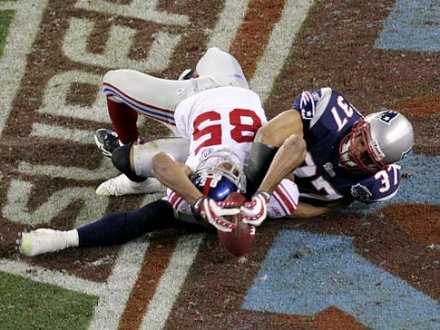
Before disemboweling, he was probably stretched out somewhat like David Tyree.
In fact, it was so dreadful (including many injuries in the distasteful rush for souvenirs) that they stopped doing it. Only gradually: Edward Marcus Despard, for instance, was sentenced to drawing and quartering, but they only hanged him to death and cut off his head posthumously. In 1814, that sentence — hanging plus posthumous beheading — formally replaced the old disemboweling-and-quartering bit as the penalty for treason.
At dawn fifty years ago today, Jose Isaias Constante Laureano was shot in Saltillo, Coahuila for murder — the last application of capital punishment in Mexican history.
Since past performance is no guarantee of future returns, nowhere is it written that the next five decades will also remain death penalty-free in Mexico. In fact, given the country’s wave of destructive drug war crimes, calls to restore the ultimate sanction have been heard from Coahuila’s own governor as well as from such unexpected quarters as Mexico’s Green Party.
Green Party pro-death penalty billboard in Mexico. (cc) image from Randal Sheppard.


 The so-called