There were two hangings reported this date at the prison in the southern Iranian city of Kazeroun (or Kazerun).
One Kourosh was executed for murdering a 52-year-old in 2004.
And someone named Abolfazl — well, he was much, much luckier. The parents of his victim availed their right to pardon him, although they waited until after the hanging had commenced to do so.
I believe (because how often can this happen in one town?) that this is the failed/survived execution attributed by Amnesty International to 2 December — which Amnesty argues “illustrates the inherent cruelty of the death penalty.”
The original link given by the Amnesty press release is now dead, but this source links the same article and says it cites 7 December; this Persian news story positively attributes the event to dawn on 17 Azar on the Iranian calendar, which corresponds to 7 December.
Not seven seconds had passed when the murder victim’s mother gave her pardon. Moments later, the victim’s father gave consent. Thus, immediately the accused was brought down from the gallows and given CPR while he was transferred to hospital.
Abolfazl survived. This story sported the headline “the sweet end of an execution.”
This is the feast day of the early Christian saint Cecilia.
There’s more than serendipity in that name’s pop culture connection: Cecilia is the patron saint of music for the rather slight reason that her heart sung only for God even when she was forced to marry the pagan Valerian. Seriously, Christianity didn’t have any early martyr with a stronger biographical context for a portfolio as significant as music?*
Being the go-to divine intermediary for something this big made Cece a popular saint centuries after her martyrdom, supposed to be either later in the 2nd century or early in the 3rd. (As with many other martyrs’ legends, Cecilia survives several executions before the Romans finally manage to cut her head off.)
Musician and songwriter Paul Simon knew enough St. Cecilia lore to explicitly use her in her musical-patronage role in a different song, “The Coast” (lyrics). The song “Cecilia” deepens immensely if it’s understood as mixed frustration and exaltation with the minstrel’s inconstant artistic muse.
Nor would that be the only 20th century musical homage for this accessible saint. In a more traditional vein, Benjamin Britten set to music a W.H. Audenpoem about Cecilia, creating the Hymn to St. Cecilia.
Blessed Cecilia, appear in visions
To all musicians, appear and inspire:
Translated Daughter, come down and startle
Composing mortals with immortal fire.
Fans of classical music should hit YouTube for Handel’s Ode for St. Cecilia’s Day, which appropriately premiered on this date in 1739. Here’s a nibble:
* So far as we know, blogging remains a niche of divine patronage as-yet unfilled. We propose to accept the protection of the patron saint of lost causes.
(Thanks to Michael Baney for the guest post. -ed.)
On this date in 1991, a Peruvian death squad showed up at the wrong party, and altered its country’s history.
In 1980 the Communist Party of Peru, better known as the Shining Path, launched its “People’s War,” which was never actually supported by the majority of Peruvians. Latin America had had its share of Marxist revolts, but this one was different from the others. There was nothing romantic about the revolutionaries, who wore plain clothes rather than uniforms, attacked the civilian population rather than invest significant capital to win them over to the Shining Path cause, and rose up in an effort to overthrow a democracy rather than a dictatorship.
The Shining Path was based mainly in Andean villages, but once they began to take serious losses in their own territory, they made a concerted effort to accelerate the war by pushing into the capital city, Lima. Both the Shining Path and the Peruvian military were committing deplorable human rights violations by the time Alberto Fujimori was elected president in 1990, although the vast majority of the violence had been confined to the hinterlands of the country up until then.
With Fujimori’s election, more urban-based death squad activities began. Perhaps the most famous was the November 3, 1991 massacre in the Barrios Altos neighborhood of Lima, a poor barrio only a few minutes’ drive away from the Congress and the Presidential Palace.
This date’s incident occurred when members of Grupo Colina (English Wikipedia entry | Spanish), a death squad that was part of the Army Intelligence Service, believed that they had identified a group of Shining Path militants having a pollada, which is a traditional fundraiser in Peru where a party is held so that chicken and beer can be sold to the neighbors. (Here’s a description, in Spanish)
A Grupo Colina squad drove to the building where this terrorist pollada was supposed to be taking place, lined the partygoers up, and extrajudicially executed them with submachine guns with silencers that the army had provided the group for the operation. Then the leader of the group, Santiago Martin Rivas, shot a young child who came running over to the body of his father. The troops got back into their vehicles, turned on their sirens to appear like they were the police in an effort to shift blame over the killings, and got drunk at the beach to celebrate.
Almost immediately it became clear that the death squad members had completely screwed up their hit.
The people who had been murdered were indeed having a pollada … not to fund the Shining Path’s Maoist agrarian war, but to fix the pipes in their building
And it transpired that that fateful night of Nov. 3, there was a differentpollada being held on a different floor in the very same building. The participants of that other party fled the building, never to return. There were reports that upon searching the rooms of those who fled, police uncovered many issues of El Dario, the Shining Path newspaper.
If Grupo Colina indeed crashed the wrong party, then it not only slaughtered a bunch of innocent people — it helpfully tipped the Shining Path to the fact that the army was onto them.
In any event, the executions became a media spectacle and the police had to at least go through the motions of investigating them. At first, the government suggested that the murders might have been actually carried out by the Shining Path, and as evidence of this theory they showed that one of the people who had been killed was previously a member of a Ronda, which is a peasant patrol group that fought against cattle rustling and, in some cases, the Shining Path. But it later turned out that the man had been a member of the Rondas many years before and hundred of miles away from the killings, and it seemed extremely improbable that the Shining Path would even bother to target him.
By December 4, 1991, the US embassy in Lima was informing the Secretary of State that the Peruvian government lacked the political will to investigate the murders, and had lied about whether or not the guns used in the extrajudicial executions were equipped with silencers in “an apparently deliberate attempt to obfuscate the situation.”
The Congress created a committee to investigate the crimes, which was a real threat to the Fujimori government because the Fujimoristas did not have a majority in Congress.
This ceased to be a problem on April 5, 1992, when Fujimori suspended the Congress, permanently disbanded the Senate, and fired a good number of the judges in the country, all in total violation of the Constitution. That ended the investigation.
Under pressure from the international community, a new Congress stacked with Fujimoristas was convened to write a new Constitution, and the investigation of the Barrios Altos killing nominally restarted. When the Congress called Nicolas Hermoza Rios de Bari, the Chairman of the Joint Command of the Armed Forces to testify, he took the oppotunity to remind the Congress that the military would never tolerate being “insulted.” When hearings continued, Hermoza Rios held an impromptu tank parade directly in front of the Congress. The few brave Congressmen and women who actually desired to expose the truth about the killings got the message loud and clear: the case would never go anywhere as long as Fujimori remained president.
When it finally looked like the perpetrators might be punished, for example, Fujimori rammed a law through the Congress that provided a general amnesty to everyone who had violated human rights “in defense of the fatherland.” When a judge ruled the amnesty law unconstitutional, Fujimori’s Congress stripped the power of judicial review from the courts in cases of amnesty laws.
In a very real sense, the Peruvian government had legalized illegality. Fujimori created a system in which there was no way to punish — or even investigate — murder so long as someone, somewhere considered the crime to have been committed for patriotic reasons.
All that changed in 2000, however, when Fujimori’s government collapsed amid scandal.
An opposition figure who vowed to create a Truth and Reconciliation Commission was sworn in as into office, and Peru reaffirmed its commitment to the American Convention on Human Rights. In 2001, in a groundbreaking decision, the Inter-American Court of Human Rights ruled in its Barrios Altos case that countries cannot issue an amnesty for “serious human rights violations.” The amnesty was thrown out and Grupo Colina members were arrested.
In 2007, Alberto Fujimori was extradited from Chile, where he had traveled, to Peru. In 2009, the Peruvian courts convicted Fujimori of a number of human rights abuses, including ordering the Barrios Altos murders. Just last month, justice was finally served when the members of Grupo Colina were convicted of murder, kidnapping, forced disappearance, and conspiracy, and were given various sentences ranging up to 25 years of prison. After 19 years, the Peruvian government has finally acknowledged that the extrajudicial executions that took place during that country’s cold war were crimes that must not go unpunished.
Between September 29 and September 30 in 1941, the Nazis, specifically Einsatzgruppe C, shot some 34,000 Jewish people at Babi Yar, a ravine outside of the Ukrainian city of Kiev.
The United States Holocaust Memorial Museum gives a suspiciously specific death count of 33,771. This is considered the single largest mass murder of World War II, and for Kiev it was just the beginning.
In the days prior to the massacre the Nazis put up posters around the city reading:
Kikes of the city of Kiev and vicinity! On Monday, September 29, you are to appear by 08:00 a.m. with your possessions, money, documents, valuables, and warm clothing at Dorogozhitskaya Street, next to the Jewish cemetery. Failure to appear is punishable by death.
The Jews believed they were being resettled. They had no knowledge of Nazi atrocities, as the Soviet press had supressed such accounts. By the thousands they arrived at the cemetery with their belongings, expecting to be loaded onto trains.
Instead they were forced to strip naked and leave their clothes, shoes and possessions at designated places, all while being beaten by the Nazis and their Ukrainian accomplices.
The naked Jews were led into a ravine which measured approximately 150 m long, 30 m wide and 15 m deep. Two or three narrow entrances led to the ravine, through which the Jews were driven. When they arrived at the edge of the ravine they were taken by Schupo officers, and laid down on top of Jews who had already been shot. All this happened very quickly. The corpses were neatly stacked. As soon as a Jew lay there, a Schupo marksman came with an mp and shot him in the neck. The arriving Jews were so shocked when they saw this horrible scene that they were absolutely submissive. It even happened that some lay themselves down and awaited the shot.
There were only two marksmen who carried out the shootings. One marksman was at one end of the ravine, the second one at the other end. I saw the marksmen standing on the already piled-up corpses while shooting one person after another. As soon as a Jew was killed by a shot, the marksman climbed over the corpses of the killed to the next supine Jew, and shot them. This went on again and again, without any distinction being made between men, women, and children. The children were led to the ravine with their mothers, and killed with them.
Babi Yar survivor Dina Pronicheva
Much of what is known about the massacre comes from Dina Pronicheva, a survivor who later testified at the war crimes trials in 1946 and whose story is told in the most graphic terms in Anatoly Kuznetzov‘s memoir/documentary history Babi Yar: a Document in the Form of a Novel.
Contrary to popular belief, Pronicheva was not the only survivor — there were at least three or four others — but she is the most famous one and the only one to testify at the war crimes trials.
Pronicheva, an actress at the Kiev Puppet Theater, tore up her identity card when she realized what was happening. Her last name and her appearance were not typically Jewish, and she told one of the Nazis that she was a Ukrainian who had been seeing someone off and gotten caught up in the crowd.
She was told to stand aside with a group of other people in the same situation. The Nazis decided to shoot them anyway, however, as they could not allow witnesses to come back to the city and tell what they knew.
When it was her turn, Pronicheva jumped into the ravine without waiting to be shot, and played dead among the mass of bodies. As Kuznetzov put it:
It seemed to her she fell for ages — it probably was a very deep drop. When she struck the bottom she felt neither the blow nor any pain, but she was immediately spattered with warm blood, and blood was streaming down her face, just as if she had fallen into a bath of blood. She lay still, her arms stretched out, her eyes closed.
All around and beneath her she could hear strange submerged sounds, groaning, choking and sobbing: many of the people were not dead yet. The whole mass of bodies kept moving slightly as they settled down and were pressed tighter by the movements of the living.
The Germans went around the ravine firing their revolvers into anyone who appeared to be still alive. One SS man got suspicious of Pronicheva’s appearance. He kicked her hard in the chest and then stomped on her hand until the bones cracked, but she managed to remain limp and silent and he went away without shooting her. Eventually she was able to crawl out of the ravine and make good her escape.
Babi Yar continued to absorb bodies throughout the Nazi occupation of Kiev: Jews, Gypsies, Ukrainians, political activists and basically anyone who pissed the Nazis off. The total number of victims will never be known because before they were driven from the area by the Russians, the Nazis dug up the ravine and burned the corpses.
Mass execution of Soviet civilians at Babi Yar. (Source)
A guesstimate would be between 70,000 and 120,000, but some accounts run as high as 300,000. Some traces were left, as Kuznetzov remembers:
The river bed was of good, coarse sand, but now for some reason or other the sand was mixed with little white stones. I bent down and picked one of them up to look at it more closely. It was a small piece of bone … in one place we saw that the sand had turned to gray. Suddenly we realized we were walking on human ashes …
Nearby there had been a fall of sand, following the rains, which had exposed an angular projection of granite and a seam of coal about a foot thick. There were goats grazing on the hillside with three little boys, each about eight years old, looking after them. They were hacking away diligently at the coal with little picks and breaking it up on a granite block.
The coal was brown and crumbly, as though it was a mixture of ashes from a railway engine and carpenter’s glue.
“What are you doing?” I asked.
“See here!” And one of them pulled from his pocket a handful of something that glittered where it was not covered in dirt, and spread it out in his hand.
It was a collection of half-melted gold rings, earrings and teeth. They were digging for gold.
Babi Yar was filled in after the war and the site is now part of a residential neighborhood in Kiev. There were manyinternationalprotests in 2009 after the city’s mayor announced plans for a hotel on the site, but he changed his mind.
Yesterday at 12 o’Clock, Vernham and Harding, were carry’d from Newgate to the Place of Execution on St. Michael’s hill, attended by the Under-Sheriff, and his Officers, and the Constables of the City, (in a Cart, with Halters about their Necks;) the Divine who attended them, having finish’d his last Office, the Cart drew away: But to the Surprize of every one, after hanging the usual Time, and being cut down, Vernham was perceived to have Life in him, when put into the Coffin; and some Lightermen and others, who promis’d to save his Body from the Surgeons, carried him away to a House; and a Surgeon being sent for, immediately open’d a Vein, which to recovered his Senses, that he had the Use of Speech, far up, robb’d his knees, shook Hands with divers persons that he knew, and to all seeming Appearance, a perfect Recovery was expected.
Appropriately metaphorical image of a gateway on St. Michael’s Hill in Bristol, (cc) Daniele Sartori.
The Rumour of this, soon came to the Under-Sherif’s Ears, who, with Mr. Legg, and several Officers armed, went to know the Truth, and finding it certain, were about to remove him to a proper Place, in order to have him again under their Care for a second Execution,and finishing the Law; which we hear would have been done in a private Manner, without any Ceremony: But whether any secret Method was used to dispatch him, or not, he died about Eleven o’ Clock, in great Agony of Pain, his Bowels being very much convls’d, as appeared by his rolling from one Side to the other, and often on his Belly.
{He was bout 20 Years of Age; while [under] Sentence of Death he behaved very penitent, laying the whole of his Misfortune upon a fatal Companion,* particularly as to the breaking open Mrs. Atherton’s House. Harding behaved very unconcerned, charging his Wife with being the chief Inset to his Misfortunes, and even curs’d her just before he received the Sacrament that Morning.}
And to our second Surprize, Joshua Harding is also come to Life again, and is actually now in Bride-well, where great Numbers of People resort to see him, Particularly Surgeons, curious of Observations. He lies in his Coffin, covered with a Rug, has Pulsation, breathes freely, and has a regular Look with his Eyes; but he has not been heard to speak, only motions with his Hand where his Pain lies. ‘Twas thought he would be executed a second Time {to the finishing his unhappy Fate by a private Execution, at the same Tree he was cut down from}; but we are now told, he is to be provided for in some convenient House of Charity, with Restraint, he being to all Appearance defective in his Intellects. Two such Resurrections happening at one Instant in the World, was never heard of in the Memory of man.**
–The Virginia Gazette, Dec. 24, 1736. {Curly-braces portions from an otherwise largely identical report in The South Carolina Gazette, Jan. 15, 1737.}
Coverage from The Daily Gazetteer is available here. The London Magazine adds the detail that all those curiosity-seekers visiting Harding “give him Money” and “are very inquisitive whether he remembers the Manner of his Execution: to which he says, he only can remember his being at the Gallows, and knows nothing of Vernham’s being with him.”
* This Annals of Bristol says that Vernham nearly refused to plead until the prospect of judicial pressing caused him to chicken out. (And ironically, to the extent it forwarded his execution date to this evidently felicitous occasion, almost saved his life.)
** Two hanged men reviving at once is remarkable indeed, but it was not so strange at this time for individual prisoners to survivetheirexecutions.
On this date in 2003, the Colombian military mounted a raid in an attempt to free 13 hostages of the narco-trafficking guerrilla organization FARC — causing the rebels to summarily execute their hostages. (Three survived.)
Scion of a political family, Gaviria had become a notable exponent of nonviolence; he and Echeverri had been captured leading an unarmed, 1,000-person solidarity march in April of 2002.
As time passes, my confidence about the benefits of spreading and promoting nonviolence in Antioquia grows stronger. It is not about using nonviolence as a tool to try to transform FARC-EP attitudes. Before we can aim that high, it is absolutely necessary for the people of Antioquia to familiarize themselves with the concept of nonviolence and to adopt it, to the best of their abilities, as their own. We need nonviolence as a society to overcome our mistakes and transform the cruel reality suffered by so many in Antioquia. Here I have pondered about what kind of message I could offer as a leader. I came to the conclusion that the only message I want and can give is about the transforming power of nonviolence, its tremendous capacity to bring out the best in human beings, even in the worst of circumstances.
Peace activist Glenn D. Paige paid Gaviria the tribute of comparing him to Mahatma Gandhi and Martin Luther King, and nominated the governor for a posthumous Nobel Peace Prize.
The diary Gaviria kept during his year’s captivity, reflecting on his “journey toward nonviolent transformation,” has been published.
(Thanks to Jeffrey Fisher [jeffreyfisher at me.com] for the guest post.)
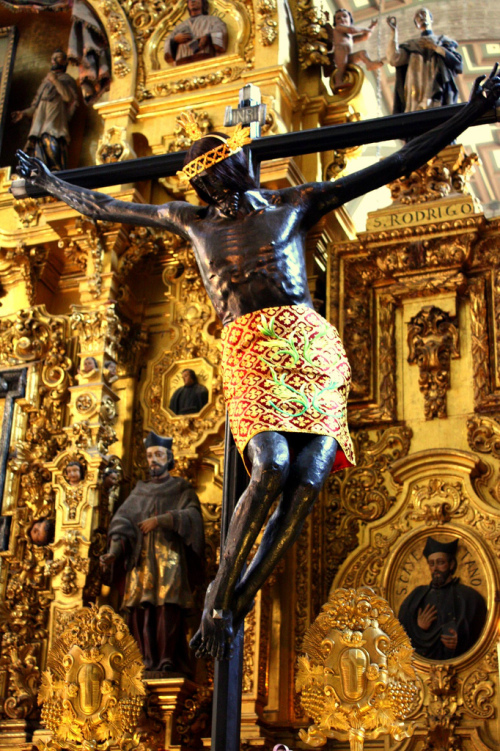
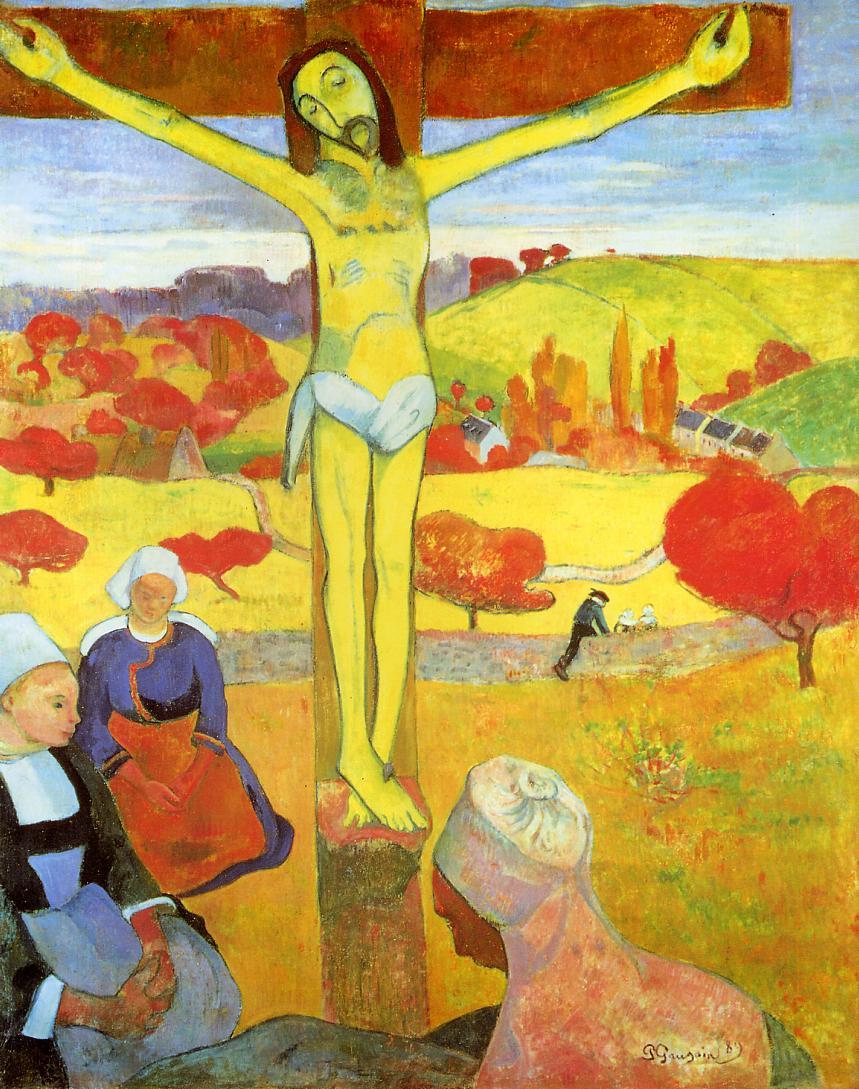
On Good Friday every year,* Christians around the world commemorate the death by crucifixion of Jesus of Nazareth, rabbi, prophet, Son of God, Son of Man, messiah, and all-around trouble-maker.
The truth is that very little is known of Jesus’ life and teachings from verifiable accounts, but this has not stopped generation after generation of Christians from telling his story, beginning with Jesus’ semi-official biographers, the evangelists of the New Testament. Almost everything we know about the life and teachings of the physical human being Jesus are in those writings, which do not portray him always in compatible ways, and which are almost entirely unconfirmed by any external source. The Roman historian Tacitus mentions (with disdain if not disgust) Jesus’ cult following, as does the Jewish historian and philosopher Josephus, but neither gives us anything to work with as historians (or, for that matter, as theologians). For the record, Suetonius and Pliny also talk about Christians, but these piecemeal sources tell us much more about Roman perceptions of Christians than about Christ and his teachings, or even necessarily Christian beliefs and practices.
What, then, can we reasonably say about Jesus?
It is almost impossible to find universal agreement around anything more than a few basics, including most importantly Jesus’ crucifixion. The Gospels narrate it; Paul the Apostle (who never met Jesus in the flesh, as it were) hangs his theology on it, together with the equally important resurrection; and no contemporary sources (Christian or otherwise) dispute it.
But it’s when we ask why Jesus was crucified that things start to get interesting.
What did he do? The two men he is traditionally said to have been crucified with are commonly understood to be “robbers,” but that they were common criminals is highly unlikely. Crucifixion is a horrible death designed to make a very public statement about the crucified, the sort of thing you use on gladiator-slave rebels like Spartacus, not on pickpockets and roustabouts. The Greek term used for these two men (lestai) is consistent with the description of the released Barabbas as one who had participated in rebellious activities, whose “criminality” was related to his revolutionary business. Moreover, the name “Barabbas” means literally “son of the father,” a purely symbolic and surely entirely fictional name, and that the people choose to have him released indicates their affinity for him as a thorn in the side of the Romans. He is thus contrasted with Jesus, the other son of the father, the peaceful (apocalyptic) revolutionary.
So Jesus would have been crucified as a political criminal, a rebel. This would make sense of accounts of his having been identified by the Romans as “Iesus Nazarenus Rex Iudaeorum”: “Jesus of Nazareth, King of the Jews.” Anyone claiming to be king (and “son of God” was a Jewish way of talking about the king of Israel recorded clearly in Psalm 2), would, if taken seriously, be understood as challenging Roman authority.
Insofar as Jesus seems to have been deliberately poking the Romans’ local running dogs, the Sadducees and the Temple priests, his seizure and termination were surely inevitable. If his teaching is as opposed to violence and unconcerned with “politics” as it seems to have been, it’s hard to believe the Romans would have noticed him without some prodding, this coming not from the “crowd,” but from the leadership (who in Mark and Matthew incite the crowd). Indeed, the priests and scribes look for ways to arrest him when the crowds are not around, because they fear a riot.
If we take the Gospel of Mark at all seriously, Jesus was preaching a new kingdom of God, an apocalyptic redemption of the people of the earth by God’s direct intervention (and with Jesus as the sacrificial pesach lamb). If we take the Gospel of Luke seriously, Jesus spoke in a classic prophetic mode, calling people — Jew and Gentile both — to care for the oppressed of the earth, the poor and the hungry and the helpless. Both Jesuses called for people to be better to each other, to love each other, and indeed to love each other when love was, according to common sense, the foolish thing.
Why would this get you executed?
Well, in itself, it wouldn’t. But the Gospel of Mark tells us of Jesus speaking with a man who realizes that all the animal sacrifices in the world don’t amount to a hill of beans (in that crazy world). When love counts more than sacrifice, we are undermining the Temple. When we go into the Temple, start knocking things over, and say it’s become about robbing the poor and not about loving God and one’s neighbor, we are undermining the Temple. And to undermine the Temple’s authority is also to undermine Rome’s authority, and Rome’s cash flow.
Jesus, like the Essenes he may or may not have associated with, was a purist.
The Temple was full of collaborators and exploiters, the kind seen before in the history of Israel (and berated by prophets like Isaiah and Amos), the kind hated also by the Dead Sea community of apocalyptic purists awaiting a final showdown between God and evil (i.e., the Roman Empire and their local potentates, the Temple authorities).
Jesus, like other Jewish prophets before him, thought that Judaism was about something. That it was somehow about justice and not just about following rules or waiting around for things to get better: that it was about our making the world a better place, and not just making our own lives better.
Start talking that way and get people on your side, and you’re fairly likely to get killed, even twenty centuries later.
* Though the actual date (even the year) of the execution marked by the movable feast of Good Friday is fundamentally unknowable, there are some present-day astronomer types who’d like to sell you April 3, 33 A.D.
Skirmishes in the frontierlands at length triggered a Texan reprisal-slash-plundering expedition.
The officially independent Somervell Expedition of volunteer Texan militiamen captured a couple of Mexican towns, then disbanded to go home. Those members of it optimistic about their chances for more raiding set off for Ciudad Mier* — the Mier Expedition.
The Mier Expedition was a flop, and the irate Mexican President Santa Anna ordered the entire band shot to make an example. Anglo diplomatic wrangling got him to go down to shooting one tenth of the band.
Well, you’ve gotta pick that tenth somehow.
The Black Bean Lottery
So on this day, 176 potentially condemned men were made to draw a bean from a pot containing 159 white ones and 17 fatal black ones.
For the lucky 159, there was no rush quite like winning your life from a legume, as this survivors’ account describes:
I knew then that I was safe, and the revulsion of feeling was so great and rapid that I can compare it to nothing except the sudden lifting of an immense weight from off one’s shoulders. I felt as light as a feather.
The 17 for whom the cosmos had ordained frijoles negros took a quick leave of their companions, and were shot in two batches. (Here is a thorough discussion of the entire affair.)
It was a typically dicey death by musketry, with lots of people requiring multiple volleys. One of the 17, one James Shepherd, even survived the execution altogether by playing dead. (He fled during the night, but was later recaptured and [successfully] re-shot.)
The most hated man (by the Mexicans), Ewen Cameron, pulled white, but Santa Anna thought better of letting him draw air and had him separately executed a month later. The rest of the lottery’s “winners” languished in prisons and work camps for more than a year of continued Texas-Mexico hostility, until they were amnestied and released in September 1844 — many destined to renew hostilities in the imminent Mexican-American War.
That survivor quoted above, William “Bigfoot” Wallace, was one of those re-enlistees. His colorful career with the Texas Rangers earned him a minor star in the firmament of Americana; he appears in Larry McMurty’s Lonesome Dove prequel Dead Man’s Walk … only in that version, he gets cinematically black-beaned at the big moment, as in this clip from the miniseries of the same title.
* The town is latterly famous as a key transit point for arms smuggling to Fidel Castro to supply the Cuban Revolution.
Beginning this day in 1781, the captain of the slave ship Zong began throwing his cargo overboard in a still-notorious case combining the horrors of the Middle Passage with the cruel rapacity of capital.
The Liverpool-based ship was en route from Africa to Jamaica, there to exchange its human chattel for New World produce bound for the European market.
Characteristically for slave ships, it was inhumanly packed: more economical for a slaver to overcrowd its captives and write off the ones who died than to maximize slaves’ chances of survival. And on this particular ship, malnutrition and disease claimed more than 60 slaves (as well as seven crew members).
Underwater sculpture off Grenada commemorating slaves thrown overboard during the Middle Passage.
With many more in danger of expiring, Captain Luke Collingwood reasoned that the cargo would be a loss if it succumbed, but that shippers’ insurance would reimburse the firm “when slaves are killed, or thrown into thrown into the sea in order to quell an insurrection.” Over a three-day span beginning Nov. 29, 1781, Collingwood had 133 still-living but sick slaves cast overboard;* “the last ten victims sprang disdainfully from the grasp of their executioners, and leaped into the sea triumphantly embracing death.” (Source)
This gave the ship’s owners — the good captain himself was not among them — the chance to attempt an insurance scam.
This historical-philosophical book (review, a pdf) analyzes the Zong affair as the emblematic “inauguration of a long twentieth century underwritten by the development of an Atlantic cycle of capital accumulation.”
When the Zong landed having lost in total more than half of its original 440 slaves (and Collingwood himself, that fastidious servant of his shareholders), its owners did indeed attempt to recoup the many who had been intentionally killed. Smelling fraud, the insurer refused to pay.
There followed the signal case of Gregson v. Gilbert, a dry insurance trial that also became a beacon of the slave system’s blood-chilling jurisprudential logic.
After a jury sided with the claimant shippers against the insurers, the matter hit a wide public on appeal before Lord Chief Justice Mansfield when abolitionist activists Granville Sharp and Olaudah Equiano seized upon its conscience-shocking quality.
While Sharp and Equiano agitated unavailingly for a homicide investigation, the insurer — which was itself in the very same business of human bondage as the shipper — self-righteously posed “as counsel for millions of mankind, and the cause of humanity in general.” (Source) Its interests, after all, would be served by the least possible indemnity for slaves murdered in passage.
Solicitor-General John Lee — “the learned advocate for Liverpool iniquity,” in Sharp’s estimation — successfully insisted upon limiting the case to its commercial considerations.
What is this claim that human people have been thrown overboard? This is a case of chattels or goods. Blacks are goods and property; it is madness to accuse these well serving honourable men of murder. They acted out of necessity and in the most appropriate manner for the cause. The late Captain Collingwood acted in the interest of his ship to protect the safety of his crew. To question the judgment of an experienced, well-travelled captain held in the highest regard is one of folly, especially when talking of slaves. The case is the same as if horses had been thrown overboard. (Quoted here; Wikipedia has it “as if wood had been thrown overboard.”)
Lord Mansfield agreed, “(though it shocks one very much) that the case of slaves was the same as … horses,” and simply found with the insurers that no liability attached them since the killings were voluntary rather than necessary.
Nobody was ever prosecuted.
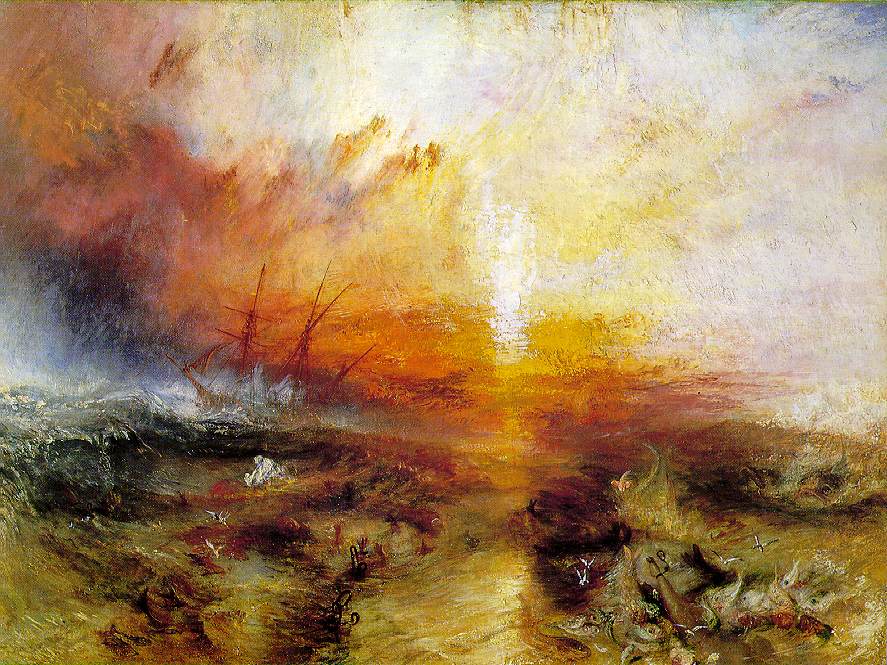
The disturbing 1840 Turner seascape “Slavers throwing overboard the Dead and Dying – Typon [sic] coming on”, also known simply as “The Slave Ship”, is widely thought to have been inspired by the Zong episode. The allusion would have been well-known to his contemporaries.
* One of the 133 survived by climbing back aboard the ship.
William Brodie, respectable burgher by day, Deacon of the Guild of Wrights, wasn’t the type for the gallows. Actually, the upright citizen is said to have proposed an improvement in the old Tolbooth gallows, replacing the old-school ladders with a forward-thinking drop mechanism.
“Brodie,” says Traditions of Edinburgh, “was the first who proved the excellence of [the] improvement … He inspected the thing with a professional air, and seemed to view the result of his ingenuity with a smile of satisfaction.”*
Insouciance in the face of mortality … but Brodie had plenty of practice in compartmentalization.
With a gambling habit, a couple of mistresses, and five kids, Brodie the oleaginous society man had a double life, or treble, or more. By and by, the well-known tendency of such profligate pastimes to lead a man to venture his neck in order to keep up appearances worked its will upon Brodie, who began using his contracts with Edinburgh’s upper crust to case their houses and copy their keys … returning at night to burgle his employers.
It was taking on partners that did in the budding master thief; inevitably, someone flipped to dodge the gallows himself. Brodie’s cover was blown, and he hanged with his confederate George Smith, keeping up appearances to the very end.
That earlier composition hasn’t been entrusted to celluloid, to my knowledge (though there is a Deacon Brodie film of recent vintage). But Jekyll and Hyde has been.
Brodie himself is supposed to have made his own bid to live on by surviving the hanging. William Roughead in Classic Crimes describes these machinations whose generally attested failure is now and again disputed anew.
Of the plans, various and futile, formed for the resuscitation of the Deacon there are two contemporary and competing versions. One is that the hangman was bribed to tamper with the rope, so as to give a short fall and avoid dislocation of the vertebrae. But by an excess of caution that officer first made it too short and then too long. The body, when cut down, was placed in a cart and driven furiously round the back of the Castle to the Deacon’s woodyard at the foot of Brodie’s Close, so that animation might be restored as in the historic case of “half-hangit Maggie Dickson,” a lady whose departed spirit was recalled by similar Jehu methods. In his own workshop his veins were opened by a French surgeon, whose services had been retained to that end; but all the resources of science could not bring the Deacon back to life. According to another account, he had, before leaving his cell for the last time, been supplied with a small silver tube for insertion in his throat at the final ceremony in order to prevent suffocation, and wires were carried down both his sides from head to foot to counteract the jerk of the fall. In spite of these precautions and of subsequent bleeding by a surgeon, his friends had reluctantly to admit that “Brodie was fairly gone.”
* This “tradition” of Edinburgh is kin to a folkloric subgenre and should not at all be presumed dependable. Roughead:
Of the many picturesque legends of old Edinburgh which, in defiance of truth, cling like ivy about her vanished past, one of the most persistent is that Deacon Brodie was the first to suffer upon the new drop which he himself designed. This myth, upon research, I found myself reluctantly compelled to disprove. He may have planned the “moveable platform for the execution of criminals,” which the Town Council caused to be erected in 1786 at the west end of the Tolbooth; but it was certainly not of his construction, nor was he the first to benefit by its ingenuity. The place of execution was the roof of a low building which projected from the west gable of the prison — roughly where the Buccleuch statue now stands. A beam was drawn out from an aperture in the wall above the platform and from this depended the fatal rope.


 Most notable among the victims of what Colombian President Alvaro Uribe called