1817: Not Hall or Read, prosecuted for blood-money

Miscarriages of justice perpetrated by actors in a position to extract private benefit from generating criminal prosecutions is a story as old as the hills. This one, as reprinted in the London Morning Chronicle, Aug. 25, 1817, at least has a happy ending:

EXTRAORDINARY CIRCUMSTANCE

Two soldiers, named Hall and Morrison, were on the 26th July tried for a highway robbery at the Stafford Assizes, before Baron Garrow, convicted, and ordered to be executed. They were prosecuted by a man named Read, a bricklayers labourer, who swore that they knocked him down and robbed him of a shilling and a penny, in a church-yard at Wolverhampton, on the 23d July. The evidence of the woman in whose house the prisoners resided, went to prove that they did not sleep at home on the night of the imputed robbery. To those two witnesses the evidence was confined, and against it there appeared nothing upon the trial, except the declarations of the prisoners, containing facts which were afterwards sworn to be others, and which, after the utmost labour of a few benevolent persons, were the means of saving the innocent prisoners from a death which appeared to all to be inevitable.

The two soldiers were, upon the 23d of July, drinking at an hour too late for admission at their lodging at Wolverhampton, and, after applying in vain to be allowed to go into the guardroom to sleep, walked about the village to kill time.

In loitering through the church-yard they met a man who seemed to be in want of work, and, like themselves, without a lodging for the night. A conversation ensued, and the stranger told them his name was Read; that he was a bricklayer’s labourer out of employment, and a Hertfordshire man.

It happened, that in his description he hit upon the part of the country from which one of the prisoners came. A jesting dialogue took place between them, and at length it was agreed that they should wrestle.

Hall was the friendly opponent of Read upon the occasion, and he was thrown in the first round of wrestling. In the second, however, Hall was more successful in the feat of activity, but his triumph nearly robbed him of his life. The vanquished man dropped a shilling and a penny from his pocket. Morrison immediately picked up the money, said it would do for beer, and put it into his pocket. The soldiers quizzed Read about his loss, and were heard by a watchman near the spot acknowledging that they had the shilling, and would certainly dispose of it in the most convivial way.

Read growled about his money, and showed a disposition to quarrel, but did not utter a word about his being robbed of it. About five o’clock in the morning the three were seen near the market-place by another watchman, and the soldiers were bantering Read upon the same subject.

The good humour of Read, however, at this time, appeared quite broken up; he spoke of having the soldiers taken into custody, but was answered by a laugh from them. A grocer, named Powis, saw them all under similar circumstances, and heard Read complain of no attempt at robbery, but saw that he was not pleased at being laughed at.

The grocer soon after met a man named Roberts, the keeper of the House of Correction at Wolverhampton, and mentioned to him that Read said two soldiers had got his money. The answer of Roberts, which did not strike the grocer as extraordinary at first, was, “I must see that man; this is a good job.”

The event, however, soon explained the language. Roberts immediately inquired after Read, questioned him upon the loss he had sustained, and in a very short time apprehended the two soldiers upon the charge of robbing Read in the highway of a shilling and a penny. Before the magistrate, Read swore that the soldiers knocked him down and robbed him of his money in the church-yard. Their commitment was immediately made out, and they were sent to the Assizes of Stafford, where, on the Saturday following they were tried and condemned for the capital offense.

The inhabitants of Wolverhampton knew nothing of the intention of Read upon the interference of Roberts in this transaction. It was generally concluded amongst them that the angry state of mind in which Read appeared, would have influenced him to swear a common assault, but nothing at all serious was apprehended from the wrestling bout. There was consequently no interference upon the part of those who were acquainted with many of the circumstances; and the matter died away until the village was struck with horror at an account in the Stafford paper of the proceedings of the Assizes. An old man was reading the paper in an ale-house to a number of politicians, who were not much affected at any thing they heard until he came to that part which stated the number of persons left for execution. Amongst the names were those of Hall and Morrison. The whole population of Wolverhampton instantly showed how they felt upon an occasion so dreadful.

The Rev. Mr. Guard, one of the most venerable characters in that part of the country, who officiates in the village where Hall’s family resides, upon hearing the event of the trial, set out for Wolverhampton, where he found the people already meeting and acting upon this subject. The men were to be hanged this day (Saturday last), and not a moment was to be lost. Mr. Guard, who had known Hall from his infancy, and would have staked his life upon the integrity of the young man, made a quick but deep inquiry into the facts, and having found every thing confirmatory of his innocence, followed Baron Garrow on his circuit to state what he had learned from the very best authority, and obtain a respite.

He saw Mr. Baron Garrow, but his Lordship appeared to see no reason to alter the opinion which he had formed from hearing the trial. The worthy Clergyman, however, was so well convinced of the truth of his own information, that he could not help exclaiming, with more zeal than discretion, “I see you are determined to hang these poor men.”

Mr. Baron Garrow was naturally offended at this intemperate observation, and an eminent Barrister remarked, that Mr. Guard’s object was wholly defeated by the use of it.

Mr. Guard was not, however, to be turned from the endeavour to save the lives of the two soldiers; there was another quarter to which he could apply. He immediately came to town, and went without ceremony to Lord Sidmouth, to whom he obtained an easy access. He remained in conversation with his Lordship between three and four hours, and Lord Sidmouth afterwards declared, that he never in his life saw such an interest taken in the fate of men who were not related by domestic ties to the individuals whom he was labouring to save. This meeting gave Mr. Guard hopes; though Lord Sidmouth had observed, that in cases of this kind the Judge was necessarily better acquainted with all the bearings of the evidence than the Secretary of State, and therefore his power was seldom interfered with, except under circumstances of strong fact.

Mr. Guard posted back to Wolverhampton the moment after he parted from the Secretary. A meeting of the inhabitants was called, at which Mr. Mander, and all the other respectable residents of Wolverhampton attended.

The witnesses were sworn, and a Petition to the Prince Regent was signed and delivered into the hands of Mr. Guard, who, accompanied by Mr. Charles Mander, very soon after arrived in town. These two gentlemen went, with Mr. Pearsall, of Cheapside, to Lord Sidmouth, and put into his hands the evidence of the innocence of the soldiers. His Lordship requested that Mr. Pearsall would relate the circumstance.

That gentleman repeated the manner in which Read and the two soldiers had acted in the presence of the watchmen and the grocer. Lord Sidmouth was just going up with the Recorder’s Report, and said, that upon his return he would examine the affidavits, and act upon them. Mr. Pearsall observed, that the men were ordered for execution on Saturday, but was assured by his Lordship that their case should not be neglected, and that the affidavits should be laid before the Attorney-General.

Upon the next meeting, Lord Sidmouth said there had been no necessity for laying the affidavits before the Attorney-General. The case, he observed, was one of the most interesting that ever came before him.

Indeed, such was the effect of the affidavits upon him, that he was not only immediately convinced that the soldiers should not be executed, but, in the absence of his clerks, he wrote the dispatch for their respite with his own hand, and sent it to the Sheriff; “because,” said his Lordship, “I could not endure the thought that the soldiers should have one hour more of unnecessary anxiety.”

Mr. Pearsall said there was no doubt that the men had no intention of felony; it would also appear, at another time, that the prosecutor had no intention of indicting them, until he was instigated by Roberts, with the view of gaining the reward called “Blood-money,” which was accordingly pocketed by Read and the keeper of the prison, to the amount of 80l.

Lord Sidmouth declared, that, under such circumstances, an immediate investigation should take place. He coincided in the opinion of the impropriety of Roberts’s conduct, and said a pardon would be instantly granted to the soldiers. He also complimented, in the warmest manner, the conduct of Mr. Guard and the other gentleman, who had exerted themselves. In the course of his observations to Lord Sidmouth, Mr. Guard said he would give up half his fortune to save the life of Hall, so convinced was he of his honesty.

While these operations were going forward in London, affidavits, copied from those handed to the Secretary, were brought to Mr. Baron Garrow by Lieut. Buchanan, of the same regiment as the soldiers, and a respite was instantly granted by his Lordship when he read them.

The Officer stated, that Baron Garrow, upon reading the affidavits, said, if the facts had been known before, their respite should have been granted; and asked whether they would, upon being pardoned, be taken into the regiment again? Lieutenant Buchanan immediately replied, that they would be most gladly received.

On this day..

1934: Not Walter Lett, To Kill a Mockingbird inspiration

July 20, 1934 was the third and last of Walter Lett’s scheduled execution dates for raping a white woman in Monroeville, Alabama.

A thirty-something ex-convict, Lett’s protestations of innocence stood little chance against the word of a white woman named Naomi Lowery, herself a penniless drifter.

Lett was almost lynched but despite his certain condemnation there was something wrong about this case — something discomfiting even for Monroeville’s worthies. We have seen elsewhere in these pages that a rape accusation was a powerful weapon on the ambiguous fringes of the color line. Just three years before this story, nine black teens had been accused of a rape on an Alabama train, and the legal odyssey of these Scottsboro Boys would dominate headlines during the Depression.

“It may have been that [Lett] and Lowery were lovers, or that she was involved with another Negro man,” one author put it. “If a white woman became pregnant under those circumstances, it was not uncommon for her to claim rape, or accuse someone other than her lover.”

Records of this trial seem to have gone missing, but Lett’s claims had enough weight (and Lowery’s had little enough) to induce Monroeville’s elders to petition Gov. Benjamin Miller* against carrying out the electrocution. Miller reprieved Lett ahead of May 11 and June 20 execution dates: “I am of the opinion and conviction that there is much doubt as to the man being guilty,” Miller told the Montgomery Advertiser. Gov. Miller was so sure that Lett didn’t do it that before the man went to the chair on July 20, Miller decided instead to let him spend the rest of his life in prison for the thing he didn’t do.

We don’t have Walter Lett’s side of this story because the strain of his position drove him mad; when the sentence was commuted, he was transported from death row directly to a mental hospital, where he died of tuberculosis in 1937.

In his stead, we have a different voice: a Monroeville schoolgirl at the time of Lett’s trial named Harper Lee** would later channel the case’s undertones of racial injustice for her legendary (and, until recently, only) novel, To Kill a Mockingbird.

In one of the famously retiring Lee’s few public comments on the book, she cited the Lett case as her model for the book’s fictional, and manifestly unjust, rape trial.

Lee’s father, A.C. Lee was the editor-publisher of the Monroeville Journal at the time of l’affaire Lett. But as a young lawyer, before Harper’s birth, Lee himself had once defended in court two men who wound up being hanged. An idealized† version of this man is the clear foundation for the defense attorney Atticus Finch in Lee’s book.

Charles Shields, whose 2006 biography of Harper Lee is quoted above on the indeterminate reason for the rape allegation, writes that the author “had a free hand to retell this macabre episode in her father’s life, which he always referred to in vague terms, no doubt because of the pain it caused him. (He never accepted another criminal case.) This time, under his daughter’s sensitive hand, A. C. Lee, in the character of Atticus Finch, could be made to argue in defense of Walter Lett, and his virtues as a humane, fair minded man would be honored.”

* Miller was an anti-Ku Klux Klan politician, a fact of possible relevance to his actions.

** Harper Lee’s childhood friend was Truman Capote, future author of In Cold Blood. (Lee traveled to Kansas with Capote and helped him research the murder case in question.) Alabama’s legislature has recognized Monroeville as the state’s literary capital.

† According to Shields, the real A.C. Lee was more of a gentleman, establishment segregationist: more like the warts-and-all Atticus Finch of Lee’s Go Set a Watchman than the saintly character played by Gregory Peck. In 1952-53, A.C. Lee helped to force out the pastor of the local First Methodist church over controversial pro-integration remarks from the pulpit. Rev. Ray Whatley’s post-Monroeville assignment took him to Montgomery, where he was president of a chapter of the Alabama Council on Human Relations while the young Rev. Martin Luther King was vice-president. Whatley was forced out of his Montgomery congregation, too: called “a liar, a communist, and a few other things” (Whatley’s words) for supporting the Montgomery Bus Boycott. They tried to reassign him to tiny Linden, Alabama, but townspeople there immediately rejected him and many stopped paying church tithes until he was shipped onward to Mobile.

See When the Church Bell Rang Racist by Donald Collins, who notes that Whatley’s anathema had a chilling effect on other white Methodist clergy — now clearly given to understand that there would be “a great price to be paid if a minister chose to speak out for racial justice.”

On this day..

1865: Not Lambdin P. Milligan, ex parte man

This date in 1865 was the originally scheduled hanging of Indiana pro-slavery gadfly Lambdin P. Milligan — a sentence respited two days prior by President Andrew Johnson, and then subsequently commuted, for which reason Milligan survived to attach his surname to a landmark Supreme Court decision the following year.

During the Civil War, the state of Kentucky was a borderlands claimed by, and viciously fought over, by both North and South. “I hope to have God on my side, but I must have Kentucky,” Abraham Lincoln wrote in 1861.

Kentucky’s northern neighbor, the Union breadbasket Indiana, had little fighting and no hint of Confederate power — but it was a hotbed of so-called “Copperheads”, northern Democrats who opposed Lincoln’s willingness to prosecute the civil war. So fraught was the Hoosier political situation that in 1862, Indiana’s Republican governor refused to call the Democrat-dominated legislature for fear that it might vote a secession bill or attempt to withdraw Indiana from the war.

The inevitable existence of northern domestic opposition to the war came joined at the hip to impossible statecraft conundrums. Just how much wartime dissent and/or resistance could be countenanced — as a legal matter, and a practical one? President Lincoln would not have received an A+ from the American Civil Liberties Union; he suspended the writ of habeas corpus in the Union and resorted to military tribunals and martial law in some places.

Our man Milligan was one of these Copperhead Indiana Democrats born to test Washington’s elasticity. He was an exponent of the Knights of the Golden Circle,* a pro-slavery secret society whose name denoted their aspiration to the antebellum filibusters‘ dream of a human-bondage empire to ring the Caribbean basin.

An attorney,** Milligan briefly became the toast of Democrats nationwide (whatever was left of the nation) for his robust defense of Clement Vallandigham when the former Congressman was prosecuted under the anti-Copperhead General Order 38.

At this point, Milligan was very well-known in what was then called the Northwest, and he was a major political player in Indiana — a pivotal state in the 1864 election.

But according to federal spies who tailed him in 1863-64, his interests in governance ran to more illicit grants of state power. Milligan was arrested in October 1864 as a principal in what was dubbed the “Northwestern Conspiracy”: a plot to mobilize the antiwar factions in that part of the country. This was no mere matter of pamphleteering; the “visionary and desperate” scheme aimed to prolong the hopes of the now-fading South by instigating an armed uprising in the Northwest that would relieve Union pressure on Dixie and perhaps turn the tide of the war.

Milligan was among several of the conspirators swept up in arrests in the following weeks, then tried by military tribunal for treason and sedition. It’s hard to argue that the plot was anything but.

But why a military court? This is the question in Milligan’s great legacy to posterity, the Supreme Court ruling Ex Parte Milligan.†

Milligan himself was not a soldier, and had not been in a war zone. He was a civilian, and Indiana’s regular civilian courts had never ceased to function. The question at stake in Milligan’s appeal to the Supreme Court was whether there was any legitimate recourse to a military tribunal under such conditions — well behind the lines, as it were.

On the morning of March 5, 1866, 34-year-old Republican U.S. Representative James Garfield — the future president whose assassin would command contentious caselaw all his own — strode into the U.S. Supreme Court to eloquently argue Milligan’s side.

“Such a doctrine,” Garfield intoned of the civilian courts’ being intentionally bypassed on national security grounds, “is too monstrous to be tolerated for a moment; and I trust and believe that … it will receive its just and final condemnation. Your decision will mark an era in American history. the just and final settlement of this great question will take a high place among the great achievements which have immortalized this decade. It will establish forever this truth, of inestimable value to us and to mankind, that a republic can wield the vast enginery of war without breaking down the safeguards of liberty; can suppress insurrection, and put down rebellion, however formidable, without destroying the bulwarks of law; can, by the might of its armed millions, preserve and defend both nationality and liberty … if the protection of the law shall, by your decision, be extended over every acre of our peaceful territory, you will have rendered the great decision of the century.

The high court found for Milligan unanimously, establishing as a constitutional bedrock Garfield’s proffered principle that civilian courts must try civilians wherever those courts are open, and ordered Milligan’s release. Although re-indicted by a civilian grand jury, Milligan was not re-prosecuted; he resumed his law practice and died near Fort Wayne, Indiana on December 21, 1899.

* Also known as the Sons of Liberty, a callback to revolutionary patriots.

** Milligan studied law in Ohio, his native soil; his class of nine also included Edwin M. Stanton — Lincoln’s War Secretary during the events of this post. Milligan himself reflected that “I should have probably been hung” but for his fortuitous ancient friendship with Stanton.

† Court precedents with names like Furman v. Georgia are most familiar to us, signifying two disputing parties; by contrast, the phrase ex parte (by/for the party) theoretically indicates a decision issued on behalf of the named party, without need of any opposing party’s intervention. (Ex parte Quirin is another notable death penalty case using this terminology.)

While the ex parte locution was once a common one for habeas corpus appeals, such cases were in practice almost invariably contested by some organ of the state — as Milligan’s was.

On this day..

2015: Eight drug smugglers in Indonesia

Moments after midnight today, Indonesia shot eight men for drug trafficking.


Coffins and grave markers for the condemned, readied prior to their executions.

Bitterly controversial in Australia and dominating headlines there at this hour, the execution’s most prominent victims were Andrew Chan and Myuran Sukumaran, condemned as ringleaders of an Australian drug-smuggling ring dubbed the Bali Nine. (The other seven members of the ring have prison sentences.)

Australia has reportedly withdrawn its ambassador to Indonesia to protest Jakarta’s turning a deaf ear to the many public and private appeals it has floated on behalf of its citizens.

The others shot early this morning were:

  • Nigerians Okwuduli Oyatanze, Martin Anderson, Raheem Agbaje Salami, and Silvester Obiekwe Nwolise
  • Brazilian Rodrigo Gularte
  • Indonesian Zainal Abidin

The party of eight was initially to be as many as ten. Frenchman Serge Atlaoui mounted a legal challenge that has for now delayed his execution; Filipina Mary Jane Veloso, who has claimed that she was completely unaware of the heroin hidden in her luggage when she arrived in Indonesia as an Overseas Filipina Worker, was spared just minutes before the execution at Manila’s urgent request when the woman alleged to have been her handler turned herself into police in the Philippines. But neither Atlaoui’s nor Veloso’s death sentence has actually been lifted, and both could eventually be shot to death

Chan’s and Sukumaran’s executions in particular are playing worldwide as a stark culture clash relative to a West that is more and more backing off the drug war,* especially given the widely advertised rehabilitation of Bali Nine duo. Chan found god; Sukumaran, a passion for painting.


Myuran Sukumaran’s ominous painting from just a few days ago: “Time is Ticking: Self-Portrait”

But one of the most self-evident readings of the affair is as a banal exercise in political expedience.

Indonesian President Joko Widodo, who hasn’t the firmest grasp on power in his country, has a surefire political winner in executing drug smugglers — plus a cherry on top for defying Australian meddling into the bargain.

Not that Widodo was ever likely to waver, but his southern neighbor’s great gnashing of teeth probably only strengthened his resolve to pull the trigger. If the intent of Indonesia’s death sentence is to scare prospective mules off crossing Indonesian soil, it was so much free advertising.

“This cannot be simply business as usual,” Australian Prime Minister Tony Abbott said — but both leaders know the score. Countries don’t undo statecraft for common criminals.

Feelings are sure to be raw for the immediate future, and matters might develop quickly for the still-ongoing sagas of Serge Atlaoui and Mary Jane Veloso. Live blogs at the Guardian have a fascinatingly wide spectrum of reaction (Twitter intervention by @AxlRose!) from the evening of the execution and its aftermath.

* What’s past is prologue.

On this day..

Feast Day of Popes Cletus and Marcellinus

Back before being pope meant jeweled slippers and your own guillotine, the bishopric of Rome — at least as chronicled in the early histories of the Church — was a virtual halfway house to a pagan executioner.

Granted, the very earliest pontiffs are mostly ciphers to posterity; little dependable information about most of them survives. We have sketchy documentation, conflated names, and traditions of legendary hagiography further to the glory of Christianity’s earliest fathers. They are almost universally ranked as both saints, and martyrs.

But is it really right that literally none of these heirs of St. Peter for three centuries reached leadership positions by dint of being venal political hustlers? Or that none just dropped dead of some inglorious disease before they could exalt their deaths in martyrdom?

Persecutions of Christianity were not, after all, literally continuous throughout this age; indeed, prominent as they are in our latter-day remembrance, instances where they turned deadly were likely rather few and far between. Roman governors had provinces to administer; not many of them viewed hunting down and killing otherwise law-abiding cultists as the most important thing to prioritize.

“Christians and pagans could live on very good terms with each other,” Victor Duruy writes in his History of Rome, and of the Roman People, from its Origin.

Asper declared openly that he was disinclined to prosecutions of that kind … Severus furnished them the reply which permitted him to discharge them … Candidus treated them as contentious persons, and sent them back to their towns with these words: “Go, and be at peace with your fellow-citizens.” “Unhappy men,” said another to them [i.e., to Christians seeking their own martyrdom], “if you are resolved to perish, are there not ropes or precipies enough for you?” and he drives them from his tribunal.

Little as we know of these men, it is a sure thing that, pre-Constantine, they did run some risk of life and limb to profess Christianity under the noses of Rome’s rulers. Even a period of toleration could turn ugly with the rise of a hostile emperor or some chance shift of the political winds; the first persecution, after all, is supposed to have been initiated by Nero as an expedient to deflect anger over the Great Fire of Rome. But despite this site‘s use of the martyrology, we can hardly take for granted that any early Christian of significance was put to a baroque death by bloodthirsty Romans.

April 26 is or was the shared feast date of two of these popes from Rome’s antiquity — both of them traditionally considered martyrs, but both now on the outs with Rome’s official chronicle. It’s a reminder that even the ancient past isn’t really past and that history, like religion, is not so much holy writ as an eternal process of becoming.

Pope Cletus was the third pope, and the second in a row after Peter’s direct successor Pope Linus to make you think of a cartoon character. One early chronology named Cletus and Anacletus (or Anencletus) as the third and fourth popes; it is generally understood now that these were merely two different names for one single man. In 1960 a distinct July 13 feast for “Saint Anacletus” was removed from the calendar, collapsing everything to April 26.

Still, basically nothing definite is known of Pope St. Cletus — including the occasion or circumstances of his death, which may well have been promoted to a martyrdom simply from reverence of Cletus’s Erdos numberChrist number of 3 or less. Cletus is said to have ordained 25 priests, and died in the year 88 or 92. He was ultimately removed from Catholicism’s liturgical calendar in 1969, though he still remains in the Roman Martyrology.

Near the opposite chronological end of Rome’s era of official intolerance we find Pope St. Marcellinus.

Marcellinus was the 29th pope, and had the tiara* when the Diocletian persecutions began in 303. While such information as survives about Marcellinus is also not very substantial, it is quite interesting.

When anti-Christian persecutions did crop up, those Christians who weren’t in active pursuit of martyrdom had a difficult choice to make: either apostasy, or punishment. Confronted in the breach with a demand to make the requisite obeisance to the gods of Rome, many ordinary Christians preferred the expedient burning a few sacrificial herbs to the prospect of, if not death, prison, torture, exile, harassment, property seizure, or whatever else was on offer for their sect at that moment. These were the lapsi — the lapsed ones.

Such episodes tended to create post-persecution friction between the go-along, get-along crowd on the one hand, and the purists who refused any such accommodation on the other. Could lapsi be re-admitted to the communion after renouncing their faith to please a Roman proconsul? (Broadly speaking, the official church did welcome lapsi back with some kind of penance and absolution.)

Pope Marcellinus is interesting because he too is said to have lapsed under the initial pressure of Diocletian’s persecution. The Liber Pontificalis, likely combining distinct traditions that were in circulation about Marcellinus, says that he burned incense to the Roman gods when it was demanded of him — and that only afterwards did he repent his weakness and confess Christianity unto martyrdom.

It is not at all certain that Marcellinus did apostatize, but it is clear that a story to that effect (disputed by ex-apostate St. Augustine, among others) was out there in late antiquity — and it’s a bit suspicious that Marcellinus’s name is omitted from some early lists of popes. (It’s possible he was being conflated with his successor, Marcellus: the opposite of what happened with Pope Cletus.) It’s also very uncertain that Marcellinus was in fact martyred; the Catholic encylopedia considers his “in all probability, a natural death” in 304. And it was probably not in April that this death occurred.

Given all those question marks, Marcellinus’s April 26 celebration was booted from the liturgical calendar in the same 1969 cleanup that fixed Pope Cletus.

* The papal tiara did not yet literally exist at this point, of course.

On this day..

1791: Alessandro Cagliostro condemned

On this date in 1791, the Inquisition in Rome condemned magician Alessandro Cagliostro to death — a sentence immediately commuted to imprisonment for the remainder of his life, which turned out to be only four more years.

Cagliostro’s rich career as European courts’ thaumaturge of choice might have been decreed by the stars right down to his pitch-perfectly sinister moniker. Is this the shadowy diabolist whom the title character of in The Cabinet of Dr. Caligari is meant to evoke?

In fact, his birth name was Giuseppe Balsamo.

Naughty by nature from the time of his youthful expulsion from the Order of St. John, Balsamo — the hobgoblin familiar haunting the adult prophet’s cimmerian shadows — hailed originally from a penniless Sicilian family. (Though Cagliostro claimed for himself a suitably exotic childhood in Arabia and Egypt)

What he wanted in native wealth he more than made up for in enterprise — both for self-education in sorcery, alchemy, and other forbidden arts, and for leveraging his expertise in lustrous capers.

Hopping from court to court, Cagliostro carved out a career moving forgeries of spiritual or temporal potency alongside his legitimate profession as a doctor and chemist and his growing public profile as an influential spiritualist. He broke through as a young man in the train of a cardinal in Rome, using this in to market on the side fake artifacts alleged to have been pilfered from the Vatican’s mysterious Egyptian troves, as well as to seduce a local girl named Serafina whom he married at age 18. Serafina would be his lifelong companion on his adventures.

Cagliostro turned up over the ensuing two decades in Russia, Poland, Germany, and England, where he was inducted into the Freemasons in 1776. He’s been credited with creating masonry’s Egyptian Rite, and with energetically propagating it in the 1780s;* indeed, it was his adherence to Freemasonry — and his sacrilegious boldness opening a masonic lodge in Rome under the nose of the pontiff — that led to his 1789 arrest.

His seances and magic potions made him a great favorite of the Versailles court for a number of years, until a glancing association with the Affair of the Diamond Necklace so damaging to the reputation of Marie Antoinette forced Cagliostro’s expulsion from France.

Considering his Mephistophelian** reputation, now very well known in Europe, Cagliostro’s return thereafter to the belly of papal power seems most unwise. Perhaps (as this biographer supposes) it was the influence of Serafina, homesick after so many years separated from her native haunts. Cagliostro’s next ports of call were the Vatican’s Castel Sant’Angelo and (after an escape attempt) the lonely Fortress of San Leo — and even his end was so shrouded in mystery and conjecture that the subsequent conqueror Napoleon commissioned an official investigation to convince everyone that he’d really shuffled off the mortal coil.

Giuseppe Balsamo, attainted and convicted of many crimes, and of having incurred the censures and penalties pronounced against heretics, dogmatics, heresiarchs, and propagators of magic and superstition, has been found guilty and condemned to the said censures and penalties as decreed by the Apostolic laws of Clement XII and Benedict XIV, against all persons who in any manner whatever favour or form societies and conventicles of Freemasonry, as well as by the edict of the Council of State against all persons convicted of this crime in Rome or in any other place in the dominions of the Pope.

Notwithstanding, by special grace and favour, the sentence of death by which this crime is expiated is hereby commuted into perpetual imprisonment in a fortress, where the culprit is to be strictly guarded without any hope of pardon whatever. Furthermore, after he shall have abjured his offences as a heretic in the place of his imprisonment he shall receive absolution, and certain salutary penances will then be prescribed for him to which he is hereby ordered to submit.

Likewise, the manuscript book which has for its title Egyptian Masonry is solemnly condemned as containing rites, propositions, doctrines, and a system which being superstitious, impious, heretical, and altogether blasphemous, open a road to sedition and the destruction of the Christian religion. This book, therefore, shall be burnt by the executioner, together with all the other documents relating to this sect.

By a new Apostolic law we shall confirm and renew not only the laws of the preceding pontiffs which prohibit the societies and conventicles of Freemasonry, making particular mention of the Egyptian sect and of another vulgarly known as the Illumines, and we shall decree that the most grievous corporal punishments reserved for heretics shall be inflicted on all who shall associate, hold communion with, or protect these societies. (Source)

Thereafter widely denounced and renounced as a rank charlatan, Cagliostro at the very least rates as of the more outstanding adventurers of his time — a distinction that bequeathed him an impressive artistic afterlife from Alexandre Dumas to Christopher Walken.

Nor have his grander poses entirely wanted for supporters in posterity, particularly among adherents to the still-extant Masonic rite he initiated. (Aleister Crowley also suggested that he might have been Cagliostro in a previous incarnation.)

W.R.H. Trowbridge’s 1910 biograhy Cagliostro: The Splendour and Misery of a Master of Magic is in the public domain and available free online.

* Cagliostro might also have written a classic occult volume, The Most Holy Trinosophia.

** “Mephistophelian” might be the literally applicable word. When the mysterious Cagliostro’s possible identity as the exiled Sicilian swindler Balsano was first exposed, eventual Faust author Johann von Goethe happened to be in Palermo — and he took it upon himself to investigate personally by calling on Balsano’s family. (“You know my brother?” “All Europe knows him.”)

On this day..

1852: “Brown”, lynched in California

In extending [Cesare] Beccaria‘s views on capital punishment to the history of lynching in the West, one begins to see that the “violent passions” of the mob were regularly invoked to justify their actions, but as Beccaria predicted, these passions were often little more than a ruse to justify the cold-blooded — and often premeditated — lynching of an accused criminal. Taken as a whole, the case list demonstrates that by and large, lynching had as much to do with vengeance as with the pursuit of justice.

The frequent invocation of San Francisco’s vigilance committees in many of the case records is clearly intended to link extrajudicial execution to “tradition,” an essential element found in the Tuskegee definition of lynching.* On a formal level, well over 50 percent of lynching cases that give a time, record that the lynching took place between midnight and 2 a.m. when the accused was usually encouraged to confess his or her crimes before being strung up. Sometimes they were allowed to make a statement, to smoke a cigarette, or confess to a priest, and after it was over, the bodies would usually be left to hang through the night. This public display of the body can be found in every case, with the shortest times usually lasting around thirty minutes, and the longest, until the bodies decayed.

In one instance, in the small village of Newtown, an African American man known only as “Brown” was apprehended for stealing money. The evidence was completely circumstantial but he was found guilty and sentenced to be hung by the mob on March 4, 1852. Unfortunately for Brown, the rope was a little too long, and once he was hanged to the tree, the branch slowly gave way — until his legs dangled to the ground. Struggilng in agony, the poor man was cut down in order to be properly hanged. Once he was fully revived, he was tied to a higher branch and the whole process was repeated. When he was finally cut down, a physician was asked to examine the body, at which point he annunced that if Brown’s body was left above ground for five minutes that he would regain consciousness. As a result, “he was therefore hastily dumped into a grave that had been dug and was half full of water, and quickly covered from sight.” Whether completely true or not, it’s hard to imagine that anyone could argue that this killing really served the greatest good.

* The Tuskegee lynching definition: “there must be legal evidence that a person has been killed, and that he met his death illegally at the hands of a group acting under the pretext of service to justice, race, or tradition,” where “a group” connotes three or more persons.

On this day..

1430: Ten men beheaded, and an eleventh man married

(Thanks to Sabine Baring-Gould for the guest post, from this piece on Helene Gillet‘s miraculously surviving her beheading. -ed.)

In the Middle Ages there were two chances of life at the last moment accorded to a malefactor condemned to death, besides a free pardon from the sovereign. One of these was the accidental meeting of a cardinal with the procession to execution; the other was the offer of a maiden to marry the condemned man, or, in the case of a woman sentenced to death, the offer of a man to make her his wife.

The claim of the cardinals was a curious one. They pretended to have inherited the privileges with which the vestal virgins of old Rome were invested. In 1309 a man was condemned to be hung in Paris for some offence. As he was being led to execution down the street of Aubry-le-Boucher, he met the cardinal of Saint Eusebius, named Rochette, who was going up the street. The cardinal immediately took oath that the meeting was accidental, and demanded the release of the criminal. It was granted.

In 1376, Charles V was appealed to in a case of a man who was about to be hung, when a young girl in the crowd cried out that she would take him as her husband. Charles decreed that the man was to be given up to her.

In 1382, a similar case came before Charles VI, which we shall quote verbatim from the royal pardon.

Henrequin Dontart was condemned by the judges of our court in Peronne to be drawn to execution on a hurdle, and then hung by the neck till dead. In accordance with the which decree he was drawn and carried by the hangman to the gibbet, and when he had the rope round his neck, then one Jeanette Mourchon, a maiden of the town of Hamaincourt, presented herself before the provost and his lieutenant, and supplicated and required of the aforesaid provost and his lieutenant to deliver over to her the said Dontart, to be her husband. Wherefore the execution was interrupted, and he was led back to prison … and, by the tenor of these letters, it is our will that the said Dontart shall be pardoned and released.

Another instance we quote from the diary of a Parisian citizen of the year 1430.* He wrote:

On January 10, 1430, eleven men were taken to the Halles to be executed, and the heads of ten were cut off. The eleventh was a handsome young man of twenty-four; he was having his eyes bandaged, when a young girl born at the Halles came boldly forward and asked for him. And she stood to her point, and maintained her right so resolutely, that he was taken back to prison in the Chatelet, where they were married, and then he was discharged.

This custom has so stamped itself on the traditions of the peasantry, that all over France it is the subject of popular tales and anecdotes; with one of the latter we will conclude.

In Normandy a man was at the foot of the gibbet, the rope round his neck, when a sharp-featured woman came up and demanded him. The criminal looked hard at her, and turning to the hangman, said: —

A pointed nose, a bitter tongue!
Proceed, I’d rather far be hung.

* This would have been during the English occupation of Paris in the Hundred Years’ War, even as Joan of Arc was delivering the country from the hands of its antagonists.

On this day..

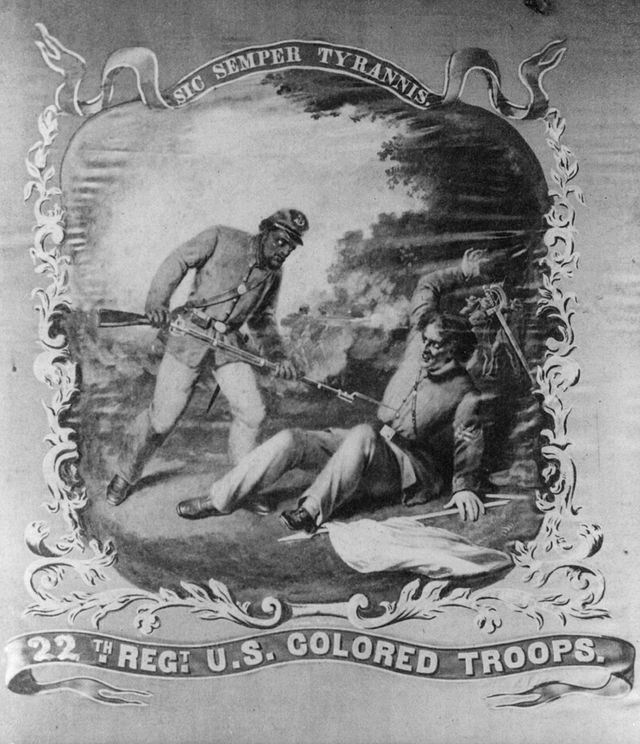
1865: The Jacksonville Mutineers

On this date in 1865, six African-American infantrymen were shot in Fernandina, Florida, for the Jacksonville Mutiny.

Formed in 1863, the 3rd Infantry Regiment, United States Colored Troops served in the trenchworks around Fort Wagner — the grinding siege in the summer of 1863 that followed the bloody attempt to storm the fort immortalized in the 1989 film Glory.

The Third was subsequently transferred to Union-occupied Jacksonville, Florida for duty garrisoning a conquered town of the Confederacy whose white citizens chafed doubly at their presence. But the unit had weathered both the boredom of the garrison and the hostility of white Floridians, and was set to muster out and return home on Halloween of 1865.

All U.S. Colored Troop regiments were officered by white men, putting an inevitable racial tinge on the inherent potential tension between enlistees and their commanders — the triggering event in our story. Heading the Third was a fellow named John L. Brower, Lieutenant Colonel by rank courtesy of his political connections but of nearly no actual military experience.

Ohio National Guard Judge Advocate General Kevin Bennett, in his 1992 article about the mutiny,* calls Brower a “martinet”; elevated to command of the Third on September 12 for what should have been a mostly ceremonial interim, Brower delighted in enforcing stringent wartime discipline months after Appomattox. While no man welcomes the taste of the lash when he’s one foot out the door back to civilian life, excess discipline meted out by cruel white overseers was particularly bad form for Colored Troop regiments.

From the standpoint of black Americans, the war had been all about destroying slavery; they had practically had to force this objective, and their own presence,** into the conflict. Being strung up by the thumbs for petty theft — Brower’s decreed punishment for one of his charges on October 29 — was far too evocative of the hated Slave Power.

“Inexperienced officers often assumed that because these men had been slaves before enlistment, they would bear to be treated as such afterwards,” one white Colored Troop commander later remembered. “Experience proved to the contrary. Any punishment resembling that meted out by the overseers caused irreparable damage.”†


The inclination of black troops to reject servile treatment and the anxiety that this provoked among their officers and the larger white community must surely be read in view of the perplexing new conditions following the Civil War.

Even among whites who supported it in principle, slavery abolition meant an unsettling and uncertain rearrangement of civilization — or at least, it potentially meant that. Would the economy continue to function without slavery? Would the daily conventions and assumptions that had sustained whites north and south have to be entirely renegotiated?

“Once let the black man get upon his person the brass letter, U.S., let him get an eagle on his button, and a musket on his shoulder and bullets in his pocket, there is no power on earth that can deny that he has earned the right to citizenship,” Frederick Douglass had proclaimed. Now that the war had finished, what else did those musket-toting sable fellows think they had earned the right to?

Press reports over the course of 1865 show a continuing theme of “Negro mutinies”: it is for wiser studies than this post to determine whether the trend such stories represent is disturbances among the black soldiery, or an exaggerated preoccupation among their white countrymen. In either event, Jacksonville was very far from unique even if the punishments were exemplary.


From the June 16, 1865 Cleveland Plain Dealer, concerning black soldiers on a steamer bound for Texas calling at Fort Monroe who, chagrined at the assignment, refused to permit the steamer’s resuming its journey.


From the June 19, 1865 Philadelphia Inquirer, concerning a company refusing to embark for Texas. “Certain evil disposed persons put it into the heads of these credulous colored soldiers that they were to be sent to Texas as servants for the white troops,” runs the report. “Doubtless some secret enemies of the Government instilled similar subtle falsehoods into the simple minds of the blacks who were disarmed at Fortress Monroe a few days ago.”


From the September 30, 1865 Daily National Intelligencer (Washington, D.C.), concerning a mutiny reported near Hilton, N.C.


From the Oct. 1, 1865 Daily Constitutionalist (Augusta, Ga.), reporting a disturbance begun when a black regiment demonstrated against a court-martial for one of their comrades accused (and acquitted) of stealing a hat.

In the midst of all of this — right about the time of the incident in this post, in fact — bulletins reached American shores of the Morant Bay Rebellion, a bloody rebellion of black laborers in British-controlled Jamaica. Slavery had been abolished on that Caribbean island more than 30 years prior: what did that uprising augur for the races in these United States?


Subtext becomes text: the Norwich (Conn.) Aurora, December 23, 1865. “The African released from restraint, and the passion of the savage provoked, will realize the scenes formerly witnessed in Hayti.” (The full article (pdf))

For our case, the name of the man punished like a slave is lost, but we do know what he did: steal some molasses from the kitchen. That’s how six of his comrades ultimately wound up looking down the barrels of their executioners.

A Lt. Greybill caught the greedy nosher and decreed a rough summary punishment, which the arriving Brower arrived helped to enforce on the resisting prisoner. “Tying up by the thumbs” was a brutal and humiliating treatment that lifted the man by those digits (often dislocated in the process) until only his toes remained on the ground, barely supporting his weight, and left him there for hours. In the film 12 Years a Slave, we see a man subjected to this sort of tiptoeing, but with a rope about the neck instead of about the thumbs.

Other enlisted men gathered around this pitiful scene, complaining about what they saw. A Private Jacob Plowden, who will eventually number among our day’s six executees, cried out that “it was a damn shame for a man to be tied up like that, white soldiers were not tied up that way nor other colored soldiers, only in our regiment.”

Plowden announced that “there was not going to be any more of it, that he would die on the spot but he would be damned if he wasn’t the man to cut him down.” Another private, Jonathan Miller, joined the incitement — “Let’s take him down, we are not going to have any more of tying men up by the thumbs.” A number of the black soldiers, 25 to 35 or so, began advancing on Brower and the hanging molasses-thief. Brower drew his sidearm and fired into them, wounding a man and sending the soldiers scurrying — some dispersing, but other dashing off to tents to arm themselves.

Several non-lethal fights now occurred in various spots around the camp between soldiers and officers, and eventually between the disaffected soldiers and arriving brethren from Company K, who had been summoned to calm the situation.

Lt. Col. Brower exchanged shots with several of the men who armed themselves, and in a bit of symmetry with the distasteful punishment that had started the whole mess, he had his thumb shot off in the process. One of the privates who had been heard complaining of the thumb-hanging, now playing peacemaker, grabbed the injured officer and escorted him to a safe building, warning some men who tried to pursue them to “stop their damn foolishness.”

Elsewhere, a Lt. Fenno sabered a protestor, and got bashed over the head with a fence-post in response. Neither injury was life-threatening to its recipient. Some shots were exchanged elsewhere in camp and/or fired demonstratively into the air, again to no fatal effect. And a Private James Thomas cut down the post where the source of all the disturbance, the fellow who just wanted an extra ration of molasses, was hanging.

This was the whole of the commotion, which Company K reinforcements soon quelled.

In a speedy series of court-martials lasting from Oct. 31 to Nov. 3, thirteen men were convicted of mutiny in this affair, and a fourteenth of conduct prejudicial to good order (his offense: not during the mutiny but after all was over, saying of Brower, “the God-damned son of a bitch, he shot my cousin. Where is he? Let me see him.”) A fifteenth man was acquitted. All 15 accused mounted their own defense, without counsel or aid — generally endeavoring to show that they had either not armed themselves or (and this was the decisive factor for the six whose conviction carried a death sentence) not fired their weapon.

The trial itself posed interesting procedural dilemmas, which Bennett explores at length in his article: first, because it was a mutiny case, the white officers of the Third who comprised the jurors were also, awkwardly, the brother-officers of the witnesses who testified against the mutineers.

And second, although the Civil War was over, Florida still technically remained in a state of rebellion, and this enabled the unit to convene a general court-martial, issue death sentences, and even carry them out without allowing any appeal to Washington. General John Foster gave the final approval to the sentences and transmitted case files to Washington after the fact; that was all the six condemned had by way of legal or executive review.

On December 10, he received a telegraph ordering him to suspend one of the death sentences in response to an inquiry raised by U.S. Senator Edgar Cowan: Cowan had been contacted by one of his constituents, who represented that Private David Craig, whom the constituent had raised from childhood, had written him complaining of his wrongful conviction. According to Sen. Cowan, the allegation was that Craig had been directed to collect arms from the mutineers as the disturbance came to an end, but was thereafter arrested in the confusion for being armed with the weapons he collected. But December 10 was nine days too late, and the late Private Craig’s case file disturbingly seems to have been lost from the National Archives.

The other five shot by musketry this date were:

  • Joseph Green
  • James Allen
  • Jacob Plowden
  • Joseph Nathaniel
  • Thomas Howard

Lt. Col. Brower only testified at one of the courts-martial, and was sent home almost immediately afterwards. He’d lost his thumb for his adventure as an officer and a gentleman, but between the original provocative punishment that he helped enforce, and then inflaming a tense situation by shooting at his soldiers, the brass was probably just as pleased to see him go as were his subordinates.

The non-executed mutineers who received prison terms (up to 15 years) had their sentences commuted following a review in 1866. The rest of the regiment mustered out as scheduled at the end of October, two days after the Jacksonville Mutiny.

* B. Kevin Bennett, “The Jacksonville Mutiny”, Civil War History, Volume 38, Number 1, March 1992. Bennett’s article is the source of all of the quotes in this post not otherwise cited.

** See I Freed Myself, or this podcast interview with its author, David Williams.

† See here for a fascinating instance of this at sea in June 1865, by the author of Becoming American under Fire: Irish Americans, African Americans, and the Politics of Citizenship during the Civil War Era

On this day..

2006: Sanjaya Rowan Kumara, with “signs of life”

Sri Lankan national Sanjaya Rowan Kumara was hanged on this date in 2006 at Kuwait’s Central Prison for murdering a woman while robbing her house.

He was pronounced dead and cut down within eight minutes. But …

medics who transported his body to a morgue said they noticed he was still moving, Al-Qabas daily reported.

Forensic experts were immediately called to examine the body and they confirmed that “there was some weak pulse in his heart,” the daily said.

The examination was repeated several times and each time “the dead body showed some signs of life,” Al-Qabas quoted unnamed medical sources as saying.

“They eventually pronounced him completely dead at 1400 hours local time,” five hours after his hanging, the sources said.

The justice ministry refused to comment on the report but head of the criminal execution department, Najeeb al-Mulla, who supervised the hanging, told Al-Watan newspaper the report was “baseless.”

On this day..