1831: Edmund Bushby, Swing rioter

On New Year’s Day of 1831, Edmund Bushby was hanged in Horsham for arson committed during southern England’s great agricultural labor rising, the Swing Riots.

“Captain Swing” was the rebellion’s namesake, a Ned Ludd-like legendary archetype, a figurehead who could never swing from the gallows. Swing was a long-suffering tenant farmer fallen desperately below subsistence and ready to fight back, and it goes without saying that in this the fictional “captain” mirrored his very real cohort — who were known to sign the captain’s anonymizing name to their letters threatening prosperous farmers: “work, money, or fire”.

Wages in Britain, which perhaps were mired in a generations-long slide to begin with, had cratered painfully following the Napoleonic Wars. And few felt the pinch more sharply than the working class in the rural economies of England’s southern half from East Anglia, Essex and Kent clear across to Somerset and Devon. Here, without the wage prop that coal mining was already beginning to confer in the north, the situation in the fields grew desperate.*

Years later, in 1851, James Caird would draw an east-west line through the English countryside — a wages line, he called it. North of that line, Caird noticed, agricultural workers were still being paid better than their brethren to the south by an enormous margin, 30% or more.

And so with the onset of harder times, like a devastating financial crash in the 1820s, this was also the line below which every farmhand existed at the edge of utter destitution — mitigated only by a niggardly allotment of poor relief forever squeezed smaller by its donors, the local landowners.** This zone of rural immiseration was the home of Captain Swing.


From Stuart Macdonald, “The progress of the early threshing machine”, Agricultural History Review, 23:1 (1975). It’s available online in pdf form here.

In 1830, following two consecutive years of crop failures, English radical William Cobbett published his survey of the countryside’s growing want in his Rural Rides. Written over the course of several years previous, it was a prescient appraisal.

As far as I had an opportunity of ascertaining the facts, the farmers feel all the pinchings of distress, and the still harsher pinchings of anxiety for the future; and the labouring people are suffering in a degree not to be described. The shutting of the male paupers up in pounds is common through Bedfordshire and Buckinghamshire. Left at large during the day, they roam about and maraud. What are the farmers to do with them? God knows how long the peace is to be kept, if this state of things be not put a stop to.

Those words Cobbett set down late in 1829. By the summer of the following year, labor rebellions began breaking out in these counties.

This wave of mutually inspired resistance saw villages’ working classes take the offensive against their local grandees. Beginning that summer, farmers’ hay ricks were set ablaze by secret arsonists; resistance rapidly metastasized from that point. (See this pdf.) “Burnings were necessary to bring people to their senses,” one Swing radical proclaimed — to force the rural gentry to come to terms with the plight of their neighbors.


1844 Punch magazine cartoon. (Source)

Following a long tradition of English machine-wrecking, Swing rioters also turned their fury on hated threshing machines, which were popping up by the hundreds and promising to displace still more of the shrinking wage share available in the countryside. (A very cheap portable machine invented in 1829 augured especially ill for the workers whose labor it would obviate; see N.E. Fox, “The Spread of the Threshing Machine in Central Southern England”, The Agricultural History Review, Vol. 26, No. 1 (1978).)

Nearly 400 were reportedly destroyed from 1830-1832 — and typically the owner of the machine would then be mulcted £2 per thresher for the dismantling labor. (In the subsequent assizes, these forcibly exactions were prosecuted as highway robbery.)

A countryside threatening to go up in flames like the farmers’ ricks inspired the requisite shock and exercise of state suppression, beginning with an aggressive investigation with widespread prosecutions in the last weeks of 1830. By the time it was all said and done, 252 people were sentenced to die and although all save 19 of those were commuted to transportation, the effect of a few very public examples would scarcely be neglected. Thomas Hardy,† born in 1840 the son of rural Dorset stonemason, would later describe his father’s recollection of the Swing days:

My father saw four men hung for being with some others who had set fire to a rick. Among them was a stripling boy of eighteen … with youth’s excitement he had rushed to the scene to see the blaze … Nothing my father ever said to me drove the tragedy of life so deeply into mind.

Edmund Bushby was one of these misfortunate souls marked for the scaffold instead of Australia. (Another Swing arsonist, Thomas Goodman, was to have hanged immediately after Bushby. Goodman was reprieved but was not told of it until after Bushby died.)

Convicted at the busy Lewes assizes of torching farmer George Oliver’s wheat in East Preston, Bushby hanged firmly‡ before a crowd of “eight to nine hundred persons,” according to the January 4 Morning Chronicle reprint of a Sussex Advertiser report,

three parts out of four of whom appeared to be agricultural labourers, who seemed deeply affected at the awful scene, and the most profound silence prevailed amongst them. The Sheriff’s javelin men surrounded the gallows, and two companies of foot guards were drawn up on the square, in the centre of the town, a considerable distance from the jail, and not within sight of the populace. Every thing passed off with the utmost order and decorum.

After the body had been suspended the usual time, it was cut down and delivered to the friends of the deceased for interment, who were waiting with a cart to receive it.

* The southern counties, nearest London, were also the areas where enclosure was most advanced and the rural labor force most thoroughly proletarianized.

** To add to the woes, comfortable parish parsons also had a customary right to exact a cash tithe that their flock could scarcely afford in bad times.

† We have met Thomas Hardy several times in these pages; his was surely a soul sensitive to the plight of the condemned. Hardy [probably] set the action of his short story “The Withered Arm” (with its gallows climax) in the Swing Riots period.

‡ His reported last words on the scaffold: “I hope you will take warning from my fate; and, my dear fellows, always attend to the Sabbath-day.” If accurately reported — and unironically uttered — this ageless gallows formula so irrelevant to Bushby’s situation surely attests to the power of a cliche. There is a good chance that Bushby heard these words spoken by some other hanged fellow in his lifetime, and knew them described more widely than that as the sort of thing everyone ought to say before turning off.

On this day..

1864: James Utz, St. Louis spy

Confederate agent James Morgan Utz had a blue Christmas indeed in 1864, awaiting his December 26 execution for espionage.

The Missourian had been captured traveling with a small band out of St. Louis disguised in Union uniforms and carrying supplies and ciphered messages for the invading Confederate army of General (and former governor) Sterling Price.

The federals handled Utz as a spy and a military court sentenced him to hang — a sentence that had already been carried out by the time President Lincoln’s grant of executed clemency arrived.

Tuesday morning last I was horrified at the announcement by a friend that Jas. Utz, Paul’s companion and leader in their attempt to go South, had been executed, being hung on Monday, the day after Christmas, in the jail yard.

It plunged me in a stupor or excitement from which my mind was not free for the entire day. The sentence barely issued and the punishment instantly carried out! The hurry, the suddenness was most revolting. No time given for taking leave of family, friends! No time for appealing for mercy or for a reprieve. No time allowed for composing himself for death!

Diary of a family member of Paul Fusz, one of Utz’s secret party. (Fusz, only 17 when captured, was pardoned after serving six months at hard labor.)

On this day..

1736: Ana de Castro and two Jesuit effigies in a Lima auto de fe

The auto de fe — those great spectacles of Spanish ecclesiastical power, enacted on the bodies of heretics and apostasizers — were scarcely limited to the Iberian peninsula.

Autos were also enacted for benefit of the subjects in the hinterlands of Spain’s global empire — especially since lapsed Jewish conversos, who were one of the principal interests of the Spanish Inquisition, were known to seek safety in the periphery.

December 23, 1736 marked perhaps the best-remembered public auto held in Lima, the capital of the Viceroyalty of Peru. Its victims were the effigies of two deceased Jesuit priests plus one living woman: Dona Ana de Castro.

All three were the playthings of Inquisitor Cristóval Sánchez Calderón — whose prosecutor’s office, then as now, enjoyed a wide scope for mischief.

According to the public domain The Inquisition in the Spanish Dependencies, one distant predecessor in the post had “aroused indignation” with his “arbitrary and scandalous conduct”: planting spies in the palace, and brazenly taking concubines. According to a report submitted to Toledo, this bygone inquisitor

was in the habit of walking the streets at night dressed as a cavalier, brawling and fighting, and on one Holy Thursday he supped with a number of strumpets … He was involved in perpetual contests with the [viceregal] judges and royal officials, whom he treated without ceremony or justice, interfering with their functions, of which a number of cases were given which, if not exaggerated, show that the land was at the mercy of the inquisitorial officials, who murdered, robbed and took women at their pleasure, and any who complained were fined or kept chained in prison.

But Inquisitors liked to keep busy with the pleasures of destroying the flesh, too.

Francisco de Ulloa, a Jesuit mystic “of little education but of high spiritual gifts,” had gained a small following who revered him as a saint by the time he died in 1709. For the Inquisition he looked like a possible exponent of heretical quietism, whose founder had been forcibly shushed by the Inquisition in the late 17th century. A half-mad expelled Jesuit named Juan Francisco Velazco was caught up in the same charge, and although he died in prison in 1719 the legal machinery proceeded against both he and Ulloa just the same — albeit without any great hurry.

Meanwhile, in 1726, a beautiful (multiple sources of the time dwell on this characteristic) noblewoman named Ana de Castro was turned in by a lover as a possible Judaizer. Her case along with those of the late Jesuit heretics languished for a decade for unclear reasons,* but when Calderon (who only became Inquisitor in 1730) turned his attention to her, she was tortured on three different occasions — treatment that her sex ought to have exempted her from.

Apparently (pdf) one basis of the case against her was her continued recourse to Jewish rituals learned in her childhood, whose observance she thought was immaterial to Christianity — things like Jewish mourning practices. But if the subsequent reports of the skeptical chief Peruvian inquisitor Mateo de Amusquibar are to be believed, Calderon was determined to send her to the stake in order to gratify his auto with a live human sacrifice. (Absent Castro, the auto’s apex sentences would have been mere floggings of various misbelievers and polygamists.)

In doing so, Calderon ignored an explicit directive straight from the mother country not to execute her; he may even have ignored Castro’s own attempt to claim the sanctuary of penitence — something her situation should have allowed her.

Amusquibar reported that the day before the auto she sought two audiences; no record was made of what occurred, but there could be no doubt that she confessed more than enough to entitle her to reconciliation; even if she did not entirely satisfy the evidence, what more could be expected of a poor woman in such agitation of mind…?

Amusquiar … states that there was no record that she was notified of the sentence; that the book of votes id not contain such a sentence and that, even if there was one, it was invalid in consequence of the absence of the Ordinary; moreover that, in spite of her confessions, no new consulta de fe was summoned to consider them. Altogether, if Amusquibar is to be believed, it was a cold-blooded judicial murder contrived, like the burning of Ulloa in effigy, for the purpose of rendering more impressive the spectacle of the auto de fe.

* Perhaps everyone was distracted through the 1720s by the Jose de Antequera case.

On this day..

1812: John Rickey but not Benjamin Jackson

The New York Evening Post published this item excerpted from the Philadelphia Democratic Press on Thursday, December 17, 1812.

On Friday, a large concourse of people assembled at Fort Mifflin, to witness the execution of John Rickey and Benjamin Jackson, soldiers of the 16th Regt. U.S. Infantry, sentenced to be shot for desertion, the former having deserted three times, the latter once.

They were conducted to the fatal spot at 1 o’clock, attended by about 600 soldiers of the 2d Artillery and 16th infantry. Rickey’s sentence having been carried into effect, Jackson was pardoned by the commanding officer.

We trust the execution of Rickey, and the exercise of mercy to Jackson, will operate as a warning to the deserters in and about this city. It is stated upon good authority, that every reasonable indulgence will be extended to such deserters as may deliver themselves up voluntarily, but those who are taken cannot expect to be shielded from the penalty of the law.

On this day..

1919: Not Joseph Cohen

This day in 1919 was the closest Joseph Cohen came to the electric chair in Sing Sing. His walk may have been 7 minutes, or possibly 11 minutes, away, but Cohen was not to die this day at the hands of the State of New York, nor at the hands of any state on any day. Instead, he would be gunned down 13 years later as a free man.

Cohen was a wealthy, influential poultry merchant in New York City, and he had a bone to pick with fellow poultryman Barnet Baff, also known as the “Poultry King”. Baff had repeatedly rebuffed other poultry merchants in their efforts to fix prices and charge an exorbitant per-truck fee for poultry handling. That was probably because Baff was making this kind of bonus cash by feeding starving chickens sand and gravel immediately before slaughter. His shady practice was great for sale and terrible for resale.

This did him no favors among other poulters of the city.

By 1913, Baff had become the target of the collective ire of several people in the poultry industry, including Cohen, Ippolito Greco, Tony Zaffarano, and Antonio Cardinale — and possibly still more rivals in the New York Live Poultry Dealers’ Association. That year, a cadre of poultry merchants took up a collection to either frighten or kill Baff.*

Initially, a bomb was placed at his home, allegedly only to “frighten” him. In August of the following year, with Baff insufficiently frightened, the group actively sought to kill their target. At least one attempt was foiled, but on November 24, Baff was gunned down at the West Washington Market in Harlem.**

(c.f. this book for information.)

The murder nearly ended in a trio of executions and several long prison sentences. Instead, it cost just two men modest prison terms and uncovered the sordid underbelly of New York poultry sales.

Details about what actually happened are muddled significantly by various parties coaching witnesses in testimony.† As the story unfolded in the press, several investigators were accused of trying to push blame from Italians to Jews. Ultimately, the New York Attorney General managed to build up a case against several major players in the New York poultry scene and the then-lightweight New York mob scene.

The first break came in 1916 when Carmine diPaolo was arrested for an assault in the Bronx. He mentioned to police that he had been approached by Greco about carrying out the murder, but had backed out before it could be finished. DiPaolo then saw Giuseppe Archiello get paid by Greco after the killing. Archiello’s interrogation implicated Frank Ferrara, Cardinale, Zaffarano, Greco, and Greco’s brother, but it did not point to a source of the estimated $4,500 that was dispersed among the participants in the murder. Archiello was tagged as one of the gunmen and sentenced to death.

Ferrara was next on the docket, charged with driving the getaway car for the two killers. This was when Gaetano Reina was fingered as the other gunman. Ferrara’s story changed repeatedly and significantly, though, and he later insisted that Reina’s name had been fed to him. Ferrara’s conviction led to a death sentence that the state hoped to use to get Ferrara to name names at the top of the food chain.

The breakthrough witness was Cardinale, who had joined the Italian Army during World War I but was involved in the plots against Baff from the start. He was taken to New York by way of a somewhat shaky international agreement that circumvented the American/Italian extradition treaty, and his lawyer — not coincidentally the same as the lawyer for Ferrara and Archiello — convinced him to give up the big names: Joseph D. Cohen, brother of Chief Chicken Inspector Harry Cohen (aka “Kid Griffo”); his brother Jacob Cohen; Moses “Chicken Moe” Rosenstein; David Jacobs; William Simon; and Abe Graff. (Cardinale smartly moved back to Italy after giving testimony.)

Ferrara also decided to “come clean”, telling investigators that Ignazio “Jack” Dragna and Ben “Tita” Rizzotta were in his getaway vehicle. He also noted that he had left this duo out of his original story for fear of reprisal, going with the state-fed names of the gunmen instead.

The six conspirators were brought into court, with the court leaning on testimony of Cardinale, Ferrara, and Joseph Sorro, whom Cardinale said was also involved in several attempts to intimidate Baff. Simon’s indictment was thrown out, while Jacob Cohen and Jacobs were acquitted. Rosenstein pled guilty and helped New York gain a death sentence for Cohen and 10-20 years for Graff.

The convicted Cohen went after the state repeatedly, pointing out the massive inconsistencies in the witness testimony that led to his indictment and conviction. Indeed, Cardinale — who dragged Cohen into this in the first place — claimed two gunmen, neither of whom was currently in Sing Sing. Sorro, meanwhile, was brought up on multiple perjury charges.

Cohen’s execution was postponed seven times, then commuted to life in prison on February 4, 1920, by Governor Al Smith. Cohen was released on November 24, 1921. Officially, he could have been retried, but the state refused.

Archiello’s lawyer‡ insisted that, thanks to Sorro’s perjury, it was no longer clear that Archiello was a gunman. The court agreed to a second trial, and Archiello — who had significant connections in the Harlem mob — pled guilty to manslaughter, receiving a suspended sentence instead of death.

Meawhile, Dragna, Rizzotta, and Reina all walked. Dragna moved to Los Angeles and headed the Los Angeles crime family until the 1950s; he may have had a hand in former leader Joseph Ardizzone’s disappearance. Reina became kingpin of the Lucchese crime family in Brooklyn, and got killed by Lucky Luciano.

The Baff murder was atypical in the mob world, in that it featured Italian families doing their dirty work in the traditionally non-Italian field of poultry. The unusual arrangement made the murder an awkward affair that uncomfortably exposed a lot of powerful people. Organized crime was significantly more, well, organized by the time that Prohibition rolled around, and future gangland business murders were handled with a more diligent eye toward shielding bankrollers from blame.

Cohen and Jacob opened up a tailor shop in Manhattan, which put them right in the Italian mafia’s business wheelhouse. He and brother Barney were both shot to death in 1932, and their killers have never been identified.

* In an unusual twist to this already twisted case, Baff may have even partially paid for his own murder.

** Baff was killed just weeks after 18 members of Cohen’s Live Poultry Dealers’ Protective Association were indicted on fraud and racketeering charges.

† The state even employed one Philip Musica, a sort of proto-Barry Minkow with his own zany criminal story. His first foray into business was attempting to sell $250 of human hair to the tune of some $370,000. It’s not clear what the link between “Step 1: Get Hair” and “Step 3: Profit” was, but his misrepresentation of the goods was enough to earn him a federal sentence. Musica spent little time in prison, turning instead into a paid investigator in New York State’s employ during the Baff affair.

He jumped straight to Step 3 for his services and retired around 1916. Musica changed his name to Frank Donald Coster and in 1920 started Girard & Co. — a hair tonic company that was likely a front for a bootlegging operation. Right around the time the old Musica was indicted for perjury in the Baff case, F. Donald Coster bought the pharmaceutical company McKesson & Robbins. Musica expanded its drug enterprise but also did side business of building up paper assets and phantom sales to bolster the company’s apparent value by about $18m. It came crashing down when the company’s treasurer tried to find out why McKesson & Robbins didn’t insure their drug warehouse (turns out “it doesn’t exist” isn’t a good reason to give your accountant).

Musica committed suicide in 1938 as federal agents closed in, and the episode spawned new accounting regulations. McKesson is now the 14th-largest business in the U.S.

‡ The lawyer for Archiello and Cardinale, Walter Rogers Deuel, was brought up by the New York State Bar Association for suborning perjury, but he continued to practice law. And Deputy Attorney General Alfred Becker, who, according to one article, “was conspicuous during the war for uncovering German and Red plots,” was also accused of misconduct, though nothing appears to have come of that charge.

On this day..

Feast Day of St. Nicholas

Today is the feast day of Santa Claus himself, St. Nicholas.

Nicholas was a real-life bishop in fourth century Asia Minor. He’s among the prelates to sign off on the Nicene Creed, Christianity’s official profession of orthodox doctrine hammered out at the emperor Constantine’s epochal Council of Nicaea.

Living as he did amid the triumph of his once-persecuted faith, Saint Nick was not called upon to offer God his own martyrdom. Our death penalty context comes from one of the stories in his hagiography — that on one occasion, returning to the seat of his diocese at Myra, Nicholas discovered that three innocent men had been condemned to imminent execution by a wicked magistrate. Hastening to the scene, he dramatically averted their beheading by seizing the executioner’s sword.

The great Russian artist Ilya Repin depicted the scene.


St. Nicholas Saves Three Innocents from Death, by Ilya Repin (1888).

Repin did not love this painting — he slinked out of its 1889 exhibition, allegedly dissatisfied with its rigidity and melodrama* — but it did express the liberal-minded artist’s distaste for capital punishment. The era we now know to be the late tsarist period in Russia saw violent (and sometimes indiscriminate) crackdowns on revolutionary terrorism following the 1881 assassination of Tsar Alexander II, to the great grief of her dissident intelligentsia. Philosopher Vladimir Solovyov called the death penalty “absolute murder”; with a like attitude, tsarist Russia’s “liberal politicians, academics and journalists repeatedly campaigned against this form of punishment.” (Source)

Around the time that Repin depicted St. Nicholas’s great act of clemency, Leo Tolstoy — who abhorred capital punishment — wrote of his youthful experience witnessing the guillotine in action in Paris, “at the moment the head and body separated and fell into the box I gasped, and realized not with my mind nor with my heart but with my whole being, that all the arguments in defence of capital punishment are wicked nonsense … [that] murder remains murder, and that this crime had been committed before my eyes.”**

Repin was forever being read and misread by the ideologues afoot in Russia, but this Tolstoyan horror at the scaffold he shared unambiguously. In a later era, by which time Repin was the established senior figure of the Russian art scene, the painter was exercised enough by Stolypin‘s wholesale use of capital punishment following Russia’s abortive 1905 revolution to issue a public denunciation of executions. But it was only ever by the hand of St. Nicholas that he had the experience of preventing one.

* See David Jackson, “The ‘Golgotha’ of Ilya Repin in Context”, Record of the Art Museum, Princeton University, Vol. 50, No. 1 (1991).

** Repin also painted Tolstoy in 1887.

On this day..

1765: Patrick Ogilvie, but not Katharine Nairn

“So great a concourse of people has perhaps not been seen”* at Edinburgh’s Grassmarket as assembled on this date in 1765 for the execution of Lieutenant Patrick Ogilvie.

It was, naturally, scandal that brought them out of the woodwork. Lt. Ogilvie’s older brother Thomas in January of that same 1765 had married a young woman named Katharine Nairn. She had barely half of Thomas’s 40 years.

Katharine soon took a shine to the more age-appropriate sibling, just back from his dashing adventures in the East Indies. Within weeks of the marriage, the two people closest to Thomas were making a fool of him in his very own home. Their eventual indictment charged Katharine and Patrick with “yielding to your inordinate desires … in the months of January, February, March, April, May, and June … at different times, and in one or other of the rooms of the house of Eastmiln, and in the out-houses adjacent thereto,” not to mention (we’re guessing during the warmer spring weather) “in the fields.”

Thomas himself seems to have been wise to the cuckoldry rather early on, but either from weakness or inclination made only token attempts to abate it. Great was the astonishment of the neighbors that Patrick wasn’t banned from the house or Katharine disallowed his company.

At length, Thomas died of poison. The suspicions were only natural.

In fact, maybe they were a little bit too natural.

It has been suspected that the true author of Thomas’s destruction and the lovers’ too was not their own unnatural passion but the greed of yet another party in the nest of family vipers living under the eldest brother’s roof: Anne Clark.

The lover of the youngest Ogilvie brother, Alexander, Anne was known as a woman of easy virtue, but she had regardless her sexual continence a potentially compelling motive to be rid of Thomas, or rid of Patrick, or both: as both Thomas and Patrick were childless, the family scandal figured to pour all the family’s estates into the puckish hands of her own man. Patrick and Katharine tried vainly to impugn her at trial as a malicious witness

So when Anne supplied a story that the lovers had openly quarreled with Thomas and even vowed in her presence to murder him — and when Anne plied the court with lurid accounts of creeping up the stairs to listen in on Patrick and Katharine romping in his alcove bed — do we hear the voice of a master villain? That reputed prostitute gave bodice-popping evidence at very great length against her incestuous would-be family —

Mrs. Ogilvie was frequently in a room by herself with the Lieutenant … upon Sunday the nineteenth day of May last, all the family went to church, excepting the two pannels and the deponent [Clarke] … the two pannels left the deponent in the low room, and went up stairs together to the east room above stairs … [and Clarke] in order to discover what was passing, went up the stair, and as the bed in the Lieutenant’s room was an alcove ed, the back of which came to the side of the stair, and there was nothing betwixt the bed and the stair, but a piece of plaster and the timber of the bed, so that a person standing in the stair could hear distinctly what passed in the bed, she stood and listened; and from the motions that she heard, is positive that they were in bed together, and abusing their bodies together, by which she means, they were lying carnally together.

You can read the whole of Anne Clark’s testimony among 130-odd pages of details from the proceedings here.

Ogilvie would hold to his innocence through multiple royal reprieves and all the way to the gallows. When the rope slipped on the first hanging attempt, he was not so daunted by the proximity of the eternal that he feared to repeat the claim: “I adhere to my former confession [profession of innocence], and die an innocent man.”

He also died alone.

His former paramour and possible confederate Katharine had delayed her hanging by pleading her belly — truthfully so, for it seemed that her many springtime frolics had in fact quickened her womb.

She delivered early in 1766 and was bound for execution a few weeks later. But Katharine’s wit supplied what crown sentiment would not and she slipped out of prison in the wardrobe of an old family servant one evening.** She had such a considerable head start before her absence was noted the next day that she reached London, hired a boat to the Netherlands, was blown back to Old Blighty by a gale, and hired another boat for Calais before anyone could catch up to her. She alit on French soil, and vanished into the safety of historical obscurity.

“Such were the different fates of two people, who, as far as we can judge of the affair, appear to have been involved in the same crime,” remarks the Newgate Calendar in an expansive vein. “The one dies, avowing his perfect innocence; the other escapes the immediate stroke of justice, which was suspended over her by the most slender thread.

“Mysterious are the ways of Providence, and, in the language of Scripture, ‘past finding out;’ but it is for mortals humbly to submit to all its dispensations.”

* London Gazetteer and New Daily Advertiser, Nov. 19, 1765.

** Hanoverian gaols had a major security hole where cross-dressing escapees were concerned.

On this day..

1867: Not Santa Anna

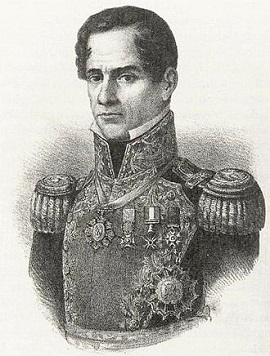
On this date in 1867, the Mexican general and onetime president Antonio Lopez de Santa Anna avoided execution at his court-martial.

Best recognized north of the Rio Grande for overrunning the Alamo, Santa Anna actually enjoyed an amazing career with a near half-century as Mexico’s definitive caudillo.

Antonio López de Santa Anna joined the military he would come to personify as a 16-year-old cadet in 1810 … except it was the Spanish colonial army, where he had hands-on training in the cold counterinsurgency tactics he would subsequently apply in his maturity.

Within barely a decade, the ambitious young officer was advanced to general — the last step by dint of his timely adherence to the incoming emperor of now-independent Mexico, Agustin de Iturbide.

Iturbide was destined for a firing squad, but Santa Anna had a better knack for tacking with his new country’s political gales — turning against his recent patron just in time to help depose the guy.

Santa Anna’s P.T. Barnum*-quality panache for shameless self-promotion — at one pont he repelled Spain’s last attempted reconquista and pronounced himself the “Napoleon of the West” — soon self-promoted himself right to the presidency. From 1833 to 1855, he held the office during 11 distinct stints.

His dictatorial exercise of power and abundant graft aroused resistance from more than just Texan Anglos, so he was often engaged in suppressing internal rebellions, and occasionally in being chased by them into exile. His last turn at president was aborted in 1855 by liberal reformers. Santa Anna fled to Cuba.

Considering the mad twists of fortune in his long career, it’s a miracle that none of his enemies ever actually executed Santa Anna. He was: both adoit and lucky to avoid purging during the tumultuous 1820s; captured by rebelling Texans, who preferred to avenge Alamo by forcing him to treaty terms; handed over to the U.S. government, which eventually sent him back to Mexico; captured again by rebelling Indians in Veracruz who sold him to the Mexican government which sent him to exile; and, tried by the liberals who finally toppled him, but in absentia since he had escaped once more. He had more lives than a cat; small wonder that here in his sixties and seventies he still wasn’t done plotting.

A full decade out of power, Santa Anna spent 1866-1867 in Staten Island, New York,** until the fall of Mexico’s French-backed Emperor Maximilian induced him once more — at the age of 73 — to sail for home with one last summons to his banner. Instead he was captured in a position that must have looked like curtains for sure.

The New York Times actually reported on July 5, 1867 that Santa Anna had been summarily executed; in fact, the restored liberal government of Benito Juarez clapped the nettlesome general in prison and subjected him to a court martial that ran Oct. 7-10. Juarez allegedly expected the old snake to be convicted of treason and finally executed, but like the Times, Juarez too was frustrated: the commission sentenced Santa Anna to exile and he was carried away to Havana once again.

It proved to be a waking death: cheated of the glory of a firing squad, the old general was pitiably forgotten.

“His schemes” — for still he schemed — “became increasingly the ravings of an old, deluded, sick man,” writes Robert Scheina in Santa Anna: A Curse Upon Mexico.

Permitted with Juarez’s death in 1874 to return to Mexico, Santa Anna now fought only for a pension. (He lost that fight.) So long his country’s first man, he “became increasingly depressed which was only relieved by his increasing senility. Santa Anna was suffering the worst possible punishment — obscurity and irrelevancy.” He died penniless of diarrhea in 1876.

* Santa Anna eventually came to hobble about on a cork leg, courtesy of a war wound. The leg was captured during the Mexican-American War, and Barnum put the artificial limb on exhibit.

That limb has never been returned to its native soil: Santa Anna’s prosthesis remains available to the Yankee gawker at the Illinois State Military Museum in Springfield.

** Santa Anna’s legacy in the United States (apart from that Alamo unpleasantness) was the importation of chicle, which the general liked to chew. Santa Anna’s American secretary, Thomas Adams, used it to create the chewing gum marketed as chiclets.

On this day..

1721: John Meff

John Meff hanged at Tyburn on this date in 1721 for returning from convict transportation.

If we are to credit the autobiographical account that Meff furnished the Ordinary of Newgate prior to his hanging, it was the last act in an adventuresome life. (Here’s the Ordinary’s account of the execution of Meff with three other men; here’s the Newgate Calendar entry based upon it, and which provides the quotes ensuing in this post.)

“I was born in London of French parents,” Meff begins — Huguenots who had fled Catholic harassment.

Huguenot refugees formed an important part of London’s Spitalfields weavers, and Meff apprenticed in this business until he could hang out his own shingle. But finding business too slow to support his family, he took to a bit of supplementary thieving.

Meff says that he had already once been condemned to death for housebreaking “but, as I was going to the place of execution, the hangman was arrested, and I was brought back to Newgate.”

Certainly the era’s executioners had frequent criminal escapades, but I have not found this remarkable Tyburn interruptus related in any press accounts in the 1710s. It’s possible that Meff is embellishing on the 1718 downfall and execution of hangman John Price — though Price was seized red-handed and not detained in the exercise of his office. This inconsistency has not prevented creation of a wonderful illustration, The Hangman Arrested When Attending John Meff to Tyburn, from this volume.

At any rate, Meff’s sentence was moderated to transportation to the New World, and he says that he “took up a solemn resolution to lead an honest and regular course of life … But this resolution continued but a short time after the fear of death vanished.”

Here Meff’s story really gets colorful — whether to the credit of the unsettled Atlantic economy or to the teller’s gift for embroidery we cannot say.

The ship which carried me and the other convicts was taken by the pirates. They would have persuaded me and some others to sign a paper, in order to become pirates; but we refusing, they put me and eight more ashore on a desert uninhabited land, where we must have perished with hunger, if by good fortune an Indian canoe had not arrived there. We waited till the Indians had gone up the island, and then, getting into the vessel, we sailed from one small island to another, till we reached the coast of America.

Not choosing to settle in any of the plantations there, but preferring the life of a sailor, I shipped myself on board a vessel that carried merchandise from Virginia and South Carolina to Barbadoes, Jamaica, and other of his majesty’s islands. And thus I lived a considerable time; but at last, being over-desirous to see how my wife and children fared inEngland, I was resolved to return at all adventures.

Once back, Meff says, he “quickly fell into my former wicked practices” — as if by gravity, no further explanation ventured. It’s hard not to suspect that he simply managed to escape his American indenture to continue a career in larceny, absent the whole marooned-by-pirates subplot. Men were known to tell tall tales to the Ordinary — who, after all, had their own story to sell the public through the deaths of their charges.

“The narrow escape he had experienced from the gallows ought to have taught him more wisdom than to have returned from transporation before the expiration of his time; but one would think there is a fatality attending the conduct of some men, who seem resolutely bent on their own destruction,” the Newgate Calendar’s entry concludes.

“One truth, however, is certain. It is easy, by a steady adherence to the rules of virtue, to shun that ignominious fate which is the consequence of a breach of the laws of God and our country.”

On this day..

1915: Leo Frank lynched

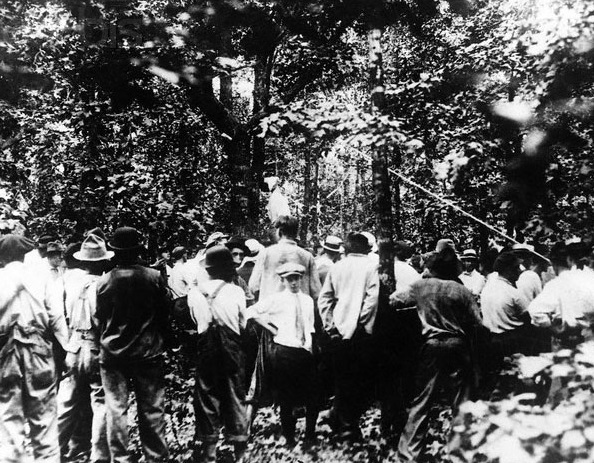
One hundred years ago today, Leo M. Frank was lynched to an oak tree at Marietta — one of the most notorious mob murders in American history.

Methodically extracted hours before from the Midgeville State Penitentiary by an Ocean’s Eleven-style team of coordinated professionals, Frank’s murder was as shocking in 1915 as it reads in retrospect.

The well-heeled Jewish Yankee was factory superintendent at the National Pencil Company in Atlanta when a 13-year-old girl in his employ was discovered in the factory’s basement — throttled and apparently raped. That was in 1913; for the ensuing two years, the prosecution of Mary Phagan’s boss as her murderer would play out in sensational press coverage.
Frank is today widely thought innocent of the crime, although the Georgia Board of Pardons and Paroles has balked at issuing an unconditional pardon since so little of the original evidence survives. (A 1986 pardon came down “without attempting to address the question of guilt or innocence” in recognition of the slanted trial and the failure to protect Frank from lynchers.) But this was much more than a courtroom drama; the Frank affair crackles with the social tensions of early 20th century America. Industry and labor; integration; sexual violation; sectional politics; race and class and power.

Populist Party politician Thomas E. Watson, whose magazines made a dishonorable intervention by openly agitating for (and then celebrating) Frank’s lynching, captures the Zeitgeist for us as he fulminates against the nationwide campaign to grant the convicted murderer a new trial: “Frank belongs to the Jewish aristocracy, and it was determined by the rich Jews that no aristocrat of their race should die for the death of a working-class Gentile.” Frank came to enjoy (if that’s the right word) the editorial support of most of the country’s major papers, but the meddling of northern publishers, and of fellow Jews in solidarity,* arguably led Georgians to circle wagons in response. Present-day Muslims called upon to disavow every bad act by every other Muslim would surely recognize this no-win position.

But then we must also add that Watson himself, a lawyer, had been approached by Frank’s defense team hoping to enlist his bombast to defend their man at trial. The white supremacist demagogue would have been perfect for the job, for the legal battle pitted the credibility of a black janitor named Jim Conley against that of Frank.

Here amid the nadir of American race relations Frank’s team made its own ugly and unsuccessful pitch for racial solidarity with his neighbors. When formulaically asked by the court that had convicted him for any statement to mitigate the impending sentence, Frank replied that

my execution will make the advent of a new era in Georgia, where a good name and stainless honor count for naught against the word of a vile criminal; where the testimony of Southern white women of unimpeachable character is branded as false by the prosecution, disregarded by the jury and the perjured vaporings of a black brute alone accepted as the whole truth.

This violent collision of two vulnerable minorities each with the keen sense that one or the other of them was being outfitted for WASP America’s nooses makes for riveting and sometimes bizarre reading. Newspapers could hardly fail to note that the all-white jury (Leo Frank’s defense team struck all the blacks) had, as Frank complained, privileged the account of just the sort of “black brute” that Southern courts were accustomed to scorn, or railroad. Thus we have the NAACP organ The Crisis taking umbrage that “Atlanta tried to lynch a Negro for the alleged murder of a young white girl” but “a white degenerate has now been indicted for the crime.” It was likewise reasoned by some that since Conley was a young black man with a criminal record who was a potential suspect in the Deep South in the murderous sexual assault of a little white girl, “the mere fact that Conley did not long ago make his exit from this terrestrial sphere, via a chariot of fire is convincing proof that he, at least, is not the man who committed the deed.”** (New York Age, Oct. 29, 1914.)

In the end it was a zero-sum game between Jim Conley and Leo Frank: one of them was the murderer; each accused the other. Their respective desperate interests permeated to their respective communities. After Frank’s lynching, hundreds of Jews left Georgia; many who remained took pains to downplay their Jewishness.

By whatever circumstance police zeroed on Frank and the white community’s passion followed — tunnel vision that would eventually manifest itself in a circus courtroom atmosphere where the prosecuting attorney was cheered and defense witnesses hooted at and the ultimate outcome more demanded than anticipated. The judge feared that an acquittal would result in the summary lynching of not only Frank but his defenders.


Mary Phagan was killed on Confederate Memorial Day, the “holiday” this ballad alludes to.

Unusually for the time, appeals on the case reached the U.S. Supreme Court which declined to intervene — although two justices filed a dissent citing the egregious trial atmosphere.

Mob law does not become due process of law by securing the assent of a terrorized jury …

This is not a matter for polite presumptions; we must look facts in the face. Any judge who has sat with juries knows that in spite of forms they are extremely likely to be impregnated by the environing atmosphere … we think the presumption overwhelming that the jury responded to the passions of the mob …

lynch law [is] as little valid when practiced by a regularly drawn jury as when administered by one elected by a mob intent on death.

But that mob would still have its say. On the eve of Frank’s scheduled June 22, 1915 hanging, outgoing governor John Slaton commuted the sentence.

“Feeling as I do about this case, I would be a murderer if I allowed this man to hang,” the governor said. “It may mean that I must live in obscurity the rest of my days, but I would rather be plowing in a field than feel for the rest of my days that I had this man’s blood on my hands.”†

Frank was spirited away to the penitentiary under cover of darkness; it was hoped that the remote and reinforced edifice would deter any reprisal. It turned out that the furies who hunted Franks could not be dissuaded by mere inconvenience: a committee calling itself the Knights of Mary Phagan formed with the open object of organizing the intended mob vengeance — and indeed it was almost superseded in July of that year by a fellow-prisoner who slashed Frank’s throat as he slept.

Frank survived that murder attempt only to await the next one. Who knows what fancies frequented him in those weeks when he ducked from the shadow of the gallows to that of the lynching-tree, object of pity or hatred. He had time on the last day to savor his impending fate when the Knights methodically cut their way into the penitentiary — snipping the phone wires and disabling the vehicles — and marched their man out with nary a shot fired. Then, a convoy of automobiles “sped” (at 18 miles per hour) all the way back to a prepared execution-site at Marietta. The drive took seven or eight hours over unpaved country lanes, and for every moment of it Frank surely knew how it would end.

* Frank was a chapter president of the Jewish fraternal organization B’nai B’rith; the Anti-Defamation League of B’nai B’rith was founded in 1913 as a direct outgrowth of the Frank campaign.

As a contrasting response, the American Jewish Committee declined to participate in the Frank campaign for fear of lending counterproductive credence to charges such as those voiced by the New York Sun (Oct. 12, 1913):

The anti-Semitic feeling was the natural result of the belief that the Jews had banded to free Frank, innocent or guilty. The supposed solidarity of the Jews for Frank, even if he was guilty, caused a Gentile solidarity against him.

** Maurianne Davis’s Strangers and Neighbors: Relations between Blacks and Jews in the United States has a trove of interesting editorial comment from Frank’s contemporaries in the black press, and the Jewish press. Conley was actually the confessed accessory, and served a year in prison for it: he said that he complied with Frank’s order to hide the body for fear that his “white” boss could easily get Conley lynched for the crime. Conley also wrote (under Frank’s directive, he said) the preposterous “murder notes” found with the body that purported to be Mary Phagan’s dying indictment of Newt Lee, the African-American night watchman.

† The allusion to political suicide suggests Slaton’s mind was on the precedent of Illinois Gov. John Altgeld, whose career was destroyed by pardoning some of the Haymarket anarchists. If so, Slaton was quite correct; he actually had to flee Georgia altogether and could not return to the state for more than a decade.

On this day..