On this day in 1419, an angry mob of Hussite peasant rebels stormed the town hall on Charles Square in Prague and threw the judge, the mayor and several city council members (either seven or thirteen; accounts differ) out the window. They all either died in the fall or were killed by the crowd outside.
Hussites followed a Christian reformer, Jan Hus, who was one of the forerunners of the Protestant Reformation. Hus was eventually excommunicated and burned as a heretic. The cause of the July 30 riot was the city council’s refusal to release from custody several Hussite prisoners.
The mob, led by the Hussite priest Jan Želivský and future general Jan Žižka, marched to the town hall, but they only became violent after someone inside the building threw a stone at them. After that there was no stopping them.
The riot had far-reaching consequences, inasmuch as it is seen as the start of the Hussite Wars, which lasted until 1434 or so and involved government-sponsored military action against the Hussites as well as Hussites fighting amongst themselves.
This event has come to be known as the First Defenestration of Prague. That is, I’m sure we all can agree, an AWESOME name, and probably the principal reason the riot is still remembered today. The word “defenestration” comes from Latin: de-, meaning “out of,” and fenestra, “window.”
The Czechs have a habit of throwing people out of windows at critical junctures in history; since 1419 there has been at least one more (nonfatal, but more famous) Defenestration of Prague, in 1618. A couple of similar events since then have sometimes been called the Third Defenestration of Prague, though this is not universally agreed upon.
On this date in 1570, Russian tsar Ivan IV Grozny — Ivan the Terrible — carried out one of his most infamous and horrible atrocities with hundreds executed on Red Square.
Ivan the Terrible, by Viktor Vasnetsov. (Cropped image; click for the full painting.)
We find ourselves in 1570 almost a quarter-century into the reign of this complicated, frightening figure. It is the oprichnina, the bloodiest spell of Ivan’s authority: years of torture, purges, and political violence vividly symbolized by the tsar’s black-clad personal Gestapo, the oprichniki.
“Children of darkness,” the exiled noble Kurbsky called these dreadful Praetorians. “Hundreds and thousands of times worse than hangmen.”
A dangerous time to draw breath, but a particularly dangerous time for any boyar, men of the feudal nobility whom Ivan set his iron hand to mastering. This, after all, was the historical task of monarchs at this time, and it was everywhere accomplished with bloodshed.
Already stung by the defection — and subsequent nasty correspondence — of one such noble, Andrei Kurbsky, Ivan was downright paranoid about disloyalty during the long-running Livonian War against Muscovy’s western neighbors, Poland, Lithuania and Sweden.
Ivan became ever readier to equate dissent with treason and to ascribe his military reverses to conspiracies on the part of his aristocratic commanders, rather than to the shortcomings of his war-machine in general. A vicious circle thus emerged – of military failures; suspected treachery; the suspects’ fear of condemnation and liquidation, and flight abroad.*
The innocent have nothing to fear!
Taking it into his head that the ancient, rival city of Novgorod — one of the cradles of Russian civilization — was scheming to deliver itself to the newly-formed Polish-Lithuanian Commonwealth, Ivan led an army there that in early 1570 massacred thousands of Novgorodians.**
He wasn’t done yet.
Returning to Moscow with his blood up, Ivan subjected his numerous Novgorodian prisoners to a savage regimen meant to uncover the extent of their nefarious doings. And it wasn’t long before the locals (who were, after all, just as suspect in Ivan’s eyes) got swept up in it, too. Politically-motivated magistrates with torture-induced confessions and denunciations did the dreadful things they always do.
This date in 1570 turned out to be the affair’s crowning carnival of barbarism.
“The Russian capital had seen many horrors in its time,” wrote Soviet-era historian A.A. Zimin (cited in this biography of Ivan IV). “But what happened in Moscow on 25 July, in all its cruelty and sadistic refinement, outdid all that had gone before and can perhaps be explained only by the cruel temperament and the sick imagination of Ivan the Terrible.”
Ivan Viskovaty (English Wikipedia link | French) had been one of Russia’s leading men on foreign affairs for a generation, as well as a longstanding ally of the tsar.
Nevertheless, he would be the first and most prominent victim on Red Square this date. Viskovaty’s rival Andrei Shchelkalov, who succeeded Viskovaty as the foreign affairs minister, neatly stitched up the senior diplomat for being in on the Novgorod “plot” as well as more exotic schemes to hand over southern cities to Turkey and the Khanate.
On July 25, in the middle of the market-place, eighteen scaffolds were erected, a number of instruments of torture were fixed in position, a large stack of wood was lighted, and over it an enormous cauldron of water was placed. Seeing these terrible preparations, the people hurried away and hid themselves wherever they could, abandoning their opened shops, their goods and their money. Soon the place was void but for the band of opritchniks gathered round the gibbets, and the blazing fire. Then was heard the sound of drums: the Tsar appeared on horseback, accompanied by his dutiful son, the boyards, some princes, and quite a legion of hangmen. Behind these came some hundreds of the condemned, many like spectres; others torn, bleeding, and so feeble they scarce could walk. Ivan halted near the scaffolds and looked around, then at once commanded the opritchniks to find where the people were and drag them into the light of day. In his impatience he even himself ran about here and there, calling the Muscovites to come forward and see the spectacle he had prepared for them, promising all who came safety and pardon. The inhabitants, fearing to disobey, crept out of their hiding-place, and, trembling with fright, stood round the scaffold. Some having climbed on to the walls, and even showing themselves on the roofs, Ivan shouted: “People, ye are about to witness executions and a massacre, but these are traitors whom I thus punish. Answer me: Is this just?” And on all sides the people shouted approval. “Long live our glorious King! Down with traitors! Goiesi, Goida!”
Ivan separated 180 of the prisoners from the crowd and pardoned them. Then the first Clerk of the Council unrolled a scroll and called upon the condemned to answer. The first to be brought before him was Viskovati, and to him he read out: “Ivan Mikhailovich, formerly a Counsellor of State, thou hast been found faithless to his Imperial Highness. Thou has written to the King Sigismund offering him Novgorod; there thy first crime!” He paused to strike Viskovati on the head, then continued reading: “And this thy second crime, not less heinous than thy first, O ungrateful and perfidious one! Thou hast written to the Sultan of Turkey, that he may take Astrakhan and Kazan,” whereupon he struck the condemned wretch twice, and continued: “Also thou hast called upon the Khan of the Krim Tartars to enter and devastate Russia:† this thy third crime.” Viskovati called God to witness that he was innocent, that he had always served faithfully his Tsar and his country: “My earthly judges will not recognize the truth; but the Heavenly Judge knows my innocence! Thou also, O Prince, thou wilt recognise it before that tribunal on high!” Here the executioners interrupted, gagging him. He was then suspended, head downwards, his clothes torn off, and, Maluta Skutarov, the first to dismount from his horse and lead the attack, cut off an ear, then, little by little, his body was hacked to pieces.
The next victim was the treasurer, Funikov-Kartsef, a friend of Viskovati, accused with him of the same treason, and as unjustly. He in his turn said to Ivan, “I pray God will give thee in eternity a fitting reward for thy actions here!” He was drenched with boiling and cold water alternately, until he expired after enduring the most horrible torments. Then others were hanged, strangled, tortured, cut to pieces, killed slowly, quickly, by whatever means fancy suggested. Ivan himself took a part, stabbing and slaying without dismounting from his horse. In four hours two hundred and been put to death, and then, the carnage over, the hangmen, their clothes covered with blood, and their gory, steaming knives in their hands, surrounded the Tsar and shouted huzzah. “Goida! Goida! Long live the Tsar! Ivan for ever! Goida! Goida!” and so shouting they went round the market-place that Ivan might examine the mutilated remains, the piled-up corpses, the actual evidences of the slaughter. Enough of bloodshed for the one day? Not a bit of it. Ivan, satiated for the moment with the slaughter, would gloat over the grief of the survivors. Wishing to see the unhapy wives of Funikov-Kartsef and of Viskovati, he forced a way into their apartments and made merry over their grief! The wife of Funikov-Kartsef he put to the torture, that he might have from her whatever treasures she possessed. Equally he wished to torture her fifteen-year-old daughter, who was groaning and lamenting at their ill fortune, but contented himself with handing her over to the by no means tender mercies of the Tsarevich Ivan. Taken afterwards to a convent, these unhappy beings shortly died of grief — it is said.
Thanks to this sort of wholesale purging, Ivan the Terrible became in the 20th century something of an allegorical shorthand for Joseph Stalin, whose ownreignofterror was a touchier subject for direct commentary. By that same token, and capturing the multifaceted meaning of the word Grozny, (both awful and awe-inspiring) Soviet patriotic mythology co-opted Ivan and his allegedly farsighted cruelty as a state- and nation-builder.
Sergei Eisenstein’s Ivan the Terrible — a planned trilogy of films of which only two were completed, due to Stalin’s distaste for his greatest director’s interpretation — captures a view of Ivan IV Grozny from the shadow of wartime Stalinist Russia. (The two extant films can be seen in their entirety on YouTube, and are well worth the watching.)
The more conventional take is that, especially by his later years, the guy’s tyrannical paranoia had metastasized enough to send him plum off his rocker. In 1581, that favorite son who had accompanied Tsar Ivan to Novgorod, and to Red Square on this date, piqued his father’s rage during an argument — and in a fury, Ivan struck him dead.
Detail view (click for the full, gorgeous canvas) of Ilya Repin‘s emotional painting of Ivan the moment after he has mortally wounded his son. Incited to his own act of lunacy by the tsar’s riveting madman expression, iconographer and Old Believer Abram Balashov slashed these faces with a knife (image) in the Tretyakov Gallery in 1913.
The capable young heir’s senseless death effectively spelled the end for Russia’s Rurikid Dynasty descended from the half-mythical Norse founder of Rus’, Rurik. That argument from order and progress in favor of Ivan’s ferocity inconveniently runs up against the fact that what he actually bequeathed to the next generations of Russians was the rudderless, war-tornTime of Troubles, when rival claimants struggled for the throne.
Ivan IV is sure to remain a controversial, compelling figure for many a year to come. Released just a few months ago as of this writing, and in a time when Ivan comparisons are coming back into vogue for the ominous contemporary Russian state, Pavel Lungin’s Tsar (review) mounts a gory critique of its subject.
* Jonathan Shepard, book review in The Historical Journal, vol. 25, no. 2 (June 1982).
** Novgorod by 1570 was not as important as it had once been, but Ivan’s sack massively depopulated the city, essentially destroying its remaining strength as an independent commercial center.
† The allied Ottoman Turks and Crimean Khanate did in fact devastate Russia (and pillage Moscow) the very next year.
On this date in 1538, Spanish conquistador Diego de Almagro was executed* at Cuzco by his vengeful rivals, the Pizarro brothers.
Conquistadoring with the rapacious Pizarros was a good way to get rich, get dead, or possibly both.
Almagro, a soldier, got to the New World in 1514 and soon fell in with alpha male Pizarro Francisco.** He’d become an adjunct to the latter’s conquest of the Incan Empire in the 1520s and 1530s; sent to capture the Incan city of Quito, Almagro found it razed by its defenders, and he sycophantically re-founded it as San Francisco de Quito.†
Things weren’t buddy-buddy for long.
The Iberian mothership divided Spain’s putative New World possessions north and south, putting Almagro in command of the southern cone. Great news … now all he had to do was actually take control of it.
Personally financing an expedition on the expectation of fabulous riches to be seized, Almagro instead foundered in Chile’s northern valleys in a frustrating environment of natives equally hostile and impecunious. After a couple years, he gave up and returned to Peru, angrier and poorer for his trouble — and there found that he could exploit the Spanish preoccupation with intransigent Incan chief Manco Inca to nick the capital city of Cuzco for himself.
Almagro actually had the lesser Pizarros — Gonzalo and Hernando — prisoner for a while, but he bartered them away to Francisco for a hill of beans (that is, a promise not to attack), and the Pizarros took their city back by routing Almagro at the Battle of Las Salinas.
The sentence of death against as august a personage as the appointed ruler of Nueva Toledo shocked many, and it was carried out against Almagro’s own entreaties for an appeal to the crown.
Detail view of a print of Almagro’s capture and execution. (Click for the full image.)
Francisco Pizarro would redeem his want of clemency towards his former partner in his own blood: in 1541, Almagro’s son, Diego de Almagro II or el Mozo, murdered Pizarro in an attempted coup d’etat. (Almagro the Younger, too, would be executed for his trouble.)
Although he was an important conquistador who spent most of his time at points further north, Almagro is best remembered today not in Peru but in Chile — for his abortive and disappointing expedition made him that land’s first European “discoverer”.
“With Major Lawrence, mercy is a passion. With me, it is merely good manners. You may judge which motive is the more reliable.”
-Alec Guinness as Prince Faisal in Lawrence of Arabia
This date in 1917 was the eve of the Battle of Aqaba, wherein a force of Arabs with famous British officer T.E. Lawrence emerged from the desert to surprise and capture the Ottoman Red Sea port today located in Jordan.*
And that makes this, in the cinematic masterpiece Lawrence of Arabia, the date on which the titular character kept the peace within his fragile coalition by personally executing a malefactor to prevent a tribal blood feud.
The victim, Gasim, is a real figure described in the real T.E. Lawrence’s memoirs —
a gap-toothed, grumbling fellow, skrimshank in all our marches, bad-tempered, suspicious, brutal, a man whose engagement I regretted, and of whom I had promised to rid myself as soon as we reached a discharging-place.
Gasim is most famous as the beneficiary of the movie scene in which Lawrence boldly turns back into the desert to rescue this worthless retainer when Gasim’s camel is found riderless in the caravan. This, too, is based on an actual incident in Lawrence’s memoir, albeit heavily dramatized on celluloid.
In the film, Lawrence’s godlike power to give Gasim life is soon mirrored by the godlike power to deprive it.
Effectively exploiting dramatic license, Lawrence of Arabia portrays the Englishman surveying the scene of the coming triumph when a disturbance breaks out in his camp. Hastening thither, he discovers clan lining up against clan over the destructive right of blood vengeance because of a murder in the camp — a murder committed by the man he has saved.
To forestall a “tribal bloodbath” on the very eve of victory, Lawrence himself volunteers to execute the culprit. Having once risked everything to save Gasim, Lawrence sacrifices him ruthlessly when the occasion demands.** This act underscores the chameleon-like other-ness of the character, one of the film’s principal leitmotifs: “I have no tribe, and no one is offended!”
Though the real Lawrence did no such thing to the real Gasim, this astonishing scene is also related in the memoirs — just at an earlier point, and with a different, less dramatically integral character.
My followers had been quarrelling all day; and while I was lying near the rocks a shot was fired. I paid no attention; for there were hares and birds in the valley; but a little later Suleiman roused me and made me follow him across the valley to an opposite bay in the rocks, where one of the Ageyl, a Boreida man, was lying stone dead with a bullet through his temples. The shot must have been fired from close by; because the skin was burnt about one wound. The remaining Ageyl were running frantically about; and when I asked what it was Ali, their head man, said that Hamed the Moor had done the murder. I suspected Suleiman, because of the feud between the Atban and Ageyl which had burned up in Yenbo and Wejh; but Ali assured me that Suleiman had been with him three hundred yards further up the valley gathering sticks when the shot was fired. I sent all out to search for Hamed, and crawled back to the baggage, feeling that it need not have happened this day of all days when I was in pain.
As I lay there I heard a rustle, and opened my eyes slowly upon Hamed’s back as he stooped over his saddle-bags, which lay just beyond my rock. I covered him with a pistol and then spoke. He had put down his rifle to lift the gear; and was at my mercy till the others came. We held a court at once; and after a while Hamed confessed that, he and Salem having had words, he had seen red and shot him suddenly. Our inquiry ended. The Ageyl, as relatives of the dead man, demanded blood for blood. The others supported them; and I tried vainly to talk the gentle Ali round. My head was aching with fever and I could not think; but hardly even in health, with all eloquence, could I have begged Hamed off; for Salem had been a friendly fellow and his sudden murder a wanton crime.
Then rose up the horror which would make civilized man shun justice like a plague if he had not the needy to serve him as hangmen for wages. There were other Moroccans in our army; and to let the Ageyl kill one in feud meant reprisals by which our unity would have been endangered. It must be a formal execution, and at last, desperately, I told Hamed that he must die for punishment, and laid the burden of his killing on myself. Perhaps they would count me not qualified for feud. At least no revenge could lie against my followers; for I was a stranger and kinless.
I made him enter a narrow gully of the spur, a dank twilight place overgrown with weeds. Its sandy bed had been pitted by trickles of water down the cliffs in the late rain. At the end it shrank to a crack a few inches wide. The walls were vertical. I stood in the entrance and gave him a few moments’ delay which he spent crying on the ground. Then I made him rise and shot him through the chest. He fell down on the weeds shrieking, with the blood coming out in spurts over his clothes, and jerked about till he rolled nearly to where I was. I fired again, but was shaking so that I only broke his wrist. He went on calling out, less loudly, now lying on his back with his feet towards me, and I leant forward and shot him for the last time in the thick of his neck under the jaw. His body shivered a little, and I called the Ageyl, who buried him in the gully where he was. Afterwards the wakeful night dragged over me, till, hours before dawn, I had the men up and made them load, in my longing to be set free of Wadi Kitan. They had to lift me into the saddle.
Peter O’Toole’s Lawrence almost palpably manifests the conflicting aspects of his character as he shoots Gasim to death — and he confirms the transformative effect of his first homicide in subsequent dialogue with Gen. Edmund Allenby.
Lawrence: I killed two people. One was … yesterday? He was just a boy and I led him into quicksand. The other was … well, before Aqaba. I had to execute him with my pistol, and there was something about it that I didn’t like. Allenby: That’s to be expected. Lawrence: No, something else. Allenby: Well, then let it be a lesson. Lawrence: No … something else. Allenby: What then? Lawrence: I enjoyed it.
* Actually, Aqaba is Jordan’s only port. This battle was not so epic as the film depicts.
** In a bit of complex foreshadowing, the cinematic Gasim has told Lawrence at the outset of the expedition that “Allah favors the compassionate.”
On this date in 1622, or very close to it, the Patuxet Native American Tisquantum (better known as Squanto) was about to be yielded by Plymouth Colony Governor William Bradford to Wampanoag chief Massasoit for immediate execution … when the unannounced appearance of a strange ship fortuitously saved him.
Squanto is most famous as the Indian godsend who saved the Mayflower Pilgrims at the Plymouth Bay colony from starvation by teaching those pious wayfarers how to live off the land in the New World.
In that capacity, he made possible (and participated in) the “First Thanksgiving” harvest gorger in 1621 that figures as the antecedent of the modern American holiday. Our day’s principal has therefore been portrayed on the stage by generations of schoolchildren from Cape Cod Bay to California.
But this was only the tail end of one of the most remarkable lives in history.
As a youth, Squanto was kidnapped from his native soil by English explorer George Weymouth, who sold him into slavery in Europe. Squanto wound up in London in some sort of forced-labor capacity, before hitching a ride back to the Americas with Captain John Smith — the Pocahontas guy.
It was thanks to this improbable abduction and return trip that Squanto was available to materialize out of the woods, speaking the Queen’s English on this alien continent, in the nick of time to save the Plymouth immigrants from disaster.**
Squanto sought his own ends and played his own game, by putting the Indians in fear and drawing gifts from them to enrich himself, making them believe he could stir up war against whom he would, and make peace for whom he would. Yea, he made them believe they kept the plague buried in the ground, and could send it amongst whom they would, which did much terrify the Indians and made them depend more on him, and seek more to him, than to Massasoit. Which procured him envy and had like to have cost him his life; for after the discovery of his practices, Massasoit sought it both privately and openly, which caused him to stick close to the English, and never durst go from them till he died.
Seeking Squanto’s life both privately and openly, Massasoit sent messengers to the Plymouth colony requesting the Machiavellian diplomat’s return in accordance with the colony’s treaty arrangements with the Wampanoag.
Bradford ducked and dilated, not wanting to give up this valuable asset, but the precarious colony also needed the amity of its Indian neighbors.
entreating [Bradford] to give way to the death of Tisquantum who had so much abused him … [Massasoit] sent his own knife and [two messengers] therewith to cut off his head and hands and bring them to him
Bradford was on the point of yielding to this demand when a strange boat appeared unannounced — and the guv hit the “pause” button on everything.
he would first know what boat that was ere he would deliver him into their custody (not knowing whether there was a combination of French and Indians). Mad with rage and impatient at delay the messengers departed in great heat.
The delay turned out to be permanent … which for Squanto was only a few more months before he caught ill† and died later in 1622.
The ship that quite unknowingly bought Squanto this extra purchase on life had nothing at all to do with the drama unfolding between Bradford and Massasoit: it was the Sparrow, the advance party of the coming Wessagusset (or Weymouth) colony which would plant itself adjacent to the Plymouth settlers and completely crash and burn.
* This site asserts May 31 was the date that the Sparrow came ashore at Plymouth. Most sites are slightly less specific, noting only that the ship arrived in very late May.
** Among Squanto’s good deeds for the fledgling colony was tracking down a boy who got lost in the wilderness. The boy was John Billington, the eponymous son of the first man hanged in the Plymouth Colony.
† Some suspect that Squanto’s “illness” wasn’t so accidental, and the frustrated Wampanoag chief simply dispensed with the diplomatic rigmarole and poisoned him off.
an apostate deacon, who for the love of a Jewess had circumcised himself. When he had been degraded he was burnt by the servants of the lord Fawkes.
The story of this nameless and foreskinless deacon — and the link includes several congruent descriptions from primary sources — is sometimes conflated with that of Robert of Reading, another Christian divine who converted in the late 13th century.
Robert’s fate — or Haggai’s, to use the new name he took — seems to be officially unknown, and might have unfolded overseas: Edward I expelled Jews from England in 1290. Nevertheless, the mixed Robert-anonymous deacon story was commemorated with a plaque at Osney Abbey.
Whomever this date’s deacon really was, he wasn’t the only one for whom this council ordained a dreadful end for having the wrong idea about the Almighty.
And there was brought thither into the council an unbelieving youth along with two women, whom the archdeacon of the district accused of the most criminal unbelief, namely that the youth would not enter a church nor be present at the blessed sacraments, nor obey the injunctions of the Catholic Father, but had suffered himself to be crucified, and still bearing in his body the marks of the wounds had been pleased to have himself called Jesus by the aforesaid women. And one of the women, an old woman, was accused of having long been given to incantations and having by her magic arts brought the aforesaid youth to this height of madness. So both being convicted of this gross crime, were condemned to be imprisoned between two walls until they died. But the other woman, who was the youth’s sister, was let go free, for she had revealed the impious deed.
On this date in 1816, poachers John Penny and John Allen hanged for the murder of a gameskeeper.
This wasn’t about preserving endangered elephants from the depredations of the ivory trade, but the centuries-long rural skirmish between classes over land use and property control.
The recipe to make a poacher [said an English Peer in 1825] will be found to contain a very few and simple ingredients which may be met with in every game county in England. Search out (and you need not go far) a poor man with a large family, or a poor man single man, having his natural sense of right and wrong … give him little more than a natural disinclination to go to work, let him exist in the midst of lands where the game is preserved, keep him cool in the winter, by allowing him insufficient wages to purchase fuel; let him feel hungry upon the small pittance of parish relief; and if he be not a poacher it will only be by the blessing of God.
It was the legacy of enclosure, the breaking-up of common lands and the abolition of longstanding privileges that underpinned (among other things) the traditions of English game-hunting and the livelihoods of commoners who depended upon it.
“After estates and commons were removed from public access by enclosure,” writes Babette Smith, “poaching became a manifestation of the class war — a civil war in fact, which was never declared.”
And not only a metaphorical war.
Pew pew pew.
The wholesale seizure of lands, wealth, and social rights had perforce to be upheld by violence. Here in Gloucestershire’s Vale of Berkeley, the principal landowner was one William FitzHardinge Berkeley, tetchy bastard son of an illustrious army officer who inherited the wealth of his family and the chip on his shoulder about not being admitted to the peerage due to his out-of-wedlock birth.
Landowners at this time had no compunctions about setting lethal traps to keep out those they legally defined as trespassers. Late in 1815, a poacher named Thomas Till had actually been killed by a tripwire-activated spring gun, to the outrage of his compatriots.
John Allen, charismatic local farmer and a poacher himself, had some score-settling on his mind one moonlit night in January when he rounded up 15 other poachers, swore them all to silence, and went out armed and looking for trouble.
They found it in a band of Berkeley’s gamekeepers, who confronted the poachers. Shooting broke out; one of the gamekeepers was killed and a few others wounded.
“Eleven young men, nine of whom were farmers’ sons and respectably connected,” in the characterization of the Gloucester Journal, were convicted of murder by a jury weeping as it delivered the verdict. For the real facts on the ground, this criminal justice framework made for a cruel fit, especially since the highhanded lord seems to have engineered the dangerous encounter to begin with. Dr. Edward Jenner, famous pioneer of immunology, was also a Gloucestershire magistrate involved in this case; he, too, had misgivings.
All but the ringleader Allen and John Penny, apparent author of the fatal shot, received the clemency of convict transportation to Van Dieman’s Land, Australia — although a couple got away outright and never stood trial and one of those arrested turned state’s evidence in exchange for a full pardon.
On this date* in 1520, on his famous voyage of circumnavigation, explorer Ferdinand Magellan ordered the immediate execution of a mutinous captain.
Not to be trifled with.
Having alit just days before at the natural harbor of Puerto San Julien on the Brazilian Argentine coast (Magellan named it) with plans to winter there, the overweening Portuguese explorer faced an uprising of grumpy Spanish officers.
Gaspar Quesada, captain of the Concepcion, along with Luis de Mendoza of the Victoria and recently displaced San Antonio skipper Juan de Cartagena, seized some of the expedition’s ships during the night of April 1-2.
Since you know Magellan’s name five centuries later, you already know he quashed it.
As the sovereign of this fragile floating world, Magellan had little choice but to treat a challenge to his authority mercilessly.**
Though accounts are inconsistent, it seems Mendoza was boldly slain by one of Magellan’s men meeting him under color of “negotiation”.
Mendoza was then posthumously beheaded and quartered along with Gaspar Quesada. Juan de Cartagena was either executed as well, or else caught a “break”: some sources relate that, instead of executing Cartagena, Magellan had him marooned.
the twentieth of June [1578], wee harboured ourselues againe in a very good harborough, called by Magellan Port S. Julian, where we found a gibbet standing upon the maine, which we supposed to be the place where Magellan did execution upon some of his disobedient and rebellious company.
–From a member of the Francis Drake expedition. Just 12 days later and at the very same place, Drake visited a similar penalty for a similar offense upon one of his own crew.
* “‘The authorities’ are divertingly divergent on the precise date of these events,” says O.H.K. Spate in The Spanish Lake, referring specifically to the dates of the mutiny. “Denucé puts them on Easter Sunday and Monday, 1–2 April; Merriman on Easter Sunday and Monday, 8–9 April; Nowell on Palm Sunday and the next day, with the trial verdict on 7 April. By the Julian calendar, in use until 1582, the dates would be 1–2 April; by the Gregorian, ten days later. Pigafetta and Maximilian, who slur over the whole affair, give no dates at all. It is not of vast moment.” Clearly, O.H.K. Spate never had to write an almanac blog.
Anyway, there’s some primary sourcing on this affair here.
** Though Magellan made an example of the leaders, he pragmatically spared about 40 others after keeping them in chains and working the pumps for three months. After all, the man still needed to crew his ships.
On this date in 1984, Elmo Patrick Sonnier was electrocuted in Louisiana’s Angola Prison for abducting and murdering two teens in St. Martin Parish.*
Elmo and his brother Eddie posed as police officers and handcuffed two high schoolers parked at a local makeout point. Then they raped the girl, and shot both of them dead.
Eddie managed, as he said, to “give it back” on the grounds that Patrick was the one who did the shooting.
Once Eddie was clear of the death penalty, he tried to cop to the shooting after all, in order to save his little brother.
The appellate life of this case involved unedifying revisions of the “who shot whom” story. Ultimately, Eddie’s later claim to have been the triggerman, though quite possibly true, is not likely to win very much sympathy for his brother. It didn’t help him in the courts, either.
Just the 17th person executed since reinstatement of the death penalty, Sonnier learned that his longshot bid for clemency had been denied straight from the man who denied it — colorful, corrupt Louisiana Gov. Edwin Edwards, who personally phoned Sonnier to give him the bad news.
Little did Sonnier know that he had equally famous company meeting him in his cell.
Sonnier was the first condemned inmate to receive the spiritual ministration of Sister Helen Prejean.
The then-obscure Louisiana nun would later write the bestseller Dead Man Walking about her experiences with Sonnier and a second death row prisoner, Robert Lee Willie. Prejean remains among the most well-known death penalty opponents in the world today.
While the book Dead Man Walking treats Sonnier and Willie in a nonfiction vein, the film adaptation (review) amalgamated those people into a single character, the fictional “Matthew Poncelet”. It’s apparent from the flashbacks in Dead Man Walking‘s execution scene, however, that Sonnier is the predominant influence on “Poncelet”.
Dead Man Walking is an interesting movie. Though its principals were all vocal death penalty opponents, the film itself is much better art than propaganda. Arguably, the doomed criminal attains a sort of personal redemption — finally admitting responsibility for a crime he had denied for much of the film; seeking the forgiveness of his victims’ surviving family — only because the death penalty awaits him.
Susan Sarandon won an Oscar for Best Actress for her turn as Sister Helen. Note that while Sonnier was in fact put to death in the electric chair (as was Robert Lee Willie), director Tim Robbins opted to portray a lethal injection because, as Helen Prejean herself put it,
we don’t want to give people the moral out whereby people could say ‘oh well, we used to do electrocution but that’s too barbaric so now we are humane and inject them’
* The murder that led to this date’s execution took place in the same area where Willie Francis survived a trip to the electric chair: the very chair that killed Patrick Sonnier.
(Thanks to Jeffrey Fisher [jeffreyfisher at me.com] for the guest post.)
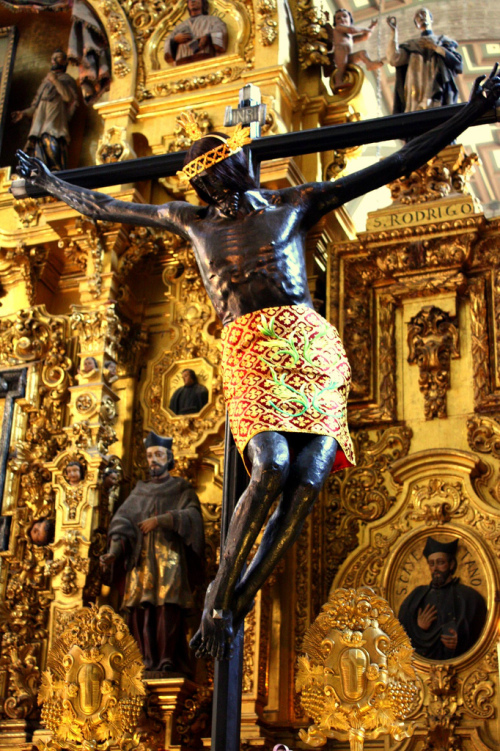
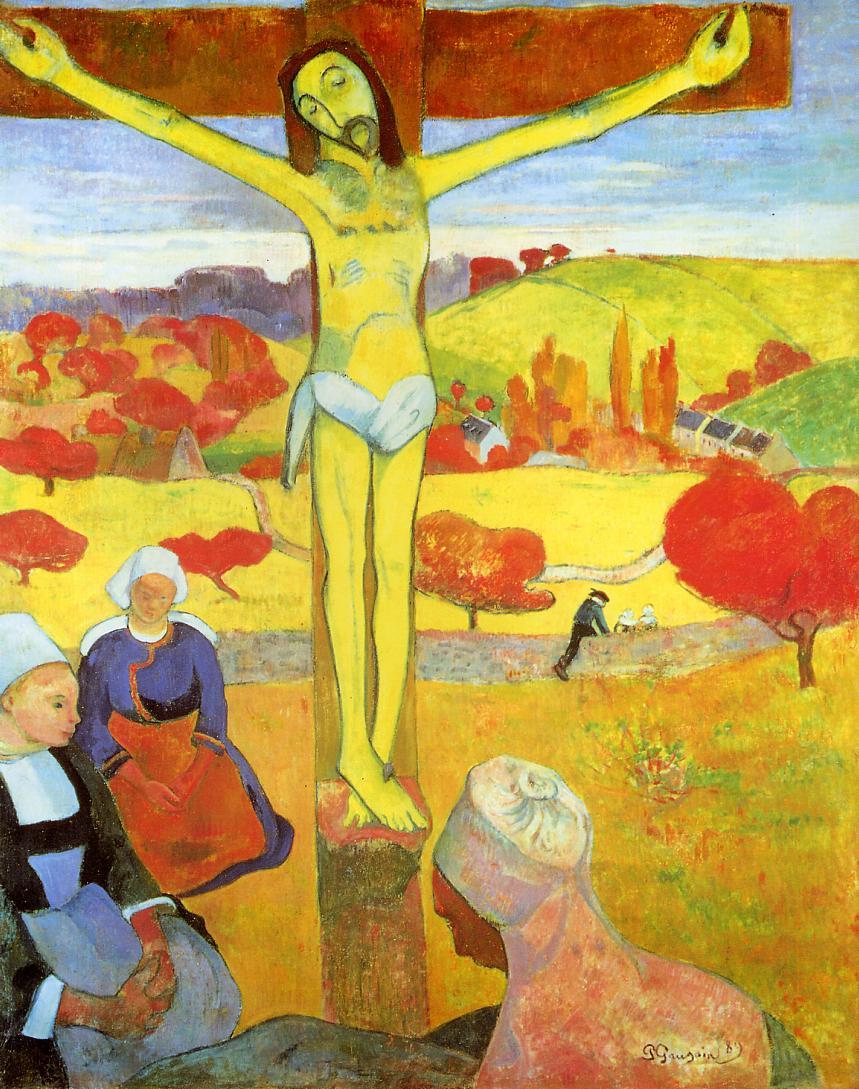
On Good Friday every year,* Christians around the world commemorate the death by crucifixion of Jesus of Nazareth, rabbi, prophet, Son of God, Son of Man, messiah, and all-around trouble-maker.
The truth is that very little is known of Jesus’ life and teachings from verifiable accounts, but this has not stopped generation after generation of Christians from telling his story, beginning with Jesus’ semi-official biographers, the evangelists of the New Testament. Almost everything we know about the life and teachings of the physical human being Jesus are in those writings, which do not portray him always in compatible ways, and which are almost entirely unconfirmed by any external source. The Roman historian Tacitus mentions (with disdain if not disgust) Jesus’ cult following, as does the Jewish historian and philosopher Josephus, but neither gives us anything to work with as historians (or, for that matter, as theologians). For the record, Suetonius and Pliny also talk about Christians, but these piecemeal sources tell us much more about Roman perceptions of Christians than about Christ and his teachings, or even necessarily Christian beliefs and practices.
What, then, can we reasonably say about Jesus?
It is almost impossible to find universal agreement around anything more than a few basics, including most importantly Jesus’ crucifixion. The Gospels narrate it; Paul the Apostle (who never met Jesus in the flesh, as it were) hangs his theology on it, together with the equally important resurrection; and no contemporary sources (Christian or otherwise) dispute it.
But it’s when we ask why Jesus was crucified that things start to get interesting.
What did he do? The two men he is traditionally said to have been crucified with are commonly understood to be “robbers,” but that they were common criminals is highly unlikely. Crucifixion is a horrible death designed to make a very public statement about the crucified, the sort of thing you use on gladiator-slave rebels like Spartacus, not on pickpockets and roustabouts. The Greek term used for these two men (lestai) is consistent with the description of the released Barabbas as one who had participated in rebellious activities, whose “criminality” was related to his revolutionary business. Moreover, the name “Barabbas” means literally “son of the father,” a purely symbolic and surely entirely fictional name, and that the people choose to have him released indicates their affinity for him as a thorn in the side of the Romans. He is thus contrasted with Jesus, the other son of the father, the peaceful (apocalyptic) revolutionary.
So Jesus would have been crucified as a political criminal, a rebel. This would make sense of accounts of his having been identified by the Romans as “Iesus Nazarenus Rex Iudaeorum”: “Jesus of Nazareth, King of the Jews.” Anyone claiming to be king (and “son of God” was a Jewish way of talking about the king of Israel recorded clearly in Psalm 2), would, if taken seriously, be understood as challenging Roman authority.
Insofar as Jesus seems to have been deliberately poking the Romans’ local running dogs, the Sadducees and the Temple priests, his seizure and termination were surely inevitable. If his teaching is as opposed to violence and unconcerned with “politics” as it seems to have been, it’s hard to believe the Romans would have noticed him without some prodding, this coming not from the “crowd,” but from the leadership (who in Mark and Matthew incite the crowd). Indeed, the priests and scribes look for ways to arrest him when the crowds are not around, because they fear a riot.
If we take the Gospel of Mark at all seriously, Jesus was preaching a new kingdom of God, an apocalyptic redemption of the people of the earth by God’s direct intervention (and with Jesus as the sacrificial pesach lamb). If we take the Gospel of Luke seriously, Jesus spoke in a classic prophetic mode, calling people — Jew and Gentile both — to care for the oppressed of the earth, the poor and the hungry and the helpless. Both Jesuses called for people to be better to each other, to love each other, and indeed to love each other when love was, according to common sense, the foolish thing.
Why would this get you executed?
Well, in itself, it wouldn’t. But the Gospel of Mark tells us of Jesus speaking with a man who realizes that all the animal sacrifices in the world don’t amount to a hill of beans (in that crazy world). When love counts more than sacrifice, we are undermining the Temple. When we go into the Temple, start knocking things over, and say it’s become about robbing the poor and not about loving God and one’s neighbor, we are undermining the Temple. And to undermine the Temple’s authority is also to undermine Rome’s authority, and Rome’s cash flow.
Jesus, like the Essenes he may or may not have associated with, was a purist.
The Temple was full of collaborators and exploiters, the kind seen before in the history of Israel (and berated by prophets like Isaiah and Amos), the kind hated also by the Dead Sea community of apocalyptic purists awaiting a final showdown between God and evil (i.e., the Roman Empire and their local potentates, the Temple authorities).
Jesus, like other Jewish prophets before him, thought that Judaism was about something. That it was somehow about justice and not just about following rules or waiting around for things to get better: that it was about our making the world a better place, and not just making our own lives better.
Start talking that way and get people on your side, and you’re fairly likely to get killed, even twenty centuries later.
* Though the actual date (even the year) of the execution marked by the movable feast of Good Friday is fundamentally unknowable, there are some present-day astronomer types who’d like to sell you April 3, 33 A.D.


 This date in 1917 was the eve of the