1306: Simon Fraser, William Wallace comrade in arms

On this date in 1306, Scottish patriot Simon Fraser was drawn and quartered in London.

This Norman-descended lord was one of the side-switching nobles during the wars of William Wallace, but after completing the full circuit from Wallace to Edward I and back again, he unexpectedly decided to lash himself to St. Andrew‘s cross for good.

Perhaps he could tell where the wind was blowing, and not just for his historical reputation: Fraser’s former ally, “Red” Comyn, went down the other fork in the road, submitting himself to an irresistible English invasion the better to devote his energies to his longshot horse in the confusing Scottish regnal derby.

Comyn’s reward was to be personally daggered to death at the altar of Greyfriars Church by Robert the Bruce.

But no amount of royal sacrilege could arrest the popular fad for cutting a deal, and as celebrated in this History of the Frasers,

Every man of influence in the Kingdom, except Sir Simon Fraser, Sir William Wallace, and the band of patriots who comprised the garrison of Stirling, followed the example of Cumming [Comyn] … The patriots were proclaimed outlaws and their estates forfeited, and they ultimately sacrificed their noble lives in the undying service of their country. The redoubted Sir William Wallace continued most deservedly to be the idol of his countrymen for the glorious part which he took in establishing the independence of his fatherland, but “if to him be due the glory of being the first to awaken Scotland from her ignominious slumber, his efforts were nobly seconded by Sir Simon Fraser, who alone of the aristocracy was disposed to view with envy the merit which called his hero to command.”

Fraser outlived Wallace by a year, persisting in the field “bold as Caesar” which supposedly led a couple of Scottish knights imprisoned in the Tower to cockily wager their heads that the English would never corral him.*

Fraser suffered the torment of being hanged and cut down still alive for beheading, the spectacle of a double death (with the disemboweling part mercifully saved for posthumous application). His head was set on a spike on London Bridge beside Wallace’s, and his mangled trunk hung in chains under guard lest any soul sensitive to Scotch nationalism or mephitis should undertake to cut it down.

For all that he’s not even the most famous Simon Fraser to be executed by the English.

* Edward collected his prize; you can read all about it as an aside in this ballad on the execution of Fraser.

Sire Herbert of Morham, feyr knyht ant bold,
For the love of Frysel ys lyf wes ysold.
A wajour he made, so hit wes ytold,
Ys heued of to smhyte yef me him brohte in hold,
Wat so bytyde.
Sory wes he thenne,
Tho he myhte him kenne
Thourh the toun ryde.

Thenne seide ys scwyer a word anon-ryht:
“Sire, we beth dede; ne helpeth hit no wyht!”
(Thomas de Boys the scwyer wes to nome.)
“Nou Ychot oure wajour turneth ous to grome,
So Y bate!”
Y do ou to wyte,
Here heued was ofsmyte
Byfore the Tour gate.

Sir Herbert of Morham, a fair and bold knight,
For the love of Fraser his life was sold.
A wager he made, as it was told,
To have his head cut off if they captured Fraser,
Whatever betide.
Sorry was he then,
When he might see him
Ride through the town.

Then his squire spoke a word immediately:
“Sir, we’re dead; there’s no creature to help us!”
(Thomas de Bois was the squire’s name.)
“Now I know that our wager brings us to harm,
So my courage ends!”
I give you to know,
Their heads were cut off
Before the Tower gate.

On this day..

1942: Tom Williams, IRA martyr

Irish revolutionary Tom Williams was hanged at Belfast’s Crumlin Road Gaol on this date in 1942.

A plaque at 46 Bombay Street in Belfast marks the home Tom Williams shared with his grandmother.

The 19-year-old Belfast Catholic had been the chief of a six-man Irish Republican Army team that mounted an Easter Sunday attack intended to divert Northern Ireland’s Royal Ulster Constabulary from preventing Republican marches to commemorate the Easter Rising. The attack killed an RUC officer, and all six IRA men were arrested and sentenced to death.

As the acknowledged leader, Williams alone paid that forfeit; the five others all had their sentences commuted. (Notably, their number included 21-year-old Joe Cahill, who was destined for an illustrious career in the movement; he would go on to co-found the Provisional IRA in 1969, and to become a prominent exponent of the peace process in the 1990s.)

“Tom Williams walked to that scaffold without a tremor in his body. The only people who were shaking were us and the hangman,” his priest said later that day. “I’ve one other thing to say to you. Don’t pray for Tom Williams, pray to him, for at this moment Tom is a saint in heaven.”

That’s about the size of Williams’s place in the Republican memory. After the prison was closed, Williams was reburied with honors (Gerry Adams attended) in 2000. He’s commemorated in a ballad.

Tom Williams (Irish republican) from REBELS OF IRELAND on Vimeo.

On this day..

1810: Santiago de Liniers

On this date in 1810, a French officer in Spanish service became an Argentine martyr.

Jacques de Liniers — or Santiago de Liniers, in the Hispanized form* — was a cavalryman turned naval officer descended of a storied noble house,** and he made his bones serving Bourbon princes on either side of the Pyrenees.

Bumping out of the French service in his early twenties, Liniers (English Wikipedia link |French | Spanish) entered his life’s destined course when he took the Spanish colors to fight the Moors in Algiers in 1774.

Progressing thence to the navy, Liniers enjoyed a variegated career at sea in the last quarter of the 18th century, participating among other engagements in the Bourbon-backed American Revolution, and in the Barbary Wars.

By the 1790s he had washed up in the Spanish possessions in the cone of South America, then organized as the Viceroyalty of the Rio de la Plata. Here he would achieve both glory and death, coming to the fore of the colony when a surprise 1806 British attack seized lightly-defended Buenos Aires during the Napoleonic Wars. Vowing to make an offering of this interloper Home Riggs Popham‘s Union Jacks to the Dominican convent where he took refuge, Liniers escaped from the occupied city to nearby Montevideo (present-day Uruguay) where he marshaled a local militia that successfully stormed Buenos Aires.

As a result, that convent still holds the captured British flags to this day … and the white-haired Liniers (he was 53 years old at this point) stands front and center in triumph in a famous painting accepting the rosbif surrender:


La Reconquista de Buenos Aires, by Charles Fouqueray (1909).

With the official leadership having fled the place, a “cabildo abierto” — an “open council” assembly of all the city’s heads of household† — anointed the re-conqueror Liniers the new viceroy.

We catch in this easy conversion of military success to populist support a foreshadowing of the caudillo political character that would so color the coming centuries of post-independence politics, writes Lyman L. Johnson in Workshop of Revolution: Plebeian Buenos Aires and the Atlantic World, 1776-1810 — “the first appearance of personalist politics in Buenos Aires … While his closest allies worked the crowd in the Plaza Mayor to demand the substitution of the viceroy, Liniers was conveniently absent in the suburbs, an absence that forced the crowd to march en masse to return him in triumph to the city.” Thereafter, “[l]eaders elevated by contested and irregular means, Liniers the prime case, would now legitimze their claims to power on the massed authority of the transformed porteno plebe.”

Buenos Aires wasn’t the only thing transforming. Across the ocean, Napoleon’s invasion had the Spanish crown on the run. King Charles IV of Spain had recognized Liniers as “Count of Buenos Aires” before Charles’s forced abdication in 1808; however, the Junta of Seville that tenuously asserted itself the Spanish rump state dispatched a different guy as viceroy and Liniers accepted that fellow’s appointment and resigned his post. It’s a surprising decision in retrospect, one that reminds of Liniers’s Old World, ancien regime roots: this very moment in time, with the Spanish crown reduced to a bauble and the Peninsular crises leaving the empire’s overseas possessions to their own devices, saw the advent of breakaway movements throughout South America. Many of Spain’s former colonies there date independence to the 1810s or 1820s as a result.

Argentina marks its independence from July 9, 1816, but that event was product of a separatist war that began with the 1810 May Revolution. This affair deposed the post-Liniers viceroy upon news of French gains in Iberia that had collapsed even the Junta of Seville. If nobody’s left in charge — why not us? (The May Revolution continued to govern in the name of the occulted Spanish king, which is why it doesn’t get the independence day laurels.)

At this, Liniers came out of retirement like an aging pugilist for one fight too many, and mounted an ill-fated royalist counterrevolution. Instead of re-creating the glories of his campaign against the British, Liniers saw his soldiers desert him to an anticlimactic capture.

He was shot together with Juan Antonio Gutierrez de la Concha and three officers of their late unreliable militia at a small town between Cordoba and Buenos Aires called Cabeza de Tigre (“Head of the Tiger”; today it’s known as Los Surgentes‡).

Despite his dying in an attempt to stand athwart Argentinian independence, his heroism against the British has secured him posthumous honor in a country he never wanted to exist. There’s a Liniers neighborhood in Buenos Aires, and a town of Santiago de Liniers; his former estate in Cordoba is preserved today as a museum and UNESCO heritage site.

* The name in either form is “James”; he got it because his birthday, July 25 of 1753, was the feast of St. James.

** The letters of U.S. Founding Father Thomas Jefferson — present in Paris as an envoy from 1784 to 1789 — preserve an invitation from another Liniers (Santiago’s older brother, the comte de Liniers?) “to a game of chess with pear and melon.”

† As distinct from the regular (“closed”) municipal council, comprising just a few handpicked grandees.

‡ Los Surgentes is unfortunately also known for an infamous 1976 massacre of disappeared leftists.

On this day..

1944: Lucien Natanson

Erwin Lucien NAUM-NATANSON, born in Bucharest (Romania), on April 5th, 1921, merchant, son of Julien and Jeanne SCHWARTZ, husband of Jeanine Hélène PROVOST, living in La Paute, killed in La Paute, on August 14th, 1944, around 21 o’clock.

The excerpt above from a report of judges and doctors of Le Bourg-d’Oisans on the executions inflicted by a German column in August 1944 comes from a family page compiled by a cousin of Lucien Natanson. Twenty-three years old and Jewish, Natanson had spent the war years laying low with his family in southeastern France until … well … read on.

On this day..

1941: Sheyna Gram and the Jews of Preili

(Thanks to Meaghan Good of the Charley Project for the guest post. -ed.)

On this date in 1941, less than two months after Germany invaded the Soviet Union, fifteen-year-old Sheyna Gram and her parents and younger brother were murdered, together with approximately 1,500 Jewish people from the town of Preili in the occupied Latvian SSR. Nearly the entire Jewish population of Preili was wiped out by the ever-diligent Einsatzgruppen.

During World War II the Nazi death squads moved from town to town in Poland and Eastern Europe. They had one job and they performed it very well, slaughtering Jews and other “undesirables” by their thousands, most notably at Babi Yar outside of Kiev in Ukraine, where 33,771 people were killed in two days.

Preili, one of the oldest Jewish settlements in Latvia, was a much smaller community than Kiev; when the German invasion began, it had a population of less than two thousand, around half of whom were Jewish.

Latvia as a whole had a prewar Jewish population of just under 100,000. Only a few thousand of them survived, mostly those who were evacuated deep into Soviet territory and beyond the reach of the Wehrmacht. Of all the Jews in Preili, only six survived the war.

Preili was no different than any of the other Soviet Jewish communities wiped out in the Holocaust, but we know details about what happened there because Sheyna Gram left a diary behind. She chronicled the day-to-day events of the German occupation from June 22, the day the Nazis invaded the USSR, until August 8, the day before she and her family were killed.

Shortly after the war, noted Soviet journalists Ilya Ehrenburg and Vasily Grossman traveled all around the USSR, interviewing people and collecting eyewitness testimonies, letters, diaries, and other documents to bear witness to the Soviet Jewish experience during the German occupation. The result, titled The Complete Black Book of Russian Jewry, was the first major documentary work on the Holocaust. However, it wasn’t actually published until 1993, and even then it was nowhere near “complete.” In 2008, Indiana University Press translated and published The Unknown Black Book: The Holocaust in the German-Occupied Soviet Territories, which consists of accounts and documents that didn’t make it into the first Black Book; the second book is nearly as long as the first.

Among the documents included in the second volume is Sheyna Gram’s diary, translated from Yiddish. It somehow survived the war even though its author had not, and even seventy-plus years later, Sheyna has not been forgotten. Several books about the Holocaust in Latvia have referenced her diary, comparing its writer to Anne Frank, and at least one play based on the diary was performed in Latvia in around 2012.

Per The Unknown Black Book, the Gram family consisted of Itzik, a 60-year-old tailor, his 52-year-old wife, and their four children: sons Gutman, 18, and Leyba, 12, and daughters Freya, 20, and Sheyna. Evidence in the diary suggests they were not a particularly observant Jewish family.

The Unknown Black Book reports that Gutman survived the war, serving in the Red Army, but Yad Vashem’s Central Database of Shoah Victims has a page of testimony for him stating he was killed in military service. Although Mrs. Gram is unnamed in The Unknown Black Book, a search of the Database of Shoah Victims turns up a Sara Gram née Zangvil who lived in Preili and was the right age. The same person, Shmuel Latvinskiy, submitted Sara and Gutman Gram’s testimonies, and Sheyna’s as well; he names himself as Sara Gram’s nephew, Gutman’s cousin, and Sheyna’s relative, making it all but certain that Sara Gram was Sheyna’s mother.

What little information is available about Sheyna indicates she was an ordinary enough teenager. She was a good student, “an intelligent girl of good spiritual development,” and had just finished the sixth grade at school when war broke out. She started her diary that very day with a few sentences, and wrote entries regularly until her death:

June 22. At twelve o’clock, the radio announced, “Germany has declared war on the USSR. At four o’clock this morning, German aircraft bombed several Russian cities.”

Toward evening, I went to Ribenishki [seven kilometers from Preili]. I sit by the radio all the time until midnight. They tell you how to protect yourself from an air raid.

The next day, Sheyna recorded that Daugavpils* had been bombed and “a state of siege has been declared.” Wanting to do her part to help with the war effort, she signed herself up for first aid lessons. “New people are coming into town all the time,” she wrote. “Each person has something new to report. The Germans are successfully advancing.” Over the following days there was an 8:00 p.m. curfew and various new rules: radios were confiscated, freedom of assembly was curtailed, and windows had to be covered.

By July 2, the Germans had arrived in Preili. The following day Sheyna wrote,

The first day went quietly. On the second day, the Germans smashed the shops and looted everything. They broke into the synagogue, hauled out the Torah scrolls, and trampled on them. In other streets, they go on various sorts of rampages. […] We are living in a state of great fear. Many Germans have stopped in our town. There are some proper gentlemen among them as well. They keep on reassuring us that they are not going to touch the workers. A decree is published that Jews and Russians do not have the right to fly their national flags. Walking on the street is permitted until 10:00 p.m., but no one dares poke their head out the door.

As per standard operating procedure, the Nazis ordered Jews to wear a six-pointed yellow star, “twelve centimeters wide and long. Men are to wear it on their backs, their chests, and their legs, just above the knee. Women will wear them on their chests and on their backs.” For the rest of the month, Jews were regularly rounded up for forced labor. Sheyna was assigned to a work party cutting peat; roll call was at five in the morning and work didn’t stop until 7:00 p.m.

Except when she was working, she didn’t leave home. She whiled away the empty hours sleeping, studying Russian, reading back issues of the Jewish magazine Yidishe bilder, and writing in her diary.

On July 27, she wrote:

This is a bloody Sunday for the Latvian Jewish people.

Morning. All the Jews in Dvinskaya Street are ordered to put on their best clothes, take some provisions with them, and go out into the street. Searches of the homes are carried out. At twelve o’clock, all the Jews are herded into the synagogue. One group of young Jews is sent to dig graves behind the cemetery. Then the Jews of two more streets are driven into the synagogue.

It is 3:30 in the afternoon. All the Jews are chased out beyond the cemetery and shot there. All 250 Jews: men, women, and children.

This is terrible. We did not expect things to end this way. The handful of survivors expects death at any moment.

Iossif Rotchko’s untranslated book about the Holocaust in Latvia describes in detail what happened that terrible day. According to his account, the killers were not German but Latvian, local collaborators, and he names names:

The unfortunate [Jews] were ordered to stop at a stone quarry. They were ordered to take off their clothes and remain in underclothes, then they were led to the edge of the pit by groups of 8-10 persons. The executioners killed them by firing at their backs, as if they were afraid to look in their eyes a final time. After all, they were neighbors. The killers were conducted to the killing ground by carts driven by the farmers I. Prikulis, J. Litaunieks, as well as others…

Whomever the perpetrators were, this was the first such massacre Sheyna was personally affected by, although she’d probably heard rumors of others. One of her friends had been among the victims, and she was understandably terrified. “We look at each other,” she wrote, “and are amazed that we are still alive.”

On July 30, she reported that the Germans had said “they are not going to touch the Jews again. They are satisfied with the 250.” She was skeptical, however, writing the next day:

Every day there are new persecutions, and there is no end in sight. We have lived this long, but we do not know whether or not we will manage to survive. They send Jewish girls to clean freed-up Jewish apartments for those who have been killing them. They do not take me. But when they clean out the apartment of my murdered friend Mery Plagova, which they are preparing for a police officer, I go. I gather up her photos and keep them with me. I cannot believe that my friends the Plagovas are dead.

The Jewish holiday of Tisha B’av on August 3 found the young diarist still contemplative.

I have never fasted on this day or ever fasted at all. Today, however, a week after the great catastrophe, after that bloody Sunday, when so many innocent victims fell, I have decided, keeping it a secret from the authorities, of course, to fast the entire day. At 1:30, they come to see me and register me for the peat work. Mama orders me to eat something, otherwise I will not be able to work. I obey her. Then they change the list and send my little brother instead of me.

Three days later the Gram family was ordered out of their apartment, but “there are no apartments to move to. It is as though we are living up in the air … Yet another commission comes and decides that we can stay where we are.”

August 8 was her last entry:

The peasants say that lots of airplanes flew over during the night. At seven o’clock we go to wash the floors of the police station. The boss is in a bad mood today. It rains the entire time. At twelve o’clock they arrest three Jewish representatives. They demand that they send thirty people out to work. Twenty-one turn up, leaving nine short. The commandant demands the nine; otherwise things will go badly. The nine have hidden themselves. We are all dreadfully worried.

Rain the entire day. They want to select nine other Jews, but he insists only on the ones from before. From the moment, the representatives are under arrest. No one knows when our sufferings will end. I feel as though the next awful thing is getting closer and closer to me.

Her intuition was right: the next day, the 1,500 Jews from Preili and the surrounding area were murdered in the Jewish cemetery, among them Sheyna, Itzik, Sara and Leyba Gram. The Unknown Black Book notes that Freya Gram survived for another week: she was “kept back after work that day by the commandant, who, when he had had his fill of her, had her killed on August 16.”

A memorial with Latvian, Hebrew and English text, marks the spot where the Preili Jews died. It was funded by David Silberman, a Holocaust survivor from Preili, and dedicated on August 8, 2004, sixty years almost to the day after the massacre. The central obelisk has a quote from Sheyna Gram’s diary, and buried beneath it is an urn with a list of the names of the victims, pieced together by the aforementioned Shmuel Latvinskiy, who wrote pages of testimony for the Gram family. Additional photos of the memorial can be seen at the bottom of this page.

* Sheyna calls this city by its Yiddish name, Dvinsk. An 832-page list of Jewish people from Daugavpils who died in the Holocaust can be found here.

On this day..

1944: The Wola Massacre begins, during the Warsaw Uprising

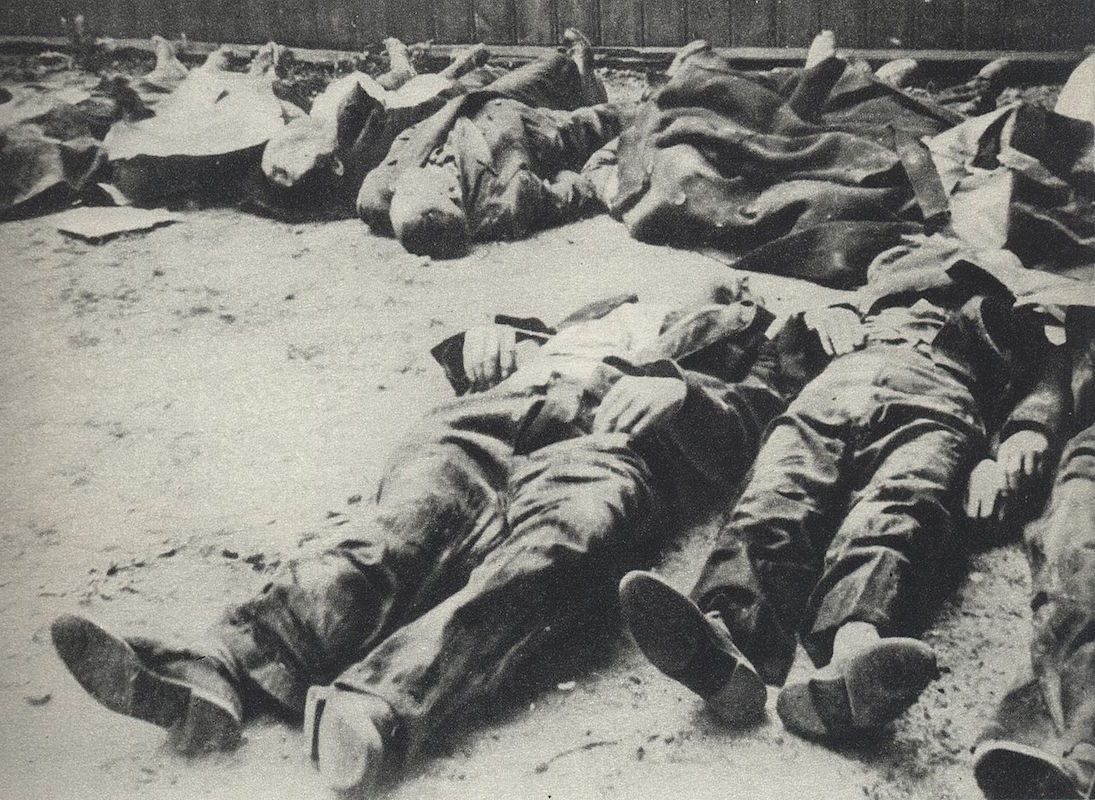
On this date in 1944, a weeklong German slaughter of Polish civilians and resistance fighters began in the Wola district of the capital city Warsaw.

The Wola Massacre marked the start of the Reich’s counterattack against the Warsaw Uprising, the heroic and suicidal rising mounted by the Polish Home Army as the Red Army’s summer offensive brought it to the banks of the Vistula.

Aiming to claim some foothold upon which to influence events in the soon-to-be Soviet-occupied Poland, the Home Army enjoyed initial success in the first days of August. But German reserves from the Replacement Army — the vehicle by which the Valkyrie plotters had attempted their coup against Hitler just days before, and now as a consequence answering directly to Heinrich Himmler — were quick to the scene and would turn back the rising in weeks of bloody urban warfare. Himmler’s authority in crushing the Warsaw Uprising would also allow him to give rein to his SS for a campaign of atrocities intended to cow the populace into speedy submission.

Himmler wasn’t a battlefield commander, of course. Chief on the scene would be Erich von dem Bach-Zelewski; for this purpose he would enlist some of the more notorious units on the eastern front, such as the lawless Sonderbataillon Dirlewanger and the “Russian National Liberation Army” of Bronislav Kaminski. They were just the types to implement Himmler’s brutal orders* for a city they were soon to lose anyway:

  1. Captured insurrectionists shall be killed whether or not they fight in accordance with the Hague Convention.
  2. The non-fighting part of the population, women, children, shall also be killed.
  3. The whole city shall be razed to the ground, i.e. its buildings, streets, facilities, and everything within its borders.

The outcome rates as perhaps the largest battlefield massacre of World War II.

On August 5, Bach-Zelewski’s forces began a coordinated push into the western suburb of Wola. Himmler’s orders were implemented immediately, as attested by numerous civilian witnesses and lucky survivors:

I lived in the Wola district at No. 8, Elekcyjna Street. At 10 a.m. on Aug. 5, 1944 a detachment of SS-men and Vlassov’s men entered. They drove us from the cellars and brought us near the Sowinski Park at Ulrychow. They shot at us when we passed. My wife was killed on the spot: our child was wounded and cried for his mother. Soon a Ukrainian approached and killed my two-year-old child like a dog; then he approached me together with some Germans and stood on my chest to see whether I was alive or not – I shammed dead, lest I should be killed too. One of the murderers took my watch; I heard him reloading his gun. I thought he would finish me off, but he went on further, thinking I was dead. I lay thus from 10 a.m. until 9 p.m. pretending to be dead, and witnessing further atrocities. During that time I saw further groups being driven out and shot near the place where I lay. The huge heap of corpses grew still bigger. Those who gave any sign of life were shot. I was buried under other corpses and nea rly suffocated. The executions lasted until 5 p.m. At 9 p.m. a group of Poles came to take the corpses away. I gave them a sign that I was alive. They helped me to get up and I regained sufficient strength to carry with them the body of my wife and child to the Sowinski Park, where they took all the dead. After this sad duty had been performed they took me to St. Laurence’s Church at Wola, where I remained till next day. I cannot state the exact number of the victims, but I estimate that those among whom I lay amounted to some 3,000 (three thousand). I met a friend in the church who had gone through the same experience as I, having lost a boy of 8, who had been wounded and died calling for his father. I am still in hospital and the image of death is constantly before my eyes.

And another:

On August 5, 1944, between 12 and 2 p.m., I saw from a window on the first floor of Wola Hospital Germans dragging women out of the cellars of No. 28, Plocka Street. They shot them in the courtyard with machine-guns. Almost at the same time, I saw in the courtyard of No. 30, Plocka Street the hands of more then 20 people raised and visible over the fence (the people themselves could not be seen). After a volley of shots these hands fell down: this was another of the executions in Wola.

And the agonizing testimony of Wanda Lurie:

I stayed in the cellar of No. 18 until August 5, when, between 11 and 12 noon, the Germans ordered all of us to get out, and marched us to Wolska Street. This march was carried out in dreadful haste and panic. My husband was absent, taking an active part in the Rising, and I was alone with my three children, aged 4, 6 and 12, and in the last month of pregnancy. I delayed my departure, hoping they would allow me to remain, and left the cellar at the very last moment. All the inhabitants of our house had already been escorted to the “Ursus” works in Wolska Street at the corner of Skierniewicka Street, and I too was ordered to go there. I went alone, accompanied only by my three children. It was difficult to pass, the road being full of wire, cable, remains of barricades, corpses, and rubble. Houses were burning on both sides of the street; I reached the “Ursus” work’s with great difficulty. Shots, cries, supplications and groans could be heard from the factory yard. We had no doubt that this was a place for mass executions.

The people who stood at the entrance were led, no, pushed in, not all at once but in groups of 20. A boy of twelve, seeing the bodies of his parents and of his little brother through the half-open entrance door, fell in a fit and began to shriek. The Germans and Vlassov‘s men beat him and pushed him back, while he was endeavouring to get inside. He called for his father and his mother. We all knew what awaited us here; there was no possibility of escape or of buying one’s life; there was a crowd of Germans, Ukrainians (Vlassov’s men), and cars. I came last and kept in the background, continuing to let the others pass, in the hope that they would not kill a pregnant woman, but I was driven in with the last lot. In the yard I saw heaps of corpses 3 feet high, in several places. The whole right and left side of the big yard (the first yard) was strewn with bodies. We were led through the second. There were about 20 people in our group, mostly children of 10 to 12. There were children without parents, and also a paralysed old woman whose son-in-law had been carrying her all the time on his back. At her side was her daughter with two children of 4 and 7. They were all killed. The old woman was literally killed on her son-in-law’s back, and he along with her. We were called out in groups of four and led to the end of the second yard to a pile of bodies. When the four reached this point, the Germans shot them through the backs of their heads with revolvers. The victims fell on the heap, and others came. Seeing what was to be their fate, some attempted to escape; they cried, begged, and prayed for mercy. I was in the last group of four. I begged the Vlassov’s men around me to save me and the children, and they asked if I had anything with which to buy my life. I had a large amount of gold with me and gave it them. They took it all and wanted to lead me away, but the German supervising the execution would not allow them to do so, and when I begged him to let me go he pushed me off, shouting “Quicker!” I fell when he pushed me. He also hit and pushed my elder boy, shouting “hurry up, you Polish bandit”. Thus I came to the place of execution, in the last group of four, with my three children. I held my two younger children by one hand, and my elder boy by the other. The children were crying and praying. The elder boy, seeing the mass of bodies, cried out: “they are going to kill us” and called for his father. The first shot hit him, the second me; the next two killed the two younger children. I fell on my right side. The shot was not fatal. The bullet penetrated the back of my head from the right side and went out through my cheek. I spat out several teeth; I felt the left side of my body growing numb, but I was still conscious and saw everything that was going on around me.

I witnessed other executions, lying there among the dead. More groups of men were led in. I heard cries, supplications, moaning, and shots. The bodies of these men fell on me. I was covered by four bodies. Then I again saw a group of women and children; thus it went on with group after group until late in the evening. It was already quite, quite dark when the executions stopped. In the intervals between the shootings the murderers walked on the corpses, kicked them, and turned them over, finishing off those who still gave any sign of life, and stealing valuables.

German soldiers too recorded wholesale executions in their diaries and correspondence; while the accounts above are all specifically attributable to the 5th of August, those that follow are undated snapshots of environment:

Policemen with rifles under their arms trudged along. All of the police from occupied Poland came together there to show off their bravery and also to enrich themselves on the side. I did not see this activity, but others did. They saw how these policemen executed those from the procession who could not keep up, those who were sick and lagging behind, and right in front of their compatriots. What was particularly troubling about this misery is that unlike in Russia what was occurring was not a matter of a completely poor, and in any event already moaning, mass of people; rather these were people of our own social class, women in fur coats, cute children who up until two days before had been fully cared for. This memory has always caused me anguish during my short stopovers in Warsaw: the look from so many hostile eyes, people of our culture, who knew exactly what I knew. For that reason I was always glad never to have been deployed in the West. And now I stood beside these people in bitter agony, and I was shocked.

Now we arrived at the command post of the SS-commander. There were two buses parked on the right side of the street. We reported to the SS-commander, a medium-built stringent man with a sharply chiseled face. With a cold glance at the procession of women and children that was passing no farther than 10 meters from us, he said, “You see, this is our biggest problem. These refugees! I don’t have enough ammunition to kill them all!” He said this quietly and with a remorseful shrug of the shoulders, this elegant officer with the Iron Cross and pleasant manners. Meanwhile tears fell down my cheeks. What kind of human being was he?

Hans Thieme

And another:

Before each daily operation I reported to the SS commander. During one visit I witnessed an event, which sickened me to my very core. The SS officer’s office was on the upper floor of a building and had a balcony that overlooked a large courtyard. The SS had lined up near a wall about 40 or so Polish men, women, and children of all ages. I distinctly recall a young woman holding hands with two small children. It was clear to me what was about to happen. I confronted the SS commander as to why these people were about to be shot. His reply was that they were being executed as a reprisal for the Germans that had been killed in the Uprising. He informed me that it was also none of my concern. Shortly, thereafter the hostages were shot before my eyes. I was disgusted by what I had witnessed and after 60 years later it still haunts me.

Eberhard Schmalz

And another:

I was setting explosives under big doors, somewhere in Old Town. From inside we heard Nicht schiessen! Nicht schiessen! (Don’t shoot! Don’t shoot!). The doors opened and a nurse appeared with a tiny white flag. We went inside with fixed bayonets. A huge hall with beds and mattresses on the floor. Wounded were everywhere. Besides Poles there were also wounded Germans. They begged the SS-men not to kill the Poles. A Polish officer, a doctor and 15 Polish Red Cross nurses surrendered the military hospital to us. The Dirlewangerers were following us. I hid one of the nurses behind the doors and managed to lock them. I heard after the war that she has survived. The SS-men killed all the wounded. They were breaking their heads with rifle butts. The wounded Germans were screaming and crying in despair. After that, the Dirlewangerers ran after the nurses; they were ripping clothes off them. We were driven out for guard duty. We heard women screaming. In the evening, on Adolph Hitler’s Square [now Pilsudzki Square] there was a roar as loud as during boxing fights. So I and my friend climbed the wall to see what was happening there. Soldiers of all units: Wehrmacht, SS, Kaminski’s Cossacks, boys from Hitlerjugend; whistles, exhortations. Dirlewanger stood with his men and laughed. The nurses from the hospital were rushed through the square, naked with hands on their heads. Blood ran down their legs. The doctor was dragged behind them with a noose on his neck. He wore a rag, red maybe from blood and a thorn crown on top of the head. All were lead to the gallows where a few bodies were hanging already. When they were hanging one of the nurses, Dirlewanger kicked the bricks she was standing on.

Mathias Schenk

A much larger catalogue of atrocity accounts awaits at warsawuprising.org.

The massacre at Wola would run on to about the 13th at which point Bach-Zelewski abated the civilian massacre order as counterproductive: too many soldier-hours needed for focused bloodbaths were being squandered orchestrating gratuitous ones. Nevertheless, weeks of hard urban warfare lay ahead, and policy continued to embrace the summary execution of captured fighters and of all fighting-age men, resistance or no. Some 200,000 civilians are thought to have died during the Warsaw Uprising.

One legacy was eerily and unknowingly captured by a LIFE magazine photographer in 1948, of a young girl in a school for disturbed children in Poland. Her face a scramble of innocence and madness as it peers into the lens, she illustrates her “home” as an incoherent chalk vortex. It wasn’t known until many years after this photo became emblematic of a generation wracked by horror, but “Tereska” — Teresa Adwentowska — was an orphaned survivor of Wola.

* Per Bach-Zelewski’s evidence to the Nuremberg tribunal. By dint of cooperation, he saved his own life from the Nuremberg gallows.

On this day..

1598: Lucas, waterboarded Guale

On this date in 1598, the indigenous Guale youth called Lucas was hanged by the Spaniards in St. Augustine, Florida, for his supposed part in the prior year’s massacre of five Franciscan missionary friars during a 1597 Guale revolt.

This entire tragic affair, documented poorly and with partiality in Spanish sources, remains an interpretive palimpsest to the few who are familiar with it. Historian J. Michael Francis grapples with it in Murder and Martyrdom in Spanish Florida: Don Juan and the Guale Uprising of 1597; a recent talk by the latter at the U.S. Library of Congress delves into the “400-year-old murder mystery”:

The key primary source for this event is Luis Jerónimo de Oré’s text The Martyrs of Florida, from approximately 1619. (Here’s a public domain English translation) The titular “Florida” as claimed by Spain in the New World colonization scramble was a much larger territory than the present-day U.S. state, peninsula, and running Internet gag; hence, the Guale territory relevant to this post lies on what is today the Georgia coast.

Ore informs us that “an Indian youth, who was a Christian and heir to the caciquedom,” was incensed when the Franciscan resident at the settlement of Tolomato presumed to disallow him a second wife.

This cacique and two other Indians, like him, given to the same immoral practice, went into the interior among the pagans, without saying anything or without obtaining permission as they were wont to do on other occasions. After a few days they returned at night with many other pagan Indians, painted and smeared with red paste, and with feathers on their heads. This among them is a sign of cruelty and slaughter.

Thus fearsomely attired, they burst upon the hut of the prudish Fray Pedro de Corpa and butchered him, setting up his head on a spear. Having done this, the angry cacique — who is known only as Juanillo, which is sometimes the name given to this rebellion — ordered other Guale to treat their nosy proselytizers likewise. As a result, four other Franciscans — Fray Miguel de Aunon and a lay brother on St. Catherine’s Island, Fray Bias Rodriguez at the mission village of Santa Clara de Tupiqui, and Fray Francisco de Verascola on Asao — were all murdered within days. A couple of other missionaries had very close escapes.


Map of the relevant part of the Georgia coast.

Besides these, a Fray Francisco de Avila was kidnapped and held hostage for ten months. Although cruelly tortured, Avila would survive captivity and produce a narrative of his own, one that Ore includes wholesale in his volume as a standalone chapter.

In the course of the ensuing Spanish raids on the Guale, the Spanish captured seven boys or young men and interrogation zeroed in on one of them: the son of the cacique of Tupiqui, who appeared as a possible participant in murdering Fray Bias Rodriguez.

Lucas was reticent on the point but after being subjected to the water torture he allowed that “he arrived in time to see Fray Bias die,” and this confession of his presence sufficed to condemn him. He was the only person judicially executed in the course of the entire revolt.

In view of said declarations of these proceedings, the crime falls upon Lucas the Indian, son of the Cacique de Tupiqui, for having been present and participated in the killing of Fray Bias, who was sent to convert the people of Tupiqui. I must condemn him by this my decree, sentenced according to his declaration, with the penalty of death. The justice which I order shall be done him is: That when he leaves the jail where he now is, it shall be with a rope around his neck, his hands tied behind him, and with a loud voice it must be proclaimed to the public his crime; that he be taken to the gallows, already prepared for this purpose, and that there he shall be hung by the neck and strangled until dead. Because, thus is it well to punish with real justice those who dare to commit such crimes, and as an example to the other Indian natives of these provinces that they may not commit similar crimes. So do I pronounce sentence and command.

And if the said Lucas is not mindful of receiving baptism and should not die repenting, and in the Catholic faith, I order that he be hung and after his death his body be burned to powder.

Gonzalo Menendez de Canco, Governor of Florida (Source)

Interpretations of the whole affair have always been driven by Ore’s narrative: either the surface reading of it, that Juanillo and company found monogamy irksome and preferred, in Ore’s words, “to give rein to their sensuality and unlawful pleasures”; or, a converse take for the era of decolonization, that the cultural interference of the Spanish empire triggered a native backlash for whom the friars were the ready-to-hand targets. In either version, the rebellion flourishes briefly but ultimately fails.

Francis in his book and the video above offers a very different reading: as a successful revolt authored by a different cacique, Don Domingo of Asao, who violently renegotiated the local balance of power** and thereby displaced the caciques of Tolomato as the paramount chiefs of the Guale. As a particularly gruesome coda, Domingo made successful obeisance to the Spanish and obtained the crown’s blessing for an expedition to destroy Juanillo, whom he blamed for the disturbance. After capturing the rebels’ last redoubt (beheading Juanillo in the process), Domingo ordered the surviving women to scalp their own men. Now that is paramount chiefdom.

Domingo appears to have maintained his preeminence among the Guale for the balance of his years — backed by and partnering with the Spanish, to the happiness of evangelizing clerics who were never more disturbed. A few years later, the Spanish even plopped down a new mission in his very own native soil … Santo Domingo de Asao.

* The Guale people are thought to have been subsumed into the Yamasee.

** View the Spanish arrivistes, who had a handful of small settlements rather than the dominating presence that their globe-straddling empire might suggest, as just “another powerful Mississippi chiefdom” to local eyes. (Source of this characterization)

On this day..

1946: Draza Mihailovic, Chetnik commander

I wanted much; I began much; but the gale of the world carried away me and my work.

-Draža Mihailovic, last statement to the court

On this date in 1946, Serbian Chetnik commander Draža Mihailovic was shot in Belgrade as a World War II traitor — a verdict that remains controversial to this day.

A colonel* in the Royal Yugoslav Army, Mihailovic escaped Germany’s initial invasion into the mountainous Balkan interior with a few dozen comrades who became the nucleus of a Serbian guerrilla movement.

These royalist Chetniks made a rivalrous opposite number to Josip Tito’s fellow guerrillas, the Communist partizans; it is easy enough to see from Mihailovic’s place in these very pages how matters settled in the end. From the first months of occupation in 1941, Chetniks and Partisans alike struck Axis occupation forces who had carved up Yugoslavia, even coordinating efforts in spite of their vast ideological chasm.

But politics didn’t stop at the border forever.

As the war progressed, the Chetniks gradually found terms with the occupiers, with Mihailovic at an October 1941 meeting dramatically rejecting Tito’s proposed common front. For the Chetniks, the leftist and polyglot Partisans who meant to rule the postwar Yugoslavia were the first enemy, “a motley collection of rascals,” in Mihailovic’s words — consisting of “Jews, Croats, Dalmatians, Bulgarians, Turks, Magyars, and all other nations of the world.”

Officially, tactical partnerships with the Germans and Italians were strictly opportunistic, not a buy-in on fascism — or they denoted a calculation (and Mihailovic’s limitless time-biding greatly aggravated the Allies while the fur was flying) to cautiously preserve his movement’s strength by avoiding engagement with an overwhelming enemy. In practice this policy drove the movement towards near-quisling status, with its major actions being undertaken against other resistance fighters on team partizan,** or to purge non-Serbs from this or that locale, even accepting German and especially Italian subsidies to do it.† Mihailovic’s enemies, he said in 1943, numbered “the Ustashi, the Partisans, the Croats and the Moslems” and “when he had dealt with these, he would turn to the Germans and the Italians.” Priorities are as priorities do.

For obvious reasons this behavior contrasts unfavorably with the Partisans’ militant “death to fascism, freedom to the people” line, and this latter movement’s ferocity in resistance saw it outstrip the Chetniks and seize the initiative for the postwar order. To a far greater extent than most other guerrillas of the bloodlands, the Partisans drove their own homelands’ liberation and left Tito master of a postwar Yugoslavia never occupied by the Red Army.

Mihailovic’s fall mirrored Tito’s rise. The Chetnik commander would be taken months after the war’s end, hiding out Saddam-like in a foxhole on the Bosnian marches. There could be no question of his fate.

Mihailovic and other Chetniks faced a predictably slanted trial for war crimes against Partisans and civilians, culminating in conviction on July 15, 1946 … two days before he faced the guns, with all of eight hours granted him to make his futile appeal. While it’s certain that the charges against him were maximized for the occasion, Mihailovic’s defense citing ignorance of and incapacity to control various units’ local atrocities is also not calculated to flatter a rebel general.


Mihailovic on trial.

Mihailovich was shot along with eight others:

  • Draghi Yovanovich, chief of the Belgrade police during the German occupation;
  • Milan Gushich and Radoslav Radich, Mihailovich aides;
  • Velibor Yonich, Tanasje Dinich, and Djure Dokich, ministers in the Serbian puppet government;
  • and, General Kosta Mushicki and a deputy named Paolovich.

In 2015, a Serbian court controversially reversed Mihailovic’s conviction.

* He’d be promoted to Brigadier General during the war years.

** World sport fanciers surely know that there is a literal team Partizan, founded as soon as World War II ended and one of the major clubs in Serbia ever since (in football, basketball, and 24 other sports). Here they are stealing the Adriatic League hoops championship from Cibona Zagreb on a full-court heave in 2010:

† This last-refuge-of-scoundrels legacy was unpleasantly recapitulated by some Serbian militias assuming the Chetnik brand during the ethnic wars attending Yugoslavia’s crackup in the 1990s. The term is basically a fighting word in certain quarters of the Balkans.

On this day..

2008: Two alleged prostitutes, by the Taliban

On this date in 2008, the Taliban executed two women whom it claimed were running a prostitution ring for U.S. soldiers based in the city of Ghazni.

The Taliban invited a journalist who gives us a disarmingly placid picture of the two burka-clad women seemingly conversing even as armed men surrounding them in the nighttime gloom prepare to take their lives.

On this day..

1906: Four Egyptians for the Denshawai Incident

If her [England’s] empire means ruling the world as Denshawai has been ruled in 1906 — and that, I am afraid, is what the Empire does mean to the main body of our aristocratic-military caste and to our Jingo plutocrats — then there can be no more sacred and urgent political duty on earth than the disruption, defeat, and suppression of the Empire, and, incidentally, the humanization of its supporters.

-George Bernard Shaw

On this date in 1906, four Egyptian villagers were hanged by the British after a UK soldier died in riot begun by a pigeon hunt.

The Denshawai Incident — which is still to this day commemorated by its own museum — as an isolated event was one of those little local indignities that comprise a foreign military occupation. By the intersection of highhandedness on the one side and accumulated anger on the other it would become what George Bernard Shaw dubbed “the Denshawai Horror.”

On June 13, a mere 15 days before the executions in this post, a gaggle of bored Tommies* set out hunting pigeons in the Nile Delta. This was for the locals an irksome pastime inasmuch as the villagers raised these tame birds in brick towers for agrarian use — as Shaw noted:

Try to imagine the feelings of an English village if a party of Chinese officers suddenly appeared and began shooting the ducks, the geese, the hens and the turkeys, and carried them off, asserting that they were wild birds, as everybody in China knew, and that the pretended indignation of the farmers was a cloak for the hatred of the Chinese, and perhaps for a plot to overthrow the religion of Confucius and establish the Church of England in its place!

On this occasion, protesting villagers dared a little more resistance than was usual and before long a gun had discharged in the struggle, injuring several and felling a local woman (she survived, though onlookers took her wound for a mortal one in the moment). As if by metaphor, somewhere in the mayhem, somebody’s wheat caught fire.

Having clumsily escalated the disturbance that their presence had provoked, the Brits at length had to flee a small riot: one of their number died in the flight, the cause never clearly ascertained but attributed by a doctor to “heat apoplexy caused or aggravated by concussion of the brain.”** Several others were collared by the villagers, who abused them but did not kill them.

As Shaw notes, in a domestic English context it might have been the gendarmes who were punished for mismanaging the situation to the detriment of the public peace.

But the English occupation of Egypt disdained the hearts-and-minds approach, preferring bile and spleen. Fifty-two(!) villagers came up on charges of murder(!!) for the heatstroked officer, and the punishments meted out by a British-controlled court† seemingly aimed to maximize rancor with the understanding that cruelty was the only language the native could comprehend.

The husband of the woman shot by the hunting party, Shaw fulminated in an incandescent essay against imperialism,

in consideration of the injury to his wife, was only sentenced to penalty servitude for life … No such sentimentality was shewn to Hassan Mahfouz. An Egyptian pigeon farmer who objects to British sport; threatens British officers and gentlemen when they shoot his pigeons; and actually hits those officers with a substantial stick, is clearly a ruffian to be made an example of.

Penal servitude was not enough for a man of 60 who looked 70, and might not have lived to suffer five years of it. So Hassan was hanged; but as a special mark of consideration for his family, he was hanged in full view of his own house, with his wives and children and grandchildren enjoying the spectacle from the roof. And lest this privilege should excite jealousy in other households, three other Denshavians were hanged with him … ages of the four hanged men respectively, 60, 50, 22 and 20.

Hanging, however, is the least sensational form of public execution: it lacks those elements of blood and torture for which the military and bureaucratic imagination lusts. So, as they had room for only one man on the gallows, and had to leave him hanging half an hour to make sure work and give his family plenty of time to watch him swinging (“slowly turning round and round on himself,” as the local papers described it), thus having two hours to kill as well as four men, they kept the entertainment going by flogging eight men with fifty lashes each: eleven more than the utmost permitted by the law of Moses in times which our Army of Occupation no doubt considers barbarous. But they Moses conceived his law as being what he called the law of God, and not simply an instrument for the gratification of his own cruelty and terror.

It is unspeakably reassuring to learn from the British official reports laid before parliament that “due dignity was observed in carrying out the executions,” that “all possible humanity was shewn in carrying them out,” and that “the arrangements were admirable, and reflect great credit on all concerned.” As this last testimonial apparently does not refer to the victims, they are evidently officially considered not to have been concerned in the proceedings at all. Finally, Lord Cromer certifies that the Englishman in charge of the proceedings is “a singularly humane man, and is very popular amongst the natives of Egypt by reason of the great sympathy he has always shewn for them.” It will be seen that Parliamentary Papers, Nos. 3 and 4., Egypt, 1906, are not lacking in unconscious humor. The official walrus pledges himself in every case for the kindliness of the official carpenter.


Edinburgh Evening News, June 29, 1906

Shaw’s determination to humanize the “natives” by analogy to English country squires unsurprisingly stands in stark contrast to the dominant thrust of domestic reportage — which consistently describes the affair as an unprovoked attack or (still better) an outrage. Shaw, however, was far from alone in his sentiment: many British elites were discomfited by the harsh and arbitrary treatment meted out in the imperial hinterlands. Another writer, Wilfrid Scawen Blunt, bemoaned the “abominable case” and took up an editorial pen in the Egyptians’ defense — albeit more in hope than expectation, for as he confided to his diary, “English feeling on these matters has become absolutely callous, and I believe if Cromer ordered a dozen of the villagers to be crucified or impaled, no serious objection would be made to it here.” And he was right to despair.

Still, gentlemen of a liberal conscience have the luxury down the decades of forgetting the individual atrocities of empire.‡

Few in the West recognized the allusion when, following 2005 bombings in London by Islamic terrorists, Ayman al-Zawahiri “announced that Britain was one of Islam’s worst enemies; it had been responsible for the deaths of thousands of Muslims across the ages, from Palestine to Afghanistan, Delhi to Denshawai.” (Source)

But it had by that time been long since that the chickens of Denshawai had come home to roost. In his autobiography, Egyptian nationalist president Anwar Sadat mused on the formative influence worked upon his childhood by the sacrifice of one of the Denshawai martyrs.

[T]he ballad which affected me most deeply was probably that of Zahran, the hero of Denshway. I recall my mother reciting it to me as I lay stretched out on top of our huge rustic oven, half-asleep while my younger brothers (and our rabbits) had all fallen asleep. It appealed to me afresh every time I listened to it. Denshway was only three miles away and the ballad dealt with a real incident … Zahran was the hero of the battle against the British and the first to be hanged. The ballad dwells on Zahran’s courage and doggedness in the battle, how he walked with his head held high to the scaffold, feeling proud that he had stood up to the aggressors and killed one of them.

I listened to that ballad night after night, half-awake, half-asleep, which perhaps made the story sink into my subconscious. My imagination roamed free. I often saw Zahran and lived his heroism in dream and reverie — I wished I were Zahran.

His wish would come as near to fruition as wishes do. Sadat had the honor of announcing to the world the Egyptian Revolution of 1952 that would expel the British occupation … and thirty years later, of also giving his life for Egypt.

* Not Dickens nor Kubrick could not have bested the names of shooting party participants Captain Bull (the eventual fatality) or Brevet-Major Pine-Coffin.

** That is, running away from a bombardment of stones. It appears to be permanently obscure (and subject to partisan slanting) precisely how these factors weighed together at the moment of Bull’s death. The diagnosis is quoted in the London Times, June 25, 1906.

† The tribunal featured mixed Egyptian and British personnel, notably including Boutros Ghali, future Egyptian Prime Minister and grandfather of the eventual United Nations head Boutros Boutros-Ghali.

‡ At least, of their own empire. According to Aliens — Uneingeburgerte: German and Austrian Writers in Exile, the Third Reich produced a German-language play about the Denshawai incident by adapting Shaw’s account.

On this day..