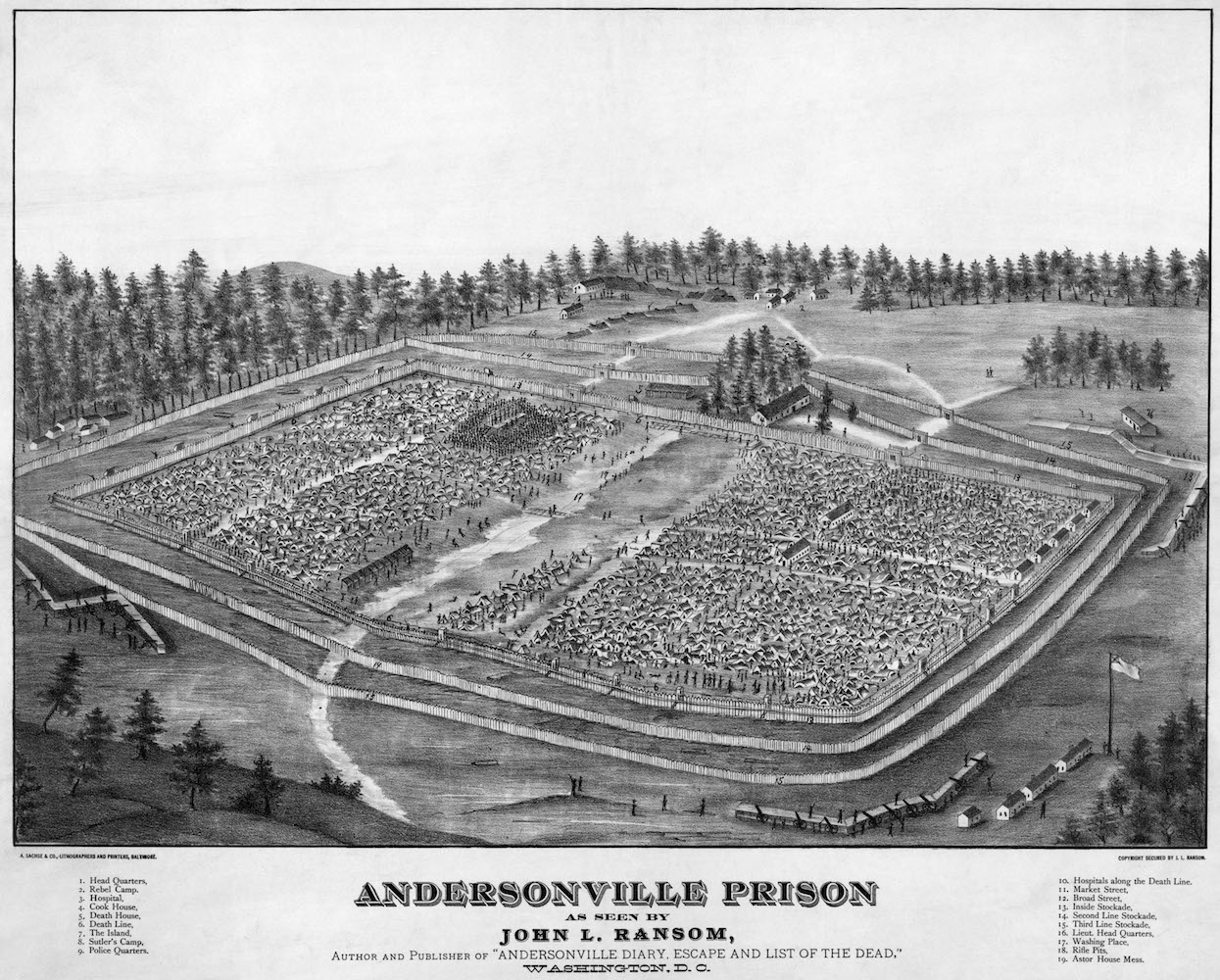
1864: The Andersonville Raiders

It’s not hard to understand why the Andersonville Raiders turned criminal. But on this day in 1864, the group was decapitated when six of its leaders were hanged in a quasi-legal action at the most inhospitable prisoner of war camp in the Confederacy.*

Andersonville Prison was opened in February 1864, 26.5 Georgian acres (about 0.1 square kilometers, or about the size of a square 4 city blocks on a side) of tightly-packed tents with a ditch of water flowing through its center. Its design population was 10-15,000 prisoners; its true population at one point was almost 30,000.** Some 45,000 Union soldiers went in, passing first the outer stockade, then the so-called “dead line” that demarcated the line outside of which they could be shot summarily, and finally into a mass of malnourished, often sickly humanity. Of these, 13,000 never emerged.

The Confederacy, you may recall, was not the war’s winner. As an aspiring nation, the CSA borrowed heavily to fund its arms, then found itself strapped for basic supplies as the war dragged on. By 1863 the nation was already economically depressed, and when a CSA-USA prisoner exchange agreement broke down, the Confederacy found itself with a lot of Union soldiers to house and nowhere to put them. Enter Andersonville: far enough from the North to be “safe”, easily defensible, and in the heart of slave labor to build it. All the Confederacy needed to build some basic housing was wood, which should be … oh wait … war update!…the Union controlled lumber supplies. Guess there won’t be housing.

Prisoners instead got lumped in with their brigade, and (at least initially) basic materials to make some sort of shelter.† New arrivals often showed up without being thoroughly checked over, so they might come in with food and supplies that weren’t already available to other internees.‡ Very quickly, the grounds were littered with Union POWs from around the country, people with vastly different backgrounds and goods. As the camp’s population breached 10,000 and then 20,000,§ there were, of course, inmates with designs on better living.

It’s not hard to see where this is going.

Sometime around May 1864, dozens of them assembled into a loose affiliation. The Raiders were headed by about a half dozen men: Charles Curtis, Patrick Delaney, John Sarsfield, William Collins (“Moseby”), a guy known only as “A. Munn”, and W.R. Rickson (or possibly Terry Sullivan; there’s an unusual disparity in diary accounts on the person’s name, but first-hand diary entries from the moment prefer Rickson) were considered the principal offenders. Each headed a small band of thieves who would trick new entrants, burgle tents, or use violence or threats of violence to amass “wealth” and keep themselves well-fed, well-clothed, and, most importantly to them in this hostile place, alive.

The Raiders had some huge advantages when they committed these crimes. Thanks to their amalgamated resources, they had good odds of being better armed and more fit than their victims — unless those victims were green, in which case they just knew the place better. The thieves started out as midnight raiders who turned tail at the first sign of genuine resistance unless they thought they could readily overpower the victim. By mid-June they were brazen, according to John Ransom: “Raiders … do as they please, kill, plunder and steal in broad day light, with no one to molest them.”

The victims were soldiers who, even if they weren’t killed, were left without resources in a deadly environment. Even the robberies and beatings were, in many cases, a prolonged form of murder, and Union inmates knew it. Indeed, Collins was thought by most to have never directly assaulted anyone, but he was known to steal blankets from the ill.

It’s unclear what the full Raider population was (estimates range from 100 to 500, but most people settle on the 100-200 range). What we can say definitively is that it was large enough to be a problem. Late in June of that year, a group called “the regulators” began taking police-like action against the perpetrators. Inmates brought their complaints to the group, which sought out and punished — usually through head shaving or other non-destructive means — those they found responsible.

On June 29, that problem started getting a real solution when the Raiders assaulted and robbed a prisoner now known only as Dowd. Dowd complained to the guards, and Andersonville’s overseer, Captain Henry Wirz, officially endorsed the Regulators as a police force/tribunal to maintain order. But first he announced an end to inmate rations until the Raiders were given up. (What a guy!)

The Regulators, headed by a man called “Lumber” (or maybe “Limber”) Jim, quickly had 80-100 inmates to deal with. Jury trials were implemented in the spirit of (but without most of the protections of) common law, and most punishments ranged from setting in the stocks to running the gauntlet.


Detail of a panorama sketch of Andersonville (click to see it) makes space for a certain well-attended sextuple hanging.

The ringleaders were also among this bunch. They were assembled on July 11 and executed at a hastily-erected gallows on the north end of camp. As far as the POWs were concerned, the ultimate crime of the Raiders was a violation of the soldier code of death before dishonor. Their bodies were buried separately from other inmates, and the US makes a point of placing no memorial flags at their graves.

To be clear, the Andersonville Raiders were, for most inmates, not the primary problem but an obviously controllable one. Remember that 30% of the interned died, and for the most part those deaths were borne of bad sanitation, hunger, and disease. The removal of the Raiders was a morale boost at best, as Andersonville was still a pee-pee soaked heckhole in which another 10,000 soldiers would die before liberation in May 1865, most of them before the summer’s end.

* It was also known as Camp Sumter, named after the county it resided in.

** The population density at peak was 330,000 people per square kilometer. For comparison, the world’s densest city is Manila, at about 71,000 people per square kilometer.

† It turns out the term “shebang” wasn’t widely-used camp lingo. Drawings and photos of the camp illustrate the variety of dwellings: open sleeping, simple V-tents, structured tents, lean-tos, huts, and shacks were all scattered about the grounds.

‡ They also came with new diseases.

§ The original camp was actually only 16.5 acres, and the population ballooned to 20,000 in early June and 33,000 in August of that year. Ransom notes that the stockade was “enlarged” on July 6. Fall transfers dropped the number to 1,500 and it bumped back up to 5,000 until war’s end. Sanitation issues persisted throughout.

On this day..

1828: William Rice but not John Montgomery, who cheated the hangman with prussic acid

(Thanks to Meaghan Good of the Charley Project for the guest post. -ed.)

Just before 6:00 a.m. on July 4, 1828, prison officers arrived at the cell of disgraced ensign John Burgh Montgomery in Newgate Prison‘s condemned hold.

They were there to escort Montgomery to his hanging. The 33­-year-­old would have been one of the last in England executed for for the crime of uttering forged notes — except that his wardens instead found him lying stone dead. With the aid of prussic acid, the counterfeiter had cheated the hangman of half his day’s prey, leaving his prospective gallows partner, thief William Rice, to face the hemp alone.

Although his guards had confiscated his razor and penknife as a routine precaution against suicide, no one had expected Montgomery to take his own life. He had pleaded guilty before the court and seemed resigned to his fate. In custody he was a model prisoner, spent his last days writing to his loved ones, and “addressed himself with great anxiety to his religious offices.”

Nobody was able to figure out how the condemned man came by enough poison to kill thirty people and how he kept it hidden, given that he and his cell were regularly searched.

The Irish-­born Montgomery, Nicola Sly records in her book Goodbye, Cruel World… A Compendium of Suicide,

was said to be a very respectable, well­-educated man, who had once held a commission in the Army. However, after inheriting a considerable fortune, he frittered it away and resorted to passing phony banknotes to support his rather dissipated lifestyle. Given his pleasing looks, gentlemanly appearance and good manners, he was very successful, since nobody thought him capable of any wrongdoing. However, he was caught after becoming careless and making the mistake of committing frequent repeated offense in a small geographical area of London.

Montgomery left behind several letters, marked by expansive tragic romanticism but no hint of suicidal intent. One letter was for the prison surgeon, asking that his body be used for dissection. He said that by this he wanted to provide some positive contribution to the public to make up for his crimes. He asked that his heart be preserved in spirits and given to his girlfriend.

To the girlfriend he wrote,

My dear idolized L.,

One more last farewell, one more last adieu to a being so much attached to the unhappy Montgomery. Oh, my dearest girl. If it had been in the power of anyone to avert my dreadful doom, your kind exertions would have been attended with such success. Oh, God, so poor Montgomery is to die on the scaffold. Oh, how dreadful have been my hours of reflection, whilst in this dreary cell.

Oh, how tottering were all my hopes; the bitterness of my reflection is bitter in the extreme. This will be forwarded to you by my kind friend Mrs. D. I should wish you to possess my writing portmanteau. Oh, I wished to have disappointed the horrid multitude who will be assembled to witness my ignominious exit. Farewell forever,

P.S. Here I kiss fervently.

The jury on the inquest into Montgomery’s death recorded a verdict of felo de se, meaning that Montgomery had willfully and knowingly taken his own life whilst of sound mind. As such, his body was buried in the graveyard of St. Sepulchre­-without-Newgate at night, and without any memorial service.

On this day..

1941: 3,500 Jews at the Khotyn Fortress … but not Adolph Sternschuss

(Thanks to Meaghan Good of the Charley Project for the guest post. -ed.)

On July 4, 1941, a thirteen-year-old Jewish boy named Ephraim Sternschuss began his diary in the Nazi-occupied Zloczow, Poland, with these lines:

Mother knows nothing about Father’s murder. I won’t be the one to tell. But I have to express what I’m feeling … I’ll write down all the details so when I’m old I’ll remember my youth and this World War, even though I’m not sure I’ll live through it.

I’m writing while lying on my back. I can’t move my legs. Mother says I’m in shock. Maybe I am. Maybe I’m so anxious because I can’t tell her about Father, who was drafted yesterday into forced labor and Mother still believes he’s alive.

The eastern Polish town of Zloczow had been annexed by the Soviet Union after the partition of Poland with the Molotov-Ribbentrop Pact in 1939. Zloczow‘s Jews, who at 14,000 people constituted about half of the population, lived in relative safety until the summer of 1941, when the Nazis invaded the Soviet Union.

They arrived in Zloczow on July 2. With the help of enthusiastic local Polish and Ukrainian collaborators, the SS rounded up 3,500 Jews, among them Adolph Sternschuss, Ephraim’s father. The victims were told they would be sent to forced labor — excavating mass graves of Soviet victims, digging anti-tank ditches, and such.

They were, in fact, digging their own graves.

Ephraim described his father’s departure thusly:

Father was taken at 10:00 a.m. An evening earlier Mrs. Reichard came by and told us that at a local Ukrainian meeting, it was decided to carry out an anti-Jewish pogrom the very next day. Unfortunately, Father didn’t believe her because she was such a gossip. Father was sitting in the kitchen when two Ukrainians came in, Warwara from our street and Bojko a tailor …

They told Father to get ready for work. Father changed into an old suit, emptied his pockets of everything except a penknife, a handkerchief and a Soviet ID. They said to give Father bread because “he would return only at two in the afternoon and he’d get hungry until then.” (My god, what hypocrisy!) Mother made two sandwiches with sausage. They also told him to bring a shovel and he kissed Mother and me and went away.

Adolph did not return at two o’clock, and at four that afternoon, Ephraim and his mother, Anna, heard the sound of distant gunfire coming from the Khotyn Fortress. A neighbor came by and told Ephraim there had been a mass shooting (the perpetrators were members of Einsatzgruppe C) and “all the men were killed.”


Khotyn Fortress. (cc) image from Andriy Baranskyy.

Ephraim assumed his father must be dead. He started his diary because he couldn’t bear to speak the dreadful fact aloud, but had to confide in somebody, if only an old school notebook.

What he didn’t know was that Adolph Sternschuss had, in fact, miraculously survived the shooting. The happy news was delivered to Ephraim’s family on July 5: Adolph was alive and hiding with friends of the family.

Around four o’clock the mother of Mrs. Kitai, Mother’s friend, came in and said that Father was alive and staying with them. Hurray! I went wild, jumping, laughing, everything. Mother gave her clean underwear for Father and asked her to tell him to stay there, not to come home, until the situation improved. Mother went out to tell Mrs. Reichard the news, and about an hour later the door opened and Father came in.

I’ll never forget the sight. His black suit was gray with dirt and dust, on his head he wore some wrinkled hat … He held the package of underwear Mother sent him and a small army shovel. When he entered I jumped out of bed and screamed “Mummy!” and ran to him. I kissed him although he was terribly stinking, like a corpse — and he started crying. It was the first time I saw Father cry.

Together with Mrs. Beer we pulled a sofa into the other room and hid the door behind a mirrored chest. We helped Father remove his clothes and then we saw what the Ukrainians were capable of. His whole back was beaten to a black pulp and swollen and he had a hideous bruise on his head.

We washed him and then he ate something and then we put him to bed and he fell asleep. He didn’t say a word.

Over the next few days, Adolph described his ordeal and his incredible survival to his only child, who wrote it all down in detail in his diary. Adolph’s story, as told to Ephraim, is worth quoting almost in full:

At noon I brought him a meal and he told me what he had gone through. I didn’t recognize his monotonous tone, but there, in the darkness of the basement, I sensed that he was reliving his ordeal. Well, in the beginning he worked near the Fortress, burying cadavers of horses.

Then he was transferred to the Fortress itself. At the entrance he was ordered to show his papers, but he lied, claiming he had none. “A man is only an addition to his identity card,” he said as if he were the father I knew.

They worked in two places: the inner court of the prison and the garden. They had to dig up mass graves of corpses killed by the NKVD — Ukrainians and Poles (and some Jews like Dr. Grosskopf and his son-in-law). The bodies were laid out in rows to be identified.

On that occasion, the Ukrainians beat the Jews, accusing them of committing these murders. Naturally, the Germans and the S.S. troops joined in, beating the Jews mercilessly. Father was followed by a short, white-haired butcher who hit him with a stout stick he had pulled out of the fence, and by a tall, blond S.S. soldier who used a coiled rope.

At noon two officers came up to Father and asked his profession. He answered, “Lawyer.” Probably they could tell from his accent that he had studied in Vienna,* but they asked him anyway. When he confirmed it, one of the Germans asked, “You aren’t Jewish, are you?” and Father said he was, and the German, furious, said, “Then I can’t do anything for you,” and the two of them stormed off.

Shortly after, the shooting began …

Around three o’clock they shot Father, but as he happened to already be in the ditch, all four bullets hit the pile of dirt, and Father fell down and pretended to be dead. An hour later it started raining and that’s what saved him: the Ukrainians and Germans were forced to stop shooting and shelter themselves under the roof.

At 9 p.m. sharp Kuba Schnapp and Freimann pulled Father out of the ditch and all three made their escape. Father practically had to be dragged away because both of them, and two corpses, were lying on his left leg. “After playing Indians,” said Father and it seemed to be that he smiled, they slipped through a hole in the fence and parted ways.

Father wanted to enter Winczura’s house but was refused. He then moved on to Barabasz and there, in the attic, were about thirty people. The next day he was forced to leave because of the terrible conditions. He moved over to a client of his, Mrs. Lewant, and stayed in the attic with the Kitai family. From there he returned home.

“One thing is etched in my memory forever,” he said. “I never imagined that Jews could die like that. They were like Romans. Proud, erect, silent. Thus they were killed.”

Seventy years later, one “old, toothless” witness, one of the fifteen remaining Jews still living in the area, recalled the massacre: “The earth shifted for days. They couldn’t bury them fast enough.”

Unfortunately, Adolph didn’t live long after he crawled out from under those corpses in the mass grave. He was not young, and his health was ruined by his horrific experience. Just a few days before Christmas, he died in his bed after a series of heart attacks.

On December 29 that year, Ephraim wrote mournfully,

Only those who have lost their fathers will understand me — and regrettably there are so many now. Dr. Hreczanik was right when he said to Mother, “your husband was killed at the Fortress.”

This first mass killing in Zloczow was followed by others. In late August 1942, the Germans rounded up 2,700 Jews and deported them to the Belzec Extermination Camp. In early November, a further 2,500 people were taken away.

A month later, a ghetto was established for between 7,500 and 9,000 people from Zloczow as well as the remnants of several nearby Jewish communities. Rather than go into the ghetto, Ephraim and his mother went into hiding, concealed outside the village of Jelechowice by sympathetic Ukrainian Catholic farmers: Grzegorz “Hryc” Tyz, his wife Maria “Misia” Koreniuk, and Helena Skrzeszewska.

The Sternschusses made the right choice: in April 1943 the Zloczow Ghetto was liquidated and all the survivors were shot and buried in mass graves.

Ephraim and Anna Sternschuss remained hidden on the rural farm for the rest of the war. When it was safe they just stayed inside the house; when there was danger they hid “downstairs” under the floor, “in a grave-like pit, narrow and long.” He kept writing in his diary:

We walk about the house without any inhibition, trusting Rex to faithfully do his duty. He barks differently at anyone so we can know in advance whether he’s a friend or a foe. In any case, whenever we hear him, Mother and I enter our room, shut the door and Misia, if the visitor is a stranger, sings “Chiming of Bells in the Dusk.” Then we sit quietly, almost without breathing, waiting for the visit to end. Nobody must know about our existence here.

The Sternschuss family’s hosts refused to accept any payment for their stay, but Ephraim and his mother did have to chip in to cover the cost of their food. Over time, others joined them: Ephraim’s aunt and uncle, Lipa and Linka Tennenbaum; the Tennenbaums’ daughters, Eda and Selma; the five members of the Parille family; and Edzia Weinstock and her daughter Eva.

Thus, the farm became a sanctuary for eleven Jews, plus the three hosts — all living on a small farm with a three-room farmhouse, a shed, an outhouse, and an uncertain grant of borrowed time. Ephraim occupied himself writing in his diary, drawing, and reading. Misia Koreniuk, one of his hosts, was a teacher, and she freely shared her “huge chest of books and magazines” with him. Ephraim even began teaching himself algebra and geometry.

It wasn’t all a nightmare. There was, for example, an amusing incident in February 1943 where they got the farm animals drunk on moonshine vodka:

It was a pity to have to throw it away, so Hryc scattered a bit in the yard for the chickens and the rest he put in the trough for the cow Krasula. The chickens pecked — and immediately lay down on the earth, absolutely foggy minded. But Krasula started going berserk, running around and climbing trees. It was terribly funny but also a bit dangerous. Hryc managed to overcome her with much difficulty and tied her up in the stable.

Through his hosts Ephraim kept up with the progress of the war and tracked the Allied advance in his diary, eagerly awaiting liberation. Yet it was hard to stay optimistic and he occasionally had thoughts of suicide. As he wrote in October 1943, he struggled to keep from succumbing to apathy and despair:

It’s all nonsense. […] Nobody knows us. We don’t have anybody in the whole wide world. Nobody. Only Mother and I. Therefore there’s no other option: one mustn’t give in to crises. We have to stay united. Today my heart is heavy. I’m writing almost in darkness but I must write. Too much crap weighs on my heart and I must pour all of it, at least in this diary.

Why is it called life? The best years of my youth have gone by and will not return. Never. Even if it all ends today, it won’t do any good … This is my life. And if I add the well known fact that everybody is born with a death verdict — what’s there to live for?

On November 6, 1943, a baby girl was born on the farm — the offspring of one of the members of the Parille family. Before the war, the mother had tried for years to get pregnant, going through “all possible treatments and nothing helped. And here, of all places, did she give birth.”

Ephraim wrote that their host, Hryc, started sobbing in despair when he found out:

So we aren’t only fourteen but fifteen with the baby! Not too bad … That’s to say very bad. Lipa is right saying that the baby can betray us all. We learned not to speak but to whisper, but a baby?! What’s to be done?

Within a few days the baby died. Perhaps it was just as well.

The situation became even more precarious in late January 1944, after a unit of retreating Germans showed up at the farm and the commander requisitioned a room in the farmhouse for himself and his Russian girlfriend.

Thus the farmhouse was divided: the German in one room, the three Ukrainian farmers in the next room, eight Jews in the 3×4 meter room down the hall, and three more hidden in the shed!

The German officer never found out about the hidden Jews, and as Ephraim noted, the man’s presence turned out to have a silver lining, because it protected everyone from the threat of looting, arson and murder at the hands of anti-Semitic Ukrainian partisans, who had become very active in the area.

Also, Helena Skrzeszewska was able to cajole the military kitchen into giving her their leftover soup, which she fed to the Jews. Ephraim noted wryly, “We live at the expense of Hitler.”

He was actually upset when the German officer left the farm two weeks later, writing,

Our citadel is no more. Again fearful nights will begin without the landlords who’ll go to the village for their sleep. We’ll remain on our own against the gangs, full of fear of the Ukrainian killers, of being set on fire … Again night watches every two hours, with a pistol and six bullets.

Sure enough, in early March, while Ephraim’s hosts were away from the farm, the Ukrainian partisans tried to set the place on fire. Ephraim was on watch that night:

I don’t know if I panicked. But now, while writing that, I think I wasn’t absolutely clear about what I was doing. Anyhow, after raising [the others in hiding], I opened the door and like an idiot went out into the lighted yard. Two sprints brought me to the well. I crouched behind its side and emptied my pistol of all its bullets, shooting into the darkness of the forest like a movie cowboy. The first time in my life.

In the meantime Lipa, Mother, Linka and Edzia came out with buckets. […] I don’t think it took us a long time to control the situation. The fools didn’t shoot at us from the forest despite the fact that we were in the light. I assume — and I’m not the only one thinking like that — that they were frightened of us being armed.

In the morning, when our landlords came back from the neighbors, they were surprised to learn that the house was still standing. […] Hryc went to the forest and found blood stains in the snow.

Later the month the Germans returned and searched the farm for signs of partisan activity, and actually encountered Ephraim’s aunt and mother inside the house:

Mother and Auntie locked us in and ran to the entrance door. They hardly made it when the door was busted open in spite of the big lock hanging outside. The Germans were astonished running into them. Despite Lipa’s warnings to Mother not to reveal her knowledge of German, she explained to them that they were locking themselves in the house in fear of the partisans.

“The partisans are all Juden,” said one of the Germans, and then asked where did Mother acquire such a German [language]. She told him she lived in Salzburg and came here to get married. “It’s all Love’s fault,” said the German, asked her to forgive him, went out and in a moment returned with a bomboniere.

In the meanwhile dawn was breaking and they discovered the Germans were S.S. troops. Mother says that if she wasn’t hit by a heart attack she would never have one. Immediately she told them they were being “evacuated” to the West. The Germans, perfect gentlemen that they were, proposed to help them, give them a truck. Auntie thanked them, said there was no need, everything was under control. Indeed.

Half an hour later our landlords returned back from the village. They looked really terrified when they saw Mother and Linka standing at the entrance to the house with two S.S. men. Mother introduced them, bid the Germans farewell and entered the hideout with Auntie.

The hideout happens to be east of the house, not west.

All the Jews spent three days in the underground hideout until the SS officers left. By then the front was very close, as Ephraim wrote on March 13:

In the nights, during shifts, we hear the “music” of artillery. The front keeps coming closer. Two days ago they were at Podhorce, 15 kms away! The windows were shaking to the blasts of cannon. But the Germans, damn it, pushed them back to a point 35 kms from us. There they stand and shoot. What bad fortune! Tarnopol has been liberated and we are not.

On March 26, Ephraim noted that it was the 1,000th day he had spent living under German occupation: “The 1,000 days we’ve spent in the Reich are like 1,000 years. With my whole heart I wish the Fuhrer and his admirers to have 1,000 such days …”

And he had months left to endure before he would see freedom.

On July 3, the second anniversary of the massacre at the Khotyn Fortress, Ephraim was using the outhouse when he saw a car stop and two Germans emerge with two men and a child. The Germans shot all three of them and left their bodies by the road. The victims, he found out later, were Jews who had been caught hiding nearby.

Liberation finally came to Jelechowice on July 16, 1944, as noted by a single sentence in red pencil in Ephraim’s diary: “THE BOLSHEVIKS HAVE ARRIVED!!!” He was sixteen years old, and had survived 1,111 days under the Germans.

On the third day after liberation, he recorded,

Mother, Auntie and I went to town. Zloczow made a terrible impression on us. Only bombed, burnt houses, torn wires on the road. A mass of troops on the way to Lvov. Our house is burnt. The neighbors — who couldn’t really understand how we managed to survive — said that the Germans had set the house on fire because it contained the archives of the Gestapo.

In the house, which was inhabited by the Gestapo unit, we found our dining room furniture in one of the rooms. It looked strange to me. That’s precisely what we need: a big table, or a buffet …

We haven’t met Jews.

Ephraim’s last diary entry was on July 29. He wrote of finally encountering some other survivors:

Maybe twenty people, perhaps thirty … All stood and cried. For sure I don’t have to write that picture down in the diary. I’ll remember it to the end of my life. All the Jews, the ten thousand Jews of Zloczow, were praying together in one small room. I heard the heart-rending sobbing, the wailing, the “Magnified and sanctified be His great name” prayer for the dead, and the “God, full of compassion” one, and I understood once and for all that they, we, address somebody who was absent when needed, and perhaps now wasn’t needed any longer, or maybe simply never existed. It was noontime and

The diary ends in mid-sentence.

Ephraim remained in Poland for over a decade after the war. He attended engineering school for two years, then switched his studies to theater. He moved to Israel in 1957. There he changed his family name from Sternschuss to Sten.

In Israel, Ephraim married, had children, and had a successful career as an author, actor, director and playwright for both stage and radio. But for decades he kept his diary hidden and did not speak of his Holocaust experiences to anyone.

Although he had a normal existence in his adopted country, he never recovered emotionally from the trauma of the war, describing it as “the load crushing my soul.”

He had thought, he said, once he left Poland, that he might finally “become a regular human being. But the world wouldn’t let me.”

In the 1990s, Ephraim returned to Zloczow, which is now part of Ukraine and called Zolochiv. Two of his Ukrainian rescuers had died, but Ephraim had a tearful reunion with Hryc Tyz, who told him, “You are my relatives. I didn’t believe I’d be lucky to yet see somebody from my family.”

His four-day trip inspired him to dig out his diary and translate it into Hebrew so that his children could read it. The diary was published in English in 2006, with annotations by an older Ephraim fifty years after the fact, under the title 1111 Days in My Life Plus Four.

Ephraim Sten died in 2004.

The Khotyn Fortress is a major tourist attraction in Ukraine and is considered one of the nation’s most stunning castles. In a nearby field, a “foul-smelling marsh” where “the grass is high and thick,” is a memorial for the 3,500 Jews (but not Ephraim’s dad) who were murdered there in July 1941.

* Zloczow answered to the sovereignty of the Austro-Hungarian Empire until 1918.

On this day..

1894: William Whaley, “the horror of the situation”

This ghastly description of a botched hanging comes courtesy of the out-of-print The palace of death, or, the Ohio Penitentiary Annex: A human-interest story of incarceration and execution of Ohio’s murderers, with a detailed review of the incidents connected with each case by H.M. Fogle (1908):


Chapter 19

William Whaley
June 22, 1894

A negro robber who beat out the brains of Allen Wilson, near Yellow Springs, Ohio, with a dray pin. Hanged June 22, 1894

A Brutal Robber Meets a Just Fate


William Whaley, serial number 25,257, was executed in the Ohio Penitentiary Annex twelve minutes after the birth of a new day, June 22, 1894, for the brutal murder of Allen Wilson, a thrifty and hard working colored man.

The crime was committed near Yellow Springs, Greene County, Ohio, on the night of June 6, 1893. Robbery was the motive for the crime, and a dray pin the instrument of destruction. He sneaked upon his victim in the dark, and literally beat his brains out.

Whaley was a young man not over twenty-five years of age, and with perhaps one exception, was the most profane man that was ever incarcerated in the Ohio Penitentiary Annex. He refused all spiritual consolation, and cursed his executioners almost with his dying breath. He was a cowardly cur, and betrayed his cowardice while on the scaffold. Three times he sank to his knees as the noose was being adjusted. The attending Guards were compelled each time to assist him to his feet, and finally to hold him up by main strength until the rattle of the lever shot his body through the open trap. Being almost in a total state of collapse, the body instead of plunging straight through the opening, pitched forward, striking the side of the door, thus breaking the force of the fall. For this reason the neck was not broken, and death was produced by the slow and harrowing process of strangulation.

Reader, if you have never seen a sight of this kind you cannot understand or comprehend the horror of the situation. Time after time the limbs were drawn up with a convulsive motion, and then straightened out with a jerk. The whole body quivered and shook like one might with the ague; while the most hideous and sickening sounds came from the throat. This continued for eighteen minutes; but to one looking on it seemed an age. After eighteen minutes the sounds ceased; the body became perfectly still; the limbs began to stiffen; the heart-beats to weaken. In just twenty-six minutes after the drop fell the last pulsation was felt, and the doctor solemnly said: “Warden, I pronounce the man dead.”

The outraged law had been avenged, and a soul unprepared had been ushered into Eternity.

On this day..

1944: Seisaku Nakamura, Hamamatsu Deaf Killer

(Thanks to Meaghan Good of the Charley Project for the guest post. -ed.)

On this date in 1944, nineteen-year-old serial killer Seisaku Nakamura was hanged for a series of horrific murders in wartime Japan. He killed at least nine people, perhaps as many as eleven, many of them while he was still a minor.

Nakamura, born deaf, was ostracized by both his family and society at large for his disability. Robert Keller, in his Asian Monsters: 28 Terrifying Serial Killers from Asia and the Far East,* notes:

It has been noted that many serial killers who suffer such ostracism retreat into a fantasy world, fueled most often by revenge fantasies. This was certainly the case with Seisaku Nakamura. He developed a near obsession with the Samurai culture and enjoyed watching movies where Samurai slaughtered their victims with lethal Katana swords.


The 47 Ronin (1941).

Yet on the surface all appeared normal. Seisaku was a bright boy who excelled at school. He was polite and deferential. He endured his condition without complaint. He’d grown, too, into a tall and strapping youth.

All was not normal, however.

According to Nakamura’s later confession, he committed his first two murders on August 22, 1938, when he was only fourteen. He tried to rape two women, he said, and murdered them after they resisted. This account has never been confirmed; perhaps he was boasting, or perhaps the murders did occur and the Japanese military government kept them out of the news.

Nearly three years passed before he committed another homicide: on August 18, 1941, Nakamura stabbed a woman to death and nearly killed another. Two days later, he stabbed and hacked another three victims to death. The police had a suspect description, but hushed up the information about the crimes for fear of causing a panic.

On September 27, Nakamura got into an argument with his brother at their parents’ home. The result was a bloodbath: he stabbed his brother in the chest, turned the knife on the rest of the family, stabbing and slashing his father, sister, niece and sister-in-law. Amazingly, only Nakamura’s brother died. Questioned by the police, the survivors refused to cooperate, saying they were afraid of retribution if they named their attacker.

Nearly a year passed with no bloodshed, but on August 30, 1942, Nakamura targeted another family. He saw a young woman on the street, followed her home, where her husband and three children were. Nakamura began his attack on the mother, and when her husband tried to defend her, he stabbed them both to death. He then slaughtered their two youngest children and turned his attention to the oldest, a girl. He started to rape her, then inexplicably broke off his assault and ran away, leaving her alive.

The survivor provided a good witness description to the police, who had their eye on Nakamura already; they had come to believe the reason his family wouldn’t say who attacked them the year before was because their attacker was one of their own.

The “Hamamatsu Deaf Killer” was arrested and quickly tried, found guilty, and sentenced to death in spite of his youth and the parade of witnesses ready to say he was insane.

Little is known about him and his crimes, as Japanese government suppressed most of the information.

* As we’ve previously noted, we cite the titles, we don’t write the titles.

On this day..

1883: Not Alferd (sic) Packer, #nerdprom attendee

The National Press Club is probably best known for its White House Correspondent’s Dinner. This site prefers to think of it as the site of the Alferd Packer plaque, a memorial to a cannibal who avoided hanging.


(cc) image from Kurt Riegel.

The plaque is rather unassuming, its simple polished brass declaring: “The Alferd Packer Memorial Grill — In Memory of Stan Weston 1931-1984.” Weston was the public affairs officer at the U.S. Department of Agriculture, who came up with a 1977 contest to name the USDA’s new cafeteria. But hold that thought for now.

Packer was born in Pennsylvania in 1842. He made his way west and joined the Union Army in Minnesota, then ambled on into the Rockies as a pioneer after the Civil War. In a particularly stunning feat of incompetence, he and five others separated from a larger expedition and tried to make it across a mountain pass in January 1874. Three months later, Packer arrived on the other side, declaring that he got separated from the other five.

But Packer had taken money and effects from them, which made the remaining members of his expedition more than a little suspicious. Caught out in a lie, Packer confessed to a carnivorous progress through his comrades: Israel Swan froze to death, and he was eaten; James Humphreys died a few days later, and he was eaten; then Frank Miller was likely murdered and eaten; and George “California” Noon fell to the pistol of Wilson Bell. With Bell armed and dangerous, Packer claims to have killed him and taken a bit of a snack for the road.*

Packer was arrested shortly after his return, but he slipped his bonds and escaped to Wyoming. There the law finally caught up to him. He was returned to Colorado, where a judge sentenced the cannibal to death.

The hanging was not to be. Packer appealed the conviction, which was ultimately overturned by the Colorado Supreme Court; on retrial he was remanded for a 40-year prison sentence instead. He was paroled in 1901, took a job as a guard at the Denver Post (who had, incidentally, helped him make parole), and died in 1907.

Back to the memorial grill.

Why would the USDA honor such an odd historical figure? Politics.

In 1977, newly appointed Secretary of Agriculture Bob Bergland had a beef with the General Service Administration, which refused to terminate the Nixon-era contract award for cafeteria services and food. Bergland’s response? Let the disgruntled employees name** and shame. The USDA cafeteria became the Packer Memorial Grill,† and Bergland paraded the press through the facility, taking every opportunity to point out just how similar he felt the food was to the diet of the honoree.

The contract was rescinded later in 1977. The plaque, meanwhile, was taken off the wall just a week after its installation. Initially, the GSA claimed it was not approved prior to installation, but it turns out the building manager, a GSA employee named Melvin Schick, simply found the name distasteful.

All of which begs the question of how it ended up gracing the National Press Club’s bar, emblazoned with Stan Weston’s name. The answer probably lies in Wesley McCune, founding member of the “Friends of Alferd Packer” and member of the National Press Club. Schick returned the plaque to Weston after the goings-on at the USDA cafeteria, and Weston hung it in his office. McCune’s group met most Aprils to hold an Alferd Packer dinner at the National Press Club. Stanley D Weston died in July of 1984, and while it’s unclear when the plaque went up, by 1989, this unusual object had a permanent home.

* A memorial was placed at Cannibal Plateau in the 1920s.

** The plaque was originally purchased by Bob Meyer and Stan Weston.

† And it wasn’t the first! The University of Colorado has had an Alferd Packer Restaurant & Grill since 1968.

On this day..

1968: Karol Kot, the Vampire of Krakow

(Thanks to Meaghan Good of the Charley Project for the guest post. -ed.)

On this date in 1968, Polish serial killer Karol Kot, called the Vampire of Kraków, was hanged in the city of Mysłowice. He was only twenty-one years old.

Kot was born in Kraków in 1946, the son of an engineer and a housewife. His abnormal, violent behavior began early. He was jealous of his baby sister, who was born when he was eight, and thought their parents loved her more. While their parents were away, he beat her and even tortured and killed her pets.

He was fascinated by death and hung around slaughterhouses in his free time, helping the employees there kill calves and drinking the animals’ blood.

Most of the sources about Karol Kot, such as this Warsaw Post article, and this article from Polish Newsweek, are in Polish. He was, however, the subject of an episode in the 2014 English-language documentary series Killers: Behind the Myth.

This Kraków Post article describes Kot’s origins. He did well enough in his studies at school, but his classmates knew him as a shy, withdrawn loner and a weirdo. Between that and his enormous knife collection, it’s no wonder there was a running joke at Kot’s school that he must be the Vampire of Kraków.

One of the few things he truly excelled at was shooting; he was the star of the local rifle club. At one point he was ranked tenth in the entire country in the youth division. Kot’s coach mentored him, invited him to his home and even told his own son, “Be like Karol.” Kot found this hilarious: he had been planning to murder the boy.

He committed his first knife attack in September 1964, at the age of seventeen, stabbing a 48-year-old woman repeatedly inside a church as she knelt to pray. She survived. In fact, she didn’t even realize she was hurt until she went home, removed her coat, saw that she was bleeding and went to the hospital.

Kot went after his second victim, a 73-year-old woman, a few days later. Kot saw her exit a tram, followed her home, and stabbed her in the back as she walked up her front steps. She survived, but remained paralyzed for the rest of her life.

Six days later he stabbed a third woman, 77 years old, again inside a church; this was his first fatality. When the nuns found her, with her dying breaths the victim whispered that her attacker had been a schoolboy.

All three of Kot’s first victims were older females. He committed no more stabbings for a year and a half, but became interested in poison instead. Kot laced open bottles of beer and soda with arsenic and left them lying around, hoping someone would drink from them, but no one was tempted. He tried giving a poisoned drink to a classmate, but his intended victim poured it out because it smelled funny.

In 1966, Kot gave up on the poisoning idea and returned to his old weapon, the knife. He changed his target demographic from elderly women to young children.

In February, he stabbed and killed an eleven-year-old boy named Leszek at Kościuszko Mound. It was a horrific attack, with far more wounds inflicted than were necessary to kill Leszek. In April, Kot attacked a little girl named Małgorzata as she was checking the mail outside her home. He stabbed her a total of eleven times in the chest, back and abdomen. She suffered from severe internal injuries, but survived.

After knifing Małgorzata, Kot went to the militia to get his gun permit renewed, then went home.

In Communist Poland, crime was rarely reported in the newspapers. In the case of Kot’s murders, however, the vexed police took the rare step of issuing press releases about his crimes, appealing to possible witnesses to come forward with information.

The citizens of Kraków were terrified. People began going out with boards and cast-iron pot lids stuffed under their clothes to protect themselves from the Vampire’s blade.

Kot was caught after he bragged about his crimes to fellow member of the rifle club. She didn’t believe him until she read in the newspaper about the attempted murder of Małgorzata. Then she went to the police.

He was arrested, but was permitted to take his final school-leaving examinations, in hopes of forestalling an anticipated insanity plea. Police used the fact that he passed his exams as evidence that he was rational and sane.

After being taken into custody, the baby-faced killer denied everything. But after his surviving victims all identified him as their attacker, he cheerfully confessed to everything. He said he committed the murders because it gave him a sense of pleasure, and he enjoyed drinking his victims’ blood as they lay dying. He even studied books of human anatomy to figure out where to place his knife.

The murders thrilled him and gave some spark to his “heavy, dull and colorless” life, he said. He felt no remorse at all.

Kot’s rifle coach was outraged at first when he heard that such a fine young athlete had been arrested. Surely this was a miscarriage of justice. After Kot confessed, however, his devastated coach wrote to him in prison, asking him to return his rifle medals because he was unworthy of them.

In his final interview, Kot said, “Soon, where I’m going, I’ll meet with my victims, and we can speak. Here on Earth, I have no one to talk to.”

Kot was sentenced to death, but his sentence was reduced to life imprisonment on appeal due to his youth. However, after the General Prosecutor intervened, the death sentence was reinstated and Kot was hanged.

On autopsy, a large tumor was found in his brain. It had gone undiagnosed in life. Whether this was the reason for Kot’s sadism is anyone’s guess.

On this day..

1827: Blue Jimmy

(Thanks to Florence Dugdale-Hardy, wife of gallows aficionado and literary titan Thomas Hardy, for the guest post on horse thief “Blue Jimmy”, whom Thomas Hardy also referenced by name in a poem. We dug up the piece here. -ed.)

Blue Jimmy: The Horse Stealer

(written by Florence Dugdale-Hardy with Thomas Hardy)

Blue Jimmy stole full many a steed
Ere his last fling he flung.

The name of “Blue Jimmy” — a passing allusion to whose career is quoted above from Mr Thomas Hardy’s ballad “A Trampwoman’s Tragedy” — is now nearly forgotten even in the West of England. Yet he and his daring exploits were on the tongues of old rustics in that district down to twenty or thirty years ago, and there are still men and women living who can recall their fathers’ reminiscences of him.

To revive the adventures of any notorious horse-thief may not at first sight seem edifying; but in the present case, if stories may be believed, the career of the delinquent discloses that curious feature we notice in the traditions of only some few of the craft — a mechanical persistence in a series of actions as if by no will or necessity of the actor, but as if under some external or internal compulsion against which reason and a foresight of sure disaster were powerless to argue.

Jimmy is said to have been, in one account of him, “worth thousands,” in another a “well-to-do” farmer, and in all a man who found or would have found no difficulty in making an honest income. Yet this could not hinder him from indulging year after year in his hazardous pursuit, or recreation, as it would seem to have been, till he had reft more than a hundred horses from their owners, and planted them profitably on innocent purchasers.

This was in full view of the fact that in those days the sentence for horse-stealing was, as readers will hardly need to be reminded, death without hope of mitigation. It is usually assumed that the merciless judicial sentence, however lacking in Christian loving-kindness towards the criminal, had at least the virtue always of being in the highest degree deterrent; yet at that date, when death was the penalty for many of what we should now consider minor crimes, their frequency was extraordinary. This particular offence figures almost continually in the calendar at each assize, and usually there were several instances at each town on a circuit. Jimmy must have known this well enough; but the imminent risk of his neck for a few pounds in each case did not deter him.

He stood nineteen times before my lord judge ere the final sentence came — no verdict being previously returned against him for the full offence through lack of sufficient evidence.

Of this long string of trials we may pass over the details till we reach the eighteenth — a ticklish one for Jimmy — in which he escaped, by a hair’s breadth only, the doom that overtook him on the nineteenth for good and all. What had happened was as follows: —

On a December day in 1822 a certain John Wheller, living near Chard, in Somerset, was standing at his door when Jimmy — whose real name was James Clace — blithely rode by on a valuable mare.

They “passed the time of day” to each other, and then, without much preface:

“A fine morning,” says Jimmy cheerfully.

“‘Tis so,” says Mr Wheller.

“We shall have a dry Christmas,” Jimmy continues.

“I think we shall so,” answers Wheller.

Jimmy pulled rein. “Now do you happen to want a good mare that I bought last week at Stratton Fair?” And he turned his eye on the flank of the animal.

“I don’t know that I do.”

“The fact is a friend of mine bought one for me at the same time without my knowledge and, as I don’t want two, I must get rid of this one at any sacrifice. You shall have her for fourteen pounds.”

Wheller shook his head, but negotiation proceeded. Another man, one named Wilkins, a nephew of Wheller, happening to pass just then, assured Wheller that he knew the seller well, and that he was a farmer worth thousands who lived at Tiverton. Eventually the mare was exchanged for a cart-horse of Wheller’s and three pounds in money.

Curiously enough Wheller did not suspect that anything was wrong till he found the next day that the animal was what he called “startish” — and, having begun to reflect upon the transaction, he went to his nephew Wilkins, who also lived at Chard, half a mile from Wheller, and asked him how he knew that the vendor of the mare was a farmer at Tiverton? The reply was vague and unsatisfying — in short the strange assurance of Wilkins, Wheller’s own nephew, was never explained — and Wheller wished he had had nothing to do with the “man worth thousands.” He went in search of him, and eventually found him at that ancient hostel “The Golden Heart” at Coombe St. Nicholas, placidly smoking a long clay pipe in the parlour over a tankard of ale.

“I have been looking for you,” said Mr Wheller with severe suddenness.

“To get another such bargain, no doubt,” says Jimmy with the bitter air of a man who has been a too generous fool in his dealings.

“Not at all. I suspect that you did not come honestly by that mare, and request to have back my money and cart-horse, when I’ll return her.”

“Good news for me!” says Jimmy, “for that I’m quite willing to do. Here, landlady! A pipe and ale for this gentleman. I’ve sent my man out to bring round my gig; and you can go back to my farm with me, and have your horse this very afternoon, on your promising to bring mine to-morrow. Whilst you are drinking I’ll see if my man is getting ready.”

Blue Jimmy went out at the back, and Wheller saw him go up the stable-yard, half-regretting that he had suspected such a cheerful and open man of business. He smoked and drank and waited, but his friend did not come back; and then it occurred to him to ask the landlady where her customer, the farmer, lived.

“What farmer?” said the landlady.

“He who has gone out to the stables — I forget his name — to get his horse put-to.”

“I don’t know that he’s a farmer. He’s got no horse in our stables — he’s quite a stranger here.”

“But he keeps the market here every week?”

“I never saw him before in my life. And I’ll trouble you to pay for your ale, and his likewise, as he didn’t.”

When Wheller reached the yard the “farmer” had vanished, and no trace of him was discoverable in the town.

This looked suspicious, yet after all it might have meant only that the man who sold him the mare did not wish to reopen the transaction. So Wheller went home to Chard, resolving to say nothing, but to dispose of the mare on the first opportunity. This he incontinently did to Mr Loveridge, a neighbour, at a somewhat low price, rubbed his hands, and devoutly hoped that no more would be heard of the matter. And nothing was for some while. We now take up the experience of Mr Loveridge with the animal. He had possessed her for some year or two when it was rumoured in Chard that a Mr Thomas Sheppard, of Stratton, in Cornwall, had been making inquiries about the mare.

Mr Loveridge felt uneasy, and spoke to Wheller, of whom he had bought her, who seemed innocence itself, and who certainly had not stolen her; and by and by another neighbour who had just heard of the matter came in with the information that handbills were in circulation in Cornwall when he was last there, offering a reward for a particular mare like Mr Loveridge’s, which disappeared at Stratton Fair.

Loveridge felt more and more uncomfortable, and began to be troubled by bad dreams. He grew more and more sure, although he had no actual proof, that the horse in his possession was the missing one, until, valuable to him as his property was for hauling and riding, his conscience compelled him to write a letter to the said Mr Sheppard, the owner of the lost animal. In a few days W. Yeo, an emissary of Mr Sheppard, appeared at Mr Loveridge’s door. “What is the lost mare like?” said Mr Loveridge cautiously.

“She has four black streaks down her right fore-foot, and her tail is stringed’ so” — here he described the shades, gave the particular manner in which the tail had been prepared for the fair, and, adding other descriptive details, was certain it was the same mare that had been brought to Chard. He had broken it in for Mr Sheppard, and never before had known a mare so peculiarly marked.

The end of the colloquy was that Mr Loveridge gave up the animal, and found himself the loser of the money he had paid for it. For being richer than his worthy neighbour Wheller who had sold it to him, he magnanimously made up their temporary quarrel on the declaration of Wheller that he did not know of the theft, and had honestly bought the horse. Together then they vowed vengeance against the thief, and with the assistance of Mr Sheppard he was ultimately found at Dorchester. He was committed for the crime, and proving to be no less a personage than the already notorious Blue Jimmy, tried at the Taunton Assizes on March 28, 1825, before Mr Justice Park.

During the trial all the crowd in court thought that this was to be the end of famous Blue Jimmy; but an odd feature in the evidence against him was that the prosecutor, Mr Sheppard, when cross-examined on the marks described by his assistant Yeo, declared that he could not swear positively to any of them.

The learned judge, in summing up, directed the jury to consider whether the identity of the mare had been so indubitably proved as to warrant them in pronouncing the prisoner guilty, and suggested that the marks described by the witness Yeo might be found upon many horses. “It was remarkable,” his Lordship observed, “that Wilkins, who was present when Wheller bought the horse, although the nephew of the latter, and living within half a mile of him, had not been brought into court to give evidence, though witnesses from so considerable a distance as Cornwall had been examined.”

In spite of this summing-up people in court were all expecting that Blue Jimmy would swing for his offences this time; yet the verdict was “Not Guilty,” and we may well imagine the expression of integrity on Blue Jimmy’s countenance as he walked out of the dock, although, as later discoveries proved, he had, as a matter of fact, stolen the mare.

But the final scene for Blue Jimmy was not long in maturing itself. Almost exactly two years later he stood at the bar in the same assize court at Taunton, indicted for a similar offence. This time the loser was one Mr Holcombe, of Fitzhead, and the interest in the trial was keener even than in the previous one.

Jimmy’s first question had been, “Who is the judge?” and the answer came that it was Mr Justice Park, who had tried him before.

“Then I’m a dead man!” said Jimmy, and closed his lips, and appeared to consider his defence no longer.

It was also a mare on this occasion, a bay one, and the evidence was opened by the prosecutor, Mr Holcombe, who stated that the last time he saw his mare in the field from which he had lost her was on the 8th of the preceding October; on the 10th he missed her; he did not see her again till the 21st, when she was in a stall of Mr Oliver’s, at the King’s Arms, Dorchester.

Cross-examined by Mr Jeremy: The field from which the mare was stolen was adjoining the public road; he had never known the mare to escape; it was not possible for her to leave the field unless she was taken out.

Elizabeth Mills examined. Her husband kept the Crown and Anchor at Mosterton, Somerset; the prisoner came to her house about four o’clock on October 9. He had two horses with him. He asked for some person to put them in the stable; another man was in his company, and eventually the other man put them in the stable himself. The prisoner was riding the mare on his arrival; it was a bay one. Her husband returned about nine at night. (Cross-examined by Mr Jeremy.) Prisoner bargained with her husband for the horses; Pierce, the constable, was there while prisoner and her husband were talking; prisoner left next morning.

Robert Mills, husband of the last witness, examined. He reached home about nine o’clock on October 9. He went with Pierce the constable into the stable and saw a blood Mare; also a pony mare. Constable and witness took two bridles and a saddle belonging to the horses into the house, having a mistrust that the animals were not honestly acquired. Prisoner called for his horses next morning, and asked what he had to pay. Witness, who now began to recognise him, said: “Jimmy, I don’t think you came by these horses straight.” He replied, “I don’t know why you address me by the familiar name of Jimmy, since it is not mine. I chopped the mare at Alphington Fair for a black cart-horse.” Prisoner spoke of the pedigree of the mare, and asked twenty-five guineas for it, and twelve for the pony. Witness offered twelve for the mare. Prisoner refused, paid his reckoning and ordered his horses. While the saddle was being put on, witness cut two marks in the hair under the mane. Prisoner then left the house. The other man had gone away before witness returned the night before. The pony was left. Witness saw the mare afterwards, on the 22nd, in Mr Holcombe’s possession. He examined the mare and found the private marks he had made on her under the mane. He had never seen the prisoner between the time the latter put up at his house and when he saw him in Tiverton Prison.

(Cross-examined by Mr Jeremy.) The morning after prisoner brought the horses to his house he asked for some beer, though he was accustomed to wine, he remarked, and said that he was going to Bridport Fair to spend a score of bank-notes or so by way of killing time.

A witness named Gillard, as he was walking to church on the morning of the 8th (the morning before the robbery was committed) saw the prisoner in a lane three miles from Fitzhead, sitting on the ground between two camps of gipsies.

The prisoner said nothing in his defence, merely shaking his head with a grim smile. The verdict was Guilty.

“A Trampwoman’s Tragedy”
by Thomas Hardy
(Stanza X)

The taverns tell the gloomy tale,
The gloomy tale,
How that at Ivel-Chester jail
My love, my sweetheart swung;
Though stained till now by no misdeed
Save one horse ta’en in time of need;
(Blue Jimmy stole right many a steed
Ere his last fling he flung.)

His Lordship, in passing sentence of death, entreated the prisoner to make the best use of the short time he would have to live in this world. The prisoner had been two years since brought before him and in 1823 he had been convicted by his learned Brother Hullock for a similar offence. The full weight of the punishment awarded to his crime must now fall upon him, without the least hope of mitigation.

Such was horse-stealing in the ‘twenties of the last century, and such its punishment.

How Jimmy acquired his repute for blueness — whether the appellative was suggested to some luminous mind by his clothes, or by his complexion, or by his morals, has never been explained, and never will be now by any historian.

About a month later, in the same old County Chronicle, one finds a tepid and unemotional account of the end of him at Ilchester, Somerset, where then stood the county gaol — till lately remembered, though now removed — on the edge of a wide expanse of meadowland, spread at that season of the year with a carpet of butter-cups and daisies. The account appears under the laconic heading, “Execution, Wednesday, April 25, 1827: James Clace, better known by the name of Blue Jimmy, suffered the extreme sentence of the law upon the new drop at Ilchester … Clace appears to have been a very notorious character” (this is a cautious statement of the reporter’s, quite unlike the exuberant reporting of the present day: the culprit was notorious indubitably). “He is said to have confessed to having stolen an enormous number of horses, and he had been brought to the bar nineteen times for that class of offence…. In early life he lived as a postboy at Salisbury; afterwards he joined himself to some gipsies for the humour of the thing, and at length began those practices which brought him to an untimely end; aged 52.”

A tradition was till lately current as to his hanging. When on the gallows he stated blandly that he had followed the strict rule of never stealing horses from people who were more honest than himself, but only from skinflints, taskmasters, lawyers, and parsons. Otherwise he might have stolen a dozen where he had only stolen one.

The same newspaper paragraph briefly alludes to a young man who was hanged side by side with Blue Jimmy, upon the “new drop”: —

“William Hazlett — aged 25 — for having stolen some sheep and some lambs. The miserable man, after being condemned, seemed to imagine that his was a very hard case.”

The County Chronicle prints the last few words in italics, appearing to hold up its hands in horror at the ingratitude of the aforesaid William Hazlett. For was not he provided with a “new drop,” and had he not for his fellow voyager into futurity that renowned Wessex horse-thief, Blue Jimmy, who doubtless “flung his last fling” more boldly than many of his betters?

On this day..

1720: Antoine-Joseph de Horn, humanity from an executioner

(Thanks to Henry-Clement Sanson for the guest post. The former executioner — the last of his illustrious dynasty comprising six generations of bourreaux — was the grandson of that dread figure of the Paris Terror, Charles Henri Sanson. Henry-Clement’s Memoirs of the Sansons: From Private Notes and Documents (1688-1847) describes some famous or infamous executions from the family annals. “If it had for purpose to furnish food for the unhealthy curiosity of people who would seek emotions in a kind of written photograph of the scenes that take place on the scaffold, it should be received with loathsomeness,” our guest author disingenuously explains of his motivations after debts resulted in his dismissal from the family post. Rather, “I have been actuated in the course of my work by an abhorrence for the punishment denounced by so many eloquent voices, the punishment of which I have had the misfortune to be the living impersonation.” Although this document appears to draw from some manner of family records, it deserves a cautious reading as pertains the intimate conversations and beneficent motivations of his kinsmen. -ed.)

Count Antoine-Joseph De Horn was the scion of a princely race; and he was connected with the highest nobility of Europe. At the time when speculation, under Law‘s auspices, was raging in Paris, and the temptation of gain was leading astray many persons of position and family, Count de Horn was living in the capital the life of a young lord of fashion and fortune. The sensation which was produced may easily be imagined when it was heard that he had been arrested and put under lock and key under the twofold charge of having murdered, in company with a Piedmontese, called the Chevalier de Milhe, and a third unknown person, a Jew who speculated in the shares of the Royal Bank, in order to rob him of a pocket-book which contained a sum of 100,000 livres.

The murder was perpetrated in a tavern of the Rue Quincampoix, where, it was alleged, Count de Horn and his accomplices had made an appointment with the Jew, under pretence of purchasing the shares he had in his pocket, but in reality to steal them from him.

The greatest agitation prevailed at Court in consequence of this affair, owing to the illustrious rank or the accused, and of his connection with the loftiest aristocracy of the land. De Horn’s trial was pursued with unprecedented rapidity, and it seems as if the numerous steps taken to save the young man’s life only hurried his fate. When his parents heard of his incarceration, they lost no time in moving heaven and earth on his behalf. On the eve of the trial, a large number of his kinsmen assembled in the Palais de Justice, and waited for the members of the court, to bow to them as they passed, by way of commending the accused to their indulgence. This imposing manifestation, undertaken by the first seigneurs of France, produced no effect: the court of La Tournelle sentenced Count de Horn and the Chevalier de Milhe to be broken on the wheel, and left there until death should follow.

This sentence filled the young man’s friends and parents with terror and surprise. They sent to the Regent a petition in which it was represented that Count de Horn’s father was mad, that his kinsman Prince Ferdinand de Ligne was in a similar condition, that lunacy was a common ailing in his family, and that the young man must have committed the crime when of unsound mind. Among those who signed the petition were Prince Claude de Ligne, Marquis d’Harcourt, the Earl of Egmont, the Duke de la Tremouille, the Duke de la Force, the Archbishop of Cambray, Prince de Soubise, the Princess de Gonzague, and many others of the same rank. All the facts adduced in this petition were certainly authentic. The great race of the Princes de Horn and Overisque had given many examples of mental aberration. All the subscribers of the petition went in a body to the Palais Royal; but the Regent only consented to receive a deputation. He was inflexible with regard to a reprieve; and it was with much difficulty that he consented to a commutation of the sentence into decapitation. He could only be moved by being reminded that he was himself related to the culprit through his mother the Princess Palatine. How he kept his promise will be seen hereafter.

This obstinacy on the part of the Regent was much commented upon. Personal animosity was said to be the cause. M. de Horn, being young, handsome, and captivating, had been something of a lady-killer. Now, morality was not the distinguishing feature of Philip d’Orleans’ court, and it was said that several beauties in fashion had regarded the foreign young lord with more than ordinary favour. Mdme. de Parabere‘s name was particularly mentioned; and it was related that the Regent had once surprised M. de Horn in conversation with the beautiful marchioness. In his fury the prince showed him the door, saying, ‘Sortez’ —to which the Count made the proud and appropriate answer: ‘Monseigneur, nos ancetres auraient dit, sortons.’ To this adventure, whether real or invented, was attributed the Regent’s hatred for Count de Horn, whose life he had sworn to sacrifice. It is not my business to discuss this question. What was most certain was that Law, the minister of finance, and Dubois, the prime minister, showed themselves the bitterest foes of Count de Horn. The influence of the shares of the Royal Bank and of the Mississippi was diminishing; and they were in hopes that this might be mended by a display of unparalleled severity for the punishment of a murder committed with the object of taking possession of some of these shares.

Shortly afterwards, Charles Sanson received a visit from the Marquis de Creqy, the nobleman who had been the instigator and leader of all the attempts made to save the unfortunate youth. He seemed convinced that the Regent would keep his word, and showed him a letter in which the Duke de Saint-Simon expressed his conviction that Count de Horn would be decapitated. The Marquis added that his royal highness had also promised that the execution should take place in the court of the Conciergerie, to spare the culprit the shame of being led through the crowd. The only thing was to spare the unhappy young man as many sufferings as possible. M. de Creqy expressed a wish to see the sword which was to be used for his execution; he turned pale when my ancestor produced the broad double-edged blade, sharp and flashing, which could hardly be styled a weapon. On one side was engraved the word Justitia; on the other a wheel, emblem of torture. It was the sword with which the Chevalier de Rohan had been decapitated.

M. de Creqy could hardly refrain from weeping when he begged Charles Sanson to be as lenient as possible in the execution of his fearful mission, to uncover only the neck of the victim, and to wait until he received the priest’s absolution before giving him the fatal blow.

The conversation then turned to the measures to be taken for the remittance of the body, which M. de Creqy claimed in the name of the family. He requested my ancestor to procure a padded coffin wherein to place the remains of De Horn, which were then to be taken away in a carriage sent expressly for the purpose. Charles Sanson promised to see to the accomplishment of these lugubrious details.

When he left, M. de Creqy, wishing to reward my ancestor for the services he asked, presented him with 100 louis, and insisted on his accepting the gift. But Charles Sanson firmly refused. M. de Creqy appeared moved, and retired. I may be forgiven for dwelling with some complacency on this trait of disinterestedness on the part of one of those who preceded me in the office I held for many years; it may be considered as an answer to the charge of cupidity which has been launched at a profession which did not appear sufficiently soiled by blood.

Only a few hours had elapsed since the visit of the Marquis de Creqy, when Charles Sanson received the order to take, on the next morning at six o’clock, from the Conciergerie, Count Antoine de Horn; to convey him to the Place de Greve, after passing through the torture-chamber, and carry out the sentence of Parliament in its cruel tenour. My ancestor’s expectation was justified; the Regent did not keep his word; Law and Dubois had won the day against the Duke de Saint-Simon and the nobility.

To my ancestor’s extreme surprise, the sentence did not even contain the secret restriction of a retentum, which spared horrible sufferings to the accused, by ordering the executioner to strangle him before breaking his limbs. How could he now keep the promise he had made to the Marquis de Creqy? Charles Sanson passed the night in anything but pleasant reflections.

It was broad daylight when my ancestor arrived at the Conciergerie with his sinister cortege. He immediately entered the prison, and was conducted to a lower room in which were the Count de Horn and M. de Milhe, who-had just been tortured. Both were horribly mangled, for they had supported the boot to the eighth spike. The Count was extremely pale. He cast a haggard look around him, and kept speaking to his companion, who seemed much more resigned and listened with religious attention to the priest who was consoling him. As to M. de Horn, instead of being plunged in the state of prostration which usually followed the abominable sufferings he had just borne, he gesticulated with feverish animation and pronounced incoherent words which almost seemed to justify what had been alleged in his defence concerning the unsoundness of his mind. He violently repulsed the priest, who was dividing his attention between the two sufferers, and repeatedly asked for Monsignor Francois de Lorraine, Bishop of Bayeux, from whom he had received the communion the day before.

The fatal moment came. The culprits were carried to the executioner’s cart. Charles Sanson sat down next to the Count, while the priest continued speaking to the Piedmontese. Seeing the unhappy young man’s extreme agitation, my ancestor thought he might quiet him by giving him some hope, even were that hope to remain unrealised.

‘My lord,’ he said, ‘there is perhaps some hope. Your relations are powerful.’

The prisoner violently interrupted him. ‘They have abandoned me,’ he exclaimed; ‘the Bishop — where is the Bishop? He promised to return.’

‘Who knows?’ my ancestor ventured to say; ‘reprieve may yet come.’

The young man’s lips turned up contemptuously. ‘If they wanted to spare my life, they would not have crippled me in this fashion,’ he replied, bitterly, casting a look at his lacerated legs and feet.

Charles Sanson says in his notes that he really hoped and expected that some attempt would be made to save De Horn. But nothing occurred. The Pont-au-Change was passed, and in another minute the cortege reached the Place de Greve. The Count looked at Sanson reproachfully as if upbraiding him for what he had said; but he was now quite collected and the fear of death had left him.

At length the cart stopped at the foot of the scaffold. The culprits, owing to the torture they had undergone, could not move unaided. Charles Sanson therefore took Count de Horn in his arms and carried him up the steps. At the same time he whispered in his ear the advice that he should ask permission to make revelations, as a means of gaining time; but the unfortunate young man had again lost his self-possession and gave vent to incoherent exclamations. ‘I knew they would not allow the Bishop to come,’ he said; … ‘they have arrested him because he had shares also. But I shall sell my life dearly; only give me arms! … they cannot refuse to give me arms!’ … While he was thus expressing himself, Charles Sanson stepped back, motioning to his assistants to begin their work which consisted in tying him to the plank on which he was to be broken. When this was done, the priest, who had just left the Piedmontese, approached De Horn: ‘My son,’ he said, ‘renounce the sentiments of anger and revenge which trouble your last moments. Only think of God: He is the sovereign author of all justice, if you appear before Him with a contrite and humbled heart.’

The Count at length seemed moved, and he joined in the priest’s prayer. As to my ancestor, he remembered M. de Creqy’s request as to priestly absolution, and in this respect his conscience was firm; but he had also promised not to make the young man suffer. In an instant he decided on the course he should adopt. Simulating sudden illness, he passed his iron bar to Nicolas Gros, his oldest assistant, took the thin rope used for the secret executions of the retentum, passed it round the Count’s neck, and before Gros had raised the heavy bar wherewith he was about to break the culprit’s limbs, he pulled the rope, and thus spared him the most atrocious sufferings ever devised by human cruelty.

On the other hand, the Chevalier de Milhe, who was being broken, uttered wild shrieks. In vain did the priest wipe the perspiration from his brow, and pour a few drops of water into his mouth. Charles Sanson was struck with the inequality of the sufferings of the two men, and told Gros to give him the coup de grace — the blow which broke the chest.

Gros obeyed, but not without casting an uneasy look at the commissaire, who was viewing the execution from the balcony of the Hotel-de-ville. No doubt the latter cared little for executions of this kind, of which, perhaps, he had seen but too many, for he perceived nothing. At this moment the priest, surprised not to hear the cries of Count de Horn, returned to exhort him to repentance: he saw that death had forestalled him. The rope was still hanging from the young man’s neck, and my ancestor hastened to conceal it while the ecclesiastic was standing between the Hotel-de-ville and himself; then, placing a finger on his lips, he solicited the priest’s discretion.

Both passed the remainder of the day beside the mangled remains. Shortly after the execution, a carriage drawn by six horses, preceded by a mounted servant, and followed by six servants in gorgeous livery, entered the Place de Greve. It was the Duke de Croy d’Havre, whose arms could be descried on the panels of his carriage through the black crape which covered it. He was soon followed by three other carriages, which stopped on the north sideof the square. They were all in deep mourning, as also the harness of the horses and the liveries of the servants. The blinds were closed, as much to avoid public curiosity as to conceal the cruel sight of the scaffold. But it was whispered in the crowd that the last comers were the Prince de Ligne, the Duke de Rohan, and a Crouiy, the last scion of the illustrious race of Arpad, which traced its origin to Attila, and put forth more legitimate rights to the crown of Hungary than the house of Hapsburg.

My ancestor was surprised not to see the Marquis de Creqy. But his astonishment was short-lived, for a rumour at the other end of the Place announced the arrival of two other carriages, in an apparel still more pompous. They drove up to the other carriages and took up a position in the same line. The Marquis de Creqy stepped out, and advanced on to the square clad in the uniform of a colonel-general and general inspector of the King’s armies, and wearing the insignias of the Golden Fleece, the grand crosses of Saint-Louis and Saint-Jean of Jerusalem. His countenance bore the traces of profound grief. He traversed the Greve with a firm step; the crowd stepped back respectfully before this great personage, who was one of Louis XIV’s godsons.

As soon as the commissaire saw M. de Creqy, he retired from the balcony of the Hotel-de-ville, as if only waiting for this final protest to bring the scene to a conclusion. This meant that justice was satisfied. The Marquis walked straight up to my ancestor with a severe face, and looking at him almost threateningly:

‘Well, sir,’ said he, in a stern voice, ‘what of your promise?’

‘Monseigneur,’ answered Charles Sanson, ‘at eight o’clock this morning M. le Comte de Horn was dead, and the bar of my assistant struck a dead body.’

The priest confirmed my ancestor’s words.

‘Well,’ said M. de Creqy, in a milder tone, ‘our house shall remember that if it could obtain nothing from the clemency of the Regent and from the justice of Parliament, it is at least indebted to the humanity of the executioner.’

The Count’s body was then untied and taken to one of the carriages. It was so mutilated that the limbs seemed ready to separate from the trunk. As a protest against the cruelty of the sentence, M. de Creqy insisted on holding one of the legs, which only adhered to the corpse by the skin. When this was done the carriages moved away in a file, and stopped before the house of the Countess de Montmorency-Lagny, nee De Horn, where the Count’s remains were placed in a bier and deposited in a chapel. It remained there for two days, surrounded by a numerous clergy who sang the mass of the dead. Meanwhile Prince Francois de Lorraine, Bishop of Bayeux, had returned to Paris. He expressed much grief at having been unable to attend his unfortunate kinsman to the scaffold, thinking that the execution was to take place at a later date. He nevertheless arrived in time to join his prayers to those of the clergy, and, in company with MM. de Creqy and de Plessis-Belliere, he escorted the body to the Castle of Baussigny, in the Netherlands, where the Prince de Horn, eldest brother of the defunct, and head of the family, usually resided.

This extraordinary affair greatly irritated the highest personages of the State against the Regent and his favourites: it proved of no assistance to Law, whose fall was unavoidable. On his return from his country-seat the Duke de Saint-Simon hastened to write to the Duke d’Havre to express his regret at what had occurred, and to say how he himself had been deceived by the false promises of the Duke d’Orleans.

I quote here the Duke d’Havre’s answer, because it not only expressed the sentiments of all the French nobility, but it corroborates what I have said concerning Charles Sanson’s conduct:

My dear Duke, — I accept with gratitude, and I understand quite well, the regret you are kind enough to express. I do not know whether the Marquis de Parabere or the Marquis de Creqy obtained of the executioner of Paris the charity which is attributed to him; but what I do know is that the death of Count de Horn is the result of a false policy, of the financial operations of the Government, and, perhaps, also of the policy of the Duke d’Orleans. You know my sentiments of consideration for you.

CROY D’HAVRE

Was Count de Horn really innocent? We have no right to judge the merits of those it was our mission to put to death. Nevertheless I have taken the liberty to allude to the rumours which were current at the time of De Horn’s arrest, and which made him out to be the victim of the Regent’s personal animosity. Another version tended to establish his innocence, or, at least, so to diminish his responsibility in the Jew’s murder, that, were the version correct, the sentence he suffered could only be regarded as a monstrous iniquity. It was said that M. de Horn and the Chevalier de Milhe had not made an appointment with the Jew with the intention of murdering and robbing him, but merely with the object of obtaining from him a large sum in shares of the Bank which the Count had really entrusted to him; that not only did the Jew deny the deposit, but that he went so far as to strike Antoine de Horn in the face. Upon this the young man, who was hot-blooded and passionate, seized a knife that lay on the table and wounded the Jew in the shoulder. It was De Milhe who finished him and took the pocket-book, of which the Count refused to have a share. If the affair occurred in this way, it must be acknowledged that the Regent, and the magistrates who served his hatred, had a heavy reckoning to answer for.

On this day..

1868: Charles Martin and Charles Morgan lynched in Cheyenne, Dakota Territory

(Thanks to Meaghan Good of the Charley Project for the guest post. -ed.)

On this date in 1868, Charles Martin and Charles Morgan were both lynched for unrelated crimes in the nine-month-old city of Cheyenne. Cheyenne was still part of the Dakota Territory at the time; later that year, it became part of the new Wyoming Territory, which was created from bits of the Dakota, Idaho and Utah territories.

Martin was originally from Missouri and, like many of the local residents, a new arrival, who had come to Cheyenne with the railroad in 1867. Historian R. Michael Wilson, in his book Crime & Punishment in Early Wyoming, detailed the start of his fall from grace:

He partnered with William A. James, who was known by everyone as Andy Harris, another member of the rowdy element. The two men bought and jointly managed a dance house and it was rumored their purchase was financed with stolen money, but there was never enough evidence to prosecute them. Eventually they had a falling-out and dissolved their partnership.

On the evening of February 13, 1868, Martin and James were at Thomas and Beauvais’s Hall on 16th Street, both up at the bar, and James came at him saying, “You are a dirty little bastard. I ought to kill you. You are no friend of mine; if I did you justice I’d shoot you now.”

He pointed a Derringer at Martin, who stuck his hand in his pocket and taunted, “Shoot, what do I care?”

James told Martin to get out or he would shoot him, and Martin started backing towards the door, with his erstwhile friend following him every step of the way. Five feet separated the men and when James reached the end of the bar, he started to lower his gun. At this point Martin pulled a five-shooter from his pocket.

James fired one shot from his Derringer and missed. Martin emptied his gun and hit every time, “the five wounds forming a neat line from James’s chin to his navel.” Mortally wounded, James collapsed and died late the following morning.

Martin was arrested. Justice was swift: the trial began on the 17th of February and concluded two days later. Four eyewitnesses to the shooting testified, as did the doctor who tended to James in his last hours. Martin argued self-defense. The jury acquitted him.

Even prior to James’s killing, Martin’s reputation, as noted in T. A. Larson’s book History of Wyoming: Second Edition Revised, was “appalling.” Wilson describes him as “a desperate character who womanized and drank liquor to excess.” His abandoned wife back in Missouri wrote to him, pleading in vain that he should give up his wild ways and return to her and their children. Consequently, Wilson says,

[t]he acquittal of Martin created a great deal of dissatisfaction within the community. Martin, had he used common sense, would have left until the indignation cooled but instead he became more insolent and defiant than ever and began making rounds of his usual haunts celebrating his liberty, and made threats of “furnishing another man for breakfast.”

It probably didn’t help that he had threatened to kill the distinguished attorney W. W. Corlett, who’d assisted with the prosecution.

On the evening of March 21, a masked mob of about fifteen vigilantes abducted Martin from the Keystone dance house where he’d been partying with “females of the lowest type.” Pistol-whipped into semi-consciousness, he was dragged to a crude tripod gallows on the east end of Cheyenne and strung up. His body was found the next morning, his feet brushing the ground, sporting horrific head injuries.

A coroner’s inquest convened that same afternoon and rendered the following verdict:

We, the undersigned, summoned as jurors to investigate the cause of Chas. Martin’s death, find that he came to his death by strangulation, he having been found hanging by his neck on a rude gallows, at the extreme end of 10th Street, in the suburbs of Cheyenne. Perpetrators unknown.

A few hours later, stock thief Charles J. Morgan was also hanged on the east side of Cheyenne.

Earlier that month, a large number of mules had gone missing from the prairie surrounding Cheyenne, including a four-mule team owned by W.G. Smith. Smith and others, determined to recover the stolen animals, seized a man named “Wild Horse” Smith and threatened to lynch him if he didn’t reveal what he knew of their whereabouts. They put a rope around his neck and three times yanked him into the air, but he maintained his silence. When he was told that the fourth time would be his last, Smith cracked and told them where the hidden stock was.

As R. Michael Wilson explains, the searchers found fifteen stolen mules at the location “Wild Horse” specified, but W.G. Smith’s team was not among them.

Smith made further inquiries and learned that Charles J. Morgan had purchased the four-mule team and some other stock for about half their value. He and a man named Kelly were driving the stock south on the road to Denver and were then only a short distance out of town in the mountains. Smith formed a posse of vigilantes and overtook Kelly at Guy Hill. Kelly was arrested and the party started for Cheyenne. On the way back to they met Morgan, a known member of the gang of thieves, who claimed that he and Kelly had bought the mules and were going to Sweetwater. Morgan was also arrested and the two prisoners were taken into Cheyenne at an early hour on March 21st.

The jail in Cheyenne was little more than a tent over a wooden frame with a wooden door and a guard at the flap. So, with escape a certainty and the vigilantes ready for action they decided to settle the matter themselves.

At daybreak, Morgan’s body was found hanging at Elephant Corral on a tripod-shaped gallows very similar to the one where Martin met his end. His remains “had blue and swollen features, tongue and eyes protruding, fists clenched, with feet now brushing the ground.” There was a sign pinned to his back: This man was hung by the Vigilance committee for being one of a gang of horse-thieves.

The coroner’s jury returned the following verdict:

We the undersigned, summoned by the Coroner to inquire into the cause of death of Chas. or J. Morgan, find the evidence that his death was occasioned by strangulation, he having been found hanging by the neck on three poles in the rear of the Elephant Corral, in Cheyenne, D.T. Perpetrators unknown.

At first there was speculation that Kelly, too, had been lynched: shortly after his partner in crime was hanged, he was taken some distance away and shots were heard in the darkness. Searches were made for his body, but it turned out that Kelly had merely been banished from Cheyenne and the shots were fired to speed him on his way.

T. A. Larson notes that this disreputable pair were the first and nearly the last known to have been lynched in Cheyenne; the Cheyenne Vigilance Committee killed only one more man there, for failure to pay a debt he owed a saloon keeper. (They are also known to have lynched three men at Dale City thirty miles away.) “It seems fair to say,” he notes, “that the record of popular justice in Cheyenne was neither very extensive nor very creditable. But it may well be that vigilantes in Cheyenne and elsewhere had a positive deterrent value which is hard to measure.”

Martin and Morgan were buried out on the prairie. No one was ever charged in their deaths.

On this day..