1413: Francesco Baldovino, to enjoy the emoluments of office

From History of the Venetian Republic: Her Rise, Her Greatness, and Her Civilization:


Francesco Baldovino was a gentleman in affluent circumstances, of a handsome person, and of engaging manners. His domestic establishment was princely. He had a large sum in the Funds. In short, every adventitious advantage, which fortune brings, was within his reach, excepting one; Baldovino was not a noble.

It is said that, at the period of the War of Chioggia, he desired to become, among the rest, a candidate for the honours of the peerage. But, his paternal ancestor having been implicated in some manner in the Bocconio conspiracy of 1300, the family laboured under a certain obloquy, and Baldovino was a disappointed man.

Among his numerous acquaintance was one Bartolomeo D’Anselmo, also a cittadino of great wealth, and also an unsatisfied expectant of nobility. It happened on Friday, the 4th March, 1413, that Baldovino and D’Anselmo met at the Minorites, and began to discuss their common grievance. “We,” cried Baldovino, at once launching into diatribe, “pay taxes enough forsooth; yet those of the Council enjoy the emoluments of office.”

“True,” returned his companion, “and indeed we ought to make it our business to see if we cannot get for ourselves a share in the administration. Devise some plan in which I may co-operate.”

“The way would be,” whispered Baldovino, “to collect a company of our following, and to massacre them as they are leaving the Council, particularly the College, the Decemvirs, and the Avogadors.”

D’Anselmo said, “That is an excellent plan. How then do you purpose to find your men?”

“I intend,” the other continued, “to seek a good many trusty fellows, who will be at my elbow to compass this matter for us on Sunday that is coming.”

“I, too,” rejoined D’Anselmo, “will bring some.”

So they parted.

Bartolomeo D’Anselmo was not a bad man; but he was a man of no steady principle, and of an exceedingly nervous temperament. He had hardly bidden farewell to Baldovino, when the treasonable dialogue which had passed between them began to haunt his imagination. He found himself a prey to a variety of unwholesome and chimerical fancies. The echoes of his own words grated on his ears. The sound of his own voice threw him into a cold sweat.

He conceived it more than possible that they might have been overheard, and that they were betrayed. He pictured himself arrested, dragged before the Ten and into the chamber of torture, put to the question, condemned to an infamous and horrid punishment. If there had been eavesdroppers, he was pretty sure that this would be his destiny; and he knew that there was only one method of escaping from the danger.

He was base enough to pursue that method; D’Anselmo turned evidence, on the same day, against his friend.

The informer was pardoned and ennobled.

The man, whom with such vile and pitiful cowardice he had denounced, was taken into custody, examined under the cord, and on Saturday morning the 5th, at eight o’clock, was executed between the Red Columns, where he was left hanging three days, as a warning to traitors.

On this day..

1780: The slave Violet, her head stuck on a pole

This date in 1780 — a month to the day since she had allegedly torched the home of her master, Sampson Sawyers* — a slave woman named Violet was hanged at Staunton.

The above named Violet was led to the barr and upon examination denied the fact wherewith she stands charged whereupon Rebecca Sawyers James Sawyers John Crow and Nan a negroe girl were sworn and examined as witnesses touching the fact as also the examination of the said Violet was taken and subscribed before James Trimble Gent. on consideration of which and of the circumstances relating to the Crime the Court are of opinion that she is guilty, and do accordingly order that she be hanged by the neck until she be dead for the said fact on the fourth day of March next at or near the town of Stanton at twelve o’clock at Noon and after she is cut down that her head be severed from her body by the neck and stuck upon a pole in the public place near Staunton and the Court do adjudge the value of the said slave to one thousand eight hundred pounds which is ordered to be certified

Slave insurrection was, of course, a deadly serious matter in the Old Dominion even in these pre-Nat Turner days. You could lose a whole city to a well-placed incendiary, which made it a particularly — shall we say — high-leverage form of resistance for the disarmed chattel. Women comprised 30% (pdf) of the convicted slave arsonists in colonial Virginia.

According to Philip J. Schwarz, every slave known to have been convicted of arson from 1740 to 1785 drew a death sentence.

The laws only tightened in the 19th century; Virginia went on to mandate death for arson in 1819 — which for slaves included burning not only buildings, but grain. (Source)

As to the grisly public monument made of Violet’s head, an Annals of Augusta County, Virginia remarks that the “custom seems to have been general in Virginia, at this, or an earlier period. The ghastly memorials thus set up were doubtless to inspire a wholesome dread in the minds of the negro slaves. They impressed themselves in many instances as local topographical designations. Witness: negro-foot precinct, in Hanover county, and Negro-head, Negro-foot and Negro-quarter, in Amelia county.”

* Sampson Sawyers was (apparently) the father of Col. John Sawyers, an American Revolution officer about whom more here. The reader will be relieved to learn that despite the loss of the naughty Violet, Col. Sawyers “was one of the extensive slave owners in Knox County in its earlier history. He was able at the marriage of his sons to give each of them several slaves, so that at the emancipation of the slaves in 1863 the Sawyers’ slaves were quite numerous, and right here I wish to pay a tribute to these slaves. Being reared in the Sawyers family, who were Scotch-Irish Presbyterians, they were a better class of slaves than was generally to be found in that day.”

That’s Knox County not in Virginia but in Tennessee, where Sampson Sawyers was a signatory (pdf) of the Cumberland Compact.

On this day..

2006: Ali Afrawi and Mehdi Nawaseri

Among the numerous ethnicities subject to rough treatment in Iran are Ahwazi Arabs, a minority concentrated in oil-rich Khuzestan, right on the border with southern Iraq. It was one of the bloodiest theaters of the Iran-Iraq War in the 1980’s.

17-year-old Ali Afrawi

On this date in 2006, two young Ahwazi Arabs were publicly hanged in Ahvaz (Ahwaz) for their alleged participation in a separatist bombing campaign there in 2005-2006.

Heady days for the dirty war unleashed by America’s Iraq invasion. Iranian officials slated the “treacherous and criminal Britain” (occupying the adjacent region of Iraq) for backing the Ahvaz bombings. Confessions to that effect extracted from today’s two principals were broadcast the evening before their execution.

Afrawi and Nawaseri, meanwhile, were only the tip of the iceberg for a spree of evidently political trials against Ahwazis that year.

The wider Ahwazi population continues to face a troubling human rights situation (pdf), seemingly subject to ethnic cleansing meant to scotch any potential for Ahwazi nationalist sentiment and keep oil wealth in the hands of Tehran.

On this day..

2000: Hassan bin Awad al-Zubair, Sudanese sorcerer

On this date in 2000, Hassan bin Awad al-Zubair was publicly beheaded in the Saudi capital of Riyadh for sorcery.

In other news, Saudi Arabia executes people for sorcery.

And not just in the bad old days of the 20th century; a Lebanese television personality who had the impiety to proffer predictions on his call-in show has been facing execution after being collared by the upright citizens’ brigade while on the umrah pilgrimage. (He appears to have escaped beheading; the case made worldwide headlines in 2009-2010.)

Hassan bin Awad al-Zubair, a Sudanese national, was not fortunate enough to have a television audience and months of publicity. Amnesty International thinks that neither he nor his family was even aware that he was death-sentenced until that sentence was actually executed.

The Saudi Interior Ministry statement on this surprise beheading explained that he had asserted the power to heal the sick and “separate married couples.” (Maybe he should have been a television personality after all.)

On this day..

1601: St. Anne Line

On this date in history, Anne Line was hanged for harboring Catholic priests in Elizabethan England.

There’s not too much question of her “guilt.”

I am sentenced to die for harbouring a Catholic priest, and so far I am from repenting for having so done, that I wish, with all my soul, that where I have entertained one, I could have entertained a thousand.

-Anne Line at the scaffold

She’d been disinherited from her Calvinist family for converting to Catholicism, and scratched out a living teaching and embroidering and keeping safe houses for forbidden Catholic clergy.

That house was raided in early February of 1601, and while the priest escaped, Anne Line did not.

Just one day after conviction, she hanged at Tyburn along with two priests, Roger Filcock and Mark Barkworth.

Anne Line was canonized in 1970; she’s one of the Forty Martyrs of England and Wales.

One of the possible interpretations (.doc) of Shakespeare’s recondite allegorical poem “The Phoenix and the Turtle” is that it’s about Anne (the phoenix) and her husband Roger Line (the turtledove; he predeceased her).

Death is now the phoenix’ nest;
And the turtle’s loyal breast
To eternity doth rest,

Leaving no posterity:–
‘Twas not their infirmity,
It was married chastity.

Truth may seem, but cannot be:
Beauty brag, but ’tis not she;
Truth and beauty buried be.

To this urn let those repair
That are either true or fair;
For these dead birds sigh a prayer.

On this day..

1716: Four Jacobite rebels at Liverpool

We doubt this entry can stack up to the one preceding for melodrama, but not every rebel on the gallows can be a peer of the realm or a guardian of the chalice of Christ. Big names get the big headlines, but other folk make up their smaller fame by their greater volume.

From the interesting Lancashire Memorials of the Rebellion, we learn of the unhappy fate of several dozen Jacobite rebels in a chapter titled, “The Prisoners Tried at Liverpool, and Their Sentences.”

At the beginning of January 1716, the Government sent down a commission of Oyer and Terminer, to try the prisoners who had been distributed in the various prisons of Lancaster, Chester, and Liverpool. As Liverpool had the reputation of being in the Whig interest [i.e., the Hanoverian, anti-Jacobite party], having sent to Parliament two Members of this party, it was conceived expedient, that the trials of so many rebels, which, under the most favourable circumstances, could not fail to have caused much factious excitement and sensation, should take place in a town, more devoted to the Whig cause than any other in Lancashire.

The judges appointed for the trial were Mr. Baron Burry, Mr. Justice Eyre, and Mr. Baron Montague, who, on the 4th of January, set out, with all their attendants, from London. For the sake of making an impression upon the country, they travelled leisurely through all the towns upon the route, so as to occupy seven days on the journey. On the 11th of the same month, they arrived at Liverpool.

Upon the day following, January 12th, the judges opened their commission; the Grand Jury were summoned, and the court sat. There had been Commissioners previously appointed to take precognitions of such as were made witnesses in reference to the fact of rebellion at Preston; which, having been laid before the Grand Jury, bills of indictment were found against 48 of the prisoners.

Copies of the Indictments were then given to the persons against whom the bills were found, and the court was adjourned for eight days, in order to afford the prisoners legal time to prepare their defense …

n the 20th of January the Court again sat, between which date and that of the 9th of February following, it is said that 74 persons were tried.

Thirty-four of these wretches drew death sentences, which were meted out in a sort of traveling road show in the realm’s northern reaches to make sure everybody got the message.

That show’s closing performance was on this date.

Liverpool, Feb. 25th. — The circuit of the Hangmen here ended.On this day suffered Mr. Burnett of Carlops, a most active gentleman in the Rebellion, along with Alexander Drummond, and two Northumberland gentlemen, viz., George Collingwood and John Hunter.

In the High Sheriff’s account is the following item: “Feb. 25. Charge of executing Bennet” [Burnet] “and three more at Leverpoole, £10, 3s.”

On this day..

1629: John Dean, boy arsonist

(Thanks to Meaghan Good of the Charley Project for the guest post. -ed.)

On or about this day in 1629, one John Dean, described in court documents as “an infant between eight and nine years,” was hanged in Abingdon, England for setting fire to two barns in the nearby town of Windsor.

According to Historia placitorum corone: The history of the pleas of the crown, Volume 1 by William Axton Stokes and Edward Ingersoll, this juvenile felon was indicted, arraigned and found guilty all on the same day, February 23, “and was hanged accordingly.” The actual date of his execution is not known, but it can’t have been long afterward. The wheels of British justice ground very quickly in those days, though not so fine.

The age of criminal responsibility in England at the time was seven years old. (It was later raised to eight, and in 1963 to ten, where it remains; there have been calls to raise it again.) Accordingly, anyone seven years or older could be charged with a crime and face the same penalties as someone seventeen or forty-seven — including the death sentence.

This does not mean that vast numbers of children were executed, however; quite the contrary. As Capital Punishment U.K. notes, “Death sentences were certainly routinely passed on 7 -13 year olds but equally routinely commuted. Girls were only typically hanged for the most serious crimes whereas teenage boys were executed for a wide range of felonies.”

The same source notes that little John Dean was probably the youngest child ever executed in England.

For reasons lost to history, he was not given the usual commutation: although there is no mention that anyone was hurt or killed in the fires, the judge found that John had “malice, revenge, craft and cunning,” and refused to recommend a reprieve. Perhaps the boy had a prior criminal record.

Thus did John Dean secure a footnote in history; were it not for his death no one would remember him today. Somehow, I doubt he would have thought it was worth it.

On this day..

1570: Hegumen Kornily of the Pskov-Pechery Monastery

Though the primary sources are shaky, at least one chronicle avers that it was on this date in 1570 that the Russian tsar Ivan the Terrible had Hegumen Kornily [Cornelius] of the Pskov-Pechery Monastery put to death.

An icon of the sainted Cornelius marks the spot of his martyrdom at his Pskovo-Pechery monastery. From (cc) image by Usama.

This was the coda to Ivan’s bloody sack of Novgorod, part of the violent state consolidation carried out in Ivan’s terrible police state.

Having left Novgorod prostrate, Ivan marched westwards towards the edge of Livonia (what is now the Russian-Estonian frontier) to put Pskov in its place.

If Ivan’s depredations here were less extensive than in Novgorod — and they were less extensive — it might be due in no small measure to this date’s victim.

Over a period of four decades, Kornily had overseen the golden age of his priory — agglomerating lands, riches, and brethren. He had also charted a somewhat independent, contra-Moscow political course, and apparently harbored anti-Ivan refugee Andrei Kurbsky.*

[Ivan] came [to Pskov] in great wrath, roaring like a lion, for he wished to torture innocent people and to spill much blood. But the Lord God, all-bountiful and all-merciful lover of mankind … took pity on the human race … when the Grand Duke came before Pskov, he halted near the town and rested at the monastery of St Nicholas. And … when the Grand Duke heard all the bells ringing, his heart was softened and he came to himself, and ordered all his soldiers to blunt their swords with stones and forbade them to commit murder in the town … he was met by the Abbot of the Pechery monastery, Kornily, with all the clergy … and they went into the cathedral church of the Holy Trinity and heard mass.**


Ivan the Terrible begs Kornily for admission to the monastery, by Klavdy Lebedev. (Detail view; click for the full canvas.)

This all sounds friendly enough.

What we may have in the passage foregoing is a conflation of legends about the monk, who is unambiguously attested a martyr to Ivan at the gates of the monastery even as he’s credited with sparing the city as a whole from the tsar’s full fury. (This particular execution — or murder — date is cited in this popular history of Ivan; “February” sometime is generally agreed.)

So maybe it was one of the tyrant’s famous piques of rage — or maybe Kornily didn’t really charm him into altering his plans at all.

Although the particulars are half-obscured in legend, one can still visit at this gorgeous monastery the “Path of Blood”: the route from the gates to the cathedral along which the remorseful tsar allegedly carried his victim’s body. Ivan also made several gifts to the monastery.†

Kornily himself is still venerated on these sacred grounds, thanks not only to his holy martyrdom but to his worldly machinations. A decade after the abbott laid down his life, the walls he had raised around the monastery proved fortification enough to repel the Polish king Stephen Bathory‡ — helping cement Kornily’s reputation as the celestial defender of Pskov.

* See the title of the next footnote? Vassian Muromtsev was a protege of Kornily’s in the Pskov-Pechery monastery; Kurbsky actually had a running correspondence with Muromtsev.

Muromtsev “was put to death together with [Kornily],” reports Kurbsky, although his authority for this claim is doubtful. “They say that they were both crushed together on the same day by some kind of instrument of torture; and their holy martyred corpses were buried together.”

** Quoted in Nikolai Andreyev, “Kurbsky’s Letters to Vas’yan Muromtsev,” The Slavonic and East European Review, June 1955.

† Andreyev, “The Pskov-Pechery Monastery in the 16th Century,” The Slavonic and East European Review, June 1954.

‡ We’ve met Stephen Bathory’s infamous niece in these pages.

On this day..

1790: Thomas de Mahy, Marquis de Favras

On this date in 1790, Thomas de Mahy, Marquis de Favras, became a penal milestone: the first French noble executed without class distinction from commoners.

At least he made history.

The scion of an ancient and penurious noble line, Favras was trying to make a different kind of history: he’d hitched onto a plot of the future Louis XVIII to reverse the still-infant French Revolution and rescue the king and queen from captivity in the Tuileries.

The royal couple were ultimately destined to escape this palatial dungeon only to the guillotine.

But in Mahy’s day, it was possible to dream of counterrevolution. And that terrifying machine of the revolution hadn’t even been invented.

For that matter, the machinery of revolutionary justice had also not been born; this was Lafayette‘s year, the revolution in its moderate phase.

It was ancien regime jurists of the Chatelet who were here appointed to judge the enemies of the nation. Having just acquitted the guy who commanded monarchist forces in Paris on Bastille Day, these establishment magistrates proceeded to throw the revolutionary left a bone by condemning Favras to the democratic capital expiration of … hanging. (Back in the good old days, he would have had the right to a beheading. Plus ça change.)

The crowd was said to be quite enthusiastic.


“Thomas de Mahy, Marquis of Favras Making Honourable Amends before Notre-Dame,” engraving by Pierre-Gabriel Berthault (French link).

Little less interested in Favras’s elimination — he was executed the day after sentence — were his fellow conspirators and other sympathetic members of the royalist party. (Future-Louis XVIII hurriedly washed his hands of the scheme.) These were quite pleased to suppress any wider exploration of

the project that this lost child of royalist enthusiasm had formed in the interest of the royal family. Among those participating in this project, but with a cowardice that is well known, were persons that an important consideration prevented from naming at the time.*

You’ve got to look forward, not back.

Despite the mob scene surrounding him as he carried his damning information to the grave, Favras had the sang-froid to remark upon being handed a copy of the order for his execution, “I see that you have made three spelling mistakes.”

“It can be said,” wrote Camille Desmoulins, “that all the aristocrats have been hung through him.”

And since they did such a metaphorically comprehensive job through this single unfortunate, it’s no wonder that Favras was the only aristocrat executed for counterrevolutionary activity during the entire first three years of the Revolution.*

* Barry Shapiro, “Revolutionary Justice in 1789-1790: The ComitĂ© des Recherches, the Châtelet, and the Fayettist Coalition,” French Historical Studies, Spring 1992.

On this day..

1688: Philip Standsfield

Oh Gentlemen, see, see dead Henrys wounds,
Open their congeal’d mouthes, and bleed afresh.
Blush, blush, thou lumpe of fowle Deformitie:
For ’tis thy presence that exhales this blood
From cold and empty Veines where no blood dwels.
Thy Deeds inhumane and unnaturall,
Provokes this Deluge most unnaturall.

–Lady Anne Neville in Shakespeare’s Richard III

There long persisted superstition* of ancient vintage that the wounds of a murder victim will bleed in the presence of the murderer.**

This date in 1688 saw the execution in Edinburgh of one Philip Standsfield (sometimes Stansfield or even Standfield) for parricide, his conviction being secured in part by the supposed accusation of his father’s corpse.

The prodigal firstborn of James Standsfield was an incorrigible scoundrel, and the state had a considerable circumstantial case to the effect that said scoundrel finally popped the old man to prevent disinheritance. (It also appeared that he’d tried to do it other times over the years.)

Circumstantial evidence is nice.

But how about some forensic evidence to really cinch a conviction? No DNA evidence here in the 17th century, so maybe something a little more … supernatural?


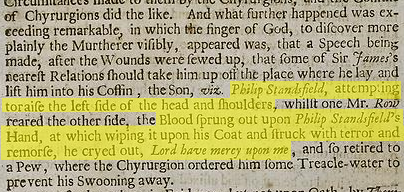
From A True Relation of a Barbarous Bloody Murther etc., available here.

The King’s Advocate insisted — over the objections of a defense attorney that “it was a superstitious observation, founded neither upon law nor reason” — that the corpse’s having bled on Philip Standsfield but none of the others in his party simultaneously attempting to move it “he must ascribe … to the wonderful Providence of God, who in this manner discovers murder.”

Divine forensics. That’s even better than the arson evidence Texas used to kill Cameron Willingham.

And it had the same result, to wit,

the said Philip Standsfield to be taken upon Wednesday next, being the 15th of February instant, to the Market-cross of Edinbrugh, and there, betwixt two and four o’clock in the afternoon, to be hanged on a gibbet till he be dead, and his tongue to be cut out and burnt upon a scaffold, and his right hand to be cut off and affixed to the east port of Haddingtoun, and his body to be carried to the Gallowlie betwixt Leith and Edinburgh, and there to be hanged up in chains; and ordains his name, fame, memory, and honours to be extinct, his arms to be riven forth and delete out of the books of arms …†

Well, you get the idea. Executed Today would like to apologize to the dempster of Edinburgh for keeping Philip Standsfield’s name, fame, and memory alive.

In our defense, we are hardly the only ones: this is thought to be the last time that Scottish law employed the bleeding-corpse “test”.

* Some other instances of purported “bleeding at the touch” may be perused here.

** In a 1927 piece in the Journal of the American Institute of Criminal Law and Criminology, Canadian jurist William Renwick Riddell says this folk belief “was wide spread and is not dead yet” and offers in a footnote (perhaps by way of explaining his interest) that “when at the Bar, I was once offered such evidence by my client; but I declined to use it.”

† The execution was botched, and the gibbeted body illicitly pulled down and tossed in a ditch — which is where the elder Standsfield’s had been discovered.

On this day..