In the year 1554, there was imprisoned at Ghent, in Flanders, for following Christ and living according to God’s commandments, a young brother named David, who, when examined, freely confessed his faith. Being asked what he thought of the sacrament, David said, that he considered it nothing else than idolatry. Then a priest said to him, “Friend, you err greatly, that you so readily confess your faith, for it will cost you your life, if you do not change your mind in time.” Thereupon David sweetly replied, “I am ready to shed my blood for the name of Christ, even though it should be here in this place; for God is my salvation, who will keep me, and preserve me from all evil.” The priest said, “It will not be as good as though you were put to death secretly here in this place; but you will be burnt publicly at the stake, for an everlasting reproach.” He was then brought into the court, where he was condemned to death, and his sentence was read, namely, that he had fallen from the true faith into heresy, and was therefore, according to the imperial edict, sentenced to be strangled and burned. David said, “No one will ever be able to prove by the Scriptures, that the faith for which I must now die is heresy.”
There was also sentenced to death with him a woman named Levina, who rather forsook, not only her six dear children, but also her temporal life, than her dear Lord and Bridegroom Jesus Christ. Arriving on the scaffold, David attempted to kneel down in order to offer up his prayer to God, but he was prevented, and they were immediately driven away to the stakes, standing at which, David said to Levina, “Rejoice, dear sister; for what we suffer here is not to be compared with the eternal good that awaits us.” (Rom. 8:18) When about to offer up their sacrifice, both exclaimed, “Father, into thy hands do we commend our spirits.” A little bag of gunpowder was tied to each of them, whereupon they were strangled and burned. But there happened a manifest miracle of God; for though they were completely burned, and the fire was as good as extinguished, David was seen to move his head, so that the people exclaimed, “He still lives.” The executioner seized the fork, and thrust it three times into his bowels, so that the blood flowed out; yet even after this he was still seen to move, hence, the executioner threw a chain around his neck, and bound him to the stake, and thus broke his neck.
Thus these two valiantly fought their way through, firmly trusting in God, who did not let them be confounded, since they had firmly built their building upon the only foundation; wherefore they shall never perish, but abide forever.
On this date in 1892, two outlaws were hanged (and a third spared at the last moment) in Gori, Georgia — part of the tsarist Russian Empire.
Josef Djughashvili, the future Stalin, was a teenager when he saw an 1892 public hanging in Gori.
The most noteworthy executioner present on this occasion was not on the scaffold, but in the audience: a 14-year-old student at an orthodox church school named Joseph Djugashvili. You know him by his later, steely revolutionist alias: Stalin.
This precocious, ferocious youth attended the public hanging with school mates to whom he was already a natural leader.
He and his friends sympathized with the doomed Caucasians, so insouciant at being strung up by the tsarist oppressor: conversing after the gruesome spectacle, Djugashvili would maintain that the men had not been consigned to hell, for they had suffered enough in the present.
But this boy was not made for theologizing; though he proceeded to seminary school in Tiflis — the best education prospect for an impoverished family — he disappeared thence into the life of professional revolutionary outlawry.
The recent (and well-received) biography Young Stalin recaptures this scene from Joseph Djugashvili’s youth.
The condemned men had stolen a cow and, in the ensuing pursuit, had killed a policeman. But the boys learned that the criminals were actually just three “peasants who had been so oppressed by landowners that they escaped into the forest,” petty Robin Hoods, attacking only local squires and helping other peasants …
The boys were fascinated. “Soso Djugashvili, me and four other schoolboys climbed a tree and watched the terrifying show from there,” remembers one of the group, Grigory Razmadze … Another spectator whom Stalin would later befriend and promote was Maxim Gorky, then a journalist, soon to be Russia’s most celebrated writer.
The Gorelis sympathized with these brave Caucasian bandits … The crowd became menacing; double ranks of Russian soldiers encircled the square. The drums began to beat. “The authorities in uniforms lingered around the scaffold,” wrote Gorky in his article. “Their dreary and severe faces looked strange and hostile.” They had reason to be nervous.
The three bandits in leg irons were marched onto the scaffold. One was separated from the others — he had been reprieved. The priest offered the two condemned men his blessings; one accepted and one refused. Both asked for a smoke and a sip of water. Sandro Khubuluri was silent, but the handsome and strong “ringleader,” Tato Jioshvili, smiled and joked valiantly before the admiring crowd. He leaned on the railings of the gallows and, noticed Gorky, “chatted to people who had come to see hi die.” The crowd threw stones at the hangman, who was masked and clad completely in scarlet. He placed the condemned on stools and tightened the nooses around their necks. Sandro just twirled his moustache and readjusted the noose. The time had come.
The hangman kicked away the stools. As so often with Tsarist repression, it was inept: Sandro’s rope broke. The crowd gasped. The scarlet hangman replaced him on the stool, placed a new noose round his neck and hanged him again. Tato also took a while to die.
Even Joseph Stalin was a child once.
One would have to really like the difficult-to-prove notion that executions have a brutalizing effect encouraging violence in others in order to see in this hanging the germ of the incomprehensiblesuffering young master Djugashvili would eventually unleash.
It’s not like this was Stalin’s only childhood exposure to brutality, and not too many of those buddies who watched this date’s hanging grew up to kill 20 million people.
Gori was one of the last towns to practise the ‘picturesque and savage custom’ of free-for-all town brawls with special rules but no-holds-barred violence. The boozing, praying and fighting were all interconnected, with drunken priests acting as referees… [At festivals during Stalin’s youth] the males in each family, from children upwards, also paraded, drinking wine and singing until night fell, when the real fun began. This ‘assault of free boxing’—the sport of krivi—was a ‘mass duel with rules’; boys of three wrestled other three-year-olds, then children fought together, then teenagers and finally the men threw themselves into ‘an incredible battle,’ by which time the town was completely out of control, a state that lasted into the following day—even at school, where classes fought classes.
This is Russia, not Georgia: festive Maslenitsa fisticuffs.
The small Georgian town that spawned the first name in Soviet terror actually maintained a public statue to its most famous son until 2010 — when it was finally removed in an apparent anti-Russian gesture in the wake of the South Ossetia war.
That execution of a black slave and his white lover was exceptional — and, of course, the chronicles of the Cape are replete with less exceptional fare, the humdrum penal brutality of an 18th century colony disposed of in a sentence of two between reports of smallpox outbreaks, price fluctuations, the transit of slave ships, and all the other business of frontier life.
A slave condemned to be burnt alive for arson; another to be hanged for theft … Two white men hanged for desertion, sheep-stealing, and attempt to murder … A Javanese “Guru” sentenced to death for instigating slaves to run away, harbouring and arming them … Matthys of Ternate punished for running away and cattle theft, &c. Sentenced to be hanged … A slave hanged for breaking into the house of Lieutenant Captain Slotsboo … Five slaves sentenced to be broken, and a female slave to be scourged … Two soldiers sentenced to run the gantlope …
And so on.
This date marks a number of such executions for a minor slave revolt (incidents of slave insubordination also pepper the Colony records). At three full entries in the chronicle, 16 implicated slaves, and some spectacularly savage punishments, it must have been one of the more noteworthy of its day; what the colonial register leaves us is just enough to suggest the forgotten suffering and resistance of the half-nameless chattel of yesteryear.
1714.
January 7 — Some 16 fugitive slaves who had conspired, armed themselves, and did much mischief. They resisted the officers of justice, shot a soldier, and murdered a Hottentot woman. They were now brought up for examination.
February 7 — The sentences passed on the fugitive slaves, and the whole history of the case. “Tromp” to be empaled alive, and to remain in that position till he dies. “Cupido” to be put on a cross, his right hand to be cut off, and with “Neptunus” to be broken on the wheel, and then to be left on a hurdle until dead. “Titus” to be broken with the coup de grace. Jeroon and Thomas to be hanged; three others to be scourged and have their right heels cut off. The eleventh prisoner is merely to look on, and afterwards to be sent home; paying the costs however.
February 8 — The empaled convict found strangled in the morning. He had received some linen from a kind friend during the night for the purpose. He would otherwise have been still alive.
On an uncertain date in January 1474, a condemned archer* escaped the noose by volunteering to endure an experimental living vivisection for kidney stones.
The authority for this incident is a single medieval chronicle with just enough context to tantalize:
In January, 1474, an archer of Meudon was condemned for many robberies, and especially for robbing the church at Meudon, to be hanged at Paris. He appealed to the Parlement which confirmed the sentence. Then the physicians and surgeons of the city represented to the king that many and divers persons were grievously molested and tormented by stone, colic, and pains in the side, with which the said archer was also much troubled, and that Monseigneur du Bouchaige (a favourite courtier mentioned by Comines) was sorely afflicted by the said maladies, and that it would be very useful to see the places where these maladies are concreted, and that this could be best done by vivisecting a human being, which could be well effected on the person of the said archer, who was also about to suffer death. Which opening and incision was accordingly done on the body of the said archer, and the place of the said maladies having been sought out and examined, his bowels were replaced and he was sewn up again. And by the king’s command the wound was well dressed, so that he was perfectly healed within a fortnight, and he received a free pardon, and some money was given him as well.
Pretty cool, and possibly the earliest semi-convincingly documented case of human vivisection in Europe.
Assuming it did really go down, it seems to have made little immediate impression on contemporaries, but it was gradually recovered in centuries later — and the medical achievement really improved in retrospect.
These few lines inflated into a story, a myth of French medicine: in the first place, the unspecified ailment became identified with kidney stones; a heroic and brilliant Italian-trained French physician named Germain Colot (or Collot)** was fabricated as the genius behind the procedure; even Louis XI turns up personally to observe.
Antoine Rivoulon’s 1851 lithograph valorizes the mythical 19th century version of the Archer of Meudon’s surgery as the first kidney stone operation, undertaken by legendary surgeon Germain Colot, and in the very presence of the sovereign. The archer looks pretty chill himself, given his situation.
“Why this story has disappeared from view is almost as baffling as its origin,” observe Vivian and Christine Nutton in their fascinating survey† of the archer’s historiography. “”Patriotic’ history … has not entirely fallen out of favour.”
One major reason is not to be sought in a library but in the operating theater. Until the middle of the nineteenth century, this story could be seen as having a practical value: it provided proof that this or that procedure, whether to remove a stone from the bladder or the kidney, could be followed safely and effectively. A modern operation could thus be given historical support, which might tip the balance in deciding which of a number of competing possible courses should be followed. John Douglas’s reprinting of the relevant sections in Rousset was an avowed attempt to secure backing for his new and controversial operation for the stone. But with the advent of anesthesia and aseptic surgery, the priorities of surgeons themselves changed in choosing how to operate … There was no need to scrutinize the historical record to establish the most effective way to proceed.
* We digress to notice that the francs-archers to which our offender belonged were a peasant militia established by Charles VII: archers received tax abatements in exchange for regular practice with the bow.
Charles’s best-known military innovation was elevating raving teenager Joan of Arc to battlefield command. Since God helps those best who help themselves, Charles also evidently was cagey enough to take a warning from rival England’s devastating use of the longbow during the Hundred Years’ War. Nice idea, but by this point the archers were “havens for tax exemption … units of ill-disciplined men” — much like our marauding, but fortuitously afflicted, patient.
They were used rarely and ineffectively, and soon after making their mark in the annals of surgery, replaced entirely by foreign mercenaries.
** “Germain Colot” connected a lineage to French lithotomy by way of the historically verifiable 16th century doctor Laurent Colot. As of this writing, Laurent’s Wikipedia page still asserts the existence of this phantom ancestor.
† Nutton, Vivian and Nutton, Christine, “The Archer of Meudon: A Curious Absence of Continuity in the History of Medicine,” Journal of the History of Medicine and Allied Sciences, Volume 58, Number 4, October 2003, pp. 401-427
On this date in 1869, Chauncey W. Millard was shot in Provo, Utah, for a stagecoach murder and robbery.
Despite the trust fund moniker, Chauncey Millard was an underbelly character, a youth of uncertain age (18 or 19, went the estimate) who had drifted west from an abusive apprenticeship. His complete backstory — not even his name* — was never fully assayed, and the Utah authorities did not keep his acquaintance more than a few weeks before they shot him. “It was snowing like this when I done it,” he remarked on his execution day: frontier justice had not allowed even a single season to elapse.
Though slightly different configurations of his backstory are to be found, all recognize him as a youth barely grown from out of that vast and indistinct vagabondage of lumpen marginalia consigned to the shadowlands to scrap for their bread. He wanted any education save a self-made career of small-time savagery. His life was nasty, brutish, and short.
The San Francisco Daily Evening Bulletin of Jan. 5, 1869, presents a representative summation, channeling a wire story from the scene:
DREADFUL DEPRAVITY — The Salt Lake Reporter of December 24th has the following:
The young man now in the county jail, for the murder of Swett, certainly comes as near being a complete reprobate as any we have met. He tells the story of the murder, and the unsuccessful attempt on Mayfield, with great circumstantiality of detail, adding in conclusion: “Well, Mayfield needn’t be afraid of ever being killed by a pistol, for it can’t be done. His life is insured. I shot at him four times, fair as ever a man did, and with good aim too, and never hurt him.” After the killing, he fled across a ridge, and the next day hired to a Bishop there to herd sheep. As he relates the story, the Bishop spoke of his intention to buy a beef, upon which the young man asked: “Have you got money enough to buy a beef?” “No,” said the Bishop, “but I think I can trade for it.” The prisoner adds very complacently: “I think he was a little scared, but if he had money enough to buy a beef, I thought I would pop him over, take what he had, and light out!” When arrested he merely said: “I suppose you’ll string me up to the first good limb you come to, but I’ll take a nap first.” Upon which he lay down in the wagon and snored quite lustily for four hours.
On awaking he expressed some surprise at not being hanged at once, and was told in this country every man could have a trial and a choice between being hanged or shot. To which he made reply: “By —, that’s bully, I’ll take shooting all the time.” He first gave his name as Chauncey Millard, stating that he had no recollection of his father; but soon after spoke of his mother’s maiden name being Millard, to his paternity is rather doubtful. He was born in the South;** early neglected and abused, and taught nothing worth knowing, his hand was against every man and a good many hands against him. The man to whom he was apprenticed mistreated him, and his first crime was destroying his master’s property for revenge. This was at the age of 13; not long after that he became a bushwhacker, and with a few companions robbed or murdered rebel or Union soldiers indifferently. With the return of peace he came West, and relates several crimes and attempts committed in this Territory.
He expresses a willingness to die, saying he has tried to make money by crime and made a failure. Strangely enough the young man has what phrenologists would call “rather a good head,” and presents an interesting but terrible case of “perverted moral instinct.” He is 18 or 19 years of age, not above the latter, though he is not certain of his age. He presents a curious case of the youthful criminal, made so by the utter neglect of moral cultivation.
Calling him, as one source does, “Utah’s version of Billy the Kid” would probably be more corrective of William Bonney’s inflated legend than of Millard’s utter obscurity.
The tawdry particular of his death: having no kin, and no care, he heedlessly made the Faustian bargain to salvage some last juvenile diversion in this world in exchange for the mortified flesh he was about to take leave of.
The execution proved what a human fiend Millard was. Selling his body to Doctor Roberts of Provo for a pound of candy, he calmly ate the sweets while sitting in the executioner’s chair awaiting the fatal shot.
* Chauncey Millard was the name he gave the lawmen, at least; his real identity was never clearly established, though the Salt Lake City News reported shortly before “Millard’s” hanging that guards found a tattoo reading “C.E. Otoway” on his arm and hypothesized that to be his real name. Did 19th century drifters usually tattoo their own names on their bodies?
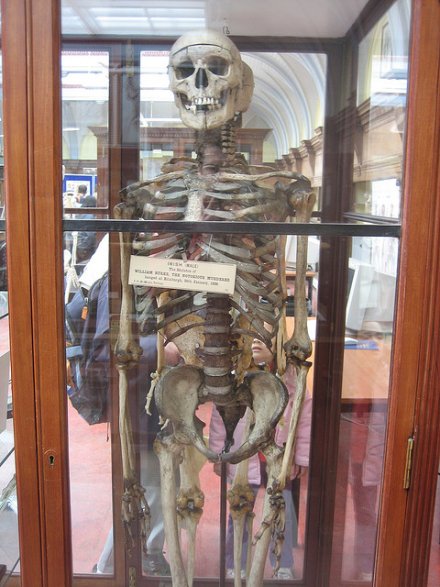
Wanted: corpses. Apply to Doctor Robert Knox, MD, FRSCEd, Professor of Medical Studies, Barclay’s Medical College, Surgeon’s Square, Edinburgh. Reference William Burke, hanged Jan. 28, 1829.
Robert Knox was a noted physician in his prime, in the early 1800s.
A surgeon, anatomist, and zoologist, Knox studied anatomy in London, then headed off to Africa in the army. Field surgery was a brutal business, and the poor anatomical knowledge at the time made it even more terrifying for those involved.
In 1821, Knox moved to France to work in the shadow of his heroes, Georges Cuvier and Étienne Geoffroy Saint-Hilaire; a year later, he was back in Edinburgh, making himself a career academic.
When his old professor came calling in 1826 with an opportunity to teach at Surgeon’s Square in Edinburgh, Knox jumped at the chance. As a partner to Barclay and curator of the school’s museum, Knox was well aware of the significant problem that faced the school: corpses were hard to come by.
And since the Royal College of Surgeons at Edinburgh certified the school as a prep course for entrance to University, coming up with bodies became a very important task.
If there’s one way to ruin your career, it’s to be caught paying a few pounds for fresh murder victims.
So it was for Knox, who gave out 7 pounds, 10 shillings for the body of an itinerant lodger who died in William Burke’s building in 1827.
This transaction led Burke to realize that such lodgers weren’t paying as much alive as dead. As a collector of bodies, Knox also had a strict no-questions-asked policy, and Burke and his partner William Hare exploited that to its fullest extent.
Almost a score of suspicious bodies later (and after the price had inflated to 10 pounds per), the pair was found out, given away as suspects by the lame and mentally disabled “Daft Jamie” Wilson, then caught when the late Marjory Campbell Docherty was found by a fellow tenant under one of Burke’s lodge’s beds.
Hare copped to a string of murders* and played stool pigeon in exchange for a lighter sentence.
Burke went to the gallows to “vehement cheering from every quarter, mingled with groans and hisses.” (London Times, Feb. 2, 1829)
“When the cheers had subsided, the wretched man was assailed with every epithet of contempt and abhorrence,” the Times continued. “Not a single indication of pity was observable among the vast crowd: on the contrary, every countenance wore the lviely aspect of a gala-day.”
William Burke’s hanging.
As a corpse himself, Burke made one final contribution to science’s insatiable desire for bodies: his cadaver went straight from the gallows to the practiced hands of one Dr Alexander Monro, who performed a complete lecture while dissecting the murderer’s corpse.
Knox, for his part, paid not with his neck but with his reputation.
Though never charged with a crime, the doctor was run out of the the lecturing business, first by subtle and not-so-subtle actions by the University, and eventually by the passage of the Anatomy Act of 1832.
He was also unable to obtain any surgical post after the incident and spent his later years writing academic books and papers, none of which have lasted like the doggerel that shadowed his steps.
Burke’s the butcher, Hare’s the thief,
Knox, the boy who buys the beef.
A few books about Burke and Hare
Anatomy of Anatomy
Robert Knox was operating under the Murder Act of 1751, which expressly forbade the burial of an executed murderer while permitting the malefactor’s dissection.
The Act had the dual effect of allowing the state to gibbet executed criminals (both hanging in chains and dissection were considered an added ignominy, beyond the punishment of the gallows), and of supplying the budding medical community with an immediate source of fresh bodies.
As courses in anatomy became more commonplace, though, the need for cadavers increased dramatically, and the business of selling bodies for science was born.
Typically, these sales manifested themselves in body-snatching — wherein “resurrectionists” illicitly exhumed a freshly buried corpse and conveyed it to some physician’s ready scalpel.
This grim trade in turn spawned a variety of security measures. The favored dead were defended by fences, watchtowers, and human lookouts. But nothing could eliminate the industry.
In particular, those with little money or no immediate relatives were unlikely to be buried in these gated graves; that left their remains ripe for the remaindering. As well, the increase in demand made so-called anatomy murder a possibility. Burke and Hare may have been notorious for the offense,** but they did not invent it.
In that case, two nurses (Jean Waldie and Helen Torrence) on death watch bartered a decent price of two shillings to sell the body of an ill child to a local surgical college. His death was delayed, and the nurses smothered him, possibly through simple carelessness.
Shortly after the Murder Act, simple economics made pikers of Torrence and Waldie. In the 17th century, England executed hundreds of prisoners a year, each a potential dissection. As Dr D.R. Johnson writes in his Introductory Anatomy:
The dissections performed on hanged felons were public: indeed part of the punishment was the delivery from hangman to surgeons at the gallows following public execution, and later public exhibition of the open body itself. …
Agents representing surgeons would bargain with condemned prisoners not under sentence of dissection (remember this only happened for murder: hanging was in vogue for stealing a sheep or even a loaf): occasionally prisoners struck a bargain to pay expenses, to provide for a family or to buy the customary decent apparel for the hanging.
Supply was unreliable, however: riots at public hangings became common, partly because of the paltry nature of hanging events, partly from superstition. The body was often reclaimed by relatives and the unpopular anatomists stoned, defeated and out of pocket. Competition was often so fierce that a rival anatomy school carried off the body.
Dissection was unpopular and other medical uses were to be found for a recently hung body – the cure of scofula, goitre, wens, ulcers, bleeding tumours, cancers and withered limbs for example. To prevent riots and disorder the Sheriff of London took all bodies of hanged men, except those sentenced to dissection, into his own custody and handed them to the relatives for burial.
Human Trafficking
Hanoverian Britain sure did keep the gallows busy. But the pace of hangings had abated by the 19th century just as demand boomed. The math didn’t add up.
Anatomy schools (officially) dissected some 592 corpses in 1825; at the time of the Burke and Hare murders, only about 50 executions were carried out annually, and each college was guaranteed just one a year.
That meant a shortfall of close to 550 bodies. With limited supply and significant demand, surgical colleges and anatomical lecturers were willing to pay top dollar for new cadavers … and the anatomical murder business really got legs.
And while the execution of Burke was met with applause from the community, in London, another group was already hard at work both body snatching and murdering its way into the classroom.
The London Burkers were caught in 1831 and convicted of murdering a 14-year-old whose cadaver they sold to St Bartholemew’s Hospital for 9 guineas.† The killers, Thomas Williams and John Bishop, had offed several others prior to the lad in question, making about the same price on each body.‡ In the grand, Burkean tradition of anatomical murderers, these miscreants were also dissected after their execution.§
Williams and Bishop were just two of a group of resurrectionists known collectively as the London Burkers, who claimed to have stolen upwards of 1,000 bodies from nearby cemeteries. That made the Burkers the largest known exploiters of the anatomical trade.
Over the decades after the Murder Act, though, resurrectionists were walking a dangerous line in their communities.
Reverence for the dead sparked community outrage when graves were found empty or disturbed, and it was often the anatomists themselves who felt the wrath of crowds.§§ In Glasgow in 1803, surgeons were threatened by an unruly mob and were forced to seek police protection; in 1813, an empty grave caused a similar furor. Punishments moved from fines to jail time as the surging demand made body-snatching an ever more lucrative trade.
A few books about body-snatching
By the time of the Burkers, anatomists were generally presumed to be body thieves in some capacity, a hostile sentiment graphically underscored during the Aberdeen riots of 1831. When a dog unearthed what looked like a human bone behind the Aberdeen surgical college, a mob coalesced and stormed the lecture hall.
The lecturer (“Dr Moir” — little else is known about the man) fled in terror as the hall was burned to the ground. Soldiers and police clashed with the crowd, which was thought to be over 10,000 strong. Hours later, the riot subsided, but Aberdeen was no longer a friendly place for a prospective medical talent.
And where Burke and Hare were still not quite sufficient to convince the House of Lords to take up a measure providing anatomists with alternatives for corpse acquisition, the Burkers and the Aberdeen riots apparently were.
The underground economy of resurrectionists was supplanted by the Anatomy Act of 1832, which allowed individuals to donate themselves or their unwilled kin to science for a pittance of compensation.
Anatomy murder is, of course, still the subject of horror movies. Like this one, or for the more classically inclined, this 1945 Boris Karloff/Bela Lugosi vehicle adapted from a Robert Louis Stevenson story inspired by Burke and Hare:
* The murders included at least one husband/wife pair, a mother and, later, her (adult) daughter, and a grandmother and her young grandson. They are also known as the West Port Murders.
** Burke entered the English language as a verb meaning … well, pretty much exactly what Burke got up to.
Dr. Murray, in the new English Dictionary, gives the following definition of the verb to ‘burke.’ ‘To murder in the same manner or for the same purpose as Burke did: to kill secretly by suffocation or strangulation, or for the purpose of selling the victim’s body for dissection,’ and the familiar lines are quoted from the Ingoldsby Legends: —
But when beat on his knees, that confounded De Guise
Just whipped out the “fogle” that caused all the breeze,
Pulled it tight round his neck until backwards it jerked him,
And the rest of the rascals jumped on him and burked him.
† 9 pounds, 9 shillings; by the time of the transactions, the guinea was no longer technically in use, but the term had stuck at the 21-shilling mark.
‡ Over the course of their 6 active months, the pair went from asking 8 guineas to asking 12 guineas; apparently 9 was the negotiated price with St Bartholemew’s.
§ The Burkers are the subject of the song “The Resurrectionist” by the Pet Shop Boys. (Lyrics)
§§ Edinburgh also had trouble as far back as 1742, when several surgeons’ homes were attacked by locals; a local beadle suspected of the crimes also had his home, dubbed resurrectionist hall, burned during the mob incident.
On this date in 1550, the leaders of England’s Prayer Book Rebellion were hanged, drawn, and quartered at Tyburn.
When Henry VIII dropped dead in 1547 and pitched his contentious realm and dubious progeny into the mid-Tudor crisis, Henry’s old theological henchman Thomas Cranmer really got to work.
During the unsteady regency of Henry’s sickly heir, Cranmer would push frenetically to make the religious reformation that his former boss never completely backed. The Archbishop sent to the continent for Protestant theologians like Peter Martyr who could help him “do away with doctrinal controversies and establish an entire system of true doctrine.”
The piece de resistance of Cranmer’s project was his Book of Common Prayer — a reformed liturgy, and in English, to go with the new English Bible. Many centuries — and revisions — later, it’s still the basis of Anglican services and of rites in many other Protestant denominations.
In 1549, it debuted to decidedly mixed reviews.
Enforced by Parliament’s Act of Uniformity, the Book of Common Prayer replaced all Latin liturgies on Whitsunday 1549, and for many of England’s Catholics, it was one affront too many. (The country’s bumpy economic realignment couldn’t have helped matters.)
On Whitmonday, traditionally-minded parishioners in West Devon unimpressed* with this newfangled vernacular service forced their local cleric to break out the old vestments and say Mass in Latin. State attempts to enforce the ban soon produced a martyr for the cause — one William Hellyons, melodramatically impaled on a pitchfork — and a march to Exeter that spiraled into outright revolt, heavy with suppressed Cornish nationalism.
We, the Cornishmen, whereof certain of us understand no English, utterly refuse this new English.
Religion, theology, the liturgy, the text of the Scripture … these were things that early modern Europeans were ready to fight and die for.
Since this considerable plunder of Church wealth had been widely redistributed to the English gentry, talk about repossessing it really emptied the pews of potential allies.
At any rate, neither Latin nor monastic restoration would be provided as carrots; London under Lord Protector Edward Seymour instead put down the rising with the more customary stick.
Such principals as remained were reserved a more awful fate: drawing and quartering at Tyburn. These seem to be the chaps who endured it:
Henry Bray, Mayor of Bodmin
Landowner and military leader Humphrey Arundell
Landowner John Wynslade
Thomas Holmes
John Bury
Bill Ind, Anglican Bishop of Truro, made news in 2007 acknowledging “that the English government behaved brutally and stupidly” in crushing the rebellion.
We wyll haue the Sacrament hang Oller the hyeghe aulter, and there to be worshypped as it was wount to be, and they whiche will not thereto consent, we wyll haue them dye lyke heretykes against the Holy Catholyque fayth.
We wyll haue . . . images to be set vp again in euery church, and all other auncient olde Ceremonyes vsed heretofore, by our mother the holy Church.
We wyll not receyue the newe seruyce because it is but lyke a Christmas game, but we wyll haue oure old seruice of Mattens, masse, Euensong and procession in Latten as it was before.
On this date in 1952, Iraq hanged Yosef Basri and Shalom Salah for an alleged Zionist bombing campaign in Baghdad.
The most remarkable thing about this campaign is that it was perpetrated against Iraq’s Jews — and if these men’s conviction was rightly secured, it was conducted by other Jews for the purpose of driving those Iraqi Jews to emigrate to the still-tenuous new state of Israel.
As the 1940s closed, well over 100,000 Jews lived in Iraq, a populace legendarily* dating to the Biblical Babylonian exile.
While this community had at certain moments in centuries past been the very flower of the diaspora, it was justifiably nervous here in the perilous 20th century.
In 1950-51, the Iraqi government offered its Jewish citizens an emigration window from a homeland tense with anti-Jewish hostility — at the same time the Israeli government was practically begging them to come. (The cost: give up Iraqi citizenship permanently. Iraq seems to have expected only a few thousand to depart.)
Against the grain of this “monstrous” mutuality of interest stood the natural obstacles for any emigre: affection for the familiarity of one’s native lands, the trauma and uncertainty of uprooting … plus the specific problem that most stood to lose their illiquid wealth either by hasty firesale disposal or (as eventually happened) outright confiscation. Particularly pending clarity in property remuneration, many Iraqi Jews were initially wary about departing.
Iraqi Jews also dismayed Zionist recruiters with their “lack [of] a Zionist outlook and even a Zionist instinct.”**
But these stick-in-the-Mesopotamians would soon receive some explosive encouragement: a headline-grabbing series of attacks on Jews and Jewish establishments during the emigration window encouraged thousands to seize the moment.
“The pace of registration for the citizenship waiver was slow in the beginning, but it increased as tensions rose between Jews and their neighbors and after acts of terror were perpetrated against Jewish businesses and institutions – especially the Mas’uda Shem-Tov Synagogue [bombed January 14, 1951]”
Israel historian Benny Morris summarizes the situation in this Q&A from 2009:
Iraqi Jews being airlifted to Israel.
Ultimately, Israel’s Operation Ezra and Nehemiah, named for two Old Testament prophets who led the Biblical Israelites out of bondage, relocated virtually the whole of Iraqi Jewry to Israel — more than 120,000 people. Today, virtually no Iraqi Jews remain.
Morris’s conclusion that Israeli intelligence did not engineer the bombing campaign that so spectacularly served its statecraft is the subject of vociferous dispute. It’s also, perhaps, a bit finely cut: a handful of zealots in the local Zionist underground, sensitive to the local sentiment and keen on the urgency of the brief denaturalization opportunity, might have undertaken the project freelance without actual straight-from-Jerusalem coordination.
Amazingly, this notion that some species of Zionist agents bombed Iraqi synagogues (pdf) in the interests of the Levant’s demographic future was commonly believed not only by Iraqi Arabs but by emigre Iraqi Jews themselves. Their suspicions can hardly have been allayed when a similar misadventure went down in Egypt a couple years later.
The inevitable dispute over the factual question can’t help but roll over into everything else that’s disputatious about the Zionist Entity.
An account already exists between us and the Arab world: the account of the compensation that accrues to the Arabs who left the territory of Israel and abandoned their property … The act that has now been perpetrated by the Kingdom of Iraq … forces us to link the two accounts . . . We will take into account the value of the Jewish property that has been frozen in Iraq when calculating the compensation that we have undertaken to pay the Arabs who abandoned property in Israel.
–Moshe Sharett, Israeli Foreign Minister, March 1951**
This sort of opportunistic ethnic arithmetic obviously loses its limited suasion to the extent that Jews can be held to have driven Jews out of Iraq — which is not to say that goring this or that ox is necessarily the reason for any one scholar’s taking this or that position.
One might, however, be less inclined to extend that benefit of the doubt to the Kingdom of Iraq itself. That realm was very pleased to point the finger at its absconding Jewry.
Our Zionist cadres, Yosef Basri and Shalom Salah, were hanged by that Iraqi Entity for three grenade attacks in the bombing series. Basri repudiated his confession in court, plausibly claiming it had been tortured out of him. (A third Jew was also convicted but not executed: Yehuda Tajar is the man Morris refers to, who returned to Israel after spending the Fifties imprisoned in Iraq.)
“Long live the state of Israel,” were their last words.
But not all “beneficiaries” of their alleged efforts shared the sentiment.
“That is God’s revenge on the movement that brought us to such depths,” one Iraqi Jewish refugee in the Holy Land reportedly exclaimed.**
Just where guilt really lies in all of this has been contested (pdf) ever since, a matter that mere hooded functionaries such as your author can hardly address with authority.
Jews Done It …
… They Never Did
* Not necessarily literally; the Mongol invasions are supposed to have broken the cultural chain of Jewish habitation of Babylon, with the city re-populated later by other Jewish migrants not of a lineal connection back to Nebuchadnezzar‘s conquests.
** Quoted by Yehouda Shenhav in “The Jews of Iraq, Zionist Ideology, and the Property of the Palestinian Refugees of 1948: An Anomaly of National Accounting,” International Journal of Middle East Studies (Nov., 1999)
On this date in 1400, English aristocrat John Holland, Earl of Huntingdon and (formerly) Duke of Exeter, lost his head for the Epiphany Rising.
John Holland’s coat of arms.
Half-brother to (and staunch ally of) Richard II, the violentJohn Holland prospered during the king’s acme in the 1390s. A variety of lucrative posts accumulated as honoraria for Holland’s exertions in the military and political fields.
Unfortunately for “Exeter”, a fellow Lord Appellant named Henry Bolingbroke was about to successfully depose Richard II, and style himself Henry IV.
Holland’s loyalty to the former King Richard, now held under lock and key, became distinctly impolitic.
Having been dispossessed of the Exeter title, earned by service the new sovereign did not consider meritorious, John Holland got in on a plot to kidnap Henry IV during a tournament at Windsor … which devolved, when Henry found out about it, into an abortive rising with a number of executions. Richard FitzAlan’s sister (also Henry IV’s mother-in-law) had the satisfaction of ordering Holland’s beheading at Pleshy Castle, Essex.
Holland’s loyalty to Richard II ultimately did them both in: because the Epiphany Rising so graphically illustrated the danger that a living rival claimant posed to Henry IV, the king had his imprisoned predecessor murdered behind dungeon walls that February.
And of course, while that act secured Henry’s throne, Bolingbroke could never entirely chop his way to uncontested legitimacy: the rival successions of Henry IV and Richard II came to blows decades later in the War of the Roses. (Much to the profit of this site.)
According to a Reuters report, it was on this date last year that an al Shabaab militant was publicly shot in Somalia by a pro-government militia.
Al Shabaab — “the youth” — is an offshoot from the (now-history) Islamist alliance involved in that whole Black Hawk Down unpleasantness.
You might remember them from this summer’s World Cup: they’re the guys who bombed World Cup viewers in Uganda, killing 76. Al Shabaab (allegedly al Qaeda-linked) basically controls southern Somalia with its allies.
“We don’t normally kill al Shabaab members,” explained a spokesman for the Ahlu Sunna Waljama’a paramilitary, in cheerily chilling terms. “We arrest them and make them understand that Islam means peace.”
The unnamed character we notice this date apparently failed to “understand,” and was shot for not renouncing his affiliation.
“This commander insisted that all people were infidels except his group … We will execute al Shabaab members who insist that it can be right to kill the innocent. What else are we supposed to do to those who believe they will go to paradise for killing us and the whole human race?”
The execution nevertheless failed to quell the intractable Somali Civil War.


 Almost a score of suspicious bodies later (and after the price had inflated to 10 pounds per), the pair was found out, given away as suspects by the lame and mentally disabled “Daft Jamie” Wilson, then caught when the late Marjory Campbell Docherty was found by a fellow tenant under one of Burke’s lodge’s beds.