1483: William Hastings, trusting too much

This honourable man, a good knight and a gentle; of living somewhat dissolute; plain and open to his enemy, secret to his friend, easy to beguile, as he that of good heart and courage forestudieth no perils; a loving man, and passing well-beloved; very faithful, and trusty enough — trusting too much.

Thomas More‘s assessment of William Hastings

The Baron Hastings arose this date as the trusted councillor of the Lord Protector. Before dinner, he’d had his head chopped off over a log in the Tower of London.


Lord Hastings sported this fancy badge of a handsomely endowed manticore.
Richard III, Act 3, Scene 4
by William Shakespeare

Richard III (Duke of Gloucester).
I pray you all, tell me what they deserve
That do conspire my death with devilish plots
Of damned witchcraft, and that have prevail’d
Upon my body with their hellish charms?

Lord Hastings.
The tender love I bear your grace, my lord,
Makes me most forward in this noble presence
To doom the offenders, whatsoever they be
I say, my lord, they have deserved death.

Richard III (Duke of Gloucester).
Then be your eyes the witness of this ill:
See how I am bewitch’d; behold mine arm
Is, like a blasted sapling, wither’d up:
And this is Edward’s wife, that monstrous witch,
Consorted with that harlot strumpet Shore,
That by their witchcraft thus have marked me.

Lord Hastings.
If they have done this thing, my gracious lord —

Richard III (Duke of Gloucester).
If? thou protector of this damned strumpet —
Tellest thou me of ‘ifs’? Thou art a traitor:
Off with his head! Now, by Saint Paul I swear,
I will not dine until I see the same.
Lovel and Ratcliff, look that it be done:
The rest, that love me, rise and follow me.

[Exeunt all but HASTINGS, RATCLIFF, and LOVEL]

Lord Hastings.
Woe, woe for England! not a whit for me;
For I, too fond, might have prevented this.
Stanley did dream the boar did raze his helm;
But I disdain’d it, and did scorn to fly:
Three times to-day my foot-cloth horse did stumble,
And startled, when he look’d upon the Tower,
As loath to bear me to the slaughter-house.
O, now I want the priest that spake to me:
I now repent I told the pursuivant
As ’twere triumphing at mine enemies,
How they at Pomfret bloodily were butcher’d,
And I myself secure in grace and favour.
O Margaret, Margaret, now thy heavy curse
Is lighted on poor Hastings’ wretched head!

Sir Richard Ratcliff.
Dispatch, my lord; the duke would be at dinner:
Make a short shrift; he longs to see your head.

Lord Hastings.
O momentary grace of mortal men,
Which we more hunt for than the grace of God!
Who builds his hopes in air of your good looks,
Lives like a drunken sailor on a mast,
Ready, with every nod, to tumble down
Into the fatal bowels of the deep.

Lord Lovel.
Come, come, dispatch; ’tis bootless to exclaim.

Lord Hastings.
O bloody Richard! miserable England!
I prophesy the fearful’st time to thee
That ever wretched age hath look’d upon.
Come, lead me to the block; bear him my head.
They smile at me that shortly shall be dead.

A longtime Yorkist pillar during the Wars of the Roses, Hastings parlayed his many years of proximity to King Edward IV into still-extant architectural glories like Ashby Castle and Kirby Castle.

Of greater moment for the pivotal year of 1483 was Hastings’s bitter enmity with the Woodville family — the kin of widowed queen when Edward died suddenly in 1483. In his life, the king had checked the rivalry between Woodvilles and York magnates. But “the king’s death at once broke up the unity of the court, the peace of the country, and the fortunes of the house of York.”

Before Edward’s body went cold, both factions raced into the power vacuum: the heir was a 12-year-old who wasn’t event present in the capital when his father died. Power in the realm hinged on the actions of men like Hastings in April and May of 1483.

And Hastings made the most of his moment — to his own later grief. While the Woodvilles flexed during the first days of the regency, Hastings drug his feet, threatened to start a civil war, and successfully negotiated for the respective sides to minimize their armed retinues when they arrived for the coronation of young Edward V. He also wrote urgently to the new de facto captain of Team York, the late king’s brother, Richard of Gloucester.

Hastening to answer the call, Gloucester hijacked a too-lax royal convoy en route to London, acquiring custody of the heir, and rolled into town that May as the master of both the boy king’s person and the political situation. Edward V and his brother were the urchins destined to disappear into the Tower of London; Gloucester would eventually crown himself King Richard III. The Woodvilles fled from power and danger, to the sanctuary of an obliging cathedral.

Big win for Bill Hastings, right? He

was extremely elated at these changes to which the affairs of the world are so subject, and was in the habit of saying that hitherto nothing whatever had been done except the transferring of the government of the kingdom from two of the queen’s blood to two more powerful persons of the king’s; and this, too, effected without any slaughter, or indeed causing as much blood to be shed as would be produced by the cut of a finger. In the course, however, of a very few days after the utterance of these words, this extreme of joy of his supplanted with sorrow. (Croyland Chronicle)

The sorrow arrived like a thunderbolt at a particularly infamous royal council meeting on June 13, 1483, when Gloucester seemingly out of nowhere denounced Hastings as a traitor, along with three others. The others we set aside; they were politically insulated from membership in the pages of Executed Today. But not so Hastings, who was detailed for immediate beheading on Gloucester’s say-so, and never mind the trial.

Politics on this plane was intrinsically cutthroat; nevertheless, this shock destruction of an essential ally puts Richard in a pretty unflattering light. Was he really, as Gloucester claimed, plotting against him? Perhaps Gloucester perceived Hastings too loyal to Edward V at a moment when he was resolved upon usurpation? Had it factored, as the proclamation alleged, that Hastings took up with the late king’s remarkable mistress Jane Shore,* “one of his secret counsel in this heinous treason, with whom he lay nightly, and namely the night past before his death”? Claims and counterclaims around this black June 13 grow thick on the ground, none of them rooted in any decisive evidence.

The estimable David Crowther deals with these perilous months in Episode 187 of the History of England Podcast. The guest episode 187a in that same series explores the aforementioned mistress of William Hastings, whose humiliating public penance inspired the Walk of Shame scene in Game of Thrones.

On this day..

1916: Henri Herduin and Pierre Millant, “cry against military justice”

Cry, after my death, against military justice!

-Henri Herduin, in his last letter to his wife

On this date in 1916, which happened to be Pentecost, two French lieutenants were shot on the Western Front for not surrendering.


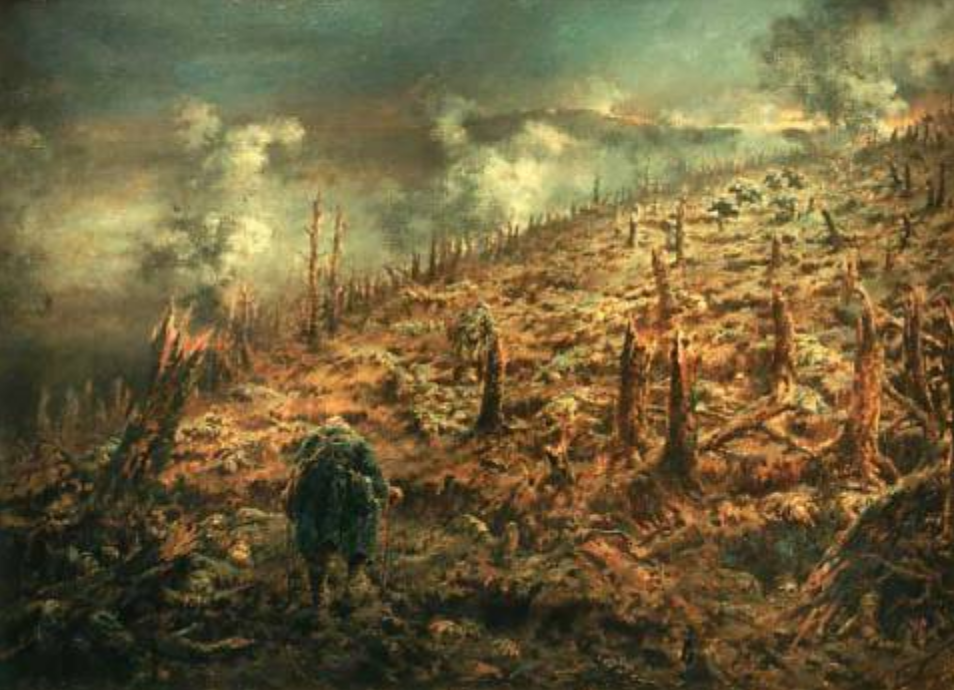
“Le ravin de la mort a Verdun”, by Ferdinand Gueldry.

During the endless Battle of Verdun, which spanned most of 1916, the Germans at one point overran a French bunker called Fort Vaux. German bombardment of the Thiaumont Farm area during this attack smashed the 347th Infantry Regiment to which both Henri Herduin and Pierre Millant belonged. With the regiment commanders killed into the bargain, Herduin and Millant found themselves at the head of a remnant of 40 or so survivors spent of both energy and ammunition, forced to fall back to avoid German encirclement.

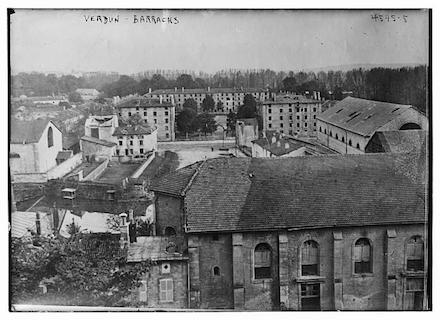
“Our division is broken, the regiment annihilated; I have just lived five terrible days, seeing death at every moment,” Herduin wrote to his wife Fernande on June 9th after he had presented himself at Anthouard barracks. He had not yet any inkling that he too would be a casualty of those terrible days. “Four days without drinking or eating, among the mud and the shells, what a miracle that I’m still here!”


Anthouard barracks during World War I. (U.S. Library of Congress)

Fate and the brass had a perverse sense of humor, for when the two lieutenants presented themselves and their fellow survivors to the reassembled remains of their regiment, about 150 men strong, they discovered that they’d survived all that mud and shelling only to die for France at the stake.

Their unit’s captain held a standing order to execute Herduin and Millant on sight for deserting their post: no need for even the pro forma proceedings of a tribunal. Indeed, the extrajudicial command might have been a fuck-you to civilian authorities who had recently attempted to curtail the army’s enthusiasm for executions. The captain, having no pleasure himself in this order, suffered Herduin to write a hasty explanation/appeal, to which the captain appended his own attestation of good character. Their missive was returned unopened, coldly marked Pas d’observation. Exécution immédiate. Had they not endured those privations to retreat but simply surrendered to the Hun, they would have been better off.

Herduin, a career soldier aged 35, gave his last service as an officer steadying the nerves of his own younger comrades in the firing squad with a demand to “hold to the end for France” — before issuing the firing command from his own lips.

Fernande made good on her husband’s own dying plea to her, and once the Great War’s guns fell silent she waged a public, and embarrassing for the army, fight to clear the men’s names. She eventually achieved a formal posthumous exoneration in 1926, as well as the honor- and pension-clinching appellations “Mort pour la France” applied to their death certificates. She even got a still-extant Rue Lieutenant Herduin christened in that man’s native city of Reims. On Armistice Day 2008, a marker to both men was unveiled on that street; yet another memorial stands to them in Fleury-devant-Douaumont, near the place they were shot.

On this day..

1813: A Nez Perce thief, by the Pacific Fur Company

On this date in 1813, Anglo-American fur trader John Clarke had an indigenous Nez Perce summarily hanged for stealing a goblet … dangerously poisoning relations between the respective communities in the Pacific Northwest.

We lay our day’s scene in the Oregon Territory, far frontier of then-only-prospective American continental expansion, beyond even the fathomless reaches of the Louisiana Purchase. The Stars and Stripes had penetrated there courtesy of the Lewis and Clark Expedition, but British, Spanish, and Russian expeditions had planted their own flags too, to say nothing of the claims of its native inhabitants.

And all these claimants had one common desire: the pelts of the beavers swarming that verdant sector.

The New York businessman John Jacob Astor bought a stake in the fur trade in the form of the Pacific Fur Company, and set down the outpost of Astoria, Oregon. (Astor was destined to become one of the republic’s early homegrown plutocrats, a fact which is merely incidental for our purposes. It was the fur business that propelled him to wealth.)

One agent of the P.F.C. was a singularly undiplomatic trader aged about 31 summers, John Clarke. Calling on a mixed Nez Perce-Palouse village to trade his canoes for horses to make an overland journey, Clarke was irritated to find that prices weren’t to his liking and the locals enjoyed pilfering his baubles.

American scribbler Washington Irving recorded the ensuing events:

[Clarke] was a tall, good-looking man, and somewhat given to pomp and circumstance, which made him an object of note in the eyes of the wondering savages. He was stately, too, in his appointments, and had a silver goblet or drinking cup, out of which he would drink with a magnificent air, and then lock it up in a large gardevin, which accompanied him in his travels, and stood in his tent. This goblet had originally been sent as a present from Mr. Astor to Mr. M’Kay, the partner who had unfortunately been blown up in the Tonquin. As it reached Astoria after the departure of that gentleman, it had remained in the possession of Mr. Clarke.

A silver goblet was too glittering a prize not to catch the eye of a Pierced-nose. It was like the shining tin case of John Reed. Such a wonder had never been seen in the land before. The Indians talked about it to one another. They marked the care with which it was deposited in the gardevin, like a relic in its shrine, and concluded that it must be a “great medicine.” That night Mr. Clarke neglected to lock up his treasure; in the morning the sacred casket was open—the precious relic gone!

Clarke was now outrageous. All the past vexations that he had suffered from this pilfering community rose to mind, and he threatened that, unless the goblet was promptly returned, he would hang the thief should he eventually discover him. The day [May 31st, 1813] gassed away, however, without the restoration of the cup. At night sentinels were secretly posted about the camp. With all their vigilance a Pierced-nose contrived to get into the camp unperceived, and to load himself with booty; it was only on his retreat that he was discovered and taken. At daybreak the culprit was brought to trial, and promptly convicted. He stood responsible for all the spoliations of the camp, the precious goblet among the number, and Mr. Clarke passed sentence of death upon him.

A gibbet was accordingly constructed of oars; the chief of the village and his people were assembled and the culprit was produced, with his legs and arms pinioned. Clarke then made a harangue. He reminded the tribe of the benefits he had bestowed upon them during his former visits, and the many thefts an other misdeeds which he had overlooked. The prisoner especially had always been peculiarly well treated by the white men, but had repeatedly been guilty of pilfering. He was to be punished for his own misdeeds, and as a warning to is tribe.

The Indians now gathered round Mr. Clarke and interceded for the culprit, They were willing he should be punished severely, but implored that his life might be spared. The companions, too, of Mr. Clarke, considered the sentence too severe, and advised him to mitigate it; but he was inexorable. He was not naturally a stern or cruel man; but from his boyhood he had lived in the Indian country among lndian traders, and held the life of a savage extremely cheap. He was, moreover, a firm believer in the doctrine of intimidation.

Farnham, a clerk, a tall “Green Mountain boy” from Vermont, who had been robbed of a pistol, acted as executioner. The signal was given, and the poor Pierced-nose, resisting, struggling, and screaming, in the most frightful manner, was launched into eternity. The Indians stood round gazing in silence and mute awe, but made no attempt to oppose the execution, nor testified any emotion when it was over. They locked up their feelings within their bosoms until an opportunity should arrive to gratify them with — a bloody act of vengeance.

Having made his grand gesture, Clarke quickly realized that he had enacted it while his small party was alone in an Indian village where they were at the mercy of their far more numerous hosts. Fearing a backlash, the white traders accordingly hightailed it back to Astoria, and then evacuated Astoria itself.

On this day..

1916: The Zainuco Massacre

On this date in 1916, eight convicts were summarily executed by Argentine police after a prison break in an affair known as the Zainuco Massacre.

Almost all the information about this event available online appears in Spanish and this also applies to the links in this post.

Jose Cancino, Nicolas Ayacura, Fructuoso Padin, Jose Lopez, Antonio Stradelli, Transito Alvarez, Francisco Cerda and Desiderio Guzman were among the last escapees among over 100 inmates who had overpowered their guards and fled the overcrowded Nequen prison on May 23.

Most of these men would be trapped and re-arrested in the coming days, but a large body of them forged rapidly westward, hoping to cover the 500 kilometers to the Chilean border. Not until a week later did police catch up with them, at a place called Zanaicuo south of the city of Zapala.

Bivouaced at a ranch there, the fugitives* were awakened from their rest during the dark early hours of May 30 by a fusillade; they had looted where possible during their flight, but their ammunition was not plentiful and quickly exhausted itself, forcing the escapees’ surrender.

At this point, their captors divided their prizes, either 15 or 16 souls, into two halves. The first of these halves, the lucky half, marched away to Zapala, destined to return to their irons. The other eight were brought to a lagoon, putatively to freshen up … and there they were shot dead, to a man. The cops’ story was that a couple of them tried to grab guns, though a resident of the parts who found the bodies reported that all eight had been shot execution-style in the head. They were consigned to a mass grave.

A few months later, nosy Neuquen journalist Abel Chaneton, who evinced an unwanted degree of interest in this incident, was also shot dead by police, permitting the quiet closure of the case.

And there it has rested ever since — mostly in obscurity, although a human rights consortium recently marked the centennial of the killings by placing a sculpture and marker, reading:

100 years after the Zainuco massacre, we rise up against oblivion and the impunity of this and all the crimes of the state authorities.

* A South African named Martin Bresler had separated from the main body of prisoners and did indeed manage to reach Chile — allegedly surviving a freezing night by nesting inside his horse, tauntaun style. He moved to the United States, fought in World War I, and wound up dying in a Buenos Aires mental asylum in 1942.

On this day..

1916: Francis Sheehy-Skeffington, Patrick McIntyre and Thomas Dickson, by Captain Bowen-Colthurst

On the morning of this date in 1916, British Captain John Bowen-Colthurst ordered the summary execution of three Irish journalists in his custody: part of a still-notorious murderous rampage through Dublin amid the Easter Rising.

Bowen-Colthurst’s subsequent “insanity” skate has been a sore subject in the century since its predictable enactment.

The product of landed Anglo-Irish elites — his childhood manor, Dripsey Castle, still stands — had trotted the globe in service of the empire: the Boer Wars, India, Tibet, and the western front.

It’s the sort of background that should have made Bowen-Colthurst a calm hand in a tight spot.* Instead, the Easter Rising panicked him. Atrocities against Irish nationalists are not exactly surprising in the abstract here, but Bowen-Colthurst’s behavior in these hours was so erratic and violent that his men would remark that he had lost his head … although they strikingly never disobeyed his patently illegal orders.

At Portobello Barracks in Dublin, which in this week swarmed chaotically with off-duty leave soldiers reporting themselves for duty in the face of the armed insurrection, the Third Royal Irish Rifles’ commander was absent on sick leave and evidently took command discipline with him. “Captain Colthurst, although not the equal in rank of Major Rosborough, was the senior office in point of service and, according to all the evidence, considered himself at liberty to ignore his brother-officers,” Francis Sheehy-Skeffington’s widow explained.

Sheehy-Skeffington — a gentle pacifist affectionately known among antiwar socialists and the women’s movement as “Skeffy” — had been arrested on sight on April 25th, while out and about trying to dissuade looters. Bowen-Colthurst marched him out overnight as a human shield for a random patrol, and did not mind murdering before his eyes a passing young man caught out after curfew.

Proceeding along, Bowen-Colthurst grenades a tobacconist’s shop, mistakenly thinking that its owner, named Kelly, was Sinn Fein man Tom Kelly. In fact, the tobacconist Kelly was a loyalist, as were the two publishers that Bowen-Colthurst arrested at his place: Patrick McIntyre and Thomas Dickson.

Ignoring their protests, our unstable captain brought all three men back to the barracks. By morning’s light, he had decided on no authority but his own to have them executed.

“I am taking these prisoners out and I am going to shoot them because I think it is the right thing to do” was all the justification that he submitted. Later, he would say that he feared the prisoners would escape; that, believing that Germans were landing and revolutionaries were gunning down Black and Tans throughout Dublin, “I took the gloomiest view of the situation and felt that only desperate measures would save the situation.” So he shot the one guy who didn’t want to fight and two guys who were on his own team. According to later testimony, he would even order Skeffy to be re-shot upon being informed that the man was still moving several minutes after execution.

Still, the tilting captain had enough self-possession to openly worry to a brother-officer that he might have committed a hanging offense … and to actively conceal the evidence of it. Had events not been exposed by a courageous whistleblower, Sir Francis Vane, everything surely would have been obfuscated into the soupy fog of war. Embarrassingly compelled by Vane’s tattling to court-martial Bowen-Colthurst only to pass him off to an asylum (and later, to Canada), the brass took it out on Vane by terminating his career a few months later: “this officer was relegated to unemployment owing to his action in the Skeffington murder case in the Sinn Fein rebellion.”

Uproar at the Bowen-Colthurst affair had some interesting knock-on effects: for one thing, the naked impunity available to an officer at a time when enlisted men in France were being shot at dawn for minor disciplinary lapses might have contributed to the British command’s decision later in 1916 to permit the execution of a shellshocked lieutenant. And, an associate of the loyalist British commander in Ireland during the Easter Rising claimed that Sheehy-Skeffington blowback subsequently led to the execution reprieve granted to Eamon de Valera: that future president of independent Ireland just so happened to have his name “first on the list” when the matter came to a head.

Today, a visitor center at the former Portobello Barracks (now called Cathal Brugha Barracks) memorializes the three men executed there on April 26, 1916.

* We don’t mean to be cavalier about the psychological strains inflicted by violence. Bowen-Colthurst seemed to exhibit signs of shell shock in the trenches, whether due to the shells themselves or to having lost his younger brother in the war.

On this day..

1246: Brandur Kolbeinsson, Age of the Sturlungs beheading

On this date in 1246, Brandur Kolbeinsson suffered a summary beheading.

The chieftain of Iceland’s powerful Ásbirningar clan — it was powerful until April 19, 1246 — Brandur lost a pivotal battle during Iceland’s decades-long era of civil strife in the 13th century, the Age of the Sturlungs.

The victor, Thordr Kakali Sighvatsson, wisely offered leniency to his vanquished foes inducing many to swear oaths that helped Thoror cement his hold on the north of Iceland. But two chiefs are too many, and when Brandur was overtaken fleeing the battlefield, he was beheaded summarily. A crucifix erected in the 21st century now marks the spot.

On this day..

1922: Cemal Azmi, the butcher of Trabzon

On this date in 1922, a Turkish official implicated in the Armenian genocide had a death sentence enforced upon him … by an assassin’s bullet.

Cemal Azmi, wartime governor of the Black Sea littoral of Trabzon,* was the point person in his region for the murder of some 50,000 Armenians. One distinctive twist in Trabzon (though by no means confined to that locality) was the prevalent use of drowning for cost-effective wholesale murder.

The Italian consul in Trabzon, Giacomo Gorrini — a veteran diplomat who hereafter would become consumed by the Armenian community’s travails until his death in 1940 — gave a heartbreaking account. His accounts of systematic mass drownings were corroborated by many other witnesses, including Turkey’s wartime German allies.

The passing of the gangs of Armenian exiles beneath the windows and before the door of the Consulate; their prayers for help, when neither I nor any other could do anything to answer them; the city in a state of siege, guarded at every point by 15,000 troops in complete war equipment, by thousands of police agents, by bands of volunteers and by the members of the “Committee of Union and Progress”; the lamentations, the tears, the abandonments, the imprecations, the many suicides, the instantaneous deaths from sheer terror, the sudden unhingeing of men’s reason, the conflagrations, the shooting of victims in the city, the ruthless searches through the houses and in the countryside; the hundreds of corpses found every day along the exile road; the young women converted by force to Islam or exiled like the rest; the children torn away from their families or from the Christian schools, and handed over by force to Moslem families, or else placed by hundreds on board ship in nothing but their shirts, and then capsized and drowned in the Black Sea and the River Deyirmen Dere — these are my last ineffaceable memories of Trebizond, memories which still, at a month’s distance, torment my soul and almost drive me frantic.

According to the tribunal that tried him in absentia in 1919, Governor Azmi personally ordered many such mass drownings. He also used the Red Crescent hospital to lodge young Armenian girls for his use as sex slaves, only to have them killed late in the war to tie up loose ends. To complete his cycle of deadly sins, Azmi also took liberal advantage of the looting opportunity afforded by the speedy vanishing of Armenian subjects.

Azmi absconded rather than face postwar prosecution but his symbolic death sentence gained bodily force via Armenian revolutionaries’ Operation Nemesis: a campaign to assassinate the chief authors of the genocide.

Nemesis’s most famous targets were the “Three Pashas” who ruled the Ottoman Empire during World War I. (They successfully murdered two of the three.) But Azmi was on the list as well, and on April 17, 1922, a pair of Armenian hit men gunned him down on the Berlin’s Uhlandstrasse along with another genocidaire, Behaeddin Shakir. The assassins weren’t even arrested.

* Centuries before, Trabzon’s Byzantine precursor, Trebizond, had been the last redoubt of the vanishing Roman Empire.

** Vahakn Dadrian, “Children as Victims of Genocide: The Armenian Case,” Journal of Genocide Research, 2003, 5(3). The same author has written widely on the Armenian genocide, including but not limited to Azmi’s conduct in Trabzon; also see his “The Turkish Military Tribunal’s Prosecution of the Authors of the Armenian Genocide: Four Major Court-Martial Series” (Holocaust & Genocide Studies, 1997 11(28) and “The Armenian Genocide as a Dual Problem of National and International Law” (University of St. Thomas Journal of Law and Public Policy, 2010, 4(2)).

On this day..

1915: Wenseslao Moguel, “El Fusilado”, survives the firing squad

On this date in 1915, Wenseslao Moguel, a soldier of Pancho Villa during the Mexican Revolution, was captured and immediately stood in front of a firing squad.

Miraculously, Moguel survived their volley, and even survived the coup de grace shot to the head afterwards delivered by the squad’s commander.

Although badly disfigured, he managed to crawl away from the execution grounds and went on to live a full life with the nickname El Fusilado (“the executed one”). He died around 1975.


In 1937, Wenseslao Moguel appeared on the Ripley’s Believe It Or Not! radio program.

On this day..

222: Elagabalus

March 11, 222 marked the downfall of the Roman emperor Elagabalus (or Heliogabalus, in the Greek rendering).*

Notorious to posterity for lapping the field in outrageous sensuality, he was the 14-year-old cousin of the deposed brute Caracalla and stepped into the purple because his crafty grandma won the civil war that ensued Caracalla’s assassination.

By family heredity he was by that time already the high priest of the Syrian sun-god Elagabalus,** in the city of Emesa (present-day Homs, Syria). History has flattered the youth with the name of his novel god, although in life the former was simply Marcus Aurelius Antoninus. By any name, his eastern affectations would smell as foul to the Romans.

We’re forever constrained by the partiality of our few sources when it comes to antiquity and the possibility cannot be dismissed that the bizarre and alien portrait remaining us is mostly the outlandish caricature of his foes. However, such sources as we have unanimously characterize Elagabalus as — per Gibbon’s summary — “corrupted by his youth, his country, and his fortune” and it is this that has made his name a western metonym for for the sybaritic Oriental despot. (“I quote in elegiacs all the crimes of Heliogabalus,” patters the Modern Major-General of Gilbert & Sullivan canon.)

But in this they are not faithless to their sources. The ancient chroniclers practically compete for outlandish anecdotes of hedonism (the very dubious Historia Augusta) …

He would have perfumes from India burned without any coals in order that the fumes might fill his apartments. Even while a commoner he never made a journey with fewer than sixty wagons, though his grandmother Varia used to protest that he would squander all his substance; but after he became emperor he would take with him, it is said, as many as six hundred, asserting that the king of the Persians travelled with ten thousand camels and Nero with five hundred carriages. The reason for all these vehicles was the vast number of his procurers and bawds, harlots, catamites and lusty partners in depravity. In the public baths he always bathed with the women, and he even treated them himself with a depilatory ointment, which he applied also to his own beard, and shameful though it be to say it, in the same place where the women were treated and at the same hour. He shaved his minions’ groins, using the razor with his own hand — with which he would then shave his beard. He would strew gold and silver dust about a portico and then lament that he could not strew the dust of amber also; and he did this often when he proceeded on foot to his horse or his carriage, as they do today with golden sand.

… and tyranny (Cassius Dio)

Silius Messalla and Pomponius Bassus were condemned to death by the senate, on the charge of being displeased at what the emperor was doing. For he did not hesitate to write this charge against them even to the senate, calling them investigators of his life and censors of what went on in the palace. “The proofs of their plots I have not sent you,” he wrote, “because it would be useless to read them, as the men are already dead.”


Detail view (click for the full image) of The Roses of Heliogabalus, by Sir Lawrence Alma-Tadema (1888). The work alludes to one of the boy-emperor’s crimes of decadence recounted in the Historia Augusta: “In a banqueting-room with a reversible ceiling he once overwhelmed his parasites with violets and other flowers, so that some were actually smothered to death, being unable to crawl out to the top.”

Most scandalous to Romans, or at least most expedient for his foes’ vituperations, were the adolescent’s outrageous transgressions of masculinity — again, we must underscore, “alleged”. They’re clearly deployed by his enemies to magnify Elagabalus’s cultural easternness, and we might suspect them to also hint at the emasculating power of the teenager’s mother and grandmother who were the true chiefs of state (and who were outrageously admitted to the Senate). Yet if we are to believe the half of what we read of Elagabalus then this effeminate priest-king constitutes one of history’s most notable transgender or genderfluid figures.

Let’s hear at some length from the tittering Cassius Dio, calling the emperor “Sardanapalus” to exoticize him by connection to Assyria.†

When trying someone in court he really had more or less the appearance of a man, but everywhere else he showed affectations in his actions and in the quality of his voice. For instance, he used to dance, not only in the orchestra, but also, in a way, even while walking, performing sacrifices, receiving salutations, or delivering a speech. And finally, — to go back now to the story which I began, — he was bestowed in marriage and was termed wife, mistress, and queen. He worked with wool, sometimes wore a hair-net, and painted his eyes, daubing them with white lead and alkanet. Once, indeed, he shaved his chin and held a festival to mark the event; but after that he had the hairs plucked out, so as to look more like a woman. And he often reclined while receiving the salutations of the senators. The husband of this “woman” was Hierocles, a Carian slave, once the favourite of Gordius, from whom he had learned to drive a chariot. It was in this connexion that he won the emperor’s favour by a most remarkable chance. It seems that in a certain race Hierocles fell out of his chariot just opposite the seat of Sardanapalus, losing his helmet in his fall, and being still beardless and adorned with a crown of yellow hair, he attracted the attention of the emperor and was immediately rushed to the palace; and there by his nocturnal feats he captivated Sardanapalus more than ever and became exceedingly powerful. Indeed, he even had greater influence than the emperor himself, and it was thought a small thing that his mother, while still a slave, should be brought to Rome by soldiers and be numbered among the wives of ex-consuls. Certain other men, too, were frequently honoured by the emperor and became powerful, some because they had joined in his uprising and others because they committed adultery with him. For he wished to have the reputation of committing adultery, so that in this respect, too, he might imitate the most lewd women; and he would often allow himself to be caught in the very act, in consequence of which he used to be violently upbraided by his “husband” and beaten, so that he had black eyes. His affection for this “husband” was no light inclination, but an ardent and firmly fixed passion, so much so that he not only did not become vexed at any such harsh treatment, but on the contrary loved him the more for it and wished to make him Caesar in very fact; and he even threatened his grandmother when she opposed him in this matter, and he became at odds with the soldiers largely on this man’s account. This was one of the things that was destined to lead to his destruction.

Aurelius Zoticus, a native of Smyrna, whom they also called “Cook,” after his father’s trade, incurred the emperor’s thorough love and thorough hatred, and for the latter reason his life was saved. This Aurelius not only had a body that was beautiful all over, seeing that he was an athlete, but in particular he greatly surpassed all others in the size of his private parts. This fact was reported to the emperor by those who were on the look-out for such things, and the man was suddenly whisked away from the games and brought to Rome, accompanied by an immense escort, larger than Abgarus had had in the reign of Severus or Tiridates in that of Nero. He was appointed cubicularius before he had even been seen by the emperor, was honoured by the name of the latter’s grandfather, Avitus, was adorned with garlands as at a festival, and entered the palace lighted by the glare of many torches. Sardanapalus, on seeing him, sprang up with rhythmic movements, and then, when Aurelius addressed him with the usual salutation, “My Lord Emperor, Hail!” he bent his neck so as to assume a ravishing feminine pose, and turning his eyes upon him with a melting gaze, answered without any hesitation: “Call me not Lord, for I am a Lady.” Then Sardanapalus immediately joined him in the bath, and finding him when stripped to be equal to his reputation, burned with even greater lust, reclined on his breast, and took dinner, like some loved mistress, in his bosom. But Hierocles fearing that Zoticus would captivate the emperor more completely than he himself could, and that he might therefore suffer some terrible fate at his hands, as often happens in the case of rival lovers, caused the cup-bearers, who were well disposed toward him, to administer a drug that abated the other’s manly prowess. And so Zoticus, after a whole night of embarrassment, being unable to secure an erection, was deprived of all the honours that he had received, and was driven out of the palace, out of Rome, and later out of the rest of Italy; and this saved his life.

He carried his lewdness to such a point that he asked the physicians to contrive a woman’s vagina in his body by means of an incision, promising them large sums for doing so.

Some books about Elagabalus

The essential problem for Elagabalus was that regardless the precise reality of the behavior his sure cultural distance from Roman manners was also a cultural distance from Roman soldiers — the men whose power to arbitrate succession had placed him in the purple to begin with. The reader may hypothesize the direction of causality but Elagabalus’s historical reputation proves that he failed to bridge that distance.

The fickle Praetorian Guard soon harbored an accelerating preference for Elagabalus’s cousin and heir Severus Alexander, a moderate and respectable Roman youth. Elagabalus triggered his own downfall, and summary deaths meted out to his associates and hangers-on like the hated charioteer/lover Hierocles, with an ill-considered attempt to disinherit this emerging rival. For this narrative we turn to Herodian, a contemporary of events who has disdain for the emperor’s weird god and his “dancing and prancing” but is not nearly so colorful on the subject of his purported sexual depravity. (For Herodian, Elagabalus’s “mockery of human marriage” consists in taking and discarding several different wives, including a Vestal Virgin.)

the emperor undertook to strip Alexander of the honor of caesar, and the youth was no longer to be seen at public addresses or in public processions.

[11 or 12 March 222] But the soldiers called for Alexander and were angry because he had been removed from his imperial post. Heliogabalus circulated a rumor that Alexander was dying, to see how the praetorians would react to the news. When they did not see the youth, the praetorians were deeply grieved and enraged by the report; they refused to send the regular contingent of guards to the emperor and remained in the camp, demanding to see Alexander in the temple there.

Thoroughly frightened, Heliogabalus placed Alexander in the imperial litter, which was richly decorated with gold and precious gems, and set out with him for the praetorian camp. The guards opened the gates and, receiving them inside, brought the two youths to the temple in the camp.

They welcomed Alexander with enthusiastic cheers, but ignored the emperor. Fuming at this treatment, although he spent the night in the camp, Heliogabalus unleashed the fury of his wrath against the praetorians. He ordered the arrest and punishment of the guards who had cheered Alexander openly and enthusiastically, pretending that these were responsible for the revolt and uproar.

The praetorians were enraged by this order; since they had other reasons, also, for hating Heliogabalus, they wished now to rid themselves of so disgraceful an emperor, and believed, too, that they should rescue the praetorians under arrest. Considering the occasion ideal and the provocation just, they killed Heliogabalus and his mother [Julia] Soaemias (for she was in the camp as Augusta and as his mother), together with all his attendants who were seized in the camp and who seemed to be his associates and companions in evil.

They gave the bodies of Heliogabalus and Soaemias to those who wanted to drag them about and abuse them; when the bodies had been dragged throughout the city, the mutilated corpses were thrown into the public sewer which flows into the Tiber.

More detail on reprisals — not exactly dated — comes from Cassius Dio:

His mother, who embraced him and clung tightly to him, perished with him; their heads were cut off and their bodies, after being stripped naked, were first dragged all over the city, and then the mother’s body was cast aside somewhere or other, while his was thrown into the river.

With him perished, among others, Hierocles and the prefects; also Aurelius Eubulus, who was an Emesene by birth and had gone so far in lewdness and debauchery that his surrender had been demanded even by the populace before this. He had been in charge of the fiscus, and there was nothing that he did not confiscate. So now he was torn to pieces by the populace and the soldiers; and Fulvius, the city prefect, perished at the same time with him.

The History of Rome podcast covers Elagabalus in episode 104.

* As pertains the mandate of this here site Elagabalus’s death is far more a murder than an execution, while the actual and threatened executions surrounding this murder are not necessarily dated, and verge towards lynchings. But between them we have a patina of somewhat orchestrated state violence with a somewhat dependable calendar peg that will suffice for a worthy cheat.

** The deity Elagabalus was among several pagan forerunners of the later sun god Sol Invictus, whose cult in turn became eventually conflated with another strange Asian religion, Christianity. There is a reading (distinctly a minority one) of Elagabalus as Rome’s Akhenaten, an unsuccessful proto-monotheist traduced by the incumbent priests who defeated his before-his-time religious revolution.

† Cassius Dio was a senatorial historian which both positioned him to know the scandalous things he reported and problematically incentivized him to concoct scandalous things to report. In particular we should note that Elagabalus’s successor Severus Alexander was personally and politically tight with Cassius Dio and, the historian boasts, “honoured me in various ways, especially by appointing me to be consul for the second time, as his colleague, and taking upon himself personally the responsibility of meeting the expenditures of my office.” In reading Cassius Dio we read the party line of the post-Elagabalus regime.

On this day..

1943: Leen Kullman, Soviet hero

Soviet spy Helene (“Leen”) Kullman was shot by the Germans on this date in 1943 … or was she?

Kullman (English Wikipedia entry | the much more detailed Estonian) was just out of teaching school when the Germans occupied Estonia. She joined the Red Army and was eventually trained as an intelligence agent, infiltrated by parachute behind German lines in September 1942, and arrested by the Gestapo in January 1943.

This is where things get interesting.

According to the Soviet hagiography that resulted in her decoration as a Hero of the Soviet Union in 1965, Kullman defied her torturers and was shot by them on March 6, 1943: a standard Great Patriotic War martyr.

However, stories in post-Soviet, and heavily anti-Soviet, Estonia have circulated to the effect that Leen Kullman wasn’t killed in 1943 at all — that she cooperated with her captors and ended up dying peacefully in West Germany in 1978. One family member allegedly received a cryptic message in the 1960s, “Leen lives with the man who saved her life, and has two children. I’m not allowed to say more.”

Almost everything about her available online is in Estonian; readers with that particular proficiency might also enjoy this 1965 radio interview with her sister.

On this day..