1291: Sa’ad al-Dawla, grand vizier

On this date in 1291, Sa’ad al-Dawla, a Jewish physician become grand vizier, was put to summary death as his patron and protector Arghun Khan lay expiring on his deathbed.

The story has it that Sa’ad won the khan’s confidence by a successful medical consult, and then told the big guy all about the corruption of his courtiers.

This descendant of Genghis Khan* knew an able servant when he saw one and Sa’ad soon had charge of the empire’s finances — the latter not failing to exercise the patronage prerogatives of his office on behalf of his own kith and kin. For the khan, a Buddhist heir to steppe conquerors, he was an able man to make the caravans run on time and the treasuries burst with gold. The Muslim populace saw it a bit differently, as one Baghdad poet gibed:

The Jews of this our time a rank attain
To which the heavens might aspire in vain.
Their is dominion, wealth to them does cling,
To them belong both councillor and king.
O people, hear my words of counsel true
Turn Jew, for Heaven itself has turned a Jew!

(Source)

We have seen many times in these pages that upstart administrators elevated by the caprice of the sovereign — Jews or otherwise — often risk an extremely perilous situation should their master predecease them. Sa’ad had resentment in proportion to his power … and when the khan fell ill, the former redoubled while the latter vanished.

Expediently accused of poisoning the dying Arghun Khan, Sa’ad was seized in the royal camp and given over to summary execution/murder. (Less exalted Jews in Baghdad faced a less exalted riot.)

* Arghun Khan’s grandfather Hulagu Khan was Genghis Khan’s grandson. Hulagu Khan has been seen in these pages, for he conquered Baghdad and executed the last Abbasid caliph in 1258.

On this day..

1957: Larbi Ben M’Hidi, in the Battle of Algiers

On this date in 1957, Algerian revolutionary Larbi Ben M’Hidi — more familiarly referred to as Si Larbi or Ben M’Hidi — was extrajudicially executed in French custody.

He was one of the founders of the militant nationalist National Liberation Front (FLN) and was a critical commander in the guerrilla war against French occupation, the Battle of Algiers. Small wonder he also features prominently in the cinematic masterpiece of the same name, where he and his opposite number, the French Col. Mathieu, are bracingly clear-eyed as to their respective sides’ necessary forms of terror.

In this scene,* for instance, the captured Ben M’Hidi is asked by a journalist whether it is not cowardly to have women kill people with bombs hidden in their baskets.

“Isn’t it even more cowardly to attack defenseless villages with napalm bombs that kill many thousands of times more?” the shackled M’Hidi replies. “Obviously, planes would make things easier for us. Give us your bombers, sir, and you can have our baskets.”

This exchange adapts a conversation that “Col. Mathieu’s” real-life model, Marcel Bigeard, reportedly had with his prisoner over dinner.

Bigeard respected Ben M’Hidi too much to torture him but the French brass was not so sanguine — perceiving that the Algerian would present a great danger to the occupation as a political prisoner. This was a dirty war, and men like Ben M’Hidi met dirty fates.

Major Paul Aussaresses,** the officer eventually tasked with dispatching the revolutionary, described how it happened in his The Battle of the Casbah: Terrorism and Counterterrorism in Algeria 1955-1957.

Ben M’Hidi didn’t want to cooperate and Bigeard knew full well what the consequences of such a refusal would be … would he have talked under torture? We knew that Ben M’Hidi was responsible for most of the attacks and that he deserved the gallows ten times over, yet it wasn’t absolutely certain that he would be found guilty in court.

On March 3, 1957, [General Jacques] Massu and I discussed the problem in the presence of [Massu’s second-in-command Roger] Trinquier. We agreed that a trial of Ben M’Hidi was not a good idea. There would have been international repercussions …

“So what do you think?” asked Massu.

“I don’t know why Ben M’Hidi should get preferential treatment compared to the other rebels. When it comes down to terrorism the leaders don’t impress me any more favorably than their underlings. We’ve already executed many poor devils who were carrying out this guy’s orders and here we are hesitating for three weeks just to find out what we’re going to do about him!”

“I agree with you completely, but Ben M’Hidi is not just some cipher who will be quickly forgotten. We can’t just make him simply disappear into thin air.”

“There’s no way we can hand him over to the police either. They claim they’ll give him the third degree to make him talk but I’m convinced he won’t say a word. If there were to be a trial and he hasn’t confessed, he could actually walk away free, along with the entire FLN cadre. So let me take care of him before he becomes a fugitive, which is bound to happen if we keep on hesitating.”

“Very well, go ahead and take care of him,” answered Massu with a sigh. “Do the best you can. I’ll cover you.”

I understood that Massu already had the government’s approval to proceed.

I picked up Ben M’Hidi the following night at El-Biar. Bigeard made sure he was somewhere else because he had been told ahead of time that I was coming to take the prisoner away. I came with a few Jeeps and a Dodge pick-up. There were about a dozen men from my first squad, all of them armed to the teeth. Captain Allaire was in charge and had a little combat group lined up and presenting arms. I asked him to go get Ben M’Hidi and hand him over to me.

“Present arms!” ordered Allaire, when Ben M’Hidi, who had just been awakened, was escorted out of the building.

To my amazement the paratroopers of the 3rd RPC gave the defeated FLN leader his final honors. It was Bigeard in effect paying his respects to a man who had become his friend. This spectacular and somewhat useless demonstration didn’t make my job any easier. Obviously at that instant Ben M’Hidi fully understood what was in store for him. I quickly shoved him into the Dodge. We traveled very fast since an ambush to free him was always a possibility. I gave very strict orders to the NCO guard sitting next to the FLN leader:

“If we’re ambushed, you shoot him immediately, even if we come out unharmed. Make sure you knock him off without hesitating!”

We stopped at an isolated farm that was occupied by the commando unit belonging to my regiment and located about twenty kilometers south of Algiers, on the left off the main road. A pied-noir had placed the farm at our disposal. It was a modest building and the living quarters were on the ground floor. My second team was waiting for us there.

The commando unit of the 1st RCP included about twenty men, some of whom were draftees, but all of them were completely reliable. Captain Allard, nicknamed Tatave, who was very much devoted to me, was in charge. I had told him what was going on and he had been briefed. I told him to have his men set up in a corner of the room where Ben M’Hidi would be placed. The farm was messy and they had to move a few bales of hay around and sweep the floor. While this was taking place the prisoner was kept isolated in another room, which had been prepared. One of my men was standing guard at the door.

Then I entered with one of the soldiers and together we grabbed Ben M’Hidi and hanged him by the neck to make it look like suicide. Once I was sure he was dead, I immediately had him taken down and brought the body to the hospital. Following my orders, the NCO who was driving left the engine running while the car was parked, in order to be able to drive off at top speed without volunteering any explanations as soon as the emergency room doctor appeared. It was about midnight.

I immediately phoned Massu.

“General, Ben M’Hidi has just committed suicide. His body is at the hospital. I will bring you my report tomorrow.”

Massu grunted and hung up the phone. He knew full well that my report had been ready since early afternoon, just to make sure. Judge [Jean] Berard was the first one to read it. It described in detail the suicide that was to take place the next night. Berard was impressed:

“Well, this is very good! You know, it does make sense!”

Actually the report didn’t make sense for very long. Massu called me to his office a few days later.

“Aussaresses, I’m in the shit. District Attorney [Jean] Reliquet [a torture foe -ed.] has called me in.”

“What? He dared summon you!”

“Yes, to discuss the suicide of Ben M’Hidi.”

“But that’s an outrageous thing to do! Because of your position you shouldn’t have to answer the summons. I’ll go, since I’m your representative to the legal authorities.”

I therefore paid a visit to the judge’s office.

“Mr. District Attorney, I am here to represent General Massu. Because of my position I can discuss the circumstances of Ben M’Hidi’s death. I’m also the author fo the report that you’ve seen.”

The district attorney was absolutely enraged.

“Yes, of course! Let’s discuss your report! What you state in it is purely circumstantial. And only circumstantial! There’s no proof. Can you military types offer any proof at all?”

“I can offer our good faith.”

I think that had I slapped Reliquet across the face it would have had less of an impact than that answer.

“Your good faith!” he answered, choking on the words. “Your good faith as soldiers. Soldiers who are suddenly being candid?”

I put my beret back on, saluted him, clicking my heels, and walked out of the room.

We never heard from the district attorney again after that. The death of Ben M’Hidi was a decisive blow to the FLN in Algiers. The attacks died down and the bulk of the rebels began retreating toward the Atlas Mountains near Blida.

We used the farmhouse again where Ben M’Hidi had been executed. I had the men dig a long ditch and some twenty bodies, including that of a woman, were buried there.

The French military’s success by 1957 in the Battle of Algiers did not clinch its fight to retain Algeria — which attained its independence in 1962, to the horror of the far right. But it did put the army in such a vaunting position vis-a-vis the civilian authorities — one can see it in Aussaresses’s disdainful treatment of Reliquet — that the generals would author a 1958 coup led by Gen. Massu himself which called Charles de Gaulle out of retirement and initiated France’s Fifth (and current) Republic.

Larbi Ben M’Hidi’s name today graces one of the main thoroughfares of Algiers.

* The full film is a must-watch and can often be searched up in the usual places. This press interrogation occurs about 88 minutes in … closely followed by a scene of a spokeman announcing that M’Hidi “hanged himself” and Col. Mathieu allowing that he “appreciated the moral fiber, courage and commitment of Ben M’Hidi to his own ideals. Notwithstanding the great danger he represented, I pay tribute to his memory.” Game recognizes game.

** Eventually, General Paul Aussaresses … although he’d be stripped of this rank (and of his Legion of Honor) for celebrating the use of torture in Algeria in The Battle of the Casbah.

On this day..

1525: Cuauhtémoc, the last Aztec emperor

Although the primary accounts — those by conquistadors Hernán Cortés and Bernal Díaz del Castillo, and historian Francisco Lopez de Gomara* — did not explicitly record the date, February 28 is the traditionally recognized anniversary of the execution of the last Aztec emperor, Cuauhtémoc.

A monument to Cuauhtemoc in Mexico City. (Author’s photo; public domain)

Cuauhtemoc (English Wikipedia entry | Spanish) was enthroned early in 1521, in a Tenochtitlan already in the train of devastation brought by the Spanish, which had over the preceding months laid low the Emperor Moctezuma II (by violence) and his brother Cuitlahuac (by smallpox, a disease that halved the city’s population within a year).

He was about 23 or 24 years old, a nobleman who must have distinguished himself in war — “a handsome man, both as regards his countenance and his figure,” in Bernal Diaz’s estimation; “a valiant man and a good warrior” by Gomara’s account.

And it would fall to him to bear his proud kingdom’s ruin.

Having previously been welcomed to Tenochtitlan as guests, Cortes and the Spanish had fought their way out and now returned as besiegers, joined by most of the Aztecs’ resentful former subject kingdoms. They soon had Tenochtitlan in a stranglehold, undaunted by the frightening sacrifice of captured prisoners.

all in a moment the large drum of Huitzilopochtli again resounded from the summit of the temple, accompanied by all the hellish music of shell trumpets, horns, and other instruments. The sound was truly dismal and terrifying, but still more agonizing was all this to us when we looked up and beheld how the Mexicans were mercilessly sacrificing to their idols our unfortunate companions, who had been captured in Cortes’ flight across the opening.

We could plainly see the platform, with the chapel in which those cursed idols stood; how the Mexicans had adorned the heads of the Spaniards with feathers, and compelled their victims to dance round the god Huitzilopochtli; we saw how they stretched them out at full length on a large stone, ripped open their breasts with flint knives, tore out the palpitating heart, and offered it to their idols. Alas! we were forced to be spectators of all this, and how they then seized hold of the dead bodies by the legs and threw them headlong down the steps of the temple, at the bottom of which other executioners stood ready to receive them, who severed the arms, legs, and heads from the bodies, drew the skin off the faces, which were tanned with the beards still adhering to them, and produced as spectacles of mockery and derision at their feasts ; the legs, arms, and other parts of the body being cut up and devoured!

In this way the Mexicans served all the Spaniards they took prisoners; and the entrails alone were thrown to the tigers, lions, otters, and serpents, which were kept in cages. These abominable barbarities we were forced to witness with our own eyes from our very camp; and the reader may easily imagine our feelings, how excessively agonizing! the more so as we were so near our unfortunate companions without being able to assist them. Every one of us thanked God from the bottom of his soul for His great mercy in having rescued us from such a horrible death!

Bernal Diaz

Wracked by famine after Cortes successfully cut off its food and water, Tenochtitlan succumbed that August. (The conquistadors found they could barely endure the stench of countless rotting bodies as they took control of the famished city.) When captured, Cuauhtemoc implored Cortes through tears (again according to Bernal Diaz),

I have done what I was bound to do in the defence of my metropolis, and of my subjects. My resources have now become entirely exhausted. I have succumbed to superior power, and stand a prisoner before you. Now draw the dagger which hangs at your belt, and plunge it into my bosom.

There would be no bosom-daggering. Cortes had a much worse fate in mind.

He saluted Cuauhtemoc for his intrepidity in defense, vowing to maintain the latter as the ruler of Mexico … Cortes’s ruler, to ratify the dictates of the conquerors, beginning with commanding his remaining loyalists to surrender. Cuauhtemoc obeyed, with what posterity can only guess must have been fathomless shame and sorrow.

Upon humiliation, Cortes heaped physical torture when the invaders’ ransack of their captured city turned up far less lesser quantities of material loot than they had anticipated — torture which Cuauhtemoc and a cousin-king of a loyal Aztec ally both endured heroically without augmenting the Spanish bottom line. Bernal Diaz once again:

The next thing which Cortes did was to collect all the gold, silver, and jewels that had been found in Mexico, of which, however, there was very little; for Quauhtemoctzin, it was said, had ordered all the treasures to be thrown into the lake four days previous to his capture. A great quantity had likewise been purloined by the Tlascallans, Tezcucans, Huexotzincans, Cholullans, and other auxiliary troops which had assisted us in the siege, besides what had fallen into the hands of the troops on board the brigantines.

The crown officials were positive that Quauhtemoctzin had concealed the greater part, and asserted that Cortes was very pleased that the monarch refused to say a word where it was hidden; for he would then be able to get the whole treasure into his own possession.

The officers then proposed that Quauhtemoctzin and the king of Tlacupa, his most intimate friend and cousin, should be put to the torture, in order to extort from them a confession as to what had become of the treasures: but Cortes could not make up his mind to insult so great a monarch as Quauhtemoctzin, whose territory more than trebled that of Spain, and that for mere lust after gold. Moreover, the monarch’s household assured us they had given up all the gold they possessed to the officers of the crown, which, it was well known, amounted to 380,000 pesos, the whole of which had been melted into bars; and one thing is certain, that the emperor’s and Cortes’ fifths were deducted from that sum; but the conquistadores were not at all satisfied, and considered this sum much below the real amount, and several expressed their suspicion to Alderete, the royal treasurer, that Cortes’ only reason for not wishing to put the monarch to the torture was, that he might secretly take possession of all his riches. Cortes, not willing that such a suspicion should any longer he upon him, or that he should afterwards be called to an account on this score, at last consented that both should be put to the torture.


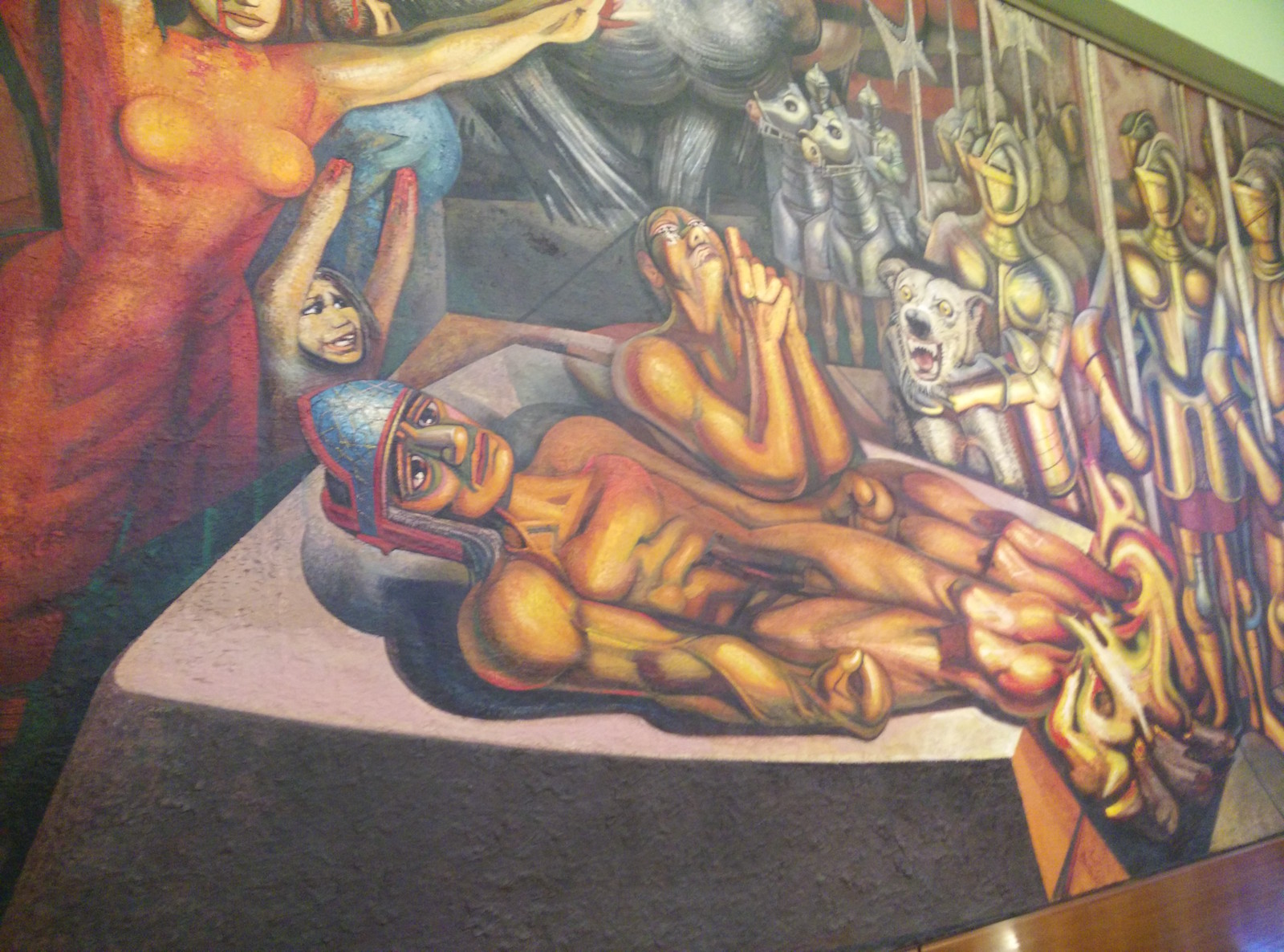
Detail view (click for the full image) of David Alfaro Siquieros‘s monumental 1950-51 mural, The Torment of Cuauhtemoc.

Boiling hot oil was then applied to their feet; upon which they confessed that, four days prior to Quauhtemoctzin’s capture, all the gold, with the cannon, crossbows, and muskets, which we had lost in the night of sorrows, when we retreated from Mexico, besides those which had been taken in Cortes’ last defeat on the causeway, had been thrown into the lake. A number of good swimmers were then sent to dive for the treasure in the spot they pointed out, but nothing was found. Yet there was some truth in the statement; for I was myself present when Quauhtemoctzin led us to a large and deep reservoir of water, built of stone, which lay near his palace. From this reservoir we fished up a sun of gold similar to the one sent us by Motecusuma, besides many jewels and other trinkets, though all of little value. The king of Tlacupa also informed us that he had hidden all manner of valuable things in some large houses, about twelve miles from Tlacupa, and he would accompany us there to point out the spot where he had buried them.

Alvarado was then despatched thither with six soldiers, among which number I also was; but when we arrived at the spot, this king assured us he had merely invented all this in the hopes that we would have killed him in a moment of anger at our disappointment.

(Diaz later added that “the suspicion was become pretty general that he [Cortes] had concealed the greater part of Quauhtemoctzin’s treasure,” and indeed some disgruntled companions — unsatisfied with the share they had been allotted for so magnificent a conquest — would come to lodge this charge against Cortes formally with Emperor Charles V.)

Cortes eventually brought both these hostages/puppet kings/torture victims along with him on a 1524-1525 expedition to Honduras, perhaps to deprive them of any opportunity to rebel in his absence.

On the evening of February 27, Cortes received a report or a rumor that the Indian kings had rebellion on their mind just the same. The timetable from this report to execution is uncertain from the records, but if it was not within 24 hours it cannot have been much longer. Diaz, a hostile-to-Cortes witness here whose narrative indicates his dismay at proceedings, describes it thus:

I have now to relate a circumstance of a very different nature, which occasioned much grief to us all. Quauhtemoctzin and other Mexican chiefs who accompanied our army had, it would appear, spoken among themselves, or secretly determined to put the whole of us to death, then march back to Mexico, and assemble the whole armed power of the country against the few remaining Spaniards, and raise an insurrection throughout the whole of New Spain. This circumstance was discovered to Cortes by two distinguished Mexican chiefs, one of whom was named Tapia, and the other Juan Velasquez. This latter personage had been Quauhtemoctzin’s captain-general during our war with Mexico, and his testimony was borne out by the investigation which Cortes made into the matter, and by the confession of several of the caziques themselves who were implicated in the conspiracy. These men fearlessly declared, that seeing how carelessly and dispiritedly we roamed about; that numbers of the men were ill from want of food; that four of our musicians, with the buffoon and five soldiers, had died of hunger; and that three other men had turned back, more willing to run the risk of reaching Mexico again than of moving forward, the thought struck them that they could not do better than fall suddenly upon us while we were crossing some river or marsh, particularly as they were upwards of 3000 in number, all armed with lances, and several of them with swords. Quauhtemoctzin did not hesitate to acknowledge that these men had spoken the truth, but added that the conspiracy did not emanate with him, and that he himself had never for a moment contemplated carrying it into effect, but had merely spoken about it with the other caziques. All the cazique of Tlacupa confessed was, his having declared to Quauhtemoctzin that it was better to die at once than daily to have death before their eyes on these fatiguing marches, and see their countrymen and relations perish with hunger.

These were sufficient proofs for Cortes, and without any further ceremony he sentenced Quauhtemoctzin and his cousin the king of Tlacupa to the gallows. Before, however, this sentence was executed, the Franciscan monks, with the assistance of Dona Marina, strove to comfort these unfortunate men, and commended their souls to God. When they were being led to the place of execution, Quauhtemoctzin turned to Cortes, and said: “Oh Malinche! I have for a long time perceived, from your false words, that you had destined me for such a death, because I did not lay violent hands on myself when you entered my city of Mexico! Why are you thus going to put me unjustly to death? God will one time ask this of you!”

The king of Tlacupa said, he could only rejoice in a death which he would be permitted to suffer with his monarch Quauhtemoctzin.

Previous to their being hung, both these unhappy caziques confessed to father Juan, who understood the Mexican language, and they begged of him to commend their souls to God. For Indians they were good Christians, and they died in the true faith, and fully believed in our holy religion.

The death of these two monarchs grieved me excessively, for I had known them in all their glory, and on our march they honoured me with their friendship, and showed me many little attentions; for instance, they would often order their servants to go in quest of fodder for my horse; besides which, they were innocent of the guilt imputed to them, and it was the opinion of all who accompanied this expedition that they were put to death unjustly.

But I will leave this miserable subject, and return to our march, on which we henceforth observed the utmost vigilance, for we greatly feared the Mexicans might rise up in arms against us, after they had thus beheld their monarch ignominiously hung by the neck from a tree. But hunger, fatigue, and sickness weighed heavier upon their minds than the misfortune of Quauhtemoctzin.


Detail view (click for the full image) of the “rebel” kings hanged from a tree.

Gomara and, of course, Cortes characterize the accusations against the Indian kings as true and the proceedings against them lawful. From the footnotes in this same Bernal Diaz volume, we have this from the later Jesuit historian and ethnographer Juan de Torquemada, who was fluent in Nahuatl:

I find it differently represented in a history written in the Mexican language, and which I believe to be perfectly correct. While Cortes (the Mexican author says) was quartered in a certain township, the Mexican chiefs one evening began to discourse among themselves about the recent hardships they had suffered, and Cohuanacotzin said to Quauhtemoctzin, to Tetlepanquetzaltzin, and to other distinguished Mexicans, ‘Thus you see, gentlemen, from kings we are become slaves, and we suffer ourselves to be led about by Cortes and this handful of Christians. If we were other people than we are, and would break through the promise we have made these Spaniards, we could play them a pretty trick here, and revenge ourselves upon them for all they have done to us, and the ill-treatment my cousin Quauhtemoctzin has suffered at their hands.’ To this the Mexican monarch replied, ‘I beg of you Cohuanacotzin to drop this subject, lest some one should overhear us, and imagine we were in earnest.’ It appears (continues Torquemada) that they were indeed overheard, for the whole of this discourse was reported to Cortes by a low-minded Mexican of the lower classes.

By law, Mexican flags fly at half-staff in his honor on February 28.

* These texts are cited throughout the post, but for ease of reference … Bernal Diaz: Memoirs of the Conquistador Bernal Diaz del Castillo, vol. 1, vol. 2 | Gomara: The Pleasant Historie of the Conquest of the West India; now called New Spaine | Cortes: History of New Spain, which is a Spanish text as I could not locate an English translation. However, even the Anglophone is liable to appreciate (from p. 225) the illustrations of Indian material culture observed by the Spaniards.

On this day..

1930: Luigi Versiglia and Callistus Caravario, missionary martyrs

From Butler’s Lives of the Saints: February:


Bishop Versaglia (left) and Father Caravario.

BB Aloysius Versaglia, Bishop and Martyr (1873-1930), and Callistus Caravario, Martyr (1903-1930)

These two martyrs in China are the first two martyrs of the Salesians of Don Bosco (St. John Bosco; 31 Jan.). They belong to a later period than the Martyrs of China considered on 17 February, above, and though they inherited much of the same history, merit separate consideration here. They died in a period marked by continued feuding between local warlords, the rise of the Kuomintang government of Sun-Yat-Sen and then Chiang-Kai-Shek, the birth of the Chinese Communist party, its initial alliance and then break with the Nationalists, and the continued “imperialist” protection of foreign interests and nationals in China.

Aloysius (Luigi) Versaglia was born in Olivia Gessi, near Pavia in the Lombardy region of Italy, on 5 June 1873. Don Bosco sent him to study at his Valdocco “Oratory” in Turin when he was twelve. At that stage his great passions were mathematics and horses, and he told his parents that he was going to study there not to become a priest but to be a veterinary surgeon. He had counted without the extraordinary charism of Don Bosco, however; he changed his mind and joined the Salesians four years later, making his simple profession on 11 October 1889. He studied for a doctorate in philosophy from 1890 to 1893, was ordained in 1895, and spent ten years as superior and novice-master of the new Salesian seminary at Genzano, near Rome. In 1905 the bishop of Macao appealed to the Salesians for missionaries. Aloysius had always longed for a missionary summons; he was appointed leader of the first Salesian missionary expedition to China, setting sail on 7 January 1906 and based initially in Macao. There he was put in charge of a small orphanage, which he transformed into a highly respected school with two hundred pupils and a spiritual centre for the whole town.

A secularizing revolution in Portugal in 1910 deprived the religious of their school, at least for a time, and the bishop sent him into China, on the Heung-Shan mission, between Macao and Canton. This was also the year of the downfall of the Chinese “Heavenly Empire,” which gave way to a republic plunged into civil turmoil. Aloysius organized residences, schools, and hospitals; he trained catechists and dreamed of a wider mission entrusted to the Salesians alone. This was to come about in 1918, when the superior of the College of Foreign Missions in Paris persuaded the pope to split the apostolic vicariate of Kwangtung (Canton and surrounding area) into two, entrusting the northern portion, with its centre at Shiu-Chow (where Matteo Ricci had landed in 1589), to the Salesians. New missionaries were sent from Turin: their leader brought Aloysius a fine chalice as a presence from the superior general of the Salesians in Turin; he took it in his hands and recalled a dream Don Bosco had had — that the Salesian mission in China would grow when a chalice was filled with blood: “It is that chalice you have brought me; it is my task to fill it,” he said. In 1920 the area was constituted an “autonomous apostolic vicariate,” and Aloysius was the obvious person to take charge of this. He was consecrated bishop on 9 January 1920 in the cathedral of Canton.

He took charge at a dangerous time, which made his presentiment of a martyr’s death entirely probable of fulfilment. The Kuomintang government of Sun-Yat-Sen had not succeeded in unifying the country, and local warlords still ruled in the north. The apostolic vacariate [sic] straddled the north-south divide. Sun-Yat-Sen appealed to the newly-formed Communist party for help; its ideology had inherited violent anti-foreign feeling from the Boxers. In such conditions, nevertheless, Aloysius over the next nine years built elementary, secondary, and tertiary schools and colleges, a cathedral, orphanages, and a seminary for Chinese candidates to the priesthood. The continued development of a native clergy was the outstanding missionary achievment [sic] of the 1920s, and Aloysius played a leading part in it. The bishop undertook endless and exhausting pastoral visitations throughout his territory, and the number of Christians trebled. Monsignor, later Cardinal, Constantini, then representative of the Holy See in China, was to say of him:

He was the best type of missionary bishop: simple, courageous, inspired by the apostolic fervour stemming from a deep communion with God and seeking nothing other than God’s reign and glory. Father and brother rather than commander, and so deeply loved and obeyed by missionaries and faithful, from whom he asked no more than he himself had done or was prepared to do.

Callistus (Callisto) Caravario was born into a working-class family in Cuorgne oin Piedmont on 8 June 1903, was educated by the Salesians, and joined the Order, taking his first vows on 19 September 1919. In 1922 he met Bishop Versaglia when the latter made a visit to Turin and promised him that he would rejoin him in China. He was sent on the China mission in October 1924. His first appointment was in Shanghai, where the Salesians had opened a school for orphans; there he learned English, French, and Chinese, began to study theology, and prepared children for baptism. The city was attacked by Nationalist-Communist militia in 1926, and his superior sent him away for safety to the island of Timor in the Indonesian archipelago, then a Portuguese colony. The Nationalists broke with the Communists in 1927, taking charge of Shanghai. After spending two years teaching and studying on Timor, Callistus returned to China, saying that he would die a martyr’s death there; he was ordained by Aloysius Versaglia in Shanghai on 18 May 1829 as a priest for the vicariate of Shiu-Chow. Thereafter the bishop and priest worked in close collaboration for what were to prove the last eight months of Callistus’ life. He was sent to join another priest in the distant mission station of Lin-Chow in a ministry caring for 150 converts and two schools, one for boys and one for girls. He was back in Shiu-Chow on 13 February 1930, when Bishop Aloysius asked him to accompany him on a pastoral visit to Lin-Chow. They were never to get there; Aloysius knew the risks but declared that if they were to wait until the passage was safe, they would never leave.

On 24 February the bishop and priest with others, including two male Chinese teachers, a sister of each of these, and a young woman catechist destined for the Lin-Chow mission, embarked by boat on the Pak-Kong Rier. The three young women were Mary Tong Su-lien, aged twenty-one, returning home to inform her parents of her decision to become a nun; Pauline Ng Yu-che, aged sixteen; and the catechist, Clare Tzen Tz-yung. The presence of these attractive young women on the boat was to play a decisive part in the subsequent course of events.

The previous year, Chiang-Kai-Shek had defeated a Communist force under General Chang-Fat-Kwai, whose soldiers were roaming the countryside living by brigandage. The bishop’s junk, after a day’s journey, happened on a band of river pirates, who regularly operated on the river and generally let missionaries pass unharmed. But this group had been joined by some soldiers from the defeated Communist army, who had been indoctrinated with anti-foreign and anti-Christian attitudes. They demanded $500 to allow the boat to proceed, threatening to shoot its occupants if this was not paid. Aloysius and Callistus protested that they were missionaries, who had usually been treated with respect, but the soldiers called them “European devils” and boarded the junk. there they found the young women and tried to drag them off to rape them. (It is possible that one of them may have been a rejected suitor of Mary Tong.) The bishop and priest stood in the doorway of their cabin to prevent this but were knocked to the ground with rifle-butts and bamboo canes.

They were all dragged on to the river bank, where Aloysius and Callistus were bound and shoved into a clump of bamboo. The women were asked why they wanted to follow the missionaries to their death; they were told that the Communists were going to destroy the Catholic Church and that they should follow them instead. Callistus made a last attempt to save them, offering to send money, but the soldiers replied that they no longer wanted the money, only to kill them because they belonged to the hated foreign religion. Aloysius begged them to kill him only, as he was old, and to spare the young, but to no avail. The brigands shot him and Callistus, battering in their skulls and putting out their eyes after they were dead. The two teachers were sent on their way on the junk. Their sisters and the catechists were taken off into the mountains. They were freed three days later by soldiers of the Nationalist army and told the whole story, declaring that Aloysius and Callistus had given their lives for them. The soldiers had paid some local villagers to bury the two bodies, which were recovered two days later. They were given an honourable burial in Shiu-Chow on 13 March. The two martyrs were regarded locally as heroes by both Christians and non-Christians because they had died to defend the women. The evidence of the specifically anti-Christian motives of the soldiers was sufficient for the Vatican to decide that they had died for the Faith; both were beatified by Pope John Paul II on 15 May 1983.

On this day..

1799: Andrea Serrao, Bishop of Potenza

On this date in 1799, the Bishop of Potenza was lynched by the faithful.

Andrea Serrao English Wikipedia entry | Italian) was a late disciple of the reformist Jansenist movement which tended among many other things to such Enlightenment-friendly notions as liberty of conscience, the reduction of the papal authority, and “regalism” — the doctrine of secular supremacy over ecclesiastical.

According to Owen Chadwick’s The Popes and European Revolution, Serrao as Bishop of the southern Italian city of Potenza

found a cathedral in disrepair, a seminary closed for the last eleven years. He raised the money for a rebuilding of the cathedral, reopened the seminary, of which the products were suspect for their ideas of liberty. He was as strong a reformer as [fellow Jansenist Bishop Scipione de’]Ricci,* and with many of the same ideas. He held a diocesan synod which is unknown because the acts were afterwards destroyed by government; but evidently its conclusions resembled those of Ricci’s Synod of Pistoia. He may have been more radical than Ricci, for he wanted clergy to be allowed to marry.

In December of 1798, Bourbon authority collapsed in the Kingdom of Naples — which ruled all of southern Italy, including Potenza — leading to the formation of the Parthenopean Republic. Serrao fully embraced it, “and urged them to obey the new government; and at the end of his address the people cried ‘Long live the French government. Long live liberty!’ and rushed out into the piazza to plant a tree of liberty. Bishop Serrao then accepted the office of civil commissioner of Potenza.” (Chadwick again)

But this Republic was destined for an imminent and bloody conclusion.

The most immediate reaction, and the one that led to Serrao’s abrupt death, was the summons of Fabrizio Cardinal Ruffo to a popular anti-Republican movement, called Sanfedismo (“Holy Faith”). In early February, a bare two weeks after the Parthenopean Republic’s establishment, Ruffo ventured from the royal refuge on Sicily and landed at his native Calabria like Che Guevara, with nothing but a handful of companions.

“Brave and courageous Calabrians, unite now under the standard of the Holy Cross and of our beloved sovereign,” Ruffo’s summons to a resistance implored. “Do not wait for the enemy to come and contaminate our home neighbourhoods. Let us march to confront him, to repel him, to hunt him out of our kingdom and out of Italy and to break the barbarous chains of our holy Pontiff. May the banner of the Holy Cross secure you total victory.”

Ruffo’s message was a winner and almost instantly began attracting holy guerrillas by the hundreds; in a few months’ time, Ruffo secured the surrender of the Republicans in Naples itself, by which time his army is reputed to have numbered 17,000.

And even in its earliest promulgation, it attained — seemingly to Andrea Serrao’s surprise — strength enough to overwhelm that tree of liberty stuff in Potenza within days of Ruffo’s landing. Back to Chadwick:

When Ruffo’s bands drew near to Potenza, many peasants and some priests regarded Bishop Serrao as ‘the enemy of the Pope, the king, and God’. Warned to escape, he said that he trusted his fellow-citizens. When the professors and students at the seminary wanted to make a bodyguard, he forbade them to arm.

Very early on 24 February 1799 soldiers of the Potenza guard smashed the tree of liberty, and raided the bishop’s palace. They came upon Serrao still in bed, and killed him with two shots of a pistol. Bleeding to death, he uttered the words ‘Long live the faith of Jesus Christ! Long live the Republic!’ The guards broke into the seminary next door, and murdered the rector as his students fled. After sacking palace and seminary they cut off the heads of bishop and rector and carried them in triumph round the city on pikes.

* There’s an interesting public domain biography of Ricci which, without any direct reference to Serrao, delves into the theological and political conflicts of the age that would have been of interest to our principal.

On this day..

2013: Kepari Leniata burned as a witch

On this date in 2013, villagers at the Papua New Guinea village of Paiala tortured their neighbor Kepari Leniata into confessing the witchcraft murder of a local child, then burnt her alive in a trash dump. Sorcery is widely feared and practiced in PNG.

Kepari Leniata, 20, ‘confessed’ after she was dragged from her hut, stripped naked and tortured with white-hot iron rods.

She was then dragged to a local rubbish dump, doused in petrol and, with hands and feet bound, thrown on a fire of burning tyres. As the mother-of-two screamed in agony, more petrol-soaked tyres were thrown on top of her.

The tragedy unfolded after Miss Leniata’s young neighbour fell sick on Tuesday morning. He complained of pains in the stomach and chest and was taken to Mt Hagen hospital where he died a few hours later.

Relatives of the boy were suspicious that witchcraft was involved in the death and learned that two women had gone into hiding in the jungle.

After they were tracked down, the pair admitted they practised sorcery but had nothing to do with the boy’s death. Miss Leniata, they said, was the person responsible.

The boy’s family went to her hut at 7am on Wednesday, stripped her and dragged her away to torture and death. (Source)

Horrific pictures circulated in the international media.

On this day..

1811: The slaves of the German Coast Uprising

Villainous blacks, and MORE VILLAINOUS WHITES who have reduced to the level of the beasts of the field these unhappy Africans — and are now obliged to sacrifice them like wild beasts in self preservation! The day of vengeance is coming!

-Marietta, Ohio Western Spectator, March 5, 1811

On this date in 1811, Louisiana planters commenced their executions of rebel slaves involved in the German Coast Uprising.

Also known as the Deslondes rebellion after the surname of its mulatto commander, this was a larger insurrection than the better-known Nat Turner rebellion: in fact, it was the largest slave rebellion in U.S. history. Louisiana at this point was still new to the Union courtesy of the 1803 Louisiana Purchase; Congress in 1811 would take up the question of statehood for the former French colony and its liability to slave rebellions stoked by Gallic sugar magnates offered no small store of vehemence for the Republic’s orators. (Louisiana was admitted as a state in 1812.)

On January 8 of that same year of 1811, some 60 to 125 black men and women — slaves of Louisiana’s brutal sugarcane economy, as well as runaways and maroons lurking in nearby river swamps — rebelled at Col. Manuel Andry’s plantation 36 miles from New Orleans. Andry was wounded but miraculously escaped, leaving behind a son whom his slaves were energetically stabbing and axing past death.

Under the improbable leadership of Charles Deslondes, who had enjoyed so much trust as to be a Andry’s slave overseer, the slaves stripped the plantation of gunpowder, weapons, horses, liquor, and the like, and began following the Mississippi along River Road — drumming, chanting, exulting with cries of “On to Orleans!”

American Uprising Book CoverWhether they knew it or not, they had selected an auspicious moment for their uprising: New Orleans lay practically defenseless, its regular garrison off augmenting the realm via the conquest of adjacent West Florida.* The rebels multiplied several times over as they marched, swelling to perhaps 500 strong over two days as they rolled through plantations — each one a sea of servile labor vastly outnumbering its white household. Yet only one more white man besides Col. Andry’s son died during the German Coast Uprising as, forewarned, planters’ families were able to flee ahead of the Jacquerie.

The Louisiana territory skirted the volcano’s mouth in this moment and everyone realized it: New Orleans, the slaves’ avowed target, was itself two-thirds black. Had the rebels reached it, something cataclysmic might have begun.† “Had not the most prompt and energetic measures been taken, the whole coast would have exhibited one general scene of devastation,” Navy Commodore John Shaw wrote to Washington, having dispatched a company of marines to shore up New Orleans’s defenses. “Every description of property would have been consumed, and the country laid waste by the Revolters.”

Instead, and as was always eventually the case, the volcano swallowed the slaves instead. Sixteen miles from the Big Easy, a scrambled militia of New Orleans volunteers and some federal dragoons and infantry pulled from Baton Rouge managed

to meet the brigands, who were in the neighbourhood of the plantation of Mr. Bernoudi [present-day Norco -ed.], colors displayed and full of arrogance. As soon as we perceived them we rushed upon their troops, of whom we made considerable slaughter.

Not a single white person lost his life in the fray but scores of slaves were either killed in fighting, were summarily executed upon capture, or, fleeing from the carnage, were hunted to their deaths in the following days. The exact butcher’s bill is unknown; Louisiana officials counted 66 dead slaves in the immediate aftermath of action, including those executed, but this certainly understates the figure.

Where principal rebels were known, the revenge was exemplary. Pierre Griffe and Hans Wenprender, who were said to have personally imbrued their hands with the blood of the two dead white planters at the outset of the rebellion, were killed on the spot, mutilated, and their heads cut off as trophies for Colonel Andry.

Decapitation and worse was also the fate awaiting captives, at least 21 of whom were ordered for immediate death on January 15 by a tribunal of planters hastily assembled for the task. “By the end of January, around 100 dismembered bodies decorated the levee from the Place d’Armes [Jackson Square -ed.] in the center of New Orleans forty miles along the River Road into the heart of the plantation district,” in the words of a recent book about the affair. Such decor cost the territory $300 per piked head in compensation to the dead slaves’ former owners.

We excerpt the sentence from the tribunal’s own hand, as published in Louisiana History: The Journal of the Louisiana Historical Association, Autumn 1977.

The Tribunal assembled on the 14th and called before it the Negroes: Jean and Thomas, belonging to Mr. Arnauld; Hypolite, belonging to Mr. Etienne Trepagnier; Koock, belonging to Mr. James Brown; Eugene and Charles, belonging to the Labranche brothers; Quamana and Robaine, belonging to Mr. James Brown; Etienne, belonging to Mr. Strax; Louis and Joseph, belonging to Mr. Etienne Trepagnier; the mulatto Guiau, belonging to Messrs. Kenner and Henderson; Acara, belonging to Mr. Delhomme; Nede, belonging to Mr. Strax; and Amar, belonging to Widow Charbonnet; all of whom confessed and declared that they took a major part in the insurrection which burst upon the scene on the 9th of this month.

These rebels testified against one another, charging one another with capital crimes such as rebellion, assassination, arson, pillaging, etc., etc., etc. Upon which the Tribunal, acting in accordance with the authority conferred upon it by the law, and acting upon a desire to satisfy the wishes of the citizenry, does CONDEMN TO DEATH, without qualifications, the 18 individuals named above. This judgment is sustained today, the 15th of January, and shall be executed as soon as possible by a detachment of militia which shall take the condemned to the plantation of their owners and there the condemned shall be shot to death. The tribunal decrees that the sentence of death shall be carried out without any preceding torture.

It further decrees that the heads of the executed shall be cut off and placed atop a pole on the spot where all can see the punishment meted out for such crimes, also as a terrible example to all who would disturb the public tranquility in the future.

Done at the County of the Germans, St. Charles Parish, Mr. Destrehan’s plantation, January 15, 1811, at 10 o’clock in the morning.

Signed,
Cabaret
Destrehan
Edmond Fortier
Aud. Fortier
A. Labranche
P.B. St. Martin

We know for sure that the militia effected these grisly sentences with dispatch because this same body condemned three more slaves to the same fate later that same day, ordering that “their heads shall be placed on the ends of poles, as those of their infamous accomplices, who have already been executed.” Yet even this was better due process than a number of other prisoners enjoyed at the hands of angry white men; the Maryland-born naval officer Samuel Hambleton recorded the “characteristic barbarity” of the French oligarchy with disgust:

Several [slaves] were wrested from the Guards & butchered on the spot. Charles [Deslondes] had his Hands chopped off then shot in one thigh & then the other until they were both broken — then shot in the Body and before he had expired was put in a bundle of straw and roasted!”‡

The shock prompted an immediate tightening of security, and not only in Louisiana — where militia conscription became enforced more rigorously, both slaves and free blacks were encumbered with new restrictions on their movements, and a larger federal military presence was deployed at Louisiana’s own request. The legislatures of Kentucky, Tennessee, and the Mississippi territory — Mississippi wasn’t admitted to statehood until 1817 — all likewise buffed up their militias in the wake of German Coast.§

* Latterly Spanish, West Florida is no part of the present-day U.S. state of Florida; rather, Florida’s former littoral extrusion towards the Mississippi was annexed by Louisiana itself.

** When the U.S. went to war with Great Britain in 1812, Louisiana’s huge servile population made it an obvious vulnerability if the British were to land and arm the slaves. Summoning him from his Alabama stomping-grounds to his date with American folklore, Edward Livingston wrote to Andrew Jackson on behalf of the New Orleans Committee of Safety on September 18, 1814, imploring him to aid the outnumbered sugar planters:

This Country is strong by Nature, but extremely weak from the nature of its population, from the La Fourche downwards on both sides the River, that population consists (with inconsiderable exceptions) of Sugar Planters on whose large Estates there are on an average 25 slave to one White Inhabitant the maintenance of domestic tranquility in this part of the state obviously forbids a call on any of the White Inhabitants to the defense of the frontier, and even requires a strong additional force, attempts have already it is said been detected, to excite insurrection, and the character of our Enemy leaves us no doubt that this flagitious mode of warfare will be resorted to, at any rate the evil is so great that no precautions against it can be deem’d superfluous.

† The rising’s Spartacus, Charles Deslondes, was himself an import from the insurrectionary Caribbean Santo Domingo colony, which suggests a probable link by inspiration to the Haitian Revolution. Santo Domingo slaves were thought so seditious that their importation was periodically banned. However, and perhaps this is no accident, no documentation survives to elucidate the rebel slaves’ ideology, or what triggered them to rise at this particular moment.

‡ Letter to David Porter, January 25, 1811 as quoted by Robert L. Paquette in “‘A Horde of Brigands?’ The Great Louisiana Slave Revolt of 1811 Reconsidered,” Historical Reflections / Réflexions Historiques, Spring 2009. Deslondes was captured on January 11th but as far as I can ascertain, we don’t have a precise date on record for his savage extrajudicial execution/murder. It obviously falls within this same short mid-January span.

§ See Thomas Marshall Thompson, “National Newspaper and Legislative Reactions to Louisiana’s Deslondes Slave Revolt of 1811,” Louisiana History: The Journal of the Louisiana Historical Association, Winter, 1992. Thompson notices that “the Tennessee law specified, as had the one in the Orleans Territory, that blacks, mulattoes, and Indians could not be members of the militia.”

On this day..

1400: Thomas le Despenser, for the Epiphany Rising

On this date in 1400, the Thomas le Despenser was beheaded — as much a lynching as an execution — by a mob at Bristol.

“I have to London sent
The heads of Salisbury, Spencer, Blunt, and Kent.”

-Henry’s loyal (for now) nobleman Northumberland summing up the destruction of the Epiphany Rising in the last scene of Shakespeare’s Richard II

House Despenser had painstakingly rebuilt its position in the three generations since Thomas’s great-grandfather, the notorious royal favorite Hugh Despenser, was grotesquely butchered for the pleasure of Roger Mortimer. (Readers interested in a deep dive should consult this doctoral thesis (pdf))

By the end of the 14th century, the family patriarch, our man Thomas, had by 1397 parlayed his firm support of Richard II against the Lord Appellant into elevation to a peerage created just for him, the Earldom of Gloucester.

The “Gloucester” sobriquet had just gone onto the market thanks to the beheading that year of the attainted Duke of Gloucester and the consequent revocation of that patrimony. This ought to have been a hint, if his ancestors’ fate did not suffice, that such glories are fleeting. Thomas le Despenser had barely two years to enjoy his newfound rank before Richard II was deposed by Henry Bolingbroke who now styled himself Henry IV.

Despite initially making his terms with the new regime, Despenser joined a conspiracy of nobles that contemplated a coup d’etat during the 1399-1400 holidays — the Epiphany Rising, whose misfire has brought other victims to our attention previously.* Titles are the least of what one forfeits in such circumstances; Thomas managed to grab a boat for Cardiff and possible refuge but to his unhappy surprise the ship’s captain put in at Bristol to deliver him to his enemies: death was summary, his head posted to the capital for duty on the London Bridge.

The Despensers had already proven the resilience of their line in the face of the violent death of this or that scion and although this was a rough coda for their century of glory they were not done for the English political scene by a long shot. Thomas’s widow Constance** got her own plotting afoot by conspiring unsuccessfully in 1405 to kidnap Richard II’s heir from Henry’s custody as an instrument to leverage for political realignment. (Constance, Executed Today is grieved to report, was not executed for this.)

* Episode 134 of the History of England podcast grapples with the Epiphany Rising.

** Constance’s brother is popularly believed to have betrayed the Epiphany Rising.

On this day..

1066: Joseph ibn Naghrela

On this date in 1066, the Jewish vizier of Granada Joseph ibn Naghrela was lynched during a notorious pogrom.

His (more illustrious) father, the scholar, courtier, and battlefield commander Samuel ibn Naghrela (or Naghrilla, or Ha Nagid), had become the trusted vizier to the Berber emirs of the taifa of Granada in Islamic Spain. Samuel helped to manage the transition to the (present-day, for purposes of this post) emir Badis or Badus when the latter was a whelp of 18.

This was the golden age of Jewish culture in Spain, thriving in an atmosphere of relative tolerance. Needless to say, the nature and extent of this religious harmony and the weight of contrary but uncommon events like that of today’s post are fodder for lively contemporary debate that gores oxes both historiographical and geopolitical.


A Jew and a Muslim play a nice game of chess in this 13th century illustration commissioned by the Christian King Alfonso X. It’s an exemplar of the late Middle Ages era of interreligious “Convivencia”.

After his father’s passing, Joseph became a powerful vizier for Badis: maybe too powerful, or at any rate so indiscreet about his influence that the Jewish Encyclopedia knocked him as “haughty”. A poem by an enemy named Abu Ishaq, whom Joseph had balked of a sinecure, has been credited with triggering the riot and it certainly plays a few timeless leitmotifs. (The translated poem is as published in Medieval Iberia: Readings from Christian, Muslim, and Jewish Sources)

Go, tell all the Sanhaja
 the full moons of our time, the lions in their lair
The words of one who bears them love, and is concerned
 and counts it a religious duty to give advice.
Your chief has made a mistake
 which delights malicious gloaters
He has chosen an infidel as his secretary
 when he could, had he wished, have chosen a Believer.
Through him, the Jews have become great and proud
 and arrogant — they, who were among the most abject
And have gained their desires and attained the utmost
 and this happened suddenly, before they even realized it.
And how many a worthy Muslim humbly obeys
 the vilest ape among these miscreants.
And this did not happen through their own efforts
 but through one of our own people who rose as their accomplice.
Oh why did he not deal with them, following
 the example set by worthy and pious leaders?
Put them back where they belong
 and reduce them to the lowest of the low,
Roaming among us, with their little bags,
 with contempt, degradation and scorn as their lot,
Scrabbling in the dunghills for colored rags
 to shroud their dead for burial.
They did not make light of our great ones
 or presume against the righteous,
Those low-born people would not be seated in society
 or paraded along with the intimates of the ruler.
Badis! You are a clever man
 and your judgment is sure and accurate.
How can their misdeeds be hidden from you
 when they are trumpeted all over the land?
How can you love this bastard brood
 when they have made you hateful to all the world?
How can you complete your ascent to greatness
 when they destroy as you build?
How have you been lulled to trust a villain [Joseph]
 and made him your companion — though he is evil company?
God has vouchsafed in His revelations
 a warning against the society of the wicked.
Do not choose a servant from among them
 but leave them to the curse of the accursed!
For the earth cries out against their wickedness
 and is about to heave and swallow us all.
Turn your eyes to other countries
 and you will find the Jews are outcast dogs.
Why should you alone be different and bring them near
 when in all the land they are kept afar?
–You, who are a well-beloved king,
 scion of glorious kings,
And are the first among men
 as your forebears were first in their time.
I came to live in Granada
 and I saw them frolicking there.
They divided up the city and the provinces
 with one of their accursed men everywhere.
They collect all the revenues,
 they munch and they crunch.
They dress in the finest clothes
 while you wear the meanest.
They are the trustees of your secrets
 –yet how can traitors be trusted?
Others eat a dirham’s worth, afar,
 while they are near, and dine well.
They challenge you to your God
 and they are not stopped or reproved.
They envelop you with their prayers
 and you neither see nor hear.
They slaughter beasts in our markets
 and you eat their trefa
Their chief ape [Joseph again] has marbled his house
 and led the finest spring water to it.
Our affairs are now in his hands
 and we stand at his door.
He laughs at us and at our religion
 and we return to our God.
If I said that his wealth is as great
 as yours, I would speak the truth.
Hasten to slaughter him as an offering,
 sacrifice him, for he is a fat ram
And do not spare his people
 for they have amassed every precious thing.
Break loose their grip and take their money
 for you have a better right to what they collect.
Do not consider it a breach of faith to kill them
 –the breach of faith would be to let them carry on.
They have violated our covenant with them
 so how can you be held guilty against violators?
How can they have any pact
 when we are obscure and they are prominent?
Now we are humble, beside them,
 as if we had done wrong, and they right!
Do not tolerate their misdeeds against us
 for you are surety for what they do.
God watches His own people
 and the people of God will prevail.

The enraged mob stormed the palace where Joseph vainly hid himself in a coal pit — murdering the hated counselor and displaying his corpse on a cross. A general pogrom has been credited with killing some three thousand Jews around Granada.

On this day..

1901: Massacre of Barrio la Nog

Corporal Richard O’Brien gave the following account of the summary execution (or simple mass murder) of Filipino villagers during the furious American backlash after Filipino insurgents’ Balangiga Massacre of American infantrymen.

It was on the 27th day of December, the anniversary of my birth, and I shall never forget the scenes I witnessed on that day. As we approached the town the word passed along the line that there would be no prisoners taken. It meant that we were to shoot every living thing in sight — man, woman, and child. The first shot was fired by the then first sergeant of our company. His target was a mere boy, who was coming down the mountain path into the town astride of a caribou. The boy was not struck by the bullet, but that was not the sergeant’s fault. The little Filipino boy slid from the back of his caribou and fled in terror up the mountain side. Half a dozen shots were fired after him. The shooting now had attracted the villagers, who came out of their homes in alarm, wondering what it all meant. They offered no offense, did not display a weapon, made no hostile movement whatsoever, but they were ruthlessly shot down in cold blood — men, women, and children. The poor natives huddled together or fled in terror. Many were pursued and killed on the spot.

Two old men, bearing between them a white flag and clasping hands like two brothers, approached the lines. Their hair was white. They fairly tottered, they were so feeble under the weight of years. To my horror and that of the other men in the command, the order was given to fire, and the two old men were shot down in their tracks. We entered the village. A man who had been on a sick-bed appeared at the doorway of his home. He received a bullet in the abdomen and fell dead in the doorway. Dum-dum bullets were used in that massacre, but we were not told the name of the bullets. We didn’t have to be told. We knew that they were.

In another part of the village a mother with a babe at her breast and two young children at her side pleaded for mercy. She feared to leave her home, which had just been fired — accidentally, I believe. She faced the flames with her children, and not a hand was raised to save her or the little ones. They perished miserably. It was sure death if she left the house — it was sure death if she remained. She feared the American soldiers, however, worse than the devouring flames.

On this day..