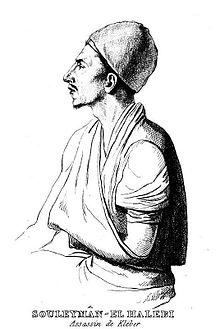
1800: Suleiman al-Halabi, assassin of General Kleber

On this date in 1800 — which was the same date they buried his victim — the 23-year-old student Suleiman al-Halabi was put to death in Cairo for assassinating French General Jean Baptiste Kleber.
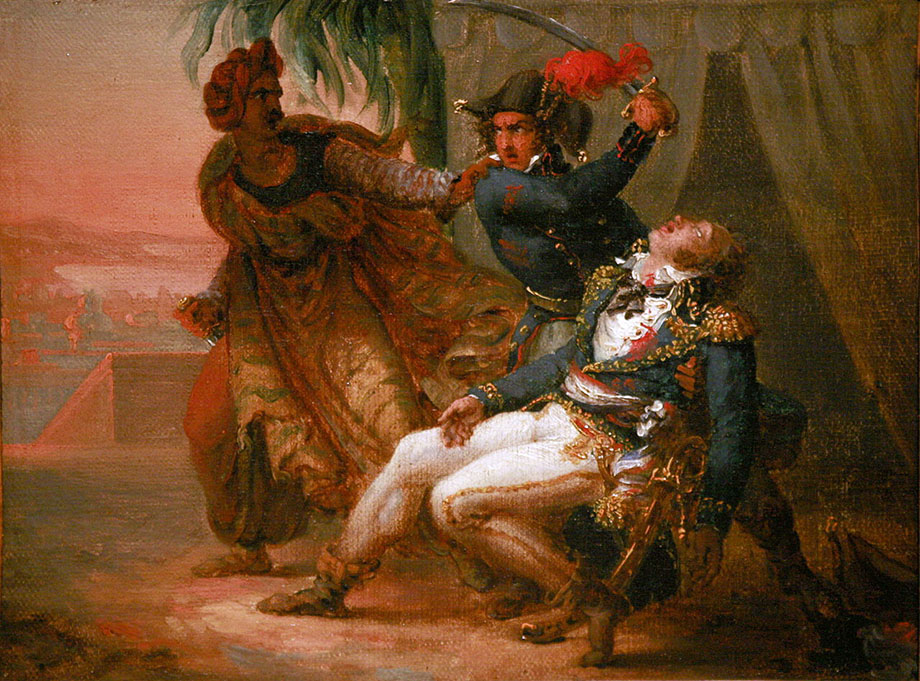
Casualty of the brief Napoleonic adventure in Egypt, Kleber had received supreme command of the expedition when Napoleon himself returned to France the previous year — a mission which involved running the English naval blockade that trapped the Armee d’Orient.

Kleber, a product of the French Revolution’s military meritocracy who had attained his rank capably suppressing the Vendee royalists, was certainly up to the martial tasks at hand. He routed a larger Ottoman-English-Mamluk force in March of 1800, and then smashed a revolt in Cairo.

But the Napoleonic invasion often figures as a periodization marker for this region: the germ of liberalism and nationalism that would tear apart the Ottoman Empire and set the scene for a recognizably modern Middle East. So it’s somewhat fitting that Kleber would be undone by a figure who could be lifted from the evening news,* the anti-occupation insurgent.

Suleiman al-Halabi (English Wikipedia entry | French) was a Syrian Kurd hailing from Aleppo. (“al-Halabi” means “of Aleppo”)

He had been in Cairo to study, but after a return visit home was induced by the Turks to attend himself to punishing the invader instead. He then made his way back to to Egypt where, disguising himself as a beggar, where he was able to approach the general innocuously and dagger him to death.

The French, of course, had just a few years before this point introduced its most distinctive execution device in place of the ghastly old methods, and employed it with egalite for commoner and king alike. Nor was France, as an imperial power, reluctant about exporting its invention to the every corner of earth.

But in this particular instance, the French decided to prioritize, er, cultural sensitivity.

The committee, after carrying through the trial with all due solemnity and process, thought it necessary to follow Egyptian customs in its application of punishment; it condemned the assassin to be impaled after having his right hand burned; and three of the guilty sheikhs to be beheaded and their bodies burned.

The “guilty sheikhs” in question were men to whom the killer had confided — not his plan, exactly, but the fact that he was on a jihad mission. Hey, close enough.

As for Suleiman al-Halabi himself,

The executioner Barthèlemy sat down on Suleiman’s belly, drew a knife from his pocket, and made a large incision to widen the rectum, then hammered the point of the stake into it with his mallet. Then he bound the patient’s arms and legs, raised the stake the air and mounted it in a prepared hole. Suleiman lived for four hours, and he had lived longer save that, during the absence of Barthèlemy, a soldier gave him a drink which caused his immediate death.

(Impaling victims could live for agonizing days, but the water caused Suleiman, mercifully, to quickly bleed out.)

Not content with going all Vlad the Impaler, the French then paid homage to the invasion’s scientific sub-theme** by shipping Suleiman’s remains back to France for use as an anthropological exhibit.† His skull still remains at the Musee de l’Homme to this day. What’s left in his homeland(s) is a martyr’s memory.

According to the scholar al-Jabarti, whose chronicle is one of the principal sources on this episode, the investigation indicated that Suleiman undertook his mission for no ideology save his family’s desperate need of the purse the Porte was willing to offer. But in the ensuing decades’ growth of nationalism and, eventually, anti-colonialism, the brave young Muslim dying on a spike to slay the French commander could not help but be viewed in an exalted light. (Notably, at the acme of Arab nationalism, the Egyptian writer Alfred Farag celebrated Suleiman as an avatar of resistance in a 1965 play. “I do not kill for revenge,” Farag’s Suleiman avers — and when pressed for the reason, he has a one-word reply: “Justice.”)

* Indeed, the name has been in the news: there’s a Suleiman al-Halabi neighborhood in Aleppo that has seen fighting during the ongoing Syrian civil war. Since it’s even a Kurdish neighborhood one can’t but suspect that it’s named for the man featured in this post; however, I haven’t been able to establish that with certainty. If any reader knows, a comment would be most welcome.

** Napoleon brought a corps of scientists and intellectuals along on his invasion, kicking off the modern Egyptology craze. His mission also uncovered the Rosetta Stone — although that artifact now resides in the British Museum because of the aforementioned naval blockade.

† According to Dark Trophies: Hunting and the Enemy Body in Modern War, phrenologists hailed Suleiman’s skull as an outstanding exemplar of criminality and fanaticism.

On this day..

1942: Vladislav Vancura, “Marketa Lazarova” author

On this date in 1942, leftist Czech novelist Vladislav Vancura was executed at Prague’s Kobylisy shooting range.

An “unsung giant” of European letters, the Bohemian doctor burst onto the literary scene in the 1920s with Pekar Jan Marhoul (Baker Jan Marhoul) and Pole orná a válecná (Fields to Plough, Fields of War). But he was notable for a remarkable perspicacity in style, genre, and artistic perspective throughout his career. He’s often referred to as a poet in prose, and maybe for this reason was equally keen on writing for and directing cinema.

Milan Kundera credited Vancura with “probably the richest vocabulary that any Czech writer has ever had; a vocabulary in which the language of every era is preserved, in which words from the Bible of Kralice [the first complete translation of the Bible into Czech] stand humbly side by side with modern argot.”

His greatest commercial success and possibly his crowning achievement was Marketa Lazarova, a short novel (120 pages in the original Czech) set amid a feud of nobles in he Middle Ages. Only tranlated into English in 2013, it “does for Czech literature something akin to what James Joyce did for English-language literature with Ulysses: breaking with the realism that previously dominated to open up a new frontier in the realm of style.”

Here’s an excerpt (via):

Folly scatters without rhyme or reason. Lend an ear to this tale of a place in the county of Mladá Boleslav, in the time of the disturbances, when the king strove for the safety of the highways, having cruel troubles with the nobles, who conducted themselves downright thievishly, and what is worse, who shed blood practically laughing out loud. You have become truly too sensitive from musing upon our nation’s nobility and fair manners, and when you drink, you waste the cook’s water, spilling it ‘cross the table, but the men of whom I speak were an unruly and devilish lot. A rabble which I cannot compare to anything else than stallions. Precious little cared they of that which you account as important. Comb and soap! Why, they did not heed even the Lord’s commandments.

‘Tis said that there were countless such ruffians, but this story concerns itself with none save the family whose name most surely calls to mind Václav unjustly. Shifty nobles they were! The eldest amidst this bloody time was baptized with a graceful name, but forgot it and called himself Kozlík till the time of his beastly death.

Vancura’s death was plenty beastly too, albeit not particularly surprising: Communist avant-garde artists in German-occupied Slavic countries didn’t usually fare the best during the war years, and Vancura compounded his risk by taking active part in the resistance. He was among hundreds of Czechs arrested, tortured, and executed in the bloody German crackdown that followed the May 27, 1942 assassination of Reinhard Heydrich.

On this day..

1559: The remains of David Joris, Anabaptist fugitive

On this date in 1559, the corpse of “Johann van Brugge” — recently exposed as underground Anabaptist leader David Joris, even though Brugge/Joris was three years dead — was burned in Basel.

The flame-bearded Joris (English Wikipedia entry | the more detailed Dutch) was a glass-painter by trade who came to the fore of the Anabaptist movement following its catastrophe at Muenster.

His home city of Delft in 1528 had flogged him and bored his tongue for his religious scruples, but Joris maintained a strong following among the re-baptized in that city. Many of those followers had occasion to try their faith against the torturers’ tongs, and dozens of arrestees impressively concealed their leader’s whereabouts from his enemies. The man’s own mother was executed in 1539.

He could only duck in and out of Delft — once he had to slip out in a basket innocuously loaded onto a boat* — or any other city. From the 1530s, his was a life on the run in Reformation Europe, where Anabaptists were no safer from Protestants than they were from Catholics.

(Sample dangerous heresy: Joris was a very early adopter of the idea that the devil was best understood as an allegorical figure, not an actual entity.)

With a literal price on his head he wandered to Strassburg, to England, back to the continent in Westphalia and Oldenburg, Strassburg again, then Antwerp, and on to Basel, Switzerland in 1544.

In Deventer in 1542 his ecstatic Wonder Boeck was printed. (We recommend the engravings.)

In Basel our hunted man was able to settle in as Brugge and live out the balance of his life, still pouring out voluminous writings in secret — a very impressive retirement considering his notoriety and his distinctive facial hair. Joris was in his fifties when he died: the years of rough living on the run had done him no favors.

Three years after his death, his son-in-law — who disagreed with Joris theologically — exposed his real identity. Basel had nothing left to do about it but to visit on his bones the punishment David Joris’s living flesh escaped to the end of his days.

* From Gary Waite’s “Staying Alive: The Methods of Survival as Practiced by an Anabaptist Fugitive, David Joris” in the January 1987 Mennonite Quarterly Review.

On this day..

1963: Julian Grimau, the last casualty of the Spanish Civil War

On this date in 1963, Francisco Franco’s government shot Communist agitator Julian Grimau.

Grimau (English Wikipedia entry | Spanish), a member of the Communist Party of Spain‘s Central Committee since 1959, had fled to exile after escaping the end of the Spanish Civil War in 1939.

But he in 1959 he took over the Communists’ activities within Spain itself, and began living underground in his old homeland. The Franco regime dearly wanted to take him.

In November 1962, secret police arrested Grimau on a bus and hustled him to Madrid’s Puerta del Sol, where within hours Grimau met with that classic 20th century dissident’s fate, the “unexplained” fall from a police headquarters window. No fuss, no —

Wait. Er … it seems he survived the fall.

That awkward circumstance — officially, Grimau hurled himself out the window for no discernible reason — tracked him into what passed for a regular judicial process. In practice, that meant a military tribunal which gave him, two days before his execution, a five-hour trial for his part in the Spanish Civil War. Specifically, Grimau was charged as a “Chekist” for torturing and executing prisoners while part of the civil administration of Republican Barcelona; the evidence submitted on this point was mere hearsay.

This charge put the fascists in the rather insincere position of avenging the Communist Party’s repression of its own civil war allies, the anarchists and the anti-Stalinist POUM party — an episode memorably recounted in Orwell’s Homage to Catalonia.

“I have never tortured anyone,” Grimau insisted to the court of the military dictatorship. “It is not my nature to do such things. I carried out the duties assigned to me by a legal government. I have been a communist for 25 years and I will die a communist.” (London Times, April 19, 1963)

Grimau’s prosecutor was a man who had made his legal bones in the immediate aftermath of the civil war as Franco’s Fouquier-Tinville, shuttling defeated Republicans into the hands of their executioners so lightly that he would joke, “bring in the accused’s widow!” with a laughing court.* This 1963 trip down nostalgia lane would prove to be the last ever occasion a Spaniard was prosecuted for the civil war; indeed, the Grimau backlash would help provide the impetus for Spain to finally scrap the military tribunals which dated to the aftermath of the civil war.

Those laws, and that war, had passed a quarter-century before. Their nakedly political requisition here triggered international outrage. Eight hundred thousand people and a litany of world leaders implored Gen. Franco to exercise his prerogative to block the execution; when Franco refused, protests livened the Spanish embassies of many a city across the globe. In Buenos Aires, someone chucked a bomb at the embassy.

None of it availed Julian Grimau. Grimau’s lawyer, who witnessed the dawn execution illuminated by the headlights of military trucks, reported that the soldiers detailed to form the firing squad were very nervous and badly botched the shooting.

There’s more about Julian Grimau in Spanish than in English; see in particular JulianGrimau.org, a site commemorating the 50th anniversary of his execution.

* The prosecutor, Manuel Martin Fernandez, didn’t even have a law degree: he had entered the profession by falsely claiming that his credentials were destroyed during the civil war. In 1964 this became publicly exposed and Fernandez himself went to prison for his decades-long imposture.

On this day..

1954: Lucretiu Patrascanu, purged Romanian

On this date in 1954, Lucretiu Patrascanu was shot in Jilava Prison outside Bucharest.

The widow’s-peaked longtime pol was one of the first inductees of the Romanian Communist Party (PCR) after its 1921 founding. Patrascanu (English Wikipedia entry | Romanian) was 21 years old then: the spirited politicking within the Communist movement would define the whole of his adult life.

By the 1930s, he held a position of national leadership. Patrascanu served in the Romanian legislature, and became a party representative to the Comintern.

It might have been at a Comintern road trip to Moscow in the 1930s that Patrascanu’s disillusionment with Stalin began. If so, it was beside the point: leftists in Romania (like everywhere else) had the more immediate threat of fascism to contend with.

After spending most of the war years under arrest, Patrascanu re-emerged as a state minister. He personally helped to author the August 23, 1944 coup that flipped Romania out of the Axis camp. But by the very next year he was under police surveillance.

He fell in the Soviet-driven late 1940s purge of Eastern European Titoists, for having such insufficiently internationalist notions as “before we are Communists, we are Romanians.” His time in prison was long enough for authorities to model his show trial on the 1952 Czechoslovakian Slansky trial, though Patrascanu himself disdained to denounce himself, or even to dignify the proceedings with a defense.

I have nothing to say, except [that I] spit on the charges brought against me.

He was posthumously rehabilitated in 1968 by Nicolae Ceausescu.

* Poignantly, Patrascanu was said to have read Koestler’s dystopian novel of the Soviet purges, Darkness at Noon, while an envoy to the 1946 Paris Peace Conference.

On this day..

1901: Filipino insurgents on Luzon

The American occupation of the Philippines from 1899 spawned a widespread indigenous resistance whose “hatred of our people is as bitter as it is groundless,” one American general puzzled.

Not all Americans saw it that way. William Jennings Bryan‘s populist magazine The Commoner slagged the U.S. Army for its liberal use of “the methods best calculated to give them new reasons for hating us.”


Cartoon on the cover of Life magazine’s May 22, 1902 issue (click for larger image) shows colonial European powers chortling, ‘Those pious Yankees can’t throw stones at us any more’ as they watch Americans apply the water cure to a Filipino captive. Torture by water cure was widespread during the Philippines-American War.

“The native is tied down flat on the ground and his mouth forced open with sticks or a string,” one soldier described it (pdf source; it’s on page 23). “Water is poured down his throat through a bamboo tube, which is nearly always handy. The native must drink the stuff, and it is poured down him until he can hold no more. As much as a gallon can be forced into a man that way. Then the water is pumped out of him by stamping on his stomach or rolling him over. When he comes to the native is always ready to talk.”

Apart from guerrillas in the field, Filipino insurgents opposed the occupiers’ superior firepower with the nasty asymmetrical tactics of assassination and terrorism, and that’s what brings us to today’s post.

Filipino terrorists known as Ducots, Mandoducots, or Sandathan on August 28, 1900 murdered a wealthy Los Banos landowner named Honorato Quisumbing who served as a town “presidente” under the American occupation.

A U.S. military court found that nine prisoners at the bar (in combination with “other natives whose names are unknown”) made “an assault upon the said Honorato Quisumbing with clubs, knives, bolos, and daggers, and did then and there wilfully, feloniously, and with malice aforethought kill and murder the said Honorato Quisumbing by striking, cutting, and stabbing the said Honorato Quisumbing with the said clubs, knives, bolos, and daggers.”

The decedent was a Visayan doing business as a merchant at Santa Cruz and Los Banos … formerly loyal to the Spanish Government and transferred his loyalty, active assistance, and cordial good will to the succeeding Government of the United States … Because of his friendshipfor, and willingness to aid, the forces of the United States, he was made a marked man, and the order went forth from the insurgent chiefs that he should be secured, dead or alive; and, as the sequel shows, a money reward was offered for his life.

General Arthur MacArthur — father of World War II General Douglas MacArthur — commuted four of the sentences to prison terms, and approved the remaining five executions for April 5, 1901.

Honorato Quisumbing’s widow was compensated by American authorities to the tune of $1,500. One of the victim’s seven sons, Eduardo, grew up to become his country’s leading botanist.


Further north on Luzon that same date, the pueblo of Mexico witnessed the hanging of insurgent captain Isabello del Rosario, also by authority of the American military government.

He’d been convicted of various depredations as what his prosecutors called “a notorious outlaw,” the most shocking of which was buring alive a man who had been reported to have made suspicious inquiries as to the whereabouts of the guerrillas. (He was also convicted of rape, extortion, and the most egregious war crime, fighting out of uniform.)

On this day..

1493: Peter Dane, in the Sternberger Hostienschänderprozess

On this date in 1493, Peter Dane was burned at the stake in the Baltic city of Rostock.

Dane, the vicar of the church at the small town of Sternberg, allegedly sold consecrated communion Host to a Jew named Eleazar, who proceeded to destroy the pieces in a weird Jewish ceremony because Jews. From this imputation came the mass burning of 27 Jews at Sternberg in October 1492. (Eleazar himself, however, got away.)


Illustration of the burning of the Sternberg Jews, from Hartmann Schedel‘s Weltchronik (1493)

Those Jews not put to death were expelled from the Duchy of Mecklenburg, leading rabbis to pronounce a reciprocal ban against any of their people settling in Mecklenburg — a ban not lifted until the mid-18th century.

Dane enjoyed a more ceremonial expulsion from this mortal coil, beginning with expulsion from the clergy at the hands of the Rostock bishop. Duly relaxed to the secular authorities, Dane too died by fire.

But the story of his sacrilege did not die.

Thanks to Johannes Gutenberg‘s hot new communications technology, pamphlets and broadsides rolled off Europe’s printing presses about the Sternberger Hostienschänderprozess — and the miracles attributed to the outraged Host, like spurting blood and killing Eleazar’s wife in her tracks.*

The very Host said to have been offended by Dane and Eleazar was duly produced, blood and all, and Sternberg became a pilgrimage destination for faithful seeking the bread’s miracle-working powers. A tourist boom came with it.

Miracles were reported, both healings and resurrections; important pilgrims, including Danish royalty and a Spanish princess, came. By March 1494 the bishop of Schwerin had established a division of the pilgrim revenues: a third to the pastor at Sternberg, a third to the bishop of Schwerin, and a third to the cathedral chapter of Schwerin (with some provision for the neighboring chapter at Rostock). Initially all the revenues were to go to Sternberg for building the blood chapel, which was completed by 1496. Six priests were delegated to pray the Hours of Christ’s passion and a seventh to show to the faithful twice daily the martyred, wonder-working hosts. In a competition for revenues that is reflected in the legend itself (the host supposedly resisted a move from court to church), the duke built a chapel on the finding site, where, before 1500, more miracles were worked; finally, against the opposition of both the bishop of Schwerin and the pastor at Sternberg, he managed to extract a portion of the pilgrim income to finance a cloister of Augustinian hermits on the site in 1510. (Source)

That killjoy Martin Luther broke up the hustle.

In his seminal 1520 Address To The Christian Nobility of the German Nation, Luther specifically names Sternberg (among other locales) in the course of denouncing the pilgrimage racket:

The country chapels and churches must be destroyed, such as those to which the new pilgrimages have been set on foot: Wilsnack, Sternberg, Treves, the Grimmenthal, and now Ratisbon, and many others. Oh, what a reckoning there will be for those bishops that allow these inventions of the devil and make a profit out of them! They should be the first to stop it; they think that it is a godly, holy thing, and do not see that the devil does this to strengthen covetousness, to teach false beliefs, to weaken parish churches, to increase drunkenness and debauchery, to waste money and labour, and simply to lead the poor people by the nose.

Every man thinks only how he may get up such a pilgrimage in his own district, not caring whether the people believe and live rightly. The rulers are like the people: blind leaders of the blind.

In the case of Sternberg, and of Mecklenburg generally, rulers and people alike — so recently blind with covetousness — went hard for Luther’s reform preaching very early on.

Sternberg’s lucrative traffic in pilgrims dried up abruptly in the 1520s, though the capital improvements they funded live on … and Peter Dane’s onetime parish church still bears a few markers of its bygone fame.

* Latin readers can get a taste of it with this Google Books scan of Mons Stellarum, a humanist review of events dating to the 1510s.

On this day..

1687: The first of the Martyrs of Eperjes

On this date in 1687, the Austrian empire made the first of its many Protestant martyrs in Eperjes — the Hungarian name for the city now in Slovakia, where it is known as Prešov.

In the wake of the unsuccessful Zrinski-Frankopan Hungarian conspiracy against Hapsburg absolutism, the arch-Catholic Holy Roman Emperor Leopold did some cracking down.

Leopold suspended the Hungarian constitution and rounded up Protestant pastors, who “were not executed, but the choice of those convicted was between recantation and serving as galley slaves.” (Source)

Rough handling pushed the most aggrieved Hungarians into outright revolt in the 1670s, eventually led by the nobleman Imre Thököly.*

Thokoly enjoyed fantastic success, carving by force of arms a Principality of Upper Hungary roughly corresponding to present-day Slovakia. Squeezed as he was between the great powers of the Holy Roman Empire and the Ottoman Turks, Thokoly allied himself with Sultan Mehmed IV and aided the Turks’ 1683 siege of Vienna.

That meant that his followers would share the downfall of that enterprise.

After the siege was thrown off, Thokoly’s rebellion was gradually quashed, culminating in a 1685 battle at Presov — one of Thokoly’s major bastions. (Hungarian link)

Thereafter, Thokoly himself would be a ward of the Ottomans, alternately a prisoner or a vassal captain in the field. (He would briefly establish himself as Prince of Transylvania with Ottoman backing in 1690.)

Pope John Paul II and Evangelical bishop Jan Midriak prayed together at a monument to the Presov martyrs in 1995.(cc) image from Jozef Kotulic.

For Presov and those misfortunate enough to be caught there, matters were worse.

The Hapsburg military governor of the former rebel territory, Antonio Caraffa, set up a star chamber to deliver some harsh justice.

From February 1687, Presov Protestants trying to raise money to re-establish war-damaged schools were accused of conspiring to rise again and subjected to a series of torture-driven show trials.

The first four of these, Sigmund Zimmermann, Caspar Rauscher, Andreas Keczer and Franz Baranyay, were beheaded and quartered on March 5, 1687. All told, some two dozen would die over the course of 1687 in this hunt, most of them on the scaffold — the Martyrs of Eperjes. (German link.)


Statue of Imre Thokoly at Budapest’s Heroes’ Square. (cc) image from Hungarian Snow.

On this day..

1943: France Bloch-Serazin, bombmaker

On this date in 1943, French resistance heroine France Bloch-Serazin was executed by the Germans in Hamburg.

Bloch-Serazin English Wikipedia entry | French) was a Jewish Communist who had supported the Spanish Republican cause, so she was right in line for some official persecution after the Germans blitzed France.

No longer employable as a chemist, she put her training to good use manufacturing explosives in her apartment. (Today, a plaque in the 19th arrondissement marks the building.)

Arrested by French police on May 16, 1942, she was condemned to death by a German military court but deported to Germany to suffer that punishment. Her husband, Fredo Serazin, was subsequently murdered by the Gestapo in prison.

As France Bloch-Serazin was born in 1913, she has recently enjoyed a renewed appreciation around the centennial of her birth, including the homage (French link) of her native city of Poitiers.

On this day..

1481: Diego Suson, by his daughter’s hand

On this date in 1481, Spain’s first auto-da-fe under the recently established Spanish Inquisition saw six burned at the stake in Seville.

These pageants of orthodox Catholic authority, with parades of heretics publicly confessing their error and being received back into the community on penitential terms, while others more contumacious were consigned to the flames, would soon become one of the signature features of Inquisition Spain. Some 700 people were executed at such events over the decade to come.

But here in the early 1480s, the terrifying powers of the Holy Office for the Propagation of Faith (the Inquisition’s business-card title) were, well … unexpected.


/Mandatory

Don Diego Suson, one of the six put to death this date, was the wealthy patriarch of a marrano family — Jews, who had converted a century prior. The Inquisition’s whole founding spirit was the sense of characters like Torquemada that as such conversions had generally been obtained under duress, the families in question were still secretly maintaining their Semitic rites. That would make them apostates (since they were baptized and supposedly Christian), and it would implicate them in God knows what other malignancy (since they were malignant Jews).

Spain, you’ll recall, is at this point about 11 years away from expelling all its Jews full stop.

This made it especially dicey for Suson that he was also a rabbi to an underground community of still-practicing “converted” Jews. (Spanish source) Torquemada was on to a real thing here.

Unfortunately his daughter — so the legend says — didn’t quite grasp what the Inquisitors had coming and lightly betrayed the fact to her Christian lover. In no time at all, the guys with the racks and thumbscrews had the terrible family secret in hand.

It’s said that the beautiful (of course) daughter was so riven with grief and shame for the careless destruction of her father that she shut herself up in a convent … and arranged that when she died her guilt-stricken head should be hung up at her former home.

The location of this macabre monument is still marked in Seville today; once known as the Calle de la Muerte, it is now called the Calle Susona.

On this day..