1942: Senitsa Vershovsky, Mayor of Kremenchuk

(Thanks to Meaghan Good of the Charley Project for the guest post. -ed.)

On this date in 1942, Senitsa Vershovsky was shot in the city of Kremenchuk in the Soviet Union, in what is now the Ukraine.

Vershovsky was the mayor of Kremenchuk and was also a major in the Red Army. His executioners were members of Einsatzgruppe A, one of Nazi Germany’s mobile killing squads: they killed Vershovsky for “carry[ing] out his duties in gross defiance of German orders … [and] sabotaging the handling of the Jewish problem by having a great number of Jews baptized in order to remove them from German control.”

Approximately 30,000 Jews lived in Kremenchuk, constituting 40% of the city’s population and they had good cause to remove themselves as far as possible from German control. The Einsatzgruppen, as they did in countless other cities throughout the Soviet Union, rounded up the Jewish population, forced them to dig their own graves, and machine-gunned them by the thousands.

Vershovsky’s attempts to help the Jews under his charge, futile though his efforts may have been, nevertheless deserve a footnote in history. For, as historian Raul Hilberg noted, in all the situation reports filed by the Einsatzgruppen during their 22 months of operation,

This incident appears to be the only one of its kind. The counterpressure was evidently too great. Whoever attempted to aid the Jews acted alone and exposed himself as well as his family to the possibility of a death sentence from a German Kommando. There was no encouragement for a man with an awakened conscience.

In a time of great adversity, Senitsa Vershovsky showed himself to be a courageous and fundamentally decent human being, and he paid for it with his life. The least we can do is remember him.

On this day..

1943: “Native parachutists” in Morocco

LONDON, Jan. 4 (U.P.) — The Morocco radio tonight quoted an announcement from General Henri Honore Giraud’s headquarters that an unspecified number of “native” parachutists, dropped in North Africa from German planes, had been executed for trying to swing local populations to the Axis cause. [Vichy North Africa had only recently gone over to the Allies -ed.]

The “fifth column” chutists found “only rare complicity,” the announcement said.

“The natives and their accomplices have all been arrested and executed immediately after court-martial,” it continued. “Military authorities contributed efficiently to the arrest of these enemy agents.

“Large rewards have been distributed to all those who helped capture the culprits.”

(Source: New York Times, Jan. 5, 1943.)

On this day..

1502: Vitellozzo Vitelli and Oliverotto da Fermo, Borgia casualties

On New Year’s Eve 1502, Cesare Borgia had two treacherous condottieri put to summary death at Senigallia.


The Showtime series The Borgias got canceled before it reached this particular depredation in Cesare Borgia’s career.

The “nephew” — that is, son — of Pope Alexander VI, Cesare resigned a cardinalcy in 1498 to follow his true passion, bloodshed, and set up as one of the Italian peninsula’s warring dukes. He had many a martial adventure before getting ambushed by a party of Spanish knights in 1507. Machiavelli considered him an able leader compromised by owing his temporal power to the pope’s territorial allotment. In The Prince, Machiavelli remarks on the lesson of Borgia’s reign, that “he who has not first laid his foundations may be able with great ability to lay them afterwards, but they will be laid with trouble to the architect and danger to the building” — and yet Cesare Borgia’s own fall months after his patron paterfamilias passed “was not his fault, but the extraordinary and extreme malignity of fortune.”

Cesare went from victory to victory in the first years of the sixteenth century, enough so that he threatened to make himself hegemonic in Italy. Several of his own allies, of which our day’s principals Vitellozzo Vitelli (his family ruled Citta di Castello) and Oliverotto da Fermo* (lord of Fermo) were two, began plotting against him and sent out feelers to build an anti-Borgia alliance among small powers who fretted the prospective domination of Cesare. (Though Borgia had them killed on a separate occasion, the others of note for purposes of this post are two members of the powerful Orsini family — Francesco Orsini, known as the Duke di Gravina; and, Cardinal Pagolo.)

As Florence’s own representative to Borgia’s court during the events in question, Machiavelli had a first-person view of events and recorded them in some detail. Taken on the back foot momentarily, Borgia stalled, firmed up his relations with friendly cities like Florence, and beat a brief tactical retreat. He came to terms with his friends-cum-rivals, who once more resumed campaigning on Borgia’s side.

Putatively back on the same team, several of the plotters soon found themselves at a stalemate besieging Senigallia, which refused to surrender to any but Borgia himself. They were therefore required to summon the dangerous prince from Lombardy. True to his name, Borgia did not miss the opportunity of an innocent invitation to destroy his foes.

Borgia marched into Seniallia with 10,000 infantrymen and 2,000 cavalry for a friendly little reunion. According to Machiavelli (who in this passage refers to Borgia as Duke Valentino, or simply as “the duke”),

Vitellozzo, Pagolo, and the Duke di Gravina on mules, accompanied by a few horsemen, went towards the duke; Vitellozo, unarmed and wearing a cape lined with green, appeared very dejected, as if conscious of his approaching death — a circumstance which, in view of the ability of the man and his former fortune, caused some amazement. And it is said that when he parted from his men before setting out for Sinigalia to meet the duke he acted as if it were his last parting from them. He recommended his house and its fortunes to his captains, and advised his nephews that it was not the fortune of their house, but the virtues of their fathers that should be kept in mind. These three, therefore, came before the duke and saluted him respectfully, and were received by him with goodwill; they were at once placed between those who were commissioned to look after them.

But the duke noticing that Oliverotto, who had remained with his band in Sinigalia, was missing — for Oliverotto was waiting in the square before his quarters near the river, keeping his men in order and drilling them — signalled with his eye to Don Michelle, to whom the care of Oliverotto had been committed, that he should take measures that Oliverotto should not escape. Therefore Don Michele rode off and joined Oliverotto, telling him that it was not right to keep his men out of their quarters, because these might be taken up by the men of the duke; and he advised him to send them at once to their quarters and to come himself to meet the duke. And Oliverotto, having taken this advice, came before the duke, who, when he saw him, called to him; and Oliverotto, having made his obeisance, joined the others.

So the whole party entered Sinigalia, dismounted at the duke’s quarters, and went with him into a secret chamber, where the duke made them prisoners; he then mounted on horseback, and issued orders that the men of Oliverotto and the Orsini should be stripped of their arms. Those of Oliverotto, being at hand, were quickly settled, but those of the Orsini and Vitelli, being at a distance, and having a presentiment of the destruction of their masters, had time to prepare themselves, and bearing in mind the valour and discipline of the Orsinian and Vitellian houses, they stood together against the hostile forces of the country and saved themselves.

But the duke’s soldiers, not being content with having pillaged the men of Oliverotto, began to sack Sinigalia, and if the duke had not repressed this outrage by killing some of them they would have completely sacked it. Night having come and the tumult being silenced, the duke prepared to kill Vitellozzo and Oliverotto; he led them into a room and caused them to be strangled. Neither of them used words in keeping with their past lives: Vitellozzo prayed that he might ask of the pope full pardon for his sins; Oliverotto cringed and laid the blame for all injuries against the duke on Vitellozzo. Pagolo and the Duke di Gravina Orsini were kept alive until the duke heard from Rome that the pope had taken the Cardinal Orsino, the Archbishop of Florence, and Messer Jacopo da Santa Croce. After which news, on 18th January 1502, in the castle of Pieve, they also were strangled in the same way.

* Machiavelli also wrote up Oliverotto in The Prince.

On this day..

1715: William Ainslie, Edinburgh Castle betrayer

Edinburgh, Scotland held a Christmas Eve 1715 hanging of a soldier for abortive plot in the abortive Jacobite rising of 1715

The plot was a bold conspiracy of Highlanders to seize Edinburgh Castle itself, which would have been every bit the coup it sounds like. Sergeant William Ainslie and two other soldiers of the garrison had been bribed to admit the plotters via a sally port.


(cc) image from Stephanie Kirby.

Once there, the Highlanders meant to seize the castle’s ample stock of weapons and cash, and also “fire three cannon; that when this signal should be heard by some men stationed on the opposite coast of Fife, a fire should be kindled on the heights; and that these beacons, continued northward from hill to hill, should, with the speed of a telegraph, apprise Mar of his advantage.”

One minor problem: the whole enterprise depended on the ability of at least 83 people to keep a secret, but “they were so far from carrying on their affairs privately, that a gentleman who was not concerned told me that he was in a house that evening, where eighteen of them were drinking, and heard the hostess say that they were powdering their hair to go to the attack of the Castle!” Even so, the word only barely got out in time, the conspirators self-defeating by showing up late (too much time powdering?) and with ladders that were too short.

William Ainslie, the sergeant who was planning to open the gate for the Highlanders, had to shout the alarm and play it off that way once he realized that the dawdling had wasted the opportunity, but he was soon found out and spectacularly hanged over the castle wall for his trouble. The inevitable hanging-ballad broadside (“The Lamentation, and Last Farewell, Of Serjeant William Ainslie, who was executed over the Castle-Wall of Edinburgh for High Treason and Treachery, on Monday the 24th of December, 1716”*) emphasizes the pecuniary motive at the expense of the patriotic, but maybe it should have been dedicated to the principle that loose lips sink ships.

Let all Bold Soldiers far and near,
That sees my dismal Fall,
Lament my sad and wretched End,
That’s brought my self in Thrall;
Here to the World I do declare,
The Castle to Betray.
Full Fifty Pounds I was to have,
for which I’m doom’d to Die.

My Name is William Ainslie,
A Serjeant Stout and Bold,
In Flanders I the French have Fought,
And would not be Control’d:
And Loyal was to King and Crown,
my Trust did ne’re Betray,
Till I was tempted with that Gold,
For which I’m Doom’d to Die.

While I did in the Castle ly,
In Irons close Confin’d
For my Dear Wife and Children all,
My Heart no Ease could find,
To GOD I did for Mercy cry,
As I in Fetters lay.
Both Night and Day to him I’le Pray,
Since I am Doom’d to Die.

Ah! wo be to that cursed Gold,
That did my Heart intice,
To act such a gross Treachery,
The Castle to Surprise;
But wo’s me, for my Treachery,
My Hour is drawing nigh.
For I most hang out o’re the Wall,
Most Just Deservedly.

Good People, pray do not revile,
My Wife and Children dear;
Whom I so dearly lov’d on Earth,
Lord to my Soul draw naer: [sic]
I hope in Mercy he’l appear,
For still to him I’ll cry;
Since I most Justly, am condemn’d,
Over the Wall to dy.

They told me a must hang some Days,
Over the Castle-Wall;
Until the Rope takes Fire and breaks,
Then to the Ground I fall:
But since that I must suffer here,
Unto the Lord, I’ll pray;
Take Warning by my shameful End,
I just deserve to dy.

Since many People here is come,
This Day to see me dy;
I hope their Prayers to God they’l send,
For me, before I dy:
My vital Breath will soon be gone,
With a strong Rope and Tree;
But yet I hope my Peace is made,
With God who lives on high.

Those that did cause my dismal End,
I do forgive them here;
For now my Life lyes at the Stake,
Oh! Lord, to me draw near:
My precious Soul I pray receive,
For unto Thee I’ll fly;
For I have acted Treason great,
And for it I must die.

I wish all People Warning take,
That’s come to see me die;
The World unto you I’ll leave,
For all Eternity:
I must away, farewel, adieu
My Wife and Children all;
For I must hang into the Air,
Over the Castle Wall.

All you that sees me here this Day,
I desire you all to pray;
That all my Sins God would forgive,
Since I am brough to die:
Let every one both far and near,
Take Warning now by me;
Your Trust, I pray, never betray,
For which you see me die.

FINIS.

* I believe this is misdated since the plot was clearly set for September 9, 1715

On this day..

69: Vitellius, “yet I was once your emperor”

Were 69 C.E. known as the Year of the Three Emperors, maybe the long and glorious era of the porcine Vitellius would still be celebrated today.

Unfortunately for Vitellius, 69 was the Year of the Four Emperors … and our Emperor No. 3 had his brief reign brutally aborted at the Gemonian Stairs on December 22.

Vitellius came from a political family; his father as Governor of Syria deposed Christ‘s reluctant judge Pontius Pilate.

In time, Vitellius’s own ruin would emerge from the Levant.

But first he had a run down Roman elites’ cursus honorum of Roman offices; he served as Consul in the year 48. Even so, he’s described to us as a ridiculous character, so much so that Vitellius himself supposedly mocked astrologers over the self-evidently preposterous prediction that he of all people could become emperor.

“Addicted as he was to luxury and licentiousness,” Cassius Dio reports, Vitellius “no longer cared for anything else either human or divine. He had indeed always been inclined to idle about in taverns and gaming-houses, and devote himself to dancers and charioteers.”

According to these chroniclers, the dissipated Vitellius entered history by the side door. The first emperor of our august year was Galba, who overthrew Nero late in 68. Galba appointed Vitellius to command the restive Rhine legions, who had notably put down the revolt of one of Galba’s early supporters and were now getting short shrift from the Galba administration. The plan here is a little sketchy; Suetonius says it was “rather through contempt than favour,” perhaps that this no-account fop would deprive the Germanic forces of an adequate figurehead for revolt. Vitellius’s dismayed creditors could scarcely be prevailed upon to let him leave Rome.

Now, Suetonius and Cassius Dio are extremely hostile witnesses who wrote (respectively) during the Flavian dynasty that Vitellius’s own usurper established, and in the wake of that period.* The facts on the ground are that Vitellius had been Consul as well as a provincial governor, was appointed by Galba to manage the vital German frontier, and leveraged the position into mastery (however brief) of the Roman world. Even these historians give Vitellius grudging credit for some of his wise civic reforms once he took power. And at the end, when all was hopeless, Vitellius’s loyalists furiously resisted their foes in the streets of Rome herself, fighting “in a solid mass opposed the victors and to a man fell giving blow for blow, dying with faces to the foe” (Tacitus, who wrote after the Flavians had passed, but whose family was elevated during that dynasty). Read without interlocutors’ gleeful character assassination, we might better incline to perceive not a buffoon but a capable political leader whom fortune (and a very large army) contrived to crush at the moment of his glory.

Be that as it may, the Caput Mundi was to find in the generations ahead that men of mediocre stature could readily be wrapped in purple by a willing army. More often than not it proved a purple shroud — as it did with Vitellius.

These Rhine legions had their grievances and whether Vitellius was a great man or small, he was emperor material enough for them. On New Year’s Day of 69, when they were supposed to take an oath to the sitting emperor, they instead cast down images of the much-resented Galba and acclaimed their new governor in his place. But even as the rebellious legions strapped on their greaves, Galba was being overthrown and executed within the walls of Rome itself.

That left Emperor No. 2, Otho, vainly endeavoring to find an arrangement with Vitellius and his marching German ranks. Even though Vitellius et al had rebelled against Galba (not Otho) they were now entirely too committed to their treasonable endeavor to just turn around and march home. In April, Vitellius won the decisive Battle of Bedriacum and Otho made his fame by nobly taking his own life rather than protracting a bloody civil war: “Let Vitellius be victor, since this has pleased the gods; and let the lives of his soldiers also be spared, since this pleases me. Surely it is far better and far more just that one should perish for all than many for one, and that I should refuse on account of one man alone to embroil the Roman people in civil war and cause so great a multitude of human beings to perish.” (Cassius Dio)

Otho’s scruples were not shared by all, including devoted supporters who could hardly fail to be moved by the sacrificial gesture. Most of these declared with the eastern provinces for the general Vespasian, lately engaged in smashing the Jewish revolt in Judea.

Vespasian was destined to be the ultimate winner in the Year of the Four Emperors — the man who could claim power, and hold it, and pass it on to his heirs. With the East came Egypt’s grain supplies, upon which Rome depended. He moved methodically but by October 69 one of his generals was penetrating Italy. By coincidence, the forces of the rival emperors again met at a second Battle of Bedriacum. Once again, it was won by the upstart.

Vitellius was offered appealing surrender terms by the approaching army but his negotiations with Vespasian’s brother were aborted by his own supporters, who besieged that enemy envoy on the Capitoline Hill and eventually put him to death over Vitellius’s objections. Yet as furiously as the Vitellian faction in Rome resisted Vespasian’s conquest that December, the balance of forces decided the outcome in advance. The Flavians at length broke through and on the 22nd of December a desperate Vitellius was captured hiding himself in the palace and making ready to flee once night fell. “Tearing off his tunic,” Cassius Dio writes,

they bound his hands behind his back and put a rope round his neck. And thus they led down from the palace the Caesar who had revelled there; along the Sacred Way they dragged the emperor who had often paraded past in his chair of state, and they conducted the Augustus to the Forum, where he had often addressed the people. Some buffeted him, some plucked at his beard; all mocked him, all insulted him, making comments especially upon his riotous living, since he had a protuberant belly. When, in shame at this treatment, he lowered his gaze, the soldiers would prick him under the chin with their daggers, in order to make him look up even against his will. A German who witnessed this could not endure it, but taking pity on him cried: “I will help you in the only way that I can.” Thereupon he wounded Vitellius and slew himself. Now, Vitellius did not die of the wound, but was dragged to the prison, as were also his statues, while many jests and many opprobrious remarks were made about them. Finally, grieved to the heart at what he had suffered and what he had been hearing, he cried: “And yet I was once your emperor.” At that the soldiers became enraged and led him to the Stairway, where they struck him down. Then they cut off his head and carried it about all over the city.

The Roman History podcast covers Vitellius in Episodes 71 and 72

* Suetonius was also directly self-interested: his father fought for Otho, and against Vitellius, at Bedriacum.

On this day..

1941: The massacre at Skede in Liepaja

The World War II occupation of the Latvian town of Liepaja (Libau, to the Germans) produced mass executions throughout 1941.

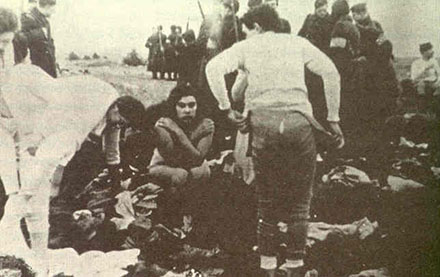
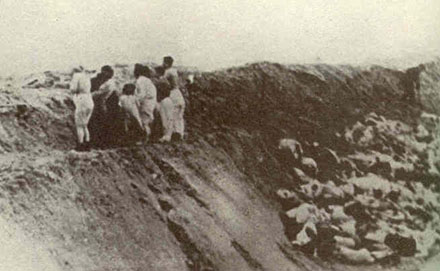
This date in 1941 commenced one of the largest such actions: over 2,700 Jews as well as 23 Communists forced over the course of two-plus days to strip on the freezing Skede dunes overlooking the Baltic and there shot by German and Latvian teams into a vast pit. It’s one of the most recognizable Holocaust atrocities because it was extensively photographed.*

As one can see from the pictures, the victims here were mostly women.


Some of the women in this photographs can be identified by name (pdf). Left to right: (1) Sorella Epstein; (2) presumably Rosa Epstein, her mother; (3) unknown; (4) Mia Epstein; (5) unknown. Alternate identification makes Mia Epstein (5) instead of (4), and (2) Pauline Goldman.

Almost all of Liepaja’s Jews perished during the war.

* Germany’s Bundesarchiv (search on Libau 1941) confirms the precise December 15 dating for these images; it also has some other photographs of atrocities in Liepaja/Libau on other occasions.

On this day..

1934: John and Betty Stam, China missionaries

On this date in 1934, Chinese Communists beheaded John and Betty Stam in the Anhui province town of Miaoshu.

The Stams had settled as China Inland Mission proselytizers in the town of Jingde (at their time generally rendered as “Tsingteh”). Betty Stam (nee Scott) had grown up in China, the daughter of a Presbyterian missionary. John was a New Jersey native who had graduated Moody Bible Institute in 1932. They had a three-month-old daughter named Helen Priscilla.

On December 6, 1934, Communist rebels in China’s long-running civil war entered Jingde and seized the foreign family. According to a tribute page kept by a great-nephew of the, John wrote a short note that evening.

Tsingteh, An.
Dec. 6, 1934

China Inland Mission, Shanghai

Dear Brethren,

My wife, baby and myself are today in the hands of the Communists in the city of Tsingteh. Their demand is twenty thousand dollars for our release.

All our possessions and stores are in their hands, but we praise God for peace in our hearts and a meal tonight. God grant you wisdom in what you do, and us fortitude, courage and peace of heart. He is able-and a wonderful Friend in such a time.

Things happened so quickly this a.m. They were in the city just a few hours after the ever-persistent rumors really became alarming, so that we could not prepare to leave in time. We were just too late.

The Lord bless and guide you, and as for us, may God be glorified whether by life or by death.

In Him,
John C. Stam

The author of John and Betty Stam: Missonary Martyr summarizes his subjects’ “inspiring and instructive story” in a blog post here.

A foreboding message, but Christian evangelizing in China had often proved dangerous to its practitioners.

The next day they were marched 12 miles to Miaoshu where they stopped for the night. Facing martyrdom, the couple stowed their daughter away like Moses, hidden in a sleeping bag with John’s last missive and ten dollars that might serve to care for her.

Miraculously, Helen Priscilla would be overlooked when the Stams’ captors came for them on December 8 and marched them through Miaoshu. It’s said that one Chinese vendor made bold to object, and was added to the doomed party for his trouble. At the end of the march, John was forced to his knees and beheaded before his companions’ eyes; Betty and the shopkeep followed him.

Little Helen survived her parents’ ordeal. A Chinese evangelist named Lo found the girl and carried her 100 miles to a mission hospital. She was taken in from there by Betty’s parents and eventually adopted by Betty’s sister and raised in the Philippines before returning to the United States.

Back in China, another missionary, Frank Houghton, was moved by the sacrifice of the Stams to compose a hymn, “Thou Who Wast Rich Beyond All Splendour” (set to an old French canticle, Quelle est cette odeur agréable?).

On this day..

1982: Dos Erres massacre

On December 7, 1982, a unit of army commandos entered the Guatemalan hamlet of Dos Erres.* There it authored one of the signature atrocities of the bloody Guatemalan Civil War.

This was the Guatemala of Efrain Rios Montt, once a junior officer during the CIA-backed 1954 coup that set in motion decades of civil strife.

Relative brutality in that conflict waxed and waned over the years. In 1982, the now-General Efrain Rios Montt overthrew another general and went full werewolf. “A Christian has to walk around with his Bible and his machine gun,” Rios Montt infamously remarked. And more than walk them: the general’s policy was a you’re-either-with-us-or-with-the-terrorists hard line called Frijoles y Fusiles, “beans and shooting.” Campesinos who were with Rios Montt got the beans.

Shortly before this date’s atrocity, a column of Guatemalan soldiers were ambushed by leftist guerrillas, killing 21. Those guys were going to get the fusiles — them, or any convenient peasants who might hypothetically be on friendly terms with them.

Dos Erres, a remote jungle village of 60 families, was the settlement nearest where the rebels were thought to be operating. The little town had already drawn the ire of the army by resisting recruitment to civil defense patrols.

Late on the night of December 6, 1982, 20 members of Guatemala’s Kaibiles commandos set aside their special forces uniforms and disguised themselves as guerrillas, in green t-shirts and civilian trousers and red armbands. Ostensibly their mission was to recapture the rifles the rebels had seized from the ambushed convoy, which were supposed to be stashed in Dos Erres.

Hiking two hours into the jungle to reach their target, the commandos crept into the still-sleeping settlement at 2 in the morning. With the support of a 40-man regular army detachment to seal Dos Erres’s perimeter, the commandos stormed into residences and drug bewildered townspeople out, herding the men into a school and the women and children into a church.

That commenced an all-day litany of horrors for the residents of what was about to become the former village. Dos Erres was wiped off the map by the end of it.

One of the senior lieutenants on the mission raped a woman, and other commandos immediately availed themselves of the implied license to abuse women and girls. By the end of it, the last sobbing women and children were led out to the forest and machine-gunned en masse.

They were by then the last survivors, save for a little boy who managed to escape into the jungle. Throughout the course of the 7th of December, the Kaibiles brought villagers old and young to the edge of the town well. “As they were brought to the well, they were asked, ‘where are the rifles?’,” one of the participants later described. “They said nothing about rifles, and they were hit on the back of the head with a sledgehammer, and thrown in the well.” Every commando had to participate, so that all were implicated.

Commando Gilberto Jordán drew first blood. He carried a baby to the well and hurled it to its death. Jordán wept as he killed the infant. Yet he and another soldier, Manuel Pop Sun, kept throwing children down the well.

The commandos blindfolded the adults and made them kneel, one at a time. They interrogated them about the rifles, aliases, guerrilla leaders. When the villagers protested that they knew nothing, soldiers hit them on the head with a metal sledgehammer. Then they threw them into the well.

“Malditos!” the villagers screamed at their executioners. “Accursed ones.”

“Hijos de la gran puta, van a morir!” the soldiers yelled back. “Sons of the great whore, you are going to die!”

[Commando Cesar] Ibañez dumped a woman in the well. [Favio] Pinzón, the cook, dragged victims there alongside a sub-lieutenant named Jorge Vinicio Sosa Orantes. When the well was half-filled, a man who was still alive atop the pile of bodies managed to get his blindfold off. He shouted curses up at the commandos.

“Kill me!” the man said.

“Your mother,” Sosa retorted.

“Your mother, you son of the great whore!”

Pinzón watched as the infuriated Sosa shot the man with his rifle and, for good measure, threw a grenade into the pile. By the end of the afternoon, the well overflowed with corpses.

The commandos left town the next morning with six captives: the rebel who had been forced at gunpoint to guide the Kaibiles to Dos Erres in the first place (he would be executed in the field); three teenage girls (the soldiers that night would take turns raping them, then strangled them the next day); and two very small boys (these were returned to the Kaibiles base). A few days later, the army returned and razed the remains of the devastated town to the ground. Only recently has the site been excavated and its many victims’ remains cataloged for proper burial.

The tragedy of Dos Erres became public in the 1990s. Five soldiers who participated in the butchery have each been sentenced to 6,060 years in prison just for this one incident, but there were many more like it in Guatemala in those years — many more people who were put to Frijoles y Fusiles.

A 1990s truth commission after the war pegged the total number of civilians killed during the war above 200,000, mostly indigenous Mayans and (as was the case for most at Dos Erres) mestizos. “State forces and related paramilitary groups were responsible for 93% of the violations documented.”

The truth commission also found that the “government of the United States, through various agencies including the CIA, provided direct and indirect support for some state operations.” Indeed, supporting death squads against leftists in Central American dirty wars was overt U.S. policy during the 1980s; just days before Dos Erres, U.S. President Ronald Reagan returned from a Latin American tour and told reporters that Rios Montt, whom he had just met, was “totally dedicated to democracy in Guatemala.”

“They’ve been getting a bum rap” from human rights nabobs, Reagan averred.

In the fullness of time that rap would eventually encompass Rios Montt’s own remarkable conviction for crimes against humanity and (since the Mayan population was targeted en masse) genocide in a landmark case that’s still being appealed as of this writing. (The May 2013 verdict against Rios Montt was immediately overturned; the case is obviously extremely politically sensitive.) In a separate case, he’s been charged specifically with responsibility for the Dos Erres massacre.

U.S. President Bill Clinton formally apologized for Washington’s role in Guatemala after the truth commission’s findings were issued in 1999.

The PBS radio program This American Life has an hour-long documentary about Dos Erres here; a companion ProPublica series has even richer (and more horrifying) detail.

* Named for its founders, two men named Ruano and Reyes, the name literally meant “two Rs”.

On this day..

1778: Josiah Phillips, attainted by Thomas Jefferson

There is one example of this violation in Virginia, of a most striking and shocking nature; an example so horrid, that if I conceived my country would passively permit a repetition of it, dear as it is to me, I should seek means of expatriating myself from it. A man, who was then a citizen, was deprived of his life thus: From a mere reliance on general reports, a gentleman in the house of delegates informed the house, that a certain man had committed several crimes, and was running at large perpetrating other crimes; he, therefore, moved for leave to attaint him; he obtained that leave instantly … Without being confronted with his accusers and witnesses, without the privilege of calling for evidence in his behalf, he was sentenced to death, and was afterwards actually executed. Was this arbitrary deprivation of life, the dearest gift of God to man, consistent with the genius of a republican government? Is this compatible with the spirit of freedom? This, sir, has made the deepest impression in my heart, and I cannot contemplate it without horror.

Edmund Randolph (Source)

On this date in 1778, attainted Revolutionary War-era outlaw Josiah Phillips was hanged in Virginia.

Contrary to Randolph’s recollection, the execution took place according to a regular jury verdict convicting Philips for stealing 28 hats and five pounds of twine — felony theft by the Bloody Code inherited from England.

Even so, it was the Act of Attainder voted unanimously by the Virginia legislature that stuck in the popular memory, so much so that even the likes of Randolph, a lawyer by trade and later the first Attorney General of the independent United States, misstated* it as the proximate cause of Phillips’s execution.

Another inheritance from the mother country, Acts of Attainder — wherein the legislature declares some party guilty of a crime and declares punishment without benefit of trial — were going right out of style in the twilight of the 18th century. The eventual U.S. Constitution would flatly abolish the practice; Britain herself has not enacted one since 1798.

So it comes as some surprise to see that Phillips was outlawed** at the instigation of no less a person than old Mr. Inalienable Rights himself, Thomas Jefferson. Jefferson’s Bill of Attainder gave Philips and his band a June 1778 deadline to turn themselves in voluntarily, or else they

shall stand and be convicted and attainted of high treason, and shall suffer the pains of death, and incur all forfeitures, penalties and disabilities prescribed by the law against those convicted and attainted of High-treason: and that execution of this sentence of attainder shall be done by order of the General court to be entered as soon as may be conveniently after notice that any of the said offenders are in custody of the keeper of the public gaol …

And that the good people of this commonwealth may not in the mean time be subject to the unrestrained hostilities of the said insurgents, be it further enacted that from and after the passing of this act it shall be lawful for any person with or without orders, to pursue and slay the said Josiah Philips and any others who have been of his associates or confederates at any time.

Now in fairness, Josiah Phillips was no ordinary hat-thief, regardless of what the charge-sheet read. He was a Tory marauder who led a gang of outlaws/guerrillas/terrorists who lurked in the Dismal Swamp and had just weeks before repelled a Commonwealth militia dispatched by Governor Patrick Henry.

For Henry, who sought the attainder, and for Jefferson the Phillips band looked like a clear security threat. “The delays which would attend the proceeding to outlaw the said offenders according to the usual forms and procedures of the courts of law would leave the said good people for a long time exposed to murder and devastation,” in the words of the attainder. And indeed, the rebellious colonies — ultra-patriotic Pennsylvania especially — had had regular recourse to Acts of Attainder against Tory loyalists over the span of the American Revolution. (Actual executions under attainders were extremely rare.)

However, the inconsistency of such an instrument long associated with monarchical tyranny with its author’s more usual Rights of Man fulminations had Jefferson still defending the Phillips attainder as late as 1815.

Whatever might have best suited Josiah Phillips, the last word on the matter in American jurisprudence has belonged to the overwhelming sentiment of his fellow-Founders … like James Madison, whose Federalist no. 44 flatly avers that Bills of Attainder “are contrary to the first principles of the social compact, and to every principle of sound legislation.”

* Randolph himself, as Virginia’s attorney general, made the call not to use the attainder against Phillips because of Randolph’s own discomfort with it. But his “misremembering” was convenient to a later interest in excoriating Patrick Henry.

** Arguably contravening Virginia’s existing 1776 Declaration of Rights. “In all capital or criminal prosecutions a man has a right to demand the cause and nature of his accusation, to be confronted with the accusers and witnesses, to call for evidence in his favor, and to a speedy trial by an impartial jury of twelve men of his vicinage, without whose unanimous consent he cannot be found guilty; nor can he be compelled to give evidence against himself; that no man be deprived of his liberty except by the law of the land or the judgment of his peers.”

On this day..

1864: Bill Sketoe, hole haunt

On this date in 1864, a hulking Methodist minister by the name of Bill Sketoe was hanged in Newton, Alabama … but his ghost story was only just beginning.

Sketoe’s life is nearly as spectral as his death, but he is known to have been a longtime denizen of Newton’s Dale County where he preached the gospel and fathered a biblically-appropriate brood of seven children.

The easiest version says that Sketoe deserted the Confederate army to care for his sick wife. However, there’s no documentary evidence that Sketoe actually served under arms in the Civil War, although two of his sons did. He might actually have been suspected of aiding Unionist raiders haunting the forests — men like John Ward, a local pro-Union guerrilla with whom Confederate guards had just days before fought a skirmish.*

For whatever reason, a local Confederate cavalry militia under one Captain Joseph Breare seized the preacher near the Choctawhatchee River on December 3, 1864, and hanged him to a convenient tree.

Now, Bill Sketoe was a large man, and the bough of the Post Oak that supported his noose bent to his weight until Sketoe’s toes touched the ground. For an ad hoc execution, an ad hoc solution: one of Breare’s so-called “Buttermilk Rangers” simply dug out the ground around Sketoe’s feet until they dangled free in the hole and their owner could strangle to death properly.

Beloved Alabama storyteller Kathryn Tucker Windham immortalized “The Hole That Will Not Stay Filled”, one of the chapters of her 13 Alabama Ghosts and Jeffrey. Local legend, it seems, held that whenever someone later filled in Sketoe’s dangling-pit — with dirt, rubbish, or anything else — it would be mysteriously un-filled within hours.

Unfortunately the present-day skeptic will not be able to put geist to test because “Sketoe’s Hole” was destroyed in a 1990 flood, and is today covered over with tons of rocks supporting a bridge strut — too much infill even for spooks. (Though not enough to deter visitors.)

Sketoe’s executioner Joseph Breare resumed his law practice after the war … until a falling tree killed him during a storm in 1866.

* David Williams develops the John Ward connection in Rich Man’s War: Caste, Class, and Confederate Defeat in the Lower Chattahoochee Valley. A few months later an incursion of different irregulars led by a Dale County Confederate officer who deserted to the Union, Joseph Sanders, precipitated the Battle of Newton.

On this day..