1782: The Gnadenhutten Massacre

You recall the time when the Jesus Indians of the Delawares lived near the Americans, and had confidence in their promises of friendship, and thought they were secure, yet the Americans murdered all the men, women, and children, even as they prayed to Jesus?

Tecumseh, to William Henry Harrison in 1810

This date in 1782 marks one of the more appalling single atrocities in the United States’s long destruction of indigenous Native Americans — the Gnadenhutten Massacre.

This incident during the American Revolution took place in the Ohio River basin, a vast and fertile flashpoint whose part in not only the revolution but the antecedent French and Indian War perhaps entitles it to claim the midwifery of the coming American empire.

After victory in the French and Indian War, the British closed the area west of the Appalachian mountains to European settlement. This proclamation:

  • Made good a wartime pact Britain had made to secure the support of the Iroquois, Lenape (Delaware) and Shawnee tribes; and
  • Trailed facts on the ground the moment it was issued.

European settlements and land claims already existed in the supposed Indian Reserve, and land-hungry settlers did not let the supposed frontier deter them from advancing new ones. Confrontations between these arriving claimants and the native inhabitants not infrequently came to atrocious resolutions.

By 1768, a new treaty pushed the line further west, effectively ceding to the colonists everything south of the Ohio River — present-day Kentucky and West Virginia.*


Map of the disputed area: the frontier moved from the yellow line along the Applachians to the orange line along the Ohio.

Ohio Country, the remaining territory in dark green shading north of the Ohio River, lay at the time of the American Revolution between the British garrison at Fort Detroit and colonial outposts along the nascent United States’s western marches, such as Fort Pitt (Pittsburgh).

The Lenape Indians in Ohio Country had a difficult calculation to make as to which side (if any) and how to support during the British-American fighting. The question split the Lenape internally.

In this cauldron, a strange morsel: Lenape who were Moravian** Christian converts had established a little missionary village. “Gnadenhutten” literally means “huts of grace”.

As one might imagine, Gnadenhutten and its sister settlements of pacifistic, Christian Lenape stood in a terribly ambiguous position in the brutal irregular war going on around them. Their fellow Lenape distrusted them because they were Christians; their fellow Christians, because they were Lenape.

Suspected by the British of being friendly enough with the American colonists to pass intelligence to their eventual murderers, these converts were in 1781 forced out of Gnadenhutten by British-allied Lenape to a new settlement aptly named “Captive Town”.

Starving there in the ensuing winter, the Moravians dispatched nearly 100 of their number back to Gnadenhutten to retrieve food abandoned at that settlement.

The Moravians were still at their village when a raiding party of Pennsylvanians descended on the town. Under no authority but the militiamen’s own festering grievances from the ongoing dirty war, the Pennsylvanians rounded up the Delaware and heartlessly declared their deaths.

Here were Indians who would pay for the violence Indians had done. And they were the best kind: the kind who didn’t fight back.

After spending a night praying and preparing for the end, the Moravian Lenape were systematically butchered on the morning of March 8† with mallet blows and scalpings.

Depending on your source, there were either 90 or 96 scalps to take that morning – women, men, and children in nearly equal proportions. At least one young boy survived the death squad and reported the massacre. Nor were all the militia themselves at peace with their deed.

one Nathan Rollins & brother had had a father & uncle killed took the lead in murdering the Indians, & Williamson was opposed to it; & Nathan Rollins had tomahawked nineteen of the poor Moravians, & after it was over he sat down & cried, & said it was no satisfaction for the loss of his father & uncle after all. — So related Holmes Jr. who was there — who was out on both Moravian campaigns, & Crawford’s. (Source)

Ah, Crawford’s campaign.

Later in 1782, another expedition of frontiersmen under Col. William Crawford set out “to destroy with fire and sword” a different Lenape settlement in Ohio. Instead, the Lenape met and routed the expedition, taking Crawford prisoner. He and the other captives from that misadventure would be burned to death, in part to avenge Gnadenhutten.

This, and whatever like tit for tat could be exacted in the field, was all the justice the Lenape could ever hope to have for the hecatomb of Gnadenhutten. American authorities declined to prosecute or sanction any members of the militia.


“Here triumphed in death ninety Christian Indians March 8, 1782”: inscription at the base of a memorial obelisk in Gnadenhutten. (cc) image from Mike Drabik.

* This might have been a nice solution, except that said treaty was made by the Iroquois — and only the Iroquois. For the Shawnee who actually lived and hunted in this cessation, this was two outside powers bartering their land. They didn’t mean to give it up on the say-so of the Iroquois. Another nasty frontier war followed, and even when that was won by Virginian militia, dissatisfied Shawnee continued targeting settlements in Kentucky; it’s partly for this reason that the Declaration of Independence slates King George III with having “endeavoured to bring on the inhabitants of our frontiers, the merciless Indian Savages whose known rule of warfare, is an undistinguished destruction of all ages, sexes and conditions.”

For more on the long and tragic Shawnee struggle in this period, see “‘We Have Always Been the Frontier’: The American Revolution in Shawnee Country” by Colin G. Calloway in American Indian Quarterly, Vol. 16, No. 1 (Winter 1992).

** The Moravian Church‘s name harkens to its Czech origins. It’s a successor to the reform tradition of Jan Hus.

† There are a few cites out there for the day before or the day after March 8.

On this day..

1871: Ma Hualong, Dungan rebel

On this date in 1871, the Qing executed Ma Hualong (or Ma Hua-lung), one of the principal leaders of a 15-year Muslim revolt in northwest China.

Ma was the fifth leader of the Jahriyya, a Sufi order whose founder Ma Mingxin had himself been executed during disturbances in the early 1780s.

By the time of Ma’s ascendancy, the Jahriyya were a major force in Gansu, Shaanxi and Ningxia.

Neither Ma nor any other single person led the Dungan revolt. (“Dungan” was a 19th century term for the ethnicity that’s now known as the Hui.) Rather, a cascading series of ethnic riots led in 1862 — while the Chinese army was absorbed elsewhere with the bloody Taiping Rebellion — to a patchwork of rebellious leaders and movements, operating independently and often viewing one another as rivals.

The Jahriyya was the closest thing to a unifying element among discontented Muslims. According to this volume, though Ma struck a pose of moderation and loyalty, in the Chinese court’s eyes, the disturbances “depend[ed] on Ma Hua-lung.” For the Qing, Ma’s nearly impregnable position at Jinjipu (Chin-chi-pao) and his diplomatic finesse were the lynchpin.

Dispatched to put down the revolt, General Tso Tsung-tang had the prestigious Ma as his primary target: with him gone, the rest of the rebels could be divided and conquered at leisure.

Unable to take Jinjipu by storm, General Tso besieged it unto near starvation, forcing Ma to surrender himself. Notwithstanding his attempts to take all the blame for the revolt on his own shoulders,

Ma was executed, together with twelve members of his immediate family, by the “slicing process”; some eighty of the lesser Muslim leaders were beheaded. Chin-chi-p’u was depopulated, and the surviving Muslims were sent, en masse, into exile or slavery.

Just a drop in a bucket for a conflict with 8 million-plus dead.

The Jahriyya order still exists to this day. And so too, of course, does General Tso — on Chinese restaurant menus.

On this day..

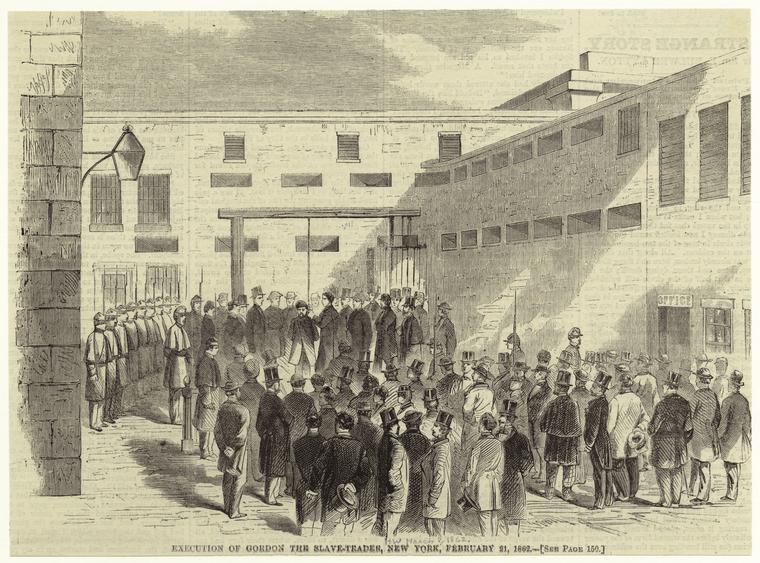
1862: Nathaniel Gordon, slave trader

On this date in 1862, the American commercial shipper Nathaniel Gordon was hanged at the Tombs for slave trading.

Importing slaves to the U.S. had been nominally illegal for over half a century, but had never been strongly enforced. In 1820, slaving (regardless of destination) had even been defined as piracy, a capital crime.

Importation of kidnapped Africans into the United States did significantly abate during this period, and that was just fine with U.S. slaveowners ever paranoid of servile rebellion.

But a voracious demand for conscript labor persisted elsewhere whatever the legal situation. About 3 million slaves arrived to Brazil and Cuba, the principal slave shipment destinations, between 1790 and 1860 — even though the traffic was formally illicit for most of this time.

Great Britain was endeavoring to strangle the Atlantic slave trade, but the diplomatic weight she had to throw around Europe didn’t play in the U.S. Washington’s adamant refusal to permit the Royal Navy to board and search U.S.-flagged ships made the stars and stripes the banner of choice for human traffickers profitably plying the African coast. “As late as 1859 there were seven slavers regularly fitted out in New York, and many more in all the larger ports,” one history avers.

Hanging crime? No slave-runner had ever gone to the gallows as a “pirate” — not until Nathaniel Gordon.

The U.S. Navy did mount its own anti-slaving patrols, but the odd seizure of human cargo was more in the line of costs of doing business than a legal terror for merchants.

So Gordon, son of triangle trade port Portland, Maine and a veteran of several known slaving runs, didn’t necessarily think much of it on August 8, 1860, when the Mohican brought Gordon’s ship to bear 50 miles from the Congo with 897 naked Africans stuffed in the hold, bound for Havana. Half of his slaves were children.

“The stench from the hold was fearful, and the filth and dirt upon their persons indescribably offensive,” Harpers reported.

Gordon chilled in very loose confinement in the Tombs, even enjoying family leave furloughs as he readied for the customary slap on the wrist.

But with Abraham Lincoln’s election in 1860, Gordon was promoted to demonstration case.

After a hung jury in June 1861, the feds won a conviction and death sentence on those long-unused piracy laws in November 1861.

Many New Yorkers were shocked at the prospect of such draconian punishment.

Abraham Lincoln found himself besieged by appeals public and private against the unprecedented judgment. “For more than forty years the statute under which he has been convicted has been a dead letter, because the moral sense of the community revolted at the penalty of death imposed on an act when done between Africa and Cuba which the law sanctioned between Maryland and Carolina,” Gordon’s counsel Judge Gilbert Dean wrote in an open letter to the President* — an argument that could hardly be more poorly calibrated to impress in 1862.

Despite Lincoln’s famous proclivity for the humanitarian pardon, he stood absolutely firm on the precedent Gordon’s hanging would set — especially in the midst of a bloody civil war driven by the very legal sanction Dean had cited so approvingly. As Lincoln wrote on February 4, 1862,

I think I would personally prefer to let this man live in confinement and let him meditate on his deeds, yet in the name of justice and the majesty of law, there ought to be one case, at least one specific instance, of a professional slave-trader, a Northern white man, given the exact penalty of death because of the incalculable number of deaths he and his kind inflicted upon black men amid the horror of the sea-voyage from Africa.

Gordon’s hanging was the one case — the only one ever.

* New York Times, Feb. 21, 1862.

On this day..

1961: About fifteen anti-Lumumbists, in Stanleyville

Although it occurred some weeks before, the execution/murder of Congolese Prime Minister Patrice Lumumba only became public on February 13, 1961.

A week later, on February 20, pro-Lumumba forces in Stanleyville (today, Kisangani) shot approximately 15 prisoners in retaliation. Stanleyville was the headquarters of Lumumba ally Antoine Gizenga, whose enclave the late Lumumba had been trying to reach when he was captured. In the confused post-Lumumba days, Gizenga elevated himself to head of state for the rebellious Lumumbist state; 21 Communist-backed states would recognize this as Congo’s legitimate government, in opposition to the official one of Joseph Kasavubu.

Those suffering the Lumumba-backers’ wrath this date included ten politicians — notably Alfonse Songolo, a former Lumumbist minister who had prominently broken with that faction after Lumumba was deposed the previous autumn — plus five soldiers in the anti-Lumumba force of the bright young officer and future definitive author of Congolese horrors, Joseph-Desire Mobutu.

The London Times had reported (Feb. 23-24) that “usually well-informed sources” alleged the execution, but that the U.N. was unable itself to confirm the fact independently.

On this day..

1815: Eight deserters by order of Andrew Jackson

(Thanks to Meaghan Good of the Charley Project for the guest post. -ed.)

On this day in 1815, eight young men condemned for desertion during the War of 1812 were executed by firing squad in Nashville, Tennessee.

They were brought out to be shot one by one, as there weren’t enough people available to form a firing squad large enough for the group of them.

Desertion was rife during this inglorious conflict, according to Wikipedia:

The desertion rate for American soldiers in the War of 1812 was 12.7%, according to available service records. Desertion was especially common in 1814, when enlistment bonuses were increased from $16 to $124, inducing many men to desert one unit and enlist in another to get two bonuses.

We’re not sure how well these eight got paid off in life … only that they collected their last check in lead.

  1. Nathaniel Chester, age unknown, a member of the Corp of Artillery.
  2. Benjamin Harris, 38, a private in the 44th Regiment. Born in Virginia and raised in New Orleans, Louisiana, he enlisted on March 26, 1814 and deserted on July 1.
  3. John Jones, 33, a private in the 2nd Rifle Regiment. He’d enlisted for a five-year stint on July 25, 1814 in Farquier, Virginia. The date he deserted has not been recorded.
  4. Jacob King, 20, a private in the 1st U.S. Artillery. He was born in Pennsylvania and enlisted on March 28, 1814 for five years. He deserted on July 12.
  5. James McBride, 21, a native of Virginia. Records about his military service are unclear: some reports are that he enlisted on April 20, 1813, and other accounts give the date as July 22, 1814. It’s possible he deserted twice; this was a common practice, as noted above.
  6. William Myers, 19, a private from Georgia. He enlisted on March 27, 1814; it’s unknown when he deserted.
  7. Drury Puckett, 36, a member of the 2nd Infantry. (Almost certainly the son and namesake of this Drury Puckett.) Like Harris and McBride, he was from Virginia and he had enlisted there for five years on September 24, 1814. The record says he deserted on December 31, but this is surely in error, because by then he had already been sentenced to die.
  8. John Young, age unknown, from Winchester, Virginia. He enlisted on October 3, 1814 and deserted after a mere five days.

General (and future President) Andrew Jackson affirmed their sentences on January 28, pardoning five others at the same time. This was twenty days after Jackson fought the Battle of New Orleans, the final major conflict in the war. This day’s event was the largest mass execution in Tennessee history.

On this day..

1943: France Bloch-Serazin, bombmaker

On this date in 1943, French resistance heroine France Bloch-Serazin was executed by the Germans in Hamburg.

Bloch-Serazin English Wikipedia entry | French) was a Jewish Communist who had supported the Spanish Republican cause, so she was right in line for some official persecution after the Germans blitzed France.

No longer employable as a chemist, she put her training to good use manufacturing explosives in her apartment. (Today, a plaque in the 19th arrondissement marks the building.)

Arrested by French police on May 16, 1942, she was condemned to death by a German military court but deported to Germany to suffer that punishment. Her husband, Fredo Serazin, was subsequently murdered by the Gestapo in prison.

As France Bloch-Serazin was born in 1913, she has recently enjoyed a renewed appreciation around the centennial of her birth, including the homage (French link) of her native city of Poitiers.

On this day..

c. 415 B.C.E.: The men of Melos

On an uncertain date in the winter of 416-415 B.C.E., the island of Melos surrendered to an Athenian siege during the ruinous Peloponnesian War.

Athens put all of Melos’s adult men to death, selling its women and children into slavery.

This ghastly event is covered by ThucydidesHistory. Thucydides’ account of the diplomatic negotiation between the mighty Athenians and the hopelessly outmuscled Melians is the subject of the Melian dialogue — a timeless classic of philosophy and statecraft.

The Athenians’ coldly realistic position — and their ultimate disposition of their conquest — is summed up in the wonderful epigraph, “the strong do what they will, and the weak suffer what they must.” (And numerous variations of this translation.)

As the reigning naval power, Athens (at war with a league led by its rival, the land power Sparta) had decided that an independent and neutral Melos would no longer be in the offing. The Melian dialogue pits Athens’ ultimatum to Melos to submit and save itself, against the Melians’ vain attempt to assert the justice of their cause; likewise, it is the dialogue of an imperial order against a holdover independent city-state from a fading era.

It’s a riveting read. The excerpts below are from this public-domain translation; there are others here and here.

Athenians: Well, then, we Athenians will use no flue words; we will not go out of our way to prove at length that we have a right to rule, because we overthrew the Persians; or that we attack you now because we are suffering any injury at your hands. We should not convince you if we did; nor must you expect to convince us by arguing that, although a colony of the Lacedaemonians, you have taken no part in their expeditions, or that you have never done us any wrong. But you and we should say what we really think, and aim only at what is possible, for we both alike know that into the discussion of human affairs the question of justice only enters where the pressure of necessity is equal, and that the powerful exact what they can, and the weak grant what they must.

Melians: Well, then, since you set aside justice and invite us to speak of expediency, in our judgment it is certainly expedient that you should respect a principle which is for the common good; and that to every man when in peril a reasonable claim should be accounted a claim of right, and any plea which he is disposed to urge, even if failing of the point a little, should help his cause. Your interest in this principle is quite as great as ours, inasmuch as you, if you fall, will incur the heaviest vengeance, and will be the most terrible example to mankind.

Athenians: The fall of our empire, if it should fall, is not an event to which we look forward with dismay; for ruling states such as Lacedaemon are not cruel to their vanquished enemies. And we are fighting not so much against the Lacedaemonians, as against our own subjects who may some day rise up and overcome their former masters. But this is a danger which you may leave to us. And we will now endeavour to show that we have come in the interests of our empire, and that in what we are about to say we are only seeking the preservation of your city. For we want to make you ours with the least trouble to ourselves, and it is for the interests of us both that you should not be destroyed.

Melians: It may be your interest to be our masters, but how can it be ours to be your slaves?

Athenians: To you the gain will be that by submission you will avert the worst; and we shall be all the richer for your preservation.

Melians: But must we be your enemies? Will you not receive us as friends if we are neutral and remain at peace with you?

Athenians: No, your enmity is not half so mischievous to us as your friendship; for the one is in the eyes of our subjects an argument of our power, the other of our weakness.

Over and over the Melian envoy is dismayed by his visitors’ indifference to the moral high ground. Frustrated of any concession, he resolves his embattled city to embark upon the remote hope of resistance in preference to voluntary servitude — leading the Athenians to part with this chilly sentiment:

You told us that the safety of your city would be your first care, but we remark that, in this long discussion, not a word has been uttered by you which would give a reasonable man expectation of deliverance. Your strongest grounds are hopes deferred, and what power you have is not to be compared with that which is already arrayed against you. Unless after we have withdrawn you mean to come, as even now you may, to a wiser conclusion, you are showing a great want of sense. For surely you cannot dream of flying to that false sense of honour which has been the ruin of so many when danger and dishonour were staring them in the face. Many men with their eyes still open to the consequences have found the word honour too much for them, and have suffered a mere name to lure them on, until it has drawn down upon them real and irretrievable calamities; through their own folly they have incurred a worse dishonour than fortune would have inflicted upon them. If you are wise you will not run this risk; you ought to see that there can be no disgrace in yielding to a great city which invites you to become her ally on reasonable terms, keeping your own land, and merely paying tribute; and that you will certainly gain no honour if, having to choose between two alternatives, safety and war, you obstinately prefer the worse. To maintain our rights against equals, to be politic with superiors, and to be moderate towards inferiors is the path of safety. Reflect once more when we have withdrawn, and say to yourselves over and over again that you are deliberating about your one and only country, which may be saved or may be destroyed by a single decision,

Athens wasn’t kidding.

Finding no traction with the Melian delegation, the greater power immediately besieged Melos. Thucydides recounts the Melians’ subsequent fate:

So the summer ended.

In the following winter the Lacedaemonians had intended to make an expedition into the Argive territory, but finding that the sacrifices which they offered at the frontier were unfavourable they returned home … About the same time the Melians took another part of the Athenian wall; for the fortifications were insufficiently guarded. Whereupon the Athenians sent fresh troops, under the command of Philocrates the son of Demeas. The place was now closely invested, and there was treachery among the citizens themselves. So the Melians were induced to surrender at discretion. The Athenians thereupon put to death all who were of military age, and made slaves of the women and children. They then colonised the island, sending thither 500 settlers of their own.


On top of everything else, the Athenian sack put an end to the production of Melian reliefs. (The island still had the glory of the Venus de Milo to look forward to, however.)

If there was a consolation for the scattered remains of the ruined Melian polis, it was that Athens’ cruel imperial hubris led it just months later to launch a catastrophic invasion of Sicily.

That defeat helped turn the Peloponnesian War decisively against Athens. Just eleven years after overrunning Melos, haughty Athens itself surrendered to a Spartan siege.

Thucydides, an exiled former Athenian general, deploys the classical dialogue form to great effect; his own perspective on the various arguments advanced in the Melian debate is difficult to discern with confidence. Clearly, however, it’s a topic of great interest to Thucydides, as his account dwells repeatedly on the conundrums touching justice and international relations: he’s one of the first intellectuals to explore what’s now thought of as the “realist” view of foreign policy. Compare the Melian Dialogue, for instance, to the Athenian demos‘s Mytilenian Debate; or, to the Plataean speech making a Melos-like appeal to the powerful Spartans.* And in one early passage, private Athenians appeal to Sparta and Corinth not to commence on war against the hegemony of Athens with words similar to those later used at Melos: “It has always been a rule that the weak should be subject to the strong; and besides, we consider that we are worthy of our power. Up till the present moment you, too, used to think that we were; but now, after calculating your own interest, you are beginning to talk in terms of right and wrong. Considerations of this kind have never yet turned people aside from the opportunities of aggrandizement offered by superior strength.”

At any rate, Thucydides’ proud city-empire would never recover from the inglorious fall inflicted by this war. The result was a fourth-century power vacuum which the Macedonia of Philip II and Alexander the Great eventually rose to fill.

* Thucydides also reports the Athenians hoisted by their own realpolitik when, in the Sicilian invasion, they attempt to appeal to Camarina for support. That city spurns the appeal, fearing subjugation should expansionist Athens prevail, and the revenge of their overwhelmingly powerful neighbor Syracuse otherwise.

On this day..

1931: The Longhua Martyrs and the Five Martyrs of the League of Left-Wing Writers

On this date in 1931, the Chinese nationalists executed 23 Communists at Longhua, including five members of the League of Left-Wing Writers.

Early in what would prove to be the very long Chinese Civil War, the Koumintang government in 1930 mounted a suppression* of Communist outposts. That included military campaigns attempting to encircle communist-held regions, as well as an internal crackdown. It’s the latter that concerns us here.

A Communist-founded League of Left-Wing Writers operating in Shanghai was formally banned by the Koumintang in September 1930. Threatened with arrest, the writers struggled to stay underground but at a January 17 meeting in the British concession area,** British police arrested Li Weisen, Hu Yepin, Rou Shi, Yin Fu, and Feng Keng. They were handed over to the Chinese authorities.


The Five Martyrs: From left: Hu Yepin, Rou Shi, Feng Keng, Yin Fu, Li Weisen (Li Qiushi)

They became the Five Martyrs of the League when they were shot this date in 1931 along with 18 other Communist prisoners, one of them a pregnant woman.

Among the five martyrs, Rou Shi† was particularly close to the great writer Lu Xun, who was heartbroken when he received word of his young protege’s untimely end — “one of China’s best youths,” in his estimation. In hiding himself, Lu Xun composed a “Lament for Rou Shi”:

To long and sleepless nights I’ve grown
accustomed in the spring;
Fled with a wife and babe in arms,
my temples are graying.
‘Mid dream there comes an image faint —
a loving mother’s tear;
On city walls the overlords’
e’er-changing banners rear.
I can but stand by looking on
as friends become new ghosts,
In anger face bayonet thickets
and search for verse ripostes.
The poem intoned, my gaze turns low —
one cannot write such down.
Moonlight shimmers with watery sheen
upon my jet-black gown.

(as translated by The Lyrical Lu Xun: A Study of His Classical-Style Verse)

The discerning present-day visitor to Longhua can pay respects at the Longhua Revolutionary Martyrs Cemetery.

* The suppression claimed, among others, the life of Mao Zedong’s first wife.

** The extraterritorial British concession in Shanghai was a legacy of the opium wars.

† There’s an English translation of Rou Shi’s short story “A Slave Mother” here.

On this day..

1814: Mariano Matamoros, Mexican revolutionary

Two hundred years ago today, the Mexican revolutionary Mariano Matamoros was shot by the Spanish at Valladolid.

A Catholic priest (defrocked for the occasion of his execution) who had previously gone to prison for his nationalist sympathies, Matamoros joined the revolutionary army of fellow-clergyman Jose Maria Morelos as the Mexican War of Independence blossomed.

Matamoros proved to have the knack for martial leadership and was a lieutenant general and Morelos’s second-in-command within months.

The Spanish captured him in early January 1814 after the revolutionaries’ failed attempt to take Valladolid. His foes could not be moved to exchange him on any terms.

Though Morelos too would suffer this fate in time, their cause eventually prevailed. Post-independence, the martyred Matamoros became a Mexican national hero. He’s interred today at Mexico City’s iconic El Angel monumental column.

He’s the namesake of several locations, including the border city of Matamoros. (Longtime readers of this site might recall the 1913 Mexican Revolution execution in Matamoros that we’ve previously profiled.) One of Mexico City’s airports also bears the Matamoros name.

On this day..

1944: Max Sievers, freethinker

On this date in 1944, German freethinker Max Sievers was beheaded at Brandenburg Prison for “conspiracy to commit high treason along with favouring the enemy.”

A working-class Berliner, Sievers (English Wikipedia entry | German) became a prominent communist and atheist writer in the interwar years. He directed the Association of Freethinkers for Cremation from the early 1920s, and in 1927 became the chair of the German Freethinkers League.

This was not a demographic Adolph Hitler was courting. In the wake of the 1933 Reichstag Fire, the Nazis stamped out atheistic movements, even converting the Freethinkers’ building into a Protestant recruitment venue.

Briefly imprisoned, Sievers fled Germany upon his release later in 1933 and from exile in Belgium — and then, after Belgium was conquered, in hiding in France — he kept up a drumbeat of antifascist propaganda, notably the 1939 book Unser Kampf gegen das Dritte Reich: von der nazistischen Diktatur zur sozialistischen Demokratie.

He was finally arrested by the Gestapo on June 3, 1943, and condemned to death by Roland Freisler.

Sievers was posthumously exonerated in 1996, and is today — and on January 17th in particular — an honored martyr for German humanist, atheist, and freethinker groups.

On this day..