1469: Richard Woodville, father of the queen

On this date in 1469, Richard Woodville, the father of the queen, lost his head.

Though he died as Earl Rivers, Woodville started life as a commoner.

As a retainer to the Duke of Bedford, Woodville drew escort duty for the mistress of the house when the master died suddenly. Not one to waste an opportunity, Woodville soon made the merry widow his merry wife: at the time, he was around 30 and she around 20, while the late husband had kicked off at age 46.

For this impertinent and unauthorized union, the couple paid a fine … and their descendants enjoyed royal power. Well-behaved women and knights-errant seldom make history, right?

Marrying nobility put Woodville into the War of Roses game of throne, where he again proved a deft hand with sneaky conjugation.

In 1464, he secretly married his widowed daughter Elizabeth to the young king Edward IV. Elizabeth Woodville became thereby the first commoner in history to marry an English king.

She also became a lightning-rod.

The Earl of Warwick, so powerful that he was known in this era of uneasy-resting crowns as “The Kingmaker”, was embarrassingly undercut by the Woodville match in his own machinations to pair Edward with a French princess. A stunned Privy Council castigated Edward when it found out — “however good and however fair she might be,” they grumbled “she was no wife for a prince such as himself; for she was not the daughter of a duke or earl” — but the young king stood by his lady.

A love match? We leave that question for the poets and the novelists.

From left to right, Philippa Gregory‘s books about Richard Woodville’s wife, daughter, and granddaughter. Gregory also wrote a nonfiction companion to this bestselling series, The Women of the Cousins’ War: The Duchess, the Queen, and the King’s Mother.

But politically, the Woodville marriage certainly upset the game board. Richard Woodville got promoted to Earl Rivers and others of the tribe profited likewise: this made good sense for Edward because these people would owe their positions, and loyalty, to him.

Contrast with the independent, arrogant aristocrat set like Warwick, who soon proceeded — and what part l’affaire Woodville plazed in his defection is up for speculation, although it was part of his own publicly asserted justification — to desert Edward’s Yorkist cause for the Lancastrian claimant.

Warwick’s rebellion succeeded in overthrowing Edward in 1469, and it was in the glow of this victory that Warwick had the obnoxious arriviste Richard Woodville beheaded as a traitor, together with the man’s son John.

Unfortunately for Warwick, it was but a moment.

Unable to govern, Warwick had to release his royal prisoner, and the sides slid back into open conflict. Edward decisively crushed the Lancastrians at the Battle of Tewkesbury, conveniently killing Warwick in the process.

Duly returned to her station, Elizabeth Woodville produced two sons for her husband, the boys history remembers as the Princes in the Tower — which is where the last LancastrianYorkist king Richard III is thought to have murdered them. In Shakespeare’s Richard III, Queen Elizabeth is quite the bummer.

Ay me, I see the ruin of my house!
The tiger now hath seiz’d the gentle hind;
Insulting tyranny begins to jet
Upon the innocent and aweless throne.
Welcome, destruction, blood, and massacre!
I see, as in a map, the end of all.

But her house wasn’t quite ruined after all: Elizabeth Woodville also produced a daughter, also named Elizabeth. This latter “Elizabeth of York” married another descendant of a commoner, who carried the Lancaster standard: this fellow of doubtful lineage would finally resolve the War of the Roses and reign as Henry VII. (Father, namesake, and predecessor, of course, to this site’s patron head-chopping monarch Henry VIII: Richard Woodville’s great-grandson.)

On this day..

1849: Ugo Bassi, nationalist priest

Measure thy life by loss instead of gain;
Not by the wine drunk, but the wine poured forth
For love’s strength standeth in love’s sacrifice;
And whoso suffers most hath most to give.

-From Harriet King‘s poem “Ugo Bassi’s Sermon in the Hospital”

On this date in 1849, the Garibaldian priest Ugo Bassi was shot in Bologna along with fellow-nationalist Count Livraghi.


Statue of Ugo Bassi at Bologna’s via Ugo Bassi.(cc) image from Biblioteca Salaborsa.

Detail view (click for full image) of Bassi and Livraghi being escorted to execution.

Bassi was a penniless Barnabite priest famous for his powerful oratory* and his national enthusiasms. He signed right up for Garibaldi‘s national movement in the heady liberal revolutions of 1848-49.

“Italy is here in our camp,” he would say of the Garibaldian forces readying their (ultimately unsuccessful) defense of the Roman Republic.** “Italy is Garibaldi; and so are we.”

Alas, in this engagement, Italy had a lot fewer guns than the French.

The new French ruler Napoleon III, who had himself been in youth a revolutionary carbonaro in Rome, saw foreign policy advantage in backing the exiled Papacy and overthrew the Republic.†

Garibaldi escaped to exile, but many of his subalterns did not. Bassi was captured unarmed — he didn’t even bear arms in battle — and Pius IX, once thought a fellow-traveler by the liberals, did not hesitate to hand him to the Austrians for punishment. The Habsburgs stood equally to lose from any gains of the Risorgimento, and accordingly gave Bassi a perfunctory military trial, then had him shot immediately in Bologna.

For crowning his open-hearted life with this sacrifice, Ugo Bassi instantly became, from that day to this, one of the best-honored Italian patriots.

He possessed at once the simplicity of a child, the faith of a martyr, the knowledge of a scholar, and the calm courage of a hero … If ever Italy comes to be united may God restore her the Voice of Ugo Bassi … The name of Ugo Bassi will be the watchword of the Italians on the day of vengeance!

Garibaldi

* Anecdote associated with Bassi once he came to firing up the Bolognese for Garibaldi: a poor girl who could give nothing to the cause spontaneously chopped off her own hair and handed it to him. This is the event depicted by Bassi’s fellow-Bolognese Napoleone Angiolini, Ugo Bassi sui gradini di San Petronio.

** Topical incidental: the Roman Republic lasted only a few months, but its constitution abolished the death penalty … so it can count as the first nation to abolish capital punishment in constitutional law.

† Earning Napoleon III the permanent wrath of Italian nationalists.

On this day..

1347: Not the Six Burghers of Calais

On this date in 1347, the city of Calais yielded to an English siege.


The siege of Calais, from Jean de Wavrin‘s Chroniques d’Angleterre. (More images)

Edward III had proceeded to invest Calais directly after the previous year’s staggering win at Crecy. The crippled French leadership could not relieve the city, and after fruitlessly probing for an opening, the relief army marched away at the start of August 1347.

By this time reduced to eating vermin and ordure, the starved city had little choice but to capitulate. According to Froissart’s account, the king declared that “the Calesians have done him so much mischief, and have, by their obstinate defence, cost him so many lives and so much money, that he is mightily enraged.” He wasn’t only sore about the city’s holding out over the preceding year: Calais was notorious as a refuge for English Channel pirates who had long bedeviled the commerce of Edward’s realm.

As a condition for sparing the rest of the town, Edward demanded that six of its leading citizens present themselves to him, “with bare heads and feet, with ropes round their necks, and the keys of the town and castle in their hands.” Edward seems truly to have meant (much against the conscience of his own nobles) to put these men to death “for that the Calesians had done him so much damage, it was proper they should suffer for it.”

This information caused the greatest lamentations and despair [in Calais]; so that the hardest heart would have had compassion on them; even the lord de Vienne wept bitterly.

After a short time, the most wealthy citizen of the town, by name Eustace de St. Pierre, rose up and said: “Gentlemen, both high and low, it would be a very great pity to suffer so many people to die through famine, if any means could be found to prevent it; and it would be highly meritorious in the eyes of our Saviour, if such misery could be averted. I have such faith and trust in finding grace before God, if I die to save my townsmen, that I name myself as first of the six.” When Eustace had done speaking, they all rose up and almost worshipped him: many cast themselves at his feet with tears and groans Another citizen, very rich and respected, rose up and said, he would be the second to his companion, Eustace; his name was John Daire. After him, James Wisant, who was very rich in merchandise and lands, offered himself, as companion to his two cousins; as did Peter Wisant, his brother. Two others then named themselves, which completed the number demanded by the king of England.

Wealthy elites sacrificing themselves for the greater good? The past really is a different country.

These six duly presented themselves, nearly naked and haltered and braced to bear the brunt of Edward’s vengeance. The English king had the executioner summoned … and then, Edward’s (very pregnant) queen Philippa dramatically fell to her knees

and with tears said, “Ah, gentle sir, since I have crossed the sea with great danger to see you, I have never asked you one favour: now, I most humbly ask as a gift, for the sake of the Son of the blessed Mary, and for your love to me, that you will be merciful to these six men.”

The king looked at her for some time in silence, and then said; “Ah, lady, I wish you had been anywhere else than here: you have entreated in such a manner that I cannot refuse you; I therefore give them to you, to do as you please with them.” The queen conducted the six citizens to her apartments, and had the halters taken from round their necks, after which she new clothed them, and served them with a plentiful dinner: she then presented each with six nobles, and had them escorted out of the camp in safety.

Edward still had the last laugh when it came to Calesian carnage.

This nigh-unconquerable foothold on the French coast would persist in English hands for two centuries: the first century spanned the Hundred Years’ War, which England was licensed to protract by dint of (and France would not settle because of) the menacing northern base England won this day. “Each will have to take up his shield,” ran a French verse cited in Barbara Tuchman’s A Distant Mirror: The Calamitous 14th Century, “For we’ll have no peace till they give back Calais.”


The Six Burghers persisted even longer than that.

George Bernard Shaw wrote a one-act play standing the story on its head, in which a henpecked Edward exasperatedly yields to his nagging wife’s merciful caprice, to the open derision of the burghers themselves.

A bit more exalted of spirited is Rodin‘s sculpture group Les Bourgeois de Calais — rendering six emaciated, suffering, and courageous figures.

I have, as it were, threaded them one behind the other, because in the indecision of the last inner combat which ensues, between their devotion to their cause and their fear of dying, each of them is isolated in front of his conscience. They are still questioning themselves to know if they have the strength to accomplish the supreme sacrifice–their soul pushes them onward, but their feet refuse to walk.

They drag themselves along painfully, as much because of the feebleness to which famine has reduced them as because of the terrifying nature of the sacrifice … And certainly, if I have succeeded in showing how much the body, weakened by the most cruel sufferings, still holds on to life, how much power it still has over the spirit that is consumed with bravery, I can congratulate myself on not having remained beneath the noble theme I dealt with.

Rodin

The discriminating connoisseur of Middle English may also enjoy Laurence Minot‘s poetic celebration of the siege of Calais. (Helpful explanatory annotations.)

Part of the Themed Set: Scary Escapes.

On this day..

1916: Captain Charles Fryatt, illegal combatant

On this date in 1916, Captain Charles Fryatt was shot at Bruges, Belgium as an illegal combatant.

Fryatt was a 42-year-old civilian mariner captaining the SS Brussels on the Harwick-Hook of Holland route when, in March 1915, a German U-Boat ordered him to heave to.

Fryatt wheeled the Brussels around on the submarine and attempted to ram it. The German ship escaped by a whisker only by scrambling an emergency dive. The Admiralty gave Fryatt a gold watch and a pat on the head for bravery.

It was not until the following year that the Germans captured that same vessel with that same captain on board. When they realized who they had, they subjected him to a snap tribunal for violating the laws of war: he’d participated in combat (by trying to ram the U-Boat) whilst being not a member of his country’s armed forces. That made him an illegal combatant, a franc-tireur in the still-current term for a civilian partisan left over from the Franco-Prussian War.

The Germans mightily loathed such terrorists, feared they would bedevil their steps in Belgium and France: people not sporting enough to stay beaten, people with the effrontery to fight back without being a duly enrolled member of a nation-state’s standing army. They did not scruple to push an expansive line on the definition of civilian non-participation.

“Every non-uniformed person,” read the a Moltke directive to the army, “if he is not designated as being justified in participating in fighting by clearly recognizable insignia, is to be treated as someone standing outside international law, if he takes part in the fighting … [or] participates in any way in the act of war without permission. He will be treated as a franc-tireur and immediately shot according to martial law.” (Source.)

So … that’s exactly what happened to Captain Fryatt.

This shooting set off a flurry of international recriminations and rebuttals.

People of normal moral sense can see readily enough that a merchant captain who scares off a submarine has not committed a grave crime any more than has a teen who chucks a grenade at commando firing at his home. The legal question for deliberation in Fryatt’s case was all about whether the merchant mariner had or had not committed an impermissible belligerent act by charging* … and as always, the definition of a war crime turned out to mirror precisely the political interest of the definer.

The British at this point had the Germans handily bottled up in a naval blockade that even seized food as “contraband”. (A tactic angrily denounced as a war crime in Berlin.) The Germans needed to get out of this stranglehold, and lacking anything approaching parity on the high seas, they staked their hopes on the U-boat. So the German interest was for maximum latitude for submarine activity; in fact, early in 1915, it was just in the process of rolling out its unrestricted submarine warfare policy of unannounced attacks on civilian freighters carrying war materiel. This does not seem to be what the U-boat stopping the Brussels did, but it gives you an idea of the scene. German military judges naturally said that German submarines who stopped a British merchant ship were not to be defied.

And the British interest, and by wonderous coincidence also its policy and legal position, naturally maintained maximum restrictions on a U-Boat’s potential targets, and maximum rights for the realm’s Captain Fryatts to resist.**

Fryatt, indeed, had followed the directives laid down by that Lord of the Admiralty, Winston Churchill. Churchill threatened to prosecute any ship captain who surrendered his vessel to a U-boat without opposing it “either with their armament if they possess it, or by ramming”: the theory was that routine resistance would maximize costs to the German navy, and maybe lead slow and vulnerable U-boats to skip the parley stage in favor of sneak attacks on unflagged steamers, which would sooner or later sink an American ship, which would help pull the U.S. into the war. (In May 1915, making no mistake at all about its target, a German U-boat intentionally torpedoed the Lusitania, generating a helpful stateside scandal also attended by dickering over the legality of the attack.)

So, the initial German announcement tersely reported that Fryatt

was condemned to death because, although he was not a member of a combatant force, he made an attempt on the afternoon of March 20, 1915, to ram the German submarine U-33 … One of the many nefarious franc-tireur proceedings of the British merchant marine against our war vessels has thus found a belated but merited expiation.

Britain replied that the captain had exercised only his “undoubted right of resistance,” and pointed out that a different merchant vessel that did obey such an order on the very same day had been sunk before it could evacuate — drowning 104 souls.

[T]he experience of German methods of warfare warned him that surrender would be no guarantee that the lives of his crew would be spared.

He determined therefore to take the best chance of saving his ship, and to steer for the submarine in order to force her to dive, and, if she were not quick enough in diving, to ram her.

This was his undoubted right under international law – to disregard her summons and resist her attack to the best of his power. It was a contest of skill and courage in which each side took their chance.

This led Germany to reiterate, on August 10, its view that Fryatt’s

act was not an act of self-defence, but a cunning attack by hired assassins …

The German War Tribunal sentenced him to death because he had performed an act of war against the German sea forces, although he did not belong to the armed forces of his country. He was not deliberately shot in cold blood without due consideration, as the British Government asserts, but he was shot as a franc-tireur, after calm consideration and thorough investigation …

Germany will continue to use this law of warfare in order to save her submarine crews from becoming the victims of francs-tireurs at sea.

There’s a 1917 monument to Captain Fryatt still displayed at London’s Liverpool Street Station, as well as a mountain in Alberta named in his honor.

Nobody was ever prosecuted for Fryatt’s execution.

* The distinction as parsed by Germany hung on whether the intended merchant prize was armed (allowed to resist) or unarmed (not).

** U-boats were new legal territory in 1915. The 1930 London Naval Treaty — although Germany was not party to it — attempted to clarify the status of these machines.

On this day..

1798: Anthony Perry and Mogue Kearns, Protestant and Catholic

On this date in 1798,* two Irish rebels — a Catholic and a Protestant — were hanged side by side at Blundell Hill, Edenderry for their parts in that year’s Irish Rebellion.

Their biographies were a study in contrast: Anthony Perry, “a Protestant gentleman of independent fortune, liberal education, and benevolent mind”; Mogue Kearns, the brooding and ordained stock of Catholic farmers. Legend has it that Kearns even survived a mob lynching in Paris during the French Revolution.**

If so, it didn’t dampen his revolutionary ardor.

The two men were major movers in the Wexford Rebellion, one of the more successful and (to the British) surprising centers of insurrection in 1798. Perry, still half-broken by British torture,† returned to the field to help rout the Brits at the Battle of Tuberneering, obtaining the nickname “the Screeching General” for his barbaric vociferations in battle.

But after this successful ambush, the United Irishmen were driven from pillar to post — a failed attack on Arklow followed by the rebels’ defeat at their Vinegar Hill encampment.

A few weeks later, the multiconfessional leaders were captured, and quickly hanged at Edenderry, with “benefit” only of a summary court-martial.

Perry was extremely communicative, and while in custody, both before and after trial, gratified the enquiries of every person who spoke to him, and made such a favourable impression, that many regretted his fate …

Kearns was exactly the reverse of his companion — he was silent and sulk, and seldom spoke, save to upbraid Perry for his candid acknowledgments … [he had] an hypocritical and malignant heart, filled with gloomy and ferocious passions — He seemed rather to be an instrument of Hell, than a minister of Heaven, for his mind was perpetually brooding over sanguinary schemes and plans of rapines, while he assumed the sacred vestments of a servant of Christ!

Their capture marked the final collapse of Wexford’s rebellious “republic”; by September of that same year, all Irish disturbances had been definitively, and bloodily, quelled.

* Some sources have July 12, an apparent transposition of the correct date; both men appear to have skirmished in Clonard on July 11 and again at Knightstown Bog on July 14, and only captured thereafter, followed by several days’ captivity before hanging.

** “The history of the Priest is somewhat extraordinary — he had actually been hanged in Paris, during the reign of Robespierre, but being a large heavy man, the lamp-iron from which he was suspended, gave way, till his toes reached the ground — in this state he was cut down by a physician, who had known him, brought him to his house, and recovered him.”

† Perry’s troops happened to capture two men involved in Perry’s torture in early June. He had his ex-tormenters executed.

On this day..

1936: Virgilio Leret, the first shot in the Spanish Civil War

On this date in 1936, Spanish aviator Virgilio Leret Ruiz was shot for resisting the fascists’ opening gambit in what would become the Spanish Civil War.


The first vignette of this recent film supporting justice for victims of the civil war is voiced by film director Pedro Almodovar, who says “My name is Virgilio Leret Ruiz … I’m a pilot, head of the air force in the eastern part of Morocco. I refuse to support the uprising, and at dawn on 18 July 1936, my comrades turned me into the first military officer assassinated for fulfilling his duty.”

Leret (Spanish link, as are all the ensuing links in this post), who has the incidental distinction of having patented an early jet engine design, was, circa 1936, stationed at the Atalayon Seaplane Base on the outskirts of Spain’s Moroccan exclave of Melilla.

This would put him in the front row for the very first action of the terrible civil war — the July 17 military uprising (Spanish link) that secured Spanish Morocco for the putschists within hours.

North Africa, correctly rated as easy pickings, was to be the first target of Franco’s rising, with the main event on the Iberian peninsula following the very next day. From their standpoint, it pretty much went off without a hitch.


This pro-Franco plaque in Melilla celebrates the city’s distinction as the place where his “glorious national movement” was launched. Image (c) Joshua Benton and used with permission.

Leret’s wife Carlota, spent 4+ years locked up and wrote this book about her fellow prisoners. She later moved to Venezuela, where Leret progeny still remain.

Despite the absence of any effective resistance elsewhere in Melilla, Captain Leret scrambled from a relaxing day swimming with his family and commanded his base to hold out for the Republican government.

While it was no real threat to the rebelling officers, the gesture required a slight detour by Franco’s forces, and even a couple of casualties before the Seaplane base surrendered that night to obviously overwhelming opposition.

The next day at dawn, “half-naked and with a broken arm,” Virgilio Leret Ruiz became — along with two ensigns under his command, Armando Corral Gonzalez and Luis Calvo Calavia — the first people executed in the Spanish Civil War.

Needless to say, a great many others would follow them.

A 2011 documentary, Virgilio Leret, the Blue Knight, retrieves the reputation of this “exceptional man”, and the experience of 20th century Spain through the fate of his family.

On this day..

1941: Not Shaike Iwensky, “standing in line to be killed”

(Thanks to Meaghan Good of the Charley Project for the guest post. -ed.)

On this day in 1941, seventeen-year-old Shaya “Shaike” Iwensky came within seconds of being shot by the Einsatzgruppen outside the city of Daugavpils, Latvian SSR. Sheer dumb luck — and a slight miscalculation by the Germans — saved his life.

Shaike was born and raised in Jonava, Lithuania and fled to Daugavpils with his brother when the Germans invaded the Soviet Union in June 1941. On June 29, he was arrested along with the other Jewish male adults in town. His brother, who was fifteen years old, was arrested alongside him, but released the same day because of his age.

For the next week and a half, Shaike was held in a crowded prison cell, fed almost nothing, and forced to work during the day.

On July 8, he noted “a change for the worse in our guards, an extraordinary meanness … In my worst fears, I could not have conjured up the kind of hell in which I now found myself.”

That day he and his comrades were stuck in a truly Sisyphean ordeal: forced to roll rocks up a hill, three men to a rock. They kept losing their grip and the rocks would slide back.

That night some other prisoners told him they had been forced to dig huge ditches, which were covered in chlorine.

The next day, the eighteenth day of Operation Barbarossa, Shaike found out what the ditches were for:

A series of shots … a short interruption and again shots … and again … It wasn’t long before we got the confirmation of what we’d been suspecting all along. One of the men in a neighboring cell stuck his head in the doorway, and said, “They are killing Jews. From the washroom window someone saw people lined up in the yard. They are from the first floor.”


Though this testimony specifically concerns a different massacre, in November of 1941, it gives a sense of the environment.

A couple of hours later, Shaike and the others from his part of the prison were ordered to leave and take all their belongings. They were marched down to the basement and made to empty their pockets into the “knee-deep rows of wallets, documents, pictures, watches, trinkets worthless to anyone else.” Then they were marched into the yard and formed into groups of twenty. Hoping to at least die with people he knew, Shaike stuck together with his old friends from Jonava.

The blue sky was almost clear, with only here and there a wisp of cloud. I looked up, and the thought hit me hard: I will never see the sky again.

It is said that, when a person faces death, his whole life flashes before him. But my thoughts were disjointed, disorderly; they tumbled through my mind rather like the flimsy clouds above, forming, changing shape, disappearing and reappearing … Catching myself picking at a hangnail, I thought, How silly. In a few minutes it will make no difference at all …

It occurred to me that reality was often quite unlike what we expect it to be. People standing in line to be killed didn’t look very different from those waiting to buy bread. Their faces, their eyes betray nothing of what is going on in their minds. People stand in line under the hot sun, they move ahead, then their times comes to die, and it is over.

Shaike and his friends waited in line for over two hours in the heat. He had not thrown out his handkerchief and was glad to have it to wipe the sweat from his face. Finally he and his group of twenty arrived at the gate … but when the soldiers came out, they didn’t escort them to the ditches. Instead they ordered everyone to turn around and march back to the prison.

That evening, the prisoners were ordered out again and taken to the killing ground, and then they realized what had happened: the Nazis had spared them because they had run out of ditches. The Jews had to cover the mass graves with earth, stamping down on the bodies and packing them together, and also to dig new trenches, presumably for themselves, until evening when they were sent back to the prison again.

That night, Shaike and some of his friends hid in an empty cell under blankets. The Nazis didn’t find them the next morning when they ordered the survivors out to get shot. They hid in the cell for two days before they were caught. Fortunately the Latvian guards who found them didn’t realize who they were, and merely beat them and tossed them in with some prisoners who’d arrived that same day.

Eventually, Shaike was released from the prison and taken to the Daugavpils Ghetto. He would eventually escape from there and spent some time living in the woods with a Soviet partisan detachment, going back and forth between there and the ghetto. Finally he was captured and taken first to the Stutthof Concentration Camp, then to Dachau. There he was liberated by Americans on April 29, 1945. At twenty years old, he was the sole survivor of his family.

Shaike moved to the United States in 1948 and changed his name to Sidney Iwens. He wrote a book about his experiences, titled How Dark the Heavens: 1400 Days in the Grip of Nazi Terror. Sidney Iwens died in Florida in 2010, at the age of eighty-four.

On this day..

2011: Scott McLaren, Highlander

A year ago today, 20-year-old Scott McLaren of the 4th Battalion (The Highlanders) the Royal Regiment of Scotland was captured by Afghan insurgents and summarily shot.

The baby-faced McLaren, not yet three months in Afghanistan at that point, had left his base in in the Nahr-e-Saraj district of Helmand province during the middle of the night; reports suggest that he’d done so in order to retrieve mislaid night-vision goggles whose loss he would have been punished for. (This detail, while poignant, is not completely certain.)
Whatever the reason for his sortie, it ended with him being captured by Afghan insurgents.

As British, U.S., and Afghanistan forces mounted a 17-hour manhunt for the missing soldier, McLaren was reportedly stripped of his body armor and equipment and, at some point, shot in the head and dumped in a canal. The exact circumstances of his capture and death may never be known.

On this day..

1945: Dr. Achmad Mochtar, quiet hero

On this date in 1945, Japanese forces occupying Indonesia cut off Dr. Achmad Mochtar’s head for a medical experiment gone horribly awry.

Officially, Dr. Mochtar had been responsible for a supposed vaccine whose administration killed hundreds of Indonesian forced laborers.

Latter-day research, however, indicates that it was the Japanese military who administered the vaccine (Indonesian link), an experimental tetanus-cholera-typhoid-dysentery combination shot, getting a trial run before it was administered to Japan’s own soldiers. When this drug proved lethal to most of its recipients, Mochtar and his staff at the Eijkman Institute were arrested in 1944 and subjected to harrowing torture.

According to Jakarta-based British researcher Kevin Baird, Mochtar agreed to take the fall for the experiment in exchange for the release of his colleagues.

“We think of this sort of heroism as the reserve of military men and not learned intellectuals,” Baird told the Guardian. “Achmad Mochtar was not only a hero of Indonesia, but a hero of science and humanity.”


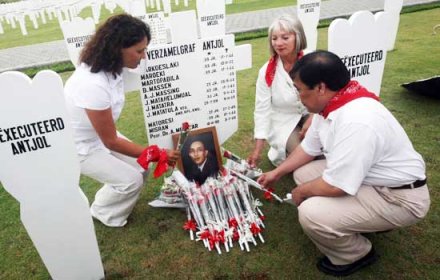
Present-day Eijkman Institute director Sangkot Marzuki (right), and two descendants of the executed man, Monique Mochtar (left) and Jolanda Mochtar (center) lay flowers at a 2010 memorial event after the doctor’s location in a mass grave was discovered. Achmad Mochtar’s name also graces a Sumatran hospital.

On this day..

1943: Marianne Elise Kurchner condemned for a joke

(Thanks to Meaghan Good of the Charley Project for the guest post. -ed.)

Sometime in the summer of 1943 in Nazi Germany, a young woman from Berlin named Marianne Elise Kürchner was guillotined for telling a joke.

Kürchner, who worked at an armaments factory, told the following joke to a coworker who denounced her:

Hitler and Göring are standing atop the Berlin radio tower. Hitler says he wants to do something to put a smile on Berliners’ faces. So Göring says: “Why don’t you jump?”

Not exactly a side-splitter. More like a neck-splitter: making jokes at Hitler’s expense was, in theory at least, a capital crime.

Mind you, most people who made nasty wisecracks about the Nazis faced no consequences at all. They were rarely denounced, and if they did come before a court they were usually given a warning, or at most a few months of “re-education” in Dachau.

The Nazis did occasionally use sedition as an excuse to arrest and execute people who’d gotten on their bad side for one reason or another, but ordinary Germans initially had little to fear.

However, as the tide of war began to turn against Germany, the punishments for sedition became ever more severe.

Marianne was called up before the People’s Court, whose president, Roland Freisler, was famous for both his long raving speeches berating defendants, and his death sentences. She admitted to making the joke but said she hadn’t been herself at the time, feeling bitter about the recent loss of her husband at the front.

Freisler would have none of it. In fact, he considered Marianne’s status as a war widow to be an aggravating factor. “The People’s Court,” Rudolf Herzog said of this case in his book Dead Funny: Humor in Hitler’s Germany, “made it a point of pride to take no account of individual suffering.” In his ruling, Friesler wrote:

As the widow of a fallen German soldier, Marianne Kürchner tried to undermine our will to manly defense and dedicated labor in the armaments sector toward victory by making malicious remarks about the Führer and the German people and by uttering the wish that we should lose the war … She has excluded herself from the racial community. Her honor has been permanently destroyed and therefore she shall be punished with death.

The People’s Court’s judgment was rendered on June 26, 1943. Marianne lost her head shortly thereafter.

On this day..