1899: Ologbosere, of the Benin Empire

On this date in 1899, British forces occupying Benin City hanged a local tribal leader for the massacre whose perpetration had justified London’s, er, “humanitarian” intervention.

The locale of today’s post is “Benin”, but it’s important to note that this is not the modern country of Benin but rather the land just to the east currently situated in southern Nigeria — which was then the Benin Empire, at the tail end of a very long run.

Ruled from Benin City (also presently in Nigeria), this great African state had been in direct contact with European countries since the 15th century.

By the 19th, of course, it had waned with colonial incursions — but Benin itself had sagely declined to extend “free trade” to the powers that meant to dominate it, nor to cede sovereignty by signing a “protectorate” arrangement.

It was only a matter of time before Britain (or someone else) made an offer Benin couldn’t refuse.

In January 1897, a British expedition attempting to enter Benin during a religious festival against the orders of its oba (king) was slaughtered by a Benin force led by the oba‘s son-in-law, Ologbosere (alternatively, Ologbosheri). Britain claimed it was a diplomatic mission; Benin apparently believed the deputation meant to attack.

Regardless, the tactical victory would prove a strategic debacle.


New York Times, Jan. 21, 1897. The last paragraph of this article innocently observes that “the country is said to be very rich, and it would not be surprising to find that one result of the punitive expedition would be the annexation of the whole territory to the British possessions in West Africa.”

The circumstances of this encounter remain murky and hotly disputed to this day. (Here’s a Benin-sympathetic take.) We at Executed Today are confident that a global superpower would never misrepresent its intentions nor engineer a provocation in order to unseat a resource-rich dictator.

As we learn from the London Times (June 12, 1897),

The object of the mission is described as peaceful, and one version even asserts that the party were unarmed … it was intended to send a party to Benin city to ask the King to remove the obstacles which he places in the way of trade …

The King and his capital have a bad reputation. He is a “Ju Ju” follower and addicted to human sacrifices, the gruesome remains of which are to be found in abundance in his capital. He is said recently to have threatened death to the next white man who attempted to visit him, and there is but too good reason to fear that he has kept his word. A military expedition against him probably would have been necessary in any event sooner or later.


Why, less than a teaspoon of Ju-Ju is enough to …

Dispatched within days, the retaliatory Benin punitive expedition sacked Benin City by the end of February, sending its reigning oba into exile. The Benin Empire had fallen; as the journalist had predicted, it was folded into Britain’s colonial administration.

Punitive force personnel reported a veritable bloodbath perpetrated within Benin City by its outgoing administration, including that trump taboo, human sacrifice.

Naval intelligence officer R.H. Bacon wrote,

The one lasting remembrance of Benin in my mind is its smells. Crucifixions, human sacrifices, and every horror the eye could get accustomed to, to a large extent, but the smells no white man’s internal economy could stand. …

Blood was everywhere; smeared over bronzes, ivory, and even the walls, and spoke the history of that awful city in a clearer way than writing ever could. And this had been going on for centuries! Not the lust of one king, not the climax of a bloody reign, but the religion (save the word!) of the race …

the atrocities of Benin, originating in blood lust and desire to terrorise the neighbouring states, the brutal love of mutilation and torture, and the wholesale manner in which the caprices of the King and Juju were satisfied, could only have been the result of stagnant brutality …

[I saw] a crucifixion tree with a double crucifixion on it, the two poor wretches stretched out facing the west, with their arms bound together in the middle. The construction of this tree was peculiar, being absolutely built for the purpose of crucifixion. At the base were skulls and bones, literally strewn about; the debris of former sacrifices … and down every main road were two or more human sacrifices.

The synoptic reports of two other officers are excerpted in this tome; e.g.,

Seven large sacrifice compounds were found inclosed by walls … [containing earthen] altars [that] were covered with streams of dried human blood … [and] open pits filled with human bodies giving forth the most trying odours.

Whilst Britain set about making Benin safe for the olfactory nerves of long-barred merchandisers, Ologbosere persisted in the bush for more than two years. He was finally snared with the connivance of some local tribal chiefs keen to do business with the new boss.


Ologbosere, captured.

Tried on June 27 — just one day before his actual execution; the verdict, of course, foreordained — Ologbosere was damned by those chiefs’ testimony that the strike force he had led back in 1897 to precipitate the intervention “was not sent to kill white men — and we therefore decide that according to native law his life is forfeited.”

Ologbosere said otherwise, to no avail.

The king told me that he had heard that the white men were coming to fight with him, and that I must get ready to go and fight the white men … when all the people called the mass meeting at Benin City and selected me to go and fight the white men, I went. I had no palaver with the white men before.

The day I was selected to go from Benin City to meet the white men all the chiefs here present were in the meeting, and now they want to put the whole thing on my shoulders.


Great Britain’s punitive expedition also resulted in the capture of many hundreds of metal objects scattered to European museums and collections — collectively known as the Benin Bronzes. (It’s a misnomer: they’re actually brass.)

Hocked to defray the expense of their plundering, their diffusion around the empires’ continent helped broaden European appreciation for African art, and influenced modernist art movements. (Notably (pdf) German expressionism: tons of the bronzes ended up in Germany, and many can still be seen at Berlin’s Ethnological Museum.)

Nigeria, and the successor obas of Benin, have for decades besought their return in vain.
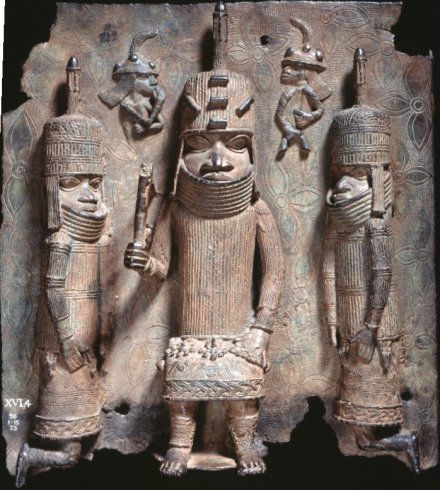

Cultural encounter: this Benin “bronze” shows the oba with two attendants, and the smaller floating heads of two European (Portuguese) traders.

More on this object, and its place in the story of Benin and Europe, in this episode of the BBC’s History of the World in 100 Objects; or, at the “bronze’s” page at the British Museum website.

On this day..

1857: Twelve blown from cannons in British Punjab

An account from the February 15, 1862 Harper’s Weekly of a very messy spectacle orchestrated to maintain British control of Punjab.

Another execution of a similar nature took place on the 13th of June, at Ferozepore. All the available troops and public establishments were convened to witness the scene. Some of the mutineers were to be hung, and around the gallows, erected during the night previous, the soldiers were drawn up. The mutineers were then brought into the centre, and the proceedings of the general Court-Martial was read. Upon being informed that if they would become Queen’s evidence they would be reprieved, twelve of the criminals accepted the offer and were marched to the rear. Two were taken to the gallows. They ascended the ladder with firm steps, and to the last moment betrayed no emotion of fear.

The remaining ten were now led away to the artillery guns, and while their irons were being struck off some cried, “Do not sacrifice the innocent for the guilty!” Two others rejoined, “Hold your sniveling: die men and not cowards — you defended your religion, why then do you crave your lives? Sahibs! they are not Sahibs, they are dogs!” Others then began to upbraid their commanding officer. The wretched beings were quickly fastened to the muzzles of ten guns, charged with blank cartridge.

The commanding officer directed port-fires to be lit. “Ready!” “Fire!” and the drama was played out. An eye-witness says: “The scene and stench were overpowering. I felt myself terribly convulsed, and could observe that the numerous native spectators were awe-stricken — that they not only trembled like aspen-leaves, but also changed into unnatural hues. Precaution was not taken to remove the sponge-and-load men from the muzzles of the guns; the consequence was that they were greatly bespattered with blood, and one man in particular received a stunning blow from a shivered arm!


A lengthier account, no less riveting and we suppose more accurate on account of its primary sourcing, is to be found in this memoir or the British campaign against the Sepoy rebellion.

June 13 The morning of June 13 was fixed upon for the execution. A gallows was erected on the plain to the north side of the fort, facing the native bazaars, and at a distance of some 300 yards. On this two sepoys were to be hanged, and at the same time their comrades in mutiny were to be blown away from guns.

We paraded at daylight every man off duty, and, with the band playing, marched to the place of execution, and drew up in line near the gallows and opposite the native quarter.

Shortly after our arrival the European Light Field Battery, of six guns, appeared on the scene, forming up on our left flank, and about twenty yards in front of the Light Company.

The morning was close and sultry, not a cloud in the sky, and not a breath of wind stirring; and I confess I felt sick with a suffocating sense of horror when I reflected on the terrible sight I was about to witness.

Soon the fourteen mutineers, under a strong escort of our men with fixed bayonets, were seen moving from the fort. They advanced over the plain at our rear, and drew up to the left front of, and at right angles to, the battery of artillery.

I was standing at the extreme right of the line with the Grenadier Company, and some distance from the guns; but I had provided myself with a pair of strong glasses, and therefore saw all that followed clearly and distinctly.

There was no unnecessary delay in the accomplishment of the tragedy. Two of the wretched creatures were marched off to the gallows, and placed with ropes round their necks on a raised platform under the beam.

The order was given for the guns to be loaded, and quick as thought the European artillerymen placed a quarter charge of powder in each piece. The guns were 9-pounders, the muzzles standing about 3 feet from the ground.

During these awful preparations, I watched at intervals the faces of the condemned men, but could detect no traces of fear or agitation in their demeanour. The twelve stood two deep, six in front and six in the rear, calm and undismayed, without uttering a word.

An officer came forward, and, by the Brigadier’s order, read the sentence of the court-martial, and at its conclusion the six men in front, under escort, walked towards the battery.

There was a death-like silence over the scene at this time, and, overcome with horror, my heart seemed almost to cease beating.

Arrived at the guns, the culprits were handed over to the artillerymen, who, ready prepared with strong ropes in their hands, seized their victims. Each of these, standing erect, was bound to a cannon and tightly secured, with the small of the back covering the muzzle. And then all at once the silence which reigned around was broken by the oaths and yells of those about to die. These sounds were not uttered by men afraid of death, for they showed the most stoical indifference, but were the long-suppressed utterances of dying souls, who, in the bitterness of their hearts, cursed those who had been instrumental in condemning them to this shameful end. They one and all poured out maledictions on our heads; and in their language, one most rich in expletives, they exhausted the whole vocabulary.

Meanwhile the gunners stood with lighted port-fires, waiting for the
word of command to fire the guns and launch the sepoys into eternity.

These were still yelling and raining abuse, some even looking over their shoulders and watching without emotion the port-fires, about to be applied to the touch-holes, when the word “Fire!” sounded from the officer in command, and part of the tragedy was at an end.

A thick cloud of smoke issued from the muzzles of the cannons, through which were distinctly seen by several of us the black heads of the victims, thrown many feet into the air.

While this tragic drama was enacting, the two sepoys to be hanged were turned off the platform.

The artillerymen again loaded the guns, the six remaining prisoners, cursing like their comrades, were bound to them, another discharge, and then an execution, the like of which I hope never to see again, was completed.

All this time a sickening, offensive smell pervaded the air, a stench which only those who have been present at scenes such as these can realize — the pungent odour of burnt human flesh.

The artillerymen had neglected putting up back-boards to their guns, so that, horrible to relate, at each discharge the recoil threw back pieces of burning flesh, bespattering the men and covering them with blood and calcined remains.

A large concourse of natives from the bazaars and city had assembled in front of the houses, facing the guns at a distance, as I said before, of some 300 yards, to watch the execution. At the second discharge of the cannon, and on looking before me, I noticed the ground torn up and earth thrown a slight distance into the air more than 200 paces away. Almost at the same time there was a commotion among the throng in front, some running to and fro, while others ran off in the direction of the houses. I called the attention of an officer who was standing by my side to this strange and unaccountable phenomenon, and said, half joking: “Surely the scattered limbs of the sepoys have not been carried so far?”

He agreed with me that such was impossible; but how to account for the sight we had seen was quite beyond our comprehension.

The drama came to an end about six o’clock, and as is usual, even after a funeral or a military execution, the band struck up an air, and we marched back to barracks, hoping soon to drive from our minds the recollection of the awful scenes we had witnessed.

Two or three hours after our return news arrived that one native had been killed and two wounded among the crowd which had stood in our front, spectators of the recent execution. How this happened has never been explained. At this time a “cantonment guard” was mounted, consisting of a company of European infantry, half a troop of the 10th Light Cavalry, and four guns, and two of these guns loaded with grape were kept ready during the night, the horses being harnessed, etc. Half the cavalry also was held in readiness, saddled; in fact, every precaution was taken to meet an attack.

As far as I can recollect, there were but two executions by blowing away from guns on any large scale by us during the Mutiny; one of them that at Ferozepore.

On this day..

1943: Wilhelm H., pensioner and vandal

(Thanks to Meaghan Good of the Charley Project for the guest post. -ed.)

On this day in 1943, a retired transport worker known only as Wilhelm H. was executed for high treason. He was seventy-four years old and had no prior criminal history.

His crime? Writing messages in a public toilet. The story of the events that lead to his death is recorded in Tom Lampert’s work of documentary history, One Life, which is the sole source for this account. Unfortunately Mr. Lampert did not disclose Wilhelm’s last name.

The story begins in August 1942, when Wilhelm wrote the following inscription in a public toilet in Berlin:

Hitler, you mass murderer, you must be murdered, then the war will be over.

Good citizens who saw the graffito promptly reported it to the authorities and it was erased. However, the exact same message appeared in the same location twice more over the next eight weeks.


Nazis and graffiti: still a going couple. (cc) image from kejoli.

On October 28, 1942, a local resident finally caught Wilhelm H. red-handed writing the subversive message on the wall, and made a citizen’s arrest.

Wilhelm initially denied having written anything and the police couldn’t find any writing implement on his person, so they were forced to let him go for lack of evidence. Two weeks later, however, when questioned again by authorities, Wilhelm admitted he had written the message. When asked why, he replied that wartime inflation had reduced his pension to a pittance. He and his wife got only 78.80 reichsmarks a month and had to pay 34.05 of that in rent.

Wilhelm held Adolf Hitler responsible for the war and hence his own privations, and as he felt incapable of action himself he resolved to call other people to rise against the Führer. He said he believed things would be better if the Führer wasn’t there anymore.

The senior district attorney turned his case over to the People’s Court, saying, “Even if the seventy-three-year-old accused does not otherwise appear to have ever engaged in harmful political activities, the suspicion that a crime has been committed here according to paragraphs 80ff. of the Penal Code [conspiracy to commit high treason] cannot be dismissed.”

During the pretrial investigation it waslearned that Wilhelm was born in Klein-Reitz in 1869. He had an elementary school education and worked as a farm laborer until the age of twenty, after which he did military service for three years. Once his term of service ended he moved to Berlin and worked for the next thirty-five years as a transport laborer. He retired on a disability pension. He had never been politically active and his neighbors described him as quiet and reclusive.

In January 1943, Wilhelm was indicted on three counts:

  • calling for the Fuhrer to be killed;
  • treasonously attempting to alter the constitution of the German Reich through violence, whereby the crime was aimed at influencing the masses by means of the written word; and,
  • aiding and abetting the enemy during a war against the Reich and harming the military powers of the Reich.

A physician at the Plötzensee Prison certified that Wilhelm was mentally and medically fit for trial. The trial itself, on March 8, 1943, lasted only an hour. Wilhelm was convicted of all charges and sentenced to death. The court stated:

The wording of the inscription … is clear. There is nothing about the sentence or its meaning to quibble over. Given H.’s selection of a public location, the inscription must be regarded as a call on the populace to kill the Führer of the German Reich. Nor can there be any doubt about the seriousness of H.’s intentions here … as his repeated writing on the inscription demonstrates beyond any doubt.

Since H. wrote his demand quite legibly in crayon on the wall, it could be read by all German comrades visiting the toilets, and this in a neighborhood made up primarily of manual laborers. In addition, the designation of the Führer as a mass murderer and the claim that the war would be over if the Führer were dead both created the appearance of oppositional movements in the Reich and stirred up visitors of the public toilets against the Führer and his Nazi regime, inciting them to acts of violence…

And all of this because H. desired greater buying power for his pension and because he himself wanted to lead an “adequate and contented” life. H.’s old Marxist views — evident in his past votes for the Social Democratic Party — resurfaced at the moment when he believed National Socialism didn’t offer him enough for his personal needs. He has placed the life of the Führer and the fate of the entire German people at risk in a reckless and wanton manner, and all this merely for his own personal well-being. In so doing, H. has expelled himself from the community of German people, who share a common destiny, and thus passed sentence on himself. He deserves to die … The People’s Court has thus sentenced H. to death, a punishment which, given the heinousness of the crime, also takes into account popular German sentiment.

Joseph Goebbels himself, Germany’s Minister of Propaganda, voiced his support for the death sentence. Wilhelm H. was calm and did not resist when he was taken to the guillotine on May 20, 1943.

On this day..

1942: Shimon Cohen, ladykiller

(Thanks to Meaghan Good of the Charley Project for the guest post. -ed.)

On this date in 1942, at close to 11:00 p.m., Shimon Cohen was shot to death in the village of Kalesnik, Lithuania.

A barber by trade, he had somehow managed to evade the roundup and mass shooting of all the Jews in the area eight months before. But he could only postpone capture and death for so long.

The details of Shimon’s death were recorded in the diary of 22-year-old Abelis Veinsteinas, later known as Aba Gefen, a fellow Jew who was also hiding in the area. Gefen and his brother were staying in the home of the Matulevich family in exchange for payment.

On May 18, Gefen wrote:

[Two days ago] Shimon Cohen was caught at friends of his. A fight broke out between the wife of the farmer who was hiding him and the farmer’s sister. One of the women informed on Shimon to the mayor of the village, who told the police. Shimon and the farmer were arrested. They say Shimon asked a priest to come and convert him, because he knows that he will die and he wants to die a a Catholic. I am very sorry to hear that — that he’ll die as a traitor to his people.

Shimon, it seems, was quite the ladies’ man, juggling multiple romantic partners at the same time. As often happens in these cases, it came back to bite him in the ass:

It seems that Shimon was betrayed by Marta, his mistress. When the Germans began to remove Jews from the town, Marta suggested that he hide with her family in the country. He agreed and lived with her at her brother’s house. But Marta’s sister-in-law also fell in love with him. Jealousy and hatred got the better of the two women. Shimon thought he would be able to save his life by declaring his love for both of them. But Marta was furious that he was making love to her sister-in-law and turned him in.

It would be kind of a funny story if it didn’t involve Nazis and death.

As Gefen recorded in subsequent diary entries, one of Shimon’s lady friends tried to save him by pulling some boards loose from the wall of the prison outhouse so he could escape. Shimon did indeed run away, but the authorities quickly caught him and he wasted no time in selling out the woman who had facilitated his escape attempt. (She was arrested, but her ultimate fate is unrecorded.)

In the days prior to his death, Shimon took religious instruction from a priest and was baptized.

At great risk, Gefen would occasionally leave his attic hideout and go to the village to retrieve some more of his family’s valuables to give to the Matuleviches.

He wrote in his diary that he was out on one of those surreptitious excursions, tiptoeing in the dark in his stocking feet, when he heard Shimon Cohen being executed:

When Mrs. Matulevitch and I went to Kalesnik at night and crossed the railroad tracks not far from the road that leads there, we heard shots … Today, when Mrs. Matulevich came back from the village, it turned out that those shots were bullets that killed Shimon Cohen, a Jew who converted just before his death. May Shimon rest in peace — but it was still no way to die.

[…]

Piletsky the partisan shot him. He had shot Jews before. In fact, they say he’s shot seventeen Jews. Now he’s killed Shimon, and he got 15 German marks for his trouble.

Gefen and his brother survived the war, staying with various villagers and occasionally in the fields. He moved to Israel in 1948. He published his diary under the title Hope in Darkness.

On this day..

1868: Kondo Isami, Shinsengumi

On this date in 1868, Shinsengumi commander Kondo Isami was beheaded at Itabashi as the civil war between the Tokugawa Shogunate and the rising Meiji government that would replace it unfolded.

A commoner raised to samurai, Kondo is famous for commanding the Shinsengumi, a sort of shogunate paramilitary renowned for hunting pro-imperial samurai.

This, of course, was ultimately a nonstarter, notwithstanding the Shinsengumi’s flair for dramatic success.

Kondo had little power to reverse the Tokugawa Shogunate’s deteriorating position even though his skill earned him progressively higher appointments in its service.

In the event, however, our principal lost the Battle of Koshu-Katsunuma, and was captured shortly thereafter.

From there, nature took its course.

He was brought in a cage to Itabashi, near Yedo, where he was beheaded. His head was put in spirits and sent to Kioto, where it was exposed in the dry bed of the Kamogawa near the fourth bridge. This most shameful of all punishments was inflicted upon Kondo Isami because, as chief adviser of his lord, the prince of Aidru, he had made himself especially hateful to the southern clans. (Source)

As a result, Kondo wouldn’t be around to say “I told you so” when the victorious Meiji scrapped their samurai-friendly xenophobia and replaced their former supporters in the warrior caste with a modernized army.

But he and his doomed band of upwardly-mobile swordsmen in romantic service of a historical dead-end are still with us. Shinsengumi adventures and Kondo Isami characters remain a staple of popular culture.

[flv:https://www.executedtoday.com/video/Shinsengumi_trailer.flv 440 330]

On this day..

1843: Ewen Cameron, black bean leftover

On this date in 1843, a Mexican firing squad disposed of Texan commander Ewen Cameron.

A Scottish immigrant, Cameron arrived in Texas just as it broke free of Mexico. His reputation for martial prowess on the frontier earned him a newsman’s tribute as “the Bruce of the West.”

High praise indeed: but his end would better resemble Wallace.

Cameron hitched on to the ill-fated Mier Expedition plundering raid over the border.

He was among the men forced to participate in the Black Bean Lottery wherein 176 Texan prisoners picked beans from a pot to determine who would live and who would die. Cameron picked a white bean, saving his life … but only briefly.*

The verdict refused by Fortune was reinstated by the hands of men.

Abrasive characters like the Bruce are not so well appreciated across their respective frontiers, and Cameron had built some ill-will in the Mexican army with his intrepidity the previous year.

The officer thereby embarrassed, Antonio Canales, was loath to let this reviled prisoner escape his clutches, and urgently petitioned Santa Anna to dispose of him.

This was duly done at Perote Prison, where the other lottery survivors languished for months or years along with other captives of various Mexican-Texan skirmishes.

Cameron County, Texas (the state’s southernmost) is named for Ewen.

* According to this account, the Mexicans loaded the fatal black beans onto the top layers in an effort to get the officers (who drew first) to pick them. Cameron was wise to the scheme, and foiled it by thrusting his hand all the way into the pot.

On this day..

1655: Massacre of Waldensians

On this date in 1655, Catholic forces under the Duke of Savoy carried out a notorious massacre of Waldensians* in the Piedmont.

This interesting, excommunicate sect had persisted for centuries in those hard-to-reach places in Alpine foothills, intermittently ignored and hunted. After Martin Luther, many Protestants inclined to see them as a proto-Reformation movement, or even a counter-papal apostolic succession reaching back to ancient Christianity.

At any rate, they sure weren’t Catholic.

And our friend the Duke decided — perhaps piqued by the murder of a missionary Catholic priest, or for whatever other reason — to mount one of those heresy-extirpating sorties and make them Catholic in 1655.

On April 17, the Marquis of Pianezza appeared with an overwhelming force of mixed Piedmontese, French, and Irish** troops. They conducted a few skirmishes, then made nice with the Waldensian civic leaders and induced them to quartering their troops temporarily further to some expedient pretext.

Alas! alas! these poor people were undone. They had received under their roof the executioners of themselves and their families. The first two days, the 22d and 23d of April, passed in peace, the soldiers sitting at the same table, sleeping under the same roof, and conversing freely with their destined victims …

At last the blow fell like a thunderbolt. At four of the clock on the morning of the 24th April the signal was given from the Castle of La Torre. But who shall describe the scenes that followed? On the instant a thousand assassins began the work of death …

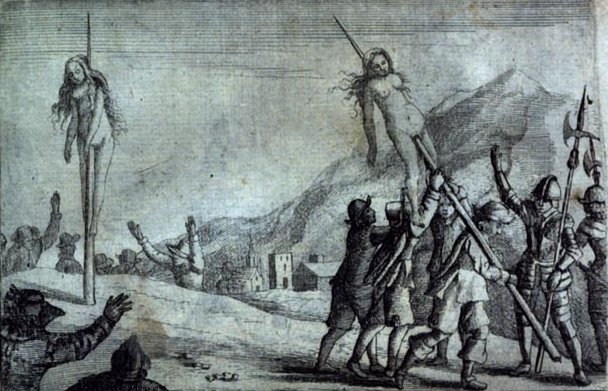
Little children were torn from the arms of their mothers, and dashed against the rocks; or, more horrible still, they were held betwixt two soldiers, who, unmoved by their piteous cries and the sight of their quivering limbs, tore them up into two halves. Their bodies were then thrown on the highways and the fields. Sick persons and old people, men and women, were burned alive in their own houses; some were hacked in pieces; some were bound up in the form of a ball, and precipitated over the rocks or rolled down the mountains … Some were slowly dismembered, and fire applied to the wounds to staunch the bleeding and prolong their sufferings; some were flayed alive; some roasted alive; others were disembowelled; some were horribly and shamefully mutilated, and of others the flesh and brains were boiled and actually eaten by these cannibals.

Source, whose atrocity accounts channel those in this French tome

Without doubting the capacity of man’s inhumanity to man, the cannibalism charge reminds that we’re dealing with propaganda alongside historiography. And what great propaganda — like, babies-torn-from-incubators great.

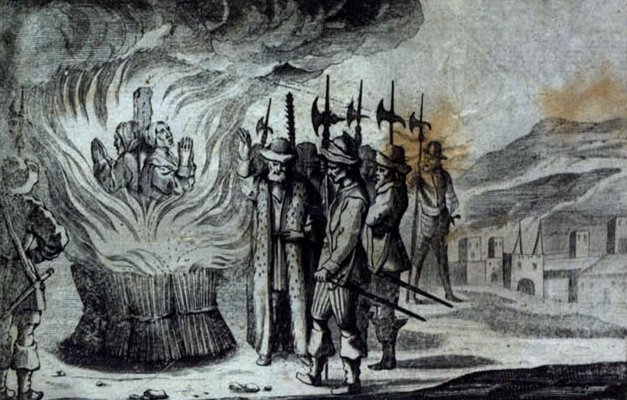
Thumbnails (click for a larger, disturbing view) of selected images of this date’s atrocities from Samuel Morland’s The History of the Evangelical Churches of the Valleys of Piedmont

And there’s little doubt as to the overall savagery of the affair, which could well have become the opening salvo in a full-scale sectarian cleansing campaign. (A later addendum to Foxe’s Book of Martyrs narrates the ensuing Piedmontese armed struggle, petering out before any definitive resolution in the field.)

Outrage at this hecatomb spread in Protestant Europe — which would also refer to the day’s doings as the “Bloody Easter,” since it corresponded with the eve of that celebration as reckoned by the Julian Calendar (source).

It was felt especially in Protectorate England, which intervened diplomatically.

A “day of solemn fasting and humiliation” was promulgated in Albion, along with collections for the relief of the survivors. Oliver Cromwell personally put £2,000 into the kitty.

More importantly, he dispatched diplomat Samuel Morland† to force the House of Savoy to lay off the persecution; in fact, he threatened to disrupt high statecraft between England and France unless the French twisted arms on behalf of the Waldensians.

Written correspondence for Morland’s diplomatic tour addressed to Louis XIV of France and various other continental potentates, as well as a fiery bit of oratory that Morland delivered to Savoy, all seem to have originated from the pen of Republican scribbler John Milton — the future author of Paradise Lost.‡

Milton, for whom the whole thing was more than just a day job, was further moved to put his umbrage at the slaughter into sonnet form:

Avenge O Lord thy slaughter’d Saints, whose bones
Lie scatter’d on the Alpine mountains cold,
Ev’n them who kept thy truth so pure of old
When all our Fathers worship’t Stocks and Stones,

Forget not: in thy book record their groanes
Who were thy Sheep and in their antient Fold
Slayn by the bloody Piemontese that roll’d
Mother with Infant down the Rocks. Their moans

The Vales redoubl’d to the Hills, and they
To Heav’n. Their martyr’d blood and ashes sow
O’re all th’ Italian fields where still doth sway

The triple Tyrant: that from these may grow
A hunder’d-fold, who having learnt thy way
Early may fly the Babylonian wo.

* The Waldensians in question here are interchangeably known as the Vaudois for their geographic region, actually above the Piedmont and abutting the Swiss region also known as Vaud. (These pages have visited the latter.)

** Fresh from being on the receiving end of another infamous massacre.

† Morland is more regarded for his post-Restoration labors as an inventor; he created an early calculator and internal combustion engine.

‡ The speech in particular is not definitively attributed; see Robert Fallon, “Milton in Government: Denmark and Savoy,” Milton Quarterly, May 1989.

On this day..

1942: Anton Schmid

(Thanks to Meaghan Good of the Charley Project for the guest post. -ed.)

On this day in 1942, Sergeant Anton Schmid was executed for high treason. His crime: saving the lives of Jews in Nazi-occupied Vilna, Poland (now part of Lithuania and called Vilnius).

Schmid was born in Vienna and owned a radio shop there before he was drafted into the German Army following the Anschluss in 1938.

After Germany’s invasion of Russia in mid-1941, Schmid was put in charge of a unit in Vilna, tasked with collecting and reassigning soldiers who had been separated from their units. He witnessed the sufferings of the Jewish population in the Vilna Ghetto and was so horrified, he decided to take action.

Schmid used his position in the military to help Jews by employing them as workers for his unit, forging papers to get them out of prison and out of the ghetto, and using Army trucks to escort them away from the city.

At great personal risk, he would go into the ghetto to hand out food and warn the inhabitants when the Germans were planning roundups. In dire situations he would even hide people in his own apartment to protect them from the Nazis. He maintained close contact with Jewish resistance organizations and assisted their activities in a variety of ways.

According to one account by a Jewish woman who was herself killed later in 1942,

[Schmid] would mock the Jews and say how easily they could be fooled, and at the same time tried to find out what the Germans were planning. As soon as he learned something new, he would tell his Jews and order them to tell their friends so that they could hide until the situation stabilized … He negotiated on their behalf like a dedicated father, without fear of being punished if he was found out. He put them in his working place and provided them with food and drink. He gave them soup and bread. In short, in those chaotic days of massacres he managed to save dozens of Jews …

Although the Jewish Underground warned Schmid that his activities had become too widely known and he was in great danger, he refused to put a stop to his effort to save the Vilna Jews. In response to their concerns he reportedly said that if given a choice between “living as a murderer and dying as a rescuer,” he would choose to die.

He saved an estimated 250 to 300 people before his arrest in January or February 1942.

At his court-marshal, his attorney tried to say Schmid had taken the Jews out of the Vilna Ghetto because he thought they could better serve the Reich elsewhere. Schmid refused to allow this, however, openly proclaiming that he had been trying to save Jewish lives. He was convicted on February 25 and sentenced to die.

In a letter to his wife and daughter, just days before his death, he tried to explain himself:

Here there were a great many Jews who were being rounded up by the Lithuanian militia and shot to death in a meadow outside the city, groups of 2-3,000 at a time. On the way there, they were smashing children against trees and such like. You can imagine how I felt … You know how I am with my soft heart. I couldn’t think otherwise and helped them… This is a heavy blow for us, but please forgive me. I was just behaving like a human being and didn’t want to hurt anyone.

In 1967, twenty-five years after his death, Schmid was honored as a Righteous Gentile by Yad Vashem. His widow attended the ceremony on his behalf and accepted a medal reading “Whoever saves one life, saves the entire world.”

A street in Vienna and a military base in Germany are named after him.

On this day..

1868: The native prisoners of Emperor Tewodros II

On this date in 1868, on the eve of his rout at the hands of a British expeditionary force, the frustrated Emperor Tewodros II had hundreds of prisoners executed en masse.

Our setting is the 1868 British Expedition to Abyssinia, “one of the most expensive affairs of honour in history.” And it all got started from a bad experience with technical support.

Tewodros — generally known to the Europeans as Theodore — had risen from a humble station to the throne of Abyssinia, but by the 1860s held it but tenuously against various rival warlords. Tewodros lodged appeals for aid with a number of European powers, including the British, who evidently took the emperor’s letter for Queen Victoria and stuck it indefinitely in a file called “Pending”.

After two years without an answer, Tewodros took hostage the British consul Charles Duncan Cameron, a missionary named Henry Stern (whose unflattering report of Tewodros’s mean origins particularly enraged the monarch), and other Europeans.


Illustration of the hostages from Henry Stern’s The Captive Missionary.

And then he took hostage the Ethiopian sent to negotiate their release.

He wasn’t “Pending” any longer.

Gaze not into Abyssinia

Tewodros, perhaps, had depended on the notoriously treacherous Ethiopian highlands to protect him from any effective reprisal. But when the Brits decided in 1867 to let men with guns resolve the dispute, they spared no expense at all.

Months of planning and millions of pounds were poured into the operation, which landed 13,000 soldiers and 40,000 animals organized by the Bombay Army.

“For a total cost of about £9,000,000,” writes Harold Marcus in a biography of another former Tewodros hostage, the future Emperor Menelik II, “Napier set out to defeat a man who could muster only a few thousand troops and had long ago ceased to be Ethiopia’s leader in anything but title.”

The forces converged on Tewodros’s last stronghold, Magdala, with the mercurial king refusing repeated demands of the invader to release his European captives.

Angrily refusing, at least according to the accounts of the hostages who were the subject of all this … and whose accounts have just enough consciousness of the privilege their own skin has given them as they witness these bloodlettings.

On April 8, the king put to death seven of the native prisoners in his train. These prisoners comprised generally people on the political outs with Tewodros, adherents of once-rebellious chiefs and the families of those adherents. It was no mean thing to slaughter a few of them arbitrarily.

But much worse was to come the following day, when the hunted emperor espied the British advance guard reconnoitering his position.

According to a report by European hostage W.F. Prideaux in the May 21, 1868 London Times, the Emperor

had seen the British troops descending the Bashilo, and had remarked among them four elephants and some white animals, which we surmised to be Berbera sheep. A short time afterwards a friend of ours (for we had a few friends at Magdala) … implored us to keep within our tents, for the King was in a fearful passion, and was then issuing an order to kill all his native prisoners, who were confined in a few houses a couple of hundred yards off. The repeated discharge of firearms, which we heard soon afterwards, confirmed the sad story, and it was with many misgivings that we asked ourselves, “What next?” At dusk, however, the King returned, and we returned to our tents comparatively at our ease. From what I have heard it appears that the King rushed down mad with rage and arackee, and calling out one of the prisoners hacked him to pieces with his own sword. Another speedily met the same fate. The third was a boy about ten years of age. His youth and innocence (for it was his father who had been the offender) were no protection. He was mangled in the same way as the two others. The cutting and slashing went on in this manner for some time, when the King, finding this mode of execution too slow for his impatient spirit, ordered out the musketeers. The remainder were then quickly shot down, and thrown over the low cliff, the force of the shock in several cases opening the chains of the wretched victims. Those whose quivering limbs showed any signs of life were fired on from above till the murderous work was completed.

The account of the Rev. Stern:

[W]e were suddenly startled by the sound of an intermittent musketry. … The rattle of musketry blended with the yells of despair, and the shouts of rage fell, however, with an ominous and appalling horror on our ears. “What is the matter?” I inquired of my neighbour. “Hist,” was the response, “the king is killing all the prisoners.” These terrible words diffused an aguish chill through my very heart. … The sun had already disappeared from the horizon, and twilight spread a dismal, dusky hue over the scene around, and still the firing continued unabated. With night it gradually diminished, and then only isolated shots reverberated across the panic-stricken camp.

The slaughter lasted about three hours, and during that interval three hundred and seven human beings* were, unwarned, and perhaps unprepared, hurled into eternity. Some of the prisoners did not unresistingly yield to their woeful doom. One, Immer Ali, a native of Ferga, near the Tzana Lake, formerly a chief of consideration in his province, in spite of hand and foot chains, with a convulsive grasp dragged his executioner towards the precipice over which he was to be hurled. The hangman, who dreaded the doom which he intended to inflict on his fellow man, shouted for help. On hearing the cry the tyrant, tiger-like, sprang forward and with his gory sword literally hacked the man to pieces.

And to hear Stern tell it, it was by dint of nothing but great fortune — or in his view, divine providence — that saved the British hostages from joining them.

One victim after another lay writhing and quivering in the last pangs at the foot of the dizzy precipice, and still the tyrant’s rage was un-appeased. “Bring the white men, and let their blood flow, mingled with that of my own subjects,” was the order that fell from his lips. Already, we were informed, whole bands of ruffians stood prepared to seize the intended prey, when several chiefs, no friends of the foreign captives, stepped forward, and requested that our execution might be deferred till next day. “Your Majesty,” they respectfully remarked, “the white men do not deserve the easy death of the sword and bullet; no, keep them till to-morrow, and then let the slow torture of a flaming hut put an end to their existence.” “You are right,” was the response.

Since the next day was Good Friday, the Christian Tewodros, “though a perfect fiend and coarse blasphemer, repaired, from a superstitious impulse, at a very early hour to church,” Stern says. The decisive British attack began later that day, and would end with the un-executed hostages liberated, and Tewodros taking his own life rather than fall captive.

Among the spoils of war was the crown of the dead emperor, which in 1925 King George V would personally present to Haile Selassie.

* The provenance of the very precise figure of 307 is not apparent in Stern’s account; presumably, he knew through his friendly contacts (of from relieving the boredom of captivity in recreational head-counting) the overall number of prisoners beforehand.

On this day..

1943: Elise and Otto Hampel, postcard writers

(Thanks to Meaghan Good of the Charley Project for the guest post. -ed.)

On this day in 1943, a working-class German couple were executed for treason and sedition in Berlin, Germany: Otto and Elise Hampel’s reign of postcard-writing terror had finally come to its conclusion.

On the surface, the Hampels seemed like two very ordinary people. Elise had an elementary school education and worked as a domestic servant before she married Otto in 1935. Otto, a World War I veteran six years older than Elise, was a factory laborer.


Two of the treasonous postcards.

They lived modest, anonymous lives in Berlin and doubtless would have continued to do so if Elise’s brother, a soldier in the German Army, had not been killed in action in France in 1940.

Elise’s brother’s death was the catalyst for the Hampels’ tragically brave and utterly ineffectual two-year campaign of resistance against Hitler’s Germany.

Together the couple hand-wrote over 200 postcards and leaflets speaking out against the Nazi regime. The postcards urged people not to serve in the German Army, to refuse to donate to Nazi organizations, and generally do everything they could to resist the government. Otto and Elise scattered the cards in mailboxes, stairwells and other locations all over Berlin. The idea was that people would find the cards, read them and show them others, and thus the seed of rebellion would take root.

What actually happened was that almost all the cards were delivered to the authorities immediately. Nobody wanted to be caught in possession of such dangerous words.

Because of the sheer number of postcards and the long duration of their distribution, the Gestapo at first thought they were dealing with a much larger group of traitors. Doubtless they were frustrated that this riffraff, who couldn’t even write properly (the postcards were full of grammatical errors and misspellings), were able to evade them for so long. But the Hampels’ resistance activities eventually caught up with them.

They were unrepentant after their arrests in October 1942, and had little to say for themselves, beyond Otto’s statement that he was “happy” about protesting against Hitler. Roland Freisler‘s People’s Court duly condemned them to die for “preparation for high treason” and “demoralizing the troops.” They were executed by guillotine in the Plötzensee Prison.

For some reason, unlike their equally courageous, foolish and doomed counterparts in the White Rose, the Hampels’ story didn’t really catch on with historians.

They were saved from oblivion by the dangerously unstable, drug-addicted author Rudolf Ditzen, aka Hans Fallada, who came upon their Gestapo file after the war.

His 1947 novel, Every Man Dies Alone, written in just 24 days, is closely based on Elise and Otto’s story. This book was Fallada’s swan song; he died weeks before its publication. Titled Jeder stirbt für sich allein in Germany, it was not translated into English until 2009 — but it then became a runaway bestseller in the United States and (under the title Alone in Berlin) in Great Britain.

On this day..