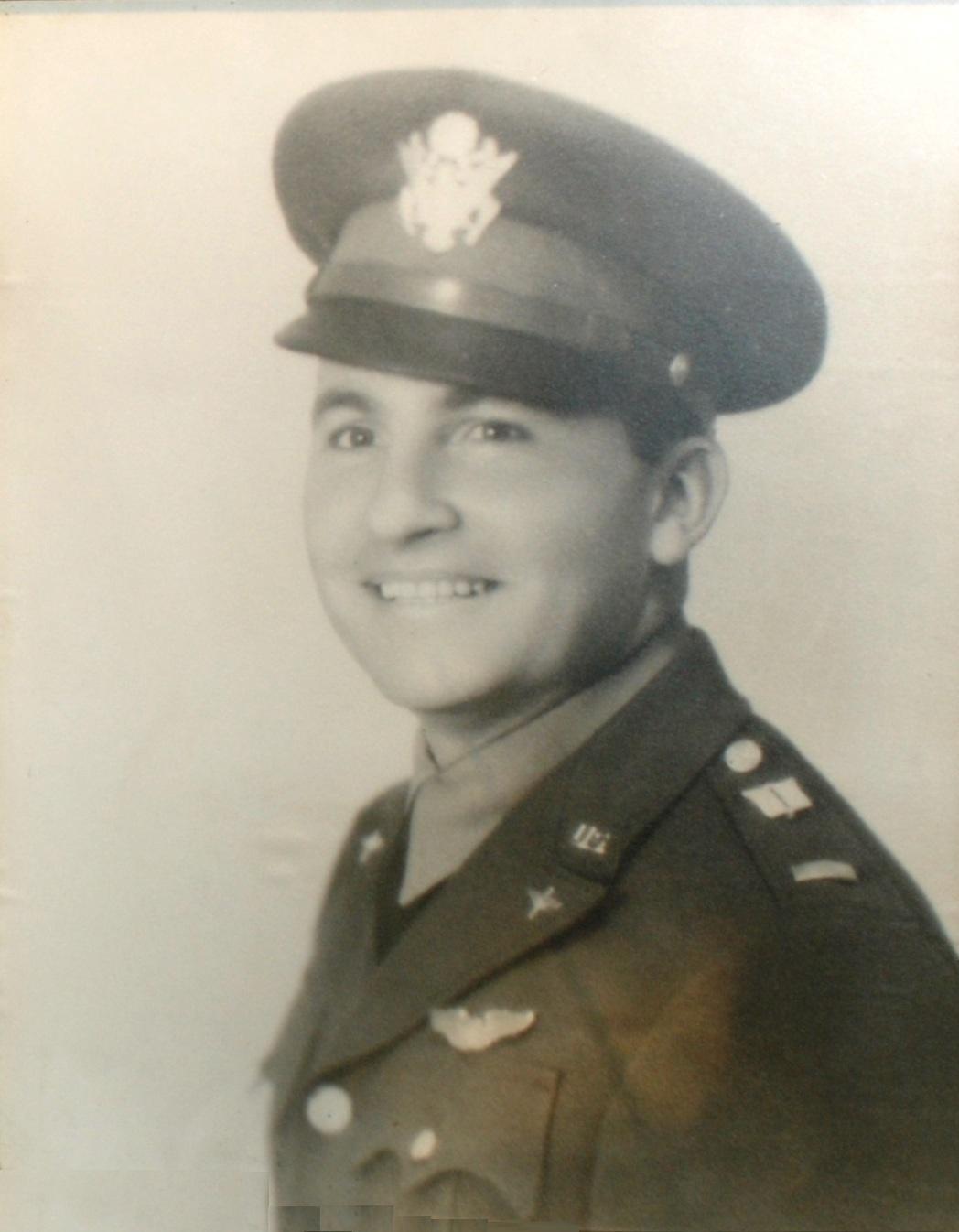
1942: Three Doolittle raiders

On this date in 1942, three captured American airmen who had bombed Japan in the Doolittle Raid were shot in Tokyo.

The Doolittle Raid — named for its commander, Jimmy Doolittle — was America’s April 1942 retaliation for the Japanese attack on Pearl Harbor a few months before.

The mission: bomb the Japanese homeland.

Later in the war, American advances in the Pacific would enable the Yankee to do this regularly. In 1942, it was all but a suicide mission.

The plan involved launching 16 B-25s from an aircraft carrier — an unprecedented feat in itself — to fly light with arms and heavy with fuel to just make it 400 miles to Honshu, and with any luck on to China before the tanks ran dry.

Considering that the bombers had to launch in a panic when the carrier group was spotted a couple hundred miles too early, the raid’s success was downright miraculous: all 16 bombers made it on to (or near enough) the mainland without being shot down, where the crews bailed out and, for the most part, escaped to allied forces. Jimmy Doolittle would title his autobiography I Could Never Be So Lucky Again.

But not all were quite as lucky as Lt. Col. (later, General) Doolittle.

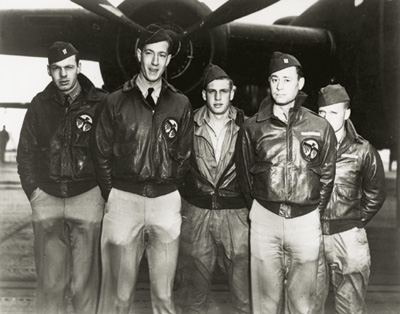
Farrow (left) and Hallmark. Spatz was a member of Farrow’s crew, and is pictured center in that plane’s crew shot here.

Two (out of eighty) drowned when their ride was ditched in the drink. Eight others were captured by the Japanese.

Four of those eight captives would survive the war to tell the tale. A fifth died in captivity. And the other three — pilots William Farrow and Dean Edward Hallmark, and (for somewhat unclear reasons) gunner Harold Spatz — were shot this day in a Shanghai cemetery following a sketchy military trial which condemned them for hitting civilian targets.

Designed largely for its psychological effect, the morale-boosting Doolittle raid has attracted interest from countless other sources who treat it in greater depth. DoolittleRaid.com and DoolittleRaider.com both provide detailed online information about the raid.

For more traditional media, one could do worse than bomber pilot Ted Lawson’s book, and its subsequent propaganda film adaptation, Thirty Seconds Over Tokyo.

On this day..

1401: Llywelyn ap Gruffydd Fychan, an army marching on his stomach

(Thanks to Jonathan Shipley of A Writer’s Desk for the guest post. -ed.)

It was on this day that a Welsh squire, Llywelyn ap Gruffydd Fychan, was gruesomely executed for thwarting the efforts of King Henry IV’s forces to squelch Welsh resistance to English rule.

First, the man’s stomach was cut out and cooked in front of him. Then, he was hanged, drawn and quartered.

The torturous execution took several hours before he succumbed to death. Then, a grisly postscript: his salted remains were sent to other Welsh towns to deter Welshmen from opposing the king.

Rewind to October, 1399.

Henry IV has been crowned King of England after overcoming the unpopular Richard II. Henry had his predecessor imprisoned and killed, then displayed at St. Paul’s Cathedral to prove to his supporters that he was gone.

Little surprise much of Henry’s reign was spent defending himself against plots, rebellions and assassination attempts. One rebellion? That of Owain Glydwr, who declared himself Prince of Wales in 1400.

This didn’t sit well with the new king. Armed men were sent out to find this treasonous Welshman. Found them they did, though perhaps they wished they hadn’t. In the summer of 1401, on the slopes of Pumlumon, Owain Glydwr crushed Henry’s army. This, too, did not sit well with the king.

Give me leave
To tell you once again that at my birth
The front of heaven was full of fiery shapes,
The goats ran from the mountains, and the herds
Were strangely clamorous to the frighted fields.
These signs have mark’d me extraordinary;
And all the courses of my life do show
I am not in the roll of common men.
Where is he living, clipp’d in with the sea
That chides the banks of England, Scotland, Wales,
Which calls me pupil, or hath read to me?

-Glendower (Glyndwr) in Shakespeare’s Henry IV, Part I

Henry then led a huge army, arriving in Llandovery, to capture this meddling countryman prince.

It was here that the English military met a 60-year-old man. A land owner from Caeo, his name was Llywelyn ap Gruffydd Fychan and the English army strongly suggested he assist them in helping locate Owain Glydwr. Llywelyn agreed.

Little did the English know, as they chased Glyndwr, that Llywelyn was taking them in the wrong direction.

He had two sons, did this Llywelyn, in Owain’s army. Though he knew he’d undoubtedly pay the ultimate sacrifice, he would not betray the Welsh people and his own family but leading the English king to the insurrectionists.

And so he led the English army on a wild goose chase.

For weeks Llywelyn lead the king and his forces through the uplands of Deheubarth. All the while Owain and his men made their escape the opposite direction to consolidate, grow, and fortify.

The king’s patience became taxed. He began to see that Llywelyn was not taking them to their man.

Angrily, the king drug Llywelyn to the town of Llandovery. In front of the castle gates, there in the town square, he was disemboweled and dismembered. Though Glyndwr’s war of liberation fizzled out, Owain was never captured nor betrayed.

Fast forward to the year 2001.

600 years after Llywelyn’s execution, a sculpture is erected. Standing 16 feet tall, erected by the castle he died in front of, is a statue of a cloaked figure, spear and shield in hand, atop a stone base inscribed with Welsh verse.

It is he, Llywelyn, commemorating his ultimate sacrifice.


Llywelyn’s striking steel statue stands watch over Llandovery. Images (c) Canis Major and stused with permission.

On this day..

1927: Martyrdom of Five Christeros

Artist unknown. The inscription reads:

Execution of Cristeros by federal soldiers on the outskirts of San Gabriel, Jalisco, October 8, 1927. On the same site, the soldiers were ambushed, suffering the same fate.

On this day..

1941: Babi Yar massacre begins

(Thanks to Meaghan Good of the Charley Project for the guest post. -ed.)

Between September 29 and September 30 in 1941, the Nazis, specifically Einsatzgruppe C, shot some 34,000 Jewish people at Babi Yar, a ravine outside of the Ukrainian city of Kiev.

The United States Holocaust Memorial Museum gives a suspiciously specific death count of 33,771. This is considered the single largest mass murder of World War II, and for Kiev it was just the beginning.

In the days prior to the massacre the Nazis put up posters around the city reading:

Kikes of the city of Kiev and vicinity! On Monday, September 29, you are to appear by 08:00 a.m. with your possessions, money, documents, valuables, and warm clothing at Dorogozhitskaya Street, next to the Jewish cemetery. Failure to appear is punishable by death.

The Jews believed they were being resettled. They had no knowledge of Nazi atrocities, as the Soviet press had supressed such accounts. By the thousands they arrived at the cemetery with their belongings, expecting to be loaded onto trains.

Instead they were forced to strip naked and leave their clothes, shoes and possessions at designated places, all while being beaten by the Nazis and their Ukrainian accomplices.

A Ukrainian truck driver and innocent bystander described the scene:

The naked Jews were led into a ravine which measured approximately 150 m long, 30 m wide and 15 m deep. Two or three narrow entrances led to the ravine, through which the Jews were driven. When they arrived at the edge of the ravine they were taken by Schupo officers, and laid down on top of Jews who had already been shot. All this happened very quickly. The corpses were neatly stacked. As soon as a Jew lay there, a Schupo marksman came with an mp and shot him in the neck. The arriving Jews were so shocked when they saw this horrible scene that they were absolutely submissive. It even happened that some lay themselves down and awaited the shot.

There were only two marksmen who carried out the shootings. One marksman was at one end of the ravine, the second one at the other end. I saw the marksmen standing on the already piled-up corpses while shooting one person after another. As soon as a Jew was killed by a shot, the marksman climbed over the corpses of the killed to the next supine Jew, and shot them. This went on again and again, without any distinction being made between men, women, and children. The children were led to the ravine with their mothers, and killed with them.

Babi Yar survivor Dina Pronicheva

Much of what is known about the massacre comes from Dina Pronicheva, a survivor who later testified at the war crimes trials in 1946 and whose story is told in the most graphic terms in Anatoly Kuznetzov‘s memoir/documentary history Babi Yar: a Document in the Form of a Novel.

Contrary to popular belief, Pronicheva was not the only survivor — there were at least three or four others — but she is the most famous one and the only one to testify at the war crimes trials.

Pronicheva, an actress at the Kiev Puppet Theater, tore up her identity card when she realized what was happening. Her last name and her appearance were not typically Jewish, and she told one of the Nazis that she was a Ukrainian who had been seeing someone off and gotten caught up in the crowd.

She was told to stand aside with a group of other people in the same situation. The Nazis decided to shoot them anyway, however, as they could not allow witnesses to come back to the city and tell what they knew.

When it was her turn, Pronicheva jumped into the ravine without waiting to be shot, and played dead among the mass of bodies. As Kuznetzov put it:

It seemed to her she fell for ages — it probably was a very deep drop. When she struck the bottom she felt neither the blow nor any pain, but she was immediately spattered with warm blood, and blood was streaming down her face, just as if she had fallen into a bath of blood. She lay still, her arms stretched out, her eyes closed.

All around and beneath her she could hear strange submerged sounds, groaning, choking and sobbing: many of the people were not dead yet. The whole mass of bodies kept moving slightly as they settled down and were pressed tighter by the movements of the living.

The Germans went around the ravine firing their revolvers into anyone who appeared to be still alive. One SS man got suspicious of Pronicheva’s appearance. He kicked her hard in the chest and then stomped on her hand until the bones cracked, but she managed to remain limp and silent and he went away without shooting her. Eventually she was able to crawl out of the ravine and make good her escape.

Babi Yar continued to absorb bodies throughout the Nazi occupation of Kiev: Jews, Gypsies, Ukrainians, political activists and basically anyone who pissed the Nazis off. The total number of victims will never be known because before they were driven from the area by the Russians, the Nazis dug up the ravine and burned the corpses.


Mass execution of Soviet civilians at Babi Yar. (Source)

A guesstimate would be between 70,000 and 120,000, but some accounts run as high as 300,000. Some traces were left, as Kuznetzov remembers:

The river bed was of good, coarse sand, but now for some reason or other the sand was mixed with little white stones. I bent down and picked one of them up to look at it more closely. It was a small piece of bone … in one place we saw that the sand had turned to gray. Suddenly we realized we were walking on human ashes …

Nearby there had been a fall of sand, following the rains, which had exposed an angular projection of granite and a seam of coal about a foot thick. There were goats grazing on the hillside with three little boys, each about eight years old, looking after them. They were hacking away diligently at the coal with little picks and breaking it up on a granite block.

The coal was brown and crumbly, as though it was a mixture of ashes from a railway engine and carpenter’s glue.

“What are you doing?” I asked.

“See here!” And one of them pulled from his pocket a handful of something that glittered where it was not covered in dirt, and spread it out in his hand.

It was a collection of half-melted gold rings, earrings and teeth. They were digging for gold.

Babi Yar was filled in after the war and the site is now part of a residential neighborhood in Kiev. There were many international protests in 2009 after the city’s mayor announced plans for a hotel on the site, but he changed his mind.

On this day..

1987: Mehdi Hashemi, Iran-Contra whistleblower

On this date in 1987,* Iranian cleric and revolutionary official Mehdi Hashemi was secretly executed … seemingly, for leaking the Iran-Contra scandal.

Hashemi was an O.G. of the Iranian Revolution, imprisoned by the notorious secret police SAVAK** and freed when the Shah’s government collapsed in 1979.

Hashemi had a series of posts in the revolutionary state generally relating to exporting the revolution, and under the aegis of Ayatollah Montazeri, who in the late 1980s was the heir apparent of Ayatollah Khomeini for leadership in the Islamic Republic.

Montazeri was a rival of parliamentarian Akbar Hashemi Rafsanjani,† and further to that rivalry the Montazeri faction leaked embarrassing information about Rafsanjani’s dealings with the United States.

The Great Satan’s disreputable Middle East policy entailed playing both sides of the destructive Iran-Iraq War — arming Saddam Hussein‘s Iraq, while also making secret weapons sales through Israel to Iran despite a supposed arms embargo, thereby obtaining the release of American hostages in Lebanon.

This is the “Iran” half of the Iran-Contra scandal … which became the Iran-Contra scandal when Hashemi publicly exposed the existence of secret Iranian-American contacts to the Lebanese magazine Ash-Shiraa.

The immediate motivations appear murky even to specialists, of whom this writer is not one … but whatever they were, the leak backfired — as so often is the case — on the whistleblower himself.

While the authors of the covert policy in each country emerged stronger, Hashemi was arrested just before the story broke publicly and “persuaded” (with 75 lashes!) into one of those Soviet-style auto-denunciations, which was broadcast on Iranian TV.

Hashemi’s self-flagellation, as characterized here, runs thus:

Deviation is my ultimate sin. This is why I now stand before you. I began my career with minor infractions, gradually strayed from the correct path, continued with larger mistakes, then to major sins, and ultimately to the worst sin possible — that of heresy, apostasy, and treason against the Imam, the Community, Islam, and the Islamic Revolution. I have to ask myself what was the root cause of my downfall? …

(His answer: “carnal instincts”.)

I now realize that despicable sinners like myself had no business inside the heir-designate’s office. I thank God that I have been removed from that office …

I would like to plead with my former colleagues and friends who shared my deviant ideas to return to the correct path, relinquish their false notions, reform themselves, unite against imperialism, and overcome the carnal instincts that can lead them toward having relations with Satan and his representatives.

He was tried on a basket of nasty charges including “corruption on earth,” murder, kidnapping, plotting against the government … and, because state authority is not immune to irony, arms struggling.

Hashemi’s patron Ayatollah Montazeri worked unavailingly behind the scenes to save his man; Hashemi’s judge noted in his memoirs that the execution was carried out before the sentence went public, specifically to prevent Montazeri throwing his weight around to stop it.

But that weight would dwindle near to nothing in the months ahead, as the case opened a schism between Montazeri and the Iranian leadership.

After publicly calling for greater political openness, and criticizing a horrifying 1988 mass execution, Montazeri was officially demoted from the designated successor position in favor of Ayatollah Khamenei — who did indeed succeed to the Supreme Leader job, and holds it to this day.

Montazeri remained a frequent internal critic (and, for a time, political prisoner) of the Iranian government during the 1990s and 2000s; by the time of his December 2009 funeral, he was an emblem for the embattled Iranian reform movement.

* The execution was reported by Iranian radio as having taken place at dawn that same day, but opposition organizations immediately charged that it had actually been carried out some days before. (See New York Times, Sep. 29, 1987) If the matter has been definitively resolved, I have not been able to document it.

** For murdering a pro-regime theologian who dissed the Khomeini-backed book The Immortal Martyr, which recast Shi’a martyr Husayn Ali as a revolutionary inspiration for modern times.

† Rafsanjani also has a son named Mehdi Hashemi Rafsanjani — who is not to be confused with the subject of this post.

On this day..

1471: Thomas Neville, the Bastard Faulconbridge

On this date in 1471, Lancastrian commander Thomas Neville was beheaded in the War of the Roses.

“The bastard Faulconbridge” (Fauconberg, Falconbridge) got his illegitimacy from dad, the Earl of Kent, and like William Neville, young Thomas played both sides of the aisle during the decades-long dynastic struggle.

Thomas made his most famous mark in May of 1471, leading a Lancastrian column to meet up at London with another led by Margaret of Anjou. Unfortunately for Neville, Margaret’s army was trounced at the Battle of Tewkesbury, leaving the Bastard on his own.

Still, he made a solo go of attacking London — “stirring of coles & proud port,” in the judgment of Holinshed, “with hautinesse of hart & violence of hand thin|king to beare downe the people, as an innudation or flowing of water streams dooth all before it: yet he came short of his purpose, & pulled vpon his owne pate finall destruction: though he thought himselfe a man ordeined to glorie.”

Thomas Neuill, bastard sonne to that valiant cap|teine the lord Thomas Fauconbridge (who had late|lie before beene sent to the sea by the earle of War|wike, and after fallen to practise pirasie) had spoiled diuerse merchants ships, Portingals and others, in breach of the ancient amitie that long had continued betwixt the realms of England and Portingale; and furthermore, had now got to him a great number of mariners, out of all parts of the land, and manie traitors and misgouerned people from each quarter of the realme, beside diuerse also foorth of other coun|tries that delighted in theft and robberies, meaning to worke some exploit against the king.

And verelie, his puissance increased dailie, for ha|uing béene at Calis, and brought from thence into Kent manie euill disposed persons, he began to ga|ther his power in that countrie, meaning (as was thought) to attempt some great and wicked enter|prise. After the kings comming to Couentrie, he receiued aduertisements, that this bastard was come before London, with manie thousands of men by land, and also in ships by water, purposing to rob and spoile the citie. Manie Kentishmen were willing to assist him in this mischieuous enterprise, and other were forced against their wils to go with him, or else to aid him with their substance and monie, insomuch that within a short time, he had got togither sixtéene or seuentene thousand men, as they accompted them|selues.

With these he came before the citie of London the twelfe of Maie, in the quarrell (as he pretended) of king Henrie, whome he also meant to haue out of the Tower, & to restore him againe vnto his crowne & roiall dignitie …

The attack gave London a fright, but was eventually repelled; the Bastard fled town as King Edward IV, fresh from Tewkesbury, approached.* He seems to have copped a pardon, but he was beheaded in unclear circumstances (Holinshed says, after resuming his career in piracy — but royal perfidy seems equally likely), and his head shipped to London Bridge for pike-topping duty.


A distant spinoff of the dynasty is rumored to have founded the Falcon Crest estate.

There’s a bastard Faulconbridge in the Shakespeare canon; oddly enough he’s not found in the Henry VI series … but as the central character in the rarely-performed King John. Apart from the name, this fictional Bastard Philip Faulconbridge doesn’t seem to have a lot in common with our man.

* Just hours after resuming London, Edward’s party murdered the theretofore imprisoned Yorkist claimant that Neville had meant to liberate, Henry VI. Henry was wed to Margaret of Anjou, truly an ill-starred marriage.

On this day..

1858: Qualchan

“Qualchan came to see me at 9 o’clock, and at 9:15 he was hung.”

George Wright

It was this morning in 1858 that the gaily dressed Yakama Indian guerrilla Qualchan turned himself in to his Anglo hunter, and was promptly put to death.

Wright was prosecuting the Yakima War in the Pacific Northwest — another characteristic Indian conflict featuring a formerly remote tribe suddenly cursed with valuable land by the discovery of gold.

Qualchan (sometimes “Qualchen”, “Qual-Chen”, or “Qualchien”) was among the Yakima chieftains resisting “encouragement” to give up that part of their territory most desirable to white settlers, and eventually, Qualchan killed encroaching white miners and made himself an outlaw.

For more than two years, the army hunted Qualchan in vain as he harried white settlers around Washington — or, as Wright put it,

Qual-Chen … has been actively engaged in all the murders, robberies, and attacks upon the white people since 1855, both east and west of the Cascade Mountains … committing assaults on our people whenever the opportunity offered.

Late in the game, the American military had been reduced to a Bushian with-us-or-against-us posture:

Kamiakin and Qualchan, cannot longer be permitted to remain at large or in the country, they must be surrendered or driven away, and no accommodation should be made with any who will harbor them; let all know that asylum given to either of these troublesome Indians, will be considered in future as evidence of a hostile intention on the part of the tribe.

The expedient that induced this potent commando to throw his own life away was the capture of Qualchan’s father, Owhi, rather dishonorably effected on an invitation to parley, then parlayed into a threat to execute the hostage lest the wanted Yakima produce himself.

“I thought then the worst that could happen would be a few months’ imprisonment,” remembered Qualchan’s wife (who was also present). “You may imagine my terror and consternation when I saw that they were making preparations to hang my husband. I first thought it was a huge joke, but when I saw the deliberateness of their preparations, the fullness of their treachery and cowardice became apparent.”

And since the U.S. was maintaining that draconian view of Qualchan’s collaborators, Wright followed up his triumph with summary hangings over the next several days of several more Palouse. By the month’s end, he was prepared to declare the Indians “entirely subdued.”

Wright’s rough peace caused the nearby creek in eastern Washington to be christened “Hangman’s Creek”, though there’s been a tendency to steer away from that frightful name in recent times. But what better way to honor an indigenous foe of colonial land conquest than by naming a golf course for him?

The unfolding fate of the Yakimas is further explored in the public-domain book Ka-mi-akin, the last hero of the Yakimas, whose title character was Qualchan’s uncle.

On this day..

1944: Six Jesuits in Palau

On this date in 1944, six Spanish Jesuit missionaries were executed in Palau by the island’s increasingly desperate Japanese defenders.

Fr. Elias Fernandez Gonzalez, Fr. Marino de la Hoz, and Br. Emilio del Villar were on hand to spread Catholicism in the island, which fell into Japan’s lap at the end of World War I and was therefore incorporated into the Asian hegemon’s economic plans.

Taking no chances with these foreign proselytizers, Japan had them confined when the Pacific War broke out in 1941.

By 1944, with the writing clearly visible on the wall, they were joined by three other Jesuits captured from nearby Yap, now a part of the Federated States of Micronesia, Fr. Luis Blanco Suarez, Fr. Bernardo de Espriella, and Br. Francisco Hernandez.

After a few months’ confinement, all six were summarily executed. Their remains have never been recovered; they were allegedly exhumed and burned shortly before Allied occupation, a bit of evidence-destruction similar to Wake Island.

There was a Japanese officer arrested for these executions and other war crimes, but he committed suicide before he could face judgment.

On this day..

1944: Mala Zimetbaum and Edek Galinski

(Thanks to Meaghan Good of the Charley Project for the guest post. -ed.)

On or about this day in 1944, Malka “Mala” Zimetbaum and Edward “Edek” Galinski were executed in the Auschwitz Concentration Camp after a failed escape attempt. Mala was 22 or 24; Edek was 20 or 21.

Mala Zimetbaum.

Mala, a Belgian Jew of Polish descent, had been living in Auschwitz for two years and had a privileged position because of her linguistic skill; she could speak about five languages and worked as an interpreter and courier. The staff trusted her and she had permission to go everywhere in camp. She often used her position to help the inmates.

Mala fell in love with Edek Galinski, a Polish gentile prisoner. He was also a longtime inmate, having been in Auschwitz since 1940. He also had the freedom to go anywhere in the camp in his capacity as a mechanic.

Sometime in the late spring or early summer of 1944, they escaped together. What they planned to do afterward is unclear; there are some stories that Mala carried documents from the camp and planned to tell the world what was happening there. How they were caught is also a bit of a mystery. According to some accounts, only one was arrested and the other went voluntarily so they could die together.

Their subsequent executions have been the subject of legend, and lives large in many memoirs by survivors of the camp. Among those who wrote about it were Primo Levi, Sara Nomberg-Przytyk and Fania Fenelon. A witness, Raya Kagan, also testified about it at Adolf Eichmann‘s 1961 war crimes trial.

All the accounts contradict each other; practically everything about the execution is disputed. Contrary to what the Wikipedia entry says as of this writing, we don’t even know whether it really took place on September 15; other dates have been suggested, including August 22. (Curiously, September 15 is also the date given for Mala’s arrival at Auschwitz in 1942.) Edek was apparently hung in the men’s camp, possibly alongside several other prisoners; Mala was executed in the women’s camp that same day. Edek supposedly tried to jump into the noose before the SS guard could finish reading his sentence, in defiance of protocol. His last words may have been “Long live Poland.” Everyone agrees that Mala slit her wrist with a hidden razor blade as she was standing before the crowd of woman prisoners waiting to be hanged. When the SS guards tried to intervene, she slapped one of them. They bound up her arm to keep her from bleeding to death. She may have been trampled to death at the execution site, but most accounts state the guards ordered some prisoners to cart her to the crematorium and throw her in alive. Several reports state that she either died on the way there, or was shot or poisoned by an SS guard who took pity on her.

According to some accounts, Mala’s last words were directed at the guard she hit: “I shall die a heroine, but you shall die like a dog!” Others say she addressed the crowd of prisoners and told them liberation was in sight, or urged them to revolt. We will never know what her final words truly were, but their meaning is clear enough.

On this day..

1790: Johan Henrik Hästesko, Anjalaman

On this date in 1790, Scandinavian aristocrat Johan Henrik Hästesko had his head lopped off in Stockholm for his part in the Anjala mutiny.

Named for the town in southern Finland where the conspiracy was cemented, the Anjala mutiny was a bid by disgruntled officers to roll back Swedish King Gustav III‘s ill-conceived* Russian War.

Dissatisfaction worked on multiple planes: nobles were angry at Gustav’s circumventing aristocratic prerogatives (both to launch this war, and elsewhere); those with Finnish estates were especially piqued at the prospect of bearing the burdens of a war and a possible Russian occupation.

The Anjala conspirators pitched Russian Empress Catherine the Great on the prospect of making peace on their authority and withdrawing Finland from Gustav’s control. Catherine demurred, and enough of the army stayed loyal to the crown that the conspiracy collapsed.

While other principals blew town, Hastesko (sketchy Swedish Wikipedia entry | much more detailed English bio on The Sword & The Sea) stuck around to face the music.

Product of an old Swedish-Finnish noble lineage, he might well have expected leniency: for all his executive overreach, Gustav III wasn’t the wholesale-execution type. And indeed, Hastesko was the only conspirator to visit the scaffold.

Cold comfort both to the condemned and to his widow Beata, the latter of whom wore mourning clothes for the remaining 51 years of her life. But she would see in her time the wheel of fortune turn for her late husband’s defeated project quite dramatically.

This particular Russo-Swedish War ultimately amounted to a tempest in a teapot, but not long after it blew over, another tetchy noble assassinated Gustav III.

In 1809, another war between Sweden and Russia did in fact result in Finnish quasi-independence.

* Completely engineered by the Swedish side, the war began with a false flag operation consisting of a staged “attack” by Swedes in Russian uniforms.

On this day..