1942: Lodz ghetto “Children’s Action” begins

(Thanks to Meaghan Good of the Charley Project for the guest post. -ed.)

Between September 5 and September 13 was the great deportation of vulnerable individuals from the Lodz Ghetto, one of the largest Nazi ghettos in Europe.

The 150,000-odd Jews within had starved, slaved and suffered for nearly two years, but what came next was almost too much to bear. The Nazis demanded that Mordechai Chaim Rumkowski,* the ghetto’s controversial chairman, turn over 20,000 non-working people for deportation, including the elderly and all children under the age of ten.

Those two groups constituted only 13,000 people altogether, so the gap had to be filled with the sick. The police and other Jewish authorities in the ghetto would have a chance to round up the deportees themselves. If they didn’t accomplish this, the Germans would do it themselves.

Rumkowski’s policy had always been one of accomodating to the Nazis’ demands and appeasing them with the goal of saving as many Jews as possible. He didn’t deviate from his plan even in this instance, and tried to explain himself to the ghetto population in an electrifying speech on September 4:

A grievous blow has struck the ghetto. They are asking us to give up the best we possess — the children and the elderly. I was unworthy of having a child of my own, so I gave the best years of my life to children. I’ve lived and breathed with children, I never imagined I would be forced to deliver this sacrifice to the altar with my own hands. In my old age, I must stretch out my hands and beg: Brothers and sisters! Hand them over to me! Fathers and mothers: Give me your children! […] I must perform this difficult and bloody operation — I must cut off limbs in order to save the body itself. I must take children because, if not, others may be taken as well — God forbid.

I have no thought of consoling you today. Nor do I wish to calm you. I must lay bare your full anguish and pain. I come to you like a bandit, to take from you what you treasure most in your hearts! I have tried, using every possible means, to get the order revoked. I tried — when that proved to be impossible — to soften the order. Just yesterday, I ordered a list of children aged 9 — I wanted at least to save this one aged-group: the nine to 10-year-olds. But I was not granted this concession. On only one point did I succeed: in saving the 10-year-olds and up. Let this be a consolation to our profound grief.

There are, in the ghetto, many patients who can expect to live only a few days more, maybe a few weeks. I don’t know if the idea is diabolical or not, but I must say it: “Give me the sick. In their place we can save the healthy.” I know how dear the sick are to any family, and particularly to Jews. However, when cruel demands are made, one has to weigh and measure: who shall, can and may be saved? And common sense dictates that the saved must be those who can be saved and those who have a chance of being rescued, not those who cannot be saved in any case. […]

Although it was never explicitly stated, the beaten-down, demoralized Lodz Jews harbored few illusions about the fate of deportees; most of them knew by now that deportation meant death.

Naturally there were cries of protest. People in the crowd suggested alternatives. They should all go together. Parents’ only children should not be taken; children should only be taken from families who had several. Rumkowski would have none if it:

These are empty phrases! I don’t have the strength to argue with you! If the authorities were to arrive, none of you would be shouting! I understand what it means to tear off a part of the body. Yesterday, I begged on my knees, but it did not work. From small villages with Jewish populations of 7000 to 8000, barely 1000 arrived here. So which is better? What do you want? That 80,000 to 90,000 Jews remain, or God forbid, that the whole population be annihilated? I have done and will continue doing everything possible to keep arms from appearing in the streets and blood from being shed. The order could not be undone; it could only be reduced.

One needs the heart of a bandit to ask from you what I am asking. But put yourself in my place, think logically, and you’ll reach the conclusion that I cannot proceed any other way. The part that can be saved is much larger than the part that must be given away!

In short, Rumkowski believed that only by cooperating with the German orders could he prevent even more lives from being lost.

He did have a point: The chairman of the Warsaw Ghetto, when faced with a similar deportation order, had committed suicide, and, as the Jewish authorities dragged their feet, the Nazis stepped in and, with much terror and bloodshed, forcibly deported close to 300,000 people over the course of six weeks. Resistance in Warsaw had made no appreciable difference in the death toll.

During the days that followed Rumkowski’s announcement, a general curfew was implemented and everyone was ordered to remain in their homes while the German SS and authorities, assisted by the Ghetto police and fire department (whose own families were exempted from the deportation) went from house to house to select their victims. The orphanages and old age homes were emptied, and Rumkowski himself supervised this to make sure no one was left behind.

People worked desperately to try to save themselves and the families. They knew the Germans would not be picky, would not be closely checking birth records or doctors’ certificates; it was enough for someone to simply look old or sick or very young.

Older men and women darkened their gray hair with coffee. Sick people dragged themselves out of bed and used makeup to brighten their faces. Children tried to hide, with their parents’ help, as Gordon J. Horwitz described in his book
Ghettostadt: Lodz and the Making of a Nazi City:

Some children hid in furniture and bedding, others in basement, in heaps of garbage and laundry, or in woodpiles. Parents did whatever they could, concealing children “in barrels in the attics, in ditches in the field, covered with leaves and branches.” One child sought refuge in a tree but was shot dead when discovered. Another, thanks to his father’s efforts to fashion an unusual hideout, rode out the danger concealed in a chimney on the roof. Though isolated and abandoned by the time they had been assembled in the collection area, child captives fought and scratched at the walls in a last-ditch effort to resist removal.

One teenage girl, after many attempts, managed to escape the assembly point and hid inside a mattress until it was safe to come out. Six-year-old Sylvia Perlmutter, whose experiences were fictionalized in her niece’s verse novel Yellow Star, hid in the cemetery.

Most of these efforts were in vain, however.

The search was thorough and the hunters ruthless. On September 13, the Nazis announced that the deportation was over. The survivors could resume their daily lives. It was not as bad as it could have been; 20,000 were not taken, after all. 15,859 people had been packed into trains, taken to the Chelmno Extermination Camp and killed. A further 600 had been shot within the ghetto itself.

For a long time after this, there were no more deportations. The ghetto inhabitants, although many of them continued to perish from starvation, overwork and disease, dared to hope that perhaps the Nazis would let them survive as long as they worked. But in the end, they didn’t escape: in August 1944, with the approaching Russian Army just 60 miles away, the entire ghetto population was deported to Chelmno and Auschwitz. An overwhelming number, including Chairman Rumkowski, perished.

* It was an open secret that Rumkowski was a pedophile who sexually abused the children in his charge both before and during the war. See Lucille Eichengreen’s Rumkowski and the Orphans of Lodz, and Edward Reichter’s Country of Ash.

On this day..

1896: Chief Chingaira Makoni, Rhodesian rebel

On this date in 1897, the British captured, then summarily tried and shot, one of the most persistent native rebels of the Second Matabele War — or (since that’s the colonial British designation), the Chimurenga, or revolutionary struggle of what would become present-day Zimbabwe.

At this point, it was “Rhodesia”, named for imperialist wizard Cecil Rhodes. It was his British South Africa Company, relentlessly pursuing mineral exploitation,* that had pushed the Union Jack into this land.

For natives, of course, that meant dispossession by white settlers, with all the attendant conflicts.

Chief Chingaira of the Makoni district was one of these: “what annoyed him most was the pegging-out of the whole of his territory for farms or gold claims.”

That’s the sort of thing to annoy a man right into outright hostility — resource conflicts, after all, would soon put British and Dutch settlers into their own war, with memorable results for death penalty history.

Not the less affronted, Makoni rose in the Ndebele-Shona chimurenga of 1896-97.** Though the revolt was defeated, its progress ultimately would claim the lives of 372 settlers — one-tenth of Rhodesia’s white settler population.

Chingaira Makoni and a few dozen of his supporters were besieged from the end of August 1896 in a cave, and forced out after several days by dynamite and pledges of safe conduct. Makoni emerged into capture in the dark of night September 3-4, but as described in this public-domain history of Rhodesia, initial plans for some regular trial were hastily discarded upon the escape of some of his fellows.

… [after capture] it was feared that if Makoni should escape … the whole district would be in a blaze, and that the safety of Umtali itself might be endangered. A court-martial was therefore convened to try him, one of the native commissioners being appointed to act as interpreter, and as his defender. In spite of his assertion that he was innocent, he was found guilty of being a rebel, and of having caused the murder of the three traders; he was therefore sentenced to be shot, and the sentence was carried out at once. He was placed with his back to a corn-bin, on the edge of the precipice on which his kraal stood, and died with a courage and dignity that extorted an unwilling admiration from all who were present. One of the best known men in Salisbury, when talking to me about it, said, “I know of nothing grander than Makoni’s death, than the quiet way in which he spoke to his people, and told them to abstain from further resistance; for himself he only begged that he might be buried decently. ‘And now,’ he said, ‘you shall see how a Makoni can die.'”

As with so many entrants in these dolorous pages, the end of the vital signs were not the end of the story. In consequence of Makoni’s martyrdom:

  • The officer who ordered his drumhead trial and execution was himself court-martialed — but acquitted
  • Makoni’s head was allegedly (pdf) hewed off as a trophy (legend has it being sent to Cecil Rhodes† himself)
  • Chingaira Makoni was elevated into the national mythology of (eventually) Zimbabwe

Though it does not deal in any great detail with our day’s principal, this narrative of the campaign by one of the white soldiers involved makes topical reading.

* Rhodes also founded the De Beers diamond mining colossus.

** Actually (and this is a scholarly pdf),

Academic historians have debated whether or not Chingaira Makoni was really a resister, or whether he did not merely stumble into confrontation with the whites, or whether, indeed, he did nothing at all and was merely a victim of white paranoia. These revisionist debates are very remote from the terms of the Chingaira myth in Makoni in the 1970s. In the myth Chingaira was unequivocally the embodiment of resistance; the hero ambiguously slain; buried, no-one was quite sure where; maybe to come again.

The source cited for this entry’s description of Makoni’s death actually upholds the “he didn’t actually rebel at all” position in its chapter on Makoni.

† Rhodes’s disastrous Jameson Raid on the neighboring Transvaal Republic had itself set the stage for the second Matabele Rebellion by depleting Rhodesian troop strength. It also got brother Frank Rhodes sentenced to death — a sentence later commuted.

On this day..

1793: Adam Philippe, Comte de Custine

The best defense would have been a good offense for French General Adam Philippe, Comte de Custine — guillotined in Paris this date in 1793 for inadequacy in command of the French revolutionary armies fighting continental monarchist armies.

You must be this tall to go on the General Moustache* ride, and poor results in the field at this time could leave you shorter. Losing to the enemy looked an awful lot like conspiring with the enemy, especially when there was a “Comte” in your name.

Custine spent the winter of 1792-1793 coughing up French conquests across the Rhine. (In his defense, several of them were things that he’d previously conquered himself.)

Recalled once to Paris to justify himself, the bewhiskered general was defended by no less than Robespierre, and thereafter returned to the field. Given this background, it was not wise of him to resume the losing streak — but he did.*

The resultant second recall saw the moustache — and its associated head — permanently shaved for treacherously throwing battles like the 1919 White Sox. This met with the great approval** of Hebert‘s Pere Duchesne :

“Epitaph on General Custine”

Here lies an headless General—(I’ll say dead)
As many living Generals want an head.

You have just done something worthy of me by denouncing Custine. You have brought into broad daylight his plots and his treason. If we had waited a few more days to recall him freedom would have been fucked. This infamous rascal, after having had the French in Frankfurt massacred, after having abandoned Mainz, after having allowed Valenciennes to be encircled, after having delivered Condé, only awaited the right moment to lead his army into a slaughter and to deliver the coup de grace to the republic by sacrificing its last resources. Fortunately, the bugger has been put to the side. His crimes have been proved, let his head promptly fall under the national razor, but let his not be the only one! Let all the scoundrels who compose his headquarters also be shortened. Pursue, denounce without rest the infamous Tourville, who was the right arm of Lameth, and who will deliver Maubeuge if we leave him in command. Make known the swindler Lapallière, and especially the ci-devant marquis de Verigni, known in all the gaming houses under the name of Debrulis. Tell the Sans Culottes in the army that this rat has emigrated twice. Don’t forget Leveneur, the intimate friend of Lafayette, and the henchman of Custine. Don’t allow these bandits a moments rest until they’ve been chased and punished as traitors.

Custine’s son also got the chop for defending his old man.

Surviving the purge: Adam Philippe’s then-three-year-old grandson, Astolphe Custine. Custine would become famous as “the de Tocqueville of Russia,” and for his aphoristic and still-current travelogue La Russie en 1839.

* Actual nickname.

** And characteristically profane. Pere Duchesne would not have had a lot of patience for coy little cunnilingus references where a salty sans-culotte f-bomb would do instead.

On this day..

1460: The residents of Amlas, impaled by Vlad Dracula

This date is the 550th anniversary of (in)famous Wallachian dictator/vampire prototype Vlad III Tepes‘s destruction of the town of Amlas, impaling all its surviving citizens.

The signature execution form of “Vlad the Impaler” was as nasty as it sounds: still-living victim mounted on a long, oiled stake driven through the rectum and emerging through the mouth to expire agonizingly over a period of hours or days. Or, alternatively, stuck through the midsection, leaving the subject horizontally mounted like a flopping fish.

And he had frequent recourse to it during his long struggle for power in the treacherous 1450s and 1460s, the period* when Vlad III became famous for the iron-willed cruelty required to exercise power in a Wallachia squeezed between the expanding Ottoman Empire and Hungary.

It was this terrifying period from the late 1450s that made Vlad Dracula — the titular second name inherited from his father‘s investment into the Order of the Dragon, Draco in Latin — the namesake for Bram Stoker‘s famous bloodthirsty Transylvanian noble, and the granddaddy of all its lucrative latter-day offspring.

(Bram Stoker didn’t invent the vampire myth, and the notion that Vlad Dracula “is” Count Dracula is one of those bits of popular folklore that’s become academically unfashionable. But still.)

The historical Vlad has his latter-day defenders, who see him as a nation-builder. Certainly, both the man himself and his vulnerable frontier principality were menaced by innumerable threats both foreign and domestic.

This date’s massacre was to deal with one such, Germans in the territory of Transylvania, which lay to the north of Vlad’s own Wallachia. Both realms are part of present-day Romania, and they were closely connected in Vlad’s time as well; the young Dracula himself was born in Transylvania, and Transylvanian towns had helped him take the Wallachian throne with the support of Hungary.

So far, everyone was on the same page. But when a power struggle erupted for the Hungarian throne in 1457, the “Saxon” emigres who formed the upper crust of merchants in Transylvania (supported by a vast sea of Romanian peasants) backed the Holy Roman Emperor while Vlad supported the usurping Hunyadi family that had so ably patronized him.** It’s quite a bit more dizzyingly complex than that, but the bottom line is that commercial and political conflicts soon saw Vlad Dracula mounting a campaign of Transylvanian terror from 1458 onward.

During the summer of 1460 Dracula organized his final raid on Transylvania. This time he attacked townships and villages in the district of Amlas known as the “Land of the Forest” or Unterwald … The meistersinger Beheim gives the exact date of the attack as falling on the feast day of Saint Bartholomew in the year 1460: August 24. Dracula struck in the early morning after “passing through the great forest” with his cavalry force. He burned the town of Amlas and impaled all the citizens, a priest having led the procession to the burial scene …

Dracula’s raid on Amlas was aimed at eliminating any remaining dissident resistance and at killing rival contenders to his throne … Dracula knew, for instance, that … the boyar Bogdan Doboca, was hiding in the village of Sercaia, in the Fagaras district. So he had the entire village razed to the ground; it had to be completely repopulated in the following century. Similar was the fat of the village of Mica. The narrator Beheim tells us that Dracula burned or destroyed half the communities in the Amlas district, including the capital city by that name. He “assembled all the citizens and all those he could find” from other villages and hanged them on hooks and pitchforks, after having had his men hack them to pieces with knives, swords, and sabers. Amlas was reduced to a ghost town, as it still is today, and other villages such as Saliste, Apodul de Sus, and Tilisca were similarly destroyed. Beheim claims that altogether some 30,000 Germans were killed during this Dracula raid on the district of Amlas.

Impressive as this date’s butchery would have been — although we know it from German propagandists who figure to have made the most of it — it was simply of a piece with Vlad’s Transylvanian campaign. To this campaign, Florescu and McNally attribute an impressive catalogue of atrocities, such as:

  • Slaughtering all the inhabitants of a village named Bod
  • Impaling one of his own captains who reported an inability to take an enemy position “for the inhabitants are brave and well fortified”
  • Boiling alive 600 Saxon merchants
  • Impaling as spies 41 Saxons who came to Wallachia to learn the Romanian language
  • Forcing one captured rival claimant with Saxon support to go through a Mass for the dead clothed in funerary vestments before personally beheading him

Fleeing Germans carrying spine-tingling eyewitness accounts and rumors of even worse made a happy match with that new media technology, the printing press, giving Dracula continental infamy and a purchase on future literary immortality.

“The horror genre conformed to the tastes of the fifteenth-century reading public as much as it does today,” observe those same authors Florescu and McNally in another volume. “No fewer than thirteen different fiteenth- and sixteenth-century Dracula stories have been discovered thus far in the various German states.”

The St. Bartholomew’s Day 1460 events are seemingly sometimes conflated† with a more famous bloodbath during the spring of 1459, when Vlad arranged a demonstrative mass impaling on the outskirts of Brasov.‡

All those whom he had taken captive, men and women, young and old, chlidren, he had impaled on the hill by the chapel and all around the hill, and under them he proceeded to eat at table and enjoyed himself in that way.

It’s this 1459 event that provides us the most horribly recognizable images of Dracula’s reign, with the insouciant Wallachian prince enjoying his repast amid a thicket of impaled wretches.

* 1456 to 1462, specifically, which was the second (and most consequential) of the three different periods Vlad III was Prince of Wallachia. The Ottomans drove him out in 1462, and he took refuge in Hungary before a return bid in 1476, which ended in his own death in battle.

** And specifically, Mihaly Szilagy (Hungarian link), the uncle of the ascendant king Matthias Corvinus. The latter would seek to woo Saxon support, and he had an on-again, off-again relationship with Vlad Dracula. Wallachia was a small buffer state from the standpoint of a greater power like Hungary, and Wallachia’s ruler a political instrument no matter how much impaling he might do.

† Perhaps because Brasov’s Church of St. Bartholomew was among the targets ravaged by Dracula’s force?

‡ Attack staged from picturesquely vampiric Castle Bran.

On this day..

1672: Cornelis and Johan de Witt lynched

Chapter 1. A Grateful People

On the 20th of August, 1672, the city of the Hague, always so lively, so neat, and so trim that one might believe every day to be Sunday, with its shady park, with its tall trees, spreading over its Gothic houses, with its canals like large mirrors, in which its steeples and its almost Eastern cupolas are reflected,–the city of the Hague, the capital of the Seven United Provinces, was swelling in all its arteries with a black and red stream of hurried, panting, and restless citizens, who, with their knives in their girdles, muskets on their shoulders, or sticks in their hands, were pushing on to the Buytenhof, a terrible prison, the grated windows of which are still shown, where, on the charge of attempted murder preferred against him by the surgeon Tyckelaer, Cornelius de Witt, the brother of the Grand Pensionary of Holland was confined.

the whole town was crowding towards the Buytenhof, to witness the departure of Cornelius de Witt from prison, as he was going to exile; and to see what traces the torture of the rack had left on the noble frame of the man who knew his Horace so well.

Yet all this multitude was not crowding to the Buytenhof with the innocent view of merely feasting their eyes with the spectacle; there were many who went there to play an active part in it, and to take upon themselves an office which they conceived had been badly filled,–that of the executioner.

There were, indeed, others with less hostile intentions. All that they cared for was the spectacle, always so attractive to the mob, whose instinctive pride is flattered by it,–the sight of greatness hurled down into the dust.

-Alexandre Dumas, pere, The Black Tulip

That ominous mob got its spectacle this date in 1672, lynching the Dutch Republic’s longtime de facto head of state, Johan de Witt along with his brother Cornelis/Cornelius.


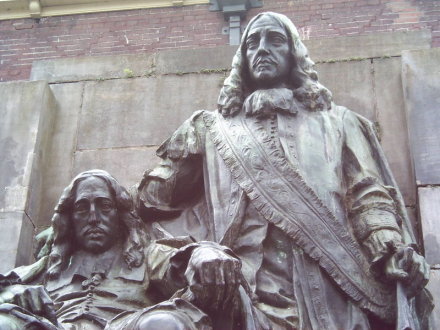
A statue of Johan (standing) and Cornelis de Witt in their native Dordrecht.

The mercantile powerhouse that was the 17th century Dutch Republic was the stage for a long-running conflict between the Orange monarchists (hence the soccer uniforms) and the Republican merchant class.

With the sudden death of the young William II, Prince of Orange in 1650, leaving the (non-hereditary) executive office of stadtholder vacant, the Republicans became ascendant.

And the outstanding figure of the First Stadtholderless Period was Johan de Witt, scion of a Dordrecht merchant family powerful enough that William II had imprisoned de Witt’s own father during a power struggle.

Elevated in 1653 and at the tender age of 28 to the leadership position of Grand Pensionary, Johan de Witt’s “eloquence, sagacity and business talents” guided the Dutch ship of state for essentially the remainder of his life.

This was the apex of the Dutch Golden Age. The Dutch East India Company dominated Asian trade routes,* and the Low Countries’ culture thrived on the wealth: Rembrandt and Vermeer were at the height of their talents; Spinoza revolutionized philosophy; van Leeuwenhoek invented the microscope.

While all these guys were landing themselves in their respective canons, Johan de Witt was trying to keep the age Golden.

Having only relatively recently broken free of Spain, the small country was an up-and-comer on the horns of a serious security dilemma: its leading commercial position put it into maritime competition with England, while its continental location made it vulnerable to the enormous army of the neighboring continental hegemon, France. Ultimately, even with its trade wealth, it did not have the resources to keep up with both of western Europe’s leading powers.

For a generation, de Witt’s statecraft kept the men of the Low Countries out of that predicament, while his brother Cornelis chipped in with a couple of timely naval victories. (Actually authored by Michiel de Ruyter, but Cornelis rode shotgun.)

In 1654, Johan brought the First Anglo-Dutch War to a close, making with Oliver Cromwell a secret pact he was only too happy to enforce never to allow William II’s son, the eventual William III, to be named stadtholder. Reason being: William III was the grandson of the Stuart king Cromwell beheaded, Charles I, and thus a potential claimant to the English throne. Both Protestant Republics had a distinct interest in keeping this monarchist well away from power. (Both would be sorely disappointed.)

A decade and a Stuart Restoration later, de Witt maintained (mostly) Dutch dominance of the seas in the Second Anglo-Dutch War, then held off France (with the help of a timely alliance with the recent adversary, England) in the War of Devolution.

In each case, he kept at least one of England or France on the sideline, or in his own camp.

But the Third Anglo-Dutch War was the charm — as it was also the Franco-Dutch War, and therefore 1672 was Rampjaar: disaster year. While the Dutch were aces on the waves, a massive French invasion easily overwhelmed them on terra firma.

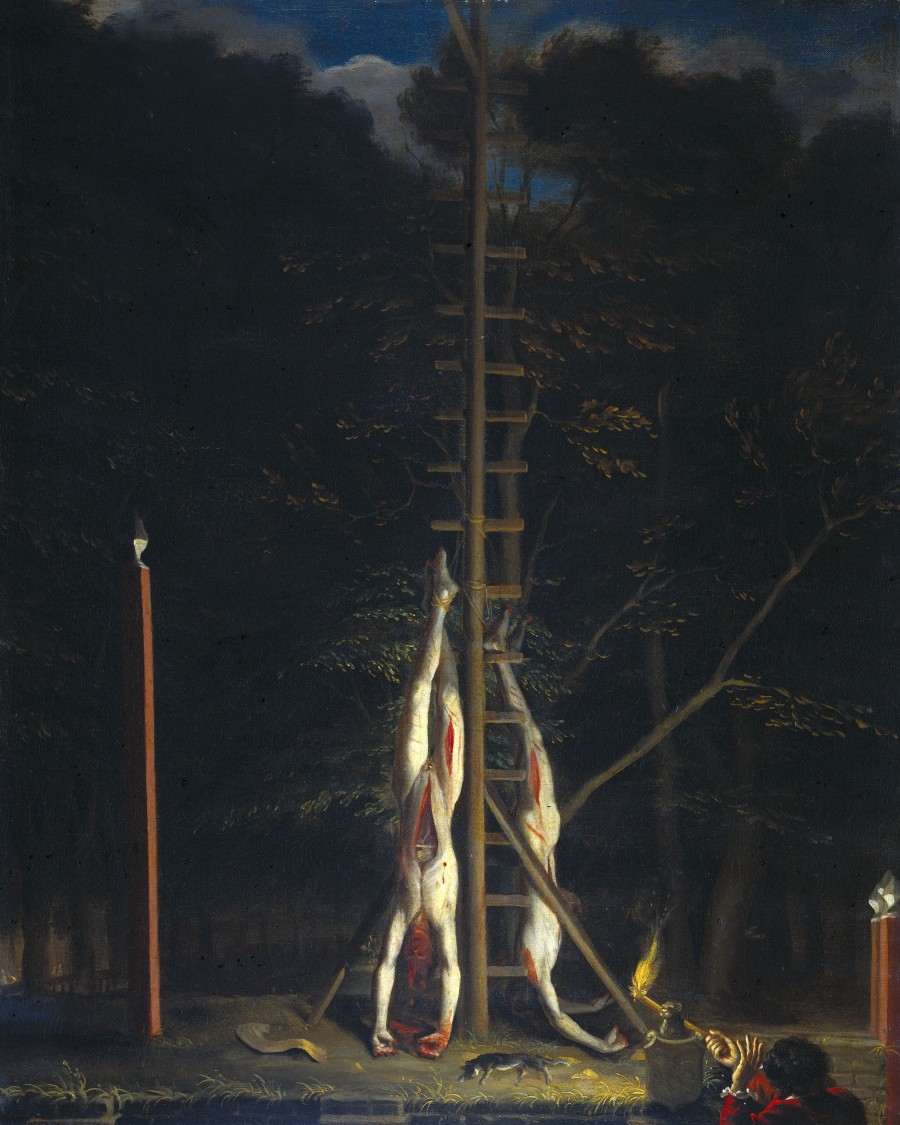
Detail view (click for the full image) of a grisly painting of the mutilated de Witt brothers strung up at The Hague. It’s attributed to Jan de Baen, who in better times took Johan de Witt’s portrait.

De Witt’s never-beloved mercantile oligarchy speedily collapsed with the military reverses, and the now all-grown-up William III was there to pick up the pieces to popular acclaim. Arrested for treason, Cornelis sustained torture without confessing, but when Johan visited him in prison — and William III incriminatingly withdrew the cavalry protecting the brothers — the mob quenched its fury with the de Witts’ blood.

every one of the miscreants, emboldened by his [Johan’s] fall, wanted to fire his gun at him, or strike him with blows of the sledge-hammer, or stab him with a knife or swords, every one wanted to draw a drop of blood from the fallen hero, and tear off a shred from his garments.

And after having mangled, and torn, and completely stripped the two brothers, the mob dragged their naked and bloody bodies to an extemporised gibbet, where amateur executioners hung them up by the feet.

Then came the most dastardly scoundrels of all, who not having dared to strike the living flesh, cut the dead in pieces, and then went about the town selling small slices of the bodies of John and Cornelius at ten sous a piece.

-Dumas

The word “ungrateful” comes to mind.

De Witt stood altogether on a lower plane than Cromwell. We regard him rather as a man of rare and singular talent, than as one of the chosen great ones of the earth, which Cromwell was. He stands far above the common run of men; and he was head and shoulders above nearly all the notable men of his time. He would have been greater if the movement of his limbs had been less burdened with the Dutch governing apparatus … He is not one whom the world can ever greatly admire or love.

History of the administration of John De Witt, grand pensionary of Holland, a Google books freebie.

(Here’s another, and here’s a 17th century volume de Witt himself coauthored.)

The rise of William III came with the decline of that Dutch Golden Age: the country fended off the immediate military threat, but it increasingly slipped behind its larger neighbors. Costly as was the Franco-Dutch War, it is a step on the path towards the present-day Europe, and this gives us enough excuse to notice that the Eurovision lead-in tune is actually from a Te Deum composed to mark its end.

But William’s own ascent to this wealthy sovereignty was just the beginning for him. Sixteen years later, the House of Orange’s champion vindicated Cromwell’s trepidation about him and gained a far more satisfactory position from which to do battle with his Gallic rival Louis XIV by stunningly overthrowing the Stuart dynasty and becoming King of England in the Glorious Revolution.**

* The Dutch remained the sole western contact of closed Japan until 1854, which is why Japan’s eventual period of scientific advancement became known as ‘Dutch Learning’.

** Albion did not forget the de Witts, either: according to this 1785 cant dictionary, the term “dewitted” had a 17th-18th century run in English to denote — well, exactly what happened to Cornelis and Johan.

On this day..

1916: Private Billy Nelson

On this date in 1916, 19-year-old Durham Private William Nelson was shot for desertion by the British military.

The Pity of It
by Thomas Hardy

I walked in loamy Wessex lanes, afar
From rail-track and from highway, and I heard
In field and farmstead many an ancient word
Of local lineage like “Thu bist,” “Er war,”

“Ich woll,” “Er sholl,” and by-talk similar,
Nigh as they speak who in this month’s moon gird
At England’s very loins, thereunto spurred
By gangs whose glory threats and slaughters are.

Then seemed a Heart crying: “Whosoever they be
At root and bottom of this, who flung this flame
Between folk kin tongued even as are we,

“Sinister, ugly, lurid, be their fame;
May their familiars grow to shun their name,
And their brood perish everlastingly.”

According to the archive capture of the lamentably defunct Shot at Dawn site — which campaigned (successfully) for clearing the names of World War I soldiers who had been executed for military failings like desertion or cowardice — Nelson gave a pitiable account of his situation. It was less the horror of trench warfare and mustard gas than desperation on his own home front that undid Nelson’s “nerves”.

“I have had a lot of trouble at home, and my nerves are badly upset. My father is a prisoner in Germany and is losing his eyesight there through bad treatment. My mother died while I was still in England, leaving my sister aged 13 and my brother aged 10. I am the only one left. I had to leave them in charge of a neighbour. I had no intention of deserting. I did not realise what I was doing when I left the camp. When I did so I went and gave myself up. When I went to the store my object was to get a night’s sleep and then go and surrender in the morning. I thought it was too late to do so that night. I did not know when the battalion was coming out of the trenches.”

Hap
by Thomas Hardy

If but some vengeful god would call to me
From up the sky, and laugh: “Thou suffering thing,
Know that thy sorrow is my ecstasy,
That thy love’s loss is my hate’s profiting!”

Then would I bear it, clench myself, and die,
Steeled by the sense of ire unmerited;
Half-eased in that a Powerfuller than I
Had willed and meted me the tears I shed.

But not so. How arrives it joy lies slain,
And why unblooms the best hope ever sown?
–Crass Casualty obstructs the sun and rain,
And dicing Time for gladness casts a moan. . . .
These purblind Doomsters had as readily strown
Blisses about my pilgrimage as pain.

That 13-year-old sister whom Nelson worried over long suffered her brother’s senseless death. In 2004, that woman’s daughter (Billy Nelson’s niece), Nora High, told the Guardian:

Every Armistice Day, my mother shed buckets of tears. We’ve got Billy’s Bible, I got that when mother died. She used to lay that out on a piece of blue satin cloth, and she would cry. She always said: ‘I won’t cry any more because that only upsets Billy. He doesn’t want me to cry. Everything’s fine for him now.’

In Time of “The Breaking of Nations”*
by Thomas Hardy

Only a man harrowing clods
In a slow silent walk
With an old horse that stumbles and nods
Half asleep as they stalk.

Only thin smoke without flame
From the heaps of couch-grass;
Yet this will go onward the same
Though Dynasties pass.

Yonder a maid and her wight
Come whispering by:
War’s annals will cloud into night
Ere their story die.

* The title is a Biblical allusion to Jeremiah 51:20.

As a slight stretch, part of the Themed Set: Thomas Hardy.

On this day..

1914: Rudolf Duala Manga Bell, in German Kamerun

On this date in 1914, the Germans hanged D(o)uala king Rudolf Duala Manga Bell for treason in German Kamerun.

European-educated and on retainer by the colonial German government, Bell was hardly the subversive type: rather, as the head of the largest clan of the important Duala tribe, he was the guy that Berlin looked to to uphold its authority.

This mutually satisfactory relationship began unraveling in 1910, with the Reich’s plan to abnegate the 1884 treaty under whose auspices it intruded into Kamerun (Cameroon) in the first place.

Seeking to confine the Duala to a few coastal villages — and subsequently, to push those Duala to less desirable inland territory — Berlin managed the rare feat of uniting the tribe’s various families, and pushing Rudolf Manga Bell himself into (surprising, to Germany) resistance.

When petitions to the Reichstag were ignored, the Duala began (Bell’s own degree of involvement in this seems to be a disputed point) making noises about holding Berlin in breach of the colonial treaty and finding itself a new European patron, like France or England.

Azanwi Nchami’s Footprints of Destiny (“the historical Cameroonian novel par excellence”) tells the story of Rudolf Manga Bell, Martin Paul Samba, and emergent Kamerunian nationalism.

And one notes the year in this post’s title, which would become momentous to Germany for other reasons. “The coming war,” notes Victor T. LeVine, “made it appear that Manga Bell had been plotting with Germany’s enemies.”

Bell was arrested for treason in the first half of 1914, as the Germans seized prime Bell land along the Wouri River.

In the conflict that became remembered as World War I, the first declarations of war were made in the very first days of August; Axis and Ententethe Central Powers and Triple Entente lined up against one another in the colonial territories, too, and German administrators in Kamerun realized that they were about to face an invasion from neighboring British and French colonies.

So it was in an atmosphere of panic and a view towards desperate internal repression that Bell was tried for treason on August 7, 1914, along with his friend and fellow-traveler Martin Paul Samba — and put to death the very next day.

Postscript

The Allied invasion had taken Duala and the other principal cities of Kamerun from the Germans by the end of September; over an 18-month campaign, the Germans were totally defeated in the territory, which France and England claimed as victors’ spoils after the war. (Also inheriting the tense relationship with the Duala; France was still trying to sort out the 1914 German expropriations that started the whole mess decades later.)

As a result, Rudolf Duala Manga Bell’s son, Alexander Ndoumbe Duala Manga Bell, not only inherited his father’s royal position among the Duala — he became Cameroon’s first elected representative to the French National Assembly.* There’s more about that guy here.

It is here that the Germans part ways with Cameroon’s national story, but there was almost a “peace in our time” diplomatic reconquista.

Although Hitler originally held the colonial movement in great disdain, in the late 1930s his regime ‘adopted’ and coordinated this movement. After 1936 the renewed campaign for the recuperation of German colonies had its desired results among the Allied powers. In discussions between the French Foreign Minister, Yvon Delbos, and the American Ambassador, William Bullitt, proposals were considered for the appeasement of Germany including tariff reductions, the involvement of the Third Reich in the development of Africa, and finally the granting of a colony to Germany, probably the Cameroons. In November 1937, during talks between Premier Chautemps, Prime Minister Chamberlain, Eden and Delbos, the suggestion was allegedly made by Chamberlain that France should ‘hand the Cameroons to Germany at once without any quid pro quo’.**

* Ralph A. Austen, “The Metamorphoses of Middlemen: The Duala, Europeans, and the Cameroon Hinterland, ca. 1800 – ca. 1960”, The International Journal of African Historical Studies, Vol. 16, No. 1 (1983).

** Richard A. Joseph, “The German Question in French Cameroun,” Comparative Studies in Society and History, Vol. 17, No. 1 (1975)

On this day..

1936: The Sacred Heart, by Spanish leftists

On this date in 1936, anticlerical leftists in the Spanish Civil War allegedly subjected a monumental statue of Christ to a ritual “execution”.


“This picture, taken by a Paramount News-reel representative and received by air from Madrid yesterday, illustrates an outrage which has no parallel in the photographs published by “The Daily Mail” of the Spanish Reds’ war on religion. It shows a Communist firing squad aiming at the colossal Monument of the Sacred Heart on the Cerro de los Angeles, a hill a few miles south of Madrid which is regarded as the exact centre of Spain.” (Source)

This outstandingly incendiary image made for great recruiting for the Francoist enemies of the “firing squad” and gave credence to a “crusade” lexicology that insured the devout would break overwhelmingly against the Republic. (Nearly 7,000 men and women in religious orders whose deaths during the war are charged to the Republican account also helped.)

Maybe that was inevitable, anyway.

George Orwell, the English leftist who volunteered for the Spanish Republicans, noted in his Homage to Catalonia that

the people in this part of Spain must be genuinely without religious feeling — religious feeling, I mean, in the orthodox sense. It is curious that all the time I was in Spain I never once saw a person cross himself; yet you would think such a movement would become instinctive, revolution or no revolution. Obviously the Spanish Church will come back (as the saying goes, night and the Jesuits always return), but there is no doubt that at the outbreak of the revolution it collapsed and was smashed up to an extent that would be unthinkable even for the moribund C. of E. in like circumstances. To the Spanish people, at any rate in Catalonia and Aragon, the Church was a racket pure and simple. And possibly Christian belief was replaced to some extent by Anarchism, whose influence is widely spread and which undoubtedly has a religious tinge.

Be that as it may, Republican types suspected photographic fakery.

Just like its inspiration is reported to have done, this statue survived its “execution” in fine shapewas resurrected by public subscription, and can still be seen at Cerro de los Angeles outside Madrid.


The “executed” statue today. (cc) image from bigchus.

On this day..

1781: Isaac Hayne, paroled prisoner of war

On this date in 1781, South Carolina patriot Isaac Hayne was hanged for breaking his conditional British parole and re-enlisting in the American Revolution.

Though Hayne is not, to us, the most famous revolutionary executed by the British, he might have been considered by his contemporaries as the most prominent individual to go to the scaffold for the cause.

A wealthy planter (lots of slaves!) whose home and grave can still be toured in Jacksonboro, Hayne was among 5,000 to surrender to the British when the latter captured Charleston in 1780.

These prisoners were required to swear an oath of allegiance to the crown in exchange for their parole, which Hayne reluctantly agreed to do because his family had been hit with smallpox.

He declared to a friend that,

as they [the British] allow no other alternative than submission, or confinement in the capital, at a distance from my wife and family, at a time when they are in the most pressing need of my presence and support, I must, for the present, yield to the demands of the conquerors. I request you to bear in mind, that previous to my taking this step, I declare that it is contrary to my inclination, and forced on me by hard necessity. I will never bear arms against my country … I do not mean to desert the cause of America.

But as the British southern campaign foundered over the year ahead, the mother country eventually attempted to call him up to do just that: bear arms against his country.

Hayne thought his parole terms protected him from ever having to serve against the colonies, so he simply got back into the fight on the revolutionary side instead. He was captured in that capacity.

The British commander Francis Rawdon handled his relapsed prisoner with uncommon severity, putting him to a drumhead military tribunal with a preordained outcome and refusing the many public pleas for leniency.

The irregular and vengeful nature of these proceedings, and Hayne’s seemingly honorable conduct, raised hackles on both sides of the Atlantic; shortly after hanging Hayne, Rawdon returned to the British Isles to find a good deal of pointed criticism of his behavior. (Parliament quashed any damaging official inquiry, and Lord Rawdon actually extracted an apology from the peer who had the temerity to motion the investigation — an intolerable impeachment on Rawdon’s honor.)

The Hayne incident was widely understood to have been conditioned by British frustration at its failing fortunes in the war. By the time of the execution, the redcoats held nothing of South Carolina save Charleston itself. General Cornwallis had recently marched north from the Palmetto State; in a few weeks’ time, he would surrender his sword and the British cause alike after the decisive British defeat at Yorktown, Virginia.

And though the commandants at Charleston scarcely anticipated that stunning reversal, they had only a few months before suffered the upsetting (but more legally tenable) hanging of the honorable British Major John Andre as a result of the Benedict Arnold affair. British forces were reputedly on the lookout for any opportunity to trade tit for tat.

Continental Gen. Nathaniel Greene alleged that the British officer who received the petition for Hayne’s life simply wrote on it John Andre — and sent it back.


Isaac Hayne was the great-uncle of South Carolina pol Robert Y. Hayne, best remembered for a hot sectional debate with Massachusetts Sen. Daniel Webster. (Read it all here, if you must.)

It was during this exchange of Senatorial disquisitions that Webster delivered one of the noted orations of the antebellum era, the aptly-named Second Reply to Hayne:

I have not allowed myself, Sir, to look beyond the Union, to see what might lie hidden in the dark recess behind. I have not coolly weighed the chances of preserving liberty when the bonds that unite us together shall be broken asunder. I have not accustomed myself to hang over the precipice of disunion, to see whether, with my short sight, I can fathom the depth of the abyss below; nor could I regard him as a safe counselor in the affairs of this government, whose thoughts should be mainly bent on considering, not how the Union may be best preserved, but how tolerable might be the condition of the people when it should be broken up and destroyed. While the Union lasts, we have high, exciting, gratifying prospects spread out before us and our children. Beyond that I seek not to penetrate the veil. God grant that in my day, at least, that curtain may not rise! God grant that on my vision never may be opened what lies behind! When my eyes shall be turned to behold for the last time the sun in heaven, may I not see him shine on the broken and dishonored fragments of a once glorious Union; on States dissevered, discordant, belligerent; on a land rent with civil feuds, or drenched, it may be, in fraternal blood! Let their last feeble and lingering glance rather behold the gorgeous ensign of the republic, now known and honored throughout the earth, still full high advanced, its arms and trophies streaming in their original lustre, not a stripe erased or polluted, not a single star obscured, bearing for its motto, no such miserable interrogatory as “What is all this worth?” nor those other words of delusion and folly, “Liberty first and Union afterwards”; but everywhere, spread all over in characters of living light, blazing on all it sample folds, as they float over the sea and over the land, and in every wind under the whole heavens, that other sentiment, dear to every true American heart, – Liberty and Union, now and for ever, one and inseperable!

When not being rhetorically posterized by New England gasbags, Robert Hayne made time to pen a justification for his famous forebear’s conduct for the Southern Review in 1828 — comparing the British behavior of executing rather than detaining a prisoner who broke parole to the massacre at Jaffa Napoleon notoriously ordered in 1799.

(Actually, Isaac Hayne’s old nemesis Francis Rawdon had only died in 1826; Robert Hayne wrote his piece to confute a vindication of himself that Lord Rawdon — also recognized by his subsequent titles, Earl of Moira and Marquess of Hastings — had authored, decades after the fact, of his conduct in the Hayne matter.)

Though this 37-page slog of Robert Hayne’s is obviously in the public domain by now, it appears it is not yet freely available online. However, it’s the source of the otherwise unattributed quotes in this article.

Part of the Themed Set: The Empire Strikes Back.

On this day..

1936: Aboune Petros, Ethiopian bishop

On this date in 1936, the Italian forces occupying Ethiopia executed anti-occupation cleric Aboune Petros.

War on Ethiopia had been Benito Mussolini‘s monument to muscular Italian nationalism.

By May of 1936, it had forced Haile Selassie into exile and established control of the country. Mission accomplished!

At last Italy has her empire.

-Mussolini

As is often the case, the war of conquest instead transmogrified into a war against continuing resistance to foreign military occupation, and the colony of Italian East Africa was a short-lived and bloody affair.

The Duce will have Ethiopia, with or without the Ethiopians.

-Italian Gen. Rodolfo Graziani

(Though the progressive counterpart to Italy’s iron-fisted approach to troublemakers was monumental construction, and 1930s-era fascist architecture is still to be seen in Addis Ababa today.)

Ethiopian Orthodox patriarch Aboune — it’s a title that can also be rendered Abuna or Abune — Petros cut a public profile a little too sympathetic to the native subversives. When the Italians demanded that he tone it down, he replied (according to a hagiography that appears several places online),

The cry of my countrymen who died due to your nerve-gas and terror machinery will never allow my conscious to accept your ultimatum. How can I see my God if I give a blind eye to such a crime?

On July 28, Italians repelled a large* Abyssinian insurgent attack by the sons of Ras Kassa between Addis Ababa and Petros’s stomping-grounds of Dessie; the next day, Petros was escorted to an abrupt martyrdom to the mirroring causes of national self-determination and anti-insurgency realpolitik.

His sacrifice is commemorated in statuary as well as a couple of notable theatrical pieces, Yedam Dems (The Voice of Blood) by Makonnen Endalkachew** and Petros Yachin Saat (Petros At That Hour) by Tsegaye Gebre-Medhin.

* On the scale of thousands. It “showed a certain tenacity,” according to the London Times‘ droll Rome correspondent in a July 30 story.

** Not the same guy as the post-colonial Prime Minister who was executed in a 1974 purge.

On this day..