1582: Philippe Strozzi, corsair

On this date in 1582, Philippe Strozzi, the Florentine-born commander of a French naval expedition against the Spanish was summarily executed as a pirate.

The Strozzi were long one of Florence’s wealthy and powerful families, as evidenced by, say, the Strozzi Palace, or the Strozzi coat of arms on Michelangelo’s Doni Tondo.

That made the Strozzi sometime-allies, sometime-rivals* of Florence’s more famous powerbrokers, the Medici. It is in both capacities that we meet Philippe (English Wikipedia entry | Italian | French).

To cut a centuries-long story short, the Strozzi had basically come out on the wrong side of the power struggle in the 16th century.

Philippe’s father, Piero Strozzi, was the child of a Strozzi-Medici union, and Piero too married a Medici. He also fought the Medici for power and ended up in exile whereupon he gravitated to the French court of … Catherine de’ Medici. (Catherine had been educated at the home of Philippe’s grandfather, Filippo Strozzi.) Catherine then turned around and used Piero as a French Marshal, including sending him to back Tuscan city-state Siena in opposition to its (and France’s) rival, Florence.**

Your basic tangled geopolitical-genealogical web.

Bottom line, Piero’s son Philippe was born in Florence but grew up Gallic, and fought in the French army all over the continent from the time he was a teenager.

When France got involved in the War of Portuguese Succession, they put this warlike fellow aboard a boat and sent him to dispute Spanish King Philip II‘s attempt to claim the Portuguese throne and unify the Iberian peninsula.

Strozzi’s armada got its clock cleaned at the naval Battle of Ponta Delgada near the Azores, with devastating loss of life.


The Spanish galleon San Mateo, which did yeoman service at this battle.

Since Spain and France were putatively at peace, Spain treated its captives not as prisoners of war but as pirates, and proceeded to execute several hundred in Vila Franca do Campo. Strozzi didn’t even get that much ceremony, however; the day after the battle, he was mortally stabbed, then tossed into the waves.

Happily, the name and the fame of the Strozzi outlived Spanish justice. In the next century, a distant relative by the handle of Barbara Strozzi became one of the most renowned composers of Baroque vocal music. (As befits wealthy Italians of the Renaissance, the Strozzi were big on the arts; Philippe was supposed to be a fine musician himself.)

* The Strozzi-Medici conflict frames the action in the play Lorenzaccio, in which the titular Brutus-like character mulls assassinating the Medici dictator in order to restore the Republic, only to find no such restoration in the offing once he actually does the deed; the father and grandfather of our day’s protagonists are both principal characters.

** That didn’t work. Strozzi was trounced at the Battle of Marciano, which signaled the permanent demise of the ancient city-state‘s independence.

On this day..

1824: Agustin de Iturbide, Emperor of Mexico

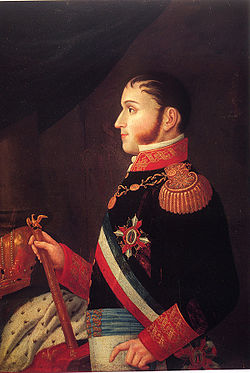
On this date in 1824, the Mexican officer who had made himself emperor was shot at the village of Padilla.

Iturbide‘s military acumen saw him through a meteoric rise in the service of what was then New Spain.

Iturbide rejected an early offer of generalship from the pro-independence leader Hidalgo in favor of spending the 1810s ably quashing the insurgency.

In a bizarre twist of fate, however, it would be Iturbide who would himself cement Mexican independence.

En route to try to finish off the last major rebel leader, Vicente Guerrero, Iturbide caught wind of the recent del Riego liberal revolt back in the mother country,* which had triggered civil war in Spain.

For the conservative royalist general, heir himself to a Basque noble lineage, the potential collapse of Bourbon authority in Spain raised the frightening specter of social upheaval.

All Iturbide’s work killing guerrillas for the sake of public order could come to naught if the Spanish monarchy collapsed or ceased projecting its power overseas … and then who knew what would emerge from the resulting power vacuum in Mexico?

So Iturbide cut a deal with Guerrero to consummate the Mexican War of Independence by separating from Madrid on an essentially conservative basis — a political breakaway without a social revolution. Independent Mexico would make nice with the Spaniards already living there, keep Catholicism as the official state religion, and get itself a constitutional monarchy of its own to insulate itself from the chance outcomes of continental politics across the ocean.

And when Iturbide marched into Mexico City and encountered a crowd conveniently imploring him to take the throne, well, who was he to deny them?

And so Iturbide transitioned smoothly from scourge of the revolution to its man on horseback,** immediately splintering the coalition that lifted him to power.


Contrary to this allegorical take on Iturbide’s coronation, he crowned himself — Bonaparte-like.

Only months after his July 1822 coronation, Iturbide shuttered Congress and began arresting the opposition. Meanwhile, Ferdinand VII had emerged from the Spanish fray as the (momentary) winner, leaving his upstart former subjects without international support.

A general that the freshly-minted emperor had himself had promoted, one Antonio Lopez de Santa Anna — yes, the Alamo guy — declared against Iturbide by the end of 1822, and come the following spring, Agustin I was a European exile, in the paradoxical position of drawing a pension from Mexico while also officially considered a traitor and outlaw.

In Tuscany and then England, Iturbide published an autobiographical justification — Statement of Some of the Principal Events in the Public Life of Agustín de Iturbide — then finally took up a much-asked-for invitation from Mexican conservatives to return and become the savior of his country against internal breakdown and a potential Spanish attack.

Founded on vainglory, this expedition was destined for fiasco; within five days of touching Mexican soil, Iturbide was serenading a firing squad with the last words, “Mexicans! I die with honor, not as a traitor; do not leave this stain on my children and my legacy. I am not a traitor, no.” Apparently they were serious about that injunction never to return.

When in Mexico City, relive happier times for our day’s subject at the Palace of Iturbide where he briefly maintained himself in the purple.


Iturbide’s palace. Creative Commons image from patricio00.

And do think twice about styling yourself Emperor of Mexico, since the only other person to claim that title also ended his reign in front of a firing squad.

* Ironically, it was a body of soldiers assembled for a reconquista of Spain’s independenceminded New World possessions that enabled del Riego to mutiny.

** Iturbide paused in the revolution’s good graces just long enough to design the Mexican flag.

On this day..

1943: Eight from the Krasnodar Trials

On July 18, 1943, eight Soviet citizens who were among 11 tried for collaboration with the recently expelled German occupiers were hanged before tens of thousands in the main square Krasnodar.

The proceedings from July 14-17 were the first major, open war crimes tribunals of World War II … which, of course, was still ongoing at this point.

But the previous winter, the Soviet Union had turned the tide by winning the Battle of Stalingrad, which victory presaged the liberation of the nearby north Caucasus city where we lay our scene.

The Russians proceeded to put the murderous Nazi occupation on trial, but did so not by trying Germans or their allies — but by trying eleven Soviet citizens for collaboration. Indeed, until the end of the war, thousands of Russians were prosecuted for crimes of collaboration, but only a relative handful of Germans for actually authoring those crimes.

These eleven were mostly* men who had served the Sonderkommando 10a (part of Einsatzgruppe D) in “guarding Gestapo buildings that held arrested Soviet citizens, executing arrests, going on military searches and expeditions against the partisans and peaceful Soviet citizens, [and] exterminating Soviet citizens by hanging, mass shootings, and use of poison gases.”

That “Soviet citizen” stuff, technically accurate, soft-pedaled the Einsatzgruppe‘s predictable primary target: local Jewry.

Sonderkommando 10a arrived in the town of Krasnodar when it fell to the Germans on August 12, 1942. On August 21 and 22, all the Jews were ordered to report for transfer to a certain neighborhood in the city. They were taken to the Pervomaisk woods, where they were shot. Many of the city’s Jews did not obey the order, but they, too, were eventually caught and shot. According to a Soviet committee of inquiry report, the number of civilians — women, old people, and children — murdered in Krasnodar was in excess of 13,000. Almost all were Jews. (Source)

This in a city that was occupied for only six months.

Under any description of the victims, these depredations were plenty to condemn collaborators with even the vaguest of associations. Only a few of the men had specific acts charged against them; evidence establishing frightful Nazi atrocities in the region (not hard to find) plus confessions to having worked for the Nazis (not hard to wring out) forged a sufficient evidentiary chain without getting lost in the weeds of such minutiae as: was the collaboration really voluntary? did these collaborators themselves actually carry out war crimes? was that confession actually reliable? (good luck with that one.)

In this military tribunal, the public prosecutor had a free hand for grandstanding, the defense had almost no scope of action, and (the USSR being an old hand at the show trial game) the accused knew their own part to play with craven self-denunciations and pleas for the “mercy” of being sent to the most dangerous part of the front. This made great headlines in Pravda and Izvestia (and update memos straight to the Kremlin) about Nazi bestiality,** and great copy with inquisitorial slam dunks like,

Today Soviet law will mete out justice to the traitors, fascist hirelings, and boot-lickers now in the prisoners’ dock. Tomorrow the court of history, the court of freedom-loving nations of the world, will pronounce its inexorable verdict on the bloodthirsty rulers of Hitlerite Germany and all its associates — on the enemies of mankind who have plunged the world into the welter of the present war. Not one of them will escape stern retribution! Blood for blood, death for death!

All were convicted; three drew long prison sentences and eight hanging, and since the tribunal permitted no appeal, those sentences were executed the day after the court finished its business.

The period quotes, and much of the information about this otherwise somewhat inaccessible trial, comes from Ilya Bourtman’s 2008 article for Holocaust and Genocide Studies, “‘Blood for Blood, Death for Death’: The Soviet Military Tribunal in Krasnodar, 1943.”


It may have been a first, but one need hardly add that it was hardly the last such prosecution.

Several others war crimes show trials took place in other Soviet cities over the next few months, and these would obviously continue after the war.

Long, long after the war.

* The one exception was a 60-year-old former kulak who had illicitly escaped the deportation prescribed for this class in the 1930s. His “collaboration” consisted of having been a doorman whom a German soldier asked a question of.

** e.g., “Death to Hitler’s Butchers and Their Vile Accomplices”

On this day..

1916: Cesare Battisti and Fabio Filzi

On this date in 1916, the Austro-Hungarian empire executed Cesare Battisti and Fabio Filzi for treasonous Italian nationalism.

It was the multiethnic Habsburg state that was itself dying of its constituents’ national aspirations; in little more than two years, the state entity that carried out this day’s sentences would no longer exist at all.

Pre-World War I, Battisti (English Wikipedia entry | Italian) was actually a Socialist representative in the Austrian parliament.

When the unpleasantness broke out, though, he made a break for the peninsula where he agitated* (successfully) for Italian entry into the fray against Austria-Hungary. Irredentists had long coveted Habsburg properties with a heavy Italian population, like the Adriatic port of Trieste and Battisti’s own native Trento; the war offered an opportunity to swipe those territories, notwithstanding Italy’s putative prewar alliance with the Austrians.

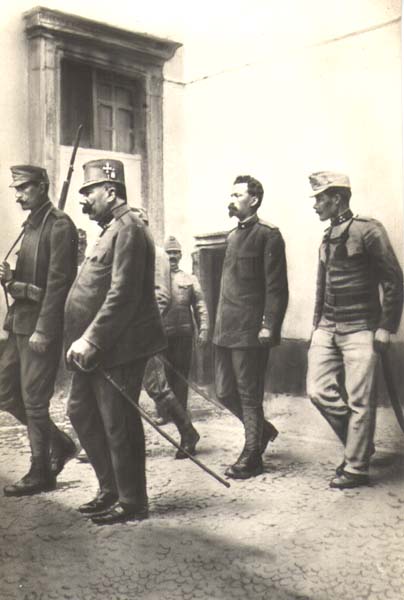
Although already 40 years of age when Italy entered the war, the intrepid Battisti enlisted to fight. He was captured along with an otherwise obscure subaltern, Fabio Filzi, on the Alpine slope of Monte Corno (now known as Monte Corno Battisti) repelling the Austrian Strafexpedition.**

Austria did not stand on ceremony with these men; their capture took place on July 10, their trial on July 12, and their executions at the Castello del Buon Consiglio — an ironic Calvary, for a parliamentarian — later that same day. (To complete the scene, the strangulation-hanging was botched when Battisti’s first rope broke.)

The Austrian writer Karl Kraus would observe that “they thought they were hanging Italy, but it was really Austria on the gallows.”

Whichever one it was, they took a lot of pictures.


Battisti and Filzi as prisoners.


Battisti leaving the courtroom en route to his execution.


Battisti approaches the scaffold.


Battisti waiting at the scaffold as the sentence is read.


The Austrian army offers a prayer and salute to the shrouded body of Cesare Battisti.

* As a socialist who broke against the internationalist position and in favor of violent nationalism, Battisti was an ally of Benito Mussolini. It was Battisti, actually, who pioneered the socialist-nationalist-newspaperman act upon which Mussolini would later raise is own star, to such an extent that Battisti’s paper, Il Popolo — the apparent inspiration behind Mussolini’s own subsequent paper, Il Popolo d’Italia — gave the still-obscure future Duce some of his earliest gigs.

A martyr’s death during World War I fortuitously spares Battisti’s legacy the unpleasant association with his friend’s postwar turn towards fascism, so there are many streets and plazas named for Battisti, as well as a memorial in Trento. He’s also honored by name in the 1918 patriotic tune La Leggenda del Piave (lyrics).

** “Punitive expedition”.

On this day..

1976: Costas Georgiou and three other mercenaries in Angola

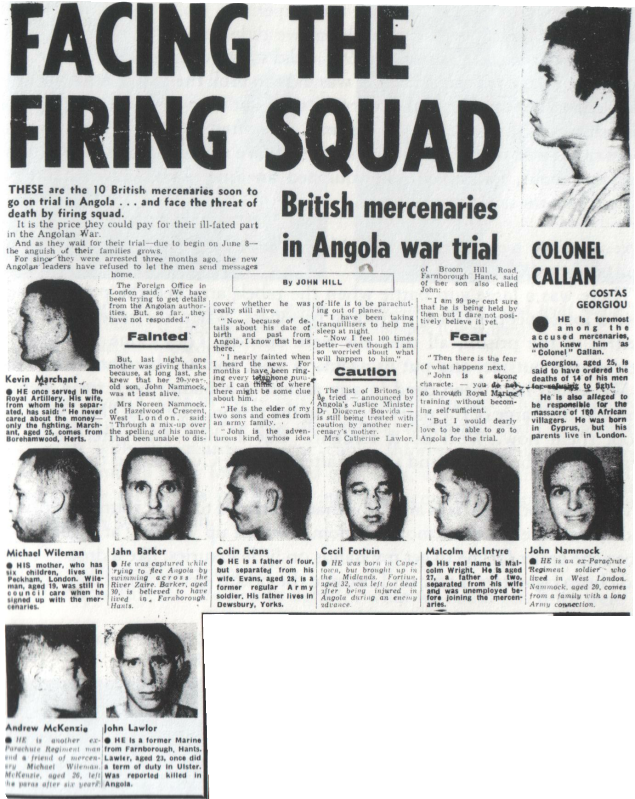
On this date in 1976, three Britons and one American were shot in Angola by a military police squad for murders committed as mercenaries earlier during the year.

Costas Georgiou.

They were among 13 foreigners sentenced at the Luanda Trial, which occurred on the pivot of Angola’s transition from generation-long anti-colonial insurrection on towards generation(s)-long civil war. Between them, more than half a million Angolans died, but this date belonged to a couple of unrepresentative Anglos.

Long story short, the immediate aftermath of Angolan independence in late 1975 was a scramble for control among the several factions who had been fighting the Portuguese … along with a scramble among interested outside states to line up their allies in this resource-rich Cold War prize.

Small wonder that foreign soldiers of fortune soon found their way into the chaotic scene.

Over the course of the first few months of independence, the Popular Movement for the Liberation of Angola (MPLA) more or less consolidated state power, and it proceeded to prosecute supporters of a rival guerrilla movement for their part in the conflict immediately after independence.

Thirteen foreign mercenaries who were captured by MPLA-supporting Cuban troops — the other nine drew long prison sentences — were charged in a show trial with war crimes for their conduct in the field in a case that made the western gun-for-hire an emblem of colonial depravity.

The most notorious of the bunch was Costas Georgiou. A Greek Cypriot emigre to Britain, he had gone to Angola as “Colonel Callan” and was wanted by Scotland Yard for there ordering a mass execution of other British mercenaries — an act he admitted at trial. Even the inevitable London Times editorial against the trial (June 29, 1976) agreed “the proceedings against Callan, if not the rigours of the sentence may be conceded.”

The others looked much less culpable, almost arbitrarily selected for death from among the ranks of unprepossessing, sometimes barely-there mercs. American Daniel Gearhart, a Vietnam veteran drowning in debt, had apparently been in the field for a mere three days and never so much as fired a shot; that he had advertised in Soldier of Fortune magazine was held to aggravate the charges against him, and in vain did the father of four insist that being tried for his life was enough to scare him straight out of the business.

Angolan defense attorneys, while also appealing against the legality of the trial on grounds of both international and domestic law, spoke that revolutionary language of decolonization in defending their charges. Georgiou, according to Maria Teresinha Lopes, was

“a colonized man … [treated in England as] a sub-human, just a Greek, just a ‘boy’.”

Another Angolan defense attorney argued against the death penalty because

“To condemn them to death while ignoring their social origin in terms of revolutionary justice would deny the theory which guided our revolution. My clients are an integral part of the exploited class.” (Both comments from London Times, June 19, 1976)

The era of decolonization was a time for idealism, but not the sort that would shrink from bloodshed.

In denying the doomed men clemency, Angola’s first independent president Agostinho Neto denounced

Mercenarism, instrument of the aggressive designs of imperialism … a scourge of the African continent and a grave threat to the peace, freedom and independence of the peoples …

It is imperative that the practice of mercenarism be banished once and for all from our planet. It is urgent that all states and peace-loving forces fight it most energetically.

We are applying justice in Angola not only in the name of our martyred people but also for the good of the brother peoples of Namibia, Zimbabwe and all the peoples of the world against whom imperialism is already getting ready to prepare new mercenary aggressions.

(Text dated July 9, and reprinted in the July 10 London Times)

You could just about substitute the word “terrorism” for “mercenarism” and read it on today’s campaign trail.

Juridically, Angola pursued these warriors as peoples who had fought unlawfully and could therefore be placed outside the protections conferred on soldiers by the Geneva Conventions — and subjected to the liberating power of revolutionary violence.

That this ad hoc concept of “mercenarism” could be exploited to license an outrage upon humanity was a notion relentlessly denounced by British and American officials,* who had not yet fully explored the utility of the “unlawful combatant” construct in extending the reach of their own security states.

As for all that peace-loving, brother-peoples stuff in the execution order?

What actually happened after the mercenaries were shot was that the two biggest former anti-colonial guerrilla movements in Angola morphed into Cold War proxies — the MPLA of the Warsaw Pact, supported by its control of the country’s oil; UNITA of NATO, supported by its control of the country’s diamonds — and bled the country dry in a horrific civil war.

* Henry Kissinger, then President Gerald Ford’s Secretary of State, complained that Angola’s decision

to ignore both the law and the facts … cannot help but affect adversely the development of relations between the United States and Angola.

On this day..

1572: The Martyrs of Gorkum

On this date in 1572, Dutch Calvinists fighting to break away from Spanish domination hanged 19 Catholics at Brielle.


The Martyrs of Gorkum, by Cesare Fracassini.

The heretofore abortive — and severely suppressedDutch Revolt blossomed in 1572 with the April 1 capture of Brielle by the Protestant raiders nicknamed Sea Beggars.

Dutch schoolchildren learn the occasion with the punny rhyme — bril, “glasses”, is a near-homophone for Brielle

“Op 1 april verloor Alva zijn bril”

On April 1st, the Duke of Alva lost his glasses

The mailed fist of imperial Spain in the Low Countries, the Duke of Alva (or Alba) would be forced by Calvinist gains this year onto the back foot; despite a vigorous counterattack that regained some lost territory in 1573, he was soon forced into retirement.

This was still just the opening saga of the Eighty Years’ War, but the Dutch Revolt would weave together theology and nationalism for Netherlands separatists. It already had.

So, small surprise that weeks after nicking the Duke of Alva’s glasses, Dutch rebels conquering other towns started making prisoners of Catholic clergy whose loyalties were suspiciously Habsburgish. Our day’s principals (here are their names; a batch of Franciscans taken are the largest contingent, to which various lay brothers, parish priests, and others were appended) were seized at and around Gorkum (Gorinchem).

The author of this intrepid iconoclastic incursion, William II de la Marck, was likewise the author of these Catholic martyrs’ doom once they had been removed back to Brielle. They were hanged without benefit of trial at an abandoned monastery.

Every sectarian propagandist of 16th century Europe made lurid heroes of his own side’s martyrs, and these were no exception to the pattern; we read in this Catholic source (perhaps while contemplating this devotional image) that

[i]t was on the 9th July 1572 when the execution of the pious sufferers began. On their side they had fully prepared themselves for it by confession and prayer. The executioner went so slowly to work that two hours had elapsed ere the last of the martyrs had taken his place on the gallows, and many of them still lived when morning broke. But the fury of the soldiers was not yet satisfied. They mutilated the dead bodies, cut off their noses and ears, and other limbs, and, alas, shame seems to touch the pen with which we write, bound them to their hats, and returned with these melancholy trophies in triumph into the city!

The location where this day’s unfortunates suffered became a pilgrimage destination, and they were formally enrolled in the minor leagues of Rome’s competitive hagiography circuit in the 19th century.

On this day..

1917: Gasim, by Lawrence of Arabia

“With Major Lawrence, mercy is a passion. With me, it is merely good manners. You may judge which motive is the more reliable.”

-Alec Guinness as Prince Faisal in Lawrence of Arabia

This date in 1917 was the eve of the Battle of Aqaba, wherein a force of Arabs with famous British officer T.E. Lawrence emerged from the desert to surprise and capture the Ottoman Red Sea port today located in Jordan.*

And that makes this, in the cinematic masterpiece Lawrence of Arabia, the date on which the titular character kept the peace within his fragile coalition by personally executing a malefactor to prevent a tribal blood feud.

The victim, Gasim, is a real figure described in the real T.E. Lawrence’s memoirs

a gap-toothed, grumbling fellow, skrimshank in all our marches, bad-tempered, suspicious, brutal, a man whose engagement I regretted, and of whom I had promised to rid myself as soon as we reached a discharging-place.

Gasim is most famous as the beneficiary of the movie scene in which Lawrence boldly turns back into the desert to rescue this worthless retainer when Gasim’s camel is found riderless in the caravan. This, too, is based on an actual incident in Lawrence’s memoir, albeit heavily dramatized on celluloid.

In the film, Lawrence’s godlike power to give Gasim life is soon mirrored by the godlike power to deprive it.

Effectively exploiting dramatic license, Lawrence of Arabia portrays the Englishman surveying the scene of the coming triumph when a disturbance breaks out in his camp. Hastening thither, he discovers clan lining up against clan over the destructive right of blood vengeance because of a murder in the camp — a murder committed by the man he has saved.

To forestall a “tribal bloodbath” on the very eve of victory, Lawrence himself volunteers to execute the culprit. Having once risked everything to save Gasim, Lawrence sacrifices him ruthlessly when the occasion demands.** This act underscores the chameleon-like other-ness of the character, one of the film’s principal leitmotifs: “I have no tribe, and no one is offended!”

Though the real Lawrence did no such thing to the real Gasim, this astonishing scene is also related in the memoirs — just at an earlier point, and with a different, less dramatically integral character.

My followers had been quarrelling all day; and while I was lying near the rocks a shot was fired. I paid no attention; for there were hares and birds in the valley; but a little later Suleiman roused me and made me follow him across the valley to an opposite bay in the rocks, where one of the Ageyl, a Boreida man, was lying stone dead with a bullet through his temples. The shot must have been fired from close by; because the skin was burnt about one wound. The remaining Ageyl were running frantically about; and when I asked what it was Ali, their head man, said that Hamed the Moor had done the murder. I suspected Suleiman, because of the feud between the Atban and Ageyl which had burned up in Yenbo and Wejh; but Ali assured me that Suleiman had been with him three hundred yards further up the valley gathering sticks when the shot was fired. I sent all out to search for Hamed, and crawled back to the baggage, feeling that it need not have happened this day of all days when I was in pain.

As I lay there I heard a rustle, and opened my eyes slowly upon Hamed’s back as he stooped over his saddle-bags, which lay just beyond my rock. I covered him with a pistol and then spoke. He had put down his rifle to lift the gear; and was at my mercy till the others came. We held a court at once; and after a while Hamed confessed that, he and Salem having had words, he had seen red and shot him suddenly. Our inquiry ended. The Ageyl, as relatives of the dead man, demanded blood for blood. The others supported them; and I tried vainly to talk the gentle Ali round. My head was aching with fever and I could not think; but hardly even in health, with all eloquence, could I have begged Hamed off; for Salem had been a friendly fellow and his sudden murder a wanton crime.

Then rose up the horror which would make civilized man shun justice like a plague if he had not the needy to serve him as hangmen for wages. There were other Moroccans in our army; and to let the Ageyl kill one in feud meant reprisals by which our unity would have been endangered. It must be a formal execution, and at last, desperately, I told Hamed that he must die for punishment, and laid the burden of his killing on myself. Perhaps they would count me not qualified for feud. At least no revenge could lie against my followers; for I was a stranger and kinless.

I made him enter a narrow gully of the spur, a dank twilight place overgrown with weeds. Its sandy bed had been pitted by trickles of water down the cliffs in the late rain. At the end it shrank to a crack a few inches wide. The walls were vertical. I stood in the entrance and gave him a few moments’ delay which he spent crying on the ground. Then I made him rise and shot him through the chest. He fell down on the weeds shrieking, with the blood coming out in spurts over his clothes, and jerked about till he rolled nearly to where I was. I fired again, but was shaking so that I only broke his wrist. He went on calling out, less loudly, now lying on his back with his feet towards me, and I leant forward and shot him for the last time in the thick of his neck under the jaw. His body shivered a little, and I called the Ageyl, who buried him in the gully where he was. Afterwards the wakeful night dragged over me, till, hours before dawn, I had the men up and made them load, in my longing to be set free of Wadi Kitan. They had to lift me into the saddle.

Peter O’Toole’s Lawrence almost palpably manifests the conflicting aspects of his character as he shoots Gasim to death — and he confirms the transformative effect of his first homicide in subsequent dialogue with Gen. Edmund Allenby.

Lawrence: I killed two people. One was … yesterday? He was just a boy and I led him into quicksand. The other was … well, before Aqaba. I had to execute him with my pistol, and there was something about it that I didn’t like.
Allenby: That’s to be expected.
Lawrence: No, something else.
Allenby: Well, then let it be a lesson.
Lawrence: No … something else.
Allenby: What then?
Lawrence: I enjoyed it.

* Actually, Aqaba is Jordan’s only port. This battle was not so epic as the film depicts.

** In a bit of complex foreshadowing, the cinematic Gasim has told Lawrence at the outset of the expedition that “Allah favors the compassionate.”

On this day..

1346: Simon Pouillet

From the Grandes Chroniques de France:

En celuy an, le samedi premier jour de juillet, fu fait à Paris une horrible justice, — né onques mais n’avoit esté faite semblable au royaume de France. Combien que nous lisons que l’empereur Henri en fist une autèle, et en Angleterre aussi, une autre fois en avint une autre semblable, toutes voies à Paris onques mais n’avoit esté telle , — d’un bourgois de Compiègne appellé Symon Pouilliet, assez riche, qui fu jugié à mort et mené aux halles de Paris; et fu estendu et lié sur un estal de bois, ainsi comme la char en la boucherie, et fu ylec copé et desmembré, premièrement les bras, puis les cuisses et après le chief ; et après pendu au gibet commun où l’en pent les larrons. Et tout pour ce qu’il avoit dit, si comme l’en luy imposoit, que le droit du royaume de France appartenoit mieux à Edouart, roy d’Angleterre, que à Phelippe de Valois. De laquelle mort tout honteuse, France pot bien dire la parole de Jhésucrist qui disoit : « Ci sont les commencemens des douleurs, » si comme il sera monstré par après.

The gist of the bolded bit:

a wealthy Compiègne bourgeois called Simon Pouilliet was broken and dismembered in Paris, and gibbeted on the common gallows. And all for saying that the right of the kingdom of France belonged more to Edward, king of England, that to Philippe of Valois.*

Come and see the violence inherent in the system!

There was cause, however, for the House of Valois to be oversensitive to Pouillet’s treasonable take on royal genealogy: it was at least plausibly true.

Edward’s interest in actualizing his nominal claim to the French throne had by this point precipitated the opening dynastic skirmishes of what would eventually (a hundred-plus years later) become remembered as the Hundred Years’ War.

And as the chronicle concludes on a note of melancholy, Simon Pouillet’s horrific butchery would be an omen of his realm’s coming sorrows.

Eight weeks later, the English sowed the battlefield of Crecy with the flower of French chivalry and established a foothold at Calais that would help sustain generations of bloodily inconclusive combat.

Then, from 1348, the Black Death ravaged Europe, bringing for its survivors the economic shock of a labor shortage, weird social movements like the flagellants, and a pervasive sense of fatalism that ate at humanity’s social bonds.

A few years after that, the French king, Philip’s successor John the Good, was actually captured by the English at the Battle of Poitiers, and ransomed as a hostage for a ruinous sum.

There’s no record whether the wind whistling through the remains of Simon Pouillet dangling on Montfaucon whispered “I told you so.”

* Pouillet had not acted on this notion — he’d merely been popping off, possibly while sauced. The absence of any actual intent on the speaker’s part, however, did not lessen the treason, as explained in The Law of Treason and Treason Trials in Later Medieval France:

The general royal position on treason by words was summed up in 1432 by Jean Barbin, king’s proctor in the Parlement of Poitiers, in the prosecution of the Fleming Hennequin Bize. ‘By word and by deed’, he began, ‘one commits the crime of lese-majesty: by deed when one makes an attempt on the person of the princeps; and by word when one speaks sinisterly of him or his acts.’ Barbin asserted furthermore that it was worse ‘to disparage by word than to injure by deed’, but he neglected to explain why.

On this day..

1908: Two Persian constitutionalists

TEHERAN, June 24.

Two of the Nationalist leaders, Malik-Mutikalamin and Mannchir Khan, were hanged in the Royal camp to-day. Anxiety is felt regarding the fate of the others, including the President, notwithstanding the verbal promise of the Shah to spare their lives.

The house of Zahir-ed-Dowleh, now Governor of Resht, has been bombarded and looted. A state of terrorism exists.

Troops are guarding the approaches to the British Legation, with orders to shoot fugitives seeking sanctuary there.

London Times, June 25, 1908

On this date, two Persian constitionalist liberals were summarily hanged by the Shah as two factions fought for the future of Iran.

A Constitutional Revolution was shaking that country’s ruling dynasty when the throne passed and the new Shah, Mohammad Ali Shah Qajar, mounted a coup dissolving the newborn parliament and reversing the country’s 1906 constitution. (According to the Shah, constitutionalism was un-Islamic.)

On June 23, the Shah’s Cossacks — he had Russian support, arranged with the connivance of other European powers — bombarded Iran’s parliament, capturing in the process a number of constitutional delegates.

Two in particular, both of them prominent Azali Bab’i exponents of the constitution, would interest the Shah.

Mirza Jahangir Khan (left), and Malek al-Motakallemin.

Journalist, revolutionary, and intellectual Mirza Jahangir Khan Shirazi was a well-known spokesperson of the reformist cause through his paper Sur-e Esrafil. Malek al-Motakallemin was a dissident essayist and preacher with an interest in Persia’s Zoroastrian ancient history.

Their hanging this day calmed the capital for the moment, but hardly settled matters in Iran. (Indeed, one could say matters have never been settled in Iran.) By the next year, Mohammad Ali Shah Qajar was out on his ear (he’d die in exile) — succeeded by the last monarch of the Qajar dynasty.

On this day..

1940: Tirailleurs Senegalais, for France

On this date in 1940, German forces even then completing their rout of France — the humiliating capitulation was mere hours away — massacred a detachment of African soldiers who mounted a doomed resistance at Lentilly.

Tirailleurs Senegalais were recruited not only from Senegal but from throughout France’s domains in sub-Saharan Africa. (There were also Algerian, Tunisian, and Moroccan tirailleurs.)

Though these soldiers’ own lands were occupied, they were instrumental to defending the freedom of their occupier on European soil: over half a million African tirailleurs are thought to have served les couleurs in the two World Wars, and died in all the horrible ways those slaughterhouses could devise.

In 1940, black troops represented some 9% of the French army, a fact pilloried in German nationalist proaganda.

It’s hardly a surprise that the black man couldn’t catch a break from skull-measuring Aryan race warriors, but then, France too had its own less than comfortable relationship with these dark-hued citizens summoned from distant villages to bleed in the trenches of Europe. The military’s official guidelines emphasized (French link) the “Senegalese’s” special value as cannon fodder.

If a sacrificial mission is necessary, a defense to the death to provide cover for forces to regroup, appeal to the valor of the black fighter.

On the other hand, French authorities put up a monument to black soldiers in the aftermath of World War I. (The occupying Nazis vengefully dismantled it.) Such are the contradictions of colonialism.

Racial reservations notwithstanding, colonial troops were employed throughout the army if for no other reason than that they constituted nearly the tenth part of that army.

Their service record naturally included (French pdf) the over-before-it-started French defense against the Nazi blitz in 1940.

In this instance, knowing full well that the campaign was lost, French officers flipped open the “sacrificial mission” playbook and ordered their African charges to oppose a German march near Lyon “without thought of retreat.”

Since victory was equally out of the question, that left death. Wehrmacht troops duly prepared by Nazi racial typecasting to see their foes as savages were all too ready to wipe out African troops they greatly outclassed.


A monument to the Tirailleurs in Lentilly, France. Image (c) filoer and used with permission.

The Lentilly cemetery “Tata”, final resting place of 188 Senegalese riflemen who died under German artillery or were massacred after the battle by the 3rd SS Division Totenkopf June 19 and 20. Image (c) filoer and used with permission.

For more on the tirailleurs, there’s an extensive French-language blog.

On this day..